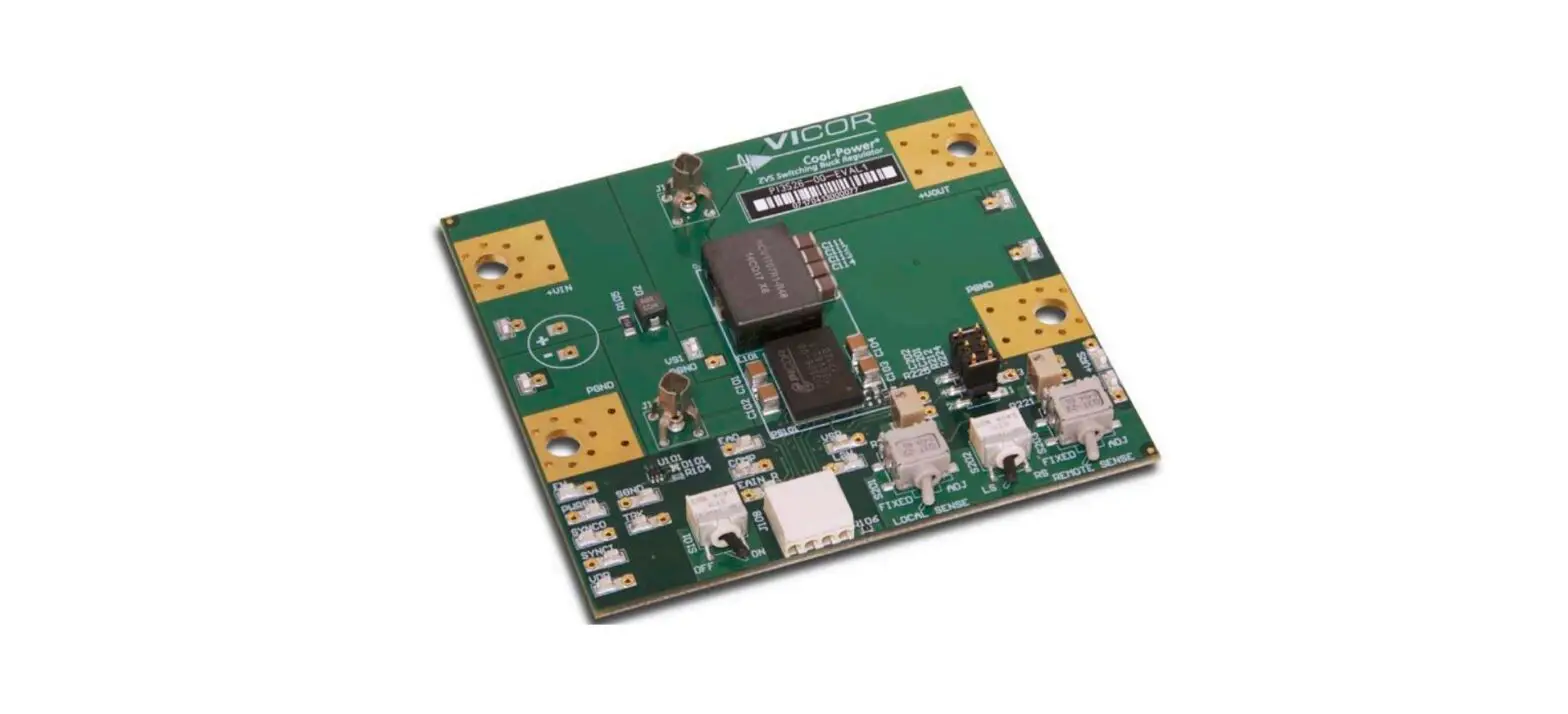
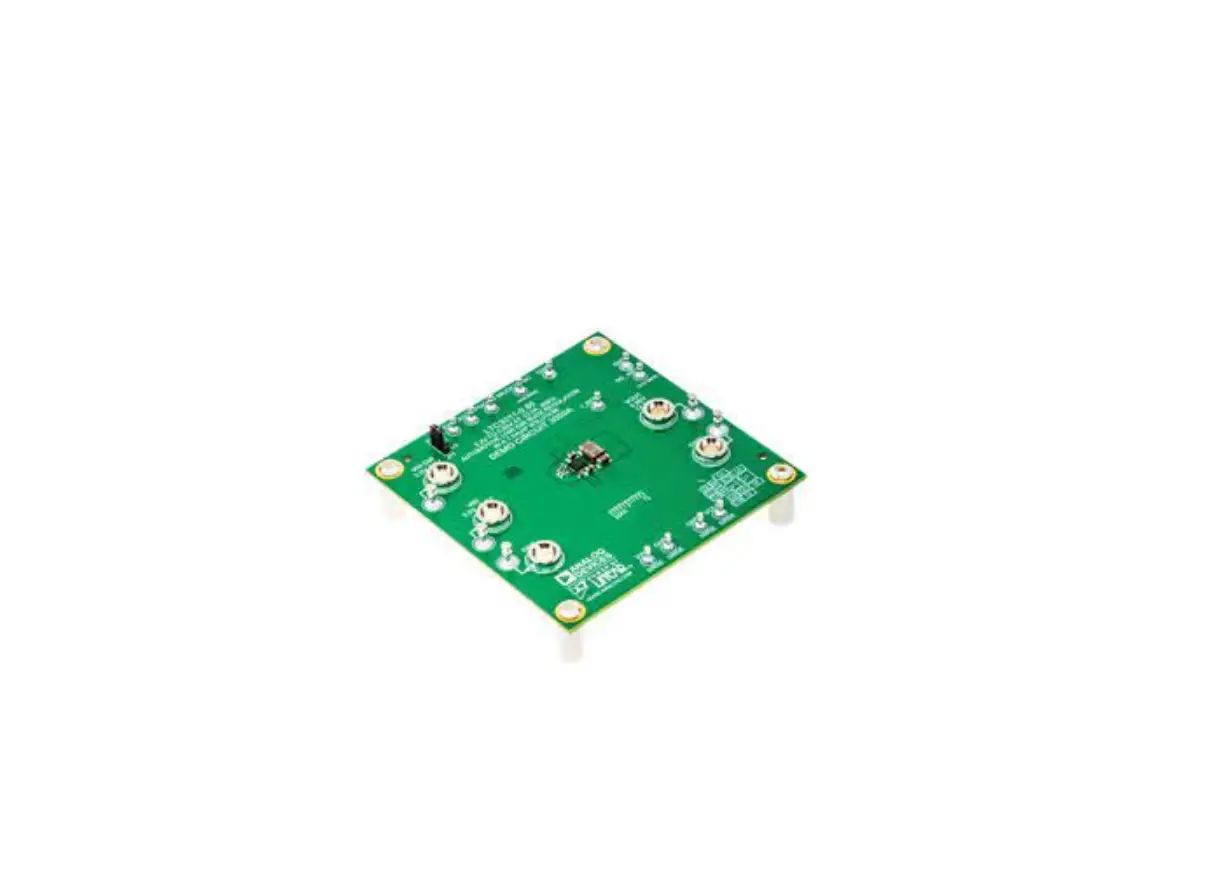
PI33xx-xx-EVAL1 Cool-Power ZVS Buck Regulator Evaluation Board
Product Information:
The product is an evaluation board for a ZVS regulator. It
provides options for making input power (Vin and GND) and output
load (Vout and GND) connections. The board has labeled I/O pins
routed to the board edge for easy access, with each pin accompanied
by a 50 mil through-hole for adding a test point or wiring to
external circuitry. It also includes a scope tip jack for measuring
output voltage (Vout) and optional jacks for measuring Vin and the
switching node of the regulator. There are headers installed for
enabling or disabling the converter and for connecting the buck’s
remote sense pin to the output. For PI33XX-20 regulators, there is
a location for a 4-pin I2C header that allows users to set device
parameters and read fault registers. The board is constructed using
4 layers of 2 oz copper to optimize the regulation path between
input and output voltage, reducing parasitic losses and improving
efficiency.
Product Usage Instructions:
- Choose the desired method for making input power (Vin and GND)
and output load (Vout and GND) connections. Options include
soldering tab style banana jacks or wire, using threaded binding
posts secured by a retaining nut, or using a #6 nut and bolt
connection. - Use the labeled I/O pins on the board edge for easy access.
These pins can be used for measurement or connection to external
circuitry. - To measure the output voltage (Vout), use the scope tip jack
provided on the board. - Optional jacks are available for measuring Vin and the
switching node of the regulator. Refer to Figure 4 in the user
manual for their locations. - Enable or disable the converter using the ENABLE jumper header
installed on the board. - Connect the buck’s remote sense pin to the output at the Vout
terminal using the remote sense jumper (H1) header. - If using PI33XX-20 regulators, locate the 4-pin I2C header and
use it to set device parameters and read fault registers. The
address of each regulator can be assigned from 0 to 7 using the
ADR0 and ADR1 tri-state address pins. - If parallel regulator operation is required, group the
connections labeled “Current Sharing” together for easy connection
between evaluation boards. - Ensure that the zero ohm jumper between SYNCI and SGND is
removed for parallel operation of PI33XX regulators. - Refer to the product datasheet for more detailed information on
using the unpopulated resistor footprints (RADJ1 and RADJ2) for
trimming the output voltage and the capacitor footprint (CTRK) for
adding additional capacitance to the output tracking pin.
USER GUIDE | UG:302
PI33xx-xx-EVAL1 Cool-Power® ZVS Buck Regulator Evaluation Board
Contents
Page
Introduction
1
Evaluation Board Supply & Load Connections 2
Bill of Materials
3
Evaluation Board Notes 4
Optional Test Points & Component Locations 4
Board Dimensions
4
PCB Metal Layers
4
Introduction
The PI33xx-xx-EVAL1 evaluation board demonstrates the features and benefits of the Picor Cool-Power® ZVS Buck Regulator PI33XX family. The board features the ZVS Buck Regulator SIP (U1), along with inductor (L1), ceramic input (C1-C8), and output capacitors (C10-C16).
The evaluation board provides several options for making input power (Vin and GND) and output load (Vout and GND) connections. The user can solder tab style banana jacks or wire, use threaded binding posts secured by a retaining nut, or to simply use a #6 nut and bolt connection.
All the I/O pins are labeled and routed to the board edge for easy access. Each I/O pin is accompanied with an adjacent 50 mil through-hole for adding a test point or to facilitate wiring to external circuitry.
The board has a scope tip jack for measuring output voltage (Vout), and has locations for two optional jacks for measuring Vin and the switching node of the regulator (See Figure 4). There are two headers installed: an ENABLE jumper which can be used to enable or disable the converter and the remote sense jumper (H1) that will connect the buck’s remote sense pin to the output at the Vout terminal.
Figure 1.
PI33xx-xx-EVAL1 Evaluation Board*
Downloaded from Arrow.com.
* RSYNCI resistor not shown
UG:302
vicorpower.com
Applications Engineering: 800 927.9474
Page 1
Introduction (Cont.) For PI33XX-20 regulators only, there is a location for a 4-pin I2C header that allows users to set certain device parameters and to read the fault registers of the regulator. Each regulator can be assigned an address from 0 to 7 using the two tri-state address pins (ADR0 and ADR1).
Connections required for parallel regulator operation are grouped together (labeled Current Sharing) to allow for easy connection between evaluation boards. There is a zero ohm jumper between SYNCI and SGND to ensure that SYNCI is grounded when not used for paralleling PI33XX regulators. This resistor must be removed for parallel operation.
There are two unpopulated resistor footprints (RADJ1 and RADJ2) used in trimming the output voltage and a capacitor footprint (CTRK) to add additional capacitance to the output tracking pin. Please refer to the product datasheet for more detailed information on these topics.
The evaluation board is constructed using 4 layers of 2 oz copper and is routed to optimize the regulation path between input and output voltage, which reduces the parasitic losses and yields the best efficiency.
Evaluation Board Supply & Load Connections
Figure 2 displays the recommended connections for input supply and output loading, and the best test points for measuring input and output voltages. All the I/O pins are brought out to the edge to allow for easy measurement and/or connection to the user’s external circuitry.
Figure 2. Evaluation Board
Measurement Connection
Downloaded from Arrow.com.
UG:302
vicorpower.com
Applications Engineering: 800 927.9474
Page 2
Figure 3.
Evaluation Board Schematic
Bill of Materials
Table 1.
Bill of Material Picor Cool-Power® ZVS Buck Regulator
Evaluation Board
Device PI3312 PI3301 PI3302 PI3303 PI3305
Qty Designators
Value
Description Manufacturer
Part Number
1
U1
2.5 V ZVS Regulator
ZVS Regulator
PICOR
PI3312-00-LGIZ
4
C10, C11 C12, C13
100 µF 6 V
Ceramic Output Capacitor
Murata
GRM31CR60J107ME39L
1
L1
200 nH
Buck Inductor
Cooper
FPT705-200-R
1
U1
3.3 V ZVS Regulator
ZVS Regulator
PICOR
PI3301-00-LGIZ
4
C10, C11 C12, C13
100 µF 6V
Ceramic Output Capacitor
Murata
GRM31CR60J107ME39L
1
L1
200 nH
Buck Inductor
Cooper
FPT705-200-R
1
U1
5 V ZVS Regulator
ZVS Regulator
PICOR
PI3302-00-LGIZ
4
C10, C11 C12, C13
47 µF 16 V
Ceramic Output Capacitor
Murata
GRM31CR61A476ME15
1
L1
200 nH
Buck Inductor
Cooper
FPT705-200-R
1
U1
12 V ZVS Regulator
ZVS Regulator
PICOR
PI3303-00-LGIZ
4
C10, C11 C12, C13
22 µF 25 V
Ceramic Output Capacitor
Murata
GRM31CR61E226KE15L
1
L1
230 nH
Buck Inductor
Cooper
FPT705-230-R
1
U1
15 V ZVS Regulator
ZVS Regulator
PICOR
PI3305-00-LGIZ
4
C10, C11 C12, C13
22 µF 25 V
Ceramic Output Capacitor
Murata
GRM31CR61E226KE15L
1
L1
230 nH
Buck Inductor
Cooper
FPT705-230-R
Downloaded from Arrow.com.
UG:302
vicorpower.com
Applications Engineering: 800 927.9474
Page 3
Table 1. (Continued)
Bill of Materials (Cont.)
Device
Qty Designators
ADJ, ADR0
ADR1, EAO
10
EN, REM
SGND, SYNCI
SYNCO, TRK
4
C1, C2 C3, C4
4
C5, C6 C7, C8
1 Common
2
C14 C15, C16
1
2
3 1 1 1 2 User Optional 2
CTRK
ENABLE H1
GND, VIN VOUT JJVOUT
PCB
RSYNCI RADJ1 RADJ2 JJVIN JJVSW
Value
4.7 µF 50 V 0.1 µF 50 V 0.1 µF 50 V 1 µF 50 V 47 nF
0 User Defined Optional
Description Manufacturer
Part Number
SM Testpoint
Keystone
5015
Ceramic Capacitor 50 V, X7R
Ceramic Capacitor
Ceramic Capacitor
Ceramic Capacitor
Ceramic Capacitor
Header Jumper
TH Testpoint
Johnson Jack
PI33XX-xxEVAL1 PCB
0603 Resistor
0603 Trim resistors
Scope Tip Jack
Murata
TDK Murata Murata Murata Samtec Vector Tektronix PICOR Rohm
TBD Tektronix
GRM31CR71H475KA12L
C2012X7R1H104K RM319R71H104KA01D GRM188R71C105KA12J GRM188F51H473ZA01D
TSW-148-07-F-S K24
131503100 PCB0108 MCR03EZPJ000
TBD 131503100
Evaluation Board Notes
The evaluation board has solder mask openings on the bottom side of the board to allow for the option of additional output capacitance (4 x 1206 or 2 x 1812).
There are two additional, unmarked, scope tip test points (circled in red in figure 4) that allow the user to measure VIN and the switching node (VS1). These are labeled as JJVIN and JJVSW in Figure 4.
There are two thru-hole pads (blue circle) for the addition of an electrolytic bulk storage capacitor. This capacitor is required when the evaluation board is connected to the input voltage source through long leads. A 100 µF, 50 V Electrolytic is recommended with an ESR between 20 and 50 m.
The two pins labeled as “N/C” (highlighted in green box in figure 4) are not electrically connected to each other.
There is an internal connection within the PI33xx between grounds SGND and PGND. It is not required to tie these two grounds together externally and these two grounds are not connected together on the evaluation board.
Downloaded from Arrow.com.
UG:302
vicorpower.com
Applications Engineering: 800 927.9474
Page 4
Figure 4. Optional Test Points & Component Locations
Figure 5. PI33xx-xx-Eval1 Board Dimensions
Downloaded from Arrow.com.
UG:302
vicorpower.com
Applications Engineering: 800 927.9474
Page 5
Figure 6. PCB Metal Layers
Downloaded from Arrow.com.
UG:302
vicorpower.com
Applications Engineering: 800 927.9474
Page 6
The Power Behind Performance
Rev 1.2 06/14 Downloaded from Arrow.com.
vicorpower.com
Applications Engineering: 800 927.9474
Page 7
 Modular Solutions For Your Power System | Vicor Corporation