 Instruction manual
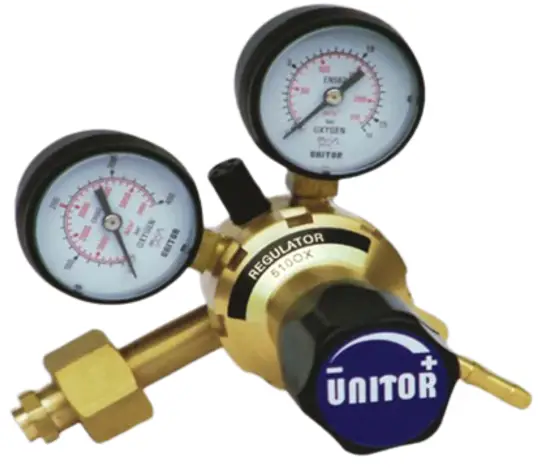
Cylinder Regulators series 510
Acetylene, Oxygen, Nitrogen,
Argon, Carbon dioxide
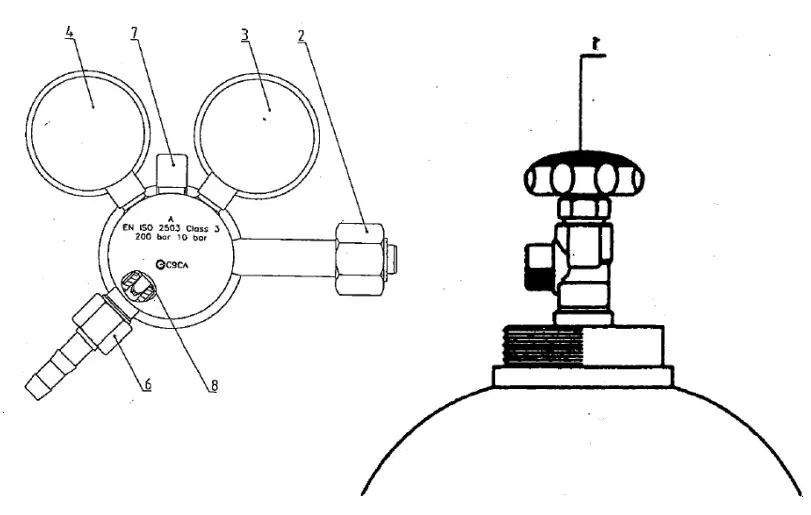
Designations corresponding to EN ISO 2503
- Cylinder valve
- Inlet stem with screw or nut
- High pressure gauge
- Low pressure gauge, or flow-meter where applicable
- Pressure adjusting screw
- Union nut and hose tail
- Safety relief valve
- Regulating orifice, for regulators with flow meter gauge only
Product Data
| Regulator no | 171-510000 | 171- 510001 | 631- 510002 | 631- 510003 | 698- 510004 | 197-510010 | 611-510011 | ||
| Type | 510 | 510 | 510 | 510 | 510 | 510 | 510 | ||
| For use with | Cylinder | Cylinder | Cylinder | Cylinder | Cylinder (C9) | Cylinder | Cylinder | ||
| Gas | Ox | Ac | N2 | N2 | CO2 | Ar/CO2 | N2 | ||
| Color code | Blue | Red | Black | Black | Black | Black | Black | ||
| Adjusting function | Pressure | Pressure | Pressure | Pressure | Pressure | Flow | Flow | ||
| Contents gauge with gaskets (spare) | 171- 550178 | 171- 550186 | 171- 550178 | 171- 550178 | 171- 550178 | 171- 550178 | 171- 550178 | ||
| Working gauge with gaskets (spare) | 171-550194 | 171-550202 | 171-550194 | 171-550194 | 171-550210 | ||||
| Connec- tions | Inlet | W21.8x 1/14″ int. | 3/4″Ext. BSP | W24.32x 1/14″int. | W24.32x 1/14″int. | CGA320 | W24.32x 1/14″int. | W24.32x 1/14″int. | |
| Outlet | R 3/8″ RH | R 3/8″ LH | R 3/8″ RH | R 3/8″ RH | R 3/8″ RH | R 3/8″ RH | R 3/8″ RH | ||
| Gauge Scales | Inlet | Bar | 400 | 40 | 400 | 400 | 400 | 400 | 400 |
| Lbf/in² | 5800 | 580 | 5800 | 5800 | 5800 | 5800 | 5800 | ||
| Outlet | Bar | 16 | 2,5 | 16 | 2,5 | 16 | 35l/min | 20l/min | |
| Lbf/in² | 230 | 36 | 230 | 36 | 230 | ||||
| Maximum pressures | Inlet | Bar | 200 | 20 | 200 | 200 | 200 | 200 | 200 |
| Lbf/in² | 2900 | 290 | 2900 | 2900 | 2900 | 2900 | 2900 | ||
| Outlet | Bar | 10 | 1,5 | 10 | 1 | 10 | 4,5 | 4,5 | |
| Lbf/in² | 145 | 22 | 145 | 14,5 | 145 | 64 | 64 | ||
| Safety valve opening pressure | Bar | 16 | 3 | 16 | 3 | 16 | 7,8 | 7,8 | |
| Lbf/in² | 290 | 43 | 290 | 43 | 28 | 115 | 115 | ||
| Max outlet capacity | l/min | 667 | 83 | 667 | 667 | 667 | 32 | 15 | |
Standards
| EN ISO 2503:1988 | Gas welding equipment. Pressure regulators for gas cylinders used in welding, cutting and allied processes up to 300 bar |
| EN 1398:2003 | Gas welding equipment. Integrated flow-meter regulators used on cylinders for welding, cutting and allied processes. Classification, specification and test |
Operating instructions for Cylinder Pressure Regulators corresponding to EN ISO 2503.
These instructions are produced in accordance with current regulations to ensure the safe operation of cylinder pressure regulators. Specific attention to these instructions will help to avoid risks and loss of production as well as enhance the reliability and durability of these cylinder pressure regulators.
THESE INSTRUCTION MUST BE KEPT PERMANENTLY AT HAND IN THE WORKSHOP For safety instructions, also see paragraph 2; If in any doubt please consult the manufacturer.
Operation
1.1. Cylinder pressure regulators are designed to reduce the respective cylinder pressure and to ensure a constant outlet working pressure. They are used with compressed gases, pressurized dissolved gases in cylinders and liquefied gases having a filling pressure of up to maximum of 300 bar.
1.2. Cylinder pressure regulators must not be used for gases in a liquid state. Cylinder pressure regulators must not be operated under temperatures of -30°C or above +60°C. Cylinder pressure regulators must not be used for corrosive gases
Safety instructions
2.1. All indications showing this exclamation mark are important safety instructions.
2.2. The cylinder pressure regulators comply with current relevant technical regulations and standards. 2.3. Under no circumstances must the cylinder pressure regulator be tampered with or modified.
2.4. Avoid the use of adaptors between the cylinder valve and the cylinder pressure regulator.
2.5. Incorrect use will endanger the operator and other personnel, damage to the cylinder pressure regulator and Installation may also be the result. 2.6. Regulations to be adhered to: National and international regulations on safe handling of welding gases. EN ISO 2503 Cylinder Pressure Regulator.
Markings
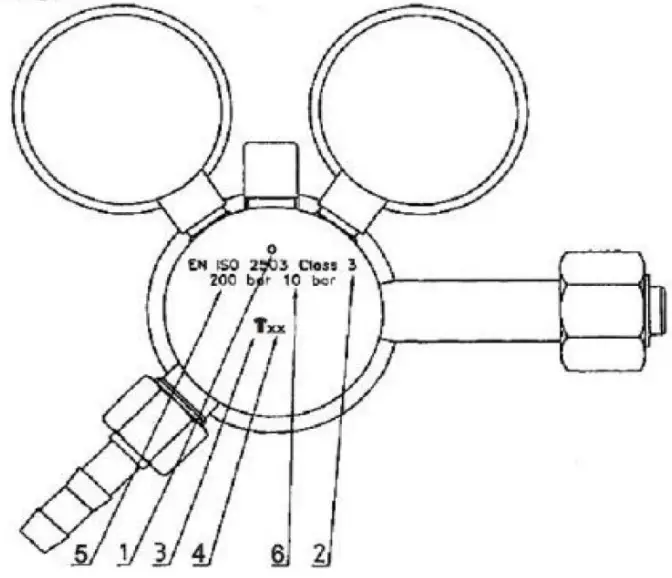
A. (Nameplate — Front view)
- Cylinder pressure regulator type and Unitor name.
B. (Rear view)
- Gas type. (See below for gas code abbreviations)
- Cylinder pressure regulator class corresponding to EN ISO 2503
- Unitor identification mark
- Lot identification
- Maximum inlet pressure for oxygen and other compressed gases
- Maximum outlet pressure
| Type of Gas | Code letter | Type of Gas | Code letter |
| Acetylene | A | LPG | P |
| Oxygen | 0 | ||
| Compressed Air | D | CO2, Nitrogen, Inert Ga | N |
Attaching the Cylinder Pressure Regulator to the cylinder valve
4.1. Keep hands, tools and regulator clean; oil and grease can cause an explosion on contact with oxygen.
4.2. The operator must be fully familiar with these operating instructions prior to the use of this equipment, all instructions should be adhered to when in use.
4.3. Check that the cylinder pressure regulator is suitable for the gas to be used. (See markings paragraph 3.) 4.4. Check that the cylinder valve connection is clean and undamaged: if not, do not connect the cylinder Pressure Regulator.
4.5. Check that both gauge pointers are at zero.
4.6. Check that the pressure adjusting knob (5) is fully screwed out (anticlockwise).
4.7. Connect the cylinder pressure regulator to the cylinder valve (1) by means of the Inlet nut on the inlet stem (2).
4.8. Connect the hose to the cylinder pressure regulator outlet (6). Use hoses of good quality, free from defects.
Operating the Cylinder Pressure Regulator for setting the pressure.
5.1. Check that the pressure adjusting knob (5) is fully screwed out (anticlockwise).
5.2. Check that downstream (shank) valve is closed.
5.3. Slowly open the cylinder valve (1) and ensure that the cylinder pressure is showing on the high pressure (contents) gauge (3)
5.4. Open the downstream (shank) valve.
5.5. Rotate the pressure adjusting knob (5) clockwise to set the required working pressure on the outlet gauge (4).
Closing down the Cylinder Pressure Regulator.
6.1. Close cylinder valve (1).
6.2. Unwind (anti-clockwise) the pressure adjusting knob (5).
6.3. Vent the pressure in the system by opening the downstream (shank) valves.
6.4. Once the system has been depressurized, close the downstream (shank) valves.
Operating and Maintenance instructions
7.1. Protect the cylinder pressure regulator from damage. Check visually for any signs of damage before use. 7.2. The preset adjustment of the safety valve (7) must not be changed.
7.3. Ensure that all washers and mating surfaces are in a satisfactory condition. Store spare washers with the regulator 7.4. If it is suspected that the cylinder pressure regulator is not functioning correctly, or is found to have any form of a leak, close the cylinder valve and remove the regulator from service immediately.
Do not, under any circumstances, undertake or allow any repairs by unauthorized personnel.
Repairs
8.1. Repair of cylinder pressure regulators is limited to replacement of gauges and gaskets and must only be carried out by competent personnel.
8.2. Only genuine spare parts may be used.
8.3. Any other repairs or modifications will lead to loss of liability.
Attention
Please use these Unitor products exclusively for the purpose indicated by Unitor and only if the operator fully understands current practices and procedures. If any further information or assistance is required please contact your local Unitor specialist.
 Revision date: 10/2011
www.wilhelmsen.com/shipsservice