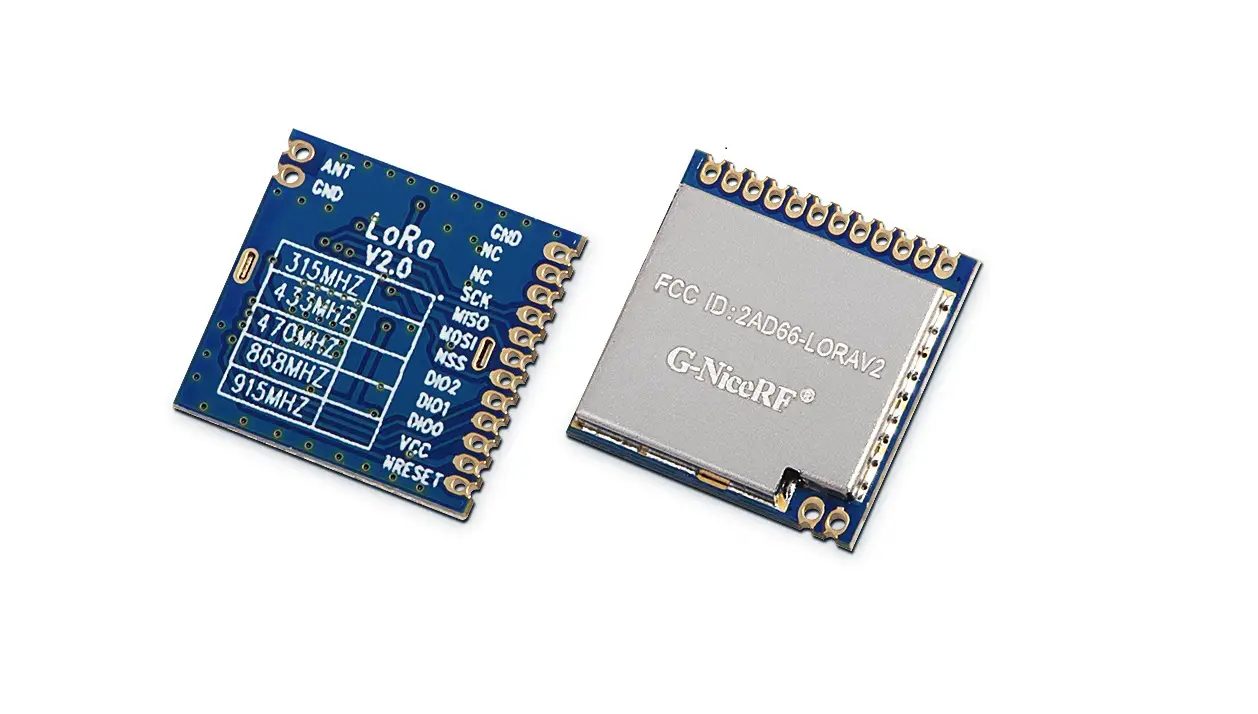
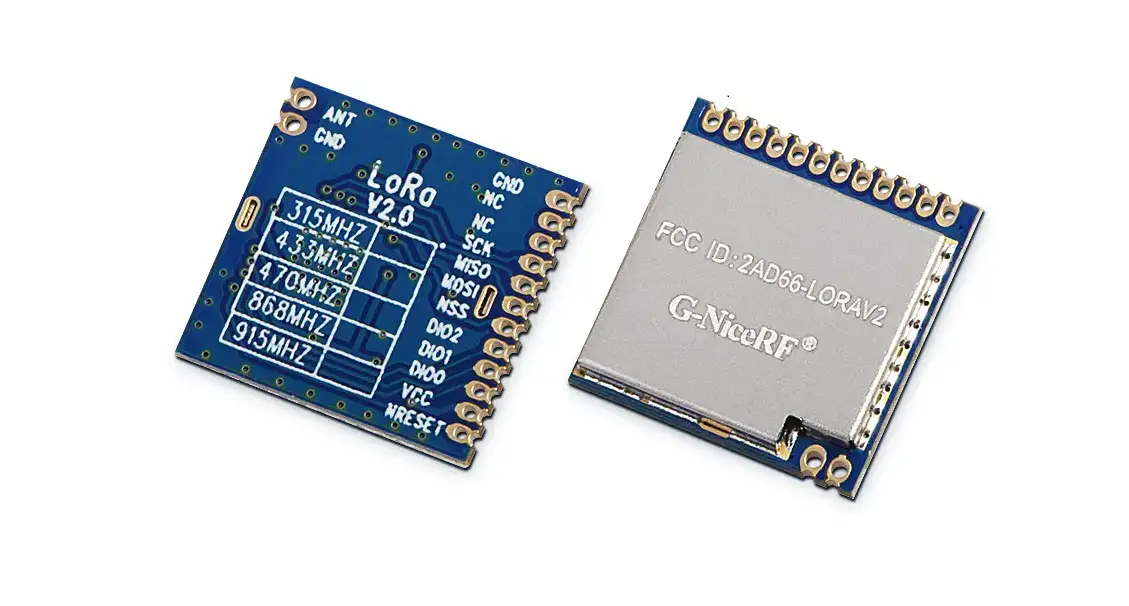
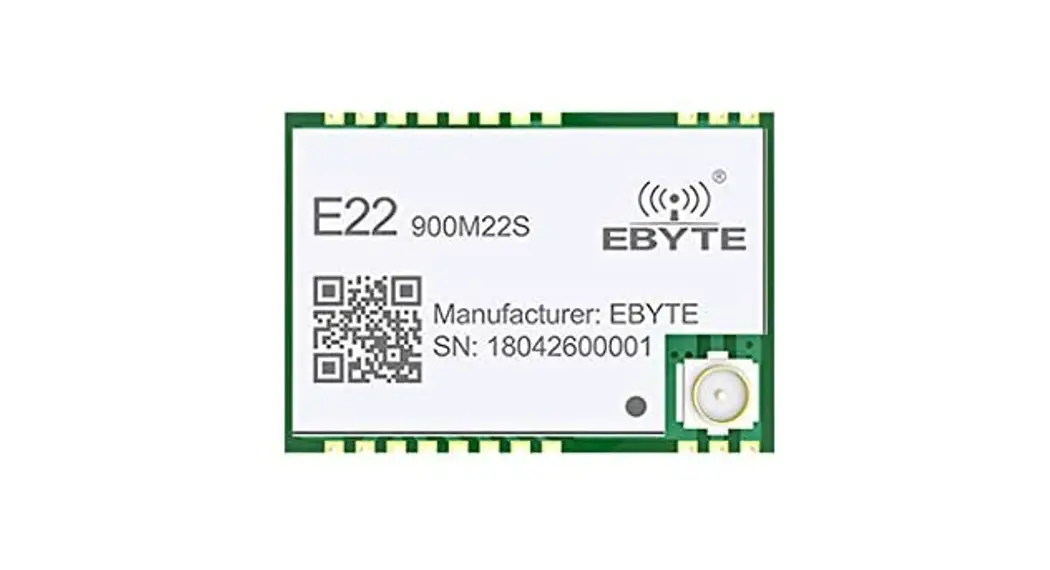
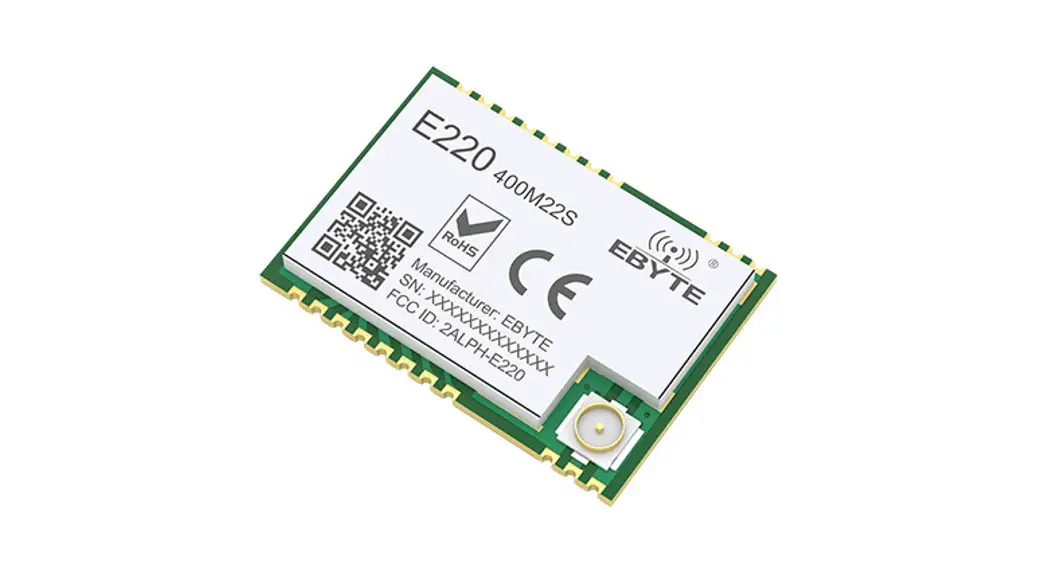
FL22-C8 LoRa 868/915MHz SPI Passive Crystal Standard Modules
Product Information:
The FL22-C8 is a LoRa 868/915MHz SPI Passive crystal standard
module. It operates in the frequency band of 863-870MHz for EU and
902-928MHz for the USA. The module supports various modulation
modes including LoRa, GFSK, and FSK. It can be powered by a voltage
range of 1.8V to 3.7V (transmit power cannot be lower than 3.1V
under +22dBm configuration). The module has a transmit current of
125mA (maximum transmit power configuration), receive current of
7mA (DC-DC mode), standby current of 600uA, and sleep current of
1uA (register value saved). It has a sensitivity of -124dBm
(typical value) and a maximum transmit power of 22.5dBm. The module
features an SPI communication interface, making it easy to connect
to various single-chip microcomputers for software programming.
Applicable scenarios for the FL22-C8 module include Smart Home,
Security monitoring, Low-power sensors, Wireless remote control,
Logistics and warehousing, Industrial control, and occasions with
high communication distance.
Product Usage Instructions:
- Power Supply:
- Connect the VDD pin (Pin 8) to the power supply voltage within
the range of 1.8V to 3.7V. - Connect the GND pin (Pin 7-13) to the power supply ground.
- Connect the VDD pin (Pin 8) to the power supply voltage within
- SPI Communication Interface:
- Connect the SPI communication interface pins to the
corresponding pins of your single-chip microcomputer or other
devices.
- Connect the SPI communication interface pins to the
- Operating Frequency Band:
- Set the operating frequency band according to your region:
863-870MHz for EU or 902-928MHz for the USA.
- Set the operating frequency band according to your region:
- Modulation Modes:
- Select the desired modulation mode (LoRa, GFSK, FSK, etc.)
based on your application requirements.
- Select the desired modulation mode (LoRa, GFSK, FSK, etc.)
- Transmit Power:
- Ensure that the power supply voltage is not lower than 3.1V
when configuring the transmit power to +22dBm. - Adjust the transmit power as per your communication needs,
keeping in mind the maximum transmit power of 22.5dBm.
- Ensure that the power supply voltage is not lower than 3.1V
- Reception Sensitivity:
- The module has a reception sensitivity of -124dBm (typical
value). - Optimize your communication setup to achieve reliable reception
based on this sensitivity value.
- The module has a reception sensitivity of -124dBm (typical
- Programming and Control:
- Utilize the SPI communication interface to program and control
the module using your single-chip microcomputer or other
devices.
- Utilize the SPI communication interface to program and control
Please note that the information provided in this document is
subject to change without notice. It is important to refer to the
latest revision history and specifications provided by Lierda
Technology Group Co., Ltd. for accurate and up-to-date information
regarding the FL22-C8 module.
FL22-C8
LoRa 868/915MHz SPI Passive crystal standard
modules
FP20 series of cost-effective LoRa module is based on Semtech’s LoRa RF integrated chip SX126X developed SPI interface module; The transmission power can be configured by software, and the maximum power can reach 22.5dBm. The internal TCXO temperature booster crystal oscillator is used, which can keep the crystal oscillator in a relatively stable state within the working temperature range, with the advantages of low temperature influence and high precision. FP20 series modules have the characteristics of low power consumption, long transmission distance and strong anti-interference ability. It is suitable for applications with relatively high transmission rates and long transmission distances, such as smart home, security monitoring, smart community, logistics, warehousing, and industrial control.
Product features
·Operating frequency band
– Operating frequency band 863-870MHz for EU, 902-928MHz for USA
·Multiple modulation options
– Supports LoRa, GFSK, FSK and other modulation modes
·Ultra-low power consumption
– Support 1.8V to 3.7V power supply (transmit power cannot be lower than 3.1V under +22dBm configuration)
– Transmit current 125mA (maximum transmit power configuration) – Receive current 7mA (DC-DC mode) – 600uA Standby current – 1uA sleep current (register value saved)
·High Link Budget
– Sensitivity -124dBm (typical value) – Transmit power Max. 22.5 dBm
·Communication interface
– SPI communication interface, can be directly connected to a variety of single chip microcomputer use, software programming is very convenient
Applicable scenarios
– Smart Home – Security monitoring – All kinds of low-power sensors – Wireless remote control – Logistics and warehousing – Industrial control – For occasions with high communication distance
Lierda Technology Group Co., Ltd. provides the contents of this document to support the product design of its customers. The customer shall design the product according to the specifications and parameters provided in the document. The Company will not be liable for any personal injury or property damage caused by improper operation of the customer. Lierda reserves the right to update this document without notice.
The copyright of this document belongs to Lierda Company. Anyone who copies and reprints this document without permission of our company will assume legal responsibility. Copyright © Lierda Science & Technology Group Co.,Ltd
Document revision history
Version Date Rev01 2022-08-04 Rev02 2022-08-12 Rev03 2022-09-08 Rev04 2022-09-22 Rev05 2022-10-11
Change description Initial version Add order information and modify details Add L-LRMFP20-97NN4 indicator Modify the indicator of L-LRMFP20-97NN4 Modify details
1 specification
Table 1 Module limit parameter
Performance
Main parameters
Minimum
Maximum
value
value
Supply voltage (V)
-0.5
+3.9
Maximum RF input power
–
+10
(dBm)
Operating temperature ()
-40
+85
Remarks
Table 2 Module operating parameters
Module type
Main parameters
L-LRMFP20-
Remarks
97NN4
Operating voltage (V)
1.8~3.7
Operating temperature (°C)
-4085
VBAT3.1V for +22dBm
VBAT2.7V for +20dBm VBAT2.4V for +19dBm
Operating Frequency Band (MHZ)
860930
User programmable customisation1
Initial frequency offset (kHz)
-3~+3
The factory deviation
Emission current(mA)
Vmin=100 Vtype=125
DC-DC mode, 22dBm emission2
1 Users are allowed to configure and use the working frequency band according to the local regulations of the terminal market. Please be sure to comply with the local regulations. If the user uses the band not allowed by the regulations, our company will not bear any responsibility. For domestic terminal market applications, please refer to the Catalogue and Technical Requirements of Micro-Power Short-range Radio Transmitting Equipment. 2 The output power must be set according to the recommended values. If the output power is not set according to the recommended values, the power and power consumption may be poor, and even the module may be damaged. For details, see Table 3-3 and 3-6
Receiving current (mA)
Sleep current (A)
Transmit power (dBm) Reception sensitivity(dBm) Communication protocols
Interface type Dimensions (mm)
Vmax=135 Vtype=6.5 Vmax=7.5 Vtype=1 Vmax=3 Vmin=20.5 Vtype=21.5 Vmax=22.5 Vtype=-124
SPI Stamp hole 18.4 × 18.4 ×
3.0
Dimensional accuracy
GB/T1804-C
DC-DC modeRx Boosted BW_L=125KHz,SF=7 Register value saving
22dBm emission, user programmable custom
SF 7_BW 125KHz
2mm spacing
Meet the dimensional tolerance class C requirements
2 Dimensioning and pin definition
2.1 Dimensional drawings
Figure 1 FP20 series module dimensions
2.2 The hardware block diagram
Figure 2 Hardware system block diagram
2.3 Pin definitions
2.3.1 Power supply
Table 3 FP20 series power pin description
Interface name
Pin serial number
Direction
description
VDD
8
Power supply
Power supply VDD
GND
713
Power supply
Power supply
ground
2.3.2 SPI communication interface
Table 4 FP20 series SPI communication interface description
Interface name Pin serial number Direction
description
MISO
9
Output
SPI data output
MOSI
10
Input
SPI data input
NSS
11
Input
The SPI of the chip was enabled
SCK
12
Input
SPI clock input
2.3.3 Functional interface
Table 5 FP20 series functional interface description
Interface
Pin serial Direction
description
name
number
NREST
1
Input
reset pin, active low
DIO1
2
Output Interrupt source mapping pin (see SX1262/8
datasheet for details)
BUSY
3
Output
Busy indicator
NC
456
NC(air floating welding, do not connect to GND)
2.3.4 RF interface
Table 6 Description of FP20 series RF port
Interface name
Pin serial number
Direction
description
RF
14
Input/output
RF input/output
3 Basic operation
3.1 Typical application circuit
Figure 3 Typical application circuit
DIO1 can realize all the interrupt mapping functions, so only one DIO1 port can be connected. The internal RF switch is controlled directly by DIO2.
Table 7 Control logic truth tables
MODE
DIO2
Transmit
1
Receive
0
sleep
0
DIO2 SetDIO2AsRfSwitchCtrl mapping function, SX126xSetDio2AsRfSwitchCtrl (1); The function is as follows:
1. void SX126xSetDio2AsRfSwitchCtrl( uint8_t enable )
2. {
3.
SX126xWriteCommand( RADIO_SET_RFSWITCHMODE, &enable, 1 );
4. }
3.2 The hardware layout
DIO port as far as possible to connect to the MCU IO port with external interrupt. The cable between the RF outlet and the antenna solder pad should be as short
as possible. The 50-ohm impedance line should be used, and the ground should be enclosed. Holes should be drilled around the cable. Add a circuit to the RF outlet portion of the antenna pad where permitted. A clearance area of at least 5mm is required around the antenna. Ensure that the ground is well grounded and a large area is best laid. Keep away from high voltage circuit and high frequency switching circuit. You can refer to the RF PCB LAYOUT Design Rules (Applicable to sub-1GHZ and Bluetooth Modules) in the application document for layout and cable routing.
3.3 Software operating
This module only serves as a slave computer and provides SPI interface. SPI interface of MCU can be used to communicate with it, and its register and transceiver cache can be operated through API instructions, that is, wireless data transceiver function can be completed. For the function of SPI operation, users need to modify it according to the way of MCU operating SPI. For the timing operation of module register read and write operation, please refer to the latest SX1262/8 data manual.
Before software development, users can first refer to LoRa point-to-point communication in the demo LoRa communication routine and example code description manual provided by our company to get familiar with the software operation. When porting code, users mainly need to tune SPI according to their own MCU, and then refer to communication routines for relevant functional function transplantation.
A pair of LoRa modules is used to realize the point-to-point communication process, as shown in Figure 3-2. In this communication process example, the transmitting device can send data to the receiving device through LoRa wireless signal. After receiving the data packet, the receiving device will return the data packet to the transmitting device through LoRa wireless signal for circular communication.
LoRa TX
LoRa RX
LoRa
LoRa
LoRa
LoRa
T_Cnt=1
LoRa Standby
LoRa Standby
R_Cnt=1
LoRa
LoRa
T_Cnt++
LoRa Standby
LoRa Standby
R_Cnt++
Figure 4 Point – to – point communication flowchart
3.4 I/O port level in sleep mode
Table 8 I/O port level in sleep mode
DIO1
BUSY
MISO
MOSI
SCK
NSS
NRESET
HIZ PD3 HIZ PU4
HIZ5
HIZ
HIZ
IN6
IN PU
3.5 Transmit power configuration
Different models of products correspond to different matching networks and different PA operation Settings. During application, you must strictly configure the transmit power according to the corresponding products. Otherwise, the power consumption of the products may be poor, the performance of the products may be degraded, and even the products may be damaged.
There are two ways to configure the transmitted power of the module. One is to configure only the SetTxParams register, and the other is to configure the paDutyCycle, hpMax, deviceSel, and paLut register values simultaneously.
3.6 Disable frequency point description
Forbidden frequency point refers to the module performance is very poor frequency point, is prohibited to use. Not recommended frequency point refers to the frequency point where the module performance is poor, customers can use as appropriate. It is recommended that customers use the frequency at least 1MHz away from the disabled frequency.
Disable the frequency864MHz896MHz Frequency is not recommended880MHz912MHz928MHz
4 Frequently Asked Questions
4.1 Modules cannot communicate even at close range
Check whether the configurations on the sending and receiving sides are inconsistent. If the configurations are different, the communication cannot be normal.
The voltage is abnormal. If the voltage is too low, the transmission is abnormal. The battery power is low. Low Battery power The voltage of the battery will be lowered
during transmission, resulting in abnormal transmission. Abnormal antenna welding RF signal does not reach the antenna or the circuit is
incorrectly welded.
3 PD = pull down with 50 k at typical conditions (the resistor value varies with the supply voltage) 4 PU = pull up with 50 k at typical conditions
5 HIZ 6 IN
4.2 Module power consumption anomaly
The module is damaged or damaged due to static electricity, resulting in abnormal power consumption.
When receiving low power, the power consumption of the module is not achieved as expected due to the incorrect timing configuration.
The single test module or MCU is normal, but the power consumption is abnormal in the coupling, which is generally due to the MCU connected by the RF module
Pin configuration related. The working environment is harsh, and the power consumption of the module will
fluctuate in extreme environments such as high temperature, high humidity and low temperature.
4.3 Insufficient module communication distance
The antenna impedance matching is not good, resulting in very little transmitted power. There are metal objects around the antenna or modules in the metal, leading to serious
signal attenuation. There are other interference signals in the test environment, resulting in the close
communication distance of the module. The transmit power of the module is abnormal due to insufficient power supply. The test environment is harsh and the signal is greatly attenuated. The module communicates with the other end after passing through the wall
environment. The wall will greatly attenuate the signal, and most of the signals are diffracted through the wall. Modules too close to the ground are absorbed and reflected, resulting in poor communication.
FCC Statement:
When using the product, maintain a distance of 20cm from the body to ensure compliance with RF exposure requirements.
This device complies with part 15 of the FCC rules. Operation is subject to the following two conditions: (1) this device may not cause harmful interference, and (2) this device must accept any interference received, including interference that may cause undesired operation.
NOTE: The manufacturer is not responsible for any radio or TV interference caused by unauthorized modifications to this equipment. Such modifications could void the user’s authority to operate the equipment.
ORIGINAL EQUIPMENT MANUFACTURER (OEM) NOTES The OEM must certify the final end product to comply with unintentional radiators (FCC Sections 15.107 and 15.109) before declaring compliance of the final product to Part 15 of the FCC rules and regulations. Integration into devices that are directly or indirectly connected to AC lines must add with Class II Permissive Change. The OEM must comply with the FCC labeling requirements. If the module’s label is not visible when installed, then an additional permanent label must be applied on the outside of the finished product which states: “Contains transmitter module FCC ID: 2AOFDFP20-C8. Additionally, the following statement should be included on the label and in the final product’s user manual: “This device complies with Part 15 of the FCC Rules. Operation is subject to the following two conditions: (1) This device may not cause harmful interferences, and (2) this device must accept any interference received, including interference that may cause undesired operation.” The module is allowed to be installed in mobile and portable applications A module or modules can only be used without additional authorizations if they have been tested and granted under the same intended end-use operational conditions, including simultaneous transmission operations. When they have not been tested and granted in this manner, additional testing and/or FCC application filing may be required. The most straightforward approach to address additional testing conditions is to have the grantee responsible for the certification of at least one of the modules submit a permissive change application. When having a module grantee file a permissive change is not practical or feasible, the following guidance provides some additional options for host manufacturers. Integrations using modules where additional testing and/or FCC application filing(s) may be required are: (A) a module used in devices requiring additional RF exposure compliance information (e.g., MPE evaluation or SAR testing); (B) limited and/or split modules not meeting all of the module requirements; and (C) simultaneous transmissions for independent collocated transmitters not previously granted together. This Module is full modular approval, it is limited to OEM installation ONLY. Integration into devices that are directly or indirectly connected to AC lines must add with Class II Permissive Change. (OEM) Integrator has to assure compliance of the entire end product include the integrated Module. Additional measurements (15B) and/or equipment authorizations (e.g. Verification) may need to be addressed depending on co-location or
simultaneous transmissionissues if applicable. (OEM) Integrator is reminded to assure that these installation instructions will not be made available to the end user.