
Operating manual
Soot Test Pump
Wöhler RP 72
TÜV By 12 RGG 015
General Information
9.1 Operation ManualInformation
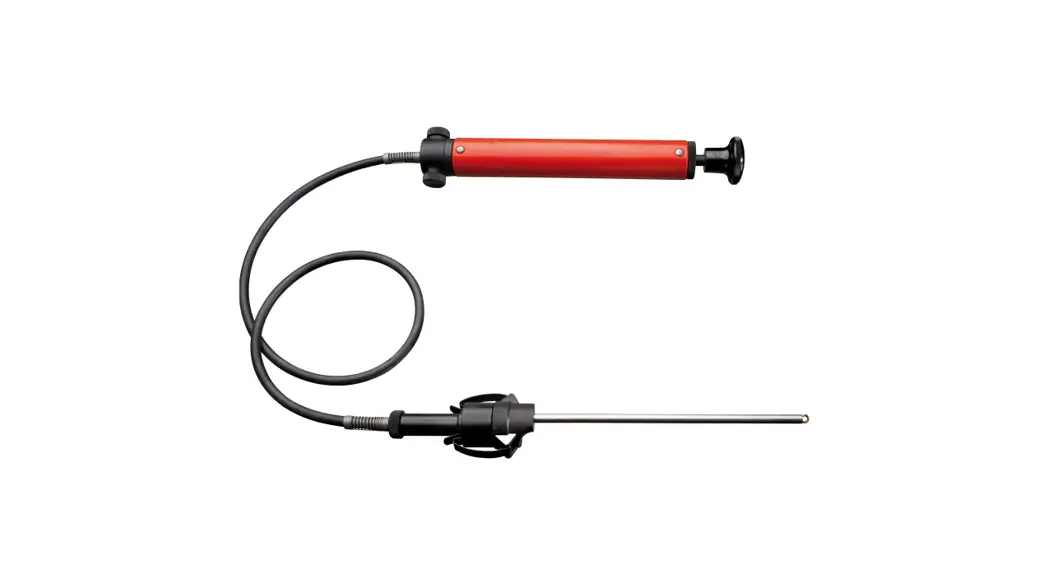
This operation manual allows you to safely work with the Wöhler RP 72 Soot Test Pump. Please keep this manual for your information. The Wöhler RP 72 Soot Test Pump should be employed by professionals for its intended use only.
Liability is void for any damages caused by not following this manual.
9.2 Notes
 WARNING!
Not following this warning can cause injury or death. ATTENTION!
Not following this note can cause permanent damage to the device. NOTE!
NOTE!
Useful information
9.3 Intended Use
The soot test pump helps to determine the soot number of liquid fuel burners according to the implementing regulation of the German Federal Immission Control Act. .
9.4 Components
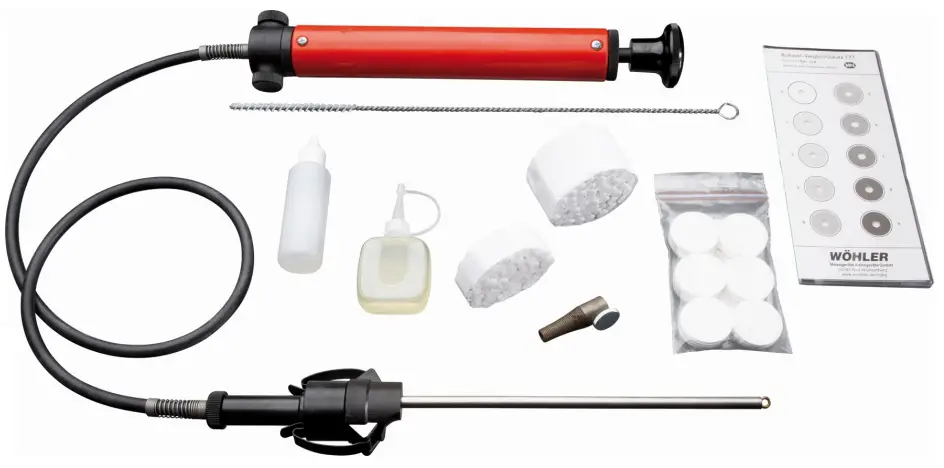
| Device | Components |
| Wöhler RP 72 soot test pump | Soot Test Pump |
| Extraction Probe 220 mm | |
| Measuring head |
9.5 Manufacturer
Wöhler Technik GmbH
Wöhler-Platz 1
33181 Bad Wünnenberg
Tel.: +49 2953 73-100
Technical Data
| Description | Data |
| Sample | 1,63 l ± 0,07 l with 10 strokes in 60 seconds |
| Operating Temperature | +10°C to +30 °C |
| Accuracy | Soot number ± 0,2 |
Component Explanation
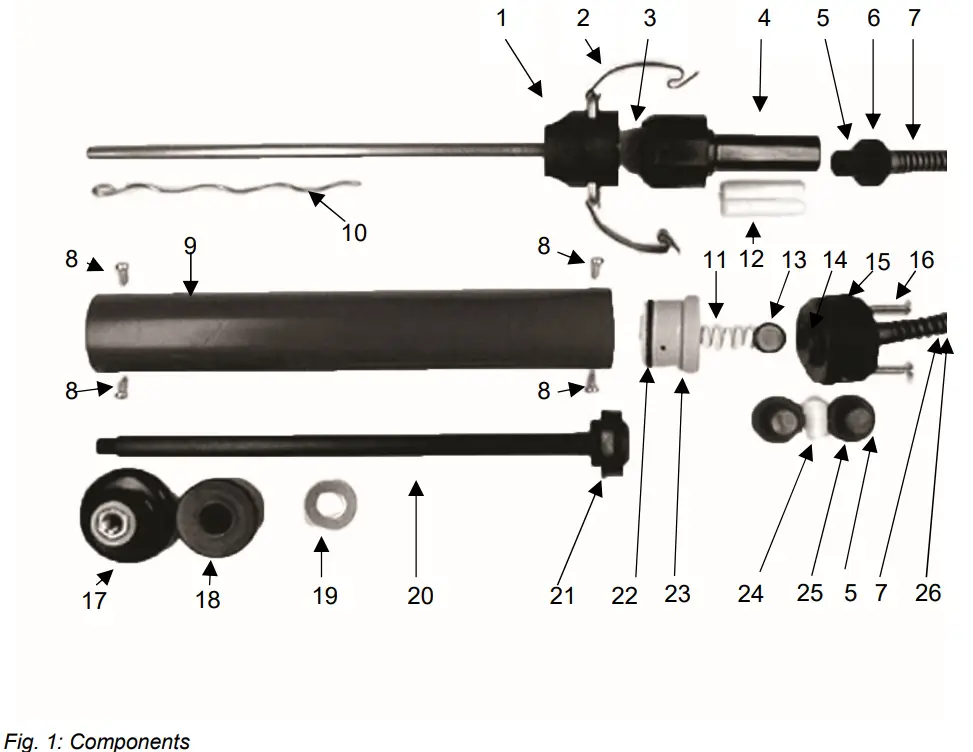
| Component Explanation | Order no. |
| 1 Measuring head with extraction probe and turbulence spiral (in- side) | 7547 |
| 2 Clamps | 2447 |
| Filter Paper TOV 12 RgG 001 | Accessories |
| 4 Measuring Head – Makrolon | 3879 |
| 50ring 9 x2 | 2334 |
| 6 Stopper with 0 ring | 2442 |
| 7 protection spring | 2441 |
| 8 Screws M 4,2 x 9,5 (4 pieces) | 2428 |
| 9 Pump Tube RP 72 | 2427 |
| 10 Turbulence Spiral | 20401 |
| 11 Spring for Valve 11 x 0,4 | 2346 |
| 12 Cotton Wool Filter Rolls, long (2 pieces) | Accessories |
| 13 Valve Disc | 2345 |
| 14 0 ring 18 x 2.2 | 2434 |
| 15 Valve lid | 7997 |
| 16 Screws 3/16″ x 20 | 2435 |
| 17 Pump Bolton with M12 inside thread | 2420 |
| 19 Aluminium disc | 2424 |
| Piston Guide | 2459 |
| 20 Piston with M12 thread | 3878 |
| 21 Sleeve | 2423 |
| 22 0 ring 30 x 3 | 2430 |
| Valve receiving means | 2429 |
| 24 Cotton Wool Filter Rolls, short | 5290 |
| 25 Plug (2 pieces) | 2438 |
| Not shown in figure: Measurement hose 0 5,5 mm, 1 m long | 2338 |
Function test of the Soot Test Pump
4.1 Measuring head and probe
ATTENTION!
The measuring head must be clean.
The clamps on the side must hold the PVC part and the aluminum part tightly together. The water trap at the measuring head has to be sealed off with an O-ring, this also applies to the screwed-in sampling probe or the screwed-in smoke testing plug.
How to perform the function test:
- Remove the piston (20) out of the pump.
- Hold the tip of the probe into the water.
- Press the piston (20) into the pump again.
During this procedure, no air bubbles should escape from the tip of the probe.
The valve disc (13) should not be deformed and should lie with its bulging side on the stainless steel spring 11. Both parts should rest unrestricted in the valve receiving means (23).
4.2 Tightness of the pump
The soot test can only be done properly if the pump is tight. How to perform the tightness test:
Bend and squeeze the hose with inserted piston and then pull the piston right up. After about 3 seconds the piston should jump right down into the pump when released. Remove the piston (20) out of the pump once again. The piston will be bound completely if the pump is tight. If this does not happen, check the items listed below.
Perfect valve rings in their right positions:
- at the water catcher (6) at both plugs (O ring 5)
- at the valve ring 15 (O ring 14)
- at the valve receiving means (O ring 22)
Check sleeve at the piston: the sleeve (21) has to fit completely into the rabbet of the sleeve holder. - The outer valve lip of the sleeve should not be damaged.
Determination of the soot number
5.1 Function
NOTE!
The soot test pumps determine the soot number in the heating system using liquid fuel, according to the first amendment to the first decree for the implementation of the Federal Emission Protection Law from 22.Sept. 1978.
From the core of the smoke gas, a defined sampling is sucked through a filter paper. The coloration that the smoke gas causes on the filter paper is compared to the fields of a
soot comparison chart.
5.2 Taking the sample
The determination of the soot number in the smoke gas and therefore the diagnosis, if there are also oil derivate in the smoke gas, has to be carried out 3 times., see chapter 5.3. Each time 10 strikes will be necessary. The sample has to be taken out right-angled to the flowing direction of the flue gas .
An additional measurement has to be carried out if the filter paper
- was decolored due to over-heating
- has become noticeably humid due to condensation or
- if no even coloration occurred on the filter paper.
5.3 Determination of the soot number
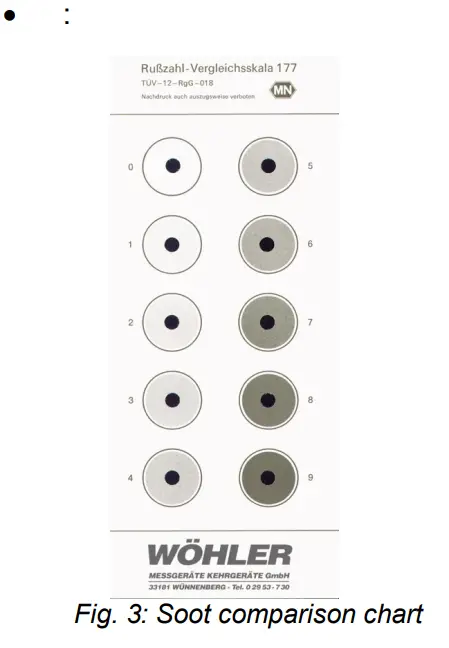
- Put the used filter paper under the soot comparison chart and search the matching segment.
The soot number of the sample is given by the number of the matching segment. - Determine the arithmetical mean of three soot numbers and round it up or down to the next number.
This rounded mean represents the soot number of the heating system.
Taking the sample
NOTE!
To avoid condensation on the filter paper, the measuring head (1) with the turbulence spiral and the probe should be warmed on the boiler.
6.1 Preparation
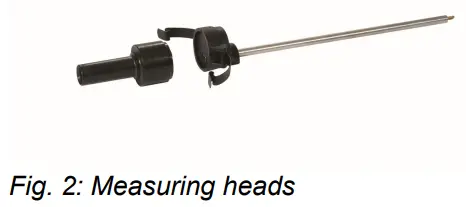
- Place the filter paper between the measuring heads (1) and (4).
- Close the measuring heads by pressing the clamps 2. It is important that the notched pin engages into the notch of the Ryton part.
NOTE!
A few quick pump strokes, previously to the measurement, increase the operational qualities of the instrument.
- Fix the sampling probe tightly in the flue gas pipe at the point of the highest temperature. Use a cone 8 mm Ø.
6.2 Extracting the smoke gas
Do 10 pump strokes as follows:
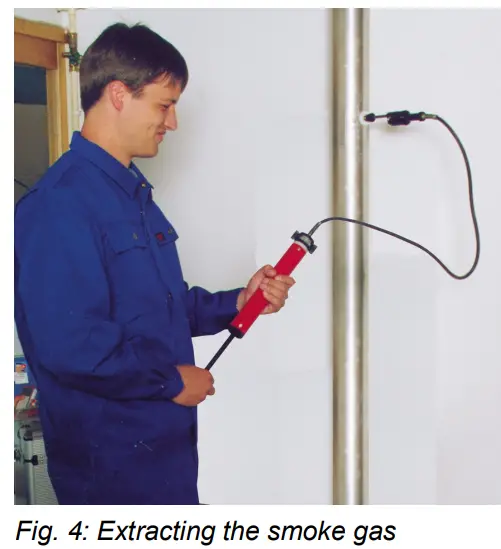
- Pull out piston (20) slowly (in about 2-3 seconds) and hold it in the final position for about 3 seconds, so that a pressure compensation can be made.
 ATTENTION! Through the filter paper, the pressure compensation can only take place slowly. Therefore it is absolutely necessary to wait 3 seconds before pressing the piston back.
 - Press the piston back.
- Repeat this procedure 10 times.
ATTENTION!
Waiting times, with pulled-up piston, should strictly be kept, so that the pump can draw the right amount of flue gas.
- Take the measuring head with the extraction probe (1) out of the check opening.
- Remove the clamps (2) from the measuring head (4).
- Remove the filter paper and analyze the sootspot on the paper as explained in chapter 5.3.
NOTE!
The excentrical check opening of the measuring head (1) allows several tests with the same paper moving the filter paper.
Maintenance
Proper operation of the Wöhler RP 72 Soot Test Pump requires regular maintenance. .
7.1 Maintenance work
| Interval | Maintenance work |
| After each working day | Airing and drying of the soot test pump: · Take out plugs (6) and (24). · Exchange wet cottonwool filter rolls (12) · Open the measuring heads (1) and (4). · Clean the measuring probe with the probe cleaning brush (see accessories). |
| Regularly | Greasing the sleeve (21) · Loosen the screws (8) and take off the piston guide (18). · Pull out piston (20) and sleeve (21). · Clean sleeve (4) and pump pipe (9) with a soft cloth from the inside, put piston 20 with sleeve (21) back into the pipe and squirt a little special maintenance lubricant on the back of the sleeve. |
| Twice a year | Check the accuracy of the Soot Test Pumpe |
Warranty and Service
8.1 Warranty
Each Wöhler RP 72 Soot Test Pump will be tested in all functions and will leave our factory only after extensive quality control testing. If used properly, the warranty period for the Soot Test Pump will be twelve months from the date of sale. Consumables are not covered by this warranty. This warranty does not cover the freight and packing costs when the device is sent to the factory for repair. Service by nonauthorized personnel or making modifications to the analyzer voids any warranty.
8.2 Service
Wöhler has built our reputation on excellence in customer service. Therefore, of course, we are readily available to assist you after the warranty period ends.
- Send us the pump and we will repair it and return it to you with our package service.
- Immediate help is provided by our technical staff over the telephone.
Accessories
| Soot comparison chart | Order no. 2416 |
| 2 Soot comparison charts | Order no. 369 |
| Wöhler RP 72 Oil Derivates Test bottle | Order no. 2481 |
Probe fixture:
| Threaded Cone for probes 8 mm Ø | Best.-Nr. 2494 Order no. 2495 |
Consumables
| Filter paper, 300 pieces | Order no. 2415 |
| Filter paper, large pack 1,800 pieces | Order no. 590 |
| Filter paper, transparent box, 300 pieces | Order no. 3700 |
| Wadding Filters, short, pack with 25 pieces | Order no. 5289 |
| Wadding Filters, short, pack with 150 pieces | Order no. 5290 |
| Wadding Filters, long, pack with 50 pieces | Order no. 2450 |
| Wadding Filters, long, pack with 150 pieces | Order no. 621 |
Maintenance
| Special maintenance lubricant | Order no. 2418 |
| Probe cleaning brush | Order no. 2419 |
| Turbulence Spiral | Order no. 20401 |
Options
| Measuring head, aluminum with clamps, for waste gas temperatures higher than 250°C and when using sampling probes of a special length. | Order no. 2728 |
| Probe 220 mm with turbulence spiral | Order no. 2727 |
Points of sale and service
Your contact:
| Germany Wöhler Technik GmbH | USA Wohler USA Inc. 208 S Main Street Middleton, MA 01949 Tel.: +1 978 750 9876 www.wohlerusa.com |
 Wöhler Technik GmbH
 Wöhler France SARL
 Wöhler Italia SRL
 Wohler USA Inc.