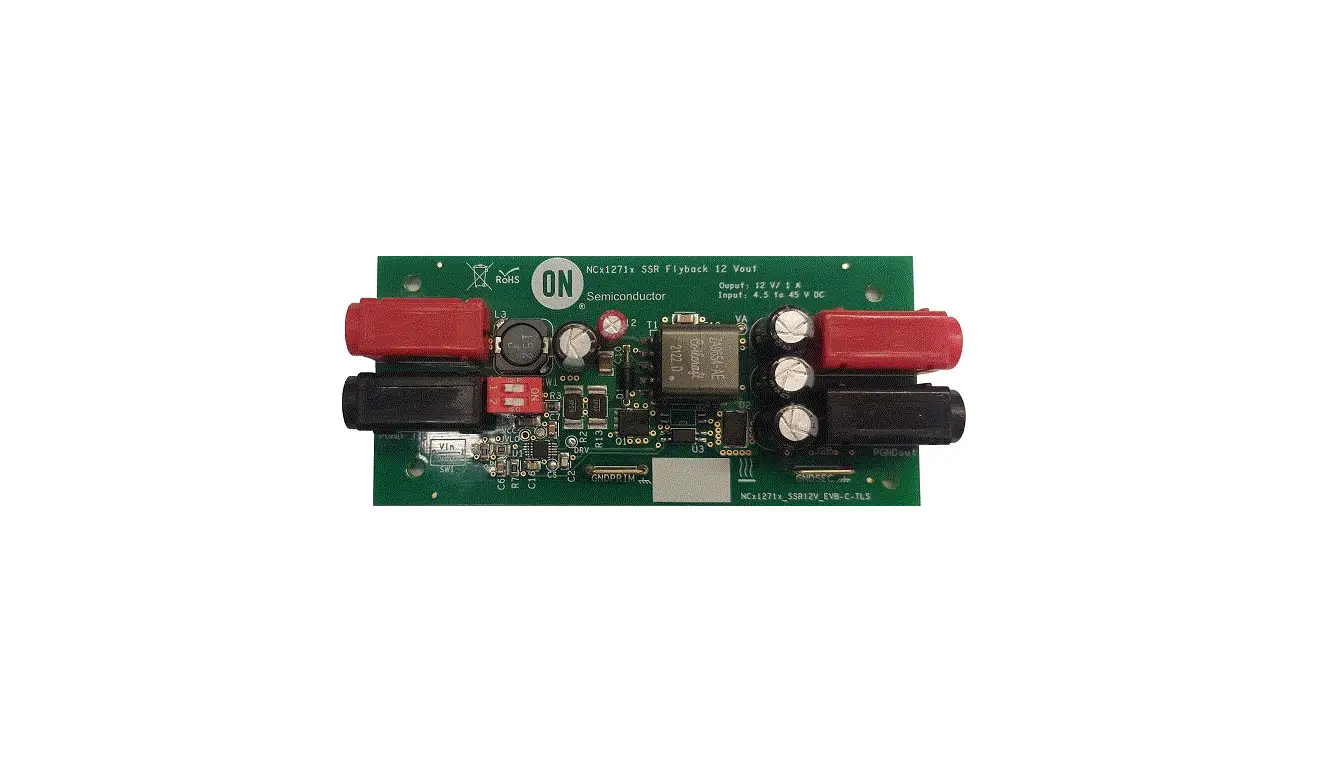
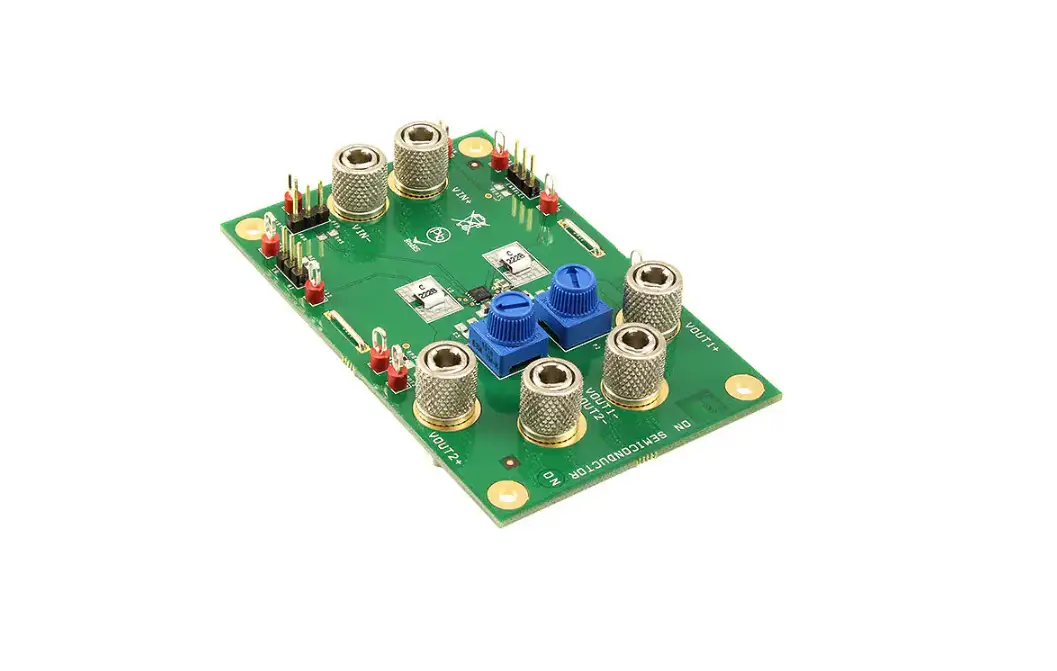
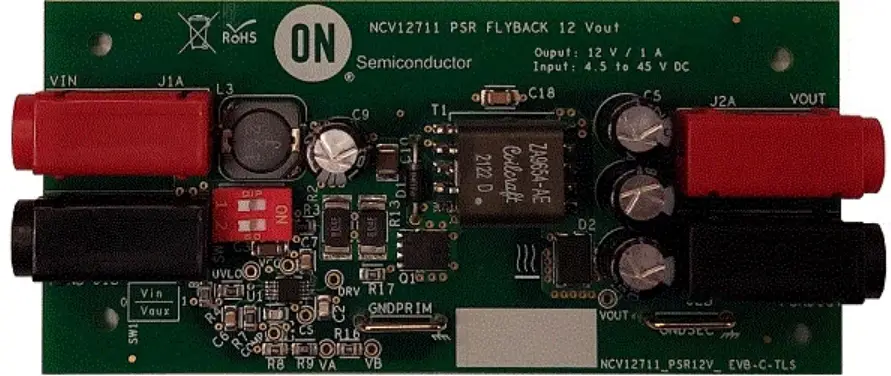
onsemi NCV12711PSRGEVB A 12-V 1-A Primary Side Regulated Isolated Flyback Converter
Product Information
- Product Name: NCV12711PSRGEVB
- Output Specification: 12 V/1 A
- Applications: Automotive
- Turn on Time: < 100 ms
- Input Voltage: 4 – 45 V dc
- Efficiency: Peaks to 88% @ full load
- Output Power: 12 W
- Operating Temperature:
- Topology: Current-Mode Flyback
- Board Size: 100 x 47 x 15 mm
- Cooling: Open Frame in Still Air
- Standby Power: See the tables on page 12
SPECIFICATION
| Devices | Applications | Input Voltage | Output Power | Topology | Board Size |
| NCV12711 | Automotive | 4 − 45 V dc | 12 W | Current−Mode Flyback | 100 x 47 x 15 mm |
| Output Spec. | Turn on Time | Efficiency | Operating Temperature | Cooling | Standby Power |
| 12 V/1 A | < 100 ms | Peaks to 88 % @ full load | 0 – 50°C | Open Frame in Still Air | See the tables on page 12 |
Product Usage Instructions
The NCV12711PSRGEVB is a primary-side-regulated flyback converter designed for automotive applications. It operates in current-mode control at a frequency of 100 kHz. The converter offers various features for building an energy-efficient system with necessary protections such as cycle-by-cycle current limit, over-current protection (OCP), and over-voltage protection (OVP) on the VCC pin.
The controller drives an N-channel MOSFET, similar to a classical flyback converter, at a user-adjustable switching frequency. The secondary side of the converter includes a low-Vf diode for efficient rectification in continuous conduction mode (CCM).
The primary-side section drives a transformer with a primary inductance of 8 mH. The current is sensed using two paralleled 40-mW resistors, which limit the maximum output current to a safe value in fault conditions.
The converter can deliver a continuous output power of 12 W in free air at the lowest input voltage (4.5 V). It is capable of delivering output power up to 4 V input, but thermal runaway may occur, so it is important to monitor the board temperature at higher input voltages.
The regulation is achieved using an auxiliary winding, eliminating the need for an optocoupler. The auxiliary winding is filtered and rectified to provide a clean DC voltage. The circuit offers different configurations for testing:
- a is closed, b open: In this mode, the VCC and VIN pins are connected together, and the auxiliary DC serves for regulation purposes only. The maximum input voltage is 25 V.
- b is closed, an open: In this mode, the controller is supplied by the VIN pin during the start-up sequence, and Vcc is biased by the rectified auxiliary supply. The input voltage can go up to 45 V.
- a and b are open: In this mode, the controller is self-supplied via an internal LDO, and the auxiliary winding serves for regulation purposes only. The input voltage can go up to 45 V.
In modes 1 and 3, which offer the best regulation figure, capacitor C12 maintains a constant load across it. However, in mode 1, the input voltage is limited to 25 V, while in mode 3, power dissipation may be a concern if a large-QG MOSFET is driven at a high switching frequency.
The NCV12711PSRGEVB features an internal operational amplifier coupled with external components to realize a type 2 compensator.
DESCRIPTION
This evaluation board user’s manual provides elementary information about a primary−side−regulated flyback converter NCV12711PSRGEVB built with the NCV12711 operated in current−mode control at 100 kHz. This control circuit offers many features to build an energy−efficient converter with all the needed protections like cycle−by−cycle current limit with a 250−mV sense voltage, over−current protection (OCP), and over−voltage protection (OVP) on the VCC pin. The controller drives an N−channel MOSFET as with any classical flyback converter at a user−adjustable switching frequency. The secondary side
hosts a low−Vf diode for efficient rectification in continuous conduction mode (CCM).
The primary−side section drives a transformer whose primary inductance is 8H. The current is sensed via two paralleled 40−mresistors which limit the maximum output current to a safe value in fault conditions. The board is rated to 12 W of continuous output power in free air at the lowest input voltage. This level is delivered down to a 4.5−V input. The converter is able to deliver output power up to 4−V input, which is the turn−off level adjusted by a UVLO resistor divider. At higher input voltages, the board may deliver more power but thermal runaway may happen and the board temperature must be monitored.
The regulation is ensured via an auxiliary winding, avoiding the use of an optocoupler. The winding is first filtered via R18/C19 and helps lower the leakage inductance peak naturally present in the transformer voltage. Then diode D4 with capacitor C12 provide adequate rectification to build a clean dc voltage. The switches let you select different configurations to test the circuit:
- a is closed, b open: in this mode, the VCC and VIN pin are connected together while the auxiliary dc serves for regulation purposes only. The maximum input voltage is 25 V; going beyond this value will trip the OVP on VCC pin.
- b is closed, a open: in this mode, the controller is supplied by the VIN pin only during start−up sequence and Vcc is biased by the rectified auxiliary supply. The input voltage can go up to 45 V.
- a and b are open: the controller is self−supplied via internal LDO and the auxiliary winding only serves for regulation purposes. The input voltage can go up to 45 V.
In the above three modes, 1. and 3. offer the best regulation figure because the load is constant across capacitor C12. However, in 1. the input voltage is limited to 25 V while in 3., power dissipation might be at stake if you drive a large−QG MOSFET at a high switching frequency.
The internal operational amplifier coupled to external components ensures the realization of a type 2 compensator. Using the simulation model or a bench measurement, components values were adjusted to crossover above 1 kHz. The maximum crossover is limited by the right−half−plane−zero (RHPZ) which degrades the phase response at the lowest input voltage and the largest output current. The board is equipped with two connectors letting you easily connect the network analyzer probes for a convenient measurement. The collected graphs show a comfortable phase margin at crossover.
A simple front−end filter limits the amount of parasitic noise going back to the source and it must be properly damped to avoid interaction with the downstream converter. C9 is providing that function with its equivalent series resistance (ESR).
KEY FEATURES OF NCV12711
- Internal 20−mA current source for lossless start−up sequence and self−supply operation
- Smooth start−up sequence with frequency sweep
- Internal operational amplifier with precise 2.5−V reference voltage
- Current−mode control operation
- Short circuit protection
- Over-voltage protection
- Input Voltage UVLO with Hysteresis
- Shutdown threshold for external disable
- 0% duty ratio mode for low standby power
- Single Resistor Programmable Oscillator
- User−Adjustable Soft−Start Ramp
BOARD PICTURES
EVALUATION BOARD SCHEMATIC DIAGRAM
MAGNETICS DATA
ZA9654−AE from Coilcraft:
TEST DATA
Startup Time

Steady−state Operation

Load Transient Response

Output Voltage Ripple

Drain−Source Voltage
Loop gain Bode plots:

Regulation Data:
For all regulation measurements, the dummy load 1 k (R19) and Zener diode D5 were removed.

Efficiency Data

Standby Data
For all standby measurements, the dummy load 1 k (R19) and Zener diode D5 were removed.
Table 1. STANDBY INPUT POWER FOR Iout = 1 mA
WHEN THE IC IS SELF−SUPPLIED VIA LDO
| VIN (V) | IIN (mA) | PIN (mW) | VOUT (V) |
| 4.5 | 14.7 | 66.5 | 13.1 |
| 15 | 6.8 | 102.6 | 13.4 |
| 25 | 4.6 | 114.5 | 14.1 |
| 45 | 4.0 | 179.0 | 15.4 |
Table 2. STANDBY INPUT POWER FOR Iout = 1 mA
WHEN THE VCC PIN IS CONNECTED TO VIN PIN
| VIN (V) | IIN (mA) | PIN (mW) | VOUT (V) |
| 4.5 | 14.9 | 67.3 | 13.0 |
| 15 | 7.0 | 104.3 | 13.4 |
| 25 | 4.6 | 115.0 | 15.4 |
Table 3. STANDBY INPUT POWER FOR Iout = 1 mA
WHEN THE IC IS SELF−SUPPLIED VIA LDO
| VIN (V) | IIN (mA) | PIN (mW) | VOUT (V) |
| 4.5 | 107.9 | 485.4 | 15.8 |
| 15 | 38.9 | 585.3 | 15.9 |
| 25 | 28.3 | 708.5 | 15.9 |
| 45 | 20.3 | 914.4 | 15.5 |
Table 4. BILL OF MATERIALS
| Designator (Main Board) | Qty | Description | Value | Toler- ance | Footprint | Manufac- turer | Manufacturer Part Number |
| C1 | 1 | Ceramic capacitor | 10 nF / 100 V | 20% | 0805 | Generic | |
| C2 | 1 | Ceramic capacitor | 22 pF / 10 V | 10% | 0805 | Generic | |
| C3 | 1 | Ceramic capacitor | 4.7 mF / 50 V | 10% | 1206 | TDK | CGA5L3X7R1H475K160AB |
| C4 | 1 | Ceramic capacitor | 10 nF / 10 V | 10% | 0805 | Generic | |
| C5, C13, C14 | 3 | Electrolytic Capacitor | 330 mF / 16 V | 20% | TH | Rubycon | 16ZLG330MEFC8X11.5 |
| C6 | 1 | Ceramic capacitor | 22 nF / 10 V | 10% | 0805 | Generic | |
| C7, C8 | 2 | Ceramic capacitor | 0.1 mF / 50 V | 20% | 0805 | Generic | |
| C9 | 1 | Electrolytic Capacitor | 100 mF / 50 V | 20% | TH | Rubycon | 50ZL100MEFC8X11.5 |
| C10, C11 | 2 | Ceramic capacitor | 2.2 mF / 100 V | 20% | 1210 | Kemet | C1210C225M1RACTU |
| C12 | 1 | Ceramic capacitor | 0.47 mF / 50 V | 20% | 0805 | Generic | |
| C15 | 1 | Ceramic capacitor | 4.7 nF / 16 V | 10% | 0805 | Generic | |
| C16 | 1 | Ceramic capacitor | 330 pF / 16 V | 10% | 0805 | Generic | |
| C17 | 1 | Ceramic capacitor | 470 pF / 100 V | 10% | 0805 | Generic | |
| C18 | 1 | Ceramic capacitor | 3.3 nF / 630 V | 10% | 1206 | Kemet | C1206C332KBRACTU |
| C19 | 1 | Ceramic capacitor | 470 pF / 50V | 20% | 0805 | Generic | |
| D1 | 1 | HV diode | 1N4937 | − | DO−41 | onsemi | 1N4937G |
| D2 | 1 | power diode | FSV10120V | − | TO−277 | onsemi | FSV10120V |
| D3 | 1 | signal diode | MMSD914 | − | SOD−123 | onsemi | SMMSD914 |
| D4 | 1 | signal diode | BAV21 | − | SOD−123 | onsemi | |
| D5 | 1 | Zener diode 15 V/3 W | 1SMB5929BT3G | 5% | SMB−2 | onsemi | 1SMB5929BT3G |
| J1a, J2a | 2 | Banana plug | − | − | − | multicomp | 24.243.1 |
| J1b, J2b | 2 | Banana plug | − | − | − | multicomp | 24.243.2 |
| L3 | 1 | Inductor | 1.5 mH | 30% | − | Coilcraft | MSS1038−152NL |
| R1 | 1 | Resistor | 18 kW | 1% | 2512 | Generic | |
| R2, R13 | 2 | Resistor | 40 mW | 1% | 2512 | Vishay | WSL2512R0400FEA |
| R3 | 1 | Resistor | 845 W | 1% | 0805 | Generic | |
| R4 | 1 | Resistor | 1.5 kW | 1% | 0805 | Generic | |
| R5 | 1 | Resistor | 68 kW | 1% | 0805 | Generic | |
| R6, R8, R17 | 3 | Resistor | 10 kW | 1% | 0805 | Generic | |
| R7, R11 | 2 | Resistor | 133 kW | 1% | 0805 | Generic | |
| R9 | 1 | Resistor | 38.3 kW | 1% | 0805 | Generic | |
| R10, R16 | 2 | Resistor | 10 W | 1% | 0805 | Generic | |
| R12, R14 | 2 | Resistor | 100 W / 0.5 W | 1% | 0805 | Generic | |
| R15 | 1 | Resistor | 0 W | 1% | 0805 | Generic | |
| R18, R21 | 2 | Resistor | 47 W | 1% | 0805 | Generic | |
| R19 | 1 | Resistor | 1 kW | 1% | 2512 | Generic | |
| R20 | 1 | Resistor | 2.2 W | 1% | 0805 | Generic | |
| SW1 | 1 | PCB Switch | − | − | − | multicomp | MCNDS−02V |
| T1 | 1 | Transformer | ZA9654−AE | − | − | Coilcraft | ZA9654−AE |
| Q1 | 1 | N−channel MOSFET | FDMS86103L | − | PQFN−8 | onsemi | FDMS86103L |
| U1 | 1 | PWM Controller | NCV12711 | − | MSOP−10 | onsemi | NCV12711A |
- NOTE: Ceramic capacitors are X7R type unless stated otherwise.
- NOTE: TH = through-hole part.
- NOTE: All parts are lead-free.
onsemi, , and other names, marks, and brands are registered and/or common law trademarks of Semiconductor Components Industries, LLC dba “onsemi” or its affiliates and/or subsidiaries in the United States and/or other countries. onsemi owns the rights to a number of patents, trademarks, copyrights, trade secrets, and other intellectual property. A listing of onsemi’s product/patent coverage may be accessed at www.onsemi.com/site/pdf/Patent−Marking.pdf. onsemi is an Equal Opportunity/Affirmative Action Employer. This literature is subject to all applicable copyright laws and is not for resale in any manner.
The evaluation board/kit (research and development board/kit) (hereinafter the “board”) is not a finished product and is not available for sale to consumers. The board is only intended for research, development, demonstration and evaluation purposes and will only be used in laboratory/development areas by persons with an engineering/technical training and familiar with the risks associated with handling electrical/mechanical components, systems and subsystems. This person assumes full responsibility/liability for proper and safe handling. Any other use, resale or redistribution for any other purpose is strictly prohibited.
THE BOARD IS PROVIDED BY ONSEMI TO YOU “AS IS” AND WITHOUT ANY REPRESENTATIONS OR WARRANTIES WHATSOEVER. WITHOUT LIMITING THE FOREGOING, ONSEMI (AND ITS LICENSORS/SUPPLIERS) HEREBY DISCLAIMS ANY AND ALL REPRESENTATIONS AND WARRANTIES IN RELATION TO THE BOARD, ANY MODIFICATIONS, OR THIS AGREEMENT, WHETHER EXPRESS, IMPLIED, STATUTORY OR OTHERWISE, INCLUDING WITHOUT LIMITATION ANY AND ALL REPRESENTATIONS AND WARRANTIES OF MERCHANTABILITY, FITNESS FOR A PARTICULAR PURPOSE, TITLE, NON−INFRINGEMENT, AND THOSE ARISING FROM A COURSE OF DEALING, TRADE USAGE, TRADE CUSTOM OR TRADE PRACTICE.
onsemi reserves the right to make changes without further notice to any board.
You are responsible for determining whether the board will be suitable for your intended use or application or will achieve your intended results. Prior to using or distributing any systems that have been evaluated, designed or tested using the board, you agree to test and validate your design to confirm the functionality for your application. Any technical, applications or design information or advice, quality characterization, reliability data or other services provided by onsemi shall not constitute any representation or warranty by onsemi, and no additional obligations or liabilities shall arise from onsemi having provided such information or services.
onsemi products including the boards are not designed, intended, or authorized for use in life support systems, or any FDA Class 3 medical devices or medical devices with a similar or equivalent classification in a foreign jurisdiction, or any devices intended for implantation in the human body. You agree to indemnify, defend and hold harmless onsemi, its directors, officers, employees, representatives, agents, subsidiaries, affiliates, distributors, and assigns, against any and all liabilities, losses, costs, damages, judgments, and expenses, arising out of any claim, demand, investigation, lawsuit, regulatory action or cause of action arising out of or associated with any unauthorized use, even if such claim alleges that onsemi was negligent regarding the design or manufacture of any products and/or the board.
This evaluation board/kit does not fall within the scope of the European Union directives regarding electromagnetic compatibility, restricted substances (RoHS), recycling (WEEE), FCC, CE or UL, and may not meet the technical requirements of these or other related directives.
FCC WARNING:
This evaluation board/kit is intended for use for engineering development, demonstration, or evaluation purposes only and is not considered by Onsemi to be a finished end product fit for general consumer use. It may generate, use, or radiate radio frequency energy and has not been tested for compliance with the limits of computing devices pursuant to part 15 of FCC rules, which are designed to provide reasonable protection against radio frequency interference. Operation of this equipment may cause interference with radio communications, in which case the user shall be responsible, at its expense, to take whatever measures may be required to correct this interference.
onsemi does not convey any license under its patent rights nor the rights of others.
LIMITATIONS OF LIABILITY: onsemi shall not be liable for any special, consequential, incidental, indirect or punitive damages, including, but not limited to the costs of requalification, delay, loss of profits or goodwill, arising out of or in connection with the board, even if onsemi is advised of the possibility of such damages. In no event shall Onsemi’s aggregate liability from any obligation arising out of or in connection with the board, under any theory of liability, exceed the purchase price paid for the board, if any.
The board is provided to you subject to the license and other terms per Onsemi’s standard terms and conditions of sale. For more information and documentation, please visit www.onsemi.com.
ADDITIONAL INFORMATION
- TECHNICAL PUBLICATIONS:
- Technical Library: www.onsemi.com/design/resources/technical−documentation
- onsemi Website: www.onsemi.com
- ONLINE SUPPORT: www.onsemi.com/support
For additional information, please contact your local Sales Representative at www.onsemi.com/support/sales
 Intelligent Power and Sensing Technologies | onsemi