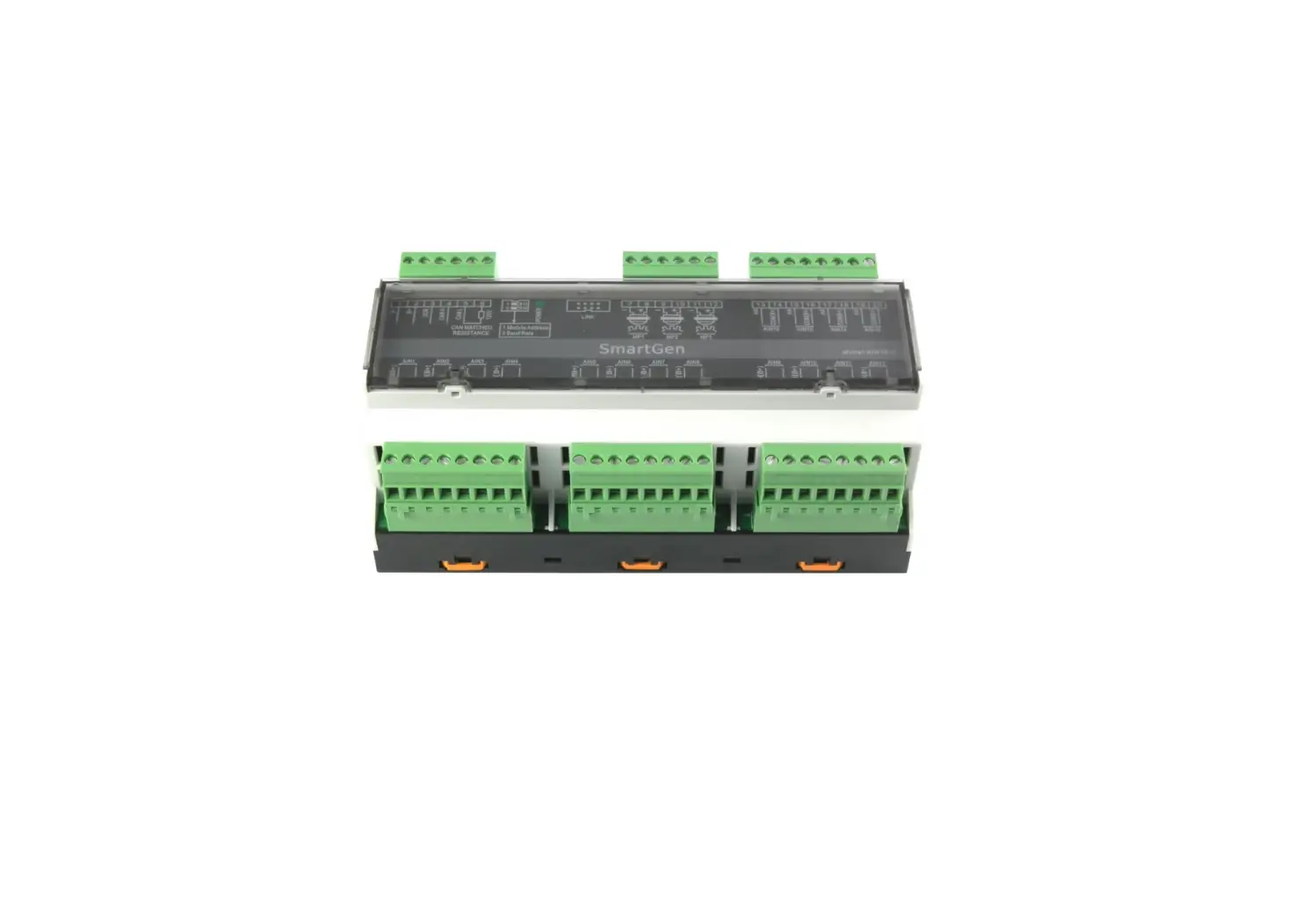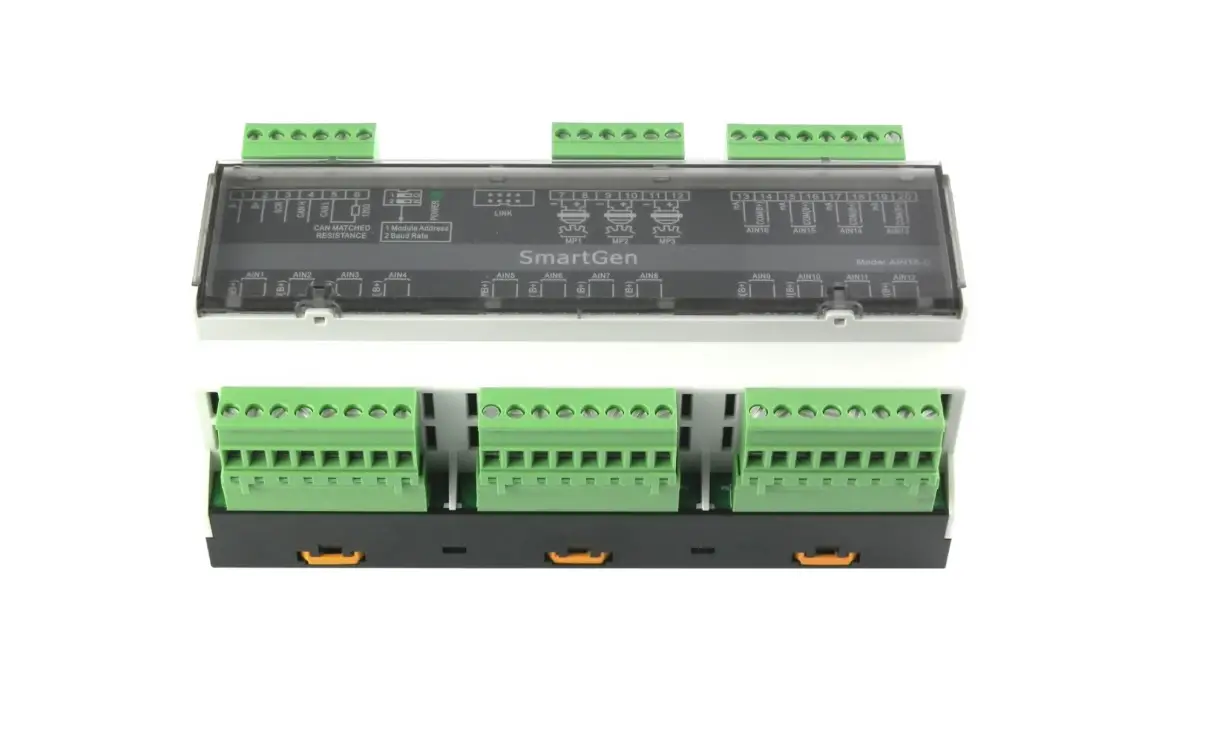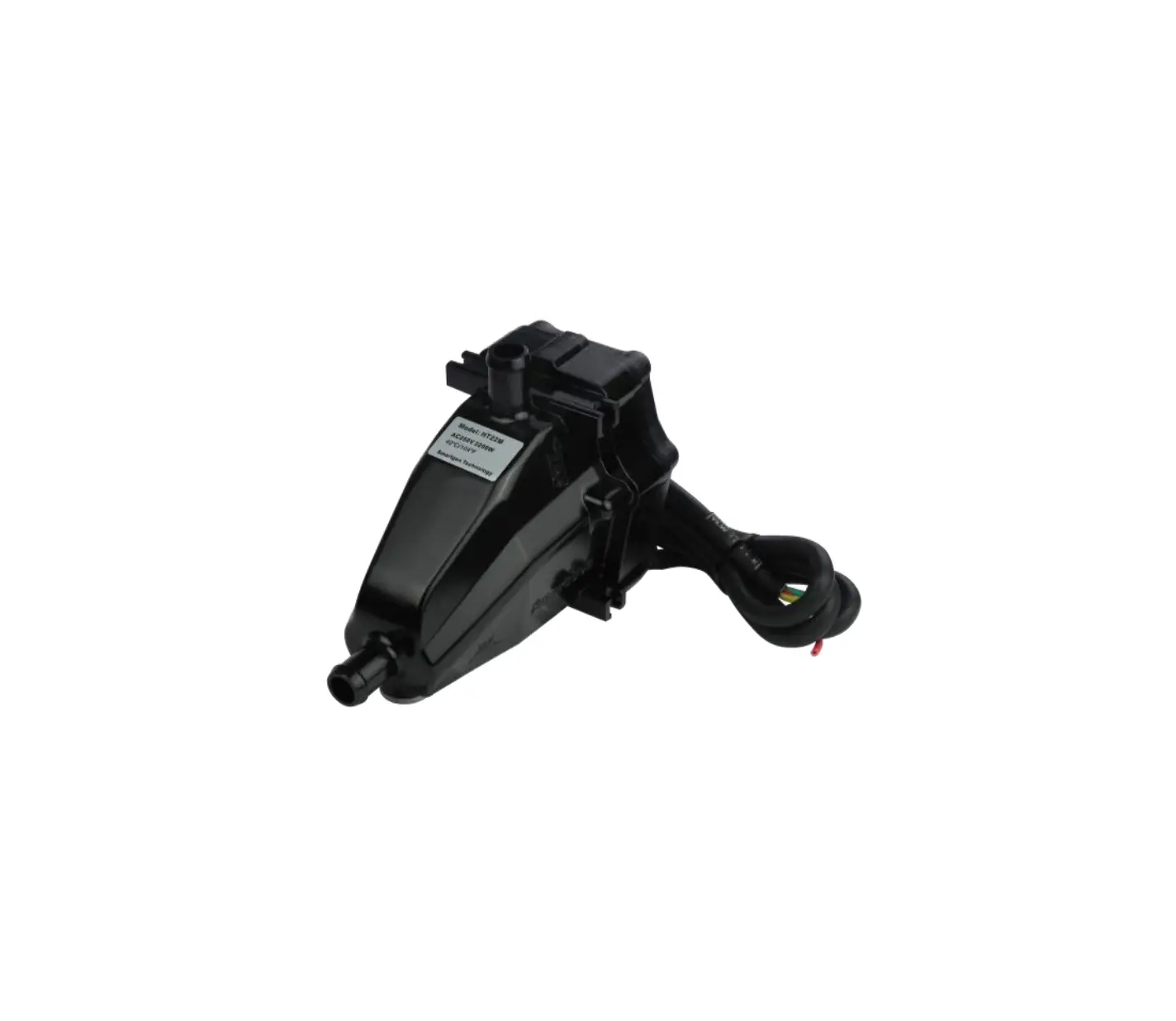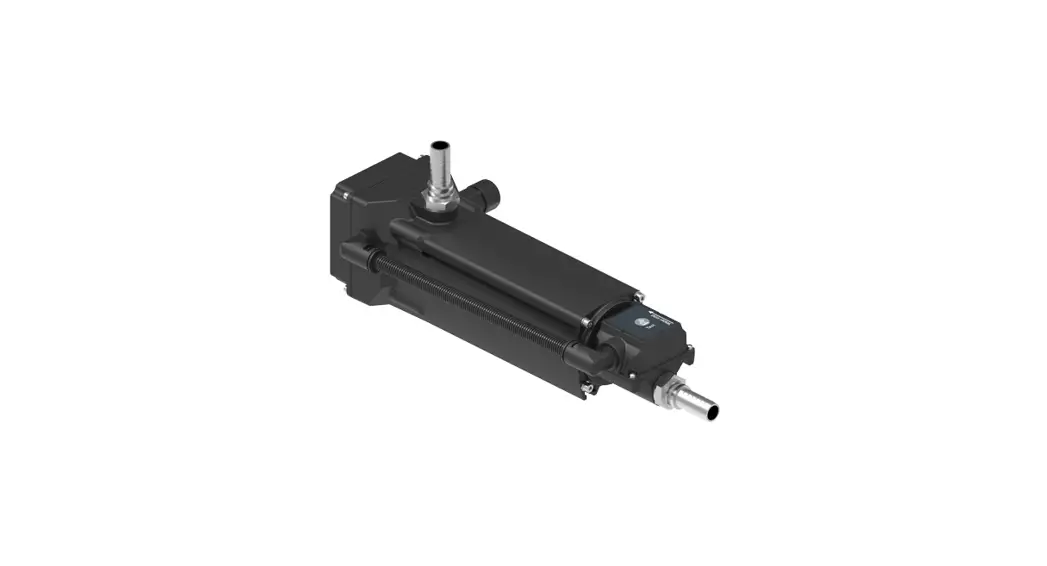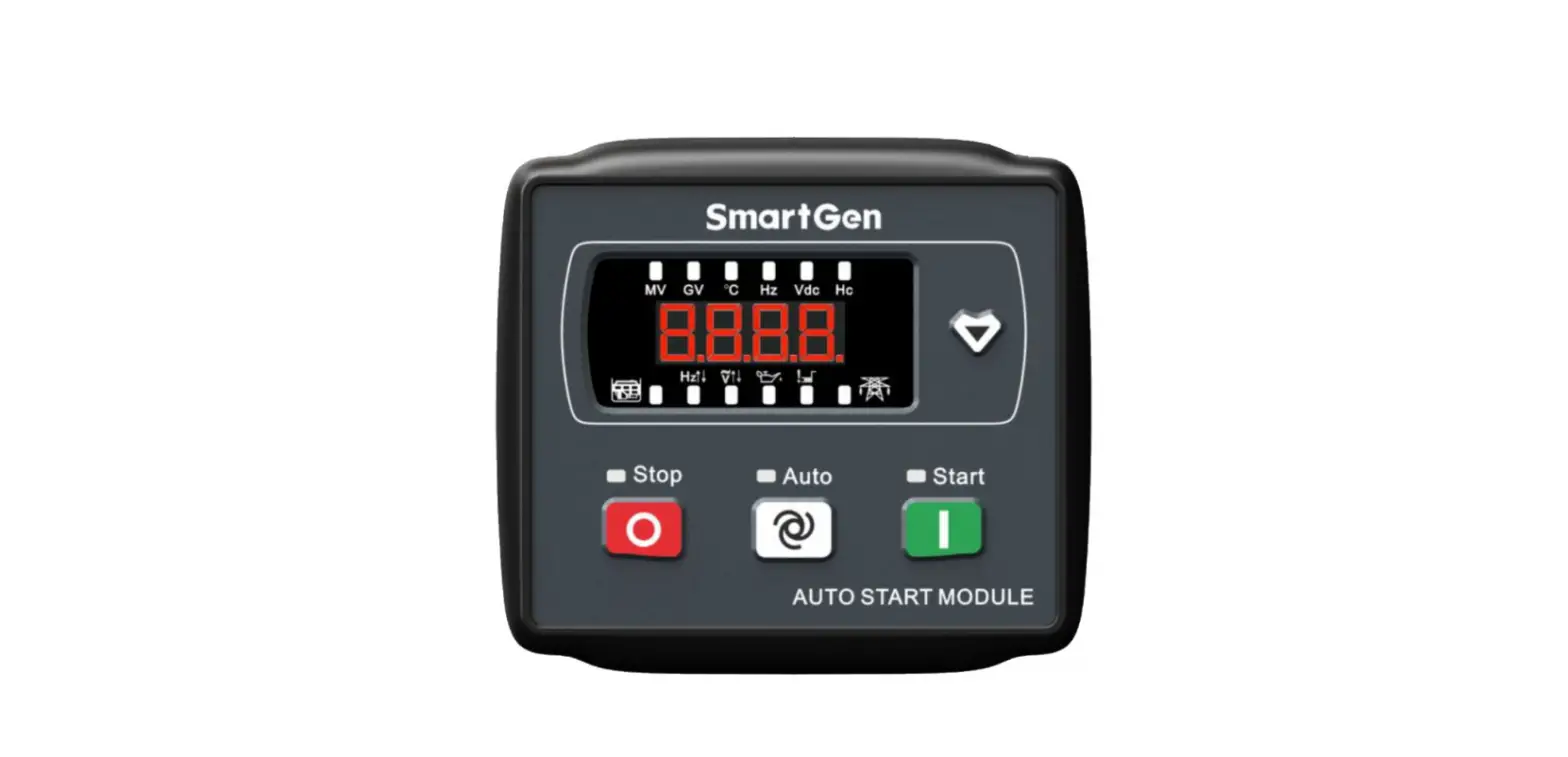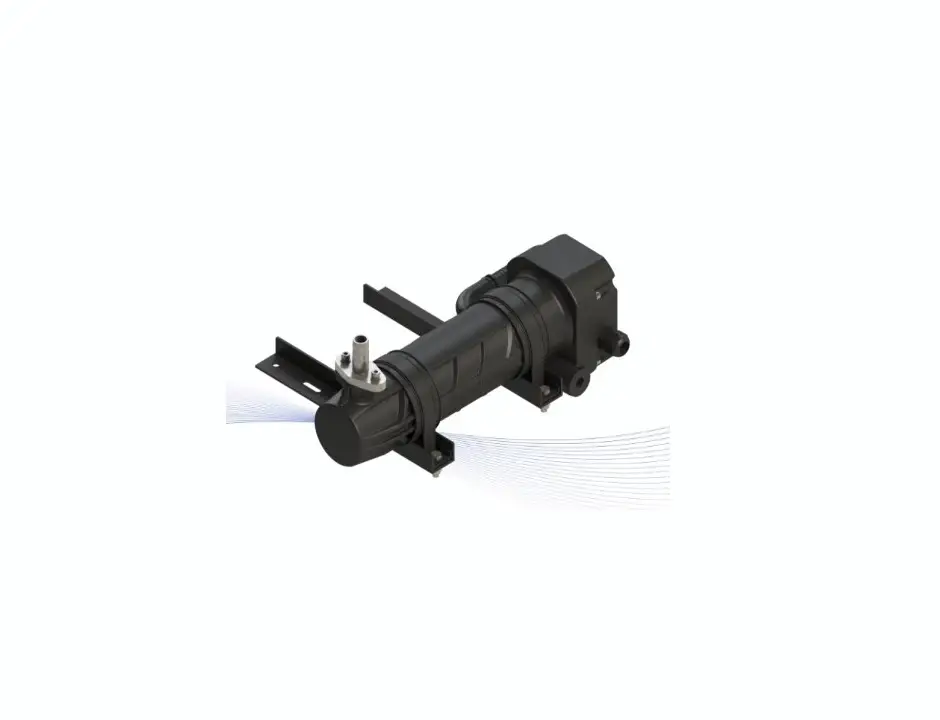
SmartGen HLS300 Marine Engine Controller, User Manual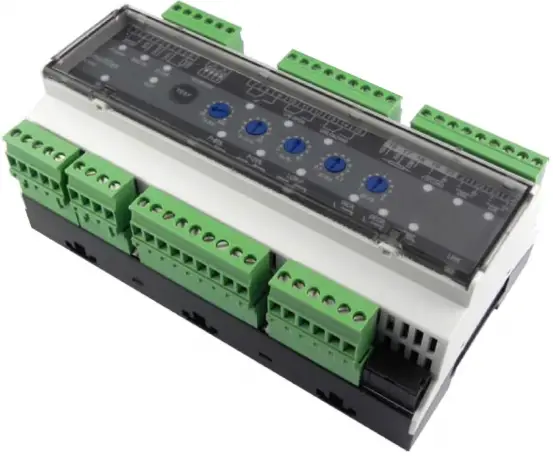
Introduction
All rights reserved. No part of this publication may be reproduced in any material form (including photocopying or storing in any medium by electronic means or other) without the written permission of the copyright holder.
Applications for the copyright holder’s written permission to reproduce any part of this publication should be addressed to Smart Gen Technology at the address above.
Any reference to trademarked product names used within this publication is owned by their respective companies.
Smart Gen Technology reserves the right to change the contents of this document without prior notice.
Table 1 – Software Version
| Date | Version | Content |
| 2015-05-21 | 1.0 | Original release. |
| 2015-09-07 | 1.1 | Modify terminal 1, terminal2 description. |
| 2017-03-09 | 1.2 | Add “Power Regulation Limit” description in parameter setting item; modified default values of Rated Voltage, Load Ramp Rate and etc. |
| 2018-08-21 | 1.3 | “Widely power supply range DC(8~35)V, suitable to different starting battery voltage environment” changed as “Widely power supply range DC(8~35)V” in section 2. |
| 2019-05-16 | 1.4 | Changed lamp description and typical application diagram. |
| 2019-11-26 | 2.0 |
|
| Sign | Instruction |
 NOTE NOTE | Highlights an essential element of a procedure to ensure correctness. |
 CAUTION CAUTION | Indicates a procedure or practice, which, if not strictly observed, could result in damage or destruction of equipment. |
OVERVIEW
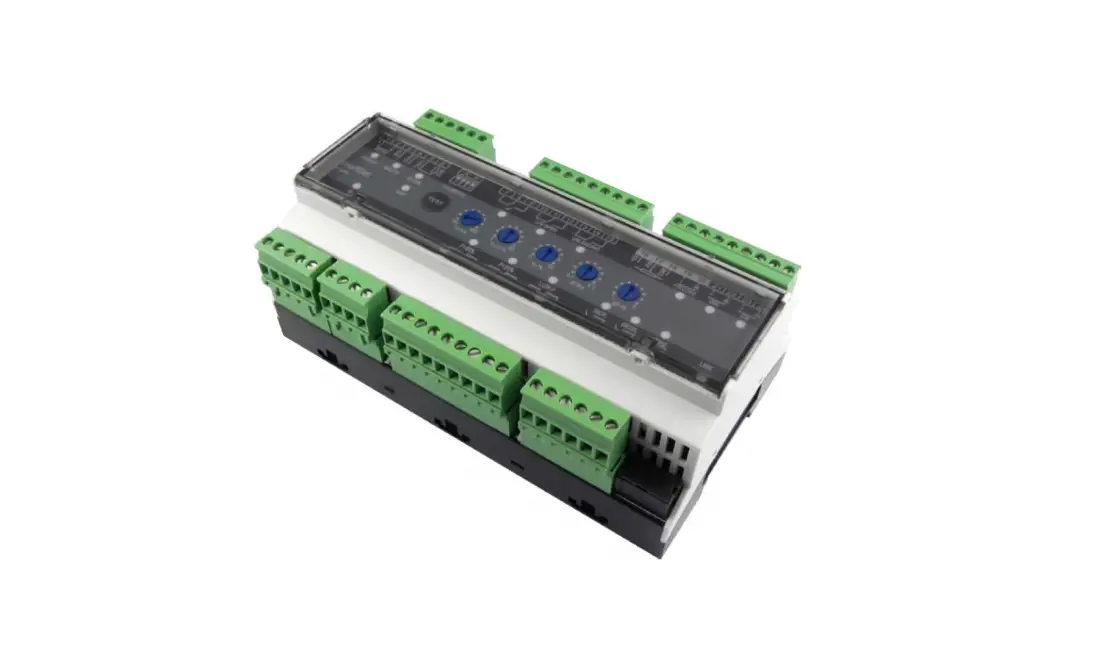
HLS300 Power Share Module is a special design for genset power share. On the basis of the set parameters, the module conducts automatically power share in genset running process.
The main function of HLS300 module is to share active load to each operating genset according to genset capacitance. The module is brief to operate, easy to install and widely used for ship genset and land genset.
PERFORMANCE AND CHARACTERISTICS
Main characters are as below:
- Suitable for 3-phase 3-wire, single phase 2-wire systems with frequency 50/60/Hz;
- Adjustable potentiometer allows for setting main parameters of power share.
- Module parameters can be set via upper computer test software. LINK port should be connected to upper computer via SG72 module (USB to LINK)
- 8 relay outputs, 2 of which are used for controlling INCR. speed raise, and DECR. reduce, 5 are used for -P, UNLOADING, P>80%, P<20%, LOW-P output, and 1 is used for C/B OPEN;
- 1 FIXLOAD mode, 1 UNL, 1 close and 1 60Hz optional digital input;
- One test button for testing relay output and panel indicators;
- Wide power supply range DC(8~35)V;
- 35mm guide rail mounting;
- Modular design, pluggable terminal, compact structure with easy installation.
SPECIFICATION
| Parameter | Details |
| Working Voltage | DC8.0V to 35.0V continuous |
| Overall Consumption | ≤2W(Standby mode≤0.5W) |
| AC Input | AC50V~ AC620 V (ph-ph) |
| AC Frequency | 50Hz/60Hz |
| Relay Output | 7A AC250V Volt free output |
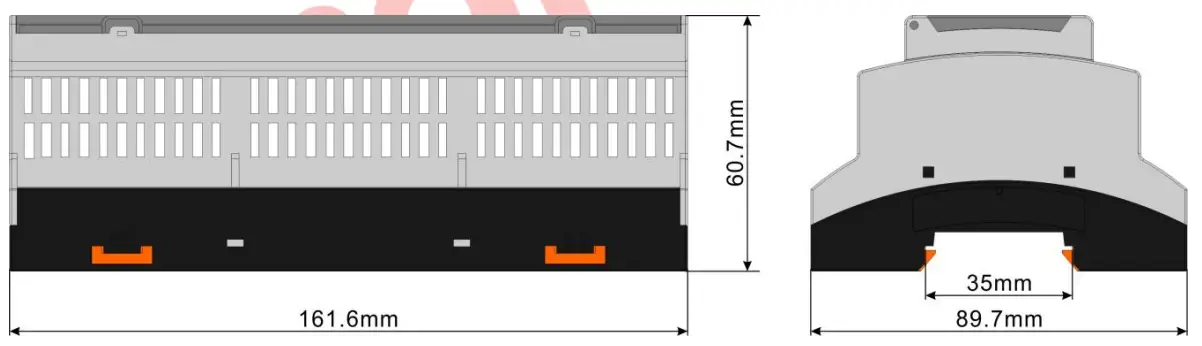
| Case Dimensions | 161.6mm x 89.7mm x 60.7mm |
| CT Secondary Current | Rated: 5A |
| Working Conditions | Temperature: (-25~+70)°C Humidity: (20~95)% |
| Storage Conditions | Temperature: (-25~+70)°C |
| Insulation Intensity | Apply AC2.2kV voltage between high voltage terminal and low voltage terminal; The leakage current is not more than 3mA within 1min. |
| Weight | 0.45kg |
PANEL INDICATORS AND TERMINALS DESCRIPTION
Fig.1 – Mask Drawing 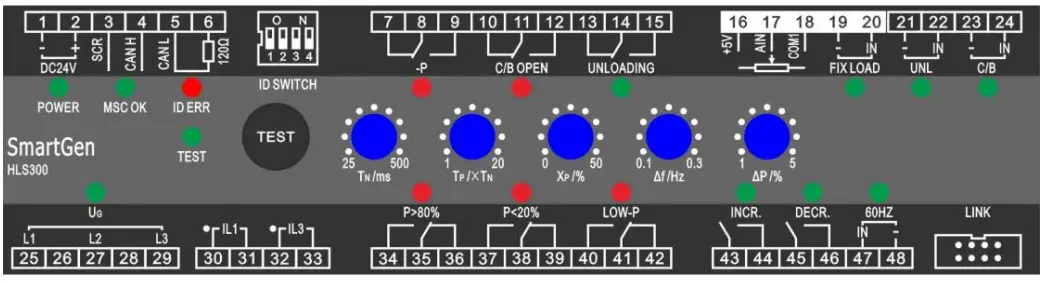
Table 4 – LEDs Definition Description
| Indicator | Color | Description | Note |
| Power | Green | Power indicator, the lamp illuminates when the power is normal. | |
| MSC OK | Green | MSC communication normal indicator, and it shall flash once for each data received. | |
| ID ERR | Red | MSCID setting error indicator, and the lamp illuminates when two module IDs are the same. | |
| TEST | Green | Indicates test mode. | |
| -P | Red | When reverse power reaches the set value and delay is expired, the relay output lamp will illuminate. | |
| C/B OPEN | Red | When the open relay is outputting, the lamp will illuminate. | |
| UNLOADING | Green | When the load is unloading, relay output lamp will illuminate. | Correspond to output function |
| FIXLOAD | Green | Fixed load mode indicator, the lamp will illuminate when input is active. | |
| UNL | Green | When Unload is active, the lamp will illuminate. | |
| C/B | Green | When the main switch close is active, the lamp will illuminate. | |
| UG | Green | When gens is normal, the lamp will illuminate; when gens is abnormal, the lamp will flash; when there is not power, the lamp will extinguish. | |
| P<20% | Red | When the load power is less than 20% (or set value) of Pn, the lamp will illuminate. | Correspond to output function |
| P>80% | Red | When the load power is over 80% (or set value)of Pn, the lamp will illuminate. | |
| LOW-P | Red | When the load is below the set value and delay is over, the lamp will illuminate. | Correspond to output function |
| INCR. | Green | When the raising speed pulse is sent, the lamp will illuminate. | |
| DECR. | Green | When the decreasing speed pulse is sent, the lamp will illuminate. | |
| 60HZ | Green | When the two stitches– and IN are short circuit, while the rated frequency is 60Hz, the lamp will illuminate. | 50/60HZ to choose |
Table 5 – Potentiometer Description
| Potentiometer | Range | Description | Note |
| TN/ms control pulse length | (25-500)ms | Control min. lasting time of pulse. | |
| Tp/×TN | (1-20)TN | Adjustable speed pulse period=Tp×TN | |
| Xp/% proportion range | (0-±50)%Pn (0-±2.5)Hz | In this area, pulse width and deviation value between Pn and rated frequency are in direct proportion. | Pn is rated power |
| △f/Hz | (0.1-0.3)Hz | Frequency precision adjustment; the frequency won’t be adjusted in setting area. | |
| △P/% | (1-5)% of Pn | Power precision adjustment; the power won’t be adjusted in setting area. |
Table 6 – Terminal Description
| No. | Function | Cable | Note | ||
| 1 | B- | 1.0mm2 | Connected with negative of starter battery. | ||
| 2 | B+ | 1.0mm2 | Connected with positive of starter battery. | ||
| 3 | SCR | 0.5mm2 | MSC communication. | ||
| 4 | CANH | 0.5mm2 | |||
| 5 | CANL | 0.5mm2 | |||
| 6 | Terminal Resistor Match | If the terminal resistance match is needed, it needs to be short circuited to the terminal 5 or hang in the air. | |||
| 7 | Reverse Power Output | Normally Close | 2.5mm2 | Output when reverse power has exceeded set value and the delay is over. | Normally open, N/C contactor; Volt free output; 7A Rated |
| 8 | COM | ||||
| 9 | Normally Open | ||||
| 10 | Open Output | Normally Close | 2.5mm2 | Output when open. | Normally open, N/C contactor; Volts free output; 7A Rated |
| 11 | COM | ||||
| 12 | Normally Open | ||||
| 13 | Load Transfer Indicator Output | Normally Close | 2.5mm2 | Output when load transfers. Can be configured to other function output; | Normally open, N/C contactor; Volts free output; 7A Rated |
| 14 | COM | ||||
| 15 | Normally Open | ||||
| 16 | +5V | 1.0mm | Power adjustment. | ||
| 17 | AIN | 1.0mm | |||
| 18 | COM1 | 1.0mm | |||
| 19 | FIXLOAD | – | 1.0mm2 | Fixed power input, active when it is short circuit. | |
| 20 | IN | ||||
| 21 | UNL | – | 1.0mm2 | Unload input, active when it is short circuit. | |
| No. | Function | Cable | Note | |||
| 22 | IN | |||||
| 23 | C/B | – | 1.0mm2 | Main switch close input, active when it is short circuit. | ||
| 24 | IN | |||||
| 25 | L1 | 1.0mm2 | AC input. | |||
| 26 | ||||||
| 27 | L2 | 1.0mm2 | ||||
| 28 | ||||||
| 29 | L3 | 1.0mm2 | ||||
| 30 | S1 | CT A Phase Input | 2.5mm2 | Externally connected to secondary coil of current transformer (rated 5A). | ||
| 31 | S2 | |||||
| 32 | S1 | CT C Phase Input | 2.5mm2 | Externally connected to secondary coil of current transformer (rated 5A). | ||
| 33 | S2 | |||||
| 34 | P>80% Output | Normally Open |
2.5mm2 | Output when P>80% Pn (can set to other value) and delay is over. | Normally open, N/C contactor; Volts free output; 7A Rated | |
| 35 | COM | |||||
| 36 | Normally Close | |||||
| 37 | P<20% Output | Normally Open |
2.5mm2 | Output when P<20% Pn (can set to other value) and delay is over. | Normally open, N/C contactor; Volts free output; 7A Rated | |
| 38 | COM | |||||
| 39 | Normally Close | |||||
| 40 | Low Power Output | Normally Open |
2.5mm2 | Output when P<10%Pn (can be set to other value) and delay is over. Can be configured to other function output. | Normally open, N/C contactor; Volts free output; 7A Rated | |
| 41 | COM | |||||
| 42 | Normally Close | |||||
| 43 | INCR. | 2.5mm2 | Raise speed. | Normally open, Volt free, 7A Rated. | ||
| 44 | ||||||
| 45 | DECR. | 2.5mm2 | Reduce speed. | Normally open, Volt free, 7A Rated. | ||
| 46 | ||||||
| 47 | Hz Selection | – | 1.0mm2 | 50/60Hz to choose | Short circuit is 60Hz | |
| 48 | IN | |||||
| LINK | Used for parameter setting or software upgrade. | |||||
Fig. 2 – PC Programming Connection Type
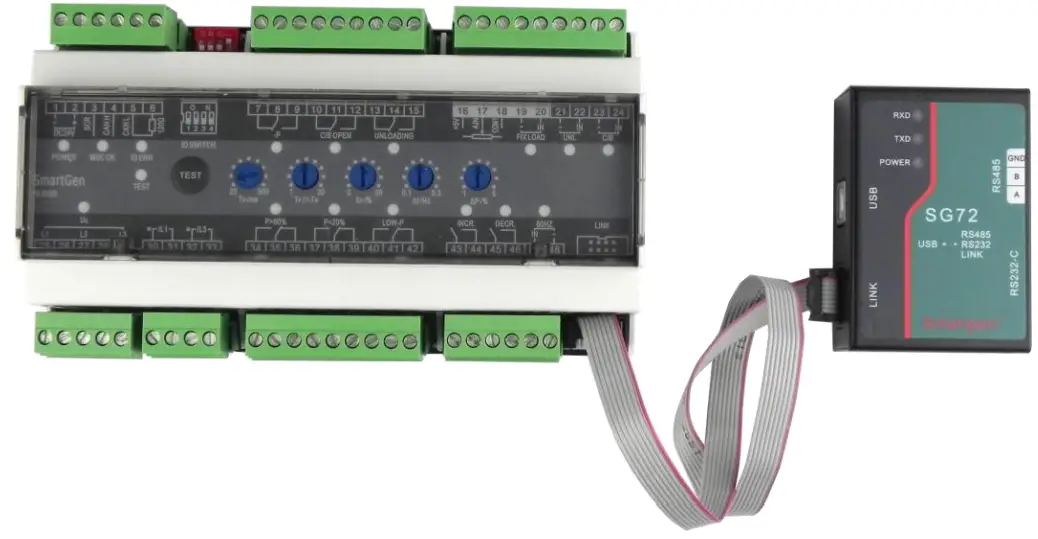
NOTE: About PC program connection, please connect SG72 module Link port with LINK port of this module. Through the PC software of our company, parameters can be set. Please see Fig. 2.
SCOPES AND DEFINITIONS OF PROGRAMMABLE PARAMETERS
Table 7 – Module Configurable Parameters
| No. | Items | Parameters | Defaults | Description |
| 1 | AC System | (0-1) | 0 | 0: 3P3W, 1: 1P2W |
| 2 | Rated Voltage | (30-30000) V | 400 | |
| 3 | Volt Trans. | (0-1) | 0 | 0: Disabled 1: Enabled |
| 4 | Volt Trans. Primary Voltage | (30-30000)V | 100 | |
| 5 | Volt Trans. Secondary Voltage | (30-1000)V | 100 | |
| 6 | Over Volt | (0-1) | 1 | 0: Disabled 1: Enabled |
| 7 | (100-120) % | 115 | Threshold | |
| 8 | (100-120) % | 113 | Returned | |
| 9 | (0-3600) s | 3 | Delay | |
| 10 | Under Volt | (0-1) | 1 | 0: Disabled 1: Enabled |
| 11 | (70-100) % | 75 | Threshold | |
| 12 | (70-100) % | 77 | Returned | |
| 13 | (0-3600) s | 3 | Delay | |
| 14 | Over Freq | (0-1) | 1 | 0: Disabled 1: Enabled |
| 15 | (100-120) % | 110 | Threshold | |
| 16 | (100-120) % | 104 | Returned | |
| 17 | (0-3600) s | 3 | Delay | |
| 18 | Under Freq | (0-1) | 1 | 0: Disabled 1: Enabled |
| 19 | (80-100) % | 90 | Threshold | |
| 20 | (80-100) % | 96 | Returned | |
| 21 | (0-3600) s | 3 | Delay | |
| 22 | Loss Of Phase | (0-1) | 1 | 0: Disabled 1: Enabled |
| 23 | Phase Rotation Monitor | (0-1) | 1 | 0: Disabled 1: Enabled |
| 24 | CT Ratio/5 | (5-6000) | 500 | |
| 25 | Full Load Rated Current | (5-6000)A | 500 | |
| 26 | Rated Power | (0-6000)kW | 500 | |
| 27 | Reverse Power Threshold | (0-20)% | 10 | |
| 28 | Reverse Power Delay | (1-20)s | 3 | |
| 29 | Low Power Threshold | (0-20)% | 10 | |
| 30 | Low Power Delay | (1-20)s | 3 | |
| 31 | 20% Power Threshold | (0-50)% | 20 | Power< the value, terminal 21, 22 (relay P<20%) outputs; |
| 32 | 20% Power Delay | (1-20)s | 3 | |
| 33 | 80% Power Threshold | (0-120)% | 80 | Power> the value, terminal 19, 20 (relay P>80%) outputs; |
| 34 | 80% Power Delay | (1-20)s | 3 | |
| 35 | Unbalance Threshold of Active Share | (0-50)% | 20 | |
| 36 | Unbalance Delay of Active Share | (1-20)s | 3 |
| No. | Items | Parameters | Defaults | Description |
| 37 | LOW-P Output Type | (0-1) | 0 | 0: N/O output 1: N/C output |
| 38 | LOW-P Output Contents | (0-30) | 16 | Default: LOW-P output Please refer to Output Port Contents. |
| 39 | P<20% Output Type | (0-1) | 0 | 0: N/O output 1: N/C output |
| 40 | P<20% Output Contents | (0-30) | 15 | Default: P<20% output Please refer to Output Port Contents. |
| 41 | UNLOADING Output Type | (0-1) | 0 | 0: N/O output 1: N/C output |
| 42 | UNLOADING Output Contents | (0-30) | 12 | Default: UNLOADING output; Please refer to Output Port Contents. |
| 43 | Address | (1-254) | 1 | |
| 44 | Load Ramp Rate | (0-100)% | 2 | |
| 45 | Load Ramp Rate Delay Percentage | (1-40)% | 15 | |
| 46 | Load Ramp Rate Delay | (0-30)s | 5 | |
| 47 | Load Parallel Ramp Minimum | (0-100)% | 5 | Load value of unload and breaker open; |
| 48 | Load Feedback Percentage | (0-100)% | 50 | Percentage of frequency dividing speed output; |
| 49 | Open Pulse Output | (1-1000)s | 3 | |
| 50 | Average Beat Freq | (0-1) | 1 | 0: Disabled 1: Enabled |
| 51 | Power Regulation Limit | (0-50)% | 30 | When the max. output duty ratio of raise/drop speed relay is 0, the relay does not output. |
| 52 | Unload Input Pulse Enable | (0-1) | 1 | There is no need to issue signal continuously during the unload process if this is enabled. |
| 53 | Load Share Optimization Enable | (0-1) | 1 | Adjust to optimize in dead area margin; suitable for high flexibility occasions for governor. |
| 54 | Speed Regulating Gain | (0-1000) | 100 | Adjust the proportion gain of governor gain. |
| 55 | Failed to Unload and Open Enable | (0-1) | 1 | 0: Disable 1: Enable |
| 56 | Failed to Unload Delay | (0-3600)s | 30 | During the delay, if unload is not up to the target, unload failure alarm occurs; if breaker open enable is set, then it will open. |
| 57 | Potentiometer Enable | (0-1) | 1 | 0: Disable 1: Enable |
| 58 | Speed Governor Tn | (25-500)ms | 100 | The min. lasting time of speed control pulse; |
| 59 | Speed Govenor Tp | (1-200) | 20 | Speed pulse period=TpxTN; |
| 60 | Speed Governor Xp | (0-±50)% | 50 | During the area pulse width is in direct ratio with current active power and rated active power deviation |
| No. | Items | Parameters | Defaults | Description |
| value; | ||||
| 61 | Speed Governor Xf | (0-±2.5)Hz | 2.5 | During the area pulse width is in direct ratio with current frequency and rated frequency deviation value; |
| 62 | △f/Hz | (0.1-0.3)Hz | 0.2 | Frequency modulation accuracy; it won’t the frequency if frequency has exceeded the set area. |
| 63 | △P/% | (1-15)% | 5 | Active power adjusting accuracy; it won’t adjust the active power if this has exceeded the set area. |
NOTE: ID can be set via dial-up switch of terminal side; the IDs of modules which are connected to the same CAN bus cannot be the same.
NOTE: The potentiometer on the module panel and configurations are exclusive; if potentiometer is enabled, then speed governor parameters are adjusted according to the potentiometer on the panel; Otherwise they will be adjusted according to configurations, and panel potentiometer will be ineffective.
OUTPUT CONFIGURATION CONTENTS
Table 8 – Output Port Contents
| No. | Output Contents | Description |
| 00 | Not Used | |
| 01 | Over Voltage | |
| 02 | Under Voltage | |
| 03 | Over Frequency | |
| 04 | Under Frequency | |
| 05 | Reverse Power | |
| 06 | Reverse Phase Sequence | |
| 07 | Loss of Phase | |
| 08 | Reserved | |
| 09 | Unbalance of Active Power Share | |
| 10 | Reserved | |
| 11 | Breaker Open Output | |
| 12 | UNLOADING Output | |
| 13 | Common Alarm Output | |
| 14 | P>80% Output | |
| 15 | P<20% Output | |
| 16 | LOW-P Output | |
| 17 | MSC ID Wrong | |
| 18 | Speed Raise Output | |
| 19 | Speed Drop Output | |
| 20 | Reserved | |
| 21 | Reserved | |
| 22 | Failed to Unload | |
| 23 | Reserved | |
| 24 | Reserved | |
| 25 | Reserved | |
| 26 | Reserved | |
| 27 | Reserved | |
| 28 | Reserved | |
| 29 | Reserved | |
| 30 | Reserved |
FUNCTION DESCRIPTION
INSTRUCTION
The function of HLS300 Power Share Module is to proportionally share active load to each operating genset according to genset capacitance. When “FIXLOAD” is active, the module works in fixed power mode; otherwise the module works in power share mode. Press  button for 3s, and it will enter into test mode, which is used to test relay output and indicator status.
FIXED POWER MODE
Target power can be set via the external device connected with terminal 16, 17, 18. When close input is active, the module will adjust present power to target power and stabilize it between △f and △P.
POWER SHARE MODE
Multiple modules are connected with each other via CAN bus and operate in power share mode together. Target power is an average of present power sums of these modules. When close input is active, the module will adjust present power to target power and stabilize it between △f and △P.
TEST MODE
Press button for 3s, and the module will enter into test mode and the lamp will illuminate, in the mean time the other lamps irrelevant with relay output will illuminate. -P relay outputs and the corresponding lamp will illuminate. In this mode, for every time to press button, there will be a relay output and the corresponding lamp will illuminate. The module will quit test mode after relay output is finished (every time there will be only one relay output and the corresponding lamp will illuminate). When it is in test mode, the module will automatically quit if there is no button pressed for about 18s. NOTE: Test mode is prohibited when the module is operating (when close input is active).
TYPICAL DIAGRAM
Fig.3 – HLS300 3Phase 3Wire Typical Application
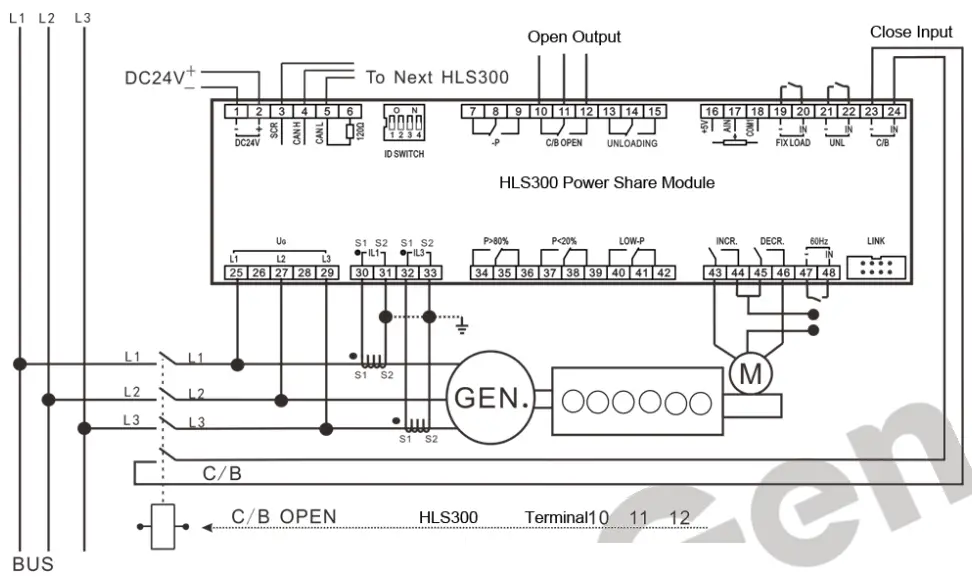
Fig.4 – HSM300-HLS300 3Phase 3Wire Typical Application
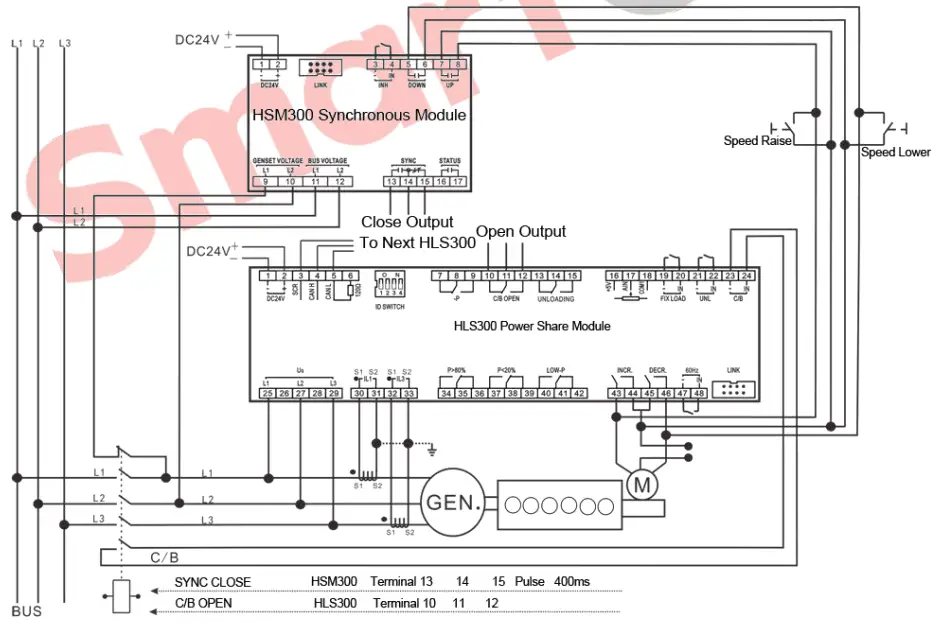
Fig.5 – HSM300-HLS300-HEP300 3Phase 3Wire Typical Application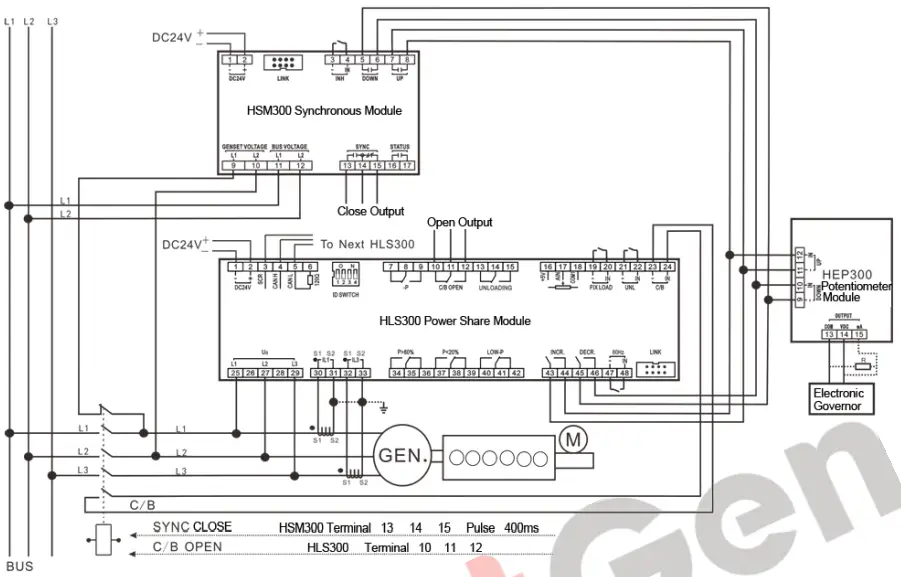
CASE DIMENSION
INSTALLATION PRECAUTIONS
OUTPUT AND EXPAND RELAYS
All outputs are relay contact output type. If it needs to expand the relays, please add freewheel diode to both ends of expand relay’s coils (when coils of relay have DC current) or, add resistance-capacitance return circuit (when coils of relay have AC current), in order to prevent disturbance for controller or other equipment’s.
AC INPUT
Current input must be connected to outside current transformer. And the current transformer’s secondary side current must be 5A. Meanwhile the phases of CT and input voltage must be correct, otherwise the sampling current and active power may be incorrect. NOTE: When there is load current, transformer’s secondary side is prohibited to have open circuit.
WITHSTAND VOLTAGE TESTCAUTION: When relay had been installed in control panel, if need the high voltage test, please disconnect relay’s all terminal connections, in order to prevent high voltage into relay and damage it.
FAULT FINDING
The followings are the common faults and troubleshooting methods during the use process of our company controllers. If other unsolvable faults occur, please contact our company.
Table 9 – Fault Findings
| Fault Symptom | Possible Measures |
| Controller no response with power on | Check controller connection wirings; Check power fuse; |
| Unbalanced power share | Check governor wirings; Check whether breaker close feedback input is normal or not; |
| Circular high and low distribution of gensets in parallel network; (Leisurely car) | Dead area of power distribution setting is too minimum; Speed governor parameter configurations make output flexibility too high; Speed governor flexibility is too high. |
| No response for unloading | Check speed governor wirings; Check unload input port wirings; |
Customer Support
SmartGen — make your generator smart
SmartGen Technology Co., Ltd.
No.28 Jinsuo Road
Zhengzhou
Henan Province
P. R. China
Tel: 0086-(0)371-67988888/67981888
0086-(0)371-67991553/67992951
0086-(0)371-67981000(overseas)
Fax: 0086-(0)371-67992952
Web: www.smartgen.com.cn
www.smartgen.cn
Email: [email protected]

 众智科技
众智科技 众智科技
众智科技