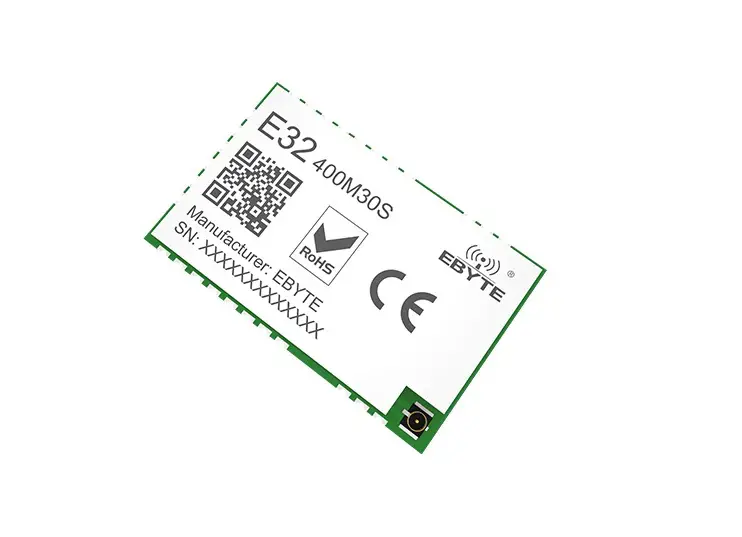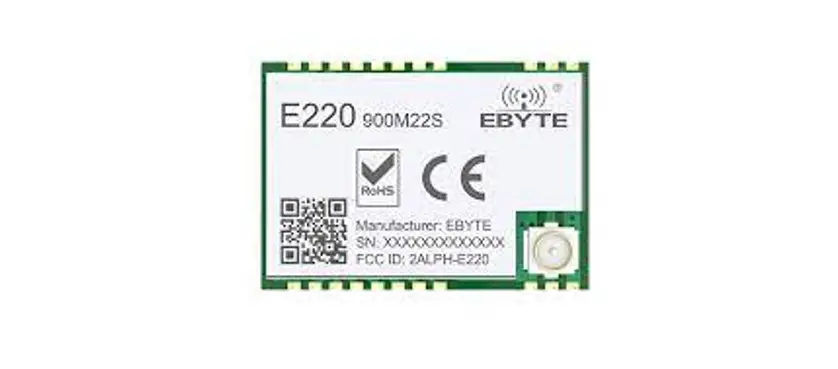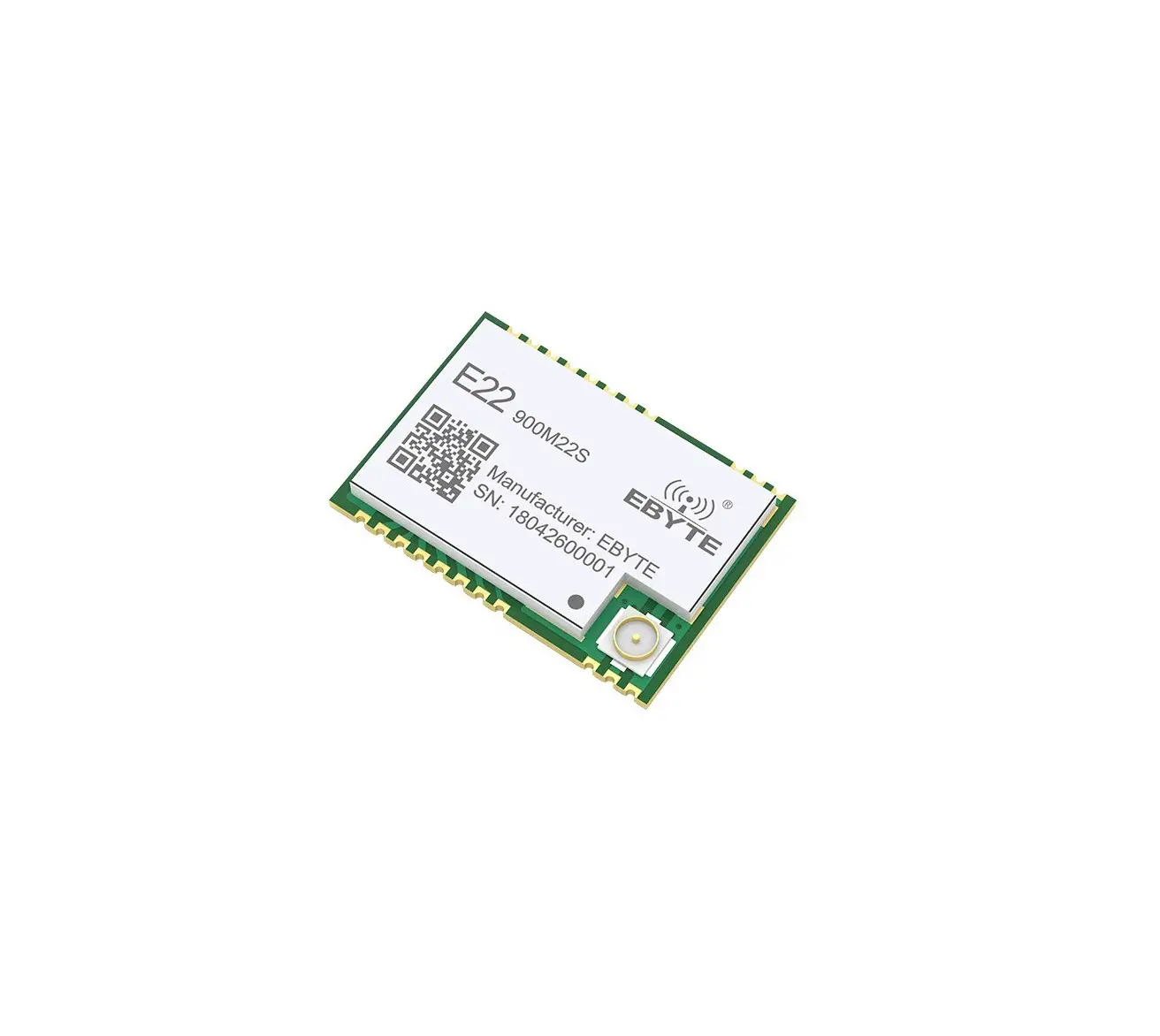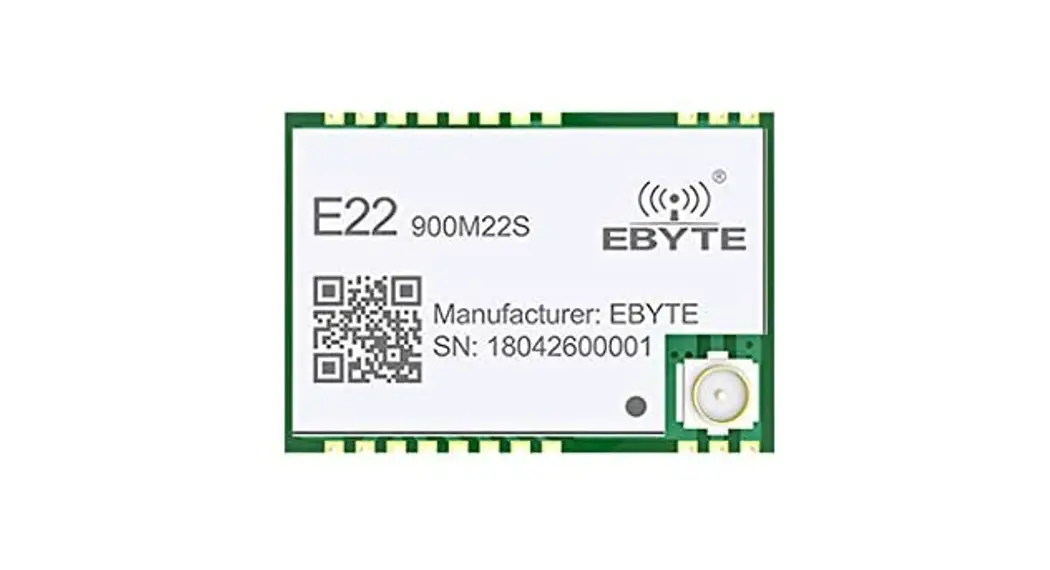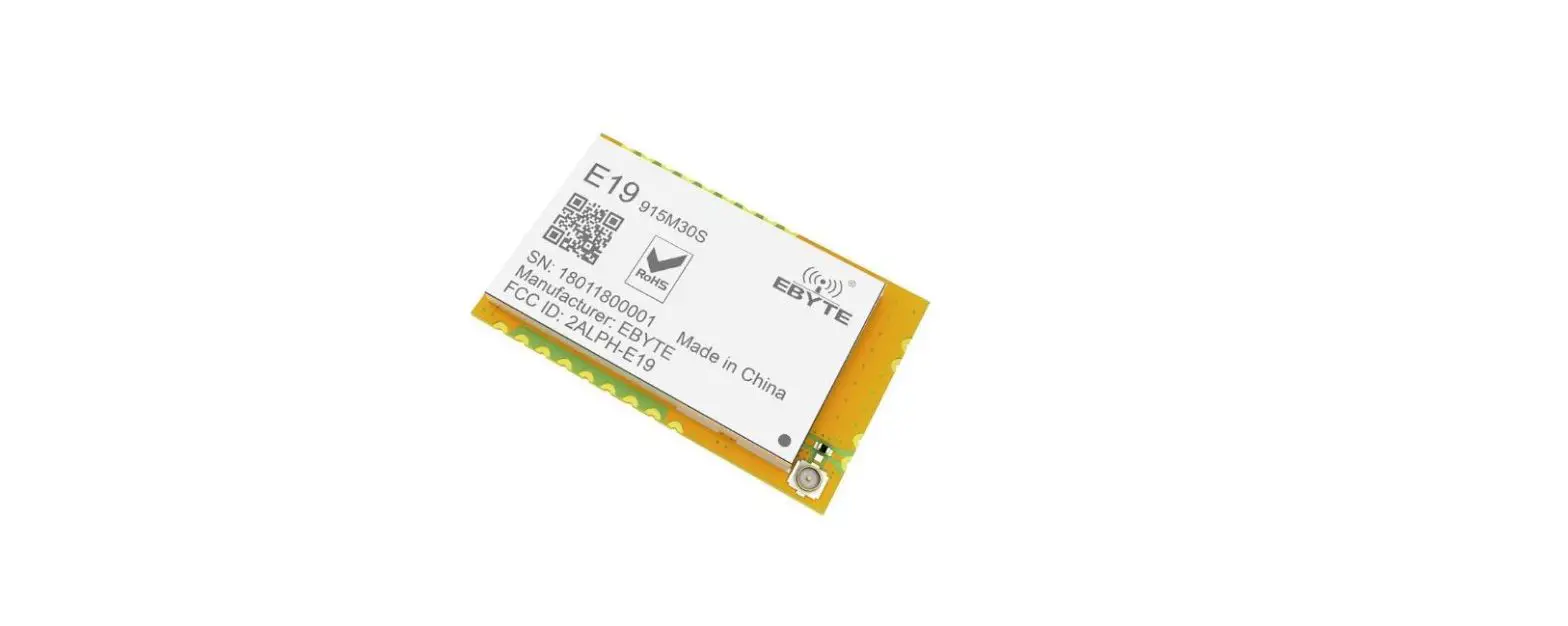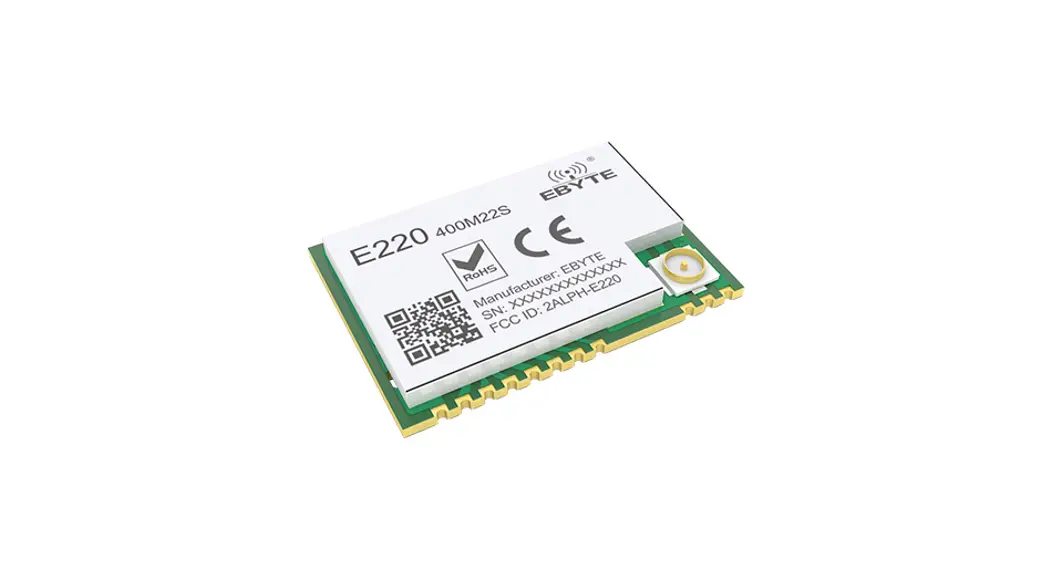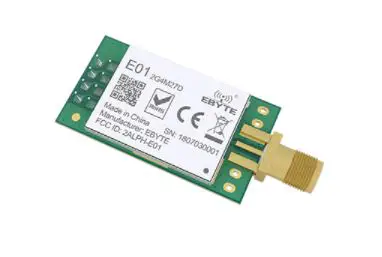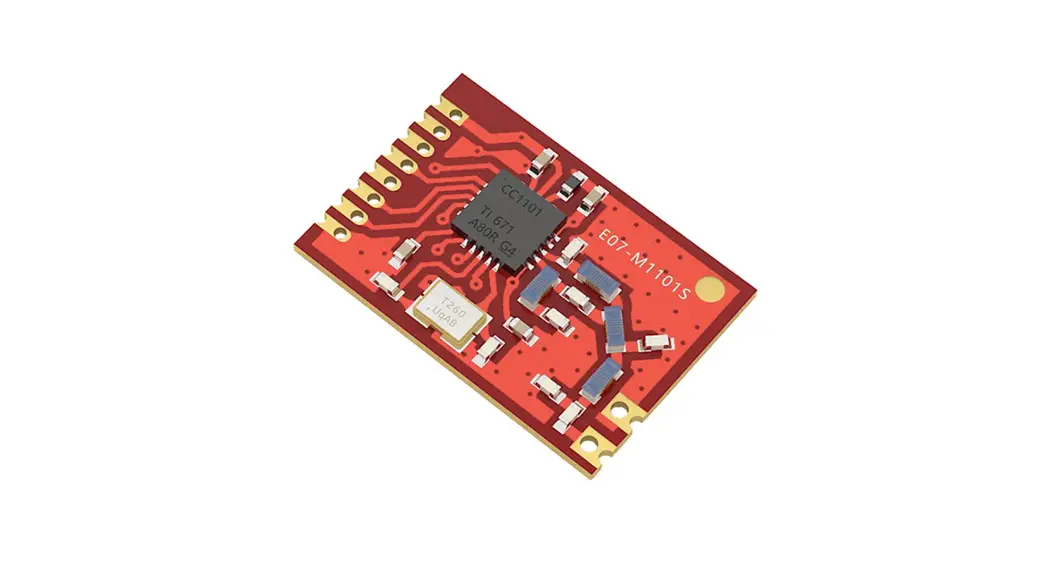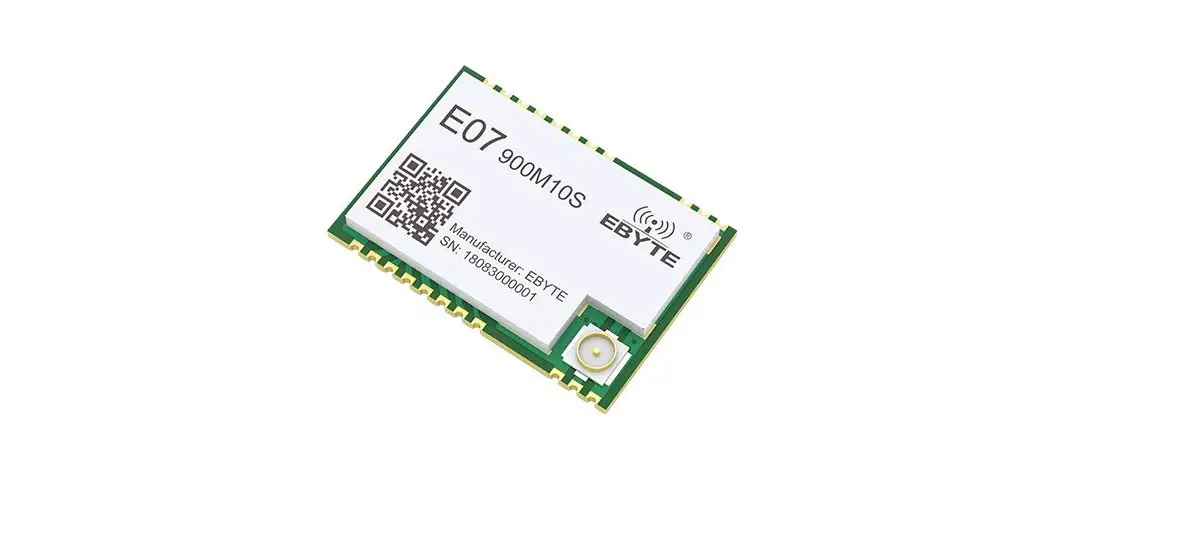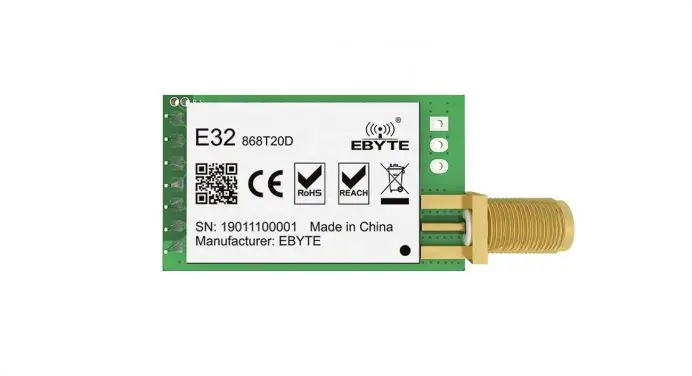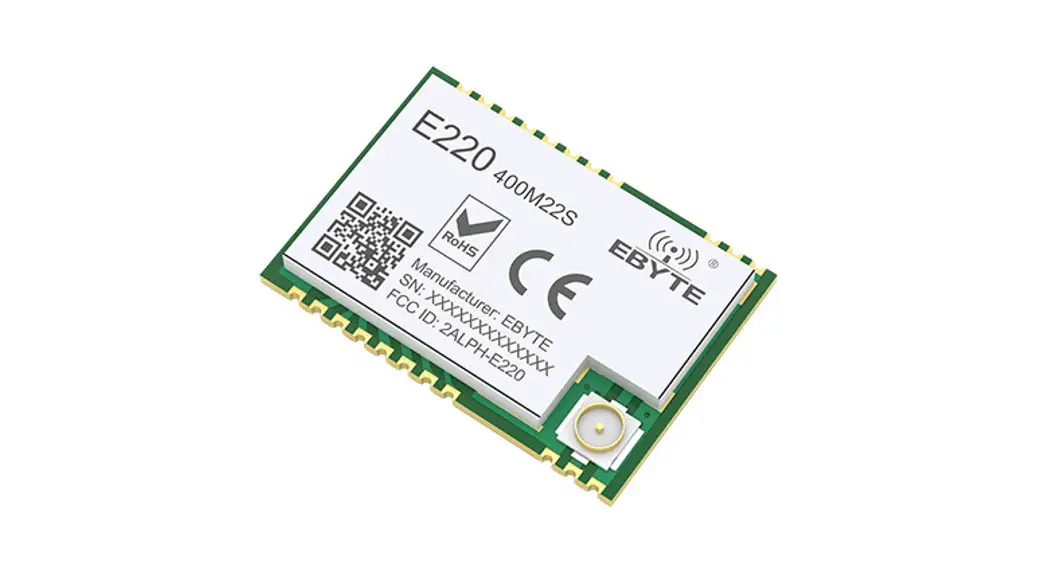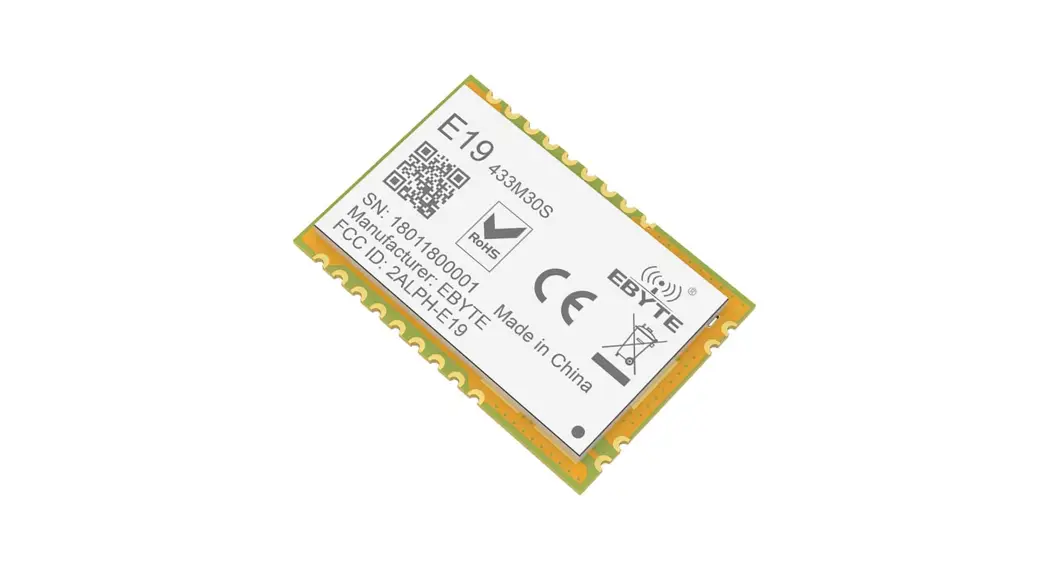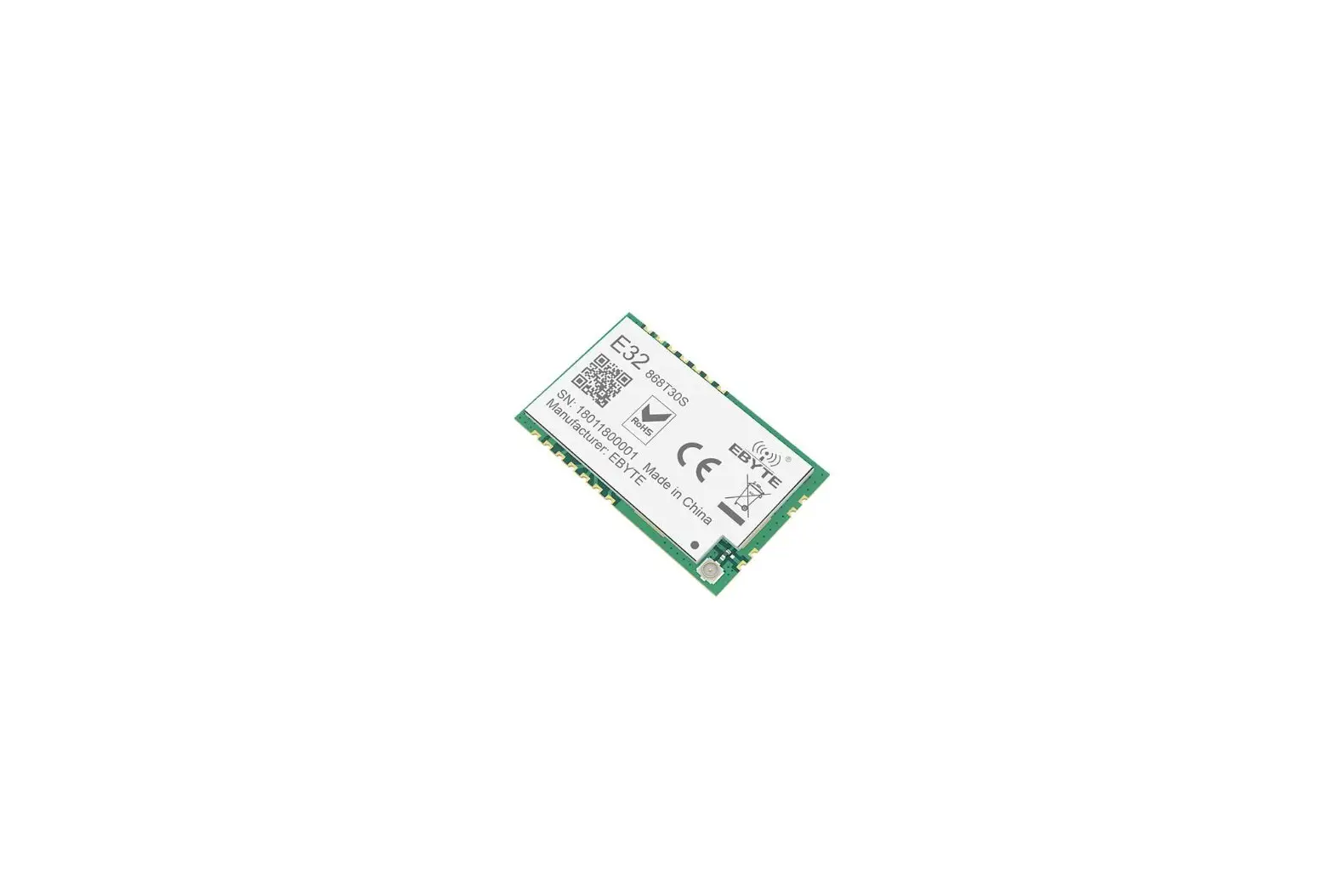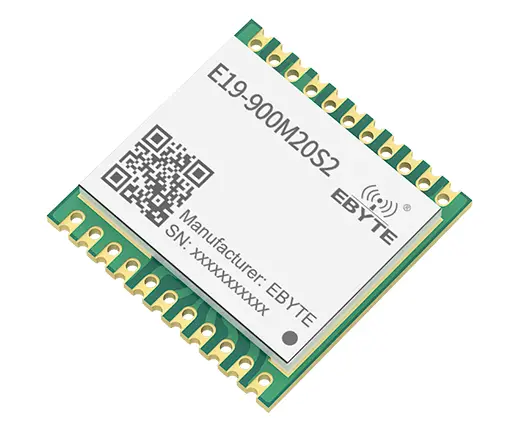

EBYTE E01-2G4M27D SX1276 868/915MHz 100m SPI SMD RF Module
Disclaimer
EBYTE reserves all rights to this document and the information contained herein. Products, names, logos and designs described herein may in whole or in part be subject to intellectual property rights. Reproduction, use, modification or disclosure to third parties of this document or any part thereof without the express permission of EBYTE is strictly prohibited.
The information contained herein is provided “as is” and EBYTE assumes no liability for the use of the information. No warranty, either express or implied, is given, including but not limited, with respect to the accuracy, correctness, reliability and fitness for a particular purpose of the information. This document may be revised by EBYTE at any time. For most recent documents, visit www.ebyte.com.
Introduction
Brief Introduction
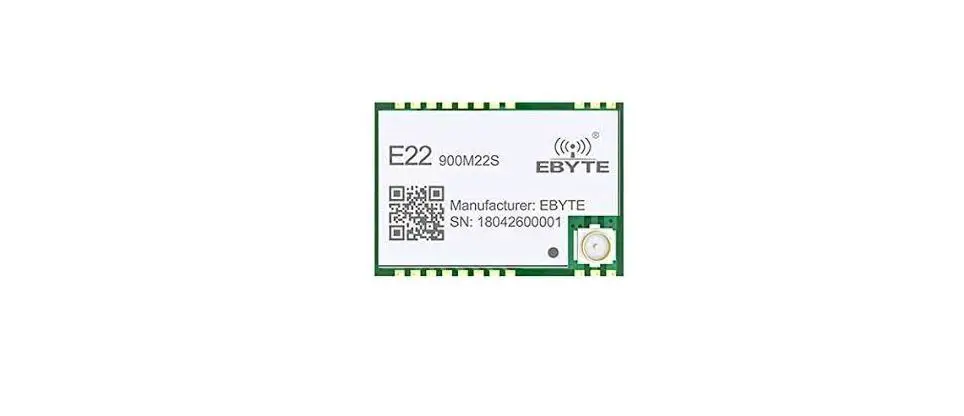
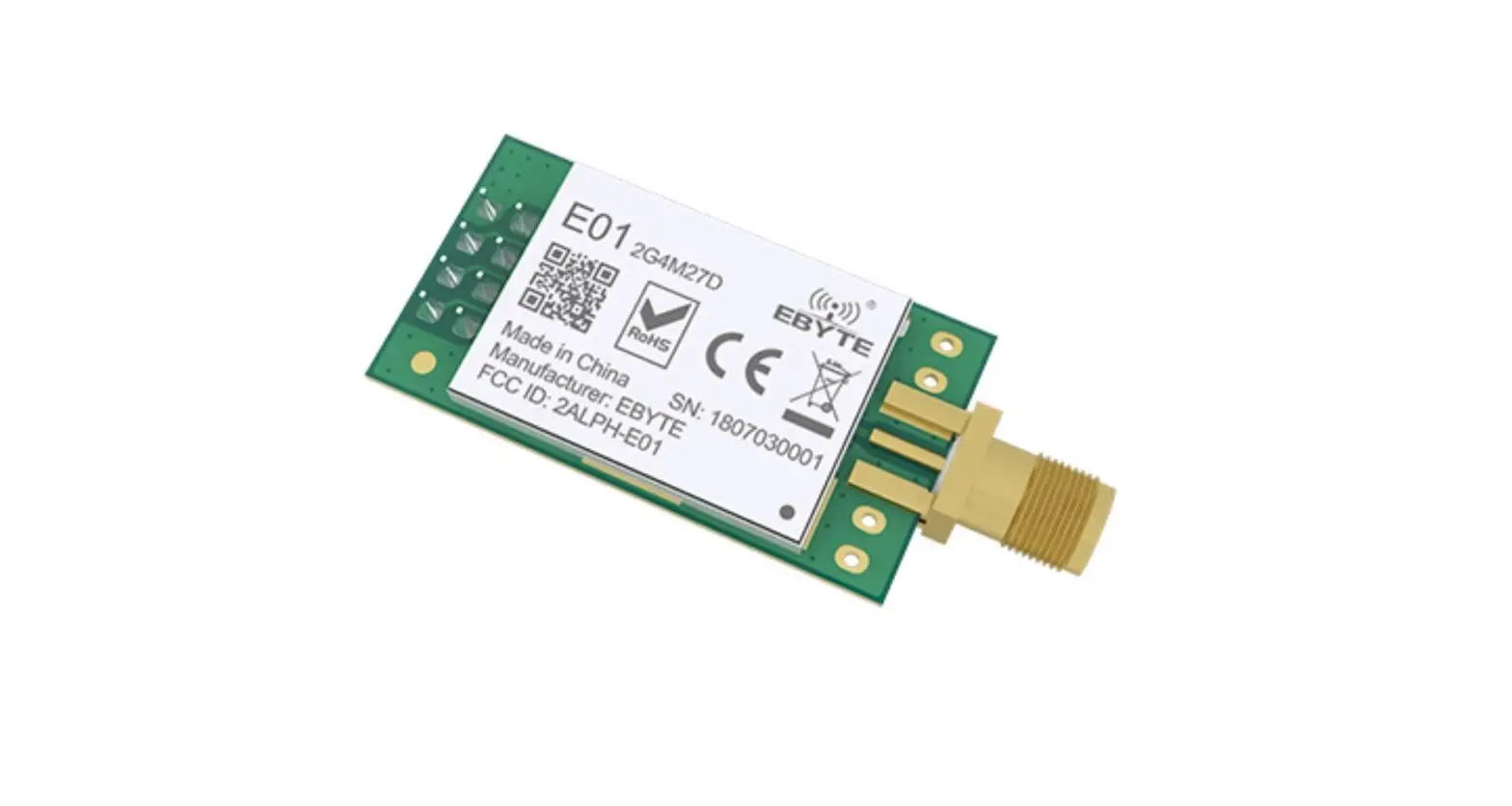
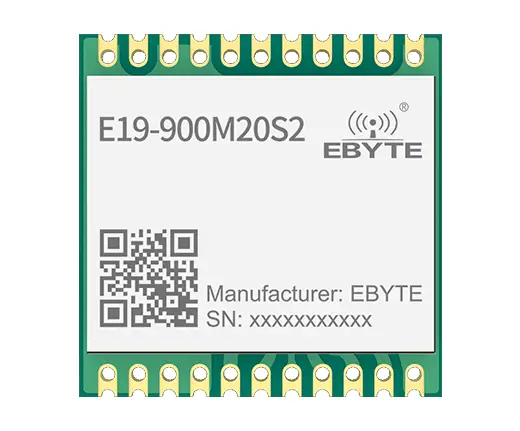
E19-900M20S2 is an ultra-small 915MHz SMD LoRaTM wireless module independently developed based on the SX1276 produced by Semtech in the United States. It uses an industrial grade high-precision 32MHz crystal oscillator.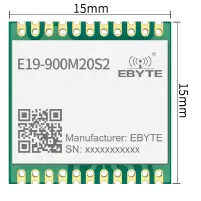
Because the original imported SX1276 is the core of the module, its stability has won unanimous praise from users, and there is no need to worry about compatibility. Because of its advanced LoRaTM modulation technology its anti-jamming performance and communication distance are far beyond the current FSK and GFSK modulation products. This module is mainly aimed at smart home, wireless meter reading, scientific research and medical treatment, and medium and long-distance wireless communication equipment. Radio frequency performance and component selection are in accordance with industrial standards.
Since this module is a pure radio frequency transceiver module, it needs to be driven by MCU or a dedicated SPI debugging tool.
Features
- Ultra-small size, only 15*15mm;
- Under ideal conditions, the communication distance can reach 5km;
- The maximum transmission power is 100mW, and the software is multi-level adjustable;
- Support the global license-free ISM 868/915MHz frequency band;
- Support the data transmission rate of 0.018kbps~5kbps in LoRaTM mode;
- Support data transmission rate up to 300kbps in FSK mode;
- Support multiple modulation modes LoRaTM/FSK/GFSK/MSK/GMSK/OOK;
- Large FIFO capacity, support 256Byte data buffer;
- Support 2.3V~3.6V power supply, power supply greater than 3.3V can guarantee the best performance;
- Industrial standard design, supporting long-term use at -40~+85℃;
- The stamp hole is convenient for users to develop and integrate.
Applications
- Smart home and industrial sensors, etc;
- Security system, positioning system;
- Wireless remote control, UAV;
- Wireless game remote control;
- Healthcare products;
- Wireless voice, wireless headset;
- Automotive industry applications.
Specification and parameter
Limit parameter
| The main parameters | Value | Remark | |
| Min. | Max. | ||
| Power supply voltage (V) | 0 | 3.6 | Over 3.6V will permanently burn the module |
| Blocking power (dBm) | – | 10 | It is less likely to burn when used at close range |
| Working temperature (℃) | -40 | +85 | Industrial grade |
Operating Parameter
| The main parameters | Value | Remark | ||||
| Min. | Typical | Max. | ||||
| Working voltage (V) | 2.3 | 3.3 | 3.6 | ≥3.3V can guarantee output power | ||
| Communication level (V) | – | 3.3 | – | Using 5V TTL is risky to burn | ||
| Working temperature (℃) | -40 | – | +85 | Industrial design | ||
| Working frequency (MHz) | 862 | 915 | 931 | Support ISM frequency band | ||
|
Power Consumptio n |
Emission current (mA) |
– |
135 | Instantaneo us power consumptio n |
Instantaneous power consumption | |
| Receiving current (mA) | – | 12.6 | – | – | ||
| Sleep current (μA) | – | 2.0 | – | Software shutdown | ||
| Max TX power(dBm) | 18.5 | 19 | 20 | – | ||
| Receiving sensitivity(dBm) | -145 | -147 | -148 | The sensitivity test condition is airspeed 0.3kbps, Coding rate 4/5, spreading factor 12 | ||
| Air data rate (bps) | LoRa(bps) | 0.018 | – | 37.5 | User programmable customization | |
| GFSK(bps) | 1.2 | – | 300 | User programmable customization | ||
| The main parameters | Value | Remark |
| Reference distance | 5000m | Clear and open, antenna gain 5dBi, antenna height 2.5 meters, air rate 1kbps |
| FIFO | 256Byte | Maximum length of single transmission |
| Crystal frequency | 32MHz | – |
| Modulation | LoRa (recommended) | FSK, GFSK, MSK, GMSK, LoRa TM, OOKTM |
| Packaging method | SMD | – |
| Interface method | 1.27mm | – |
| Communication Interface | SPI | 0~10Mbps |
| Dimensions | 15*15mm | – |
| Antenna interface | Stamp hole | Equivalent impedance is about 50Ω |
Size and pin definition
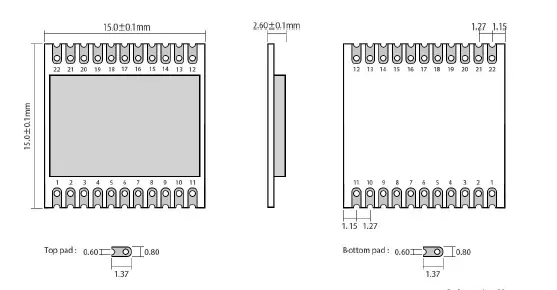
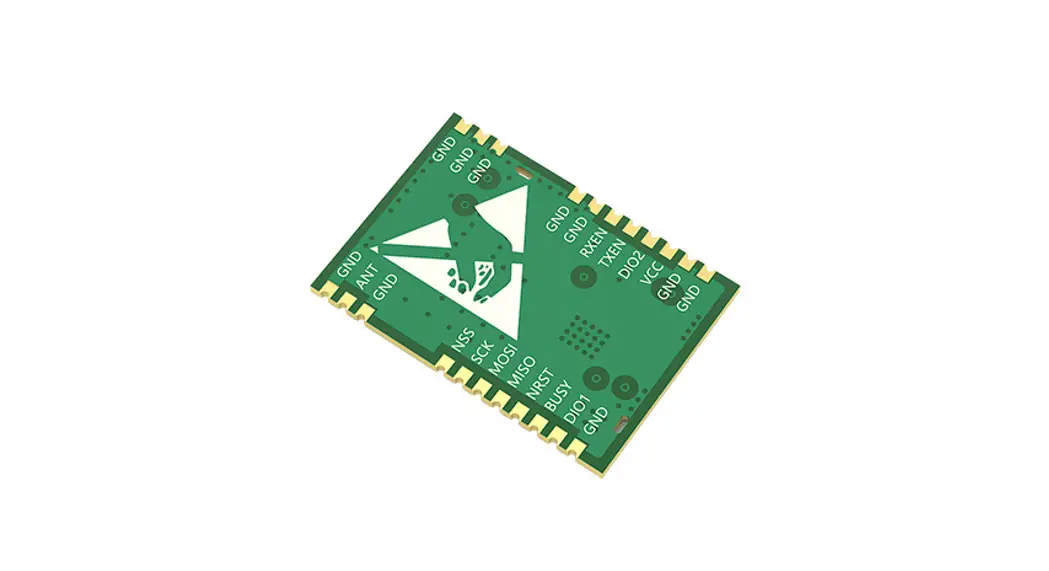
| Pin No. | Item | Direction | Description |
| 1 | GND | – | Ground wire, connected to the power reference ground |
| 2 | GND | – | Ground wire, connected to the power reference ground |
| 3 | GND | – | Ground wire, connected to the power reference ground |
| 4 | GND | – | Ground wire, connected to the power reference ground |
| 5 | DIO0 | Input/Output | Configurable general IO port (see SX1276 manual for details) |
| 6 | DIO1 | Input/Output | Configurable general IO port (see SX1276 manual for details) |
| 7 | DIO2 | Input/Output | Configurable general IO port (see SX1276 manual for details) |
| 8 | DIO3 | Input/Output | Configurable general IO port (see SX1276 manual for details) |
| 9 | NC | – | Internal use of the module (this pin cannot be connected to any electrical network in the circuit design) |
| 10 | DIO5 | Input/Output | Configurable general IO port (see SX1276 manual for details) |
| 11 | GND | – | Ground wire, connected to the power reference ground |
| 12 | GND | – | Ground wire, connected to the power reference ground |
| 13 | VCC | – | Power supply, range 2.3~3.6V (recommended 3.3V, recommended to add ceramic filter capacitor) |
| 14 | SCK | Input | SPI clock input pin |
| 15 | MISO | Output | SPI data output pin |
| 16 | MOSI | Input | SPI data input pin |
| 17 | NSS | Input | Module chip select pin, used to start a SPI communication, active low |
| 18 | RST | Input | Chip reset trigger input pin, active low |
| 19 | GND | – | Ground wire, connected to the power reference ground |
| 20 | GND | – | Ground wire, connected to the power reference ground |
| 21 | ANT | – | antenna |
| 22 | GND | – | Ground wire, connected to the power reference ground |
Basic operation
Hardware Design
- It is recommended to use a DC stabilized power supply to supply power to the The power ripple coefficient should be as small as possible, and the module must be reliably grounded;
- Please pay attention to the correct connection of the positive and negative poles of the power Reverse connection may cause permanent damage to the module;
- Please check the power supply to ensure that it is within the recommended power supply voltage. If it exceeds the maximum value, it will cause permanent damage to the module;
- Please check the stability of the power supply, the voltage should not fluctuate greatly and frequently;
- When designing the power supply circuit for the module, it is often recommended to reserve more than 30% of the margin, and the whole machine is conducive to long-term stable operation;
- The module should be as far away as possible from power supply, transformer, high frequency wiring and other parts with large electromagnetic interference;
- High-frequency digital wiring, high-frequency analog wiring, and power wiring must avoid the bottom of the module. If it is necessary to pass under the module, assume that the module is soldered to the Top Layer, and the top layer of the contact part of the module is covered with copper (all copper And well grounded), it must be close to the digital part of the module and routed in the Bottom Layer;
- Assuming that the module is soldered or placed on the Top Layer, it is also wrong to randomly route the wires on the Bottom Layer or other layers, which will affect the stray and receiving sensitivity of the module to varying degrees;
- Assuming that there are components with large electromagnetic interference around the module, it will greatly affect the performance of the According to the intensity of the interference, it is recommended to stay away from the module. If the situation permits, proper isolation and shielding can be done;
- Assuming that there are large electromagnetic interference traces (high-frequency digital, high-frequency analog, power traces) around the module, it will greatly affect the performance of the According to the intensity of the interference, it is recommended to stay away from the module. Isolation and shielding;
- If the communication line uses 5V level, a 1k-5.1k resistor must be connected in series (not recommended, there is still a risk of damage);
- Try to stay away from part of the physical layer that is also 2.4GHz TTL protocol, such as 0;
- The antenna installation structure has a great impact on the performance of the module. Make sure that the antenna is exposed, preferably vertically upward. When the module is installed inside the case, a high-quality antenna extension cable can be used to extend the antenna to the outside of the case;
- The antenna must not be installed inside the metal shell, which will greatly reduce the transmission distance.
Programming
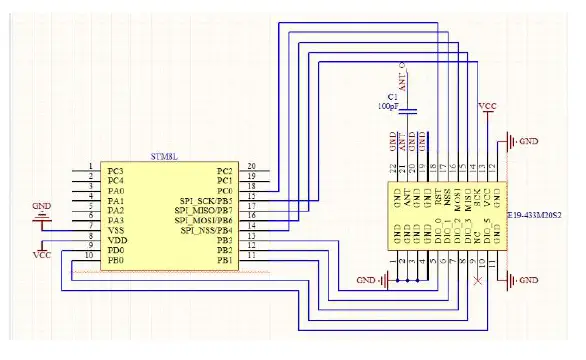
- DIO0, DIO1, DIO2, DIO3, and DIO5 are general-purpose I/O ports, which can be configured into multiple functions. Refer to the SX1276 manual for
- When the module is sending, the DIO4 pin of SX1276 is set low, when the module is receiving, the DIO4 pin of SX1276 is set high, which requires the customer to write software to control
- The SPI communication rate should not be set too high, usually 1Mbps is recommended;
- The register configuration can be reinitialized when the chip is idle for higher stability
Programme Diagram
Connection for Programming
FAQ
Communication range is too short
- The communication distance will be affected when obstacle exists;
- Data lose rate will be affected by temperature, humidity and co-channel interference;
- The ground will absorb and reflect wireless radio wave, so the performance will be poor when testing near ground;
- Sea water has great ability in absorbing wireless radio wave, so performance will be poor when testing near the sea;
- The signal will be affected when the antenna is near metal object or put in a metal case;
- Power register was set incorrectly, air data rate is set as too high (the higher the air data rate, the shorter the distance);
- The power supply low voltage under room temperature is lower than 5V, the lower the voltage, the lower the transmitting power;
- Due to antenna quality or poor matching between antenna and module.
Module is easy to damage
- Please check the power supply source, ensure it is 0V~3.6V, voltage higher than 3.6V will damage the module;
- Please check the stability of power source, the voltage cannot fluctuate too much;
- Please make sure antistatic measure are taken when installing and using, high frequency devices have electrostatic susceptibility;
- Please ensure the humidity is within limited range, some parts are sensitive to humidity;
- Please avoid using modules under too high or too low temperature.
BER(Bit Error Rate) is high
- There are co-channel signal interference nearby, please be away from interference sources or modify frequency and channel to avoid interference;
- Poor power supply may cause messy code. Make sure that the power supply is reliable;
- The extension line and feeder quality are poor or too long, so the bit error rate is high.
Soldering Guide
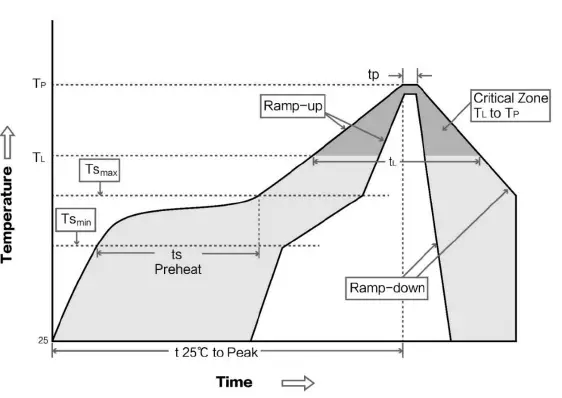
Reflow Soldering Temperature
| Profile Feature | Curve characteristics | Sn-Pb Assembly | Pb-Free Assembly |
| Solder Paste | Solder paste | Sn63/Pb37 | Sn96.5/Ag3/Cu0.5 |
| Preheat Temperature min (Tsmin) | Min preheating temp. | 100℃ | 150℃ |
| Preheat temperature max (Tsmax) | Mx preheating temp. | 150℃ | 200℃ |
| Preheat Time (Tsmin to Tsmax)(ts) | Preheating time | 60-120 sec | 60-120 sec |
| Average ramp-up rate(Tsmax to Tp) | Average ramp-up rate | 3℃/second max | 3℃/second max |
| Liquidous Temperature (TL) | Liquid phase temp. | 183℃ | 217℃ |
| Time(tL)Maintained Above(TL) | Time below liquid phase line | 60-90 sec | 30-90 sec |
| Peak temperature(Tp) | Peak temp. | 220-235℃ | 230-250℃ |
| Aveage ramp-down rate(Tp to Tsmax) | Aveage ramp-down rate | 6℃/second max | 6℃/second max |
| Time 25℃ to peak temperature | Time to peak temperature for 25℃ | 6 minutes max | 8 minutes max |
Reflow Soldering Curve
E19 Series Modules
| Model No. | IC | Frequency | Tx power | Distance | Package | Pin Type |
| Hz | dBm | km | ||||
| E19-433M20S2 | SX1278 | 433M | 20 | 5 | SMD | Stamp hole |
| E19-433M20SC | SX1278 | 433M | 20 | 5 | SMD | Stamp hole |
| E19-868M20S | SX1276 | 868M | 20 | 5 | SMD | Stamp hole |
| E19-915M20S | SX1276 | 915M | 20 | 5 | SMD | Stamp hole |
| E19-433M30S | SX1278 | 433M | 30 | 10 | SMD | Stamp hole |
| E19-868M30S | SX1276 | 868M | 30 | 10 | SMD | Stamp hole/IPEX |
| E19-915M30S | SX1276 | 915M | 30 | 10 | SMD | Stamp hole/IPEX |
Antenna Recommendation
Recommendation
Antenna plays an important role in wireless communication. Often inferior antennas will have a great impact on the communication system. Therefore, our company recommends some antennas as supporting our company’s wireless modules with excellent performance and reasonable prices.
| Model No. | Type | Frequeny Hz | Interface | Gain dBi | Length mm | Cable mm | Function Feature |
| TX868-JZ-5 | Plastic Rubber | 868M | SMA-J | 2.0 | 52 | – | Ultra-short straight, omnidirectional antenna |
| TX868-JK-20 | Plastic Rubber | 868M | SMA-J | 3.0 | 210 | – | Bendable glue stick, omnidirectional antenna |
| TX868-XPL-100 | Magnet Base | 868M | SMA-J | 3.5 | 290 | 100 | Small Magnet Base, high cost performance |
| TX915-JZ-5 | Plastic Rubber | 915M | SMA-J | 2.0 | 52 | – | Ultra-short straight, omnidirectional antenna |
| TX915-JK-11 | Plastic Rubber | 915M | SMA-J | 2.5 | 110 | – | Bendable glue stick, omnidirectional antenna |
| TX915-JK-20 | Plastic Rubber | 915M | SMA-J | 3.0 | 210 | – | Bendable glue stick, omnidirectional antenna |
| TX915-XPL-100 | Magnet Base | 915M | SMA-J | 3.5 | 290 | 100 | Small Magnet Base, high cost performance |
Revision history
| Version | Date | Description | Issued by |
| 1.0 | 2020-11-30 | Initial version | Linson |