EBYTE E73-2G4M04SID SMD Wireless Module User Manual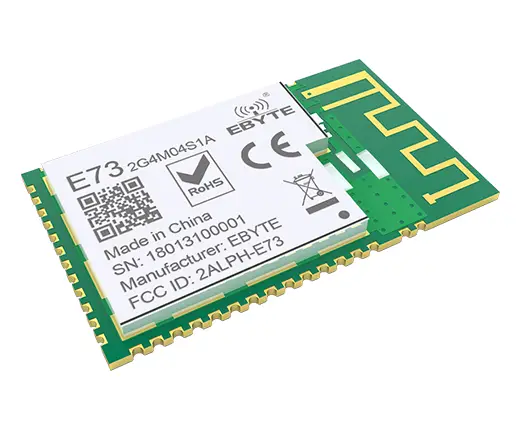
Overview
Introduction
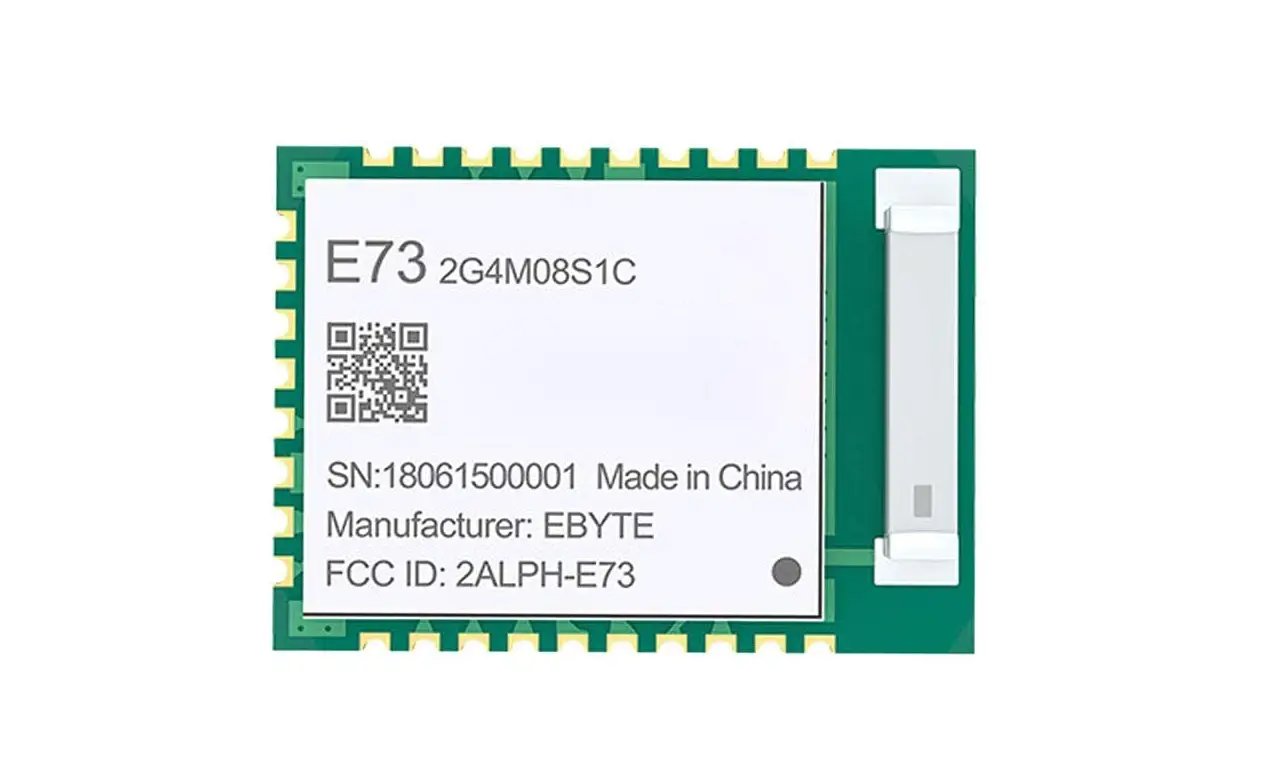
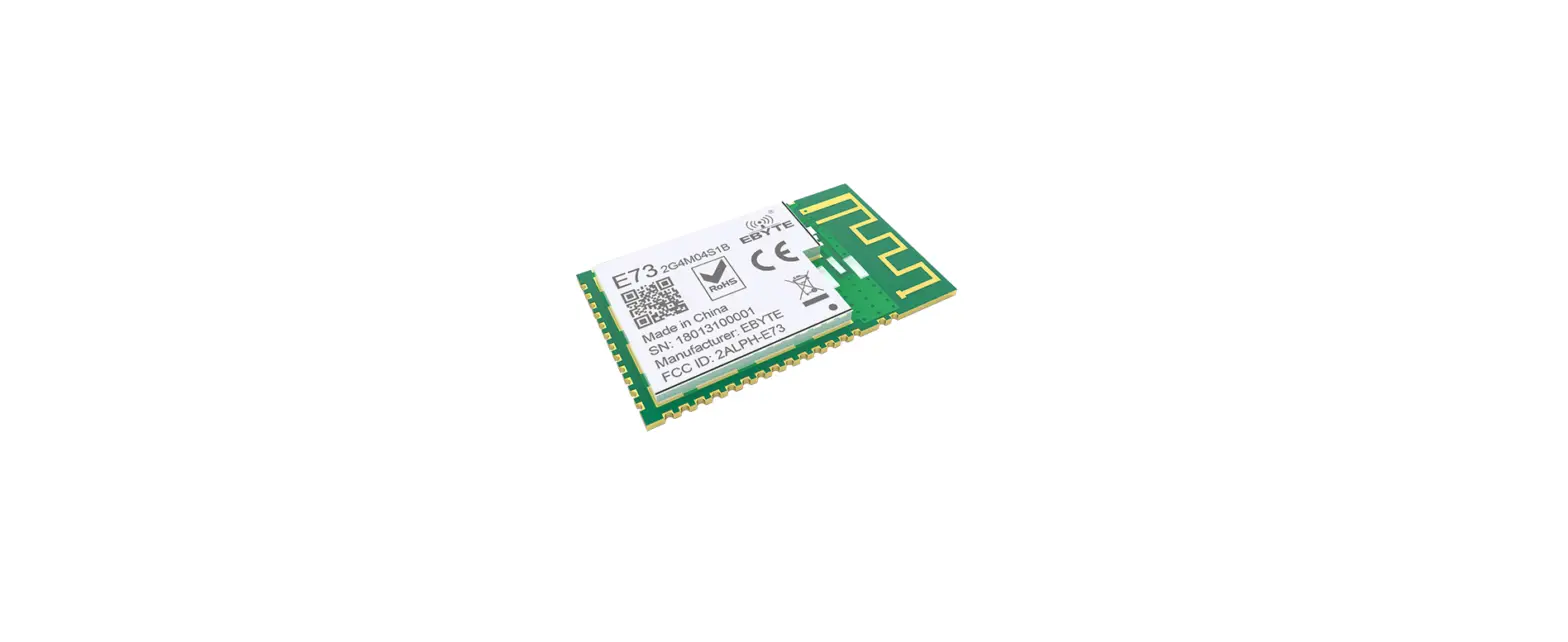
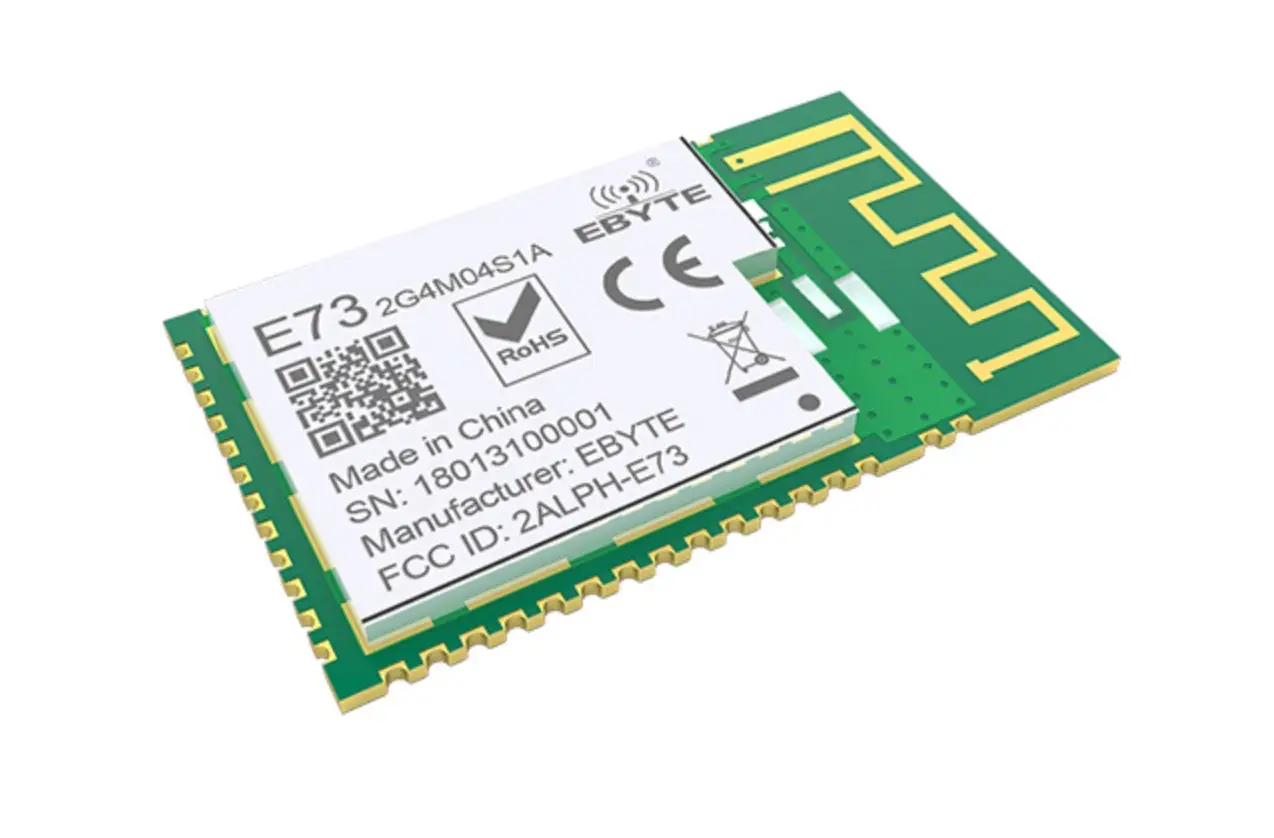
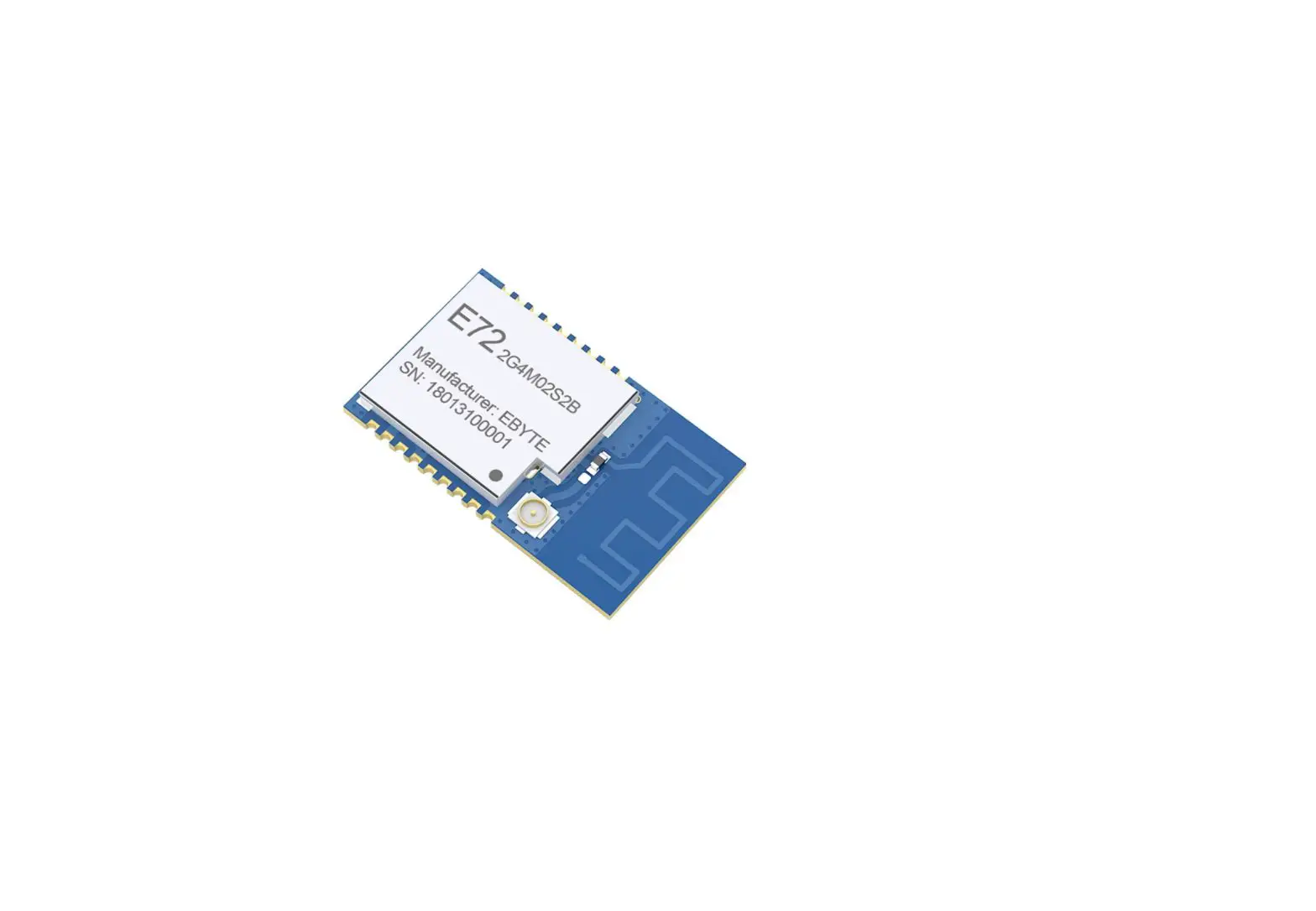
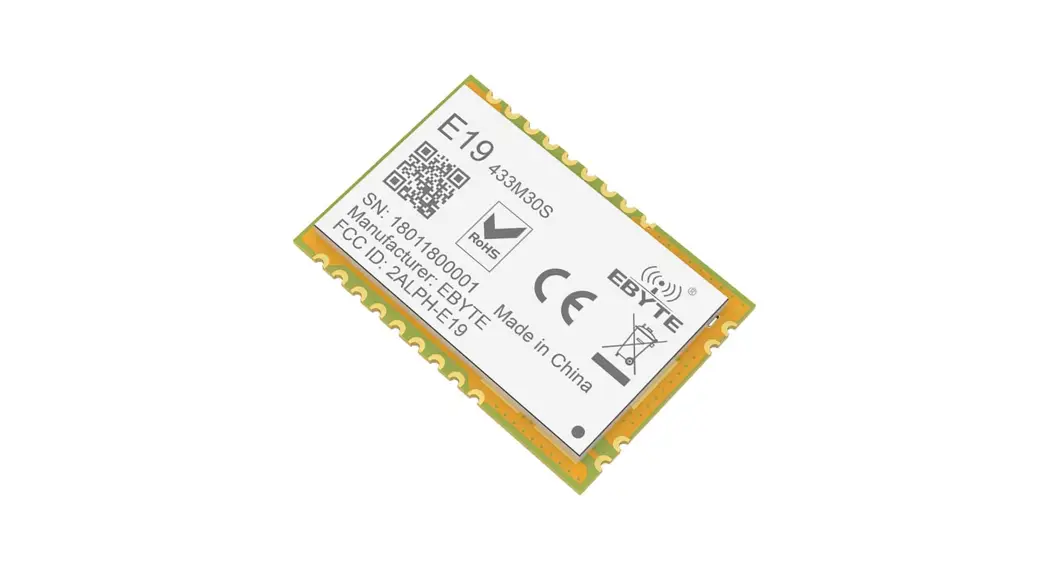
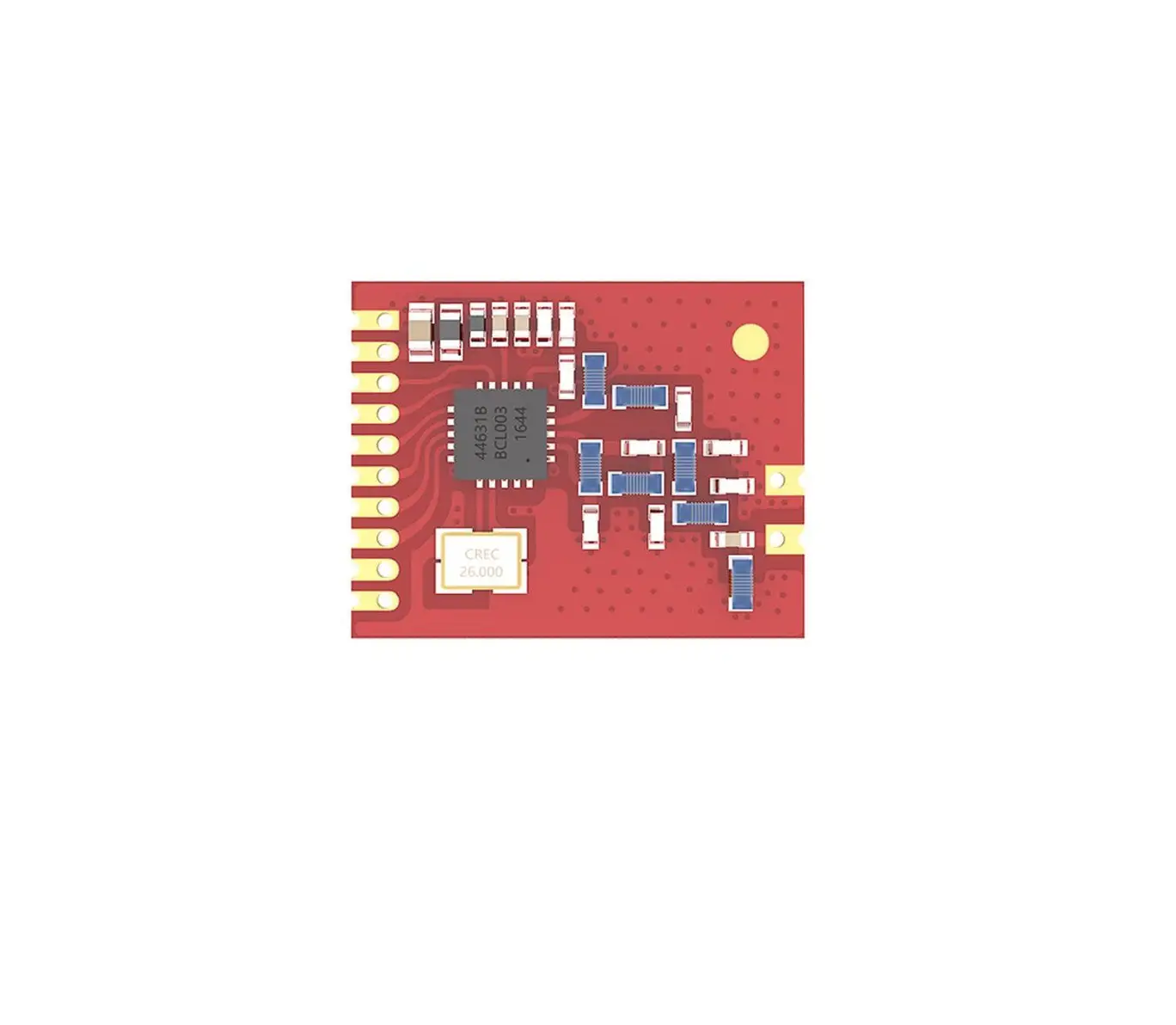
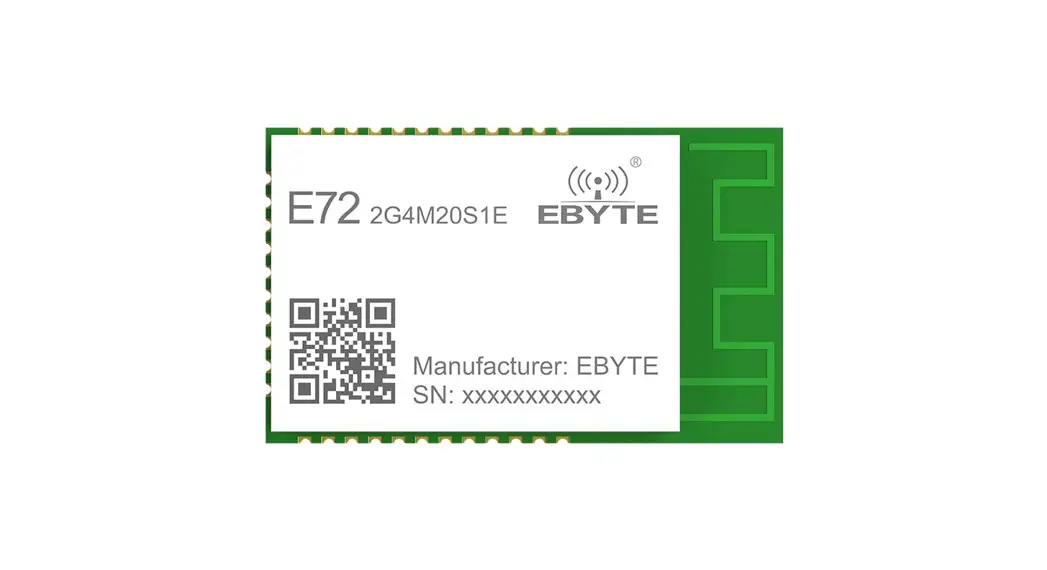
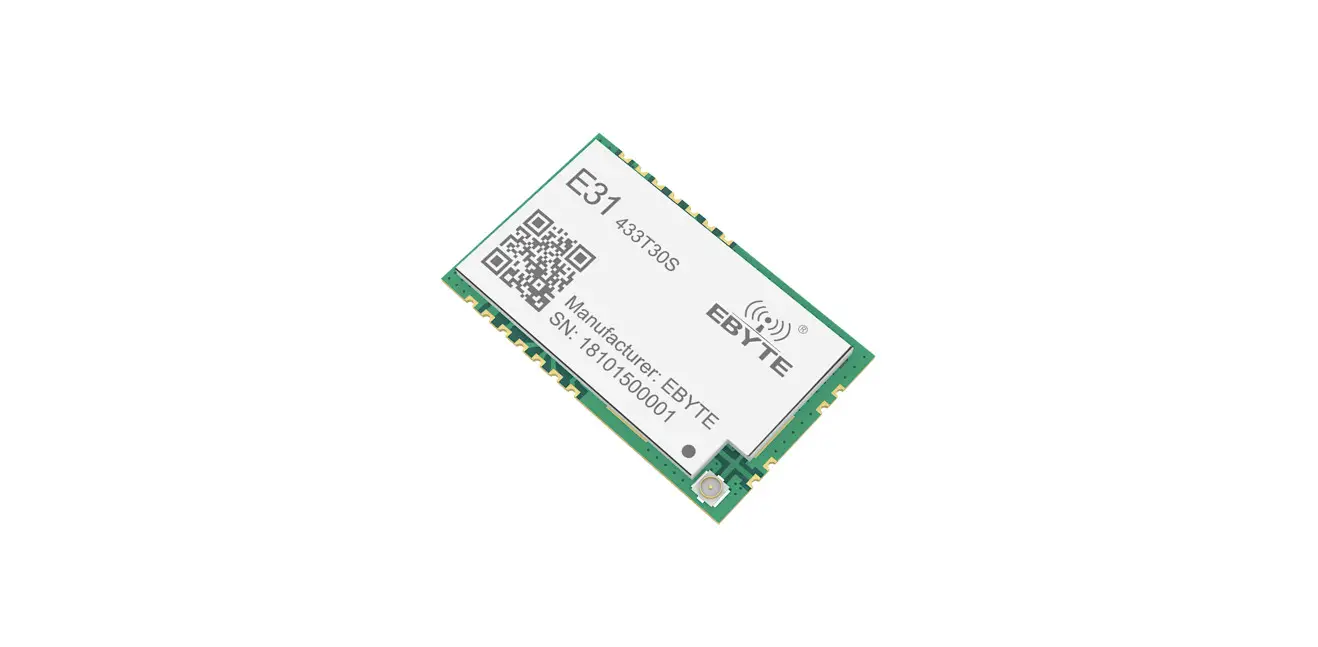
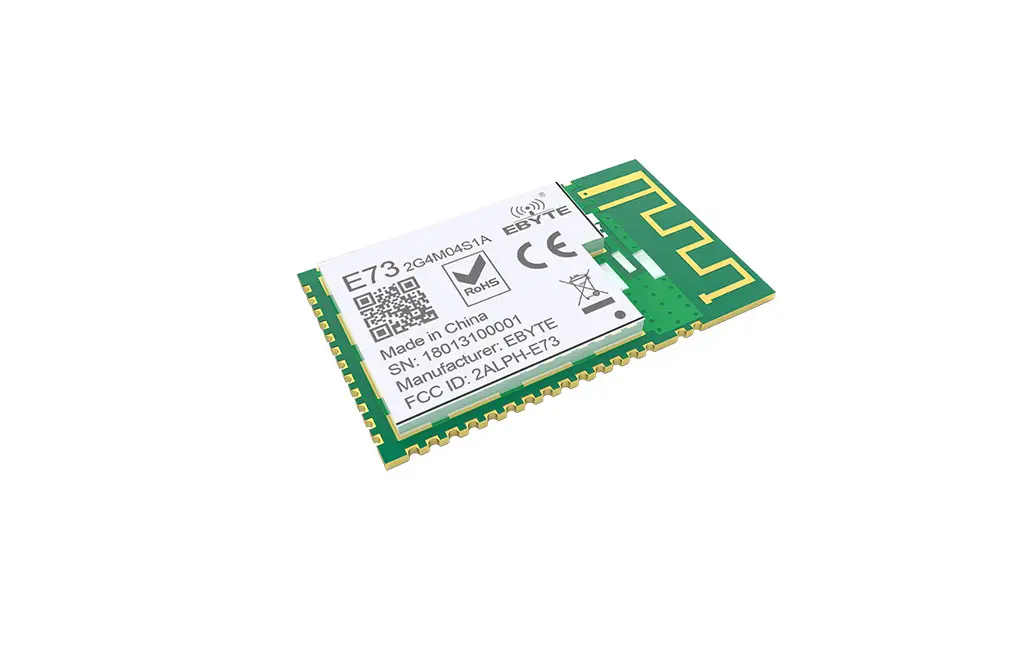
E73-2G4M04S1D is a SMD bluetooth wireless module based on NORDIC’s nRF51822 RF chip. NRF51822 has high-performance ARM CORTEX-M0 core and Bluetooth 4.2 RF transceiver and protocol stack, and has abundant peripheral resources such as UART, I2C, SPI, ADC, DMA, PWM, etc. The module brings out almost all IO ports, which is convenient for users to conduct multi-faceted development, Please see pin definitions for details. The module has built-in PCB antenna and can connect other antennas through IPEX. The product has obtained FCC, CE, RoHS and other international authoritative certification reports, users do not need to worry about its performance. We use a 32MHzhighprecision low temperature drift active crystal to ensure its industrial properties and stability.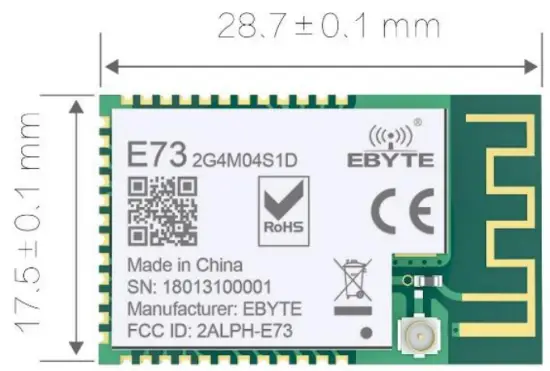
Because this module is a pure hardware SoC module, users need to program it before they can use it.
Features
- Communication distance tested is up to 100m;
- Maximum transmission power of 2.5mW, software multi-level adjustable;
- Support bluetooth 4.2 and bluetooth 5.0;
- Built-in 32.768 kHz clock crystal oscillator;
- Support for the global license-free ISM 2.4GHz band;
- Rich resources, 256KB FLASH, 16KB RAM;
- Support 2.0V~3.6V power supply, more than 3.3V power supply can guarantee the best performance;
- Industrial grade standard design, support -40 ~ 85 °C for a long time;
- Support onboard PCB antenna and IPEX interface, users can choose according to their needs;
Application
- Smart home and industrial sensors;
- Security system and positioning system;
- Wireless remote control, UAV;
- Wireless Game Remote Controller;
- Health care products;
- Wireless voice, wireless headset;
- Automotive industry applications.
Specification and parameter
Limit parameter
| Main parameter | Performance | Remark | |
| Min. | Max. | ||
| Power supply(V) | 0 | 3.6 | Voltage over 3.6V will cause permanent damage to module |
| Blocking power(dBm) | – | 10 | Chances of burn is slim when modules are used in short distance |
| Operating temperature(℃) | -40 | 85 | / |
Operating parameter
| Main parameter | Performance | Remark | |||
| Min. | Typ. | Max. | |||
| Operating voltage (V) | 1.8 | 3.3 | 3.6 | ≥3.3 V ensures output power | |
| Communication level (V) | 3.0 | For 5V TTL, it may be at risk of burning down | |||
| Operating temperature(℃) | -40 | – | 85 | Industrial design | |
| Operating frequency (MHz) | 2379 | 2430 | 2496 | Support ISM band | |
| Power consumption | TX current (mA) | 14 | Instant power consumption | ||
| RX current (mA) | 12 | ||||
| Sleep current (μA) | 1 | Software is shut down | |||
| Max Tx power (dBm) | 3.8 | 4 | 4.3 | ||
| Receiving sensitivity (dBm) | -95.4 | -96.0 | -96.8 | Air data rate is 1Mbps | |
| Main parameter | Description | Remark |
| Distance for reference | 100m | Test condition:clear and open area, antenna gain: 5dBi, antenna height: 2.5m,air data rate: 1Mbps |
| Crystal frequency | 16MHz / 32.768KHz | |
| Support protocal | BLE 4.2/5.0 | |
| Package | SMD | |
| Connector | 1.27mm | |
| IC | nRF51822-QFAA/QFN48 | |
| FLASH | 256KB | |
| RAM | 16KB | |
| kernel | ARM CORTEX-M0 | |
| Size | 17.5 * 28.7 mm | |
| Antenna | Onboard PCB / IPEX | Equivalent impedance is about 50 ohms |
Size and pin definition
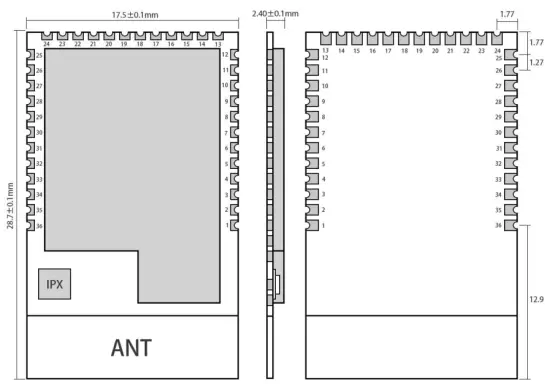
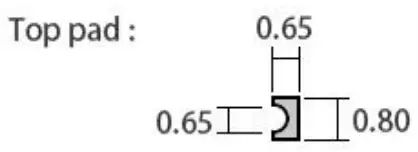
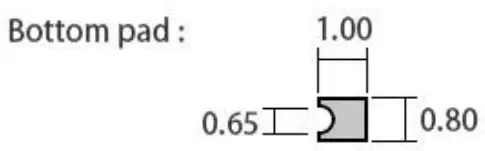
Pad quantity: 36
Unit: mm
| No. | Pin item | Pin direction | Application |
| 1 | P0.21 | Input/Output | MCU GPIO |
| 2 | P0.22 | Input/Output | MCU GPIO |
| 3 | P0.23 | Input/Output | MCU GPIO |
| 4 | P0.24 | Input/Output | MCU GPIO |
| 5 | P0.25 | Input/Output | MCU GPIO |
| 6 | P0.28 | Input/Output | MCU GPIO |
| 7 | P0.29 | Input/Output | MCU GPIO |
| 8 | P0.30 | Input/Output | MCU GPIO |
| 9 | P0.00 | Input/Output | MCU GPIO |
| 10 | P0.01 | Input/Output | MCU GPIO |
| 11 | VCC | Power supply 2.1 ~ 3.6V DC(Note: The voltage higher 3.6V is forbidden) | |
| 12 | GND | Ground electrode, connect to power reference ground | |
| 13 | GND | Ground electrode, connect to power reference ground | |
| 14 | P0.02 | 0.9 V Digital power supply decoupling controller | |
| 15 | P0.03 | Input/Output | MCU GPIO |
| 16 | P0.04 | Input/Output | MCU GPIO |
| 17 | P0.05 | Input/Output | MCU GPIO |
| 18 | P0.06 | Input/Output | MCU GPIO |
| 19 | P0.07 | Input/Output | MCU GPIO |
| 20 | P0.08 | Input/Output | MCU GPIO |
| 21 | P0.09 | Input/Output | MCU GPIO |
| 22 | P0.10 | Input/Output | MCU GPIO |
| 23 | P0.11 | Input/Output | MCU GPIO |
| 24 | GND | Input/Output | MCU GPIO |
| 25 | GND | Input/Output | MCU GPIO |
| 26 | P0.12 | Input/Output | MCU GPIO |
| 27 | P0.13 | Input/Output | MCU GPIO |
| 28 | P0.14 | Input/Output | MCU GPIO |
| 29 | P0.15 | Input/Output | MCU GPIO |
| 30 | P0.16 | Input/Output | MCU GPIO |
| 31 | SWDIO/ nRESET | Input | Serial line debugging and programming debugging / MCU reset, low level enable |
| 32 | SWDCLK | Input | Serial Line Debugging / Clock Input Debugging and Programming |
| 33 | P0.17 | Input/Output | MCU GPIO |
| 34 | P0.18 | Input/Output | MCU GPIO |
| 35 | P0.19 | Input/Output | MCU GPIO |
| 36 | P0.20 | Input/Output | MCU GPIO |
| ★ For more details, please refer to《nRF51822Datasheet》in NORDIC ★ | |||
Basic Operation
Hardware Design
- It is recommended to use DC stabilized power supply to supply power to the module. The power supply ripple coefficient is as small as possible, and the module needs to be reliably grounded.
- Please pay attention to the correct connection of the positive and negative poles of the power supply. If the reverse connection is connected, the module may be permanently damaged.
- Please check the power supply to ensure that between the recommended supply voltage, if exceeding the maximum, the module will be permanently damaged.
- Please check the stability of the power supply, the voltage can not be significantly frequent.
- When designing the power supply circuit for the module, it is often recommended to reserve more than 30%of the margin, and the whole machine is beneficial for long-term stable operation.
- The module should be as far away as possible from the power supply, transformers, high-frequency wiring and other parts with large electromagnetic interference.
- High-frequency digital traces, high-frequency analog traces, and power traces must be avoided under the module. If it is necessary to pass through the module, assume that the module is soldered to the Top Layer, and the copper is spread on the Top Layer of the module contact part(All copper-covered and well grounded), and must be close to the digital part of the module and routed in the Bottom Layer.
- Assuming the module is soldered or placed in the Top Layer, it is also wrong to randomly route the Bottom Layer or other layers, which will affect the module’s spurs and receiving sensitivity to varying degrees.
- Assume that there are traces with large electromagnetic interference around the module (high-frequency digital, high-frequency analog, power trace), which will greatly affect the performance of the module. It is recommended to stay away from the module according to the strength of the interference. If possible, you can do it properly. Isolation and shielding
- If the communication line uses a 5V level, a 1k-5.1k resistor must be connected in series (not recommended, there is still a risk of damage).
- Try to stay away from some physical layers and also have a 2.4GHz TTL protocol, for example: USB3.0
- The antenna mounting structure has a great influence on the performance of the module. It is necessary to ensure that the antenna is exposed, preferably vertically upward. When the module is mounted inside the case, use a good antenna extension cable to extend the antenna to the outside of the case.
- The antenna must not be installed inside the metal case, which will greatly reduce the transmission distance.
Software Programming
- The core of this module is nRF52832, which is completely equivalent to nRF52832. Users can operate according to the nRF52832 chip manual (see nRF52832 manual for details).
- Because the officially provided programming tool nRFgo Studio has poor compatibility, it is recommendedtouseJ-LINK-V8 or above for program burning.
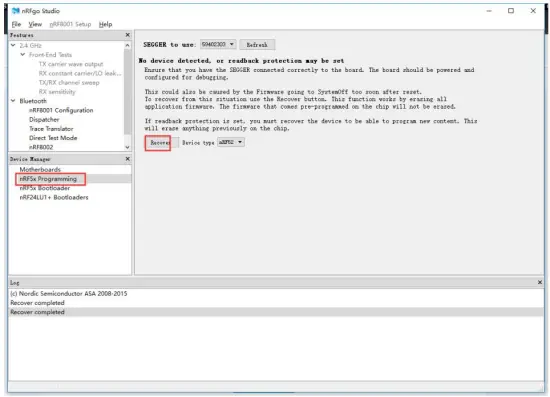
- About the issue that the old model can be programmed, while the new model can’t be programmed, It is because the new model being added with read/write protection during production. It needs to be properly connected to the line and then use the official nRFgo Studio for Recover (Jlink supports the official nRFgo). Studio), as shown below:

FAQ
Communication range is too short
- The communication distance will be affected when obstacle exists.
- Data lose rate will be affected by temperature, humidity and co-channel interference.
- The ground will absorb and reflect wireless radio wave, so the performance will be poor when testing near ground.
- Sea water has great ability in absorbing wireless radio wave, so performance will be poor when testing near the sea.
- The signal will be affected when the antenna is near metal object or put in a metal case.
- Power register was set incorrectly, air data rate is set as too high (the higher the air data rate, the shorter the distance).
- When the power supply at room temperature is lower than the recommended low voltage, the lower the voltage is, the lower the transmitting power is.
- Due to antenna quality or poor matching between antenna and module.
Module is easy to damage
- Please check the power supply and ensure it is within the recommended range. Voltage higher than the peak will lead to a permanent damage to the module.
- Please check the stability of power supply and ensure the voltage not to fluctuate too much.
- Please make sure anti-static measures are taken when installing and using, high frequency devices have electrostatics usceptibility.
- Please ensure the humidity is within limited range for some parts are sensitive to humidity.
- Please avoid using modules under too high or too low temperature
High bit error rate
- There are co-channel signal interference nearby, keep away from interference sources or modify frequency, channel to avoid interference.
- Unsatisfactory power supply may also cause garbled characters, and ensure the reliability of the power supply.
- If the extension cable or feeder is of poor quality or too long, the bit error rate will be high
Welding operation guidance
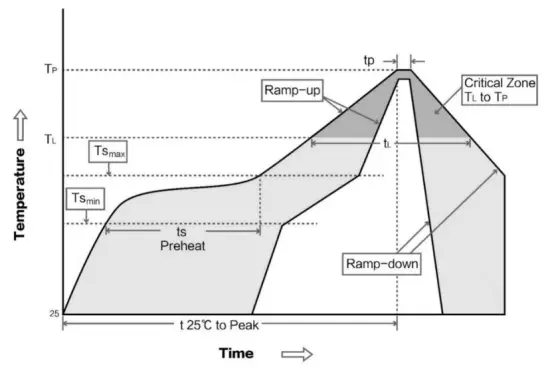
Reflow Soldering Temperature
| Profile Feature | Curve feature | Sn-Pb Assembly | Pb-Free Assembly |
| Solder Paste | Solder paste | Sn63/Pb37 | Sn96.5/Ag3/Cu0.5 |
| Preheat Temperature min (Tsmin) | Minimum preheating temperature | 100℃ | 150℃ |
| Preheat temperature max (Tsmax) | Maximum preheating temperature | 150℃ | 200℃ |
| Preheat Time (Tsmin to Tsmax)(ts) | Preheating time | 60-120 sec | 60-120 sec |
| Average ramp-up rate(Tsmax to Tp) | Average rising rate | 3℃/second max | 3℃/second max |
| Liquidous Temperature (TL) | Liquid phase temperature | 183℃ | 217℃ |
| Time(tL)Maintained Above(TL) | Time above liquid us | 60-90 sec | 30-90 sec |
| Peak temperature(Tp) | Peak temperature | 220-235℃ | 230-250℃ |
| Aveage ramp-down rate(Tp to Tsmax) | Average descent rate | 6℃/second max | 6℃/second max |
| Time 25℃ to peak temperature | Time of 25 ° C to peak temperature | 6 minutes max | 8 minutes max |
Reflow Soldering Curve
| Model | Chip | Frequency Hz | Transmit power dBm | Test distance km | Air Data rate | Packaging | Size mm | Antenna Type |
| E73-2G4M08S1C | nRF52840 | 2.4G | 8 | 0.1 | BLE 4.2/5.0 | SMD | 13.0 * 18.0 | PCB/IPX |
| E73-2G4M04S1A | nRF52810 | 2.4G | 4 | 0.1 | BLE 4.2 | PCB/IPEX | 17.5 * 28.7 | PCB/IPX |
| E73-2G4M04S1D | nRF51822 | 2.4G | 4 | 0.1 | BLE 4.2 | PCB/IPX | 17.5 * 28.7 | PCB/IPX |
| E73-2G4M04S1B | nRF52832 | 2.4G | 4 | 0.1 | BLE 4.2/5.0 | PCB/IPX | 17.5 * 28.7 | PCB/IPX |
Antenna Type
Antenna recommendation
The antenna plays an important role in the communication process. The inferior antenna often has a great impact on the communication system. Therefore, we recommend some antennas that support our wireless modules and have excel lent performance and reasonable price.
| Product | Type | Frequency Hz | Interfac e | Gain dBi | Size | Feeder | Features |
| TX2400-NP-5010 | Flexible antenna | 2.4G | IPEX | 2 | 50*10mm | – | Built-in flexible FPC soft antenna |
| TX2400-XP-150 | Sucker antenna | 2.4G | SMA-J | 3.5 | 15cm | 150cm | High Gain |
| TX2400-JK-20 | Rubber antenna | 2.4G | SMA-J | 3 | 200mm | – | Flexible, Omnidirectional |
| TX2400-JK-11 | Rubber antenna | 2.4G | SMA-J | 2.5 | 110mm | – | Flexible, Omnidirectional |
| TX2400-JZ-3 | Rubber antenna | 2.4G | SMA-J | 2 | 30mm | – | Ultra short straight,Omni directional |
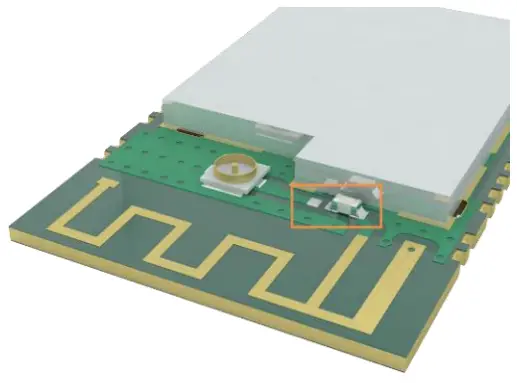
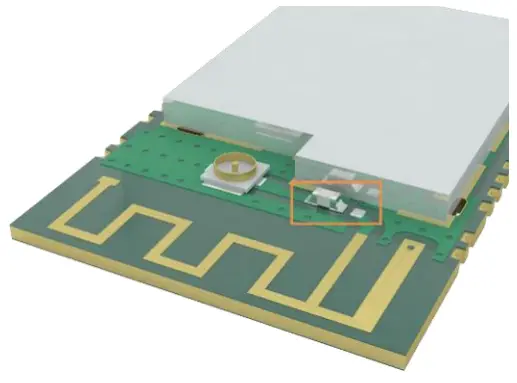
Antenna Choice
- Type: onboard PCB antenna (default)

- Type: IPEX interface
Revision history
| Version | Date | Description | Issued by |
| 1.00 | 2018/8/30 | Original version | huaa |
| 1.10 | 2018/9/30 | Model No. split | huaa |
About us
Website: www.ebyte.com
Sales: [email protected]
Support: [email protected]
Tel: +86-28-61399028 Ext. 812
Fax: +86-28-64146160
Address: Innovation Center B333~D347, 4# XI-XIN road,High-tech district (west), Chengdu, Sichuan, China

 LoRa/ZigBee/WiFi/蓝牙模块-数传电台-无线遥控开关-串口服务器-无线通信模块-成都亿佰特电子科技有限公司