

TAL 049
Low Voltage Alternator – 4 pole
730 to 1000 kVA – 50 Hz / 915 to 1250 kVA – 60 Hz
Electrical and mechanical data
TAL 049 – 730 to 1000 kVA – 50 Hz / 915 to 1250 kVA – 60 Hz
The best of performance
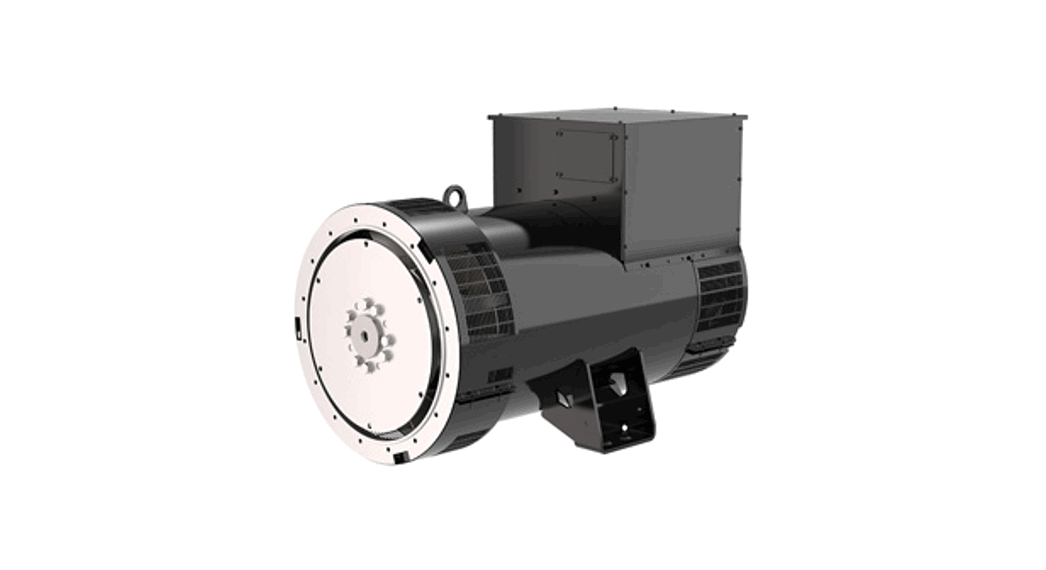
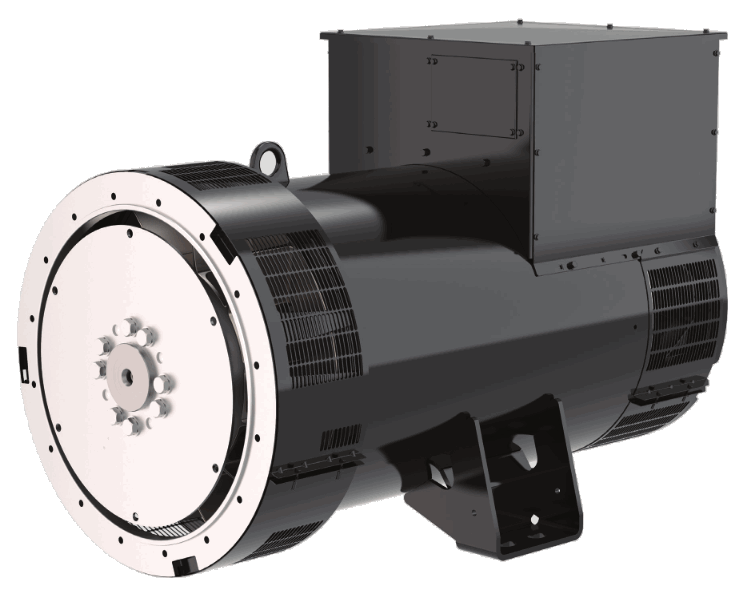
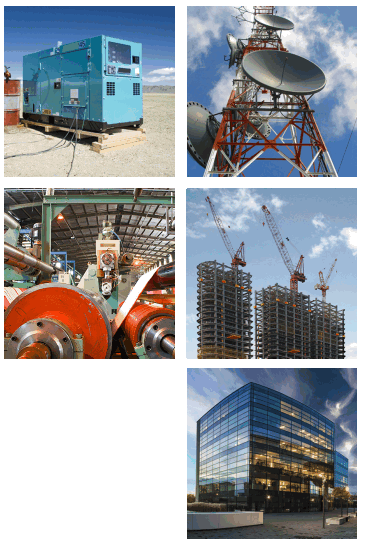
Nidec Leroy-Somer TAL 049 alternator has been designed to offer you the best power generation performances. With its meticulous design and optimized architecture, the TAL 049 strikes the perfect balance between compactness, reliability, performance and longevity.
Whatever your application, the TAL 049 will meet your needs and will adapt to all situations. Standards
Nidec Leroy-Somer TAL 049 alternator meets all key international standards and regulations, including IEC 60034, NEMA MG 1.32-33, ISO 8528-3, CSA C22.2 n°100-14 and UL 1446 (UL 1004 on request).
Also compliant with IEC 61000-6-2, IEC 61000-6-3, IEC 61000-6-4, VDE 0875G, VDE 0875N and EN 55011, group 1 class A for European zone.
Nidec Leroy-Somer TAL 049 alternator can be integrated in EC marked generator set, and bears EC, EAC and CMIM markings.
It is designed, manufactured and marketed in an ISO 9001 and ISO 14001 quality assurance environment.
 Electrical characteristics and performances
- Class H insulation
- Shunt excitation
- Low voltage winding:
Three-phase 50 Hz: 220V – 240V and 380V – 415V (440V) 60 Hz: 208V – 240V and 380V – 480V - 6-terminal plates in 6-wire version or suitable for 12-wire option
- Optimized performance
Excitation and regulation system
| Excitation system | Regulation options | ||||||
| AVR | SHUNT | AREP+ (option) | PMG (option) | ULC/US | Remote voltage potentiometer | C.T. Current transformer for paralleling | |
| Three-phase 6-wire | R150 | Standard | √ | ||||
| R180 | Standard | Standard | √ | √ | |||
| D350 | Option | Option | Option | √ | √ | √* | |
| Three-phase 12-wire | R150 | Standard | √ | ||||
| R250 | Option | √ | √ | ||||
| R180 | Standard | Standard | √ | √ | |||
| D350 | Option | Option | Option | √ | √ | √* | |
*: only with AREP+ or PMG
Protection system and options
- Degree of protection: IP 23
- Complete winding protection for non-harsh environments with relative humidity ≤ 95%
- Options:
– Three-phase 12-wire with 7-terminal plates
– AREP+ or PMG excitation
– ULc/us
– Customized painting (unpainted machine as standard)
– Space heater
– Droop kit for alternator paralleling
– Stator sensors
– Winding 8 optimized for three-phase 380V / 416V – 60 Hz
– Reinforced winding protection for harsh environments and relative humidity greater than 95% (system 2 – 4 without derating)
Mechanical construction
- Compact and rugged assembly to withstand engine vibrations
- Steel frame
- Cast iron flanges and shields
- Single-bearing design to be suitable with most diesel engines
- Greased for life bearings
- Standard direction of rotation: clockwise when looking at the drive end view (for anti-clockwise, derate the machine by 5%)
Terminal box design
- Easy access to AVR and terminals
- Standard terminal box with possibility of mounting measurement CTs
- Possibility of current transformer for parallel operation
General characteristics
| Insulation class | H | Excitation system 6-wire | SHUNT AREP+ / PMG | |
| Winding pitch | 2/3 (wind.6S – 6-wire / wind.6 – 12-wire) | AVR type | R150 R180 | |
| Number of wires | 6 (12 option) | Excitation system 12-wire (option) | SHUNT AREP+ / PMG | |
| Protection | IP 23 | AVR type | R150 R180 | |
| Altitude | ≤ 1000 m | Voltage regulation (**) | ± 0.8 % ± 0.5 % | |
| Overspeed | 2250 R.P.M. | Total Harmonic Distortion THD (***) in no-load < 3.5 % | ||
| Air flow 50 Hz | 1 m3/s | Total Harmonic Distortion THD (***) in linear load < 5 % | ||
| Air flow 60 Hz | 1.2 m3/s | Waveform: NEMA = TIF (***) | < 50 | |
| AREP+/PMG Short-circuit current = 2.7 In : 5 seconds (*) | Waveform: I.E.C. = THF (***) | < 2% | ||
| (*) D350: 10 seconds (**) Steady state (***) Total harmonic distortion between phases, no-load or on-load (non-distorting) | ||||
(*) D350: 10 seconds (**) Steady state (***) Total harmonic distortion between phases, no-load or on-load (non-distorting)
Ratings 50 Hz – 1500 R.P.M.
kVA / kW – P.F. = 0.8
| D u t y / T ° C | Continuous / 40 °C | Continuous / 40 °C | Stand-by / 40 °C | Stand-by / 27 °C |
| Class / T° K | H / 125° K 3 ph. |
380V | F / 105° K 3 ph. 400V 415V |
440V |
380V | H / 150° K 3 ph. 400V 415V |
440V | H / 163° K 3 ph. | |||||||||
| Phase | |||||||||||||||||
| Y | 380V | 400V | 415V | 440V | 380V | 400V | 415V | 440V | |||||||||
| ∆ | 220V | 230V | 240V | 220V | 230V | 240V | 220V | 230V | 240V | 220V | 230V | 240V | |||||
| YY (*) | 200V | 220V | 200V | 220V | 200V | 220V | 200V | 220V | |||||||||
| TAL 049 B | kVA | 730 | 730 | 730 | 665 | 665 | 665 | 665 | 605 | 775 | 775 | 775 | 705 | 805 | 805 | 805 | 730 |
| kW | 584 | 584 | 584 | 532 | 532 | 532 | 532 | 484 | 620 | 620 | 620 | 564 | 644 | 644 | 644 | 584 | |
| TAL 049 C | kVA | 820 | 820 | 820 | 810 | 745 | 745 | 745 | 735 | 870 | 870 | 870 | 860 | 910 | 910 | 910 | 890 |
| kW | 656 | 656 | 656 | 648 | 596 | 596 | 596 | 588 | 696 | 696 | 696 | 688 | 728 | 728 | 728 | 712 | |
| TAL 049 D | kVA | 910 | 910 | 910 | 820 | 830 | 830 | 830 | 745 | 965 | 965 | 965 | 870 | 1010 | 1010 | 1010 | 900 |
| kW | 728 | 728 | 728 | 656 | 664 | 664 | 664 | 596 | 772 | 772 | 772 | 696 | 808 | 808 | 808 | 720 | |
| TAL 049 E | kVA | 1000 | 1000 | 1000 | 950 | 910 | 910 | 910 | 865 | 1060 | 1060 | 1060 | 1005 | 1100 | 1100 | 1100 | 1045 |
(*) 12-wire option
Ratings 60 Hz – 1800 R.P.M.
| D u t y / T ° C | Continuous / 40 °C | Continuous / 40 °C | Stand-by / 40 °C | Stand-by / 27 °C |
| Class / T° K | H / 125° K 3 ph. |
380V | F / 105° K 3 ph. 416V 440V |
480V |
380V | H / 150° K 3 ph. 416V 440V |
480V | H / 163° K 3 ph. | |||||||||
| Phase | |||||||||||||||||
| Y | 380V | 416V | 440V | 480V | 380V | 416V | 440V | 480V | |||||||||
| ∆ | 220V | 240V | 220V | 240V | 220V | 240V | 220V | 240V | |||||||||
| YY (*) | 208V | 220V | 240V | 208V | 220V | 240V | 208V | 220V | 240V | 208V | 220V | 240V | |||||
| TAL 049 B | kVA | 725 | 795 | 840 | 915 | 660 | 725 | 765 | 835 | 770 | 845 | 890 | 970 | 800 | 875 | 925 | 1005 |
| kW | 580 | 636 | 672 | 732 | 528 | 580 | 612 | 668 | 616 | 676 | 712 | 776 | 640 | 700 | 740 | 804 | |
| TAL 049 C | kVA | 815 | 890 | 940 | 1025 | 740 | 810 | 855 | 935 | 865 | 945 | 995 | 1085 | 895 | 980 | 1040 | 1130 |
| kW | 652 | 712 | 752 | 820 | 592 | 648 | 684 | 748 | 692 | 756 | 796 | 868 | 716 | 784 | 832 | 904 | |
| TAL 049 D | kVA | 905 | 990 | 1045 | 1140 | 825 | 900 | 950 | 1035 | 960 | 1050 | 1110 | 1210 | 1000 | 1090 | 1155 | 1255 |
| kW | 724 | 792 | 836 | 912 | 660 | 720 | 760 | 828 | 768 | 840 | 888 | 968 | 800 | 872 | 924 | 1004 | |
| TAL 049 E | kVA | 990 | 1083 | 1146 | 1250 | 900 | 985 | 1045 | 1140 | 1050 | 1150 | 1215 | 1325 | 1089 | 1192 | 1260 | 1375 |
| kW | 792 | 866 | 917 | 1000 | 720 | 788 | 836 | 912 | 840 | 920 | 972 | 1060 | 871 | 954 | 1008 | 1100 | |
Efficiencies 400 V – 50 Hz (— P.F.: 0.8) (…… P.F.: 1) 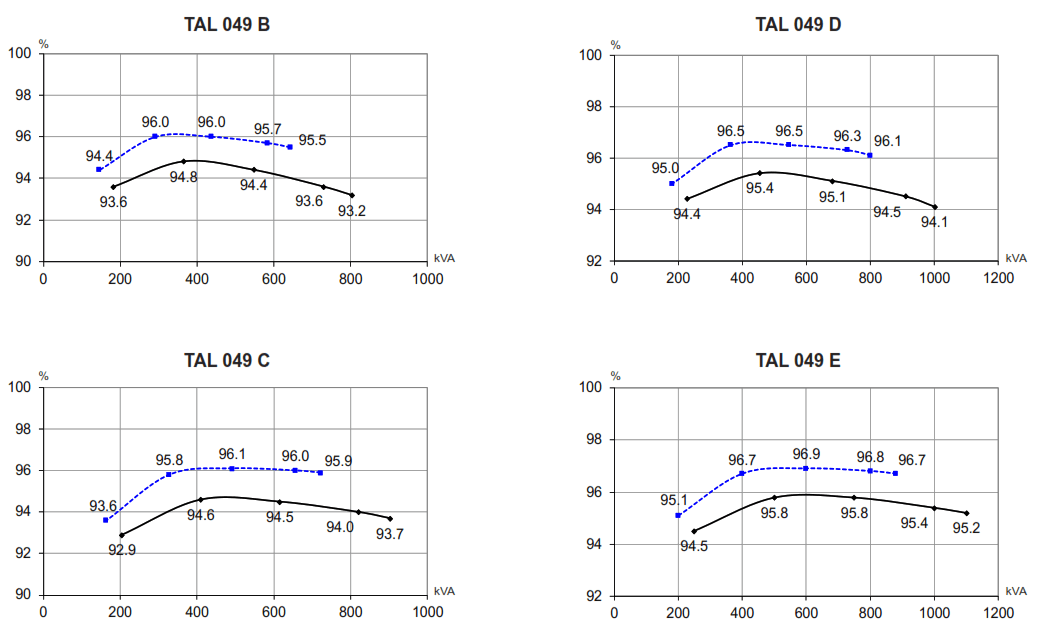
Reactances (%). Time constants (ms) – Class H / 400 V
| B | C | D | E | |
| Kcc Short-circuit ratio | 0.28 | 0.37 | 0.28 | 0.34 |
| Xd Direct-axis synchronous reactance unsaturated | 403 | 330 | 402 | 348 |
| Xq Quadrature-axis synchronous reactance unsaturated | 205 | 168 | 205 | 177 |
| T’do No-load transient time constant | 2028 | 2074 | 2108 | 2153 |
| X’d Direct-axis transient reactance saturated | 19.8 | 15.9 | 19 | 16.1 |
| T’d Short-circuit transient time constant | 100 | 100 | 100 | 100 |
| X”d Direct-axis subtransient reactance saturated | 15.9 | 12.7 | 15.2 | 12.9 |
| T”d Subtransient time constant | 10 | 10 | 10 | 10 |
| X”q Quadrature-axis subtransient reactance saturated | 18.3 | 14.4 | 16.9 | 14.1 |
| Xo Zero sequence reactance | 0.82 | 0.66 | 0.79 | 0.67 |
| X2 Negative sequence reactance saturated | 17.12 | 13.59 | 16.11 | 13.53 |
| Ta Armature time constant | 15 | 15 | 15 | 15 |
| Other class H / 400 V data | ||||
| io (A) No-load excitation current SHUNT/AREP+ | 0.79 | 1.11 | 0.81 | 0.9 |
| ic (A) On-load excitation current SHUNT/AREP+ | 4.03 | 4.62 | 4.03 | 3.62 |
| uc (V) On-load excitation voltage SHUNT/AREP+ | 45.7 | 52.2 | 45.4 | 40.9 |
| ms Response time (∆U = 20% transient) | 500 | 500 | 500 | 500 |
| kVA Start (∆U = 20% cont. or ∆U = 30% trans.) SHUNT* | 1040 | 1324 | 1354 | 1753 |
| kVA Start (∆U = 20% cont. or ∆U = 30% trans.) AREP+* | 1478 | 1897 | 1913 | 2553 |
| % Transient ∆U (on-load 4/4) SHUNT – P.F.: 0.8 LAG | 19 | 18.7 | 18.4 | 16.2 |
| % Transient ∆U (on-load 4/4) AREP+ – P.F.: 0.8 LAG | 14.5 | 12.3 | 14.1 | 11.3 |
| W No-load losses | 7774 | 10303 | 8474 | 9556 |
| W Heat dissipation | 39596 | 41666 | 42360 | 38187 |
Transient voltage variation 400 V – 50 Hz 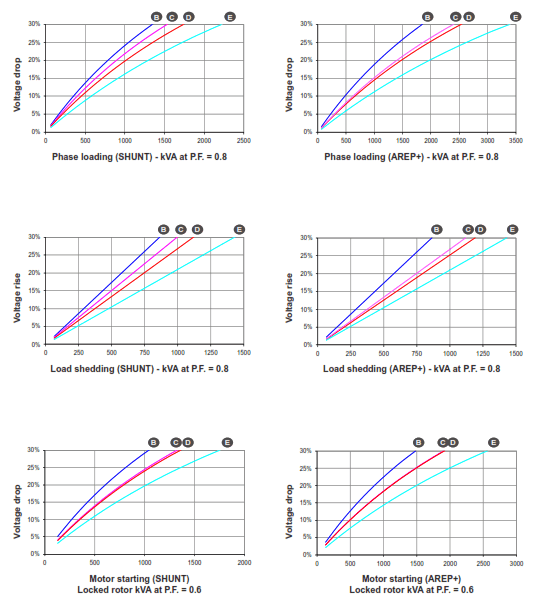 – For a starting P.F. other than 0.6, the starting kVA must be multiplied by K = Sine P.F. / 0.8
– For voltages other than 400V (Y), 230V (Δ) at 50 Hz, then kVA must be multiplied by (400/U) 2 or (230/U) 2
. – Transient performance of the PMG option, consult us.
Efficiencies 480 V – 60 Hz (— P.F.: 0.8) (…… P.F.: 1) 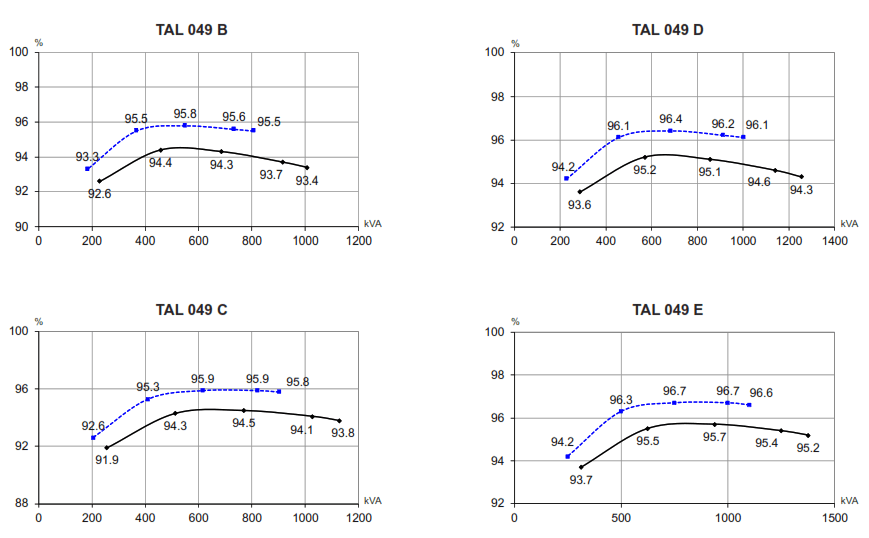
Reactances (%). Time constants (ms) – Class H / 480 V
| B | C | D | E | |
| Kcc Short-circuit ratio | 0.27 | 0.36 | 0.27 | 0.33 |
| Xd Direct-axis synchronous reactance unsaturated | 421 | 344 | 419 | 363 |
| Xq Quadrature-axis synchronous reactance unsaturated | 214 | 175 | 214 | 185 |
| T’do No-load transient time constant | 2028 | 2074 | 2108 | 2153 |
| X’d Direct-axis transient reactance saturated | 20.7 | 16.6 | 19.9 | 16.8 |
| T’d Short-circuit transient time constant | 100 | 100 | 100 | 100 |
| X”d Direct-axis subtransient reactance saturated | 16.6 | 13.2 | 15.9 | 13.4 |
| T”d Subtransient time constant | 10 | 10 | 10 | 10 |
| X”q Quadrature-axis subtransient reactance saturated | 19.1 | 15 | 17.7 | 14.7 |
| Xo Zero sequence reactance | 0.86 | 0.69 | 0.82 | 0.7 |
| X2 Negative sequence reactance saturated | 17.89 | 14.16 | 16.82 | 14.1 |
| Ta Armature time constant | 15 | 15 | 15 | 15 |
| Other class H / 480 V data | ||||
| io (A) No-load excitation current SHUNT/AREP+ | 0.79 | 1.11 | 0.81 | 0.9 |
| ic (A) On-load excitation current SHUNT/AREP+ | 4.15 | 4.72 | 4.13 | 3.69 |
| uc (V) On-load excitation voltage SHUNT/AREP+ | 47.2 | 53.6 | 46.8 | 41.9 |
| ms Response time (∆U = 20% transient) | 500 | 500 | 500 | 500 |
| kVA Start (∆U = 20% cont. or ∆U = 30% trans.) SHUNT* | 1247 | 1626 | 1624 | 2114 |
| kVA Start (∆U = 20% cont. or ∆U = 30% trans.) AREP+* | 1770 | 2373 | 2307 | 3224 |
| % Transient ∆U (on-load 4/4) SHUNT – P.F.: 0.8 LAG | 19.6 | 19.2 | 19 | 16.7 |
| % Transient ∆U (on-load 4/4) AREP+ – P.F.: 0.8 LAG | 15 | 12.6 | 14.5 | 11.7 |
| W No-load losses | 12224 | 15725 | 13141 | 14640 |
| W Heat dissipation | 48486 | 51103 | 51860 | 47175 |
Transient voltage variation 480 V – 60 Hz
– For a starting P.F. other than 0.6, the starting kVA must be multiplied by K = Sine P.F. / 0.8
– For voltages other than 480V (Y), 277V (Δ), 240V (YY) at 60 Hz, then kVA must be multiplied by (480/U) 2 or (277/U) 2 or (240/U) 2.
– Transient performance of the PMG option, consult us.
3-phase short-circuit curves at no load and rated speed (star connection Y) 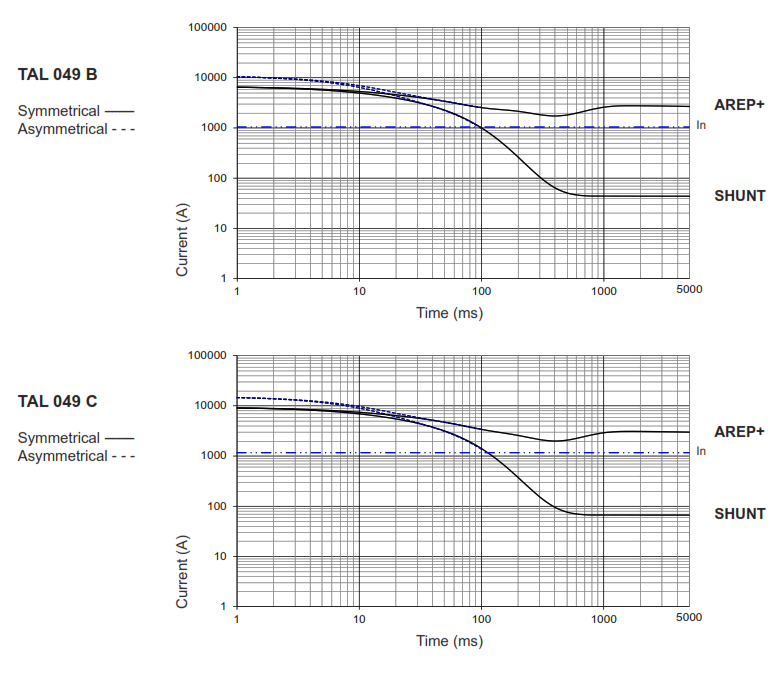
Influence due to connection
For (Δ) connection, use the following multiplication factor:
– Current value x 1.732.
3-phase short-circuit curves at no load and rated speed (star connection Y) 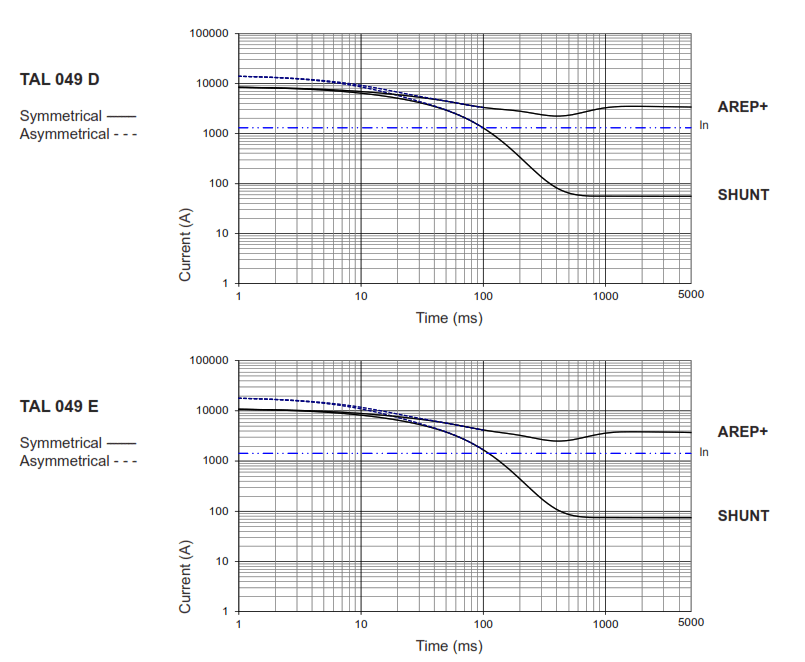
Influence due to short-circuit Curves are based on a three-phase short-circuit.
For other types of short-circuit, use the following multiplication factors.
| 3 – phase | 2 – phase L / L | 1 – phase L / N | |
| Instantaneous (max.) | 1 | 0.87 | 1.3 |
| Continuous | 1 | 1.5 | 2.2 |
| Maximum duration (AREP+/PMG) | 1.5 |
Single-bearing dimensions
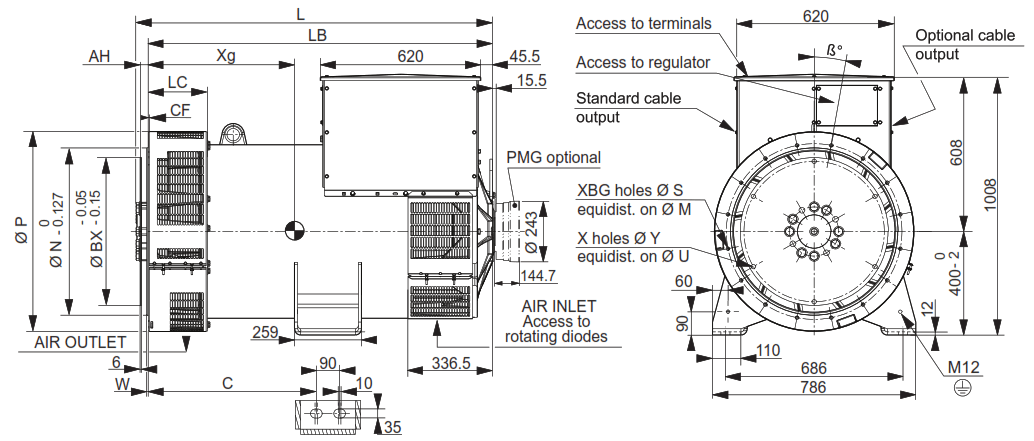
Dimensions (mm) and weight
| Type | L without PMG maxi* | LB | C | Xg | Weight (kg) |
| TAL 049 B | 1372 | 1331 | 650 | 629 | 1574 |
| TAL 049 C | 1372 | 1331 | 650 | 636 | 1635 |
| TAL 049 D | 1462 | 1421 | 650 | 673 | 1788 |
Coupling
| Flex plate | 14 | 18 |
| Flange S.A.E 1 | x | |
| Flange S.A.E ½ | x | |
| Flange S.A.E 0 | x | x |
| Flange S.A.E 00 | x |
Flange (mm)
| S.A.E. | P | N | M | LC | XBG | S | w | B | CF |
| 1 | 773 | 511. | 530. | 229. | 12 | 12 | 6 | 15° | 38 |
| 1/2 | 773 | 584. | 619. | 229. | 12 | 14 | 6 | 15° | 17 |
| 0 | 773 | 648. | 679. | 229. | 16 | 14 | 6 | 11° 15′ | 37 |
| 00 | 883 | 787. | 851. | 245 | 16 | 14 | 7 | 11° 15′ | 40 |
Flex plate (mm)
| S.A.E. | BX | U | X | Y | AH |
| 14 | 466.7 | 438.15 | 8 | 14 | 25.4 |
| 18 | 571.5 | 542.92 | 6 | 17 | 15.7 |
Torsional analysis data
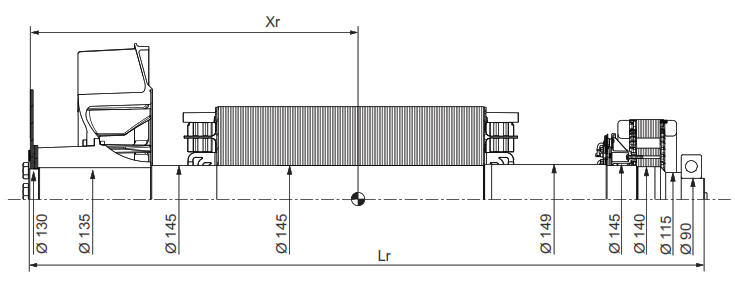
Centre of gravity: Xr (mm), Rotor length: Lr (mm), Weight: M (kg), Moment of inertia: J (kgm 2 ): (4J = MD 2)
| Flex plate | S.A.E. 14 | S.A.E. 18 |
| Type | Xr | Lr | M | J | Xr | Lr | M | J |
| TAL 049 B | 626 | 1345 | 602 | 9.61 | 614 | 1345 | 604 | 9.87 |
| TAL 049 C | 634 | 1345 | 628 | 10.16 | 622 | 1345 | 630 | 10.42 |
| TAL 049 D | 671 | 1435 | 684 | 11.12 | 659 | 1435 | 686 | 11.38 |
| TAL 049 E | 681 | 1435 | 701 | 11.48 | 669 | 1435 | 703 | 11.74 |
NOTE : Dimensions are for information only and may be subject to modifications. The torsional analysis of the transmission is imperative. All values are available upon request.
© Nidec 2020. The information contained in this brochure is for guidance only and does not form part of any contract. The accuracy cannot be guaranteed as Nidec have an ongoing process of development and reserve the right to change the specification of their products without notice.
Moteurs Leroy-Somer SAS. Siège : Bd Marcellin Leroy, CS 10015, 16915 Angoulême Cedex 9, France.
Capital social : 38 679 664 €, RCS Angoulême 338 567 258. 5677 en – 2021.12 / o
Electric Power Generation
www.leroy-somer.com/epg
Linkedin.com/company/leroy-somer
Twitter.com/Leroy_Somer_en
Facebook.com/LeroySomer.Nidec.en
YouTube.com/LeroySomerOfficiel
 Leroy-Somer Alternators - Generators