 ITMF44A121DFHD User Manual
Safety Precautions
WARNING: Safety Instructions
Do not place the monitor in a rain, humid environment or open the monitor case to avoid any shock, electrical hazards, and/or mechanical hazards.
Operation
- Keep the monitor out of direct sunlight and away from stoves or any other heat source.
- Keep the monitor out of the water source.
- Remove any object that could fall into ventilation holes or prevent proper cooling of the monitor’s electronics.
- Do not block the ventilation holes.
- Do not knock or drop the monitor during operation or transportation.
Maintenance Guidelines
CAUTION
Before cleaning the monitor, unplug the monitor power cable from the electrical outlet.
Caring For Your Monitor
- To clean your screen, slightly dampen a soft, clean cloth with water, If possible, use a special screen-cleaning tissue or solution. Do not use benzene, thinner, ammonia, abrasive cleaners, or compressed air.
- Use a slightly dampened, warm cloth to clean the frame. Avoid using detergent of any kind as some detergents might leave a milky film on the plastics.
- Unplug the monitor if you are not going to use it for an extended period of time.
- To avoid the risk of shock or permanent damage to the set, do not expose the monitor to dust, rain, water, or excessive moisture environment. If your monitor gets wet, wipe it with dry cloth as soon as possible.
 The terms HDMI and HDMI High-Definition Multimedia Interface, and the HDMI Logo are trademarks or registered trademarks of HDMI Licensing Administrator, Inc. in the United States and other countries.
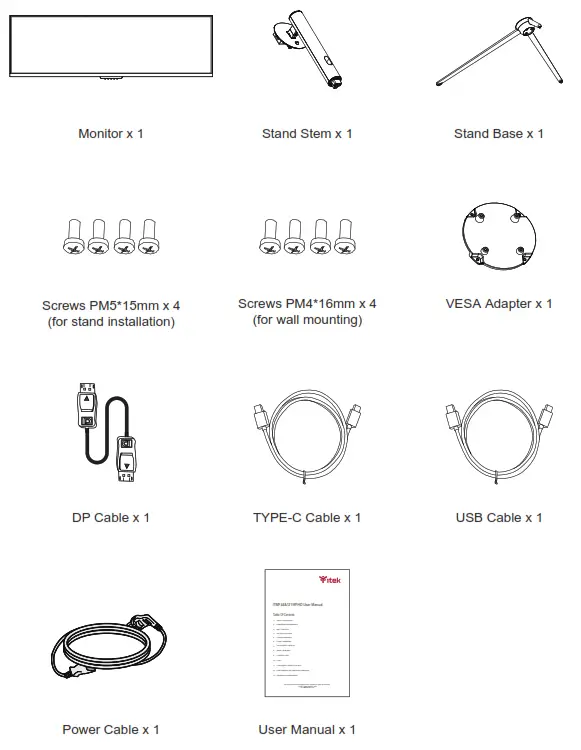
Box Contents
Product Overview
4.1 – Monitor Buttons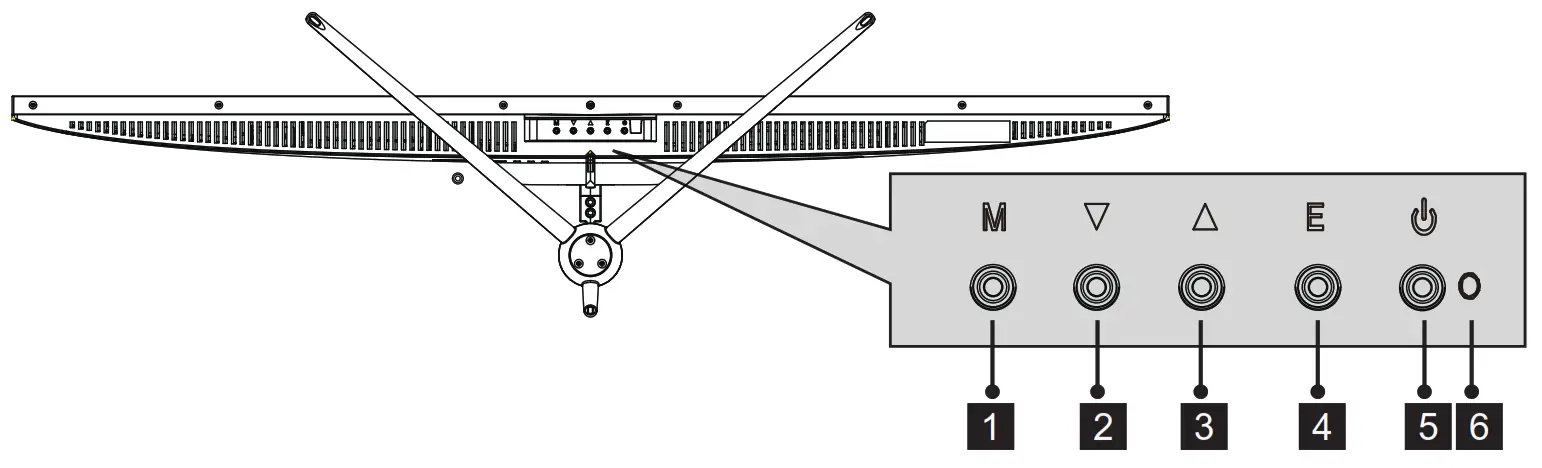
- M Menu Button: Press to display the OSD menu or enter sub-menus.
 Down Button: Press to move down in the menus.
 Up Button: Press to move up in the menus.
- E Exit Button: Press to exit.
 Power Button: Press to turn the monitor on/off.
- LED indicator: Changes colors to indicate status.
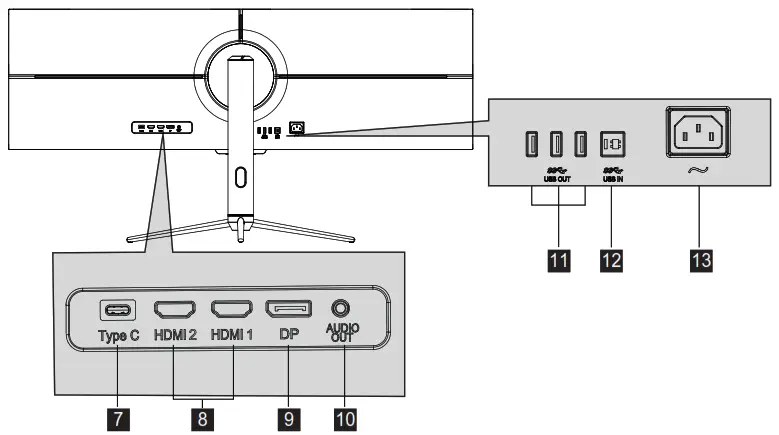
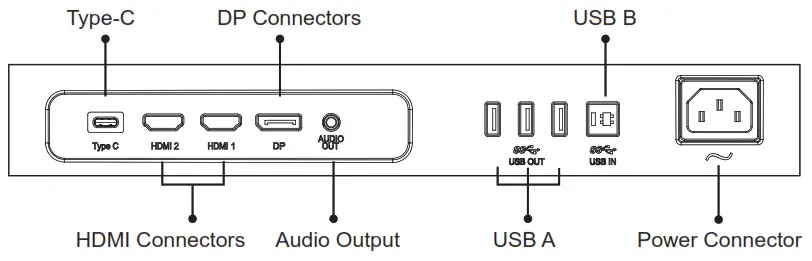
4.2 – Monitor Ports
- Type-c: Insert one end of the Type-c cable into the computer’s Type-c output and connect the other end to the monitor’s Type-c port.
- HDMI Connectors: Insert one end of the HDMI cable into the computer’s HDMI output and connect the other end to the monitor’s HDMI port.
- DP Connectors: insert one end of the DP cable into the computer’s DP output and connect the other end to the monitor’s DP port.
- Audio Output: Insert the audio cable for the output of audio signals.
- USB A: USB out Port.
- USB B: USB in Port.
- . Power Connector: Insert the power cable to supply power to the monitor.
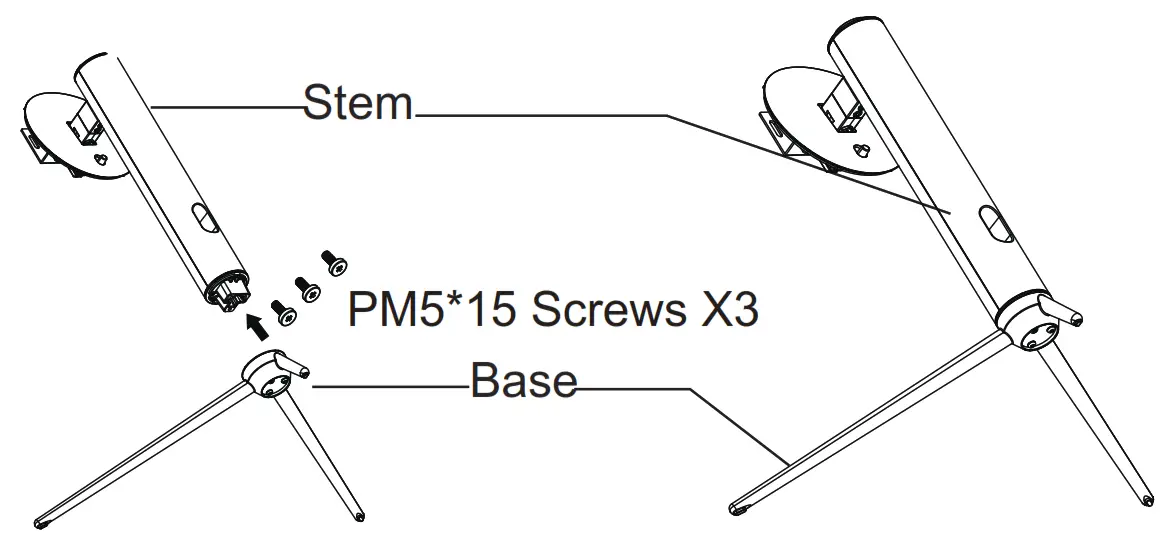
Stand installation
- Take out the two main parts of the stand. Then use the screwdriver and the 3 screws to fasten base to the stem.

- Take out the monitor and put it on the flat foam, insert the stand on the back of the monitor.

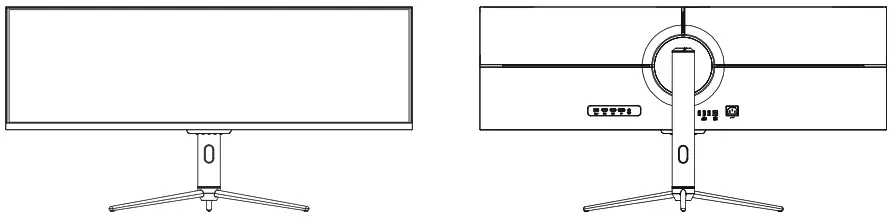
- Use both hands to place the assembled monitor on a flat desk.

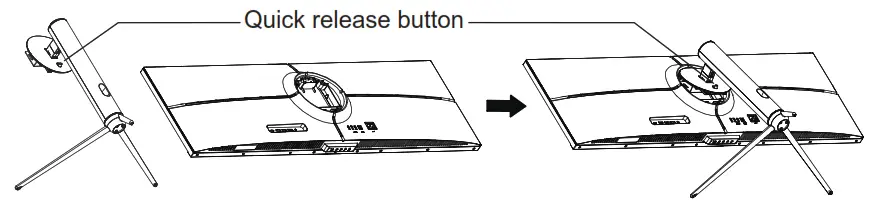
 Make sure the monitor is laid on a flat surface before removing the stand.
Mount installation
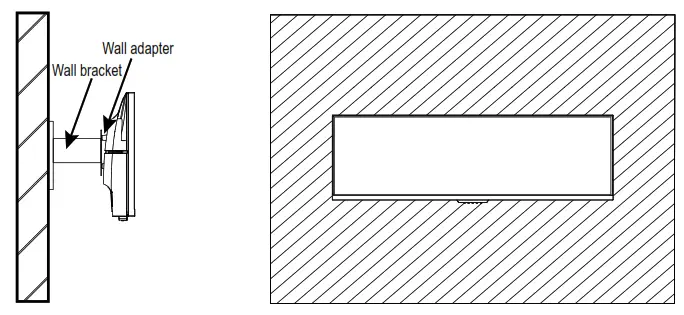
 This monitor only includes screws that may be used when attaching the monitor to a VESA 75*75mm type mount. No VESA mount or mounting accessory is included.
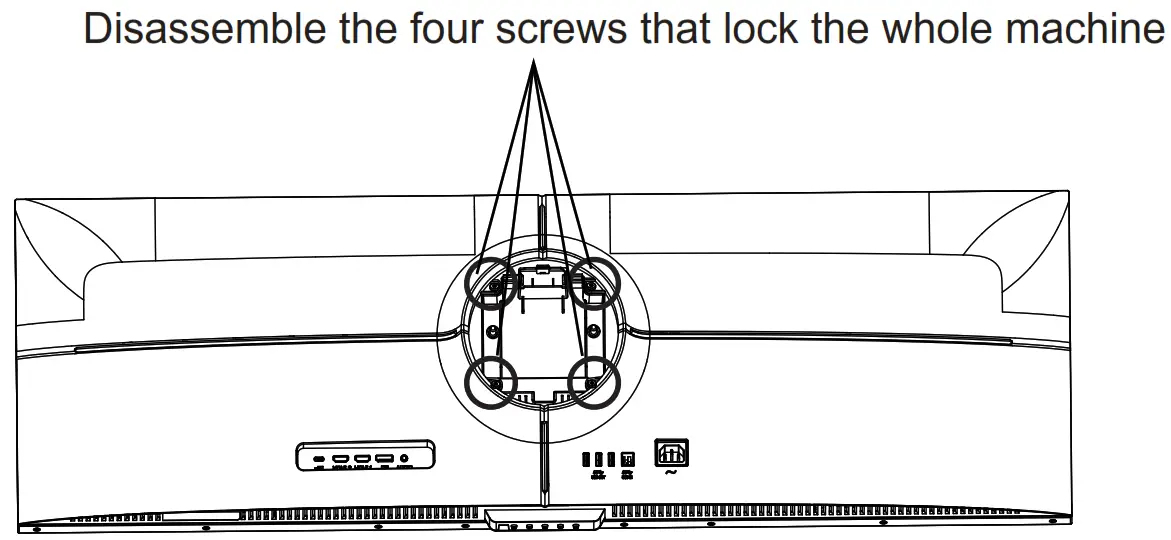
- Take a screwdriver to remove the four screws locked in the middle of the whole machine. (when disassembling the screws, the display screen cannot leave the Styrofoam to prevent the screen from breaking)

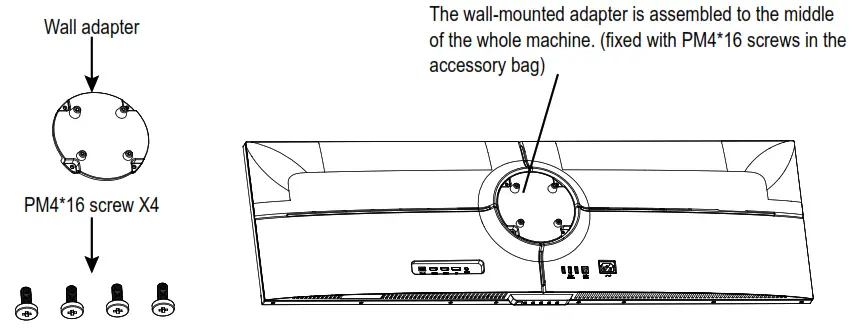
- Take out the wall-mounted adapter/four PM4*16 screws from the accessories as shown in the figure above, assemble it in the middle of the whole machine, and fix it by locking.

- Do not pinch the screen directly with your hands during the process of hanging the product.

Connectivity Options
7.1 – Connecting the Power Cable
Connect the included power cable to the power connector and then plug the other end into a wall outlet.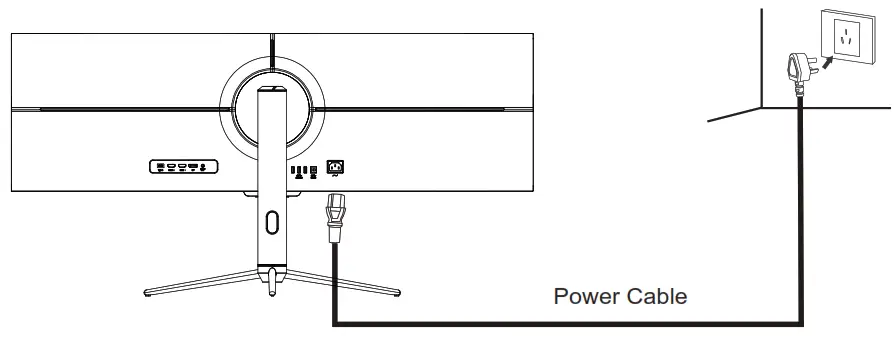
7.2 – Connecting Your Earphones
Plug in your earphones to receive audio signals from your monitor. If you have an audio device connected to your computer when you connect your earphones to the monitor, the audio devices will not produce sound. Earphones and other audio devices are not included.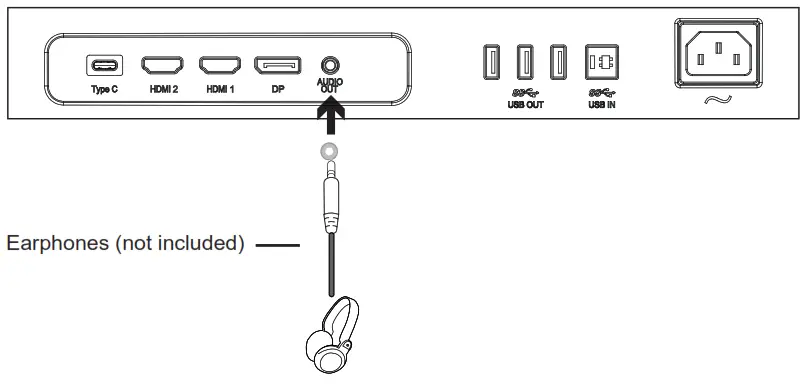 Exposure to loud audio for prolonged periods of time may permanently damage your hearing.
7.3 – DP Connectivity
For the monitor to receive DP signals from the computer, use the DP cable to connect the monitor to the computer.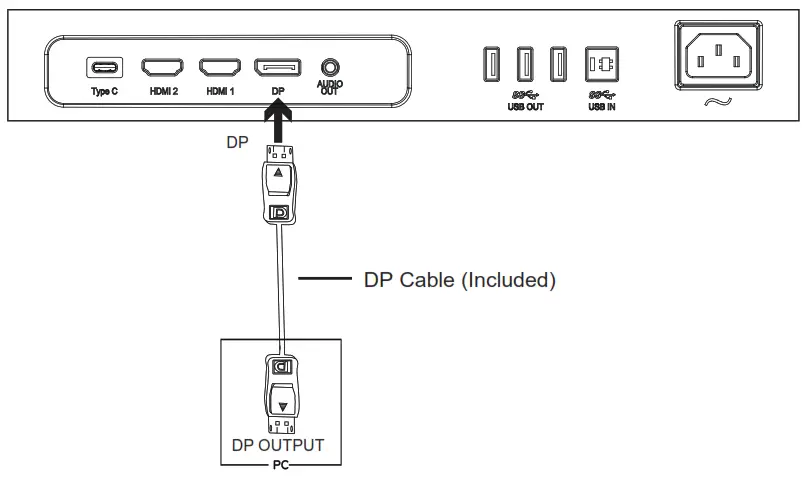
7.4 – HDMI Connectivity
For the monitor to receive HDMI signals from the computer, use an HDMI cable to connect the monitor to the computer.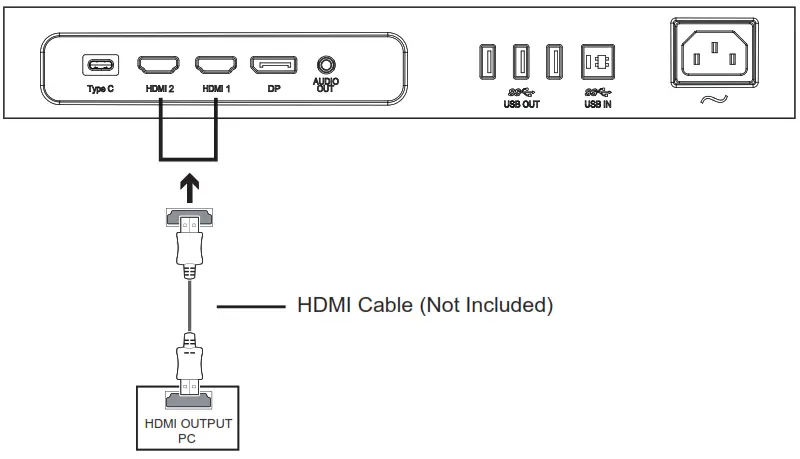
Basic Operation
- Insert one end of the DP cable into your PC’s graphics card. An HDMI cable may also be used. HDMI cable is not included.
- Connect the other end of the cable to the corresponding connector on your monitor.

- Connect the power cable to your monitor then connect the other end to your power source. It is recommended that you use a surge protector with adequate voltage if a wall outlet cannot be reached directly.
- Locate the power button on the monitor and press it to turn the monitor on.
indicator Light
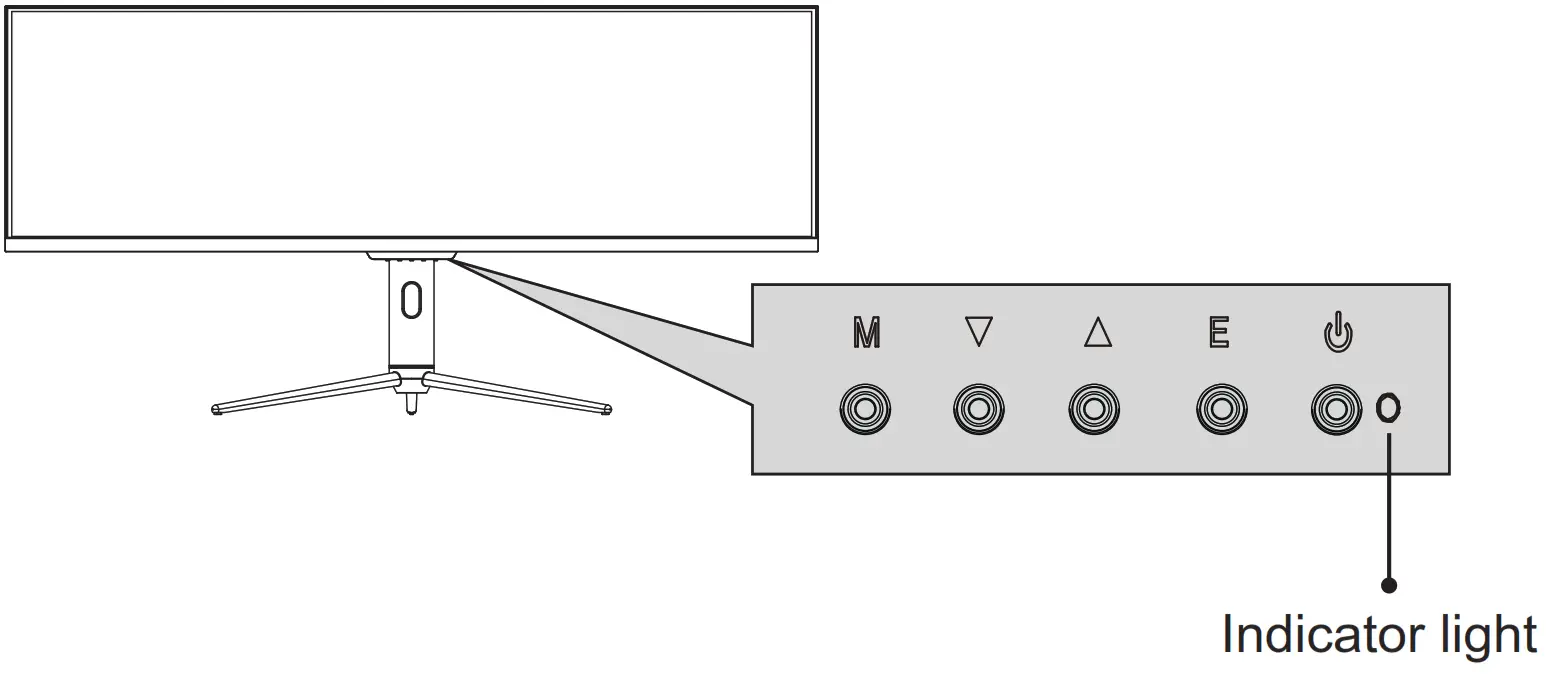
Solid blue light indicates power is on and the monitor is operating normally. Flashing blue light indicates no video source, no horizontal or vertical signal has been detected or power is low. Please ensure your computer is on and all video cables are fully inserted and/or connected.
On-Screen Display (OSD)
The On-Screen Display (OSD) Menu may be used to adjust your monitor’s settings and appears on screen after turning on the monitor and pressing the M button. When using the monitor for the first time, settings will automatically adjust to optimal settings according to your computer’s configuration and parts etc.
- Press one of the buttons(
 ) to activate the navigation window.
- Press M (
 ) to enter the OSD screen.
- Press or to browse functions.
Highlight the desired function, then press M to enter the sub-menu.
Press or to browse sub-menus, then press M to highlight the desired function.
Press or to highlight an option, then press M to confirm the settings and exit the current screen. - Press E to exit the current screen.
 ) to activate the navigation window.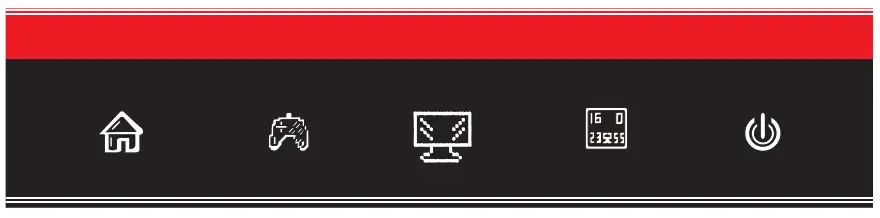
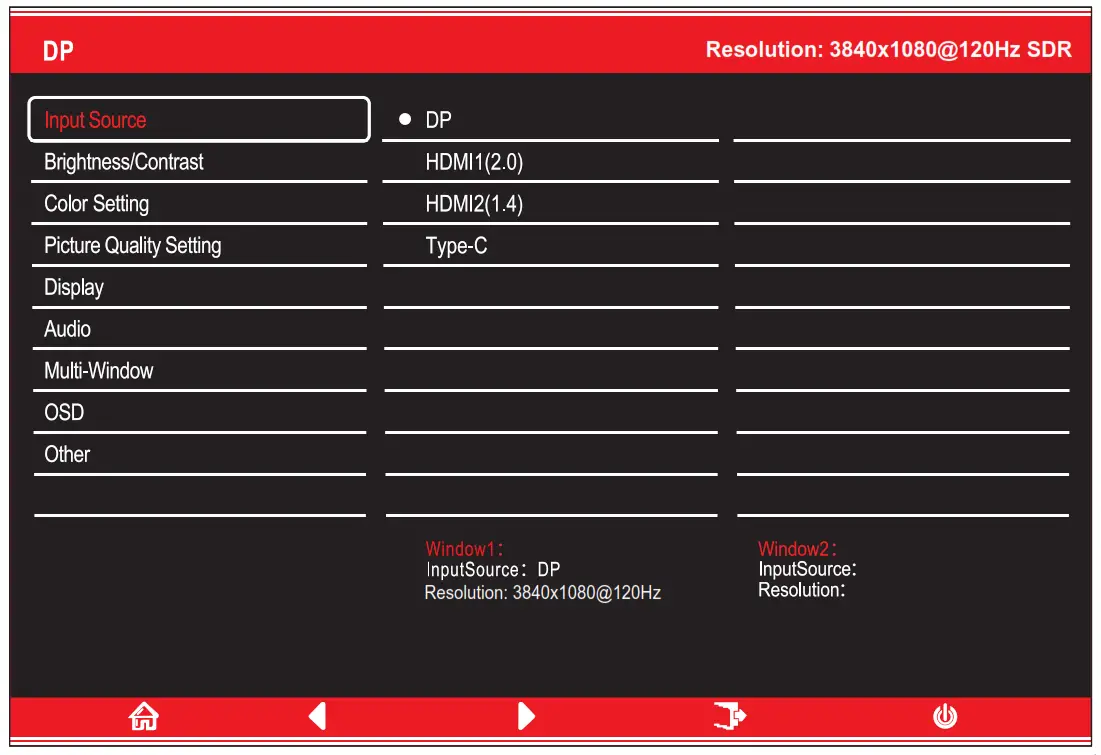
Main Menu | Sub-Menu | Options | Description |
| Input Source | DP | NONE | Switch to DP signal input |
| HDMI 1 (2.0): HDMI 2 (1.4): | NONE | Switch to HDMI signal input | |
| Type-C | NONE | Switch to Type-C signal input | |
Brightness! Contrast | Brightness | 0-100 | Adjust display brightness |
| Blacklevel | 0-100 | Adjust display black level | |
| Contrast | 0-100 | Adjust display contrast | |
| DCR | On | Turn on the DCR function | |
| Ott | Turn off the DCR function | ||
Color Setting | Gamma | Gamma 1.8 | Set Gamma add-in |
| Gamma 2.0 | |||
| Gamma 2.2 | |||
| Gamma 2.4 | |||
| Gamma 2.6 | |||
| Picture Mode | Standard. Picture. Movie. Game. FPS, RTS | Set visual mode according to activity | |
| Color Temperature | Warm. Cool User | Select color temperature | |
| Low Blue Light | 0-100 | Set blue light filtering level | |
| Hue | 0-100 | Adjust hue levels | |
| Saturation | 0-100 | Adjust saturation levels | |
| Picture Quality Setting | Sharpness | 0-100 | Set display sharpness |
| Response Time | Off, High. Middle. Low | Adjust response time | |
| Noise Reduction | Off, High. Middle. Low | Reduce the interference of image noise caused by signal source interference | |
| Super- Resolution | Off. High. Middle. Low | When the resolution of the display screen is low, this function can be turned on to enhance the image resolution | |
| Dynamic Luminous Control | On. Off | Compensate for gray scale display screen and strengthen the expression of gray scale | |
| MPRT | On. Off | Moving Picture Response Time | |
Display | Aspect Ratio | Wide Screen. 4:3. 1:1. Auto | Selectthe on-screen aspect ratio |
Audio | Mute | On. Off | Turn mute mode on/off |
| Volume | 0-100 | Adjust audio volume | |
| Audio Source | DP. HDMI 1. HDMI 2. Type-C | Select audio signal input via HDMI or DP or Type-C |
| Main Menu | Sub-Menu | Options | Description |
| Multi-Window | Multi-Window | Off, PIP Mode, PBP 2Win | Select PIP/PBP modes according to the number of input signals etc. |
| Sub Win2 Input | DP, HDMI1(2.0), HDMI2(1.4), Type-C | Select according to input signal for PIP/ PBP mode | |
| PIP Size | Small, Medium, Large | Adjust the PIP/PBP display window size | |
| PIP Position | Top Right, Top Left, Bottom Right, Bottom Left | Adjust the PIP/PBP window position | |
| Swap | NONE | Swap the two-channel signal source of only the PIP/PBP 2 screens function | |
| OSD | Language | English | Set OSD language |
| OSD H-Position | 0-100 | Adjust the OSD’s horizontal position | |
| OSD V-Position | 0-100 | Adjust the OSD’s vertical position | |
| OSD Transparency | 0-100 | Set the OSD’s overall transparency | |
| OSD Time Out | 5-100 | Set how long the OSD remains open after non-use | |
| Other | DP Version | On, Off | |
| Adaptive-Sync | On, Off | Turn the Adaptive-Sync function on/off | |
| HDR | On, Off; Auto-Detect | Turn the HDR mode on/off | |
| Type-C Function | On, Off | Turn type-C power on / off | |
| Reset | None | Reset monitor configurations |
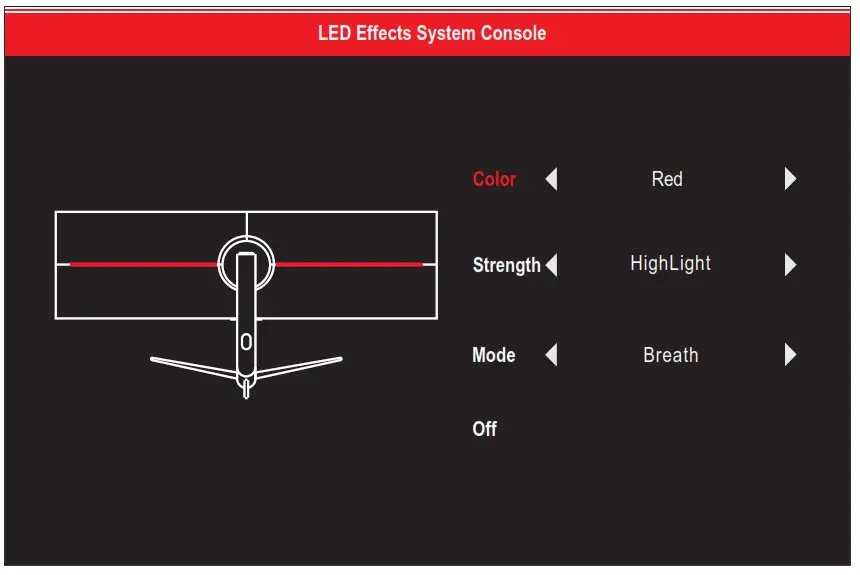
LED Effects System Console
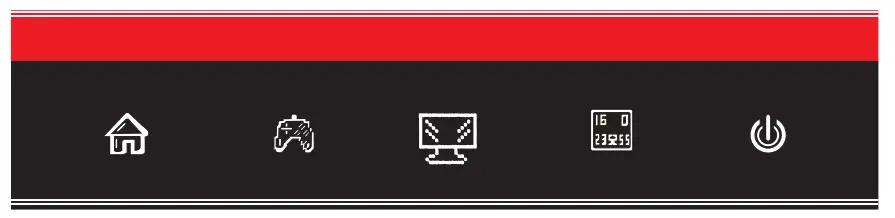
- Press one of the buttons ( ) on the monitor to activate the navigation.

- Press button on the monitor to enter the LED Effects menu.

- Press or to select the settings.
Highlight the desired option, and press M to confirm. - Press E to exit the current settings.
RGB Ranges and Game plus Switching
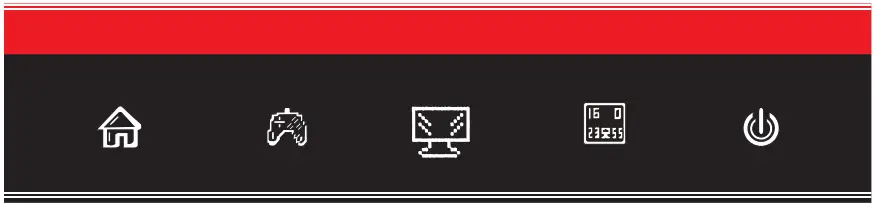
- Press one of the buttons ( ) to activate the navigation window.

- Press button to switch Game plus modes. According to the needs of your game, choose the corresponding game icon.These game icons are primarily designed to optimize your aim during shooting games, though they can be used for other scenarios.

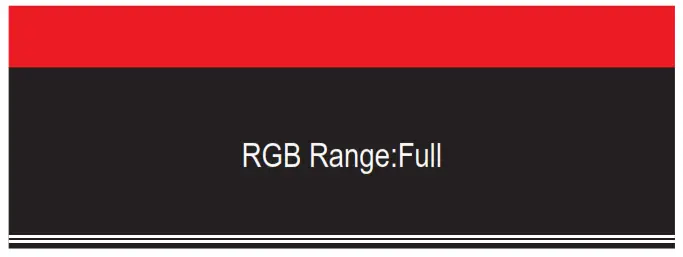
- Press E button to switch RGB Ranges including Limited and Full. Full Range is suitable for most activities.

Technical Specifications
| Model | ITMF44Al21DFHD |
| Screen Size | 43.8″ |
| Aspect Ratio | 32:9 |
| Backlight | E-LED |
| Brightness | 400 cd/m2(Typ.) / 350 cd/m2(Min.) |
| Panel | IPS |
| Resolution | DP1.4: 3840.1080@120Hz HDMI 1.4: 3840’1080©68Hz HDMI 2.0: 3840’1080©120Hz |
| Refresh Rate | 120Hz |
| Response Time | 1ms MPRT |
| Viewing Angle | 3178*(H) / 3178°(V) |
| Contrast Ratio | 1000:1 |
| VESA Mounting | 75 x 75mm |
| Display Colours | 1.07G |
| Adaptive-sync | Yes |
| Interface | DP 1.49, HDMI 1.4-1, HDMI 2.0.1, Audio oute1, USB-A 3.0’3, USB-B 3.0’1, Type-C 3.1’l |
| Power Input | AC 100-240– 50/60Hz 2 2A |
| Audio | |
| Speakers | NO |
| Audio Out | Yes |
| Accessories | |
| Power Cable | Yes |
| USB 3.0 | Yes |
| USB Type-C | Yes |
| Additional Functions | |
| Low Blue Light | Yes |
| Physical Dimensions | |
| Dimensions (w/ stand) | 1089.4.547.4’286.8mm |
| Dimensions (w/o stand) | 1089.4.329.5″83.6mm |
| Net Weight | 11.7kg |
| Gross Weight | 15.14kg |
For more information please visit our web site or write us an email:
https://www.itekevo.com
[email protected]