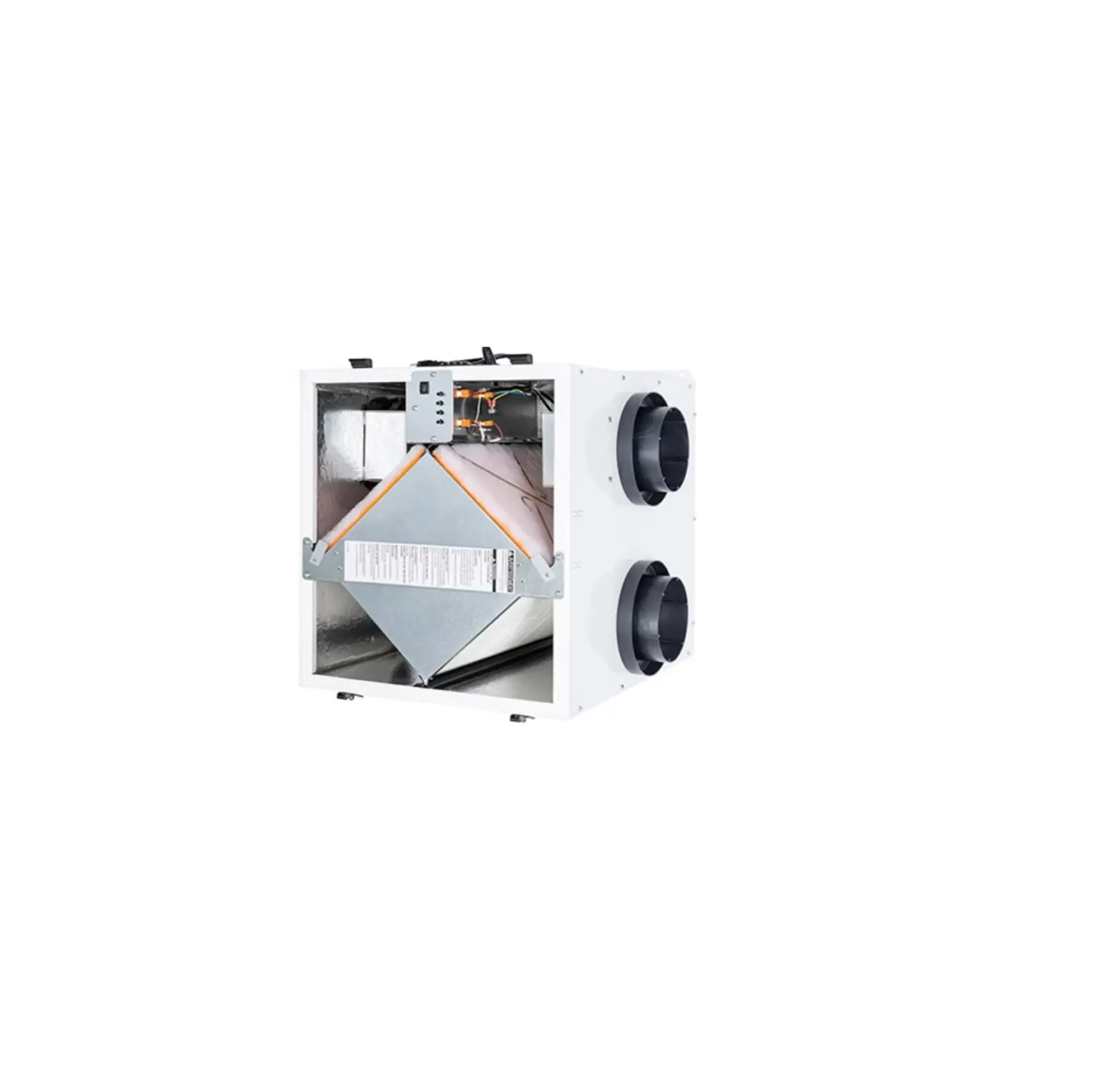
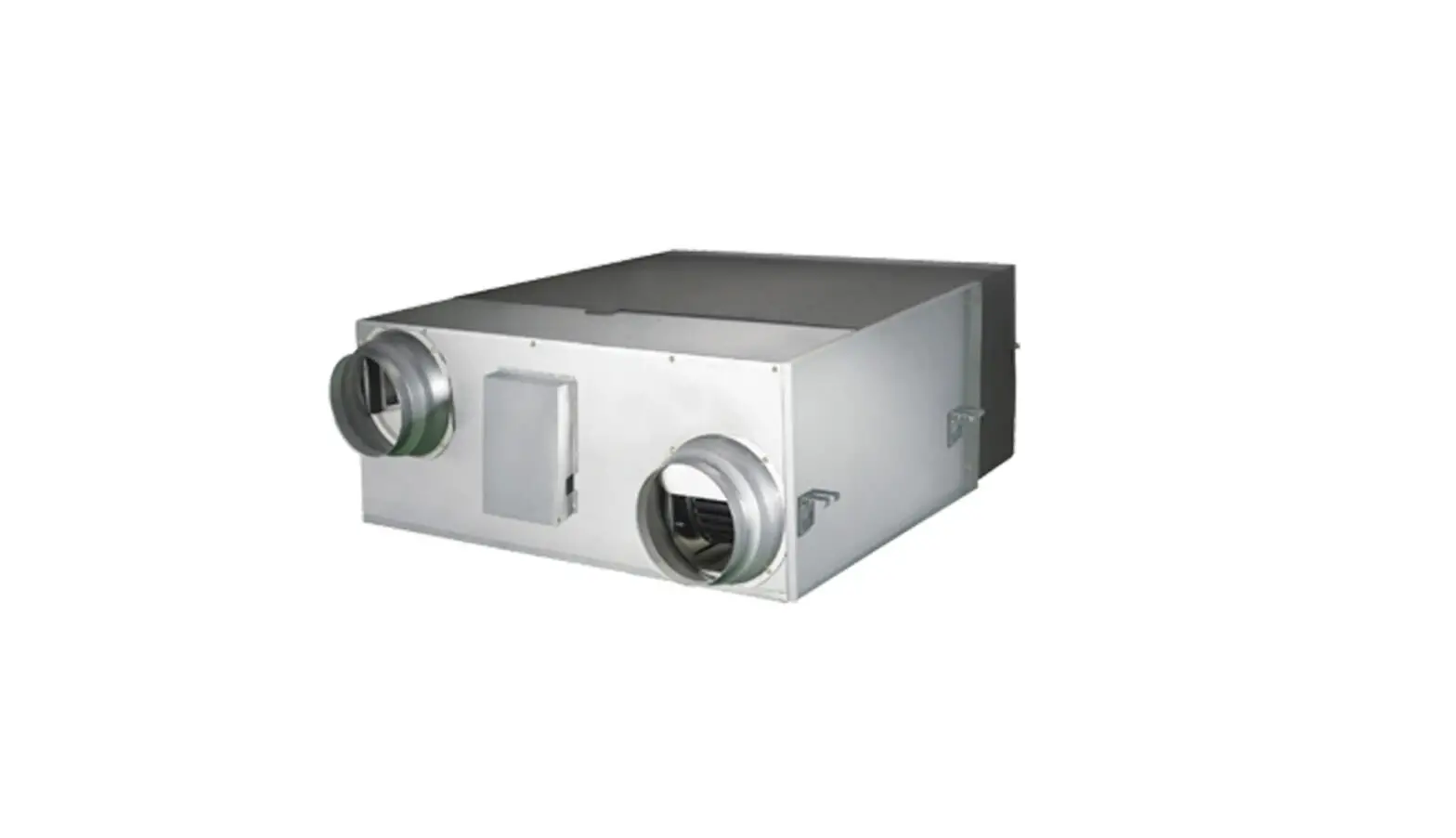
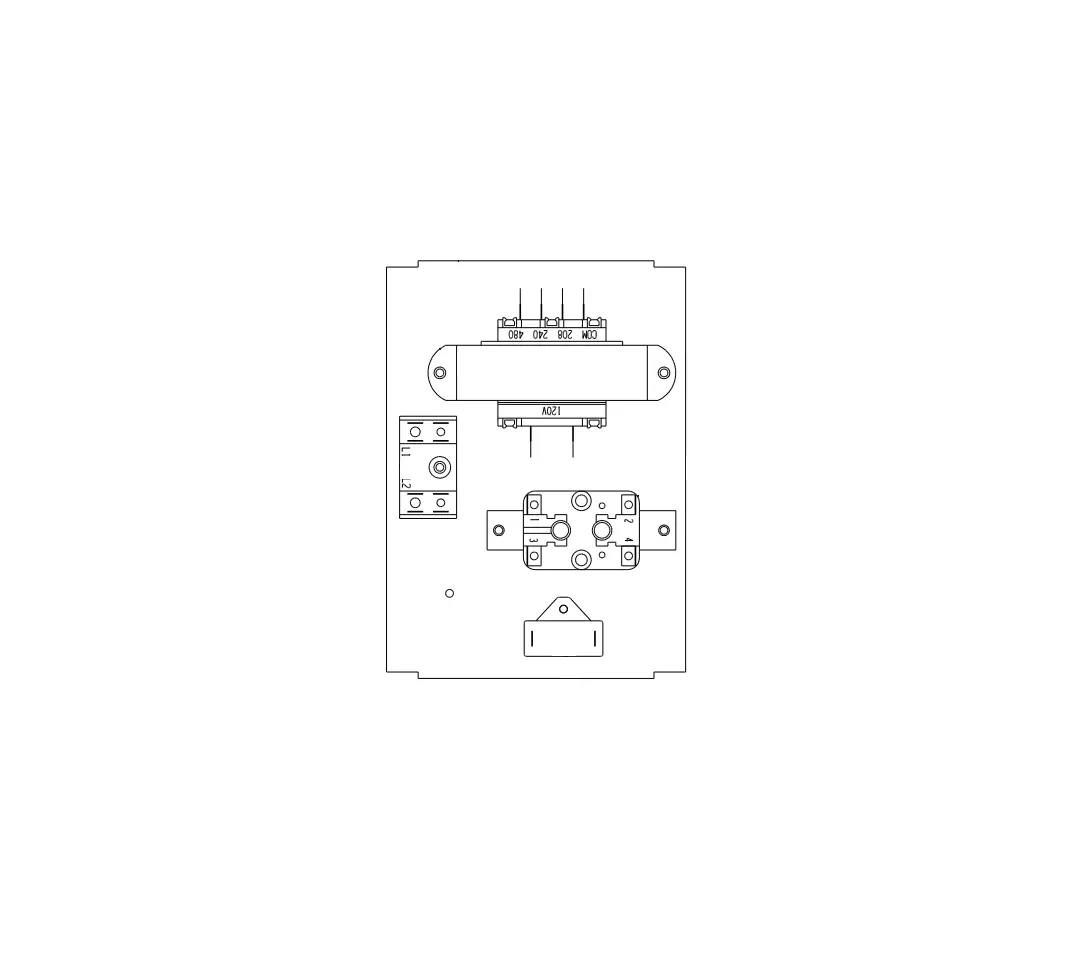
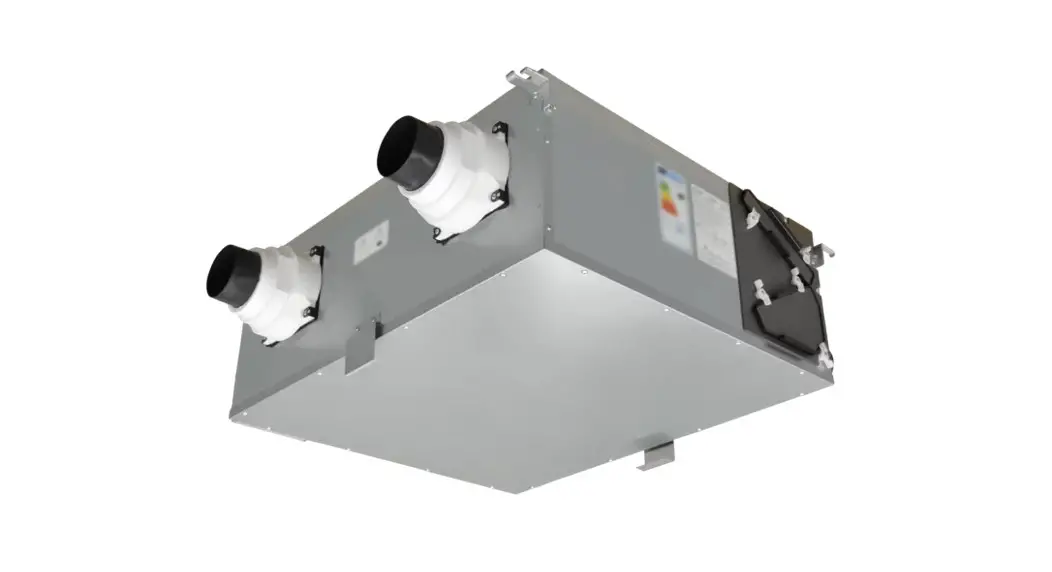
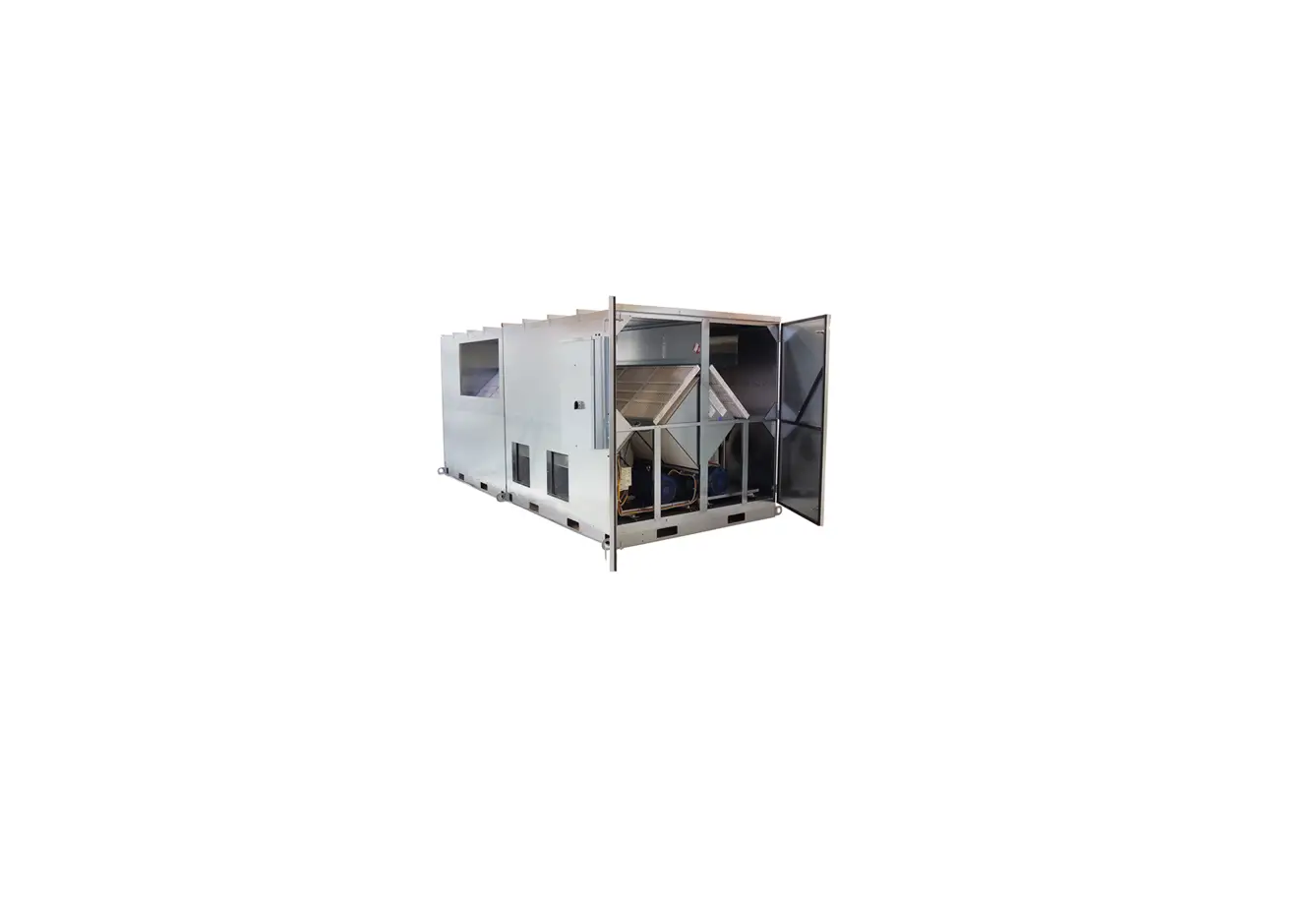
EV450RT Energy Recovery Ventilator
EV SERIES ERV
Installation, Operation and Maintenance Manual
EV450RT
Model: EV450RT shown
ERV EV-Series Outdoor
WARNING
Three phase motors are NOT suitable for use with solid state speed control.
Single phase EC motors are NOT suitable for use with solid state speed control. They already have speed control built into the motor electronics.
WARNING
ARC FLASH AND ELECTRIC SHOCK HAZARD
Arc flash and electric shock hazard. Disconnect all electric power supplies, verify with a voltmeter that electric power is off and wear protective equipment per NFPA 70E before working within electric control enclosure. Failure to comply can cause serious injury or death.
Customer must provide earth ground to unit, per NEC, CEC and local codes, as applicable.
Before proceeding with installation, read all instructions, verifying that all the parts are included and check the nameplate to be sure the voltage matches available utility power.
The line side of the disconnect switch contains live highvoltage.
The only way to ensure that there is NO voltage inside the unit is to install and open a remote disconnect switch and verify that power is off with a volt meter. Refer to unit electrical schematic.Follow all local codes.
AVERTISSEMENT
Moteurs de trois phase ne convient pas pour utilisation avec regulateur de vitesse electronique.
Moteurs d’une phase de l’EC ne conviennent pas pour une utilisation avec regulateur de vitesse electronique. Ils ont déjà le contrôle de vitesse intégré dans le moteur électronique.
WARNING
RISK OF INJURY OR DAMAGE.
Motor may have a manual reset thermal protector. Disconnect power before servicing or resetting motor thermal protector. Use caution, motor may be hot. Allow the motor to cool before resetting the thermal protector.
If the motor thermal protector tripped, correct the issue that caused the motor to overheat (e.g. over motor rated amperage or locked rotor).
If the motor has a manual reset thermal protector, the red thermal protector reset button is located on the motor body, on or near the lead end of the motor. If the button does not reset, the motor may still be too hot. Allow the motor to fully cool to reset the thermal protector, you should feel or hear a click when the thermal protector resets while pushing the reset button.
CAUTION
RISK OF ELECTRIC SHOCK OR EQUIPMENT DAMAGE
Whenever electrical wiring is connected, disconnected or changed, the power supply to the ERV and its controls must be disconnected. Lock and tag the disconnect switch or circuit breaker to prevent accidental reconnection of electric power.
IMPORTANT
This equipment is to be installed by following industry best practices and all applicable codes. Any damage to components, assemblies, subassemblies or the cabinet which is caused by improper installation practices will void the warranty.
CAUTION
RISK OF CONTACT WITH HIGH SPEED MOVING PARTS Disconnect all local and remote power supplies, verify with a voltmeter that electric power is off and all fan blades have stopped rotating before working on the unit. Do not operate this unit with any cabinet panels removed.
IMPORTANT
This unit is intended for general ventilating and heating only. Do not use to exhaust hazardous or explosive materials and vapors. Do not connect this equipment to range hoods, fume hoods or collection systems for toxics.
IMPORTANT
This unit is for ventilating finished structures only. It is not to be used until after all construction has been completed and construction debris and dust are cleaned from the Occupied Space.
2 1.800.627.4499
EV-Series Outdoor
OWNER INFORMATION ERV
READ AND SAVE THIS MANUAL/LIRE ET CONSERVER CE MANUEL
NOTICE
This manual contains space for maintaining written records of unit maintenance and/ or repairs. See Section 7.7 Maintenance Records. At the time the ERV is commissioned, a maintenance schedule should be developed by the user to incorporate monthly and seasonal maintenance and include start-up maintenance tasks as described in this manual.
UNIT INFORMATION
Record information as shown below. In the unlikely event that factory assistance is ever required, information located on the unit label will be needed. Locate the RenewAire unit label found on the outside of the unit. NOTE: This information is for purposes of identifying the unit-specific option data from the Option Code.
Option Code:
EV450JRT –
—
Serial Number:
SO #:
NOTE: This page is to be completed by the installing contractor. The completed document is to be turned over to the owner after start up.
Energy Recovery Ventilator
1
UNIT INFORMATION
208-230V
4.8
6.0
15
Option Code: EV450JRT–D15E—-GNT—L
MODEL/MODELE: EV450RT
SO#: 074704 JO#: 43848-0000
Serial Number: A20 7889C
UNIT LABEL (TYPICAL)
Label No: 130137_000_D03
1.800.627.4499 3
EV 450RT
ROOFTOP UNIT
Energy Recovery Core is AHRI Certified®
Energy Recovery Ventilator Standard
SPECIFICATIONS
Ventilation Type: Static plate, heat and humidity transfer
Typical Airflow Range: 240-500 CFM
AHRI 1060 Certified Core: One L85-G5
Standard Features: Non-fused disconnect 24 VAC transformer/relay package
Filters: Total qty. 2, MERV 8: 14″ x 20″ x 2″
Unit Weight: 184-243 lbs., varies by option(s)
Max. Shipping Dimensions & Weight (on pallet): 96″ L x 47″ W x 25″ H 350 lbs.
Motor(s), choice of: Qty. 1, 0.6 HP (standard single phase) Qty. 1, 0.5 HP (standard three phase)
Options: Qty. 1, Variable Speed/ECM – Direct Drive Motors
(see EV450IN EC Motor submittal) 0.5 HP, 120V/1Ph/60HZ, 0.5 HP, 208-230V/1Ph/60HZ Fused disconnect Integrated programmable controls enhanced, premium Qty. 2, Factory mounted filter alarms both airstreams Double wall construction Exterior paint – white, custom colors
Accessories: Filters – MERV 13, 2″ (shipped loose) Automatic balancing damper – 4″, 5″, 6″ Solid state speed control kit – 115V, qty. 1,
208-230V, qty. 1 RA/FA Horizontal plenum box – RTC/RTH configuration RA/FA Vertical and horizontal plenum box
– RTR/RTF configuration Rooftop adapter transition paint – white, custom colors Roof curb – standard 14″ Curb wind clip Engineered combo curb for Carrier RTU Engineered combo curb for Trane RTU Digital time clock – wall mount (TC7D-W),
in exterior enclosure (TC7D-E) Carbon dioxide sensor/control –
wall mount (CO2-W), duct mount (CO2-D) IAQ sensor – wall mount (IAQ-W),
duct mount (IAQ-D) Motion occupancy sensor/control –
ceiling mount (MC-C), wall mount (MC-W) Smoke detector – duct mount (SD-D) Electric duct heater – EK series (1175 kW);
designed for indoor ductwork installation only
Note: Indirect Gas-Fired Duct Furnace is not available on the EV450RT.
ELECTRICAL DATA
HP Volts HZ Phase FLA
0.6 120 60 Single 7.2 0.6 208-230 60 Single 3.9-3.6 0.6 277 60 Single 3.5 0.5 208-230 60 Three 1.7-1.5 0.5 460 60 Three 0.8
Min. Cir. Amps
9.0 4.9 4.4 2.1 1.0
Max. Overcurrent Protection
Device 15
15
15
15
15
UNIT PERFORMANCE
Airflow CFM
240 375 450 500 550
ESP in H 0 2
1.00 0.75 0.50 0.25 0.00
1P 425 493 534 563 593
Watts
Note: Watts is for the entire unit. Note: Airflow performance includes effect of clean, standard filter supplied with unit.
3P 243 341 412 461 516
Specifications may be subject to change without notice.
4 1.800.627.4499
Specifications may be subject to change without notice.
EV450RT Energy Recovery Ventilator Standard or EC Motor Option
CURB EV450
45 3/8″ O.D.
11 3/4″
74 3/4″ Overall 48 7/8″ Case
FA A
RA A
31 1/4″ O.D. 22 3/4″
27 1/2″ I.D. 13″
12 5/8″
16 1/2″ 41 5/8″ I.D.
TOP VIEW
12 5/8″
CURB CROSS-SECTION A-A (TYP.)
1 1/2″ X 1/4″ Neoprene Gasket
1 7/8″
3/4″ X 3 1/2″ Wooden Nailer
3″
SECTION A-A
12 1/4″
14″ 46″ 14 1/4″ Minimum Service Area (Door can be Removed from Hinges)
3″
TOP VIEW
48 3/8″ Minimum Service Area
Door Swing
31 3/8″
RA Opening 11 3/4″ X 13″ (Triangular)
FA Opening 5 1/2″ X 6 1/4″
ABBREVIATION EA: Exhaust Air to outside OA: Outside Air intake RA: Room Air to be exhausted FA: Fresh Air to inside INSTALLATION ORIENTATION Unit must be installed in orientation shown. NOTE: 1. UNLESS OTHERWISE SPECIFIED, DIMENSIONS ARE ROUNDED TO THE NEAREST EIGHTH OF AN INCH. 2. SPECIFICATIONS MAY BE SUBJECT TO CHANGE WITHOUT NOTICE.
36 1/2″ Overall 34 1/4″ Case
19 1/4″ Overall
19 1/4″ Case
1 5/8″ Typ.
30 5/8″ Lifting Lugs
LEFT VIEW AADMvIaRriolaaFbdwLleeOainslW :gsEhoCVTwyO4npi5Nne0dFiR:mIGTUenUnsiRoitnAdDTraiIwmOinNeg.nsion Version: JUL17
EA
CL 5 1/4″ Power In CL 4 1/8″ Control In (2) 7/8″ Holes for Wiring in Bottom of Unit
FA
RA
44 5/8″ Lifting Lugs
FRONT VIEW
OA
Disconnect Switch
CL 4 7/8″ Control In CL 4 1/4″ Power In
RIGHT VIEW
UNIT MOUNTING & APPLICATION Must be mounted as shown. Airstreams can not be switched. Rooftop adapter accessories can be used to provide RTR and RTF (45RTRF) or RTH and RTC (45RTCH) airflow.
1.800.627.4499 5
TABLE OF CONTENTS ERV
EV-Series Outdoor
1.0 OVERVIEW
8
1.1 DESCRIPTION …………………………………………………8
2.0 COMPNENT DESCRIPTIONS
8
2.1 CABINET ……………………………………………………….8 2.2 ENTHALPIC CORES ………………………………………….8 2.3 FAN/MOTOR ASSEMBLIY…………………………………..9 2.4 E-BOX …………………………………………………………..9 2.5 FILTERS ………………………………………………………..9 2.6 FACTORY INSTALLED OPTIONS…………………………..9
3.0 SHIPPING/RECEIVING/HANDLING
9
3.1 UNIT WEIGHTS AND DIMENSIONS ………………………9
3.1.1 Unit Dimensions and Weight …………………………………………9 3.1.2 Maximum Shipping Dimensions and Weight (on pallet) ………9
3.2 RIGGING AND CENTER OF GRAVITY …………………..10
3.2.1 EV450RT Hoisting Weights and COG……………………………. 10
3.3 RECIEVING …………………………………………………..10
3.4 HANDLING AND STORAGE ………………………………. 10
5.5 EXTERNAL CONTROL CONNECTIONS…………………17
5.5.1 Single 2-Wire Control, Unpowered ………………………………. 17 5.5.2 Control Sending 24 VAC “On” Signal …………………………… 17 5.5.3 Control Operating on Unit’s 24 VAC Power Supply………….. 17
5.6 QUICK START FOR TESTING CORRECT 3 PH WIRING ……………………………………………………………………….18
6.0 OPERATION
18
6.1 PRINCIPLE OF OPERATION ………………………………18
6.2 PRE-START-UP ……………………………………………..18
6.2.1 Verify Voltages………………………………………………………… 18 6.2.2 Verify Transformer Wiring …………………………………………. 18 6.2.3 Inspect Filters ………………………………………………………… 18 6.2.4 Inspect Foam Gasketing……………………………………………. 18 6.2.5 Inspect Fans…………………………………………………………… 18 6.2.6 Inspect and Clean the Cabinet Interior…………………………. 18 6.2.7 Inspect Ductwork Connections…………………………………… 18
6.3 UNIT START-UP …………………………………………….19
6.3.1 Fixed Speed Units ……………………………………………………. 19
6.4 FILTER PRESSURE DROP…………………………………19
6.5 NORMAL OPERATION ……………………………………..20
6.6 EXTREME COLD OPERATION ……………………………20
4.0 UNIT PLACEMENT
10 7.0 MAINTENANCE
20
4.1 BEFORE YOU BEGIN ……………………………………….10
4.2 SERVICE CLEARANCES …………………………………..11
4.3 SOUND ATTENUATION…………………………………….11
4.3.1 Outside the Building…………………………………………………. 11 4.3.2 At the Curb…………………………………………………………….. 11 4.3.3 Ducts ……………………………………………………………………. 11 4.3.4 Radiated Noise ……………………………………………………….. 12 4.3.5 Aerodynamic (Velocity) Noise…………………………………….. 12
5.0 INSTALLATION
12
5.1 CURB SPECIFICATIONS …………………………………..12
5.2 DUCTWORK ………………………………………………….13
5.2.1 Connecting Ducts to Unit…………………………………………… 13 5.2.2 Duct Layout Options ………………………………………………… 13
5.3 ELECTRICAL REQUIREMENTS…………………………..14
5.3.1 Electronically Commutated Motors ……………………………… 14 5.3.2 Power Supply …………………………………………………………. 14 5.3.3 Low Voltage Control System ……………………………………… 14 5.3.4 How to Reset the 24 VAC Circuit Breaker ……………………… 15 5.3.5 Limits of Power Output …………………………………………….. 15
5.4 WIRING SCHEMATICS……………………………………..16
7.1 MAINTENANCE 24 HRS. AFTER START-UP ………….20
7.2 MAINTENANCE 30 DAYS AFTER START-UP………….20
7.3 MAINTENANCE SCHEDULE………………………………20
7.4 FILTERS ………………………………………………………21
7.5 FAN MOTOR………………………………………………….21
7.6 ENTHALPIC CORE ………………………………………….21
7.6.1 Enthalpic Core Maintenance ……………………………………….21 7.6.2 Enthalpic Core Removal …………………………………………….21 7.6.3 Enthalpic Core Rempacement……………………………………..21
7.7 MAINTENANCE RECORDS ……………………………….22
7.8 SERVICE PARTS…………………………………………….23
8.0 TROUBLESHOOTING
23
9.0 FACTORY ASSISTANCE
23
6 1.800.627.4499
EV-Series Outdoor
TABLE OF CONTENTS ERV
TABLE OF ILLUSTRATIONS
Figure 3.2.0 EV450RT Weights and COG ………………………………………………………………………………. 10 Figure 4.2.0 Service Clearances, Top View ……………………………………………………………………………. 11 Figure 5.1.0 RTR/RTF Configuration, RTR Shown……………………………………………………………………. 12 Figure 5.1.1 RTC/RTH Configuration …………………………………………………………………………………….. 13 Figure 5.4.0 EV450 Single Pase Unit Power Wiring Schematic ………………………………………………….. 16 Figure 5.4.1 EV450 Three Pase Unit Power Wiring Schematic …………………………………………………… 16 Figure 5.5.0 A Switch or Non-Powered Control Using Unit’s 24 VAC Power Supply………………………… 17 Figure 5.5.1 24 VAC from an External Source ………………………………………………………………………… 17 Figure 5.5.2 An External Control Device using Unit’s 24 VAC Power Supply …………………………………. 17 Figure 6.4.0 Initial Pressure Drop of MERV 8 Filters, Supplied with this Unit………………………………… 19 Figure 6.4.1 Initial Pressure Drop of MERV 13 Filters, Available as an Accessory ………………………….. 19 Figure 7.8.0 Service Parts…………………………………………………………………………………………………..23
CONFIGURATION CODE
E V 4 5 0 J R T – – MODEL NUMBER
—-
–
DIGIT NUMBER 1 2 3 4 5 6 7 8 9 10 11 12 13 14 15 16 17 18 19 20 21 22 23 24 25
Digit 11:
“S” = Single “D” = Double
Wall Type
Digit 12:
Phase
“1” = Single Phase “3” = Three Phase
Digit 13:
Voltage
“1” = 115V “4” = 460V “5” = 208-230V “9” = 277V
Digit 14:
FA/EA Horsepower
“-” = Standard EV450 Motors “E” = EC Direct Drive Motors
Digit 19:
Unit Control
“A” = Standard Unit Control Wiring “G” = Terminal Strip for EC Motors
Digit 20:
Disconnect
“N” = Non-Fused (STANDARD) “F” = Fused
Digit 21:
Unit Control Enhancements
“T” = Transformer with Isolation Relay (STANDARD) “1” = Enhanced Controls “2” = Premium Controls “3” = Enhanced Controls with BACNET License “4” = Premium Controls with BACNET License
Digit 22:
Filter Options
“-” = None “F” = Filter Monitor Both Airstreams
Digit 23:
Other Options
“-” = None (Reserved)
Digit 24:
Paint and Customization
“-” = None “W” = White Paint “C” = Custom Paint “X” = Custom Unit
Digit 25:
Safety Listing
“L” = Listed “N” = Non-Listed
*NOTES: Digit 6 “J” = G5 Core Type
Digits 9,10, 15, 16, 17 & 18 are not used in these models.
Restrictions:
1: Voltage Codes “1” & “9” only available with Phase Code “1” (Single-Phase). 2: Voltage Codes “4” & “8” only available with Phase Code “3” (Three-Phase). 3: Motor Code “E-” (EC Motors) only available with Phase Code “1” (Single Phase) 4: Unit Control Code “G” (Terminal Strip) only available with Motor Code “E-“. 5: Some units with Customization Code “X” are not safety listed.
1.800.627.4499 7
OVERVIEW ERV
EV-Series Outdoor
NOTE: This unit is an Energy Recovery Ventilator, or ERV. It is commonly referred to throughout this manual as an ERV.
1.0 OVERVIEW
1.1 DESCRIPTION
The EV450RT Energy Recovery Ventilator is a device for recovering both sensible energy (heat) and latent energy (moisture) from the Exhaust Air from an Occupied Space and injecting those energies into an incoming Outside Air stream. It accomplishes this task by forcing the two airstreams through enthalpic cores, where the energy exchange takes place. The two airstreams pass through the enthalpic cores at right angles and the airstreams never mix together. See Section 2.2 Enthalpic Cores in this manual.
Each ERV has two electric blowers, one for each airstream. Fan speeds can be either single speed, using adjustable sheaves to change fan speed, or they can have electronically commutated motors There are a number of different control devices available to control the operation or speed of the unit fans.
There are two types of EV450 units, one for indoor installations and one for rooftop, or outdoor, installation. This manual is for the EV450RT, which is the outdoor unit. For information on the indoor version of this product, see the EV450IN Installation and Operation Manual.
EV450RT units are designed to be installed outdoors, mounted on either a factory-supplied curb or on owner-supplied rails.
These ERVs are commonly installed as part of an air handling system that provides heating and cooling of Supply Air. They can also be installed to operate as stand-alone devices when ducted directly to and from the Occupied Space.
Each unit has an integral 24 VAC power supply that is used internally and can also be used as a power source for other optional control devices.
The EV450RT units are low-maintenance, requiring periodic replacement of the air filters and annual vacuuming of the enthalpic cores. See Section 7.0 Unit Maintenance in this manual.
IMPORTANT
It is important to understand and use the equipment airstream terminology as it is used in this manual. The airstreams are defined as:
u OUTSIDE AIR (OA): Air taken from the external atmosphere and, therefore, not previously circulated through the system.
u FRESH AIR (FA): Air that is downstream of the enthalpic cores and is ready for conditioning or for return to the Occupied Space.
u RETURN AIR (RA): Air that is returned to the ERV from a conditioned space.
u EXHAUST AIR (EA): Air that is removed from a heating or cooling appliance or from the Occupied Space and discharged.
2.0 COMPONENT DESCRIPTIONS
2.1 CABINET
The cabinet for the EV450RT is made of 20 gauge galvanized steel and has 1″ thick highdensity, foil-backed insulation on the inside. Units are available in either single-wall or doublewall construction. Doors are hinged and are fitted with stainless steel machine screws through the faces to prevent accidental opening of the doors when the unit is in operation. Doors may be completely removed by removing the hinge pins. All units are equipped with adjustable-height leveling legs for purposes of leveling the unit. Duct flanges are provided at all four airstream openings for connection of field-supplied ductwork.
2.2 ENTHALPIC CORES
All EV450RT ERVs use a static-plate enthalpic core. The enthalpic cores transfer both latent and sensible energies between the airstreams. Cores are bi-directional and may be rotated in their mounting hardware, but care must be taken to install the correct side of the core toward the unit door. Gasketing is pre-installed on the cores and must be positioned to provide a proper air
8 1.800.627.4499
EV-Series Outdoor
SHIPPING/RECEIVING ERV
seal. For information on annual maintenance of the cores, see Section 7.0 Maintenance in this manual.
2.3 FAN/MOTOR ASSEMBLY
A single motor with manual reset thermal protection directly drives two fans for quiet operation.
2.4 E-BOX
Every EV450RT is equipped with what is known as an “E-Box.” High-voltage supply wiring and low-voltage control wiring is all terminated here. If optional integrated programmable controls are installed, an additional 24 VAC transformer is installed here to power both the controller and its dedicated sensors.
2.5 FILTERS
All EV450RT units come equipped with two MERV 8 14″ x 20″ x 2″ (nominal) pleated filters. MERV 13 filters can be ordered as an accessory and are shipped loose.
u (2) 14″ x 20″ x 2″ (nominal) pleated filters. Actual size: 13.5″ x 19.5″ x 1.75″
u Minimum recommended effectiveness: MERV 6.
2.6 FACTORY INSTALLED OPTIONS
All EV450RT units can be ordered with factory installed options. See Unit Configuration Code on page 7.
Options will have supplemental manuals shipped with the unit.
For EC Motor option, see EC Motor Supplemental Manual.
For Commercial Controls, see Commercial Controls Supplemental Manual.
For Filter Alarm, see Filter Alarm Supplemental Manual.
3.0 SHIPPING/RECEIVING/HANDLING
EV450RT units are palletized at the factory and then shipped by common carrier. Upon receipt by the installer, the shipment should be inspected for shipping damage, prior to unloading. Any discovered shipping damage should be immediately reported to the RenewAire sales rep and the damage must be recorded on the Bill Of Lading, prior to signing for acceptance of the shipment. The unit can be handled with a forklift or a crane. Prior to moving the unit, verify that all latches and securing bolt on the cabinet door are tightly fastened.
If a crane is used for moving the EV450RT unit, use slings or shackles at all four corners to hoist the unit; spreader bars are recommended in order to avoid damage to the unit. The hoisting slings must be positioned around the ends of the unit so they do not touch the unit door. Unit hoisting weights and Center of Gravity are detailed in Section 3.1 Unit Weights and Dimensions in this manual.
Perform a test lift to make sure the unit is being hoisted level and is secure.
Place the EV450RT unit on a flat surface where it will be protected from the weather and incidental damage. Do not remove protective coverings from any duct openings and keep the door secured and tightly closed.
3.1 UNIT WEIGHTS AND DIMENSIONS
3.1.1 Unit Dimensions and Weight: 75″ L x 36 1/2″ W x 19 1/4″ H 184-243 lbs., varies by option(s)
3.1.2 Maximum Shipping Dimensions and Weight (on pallet): 96″ L x 47″ W x 25″ H 350 lbs.
1.800.627.4499 9
UNIT PLACEMENT ERV
EV-Series Outdoor
3.2 RIGGING AND CENTER OF GRAVITY
3.2.1 EV450RT Hoisting Weights and COG
UNIT COG RANGE
LR
43.500″
BASIC UNIT WEIGHTS (lbs.)
Motors
UNIT LF LR RR RF
1-PHASE (.6 HP)
184
53
48
39 44
3-PHASE (.5 HP)
188
54
50
50 44
ADDITIONAL WEIGHTS FOR OPTIONS (lbs.)
Options
UNIT LF LR RR RF
Double Wall
55
14
15
14 12
Total Selected Weights
RR
INDICATES LOCATIONS AT WHICH CORNER WEIGHTS ARE
CALCULATED: ALONG CENTERS OF CURB RAILS.
Center of gravity: From Left (A) = 20″, From Front (B) = 15″ (+/- 2″)
29.375″
A
B
LF
RF
FIGURE 3.2.0 EV450RT WEIGHTS AND COG
3.3 RECEIVING SPECIFICATIONS SUBJECT
TO CHANGE WITHOUT NOTICE.
12/8/06 MF 12/30/15 KMC; uppdated corner labels
Scale: 1″ = 24″ Do not scale drawing
EV450RT Corner Weights
Upon receipt of the EV45J0UNR18TM,HiKnspect the unit forReonbewvAiiroe LuLsC external damage. If damage is EV450RT_CORNER_WEIGHTS_MAR20.dwg MAR20 KMC
observed, take digital pictures and report the damage to your RenewAire rep. Note the damage
on the carrier’s Bill of Lading. Depending on expected transport and storage conditions, the
unit may have only the duct openings covered, it may be stretch-wrapped or it may be crated.
Do not unwrap the unit at this time. The unit will normally be moved to its final location while
still wrapped and attached to its pallet. The preferred method of hoisting the EV450RT from the
carrier truck is by using a construction forklift.
Once the unit is unwrapped, prevent dirt and debris from entering the cabinet by covering any duct openings. Keep the duct openings covered until it is time to connect ductwork.
3.4 STORAGE
Units that must be stored prior to installation should be left on their pallets and protected from weather and physical damage. Units must be placed on a level surface to prevent wracking of the pallet and the EV450RT. The access door must be secured with all available hardware (door latches and securing bolt) and all openings into the cabinet must be sealed to prevent entry of dust, dirt and debris.
4.0 UNIT PLACEMENT
4.1 BEFORE YOU BEGIN
The EV450RT is designed for installation outdoors, typically on a roof top. The preferred mounting method is to place the ERV on an optional manufactured curb, designed for the specific unit. RenewAire recommends the use of optional curb clips to provide substantial resistance to wind damage.
For all installations, maintain needed service clearances as shown on the dimensioned drawings located in Section 4.2 of this manual. The curb should be placed on the completed roof decking and located so that the entire perimeter of the curb rests directly on or above structural steel roof supports.
10 1.800.627.4499
EV-Series Outdoor
UNIT PLACEMENT ERV
4.2 SERVICE CLEARANCES
CURB EV450
45 3/8″ O.D.
11 3/4″
RA A
74 3/4″ Overall 48 7/8″ Case
31 3/8″
RA Opening 11 3/4″ X 13″ (Triangular)
ABBREVIATION EA: Exhaust Air to outside OA: Outside Air intake RA: Room Air to be exhausted FA: Fresh Air to inside INSTALLATION ORIENTATION Unit must be installed in orientation shown. NOTE: 1. UNLESS OTHERWISE SPECIFIED, DIMENSIONS ARE ROUNDED TO THE NEAREST EIGHTH OF AN INCH.
31 1/4″ O.D. 22 3/4″
2. SPECIFICATIONS MAY BE SUBJECT TO CHANGE WITHOUT NOTICE.
16 1/2″ 41 5/8″ I.D.
TOP VIEW
12 5/8″
12 1/4″
3″
TOP VIEW
48 3/8″ Minimum Service Area
FA Opening 5 1/2″ X 6 1/4″
OSS-SECTION A-A (TYP.)
FIGURE 4.2.0 SERVICE CLEARANCES, TOP VIEW
14″ 46″ 14 1/4″ Minimum Service Area (Door can be Removed from Hinges)
/4″
1 7/8″
e Gasket
/2″ Nailer
CAUTION
The EV450RT weighs approximately 243Dlobosr. It is the installer’s responsibility to make sure
that the screws or bolts used for securinSgwtinhge units are properly selected for the loads and
3″
substrates involved. Secure the EV450RT so that it cannot fall or tip in the event of accident,
SECTION A-Astructural failure or earthquake.
36 1/2″ Overall
30 5/8″ Lifting Lugs
LEFT VIEW
RenewAire strongly recommends that you secure rooftop units properly to the building 34 1/4″ Case
structure. Strong winds, tornados, and hurricanes can and do displace or remove rooftop
19 1/4″ Overall
equipment from rails or curbs. When this happens, the equipment, adjacent roof structure,
and the
even vehicles parked near building. The eEqAuipment is
the put
building can be damaged, and raOinAtypically enters out of service and the collateral damage can be ver
y
expensive.
4.3
SOUNDCCLL
5 1/4″ Power In
A4 1T/8T” ECoNnUtroAl ITn ION
FA
RA
Take these si(fmo2)r pWlier7in/8sg”tiHenoplessto attenuate n4o4is5e/8″frLoiftmingtLhuegsunit. Bottom of Unit
Disconnect Switch
CL 4 7/8″ Control In CL 4 1/4″ Power In
4.3.1 Outside the Building
FRONT VIEW
RIGHT VIEW
RT
The exhaust hood is the primary source of noise outside the building. When practical, orient the
Unit Dimenseioxnhaust air hood to point away from houses or public areas.
Cut the holes in the roof deck to fit closely around the duct(s) passing through the roof deck. Seal all gaps around the duct(s) at the roof deck.
4.3.2 At the Curb
Cut the holes in the roof deck to fit closely around the duct(s) passing through the roof deck. Seal all gaps around the duct(s) at the roof deck.
4.3.3 Ducts
Make sure the ductwork at the unit outlets is stiff enough to resist the flexure and resulting booming associated with system start-up and shut-off, as well as the turbulent flow conditions at the blower outlets.
In general, provide smooth transitions from the ERV’s outlets to the duct. The ducts connecting to the outlets should be straight for a sufficient distance, with gradual transitions to the final duct size.
These guidelines are consistent with SMACNA recommended duct layout practices for efficient and quiet air movement. Follow SMACNA guidelines.
1.800.627.4499 11
INSTALLATION ERV
EV-Series Outdoor
12 1.800.627.4499
4.3.4 Radiated Noise
The EV450RT is insulated with high-density fiberglass. This provides significant attenuation of radiated sound from the unit itself.
The outlet ducts can be significant sources of radiated sound as well. The FA duct should be insulated for sound control. This insulation should start at the unit. At a minimum the first ten feet of duct should be insulated. All parts of the FA and RA ducts located in a mechanical space with noise-generating equipment also should be insulated for sound control, both to minimize sound radiation out of the FA duct, and also to control sound radiation into both ducts.
4.3.5 Aerodynamic (Velocity) Noise
When sound attenuation is a design concern, the primary consideration is velocity noise at the unit’s FA blower outlet. The average velocity at the blower outlet is 2800 FPM when the unit is operating at 450 CFM. The average velocity at the Exhaust Hood outlet is 1370 FPM when the unit is operating at 450 CFM.
5.0 INSTALLATION
5.1 CURB SPECIFICATIONS
For all rooftop curbs, the curb is to be placed in a location specified by the Architect/Engineer as being capable of supporting all known loads. Curbs are to be installed using Industry Best Practices. For installation guidelines, see the current National Roofing Contractors Association (NRCA) manuals.
For metal roofs that are supported by structural steel, the supporting structural steel must be located so that it supports the entire perimeter of the curb. Ideally, the curb will be placed directly on the structural steel and the metal roof decking is to be fitted around the curb. It is acceptable to place the metal roof decking on the structural steel and then place the curb on top of the metal roof decking. When this is done, wood fillers must be installed in the decking corrugations to provide complete support for the curb bottom flanges. In all cases, all four bottom flanges of the curb must bear directly on or over the structural steel roof supports.
For pre-stressed concrete roofs, the location of the curb must be approved by an engineer as being capable of supporting all known loads.
Curbs are shipped knocked-down and include all necessary assembly hardware, to include foam gasketing tape. To assemble the curb, assemble the four sides of the curb with the provided hardware, but leave the hardware loose. When the four curb sides are assembled, install the provided mid-rails within the curb walls and then tighten all fasteners. See Dimension Drawings on page 5 for curb dimensions.
Curb clips are available as an optional accessory and can be installed as needed. Install foam gasketing (provided) on all bearing surfaces on the curb.
The RTF/RTR Adapter Accessory allows horizontal connection of either the Fresh Air duct or the Return Air duct, stack the RTF/RTR Adapter Accessory on the Standard Roof Curb. Duct openings to be field cut into adapter. Opening location and size is flexible.
EA
OA
FA
28″
RA
ADAPTER (FULLY INSULATED)
EV450RT WITH RTF/RTR ADAPTER (45RTRF) AND CURB (45CURB)
FIGURE 5.1.0 RTR/RTF CONFIGURATION, RTR SHOWN
EV-Series Outdoor
INSTALLATION ERV
The RTH/RTC Adapter Accessory allows horizontal connection of both the Fresh Air and the Return Air ducts. It is also possible to connect the adapter directly to the return plenum of most Rooftop Units (openings must be cut into RTU). Duct openings to be field cut into adapter. Opening location and size is flexible.
EA
ADAPTER (FULLY INSULATED)
FA
RA
OA
15 1/2″
FIGURE 5.1.1 RTC/RTH CONFIGURATION
5.2 DUCTWORK
Basic Requirements:
u Always connect an Room Air (RA) and a Fresh Air (FA) duct to each Rooftop unit.
u With Rooftop units, the RA and FA ducts cannot be interchanged.
u With RTV units, both ducts are inside the building. In other units, such as the RTR/RTF and RTC/RTH, that utilize the optional roof adapter, at least one of the ducts is outside and must be weatherized.
u Any weatherized duct must be thermally insulated to prevent condensation on the inside or outside of the duct. The duct lining must be vapor-sealed, and the duct exterior must be rain tight.
5.2.1 Connecting Ducts to Unit
The basic unit has a RA inlet and FA outlet on the underside of the unit. The nominal duct size for connection to the underside of the unit is 10″ x 10″.
See Section 3.2 for ducting options. It is important to connect the ducts to the correct Curb and/or Adapter compartment.
5.2.2 Duct Layout Options
The duct system for the ERV can be either:
u Wholly separate from the building’s ductwork (stand-alone);
u Wholly dependent on the building’s ducts; or
u A hybrid of the two.
Stand-alone systems do not rely on the operation of the building’s heating and air conditioning system to distribute the fresh air. Because ventilation delivery is the system’s only requirement, it can be designed for maximum ventilation effectiveness.
Systems that rely on the existing air distribution system are less expensive to install. In addition, the fresh air is always passed through the heating or cooling equipment for further tempering to room conditions.
CAUTION
Tape both inner and outer vapor barriers of insulated duct to collars on duct adapters. This is critical to prevent migration of moisture into insulation. Build-up of moisture can result in failure of the duct system and/or frost in the insulation. Make sure any tears in the inner and outer vapor barriers are sealed.
1.800.627.4499 13
INSTALLATION ERV
EV-Series Outdoor
NOTE: If your unit is equipped with EC Motors, please refer to “EC Motor Supplemental Manual” for more detail. Use conduit, strain reliefs, etc. as required by code to secure the field wiring.
NOTE: Standard EV450RT with single phase original equipment motors are suitable for use with solid state speed control. NOTE: Le EV450RT avec moteurs d’équipement d’origine monophasés sont adaptés pour une utilisation avec regulateur de vitesse electronique.
5.3 ELECTRICAL REQUIREMENTS
5.3.1 Electronically Commutated Motors These ERVs may be ordered with factory-installed features including Electronically Commutated (EC) Motors. Consult the supplemental Installation and Operation Manual(s) for these features if supplied.
Electrical Options are identified on the Unit Label located near electrical box on the outside of the unit. Find the complete Unit Model Number in the lower left corner of the Unit Label. Use the configuration chart to determine motor power and voltage installed in your EV450RT.
Follow these steps: 1. Confirm the voltage of the power supply matches the unit. 2. Remove both unit access panels, i.e., the larger motor door and small filter door. 3. Remove electrical box cover by removing two or three screws. Connect the units power field
wiring to the terminals of the disconnect switch 4. Connect service ground to ground wire pigtail. 5. Connect the control system to the pigtails in the control voltage compartment of the units
electrical box. Make sure you are connecting the correct voltage, 24 VAC, to the control pigtails. See Wiring Schematics.
CAUTION
Before bringing power to the unit check unit nameplate to confirm it matches the voltage and phase of the power you are supplying. Remember that your field connections need to be accessible for inspection. You must make sure to provide the correct voltage and phase power supply. Installing the incorrect voltage and phase will destroy the motor and possibly lead to injury!
5.3.2 Power Supply Remove both access panels to the electrical box. u Two 7/8″ holes or knock-outs are provided in the bottom of the unit. These may be used to
bring power into the unit through a curb, where allowed. u It is also possible to bring wiring into the unit through the sides of the unit. This is allowed
only in the area below the electrical box’s inner wall, and above the bottom panel. This area is marked on the unit. (See below). u Use conduit, strain reliefs, etc. as required by code to secure the field wiring.
5.3.3 Low Voltage Control System This ERV is provided with a Class II 24 VAC power supply system that operates the unit’s contactor for EV450. The ERV’s 24 VAC Power Supply can also be used to power the externallyinstalled controls system: up to 8 VA of power is available. The unit’s power supply system includes an isolation relay so you can use external controls whose contact ratings are as low as 50 mA (1.2 VA). Also, it is possible to operate the isolation relay with 24 VAC power from an external source (with proper wiring connections). A built-in circuit-breaker prevents damage to the transformer and other low-voltage components in the event of a short-circuit or overload. In extreme cases, the transformer itself is designed to fail safely.
14 1.800.627.4499
EV-Series Outdoor
INSTALLATION ERV
Specifications: u Nominal Output Voltage under load: 24 VAC u Typical Output Voltage at no load: 2931 V u Minimum contact rating for connected control device: 50 mA (1.2 VA) u Circuit Breaker Trip Point: 3 A
CAUTION
1. Connect only to components intended for use with 24 VAC power. 2. Do not undersize the low-voltage wires connected to this device. Observe the wire length
and gauge limits indicated in this manual. 3. Do not overload this unit’s 24 VAC power supply system. Confirm that the power require-
ments of devices you connect to this power supply system do not exceed 8VA in total. 4. If an external source of 24 VAC power is used to control the unit, consult the wiring
schematics and connect the external power only to the specified terminals in order to avoid damaging the unit or external controls. Connect only CLASS II power to the control terminals of this unit. 5. Unit is not equipped to receive analog signals (such as 110 vdc or 420 mA).
NOTICE
If primary-side voltage is 230 VAC, move black primary-side lead from transformer’s “208 V” terminal to the transformer’s terminal marked “240 V” (“230 V” in some units). Do not move the black primary-side lead that is connected to the transformer’s “COM” terminal.
5.3.4 How to Reset the 24 VAC Circuit Breaker
If the transformer is subjected to an excessive load or a short circuit, the circuit breaker will trip to prevent the failure of the transformer. When it trips the circuit breaker’s button pops up. Shut off the primary-side power to the unit, and remove the excessive load or the short. The circuit breaker can be reset about fifteen seconds after it trips by pressing in the button.
5.3.5 Limits of Power Output
If limits on wire gauge and length are observed, you may connect control devices that draw up to 8 VA to the blue and red wires. More than one device can be connected as long as total steady-state load does not exceed 8 VA.
Wire Gauge
#22
#20
#18
#16
#14
#12
Circuit Length 100′
150′
250′
400′
700′
1000′
“Circuit Length” is distance from ERV to Control Device.
Observe these limits to wire length and gauge in order to ensure reliable operation of the control system.
CAUTION
Be careful if the external control system provides 24 VAC power at its control output: make sure blue and red leads are separately capped and not connected to any other wires.
1.800.627.4499 15
INSTALLATION ERV
EV-Series Outdoor
A
B5.4 WIRING SCHEMATICCS
1
Input Power 115 VAC, 1 Phase
208-230 VAC, 1 Phase
277 VAC, 1 Phase
2
L1
N/L3 GND
3
RD BU
4
RD
BU
5
F1
BK
BK
Contactor
1L1
2T1
3L2
4T2
24 VAC A1 A2
OR
BK BK
6
7
8
D
E
M1
M1
M
9
Relay
4
12
8
24 VAC 13 14
0
YL
1
Transformer RD YL
BU
COM 24V
2
A
B
C
D
E
FIGURE 5.4.0 EV450 SINGLE PHASE UNIT POWER WIRING SCHEMATIC
31
REV.
DATE
NAME
CHANGES
Input Power
4
1/21/2021
NealW
Changed Transformer to 75 VA
2
208-230 VAC, 3 Phase 460 VAC, 3 Phase
3
1/27/2020
austine
2
8/1/2018
austine
1
5/16/2018
austine
Revised Disconnect Nomenclature Added Wire Color Labels Updated Wire Colors
L1 L2 L3 GND
0
11/1/2017
austine
New
Family Description
208-230VCAoCnf,ig3 Phase
RenewAire
EV450Jxx–x11,15,19—–AxTx-xx No Dampers EV450Jxx–x11,15,19—–AxTx-xx_004
3
4
Contactor
M1
RD
RD
1L1
2T1
RD
YL
YL
5
BU
BU
F1
6
BK BK
3L2
4T2
5L3
6T3
24 VAC A1 A2
OR
YL BU
7
460VAC, 3 Phase
8
9
Relay 4
12
8
24 VAC
13 14
0
YL
1
Transformer
RD
YL
BU
2
COM 24V
FIGURE 5.4.1 EV450 THREE PHASE UNIT POWER WIRING SCHEMATIC
3
REV.
DATE
NAME
CHANGES
RenewAire
16 1.800.627.4499
3
1/21/2021
NealW
2
8/1/2018
austine
1
5/16/2018
austine
0
11/2/2017
austine
Changed transformer to 75 VA Added Wire Color Labels Updated Wire Colors New
Family Description Config
EV450Jxx–x34,35—–AxTx-xx
No Dampers EV450Jxx–x34,35—–AxTx-xx_003
EV-Series Outdoor
INSTALLATION ERV
5.5 EXTERNAL CONTROL CONNECTIONS
5.5.1 Single 2-Wire Control, Unpowered Use the schematic shown in Figure 5.5.0; if the control requires no power to operate and acts like a simple on/off switch. The control must not supply any power to the ERV unit. u Connect the blue lead to one yellow lead. u Connect the control’s contacts to the red lead and the remaining yellow lead. Control on separate Power Supply, no power present at Control Output: Wire as shown for the Single 2-wire control.
SUPPLY
Connect Blue & First Yellow Leads
Connect Switch between Red & Second Yellow Leads
UNIT INTERNAL CONTROL WIRING (SIMPLIFIED)
BLUE YEL YEL RED
C Isolation Relay Coil
Unit 24VAC Power Supply
FIGURE 5.5.0 A SWITCH OR NON-POWERED CONTROL USING UNIT’S 24 VAC POWER SUPPLY
5.5.2 Control Sending 24 VAC “ON” Signal Use the schematic shown in Figure 5.2.1 if a 24 VAC “ON” signal is to be sent from an external power source to the ERV. u Make sure the blue and red leads are separately capped and not connected to any other wires. Now you safely can apply 24 VAC to the two yellow leads to operate the ERV’s isolation relay.
NOTE: The simplified schematics below show only the relevant portions of the low-voltage control circuit in the ERV unit and representational external control approaches. See the complete unit schematics on the previous page.
CAUTION
Make sure the control provides no voltage or current at its output terminals.
Cap Blue and Red Leads when using 24VAC from external source.
UNIT INTERNAL CONTROL WIRING (SIMPLIFIED)
BLUE YEL YEL RED
C Isolation Relay Coil
Unit 24VAC Power Supply
FIGURE 5.5.1 24 VAC FROM AN EXTERNAL SOURCE
5.5.3 Control Operating on Unit’s 24 VAC Power Supply
Use the schematic shown in Figure 5.5.4 if controls are operating on unit’s 24 VAC power supply.
u 24 VAC power is available at the blue and red leads.
u Connect one of the yellow leads to the blue lead.
u Connect the switched output of the Control to the red lead to operate the ERV’s isolation relay.
AN EXTERNAL CONTROL DEVICE USING UNIT’S 24VAC POWER SUPPLY
Connect Blue & First Yellow Leads
External Control is powered by 24VAC available between the Red and Blue leads. 8VA Maximum Load.
MPU
UNIT INTERNAL CONTROL WIRING (SIMPLIFIED)
BLUE YEL YEL RED
C Isolation Relay Coil
Unit 24VAC Power Supply
Connect Control’s N.O. Output to 2nd Yellow Lead
FIGURE 5.5.2 AN EXTERNAL CONTROL DEVICE USING UNIT’S 24 VAC POWER SUPPLY
CAUTION
Supply only 24 VAC (not VDC) from a Class II Power Source.
CAUTION
External control system should not draw more than 8 VA.
1.800.627.4499 17
OPERATION ERV
EV-Series Outdoor
5.6 QUICK-START FOR TESTING CORRECT 3PH WIRING
All units that run on 3 phase power should be test-run immediately after high voltage wiring connections are made. This will verify that the three phases are properly connected, that the dampers will open and close properly and the fans are working properly. For purposes of testing correct phase connections, the internal 24 VAC power supply will be used to power-up the fans and all external control devices will be disabled, when applicable.
6.0 OPERATION
6.1 PRINCIPLE OF OPERATION
The EV450RT has one basic purpose: to exhaust air from a structure and bring in fresh air from outside, while transferring heating or cooling energy from the exhaust air to the fresh air. The EV450RT is a very simple device, and will accomplish this purpose as long as the blower is able to move air through the enthalpic core.
6.2 PRE-START-UP
6.2.1 Verify Voltages Using a voltmeter, test the input voltages as supplied to the disconnect switch. Refer to Digit 13 of the unit Configuration Code to find the rated voltage. The supplied voltage must be within +/10% of the rated voltage.
6.2.2 Verify Transformer Wiring Units with 230 VAC power source are shipped with the transformer wired for 208 VAC. If the unit is receiving 230 VAC, make sure the black primary-side wire on the transformer’s 208 V terminal has been moved to the 230 V terminal.
6.2.3 Inspect Filters Clean filters must be installed prior to fan start-up.
6.2.4 Inspect Foam Gasketing Inspect the gasketing to make sure there are no gaps allowing air movement around the cores or filters.
6.2.5 Inspect Fans Prior to start-up, the fans should be rotated by hand to make sure that the impeller is not rubbing anywhere and that they turn freely.
6.2.6 Inspect and Clean the Cabinet Interior During the construction and installation phases of a project, dust, dirt and debris will often accumulate inside a unit. Thoroughly clean the inside of the unit by vacuuming and/or wiping metal surfaces with a damp rag.
6.2.7 Inspect Ductwork Connections Ducts attached to the ERV must be firmly attached, sealed and supported in accordance with installation instructions and SMACNA guidelines.
18 1.800.627.4499
EV-Series Outdoor
OPERATION ERV
AUG17
6.3 UNIT START-UP
14x20x2 MERV 8 (IOM)
6.3.1 Fixed-Speed Units
Most fixed-speed units do not have any external controlling signals and only require turning on the disconnect switch, located on the E-Box. When the disconnect switch is turned ON, power is suppled to the motor contactors, causing the fans to run.
Some fixed-speed units are wired to receive an actuating signal from an external source. If there is an external actuating signal source, verify the type of signal and that it is wired according to the low-voltage wiring diagrams found in Section 5.5 of this manual. Turn on the disconnect switch and then turn ON the actuating device. Power is then applied to the motor contactors and the fans will begin running.
6.4. FILTER PRESSUREInDitRiaOl PPressure Drop of MERV 8 Filters
supplied with this unit 0.4
Clean-filter Pressure Drop (in.w.g.)
AUG17
0.3
0.2
14x20x2 MERV 13 (IOM)
0.1
0.0
200
300
400
500
600
Unit Airflow (CFM)
FIGURE 6.4.1 INIITnIAitLiaPlREPSrSeUsRsEuDrReOPDOrFoMpERoVf 8MFEILTREVRS1, S3UFPPilLtIeEDrsWITH THIS UNIT (available option)
0.4
Clean-filter Pressure Drop (in.w.g.)
0.3
NOTE: Make sure
clean filters are
0.2
installed before
balancing airflow. Dirty
or clogged filters reduce
0.1
airflow through the unit.
0.0
200
300
400
500
600
Unit Airflow (CFM)
FIGURE 6.4.2 INITIAL PRESSURE DROP OF MERV 13 FILTERS, AVAILABLE AS AN ACCESSORY
1.800.627.4499 19
MAINTENANCE ERV
EV-Series Outdoor
NOTE: Always replace securing screw when reinstalling door.
WARNING
Danger of injury from un-guarded blower in unit. Disconnect power to unit before opening door. Danger of injury if unit starts unexpectedly. Switch power off at service disconnect. Lock-out/tag-out the disconnect.
6.5 NORMAL OPERATION
A wide variety of control schemes may be selected by the engineer, installer, or owner to meet the ventilation needs of the facility. These may include timer clocks, occupancy sensors, dehumidistats (for cool-weather operation), carbon dioxide sensors, and others. DDC systems may also control the unit. Most control schemes will operate the unit only when needed.
Continuous operation is acceptable in virtually all conditions. Unit will not be damaged by continuous operation as long as air flow occurs. Blower motors may overheat if filters become completely blocked due to lack of maintenance. Motors are thermally protected. With continuous operation, some external frosting may occur in very cold weather (see Section 6.6).
6.6 EXTREME COLD OPERATION
EV450RT units are capable of operating without internal frosting at temperatures down to -10°F, with indoor humidity below 40%. The units can operate under more severe conditions occasionally with little or no impact on their performance. At lower humidities, they can operate at still lower outside temperatures without freezing the enthalpic cores.
Some condensation or even frost may form on the outside of the unit or drip off the cabinet during very cold conditions, especially if the unit runs continuously. Exterior condensation during extreme cold conditions can be reduced or prevented by periodically cycling the unit OFF for several minutes to allow the cabinet to warm up.
7.0 MAINTENANCE
RenewAire ERVs are built to operate with minimal maintenance. After unit commissioning, the primary areas of attention are the air filters and annual vacuuming of the enthalpic cores.
7.1 MAINTENANCE 24 HRS. AFTER START-UP
24 hours after unit start-up:
u In new installations, check the air filters since they will often collect dust, dirt and debris at time of start-up.
7.2 MAINTENANCE 30 DAYS AFTER START-UP
After 30 days of operation:
u Tighten all electrical connections.
u Check the air filters as part of the normal monthly maintenance.
7.3 MAINTENANCE SCHEDULE
Experience on the part of the service person is the most important issue in establishing a maintenance schedule. There will be times of the year when frequent inspection of the filters will be required, such as spring and summer when there may be pollen, dust, dirt or debris from budding trees and bushes that can clog the filters. Also see Section 7.7 Maintenance Records in this manual.
WARNING
RISK OF INJURY OR DAMAGE.
Motor may have a manual reset thermal protector. Disconnect power before servicing or resetting motor thermal protector. Use caution, motor may be hot. Allow the motor to cool before resetting the thermal protector.
If the motor thermal protector tripped, correct the issue that caused the motor to overheat (e.g. over motor rated amperage or locked rotor).
If the motor has a manual reset thermal protector, the red thermal protector reset button is located on the motor body, on or near the lead end of the motor. If the button does not reset, the motor may still be too hot. Allow the motor to fully cool to reset the thermal protector, you should feel or hear a click when the thermal protector resets while pushing the reset button.
20 1.800.627.4499
EV-Series Outdoor
MAINTENANCE ERV
7.4 FILTERS
Inspection and replacement of air filters is the most frequent maintenance issue. For units that do not have filter air pressure differential sensors, filters must be visually inspected monthly, as a minimum. If a filter looks discolored or dirty, REPLACE IT! When installing new filters, DO NOT USE filter sprays. Residue from the filter spray could migrate to the enthalpic core media and damage the cores. For units that have filter air pressure differential sensors, a dirty filter alarm will occur on the connected alarm or control device. Filter cleanliness and replacement is the most important and frequent maintenance issue. Dirty filters will cause an immediate reduction in operating efficiency of the ERV. Normally, filters should be inspected and changed when they are dirty. Paper filters are not to be cleaned, they are to be replaced. In general, if a filter looks dirty, replace it. The best indication of dirty filters is to check the pressure drop across the filter banks with an optional filter monitor. If it is not possible to check the pressure drop, the rule of thumb would be to change the filters every two months.
7.5 FAN MOTOR
The motor needs no lubrication. If necessary vacuum clean the blower wheels at the same time you clean the face of the enthalpic core (annually).
7.6 ENTHALPIC CORE
CAUTION
RISK OF DAMAGE TO ENTHALPIC CORES Whenever working within the ERV cabinet, protect the enthalpic cores from accidental damage. The core media is subject to damage from dropped tools or other foreign objects
7.6.1 Enthalpic Core Maintenance The enthalpic core media is a fibrous material that must be kept clean at all times. As a minimum, cores should be cleaned once per year. u DO NOT WASH OR ALLOW THE ENTHALPIC CORES TO GET WET. u DO NOT EXPOSE THE ENTHALPIC CORES TO HIGH HEAT OR FLAMES. u DO NOT DIRECT COMPRESSED AIR AT THE CORE MEDIA. u DO NOT REMOVE THE ENTHALPIC CORES FROM THE ERV UNLESS NECESSARY. u USE CAUTION WHEN WORKING AROUND THE ENTHALPIC CORES. DO NOT DROP TOOLS OR
OTHER OBJECTS ON THE CORES, DO NOT BUMP OR TWIST THE CORES. To access enthalpic cores for cleaning, remove the air filters. To clean enthalpic cores, all exposed surfaces must be vacuumed with an attachment having long, soft bristles. The greatest buildup of dirt and dust will normally be on the leading 12 inches of the inlet side (closest to the air filters).
7.6.2 Enthalpic Core Removal Before removing enthalpic cores, switch the main disconnect to OFF. Open the door to the Energy Recovery Module and simply pull the core straight out of its guides.
7.6.3 Enthalpic Core Replacement Cores have foam gasketing on one end of each core. The core should be reinstalled so that the foam gasketing is toward the back of the ERV and the core label is facing toward the front.
NOTE: See chart for information on the initial resistance of the filters originally supplied with this unit. If replacement filters have higher resistance, the airflow of the system will be lower.
1.800.627.4499 21
MAINTENANCE ERV
EV-Series Outdoor
OA FILTER CHANGE
7.7 MAINTENANCE RECORDS
RA FILTER CHANGE
MAINTENANCE LOG
ENTER DATES OF SERVICE
INSPECTION/ CLEANING
CLEAN CORE
CLEAN BLOWERS
INITIALS
22 1.800.627.4499
7.8 SERVICE PARTS
EV-Series Outdoor
FACTORY ASSISTANCE ERV
8w.w0w.TreRneOwaUireB.cLoEmSH(8O00O) 6T27I-N44G99
FIGURE 7.8.0 SERVICE PARTS, EV450RT [email protected]
If problems occur with a RenewAire ERV, the primary resources for troubleshooting are the unit as-built wiring schematics and the Sequence Of Operation (SOO) for each control scheme.
9.0 FACTORY ASSISTANCE
In the unlikely event that you need assistance from the factory for a specific issue, make sure that you have the information called for in the Unit Information page in the front of this manual. The person you speak with at the factory will need that information to properly identify the unit.
To contact RenewAire Customer Service: Call 800-627-4499 Email: [email protected]
1.800.627.4499 23
About RenewAire
For over 30 years, RenewAire has been a pioneer in enhancing indoor air quality (IAQ) in commercial and residential buildings of every size.This is achieved while maximizing sustainability through our fifth-generation, static-plate, enthalpic-core Energy Recovery Ventilators (ERVs) that optimize energy efficiency, lower capital costs via load reduction and decrease operational expenses by minimizing equipment needs, resulting in significant energy savings. Our ERVs are competitively priced, simple to install, easy to use and maintain and have a quick payback. They also enjoy the industry’s best warranty with the lowest claims due to long-term reliability derived from innovative design practices, expert workmanship and Quick Response Manufacturing (QRM).
As the pioneer of static-plate core technology in North America, RenewAire is the largest ERV producer in the USA. We’re committed to sustainable manufacturing and lessening our environmental footprint, and to that end our Waunakee, WI plant is 100% powered by wind turbines. The facility is also one of the few buildings worldwide to be LEED and Green Globes certified, as well as having achieved ENERGY STAR Building status. In 2010, RenewAire joined the Soler & Palau (S&P) Ventilation Group in order to provide direct access to the latest in energyefficient air-moving technologies. For more information, visit: renewaire.com
201 Raemisch Road | Waunakee, WI | 53597 | 800.627.4499 | RenewAire.com
Member of the S&P Group Family of Brands
2022 © RenewAire LLC 138060_013_APR22
 RenewAire Energy Recovery Ventilation - ERVs