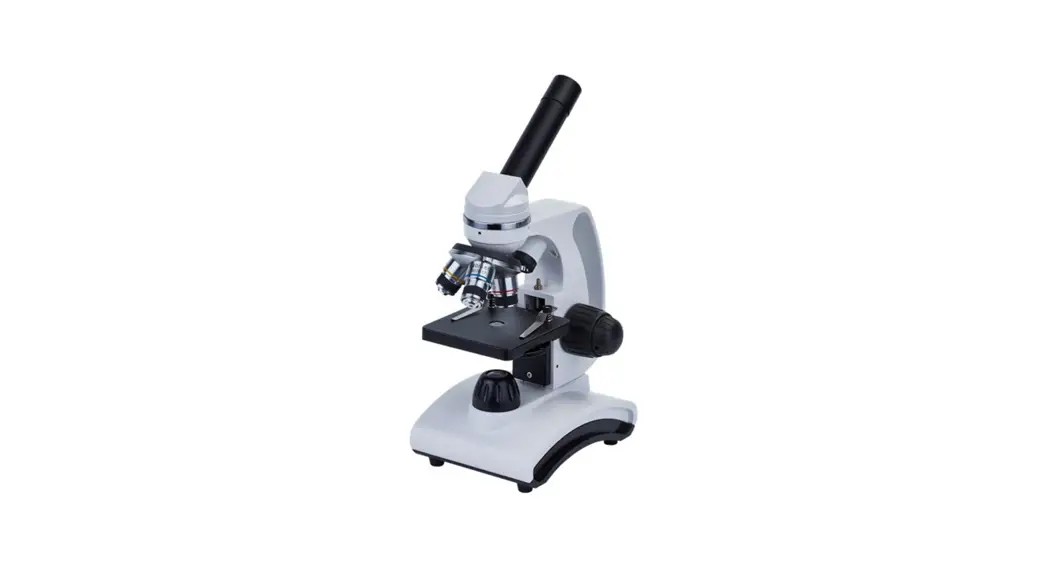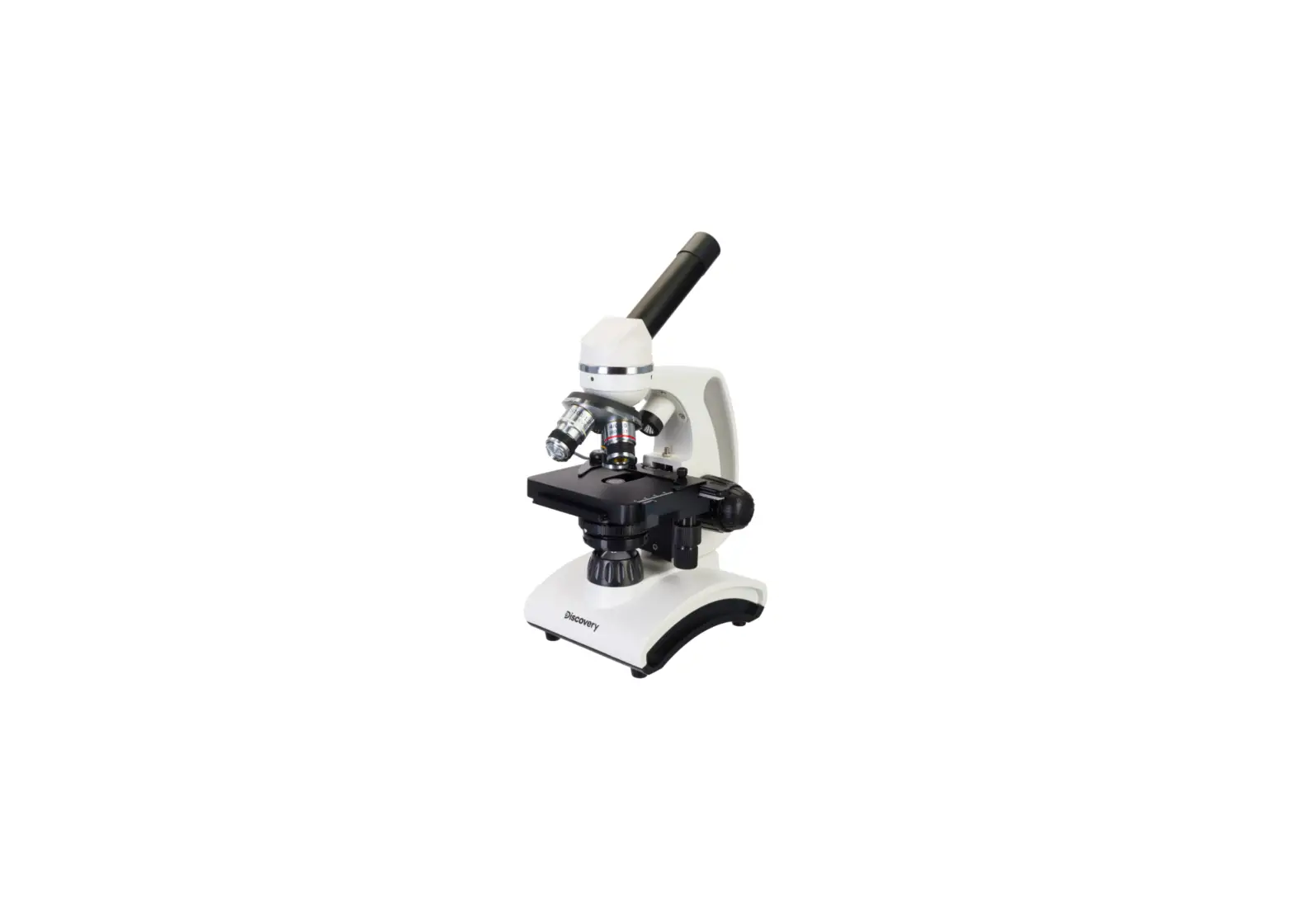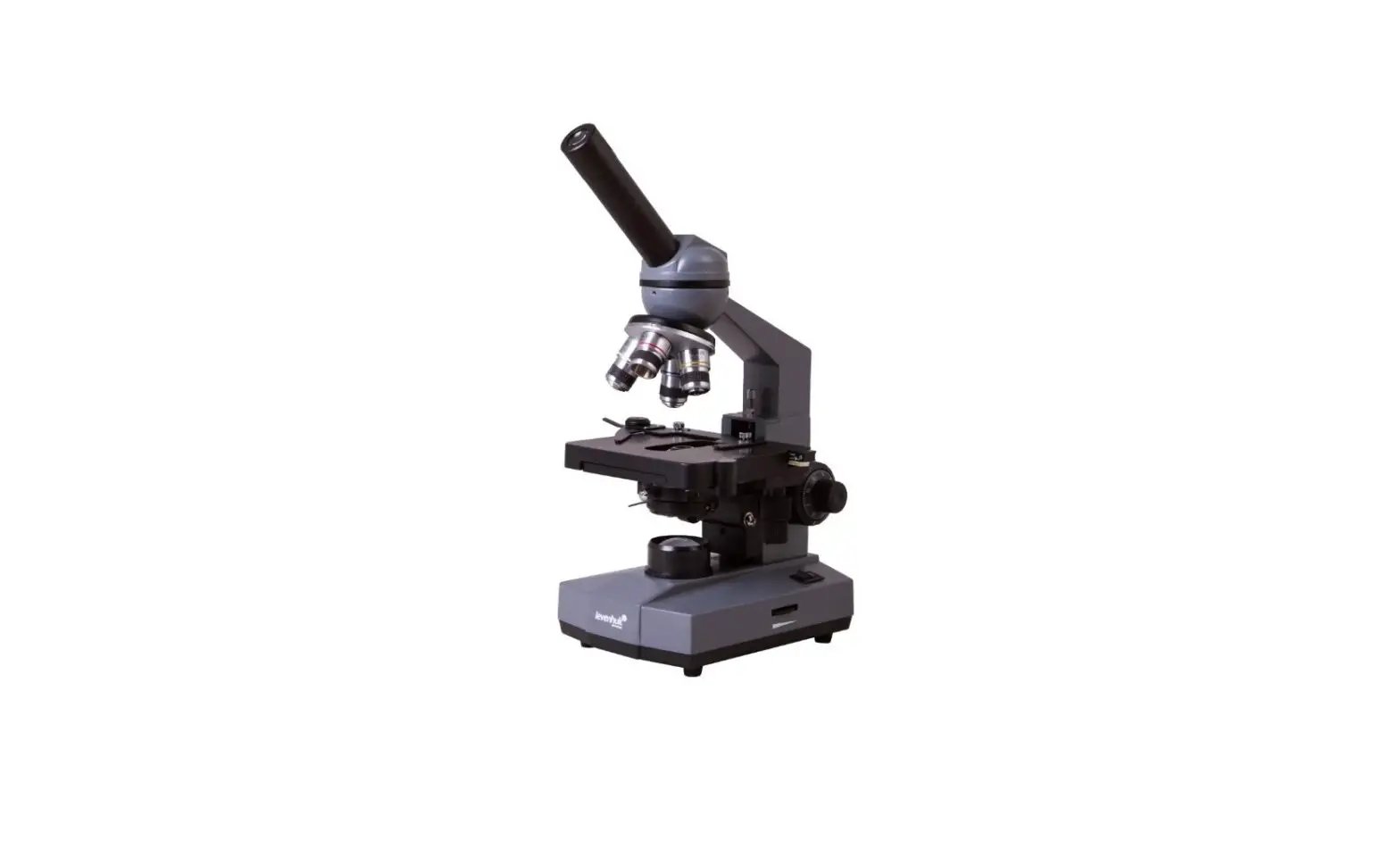
levenhuk 320 BASE Biological Microscopes User Manual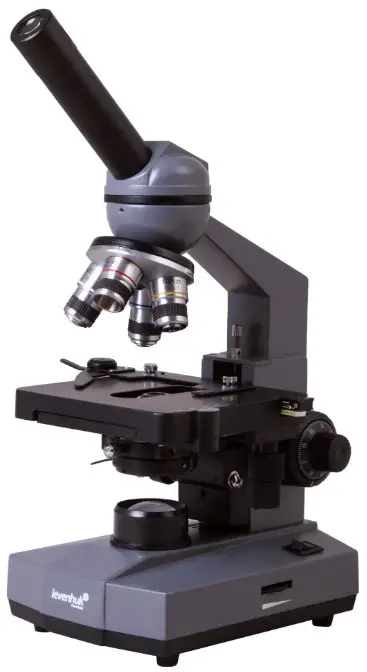
Overview
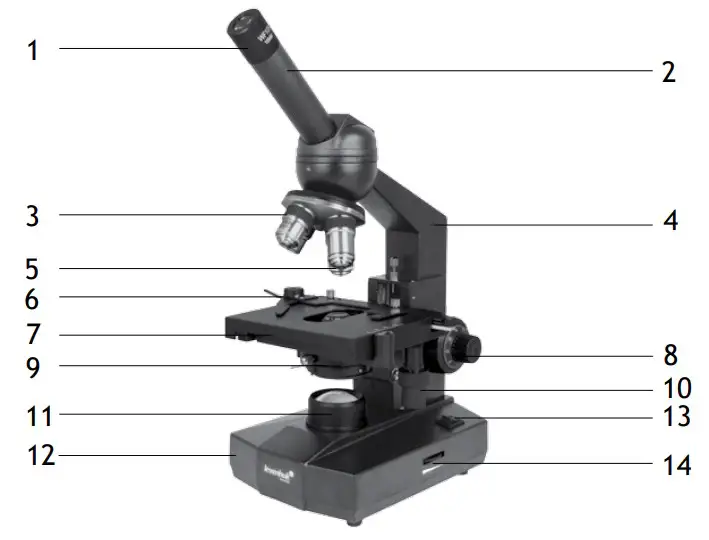
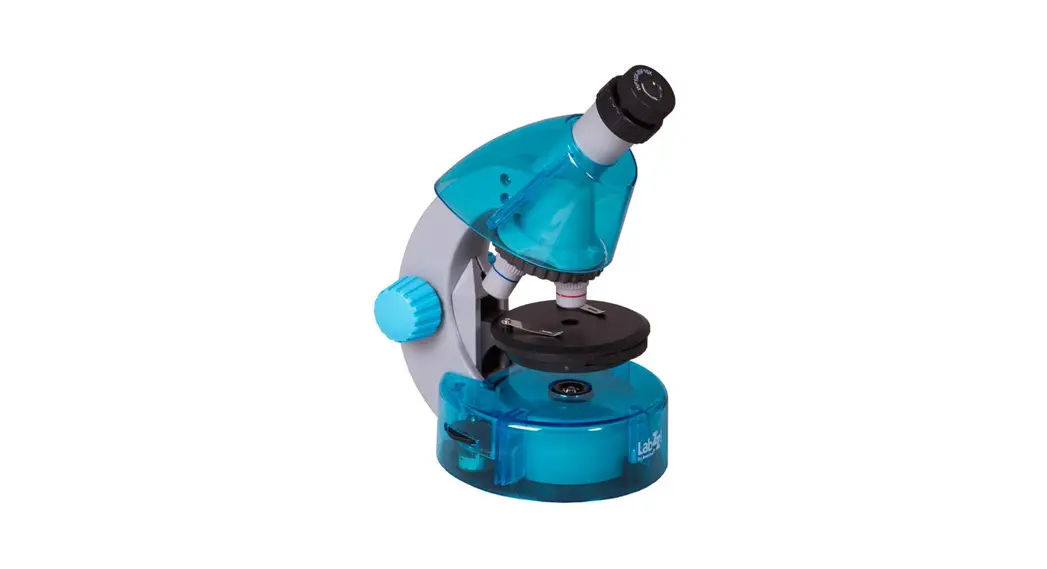
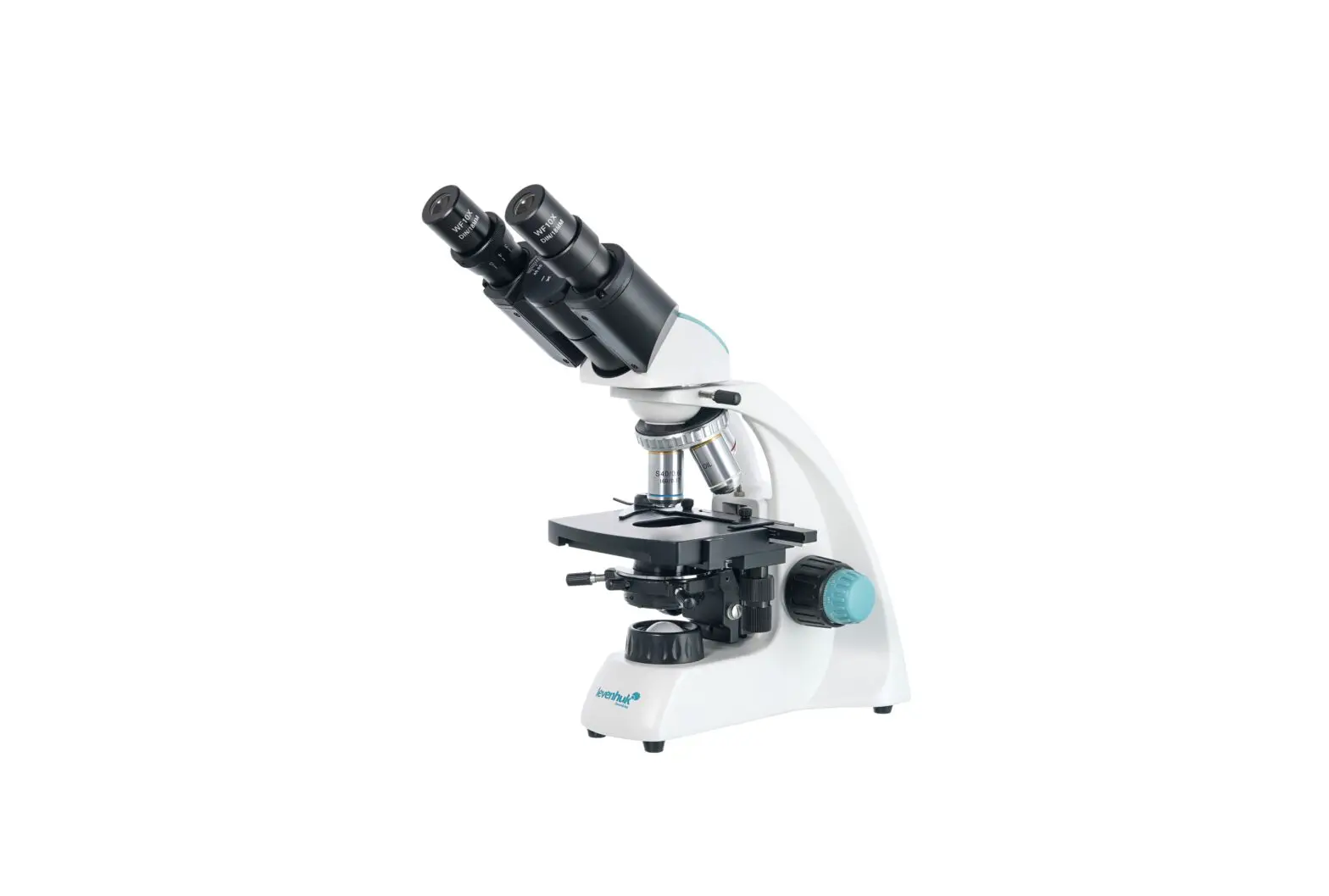
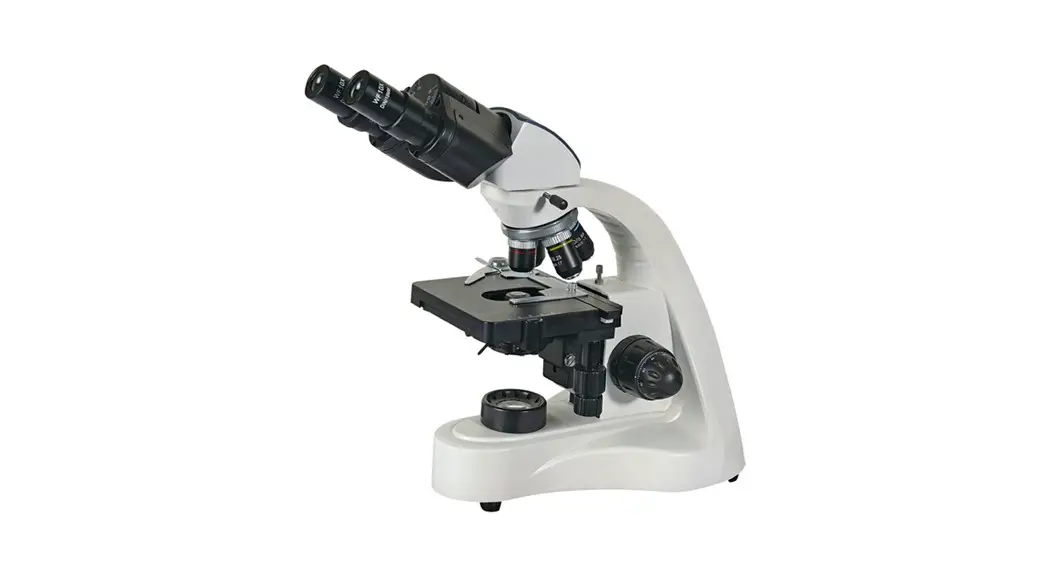
- Eyepiece
- Monocular head
- Revolving nosepiece
- Arm
- Objective lenses
- Mechanical scale
- Stage
- Focus adjustment knob
- Condenser
- Coaxial stage control
- Illumination
- Base
- Illumination switch
- Brightness adjustment wheel
Caution: Please refer to the specifications table for the correct mains voltage and never attempt to plug a 110V device into 220V outlet and vice versa without using a converter. Remember that mains voltage in the U.S. and Canada is 110V and 220–240V in most European countries.
Never, under any circumstances, look directly at the Sun, another bright source of light or at a laser through this device, as this may cause PERMANENT RETINAL DAMAGE and may lead to BLINDNESS.
General use
Levenhuk 320 series biological microscopes are designed for observations of specimens in the transmitted light. They are used in many scientific fields, including biology, ecology, medicine and veterinary science, as well as for technological research and school presentations.
Microscope parts
Base. It houses the illumination source, electronics, and control mechanisms.
Arm. This piece holds the base, the stage and the head of the microscope together.
Rack-and-pinion mechanism. The stage with the condenser are mounted on the arm and are moving vertically along it. Coarse and fine focus systems provide for smooth vertical movements of the stage. For additional precision, a condenser may be adjusted separately.
Head. A monocular head is mounted at a 45° angle at the upper end of the arm and is 360° rotatable.
Eyepieces and objectives. Consist of lenses that allow magnifying the image. High-quality achromatic objectives with 4x, 10x, 40x and 100x magnifications provide for sharp and bright images. The total magnification is calculated by multiplying the eyepiece magnification to the objective magnification.
Revolving nosepiece. The quadruple revolving nosepiece allows you to change objectives smoothly and easily.
Stage. Sturdy and reliable stage with a specimen holder and mechanical scale can be used to move your slides while observing them. The lower illumination light passes through the opening in the middle of the stage.
Condenser. Abbe condenser, 1.25 N.A. iris diaphragm is a system of lenses located below the stage that allows gathering and directing the light rays.
Focusing knob. A coarse and fine focusing system allows moving the stage up and down adjusting the image sharpness.
Lower illumination. Illumination with adjustable brightness allows observing transparent objects.
The illumination system can be powered by batteries or an AC power supply
Using the microscope
Getting started
- Unpack the microscope and make sure all parts are available.
- Move the stage to the lowermost position using the focusing knob.
- Connect the microscope to AC power using the AC adapter. Levenhuk 320 PLUS microscopes can be operated in standalone mode. To do this, you need to insert the batteries in the battery compartment ensuring to match the proper polarity markings.
- Turn on the illumination or adjust the reflector to evenly illuminate the specimen within the field of view.
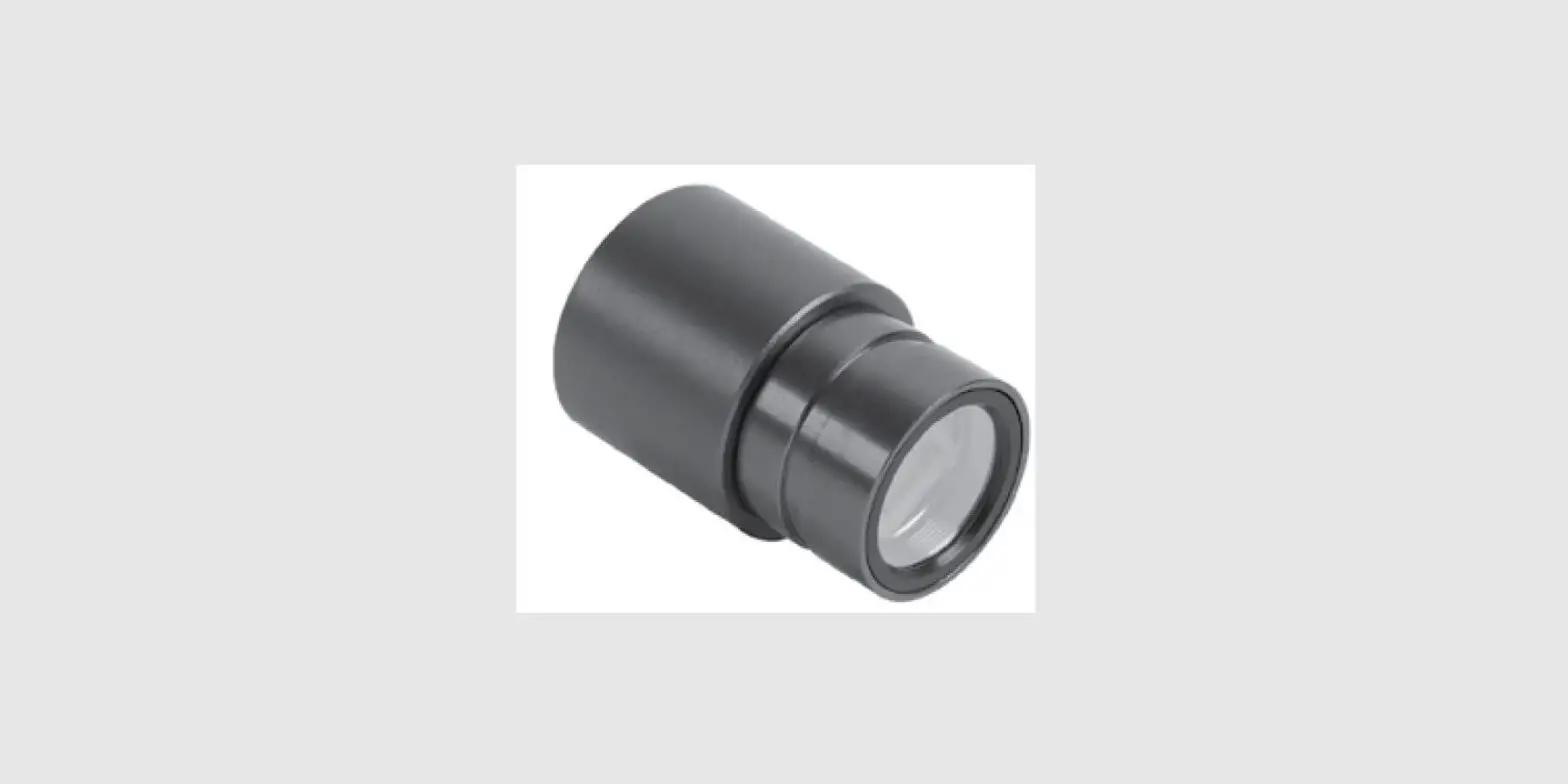
- Insert the eyepiece into the eyepiece tube.
- Slowly adjust the illumination brightness, from dark to light. When you finish your observations, always dim the illumination before unplugging the power cable.
- If you need to change the light bulb, unplug your microscope first.
Focusing
- Place a specimen on the stage and fix it with the holders.
- Select the 4x objective rotating the revolving nosepiece.
- Center the observed specimen in the field of view.
- Rotate the focusing knob to slowly raise the stage until the objective is close to the specimen; keep checking the distance between the objective and the object to avoid their contact.
CAUTION: The objective should not touch the specimen, otherwise the objective or/ and the specimen might be damaged. - Look through the installed eyepiece and lower the stage slowly rotating the focusing knob until you see the sharp image of the observed specimen.
- Such adjustment protects the frontal lens from contacting the object when you use objectives of other magnifications; though, slight refocusing might be required.
- If the image is too bright, adjust the diaphragm disk until the passing light ray is reduced to a comfortable brightness level. If the image is too dark, increase the light ray.
Selecting the objective
- Start your observations with the lowest magnification objective (4x) and select a specimen segment for detailed research. Then move the specimen to center the selected segment in the field of view, to make sure it keeps centered when the objective is changed to a more powerful one. Once the segment is selected, you should center its image in the microscope’s field of view as precisely as possible. Otherwise, the desired segment might fail to center in the field of view of the higher power objective.
- Now you can switch to a more powerful objective by rotating the revolving nosepiece. Adjust the image focus, the iris diaphragm and the illumination brightness if required.
- When using a 100x objective lens, you have to fill the space between the lens and the specimen with immersion oil. There should be no air bubbles in the oil, as they might reduce the resulting quality of the image. Do not use any substitutes for the immersion oil, as this will significantly reduce the quality of the resulting image. When you are finished observing, clean the immersion oil with a cloth or filter paper. If the objective lens is stained, you can clean it with a cotton pad dipped in isopropyl alcohol. Do not apply any excessive pressure, as you may damage the objective lens!
Digital camera
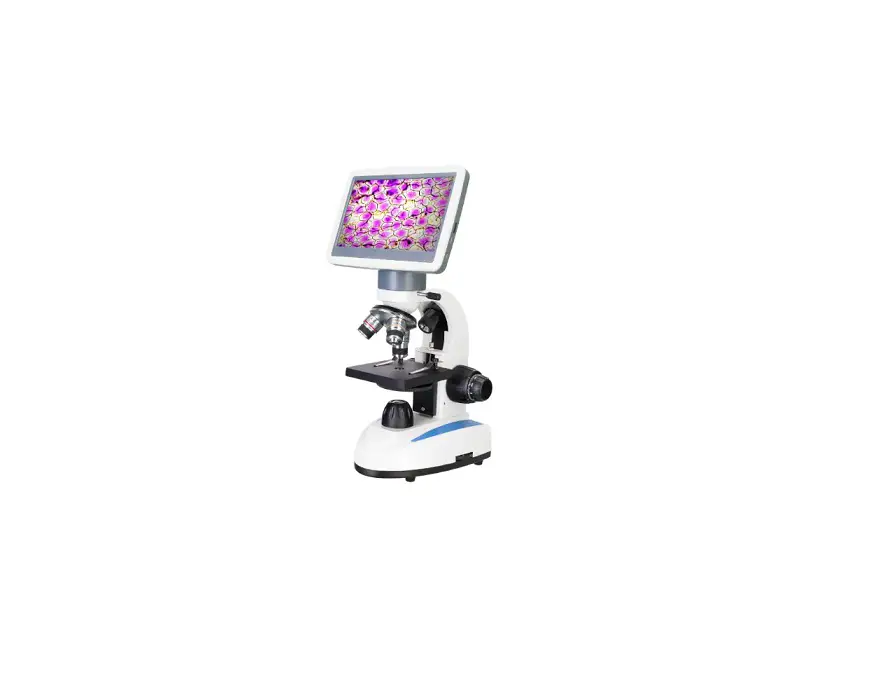
Levenhuk D320L BASE and D320L PLUS come with a digital camera. The digital camera is installed in the eyepiece tube in place of the eyepiece. It allows you to observe specimens in fine detail and true colors on your PC monitor and save images on the hard drive. Connect the camera to your PC via a USB-cable that also acts as a power cable.
Microscopes specifications
| 320 BASE | D320L BASE | 320 PLUS | D320L PLUS | |
| Type | biological | biological, digital | biological | biological, digital |
| Optics material | optical glass | |||
| Head | monocular, inclined at 45°, 360° rotatable | |||
| Eyepiece tube diameter | 23.2mm | |||
| Magnification | 40–1000x | 40–1600x | ||
| Revolving nosepiece | quadruple | |||
| Objective lenses | achromatic 4x/0.1, 10x/0.25, 40x/0.65, 100x/1.25 (oil immersion) | |||
| Eyepieces | WF10x | WF10x with pointer, WF16x with pointer | ||
| Condenser | Abbe N.A. 1.25 with iris diaphragm | |||
| Illumination | halogen lamp 20W, lower illumination with brightness adjustment | LED 0.75W, lower illumination with brightness adjustment | ||
| Focus system | coaxial with coarse (20mm) and fine (0.02mm) adjustment | |||
| Stage | double layer mechanical stage with mechanical scale, 110×125mm | |||
| Body material | metal | |||
| Power supply | 110V, 50Hz | 110V, 50Hz or three AA batteries | ||
| Filters | blue | blue, yellow, green | ||
| Immersion oil | yes | |||
| Dust cover | yes | |||
| Digital camera | no | yes | no | yes |
Digital cameras specifications
| D320L BASE Digital camera | D320L PLUS Digital camera | |
| Max. resolution (for still images) | 2048×1536px | |
| Megapixels | 3 | 3.1 |
| Sensor | 1/2.7 | 1/2 |
| Pixel size | 2.2×2.2μm | 3.2×3.2μm |
| Mounting location | eyepiece tube (replaces the eyepiece) | |
| Image format | *.jpg, *.bmp, *.png, etc. | |
| Spectral range | 380–650nm | 400–650nm |
| Exposure | ERS | |
| Software image control | image size, brightness | image size, brightness, exposure control |
| Interface | USB 2.0, 480Mb/s | |
| System requirement | Windows XP (32-bit), Windows Vista/7/8/10/11 (32-bit or 64-bit), Mac OS X, Linux, CPU IntelCore 2 or above; RAM 2GB, USB port 2.0, CD-ROM | Windows XP (32-bit), Windows Vista/7/8/10/11 (32-bit or 64-bit), Mac OS X, Linux, CPU IntelCore 2 or above; RAM 2GB, USB port 2.0, CD-ROM |
| USB cable | yes | |
| Software CD | yes | |
| Camera adapter | no | yes |
The manufacturer reserves the right to make changes to the product range and specifications without prior notice.
Care and maintenance
Never, under any circumstances, look directly at the Sun, another bright source of light or at a laser through this device, as this may cause PERMANENT RETINAL DAMAGE and may lead to BLINDNESS. Take necessary precautions when using the device with children or others who have not read or who do not fully understand these instructions. After unpacking your microscope and before using it for the first time check for integrity and durability of every component and connection. Do not try to disassemble the device on your own for any reason. For repairs and cleaning of any kind, please contact your local specialized service center. Protect the device from sudden impact and excessive mechanical force. Do not apply excessive pressure when adjusting focus. Do not overtighten the locking screws. Do not touch the optical surfaces with your fingers.
To clean the device exterior, use only special cleaning wipes and special optics cleaning tools from Levenhuk. Do not use any corrosive or acetone-based fluids to clean the optics. Abrasive particles, such as sand, should not be wiped off lenses, but instead blown off or brushed away with a soft brush. Do not use the device for lengthy periods of time, or leave it unattended in direct sunlight. Keep the device away from water and high humidity. Be careful during your observations, always replace the dust cover after you are finished with observations to protect the device from dust and stains. If you are not using your microscope for extended periods of time, store the objective lenses and eyepieces separately from the microscope. Store the device in a dry, cool place away from hazardous acids and other chemicals, away from heaters, open fire and other sources of high temperatures. When using the microscope, try not to use it near flammable materials or substances (benzene, paper, cardboard, plastic, etc.), as the base may heat up during use, and might become a fire hazard. Always unplug the microscope from a power source before opening the base or changing the illumination lamp. Regardless of the lamp type (halogen or incandescent), give it some time to cool down before trying to change it, and always change it to a lamp of the same type. Always use the power supply with the proper voltage, i.e. indicated in the specifications of your new microscope. Plugging the instrument into a different power outlet may damage the electric circuitry of the microscope, burn out the lamp, or even cause a short circuit. Children should use the device under adult supervision only. Seek medical advice immediately if a small part or a battery is swallowed.
Battery safety instructions
Always purchase the correct size and grade of battery most suitable for the intended use.
Always replace the whole set of batteries at one time; taking care not to mix old and new ones, or batteries of different types. Clean the battery contacts and also those of the device prior to battery installation. Make sure the batteries are installed correctly with regard to polarity (+ and –). Remove batteries from equipment that is not to be used for an extended period of time. Remove used batteries promptly. Never short-circuit batteries as this may lead to high temperatures, leakage, or explosion. Never heat batteries in order to revive them. Do not disassemble batteries. Remember to switch off devices after use. Keep batteries out of the reach of children, to avoid risk of ingestion, suffocation, or poisoning. Utilize used batteries as prescribed by your country’s laws.
Levenhuk International Lifetime Warranty
All Levenhuk telescopes, microscopes, binoculars, and other optical products, except for their accessories, carry a lifetime warranty against defects in materials and workmanship. A lifetime warranty is a guarantee on the lifetime of the product on the market. All Levenhuk accessories are warranted to be free of defects in materials and workmanship for six months from the purchase date. The warranty entitles you to the free repair or replacement of the Levenhuk product in any country where a Levenhuk office is located if all the warranty conditions are met.
For further details, please visit: www.levenhuk.com/warranty
If warranty problems arise, or if you need assistance in using your product, contact the local Levenhuk branch.
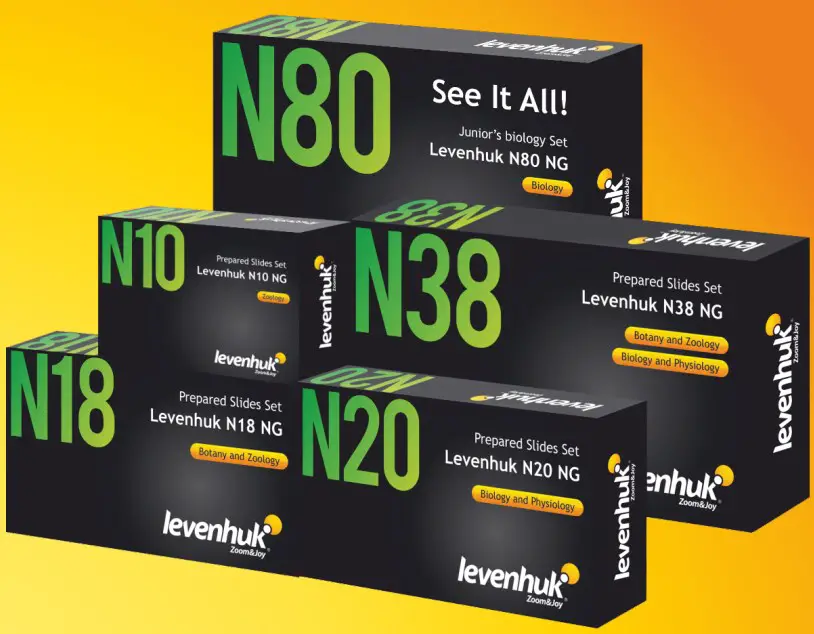
Levenhuk prepared slides sets
The Levenhuk slides sets include thoroughly prepared specimens of various biomaterials as well as blank slides and cover glasses for you to make your own specimens.
Prepared slides, blank slides and cover slips can be used with any microscope model.
Levenhuk Worldwide:
USA: www.levenhuk.com
Azerbaijan: www.levenhuk.az
Bulgaria: www.levenhuk.bg
Canada: www.levenhuk.ca
Czech Rep.: www.levenhuk.cz
Estonia: www.levenhuk.ee
Finland: fi.levenhuk.com
Germany: www.levenhuk.de
Hungary: www.levenhuk
Iceland: www.levenhuk.is
India: www.levenhuk.in
Italy: www.levenhuk.it
Latvia: www.levenhuk.lv
Lithuania: www.levenhuk.lt
Netherlands: www.levenhuk.nl
Poland: www.levenhuk.pl
Romania: www.levenhuk.ro
Russia: www.levenhuk.ru
Slovakia: www.levenhuk.sk
Spain: www.levenhuk.es
Turkey: www.levenhuk.tr
Ukraine: www.levenhuk.ua
United Kingdom: www.levenhuk.uk
EU: www.levenhuk.eu
Levenhuk Inc. (USA): 928 E 124th Ave. Ste D, Tampa, FL 33612,
USA, +1 813 468-3001, contact_[email protected]
Levenhuk Optics s.r.o. (Europe): V Chotejně 700/7, 102 00 Prague 102,
Czech Republic, +420 737-004-919, [email protected]
Levenhuk® is a registered trademark of Levenhuk, Inc.
© 2006—2023 Levenhuk, Inc. All rights reserved. 20230313

References
 Levenhuk’s Official Finland Website!
 Официален уебсайт на Levenhuk в България
-
Доживотна гаранция на Levenhuk – Официален уебсайт на Levenhuk в България
-
Levenhuk optical instruments store | Levenhuk - best optical equipment
-
Levenhuk lifetime warranty details | Levenhuk - best optical equipment
-
Oficiální webové stránky Levenhuk pro Českou republiku
-
Doživotní záruka společnosti Levenhuk – Oficiální webové stránky Levenhuk pro Českou republiku
-
Die offizielle Website von Levenhuk in Deutschland
-
Levenhuk Lebenslange Garantie – Die offizielle Website von Levenhuk in Deutschland
-
Compre desde el sitio web oficial de Levenhuk en España
-
Garantía internacional de por vida Levenhuk – Compre desde el sitio web oficial de Levenhuk en España
-
Levenhuk’s official website in Europe
-
Levenhuk Lifetime Warranty – Levenhuk’s official website in USA
-
A Levenhuk élettartamra szóló szavatossága – A Levenhuk hivatalos magyarországi weboldala
-
Levenhuk’s official website in Europe
-
Sito web ufficiale di Levenhuk in Italia
-
Skyhunters Europe
-
SkyHunters
-
Levenhuk’s official website in Europe
-
Oficjalna witryna internetowa Levenhuk w Polsce
-
Gwarancja bezterminowa Levenhuk – Oficjalna witryna internetowa Levenhuk w Polsce
-
Официальный сайт Левенгук
-
Поддержка - Гарантийное обслуживание Левенгук - Levenhuk Russia
-
Optický přístroj Levenhuk - online prodejna optických přístrojů
-
Интернет-магазин оптических приборов
-
Levenhuk’s official website in Europe
 Levenhuk’s Official Finland Website!
 Официален уебсайт на Levenhuk в България
 Levenhuk optical instruments store | Levenhuk - best optical equipment
 Oficiální webové stránky Levenhuk pro Českou republiku
 Die offizielle Website von Levenhuk in Deutschland
 Compre desde el sitio web oficial de Levenhuk en España
 Levenhuk’s official website in Europe
 A Levenhuk élettartamra szóló szavatossága – A Levenhuk hivatalos magyarországi weboldala
 Levenhuk’s official website in Europe
 Sito web ufficiale di Levenhuk in Italia
 Skyhunters Europe
 SkyHunters
 Levenhuk’s official website in Europe
 Oficjalna witryna internetowa Levenhuk w Polsce
 Официальный сайт Левенгук
 Optický přístroj Levenhuk - online prodejna optických přístrojů
 Интернет-магазин оптических приборов
 Levenhuk’s official website in Europe