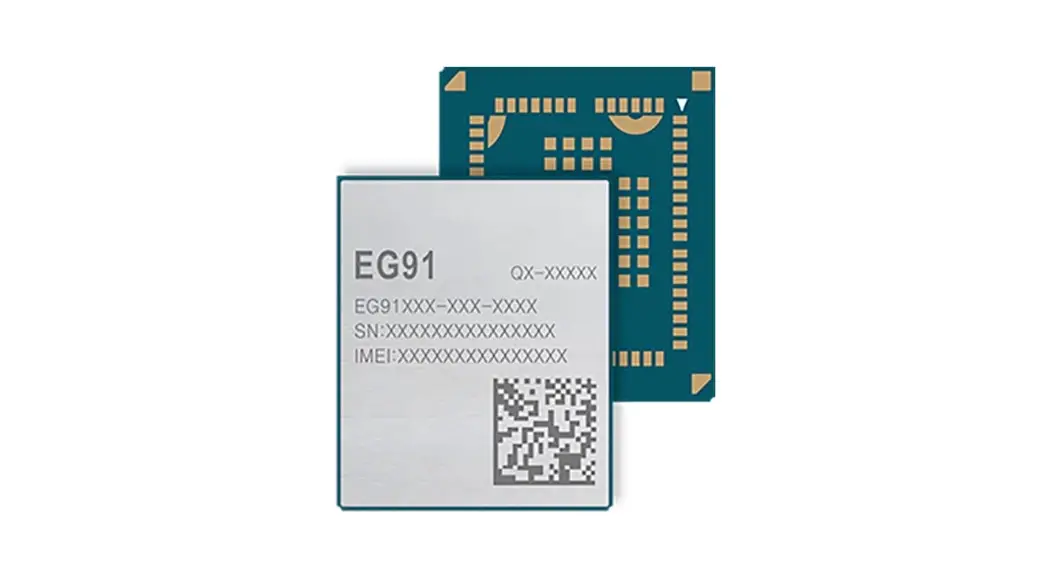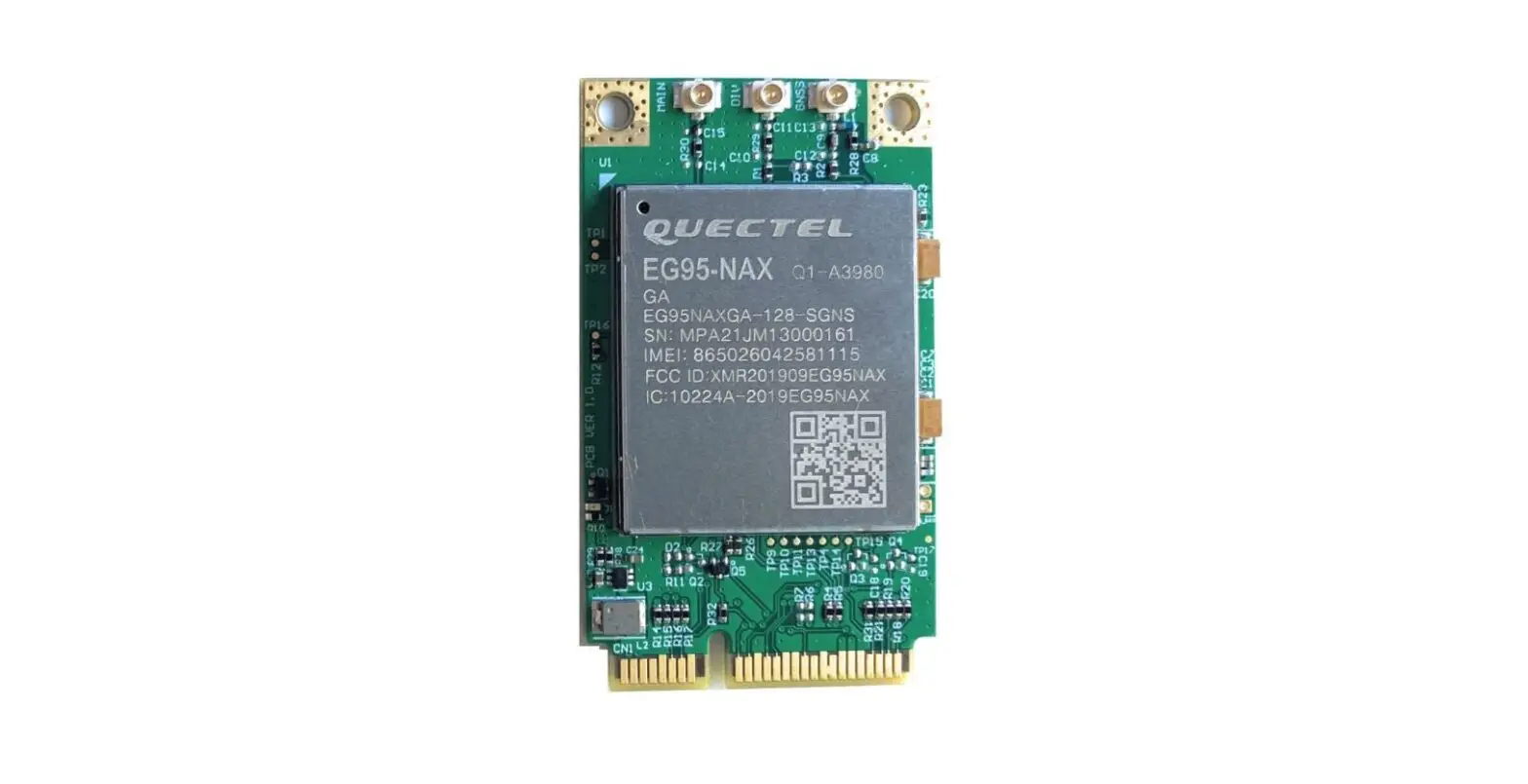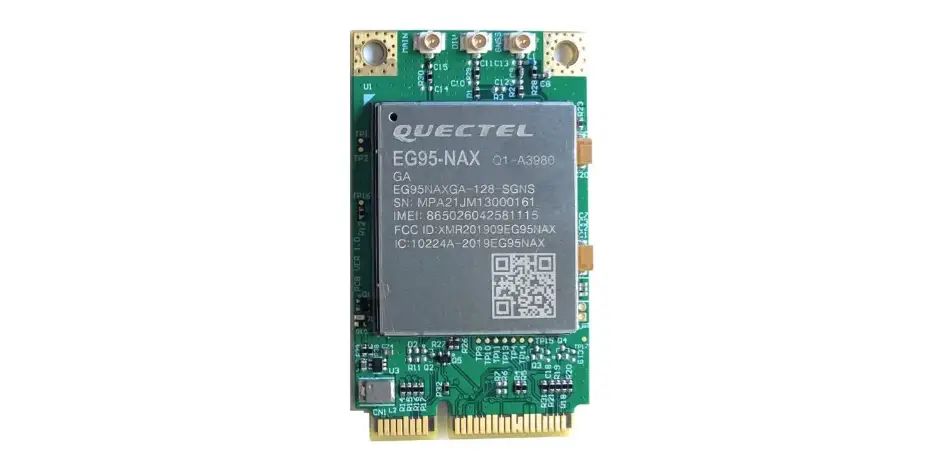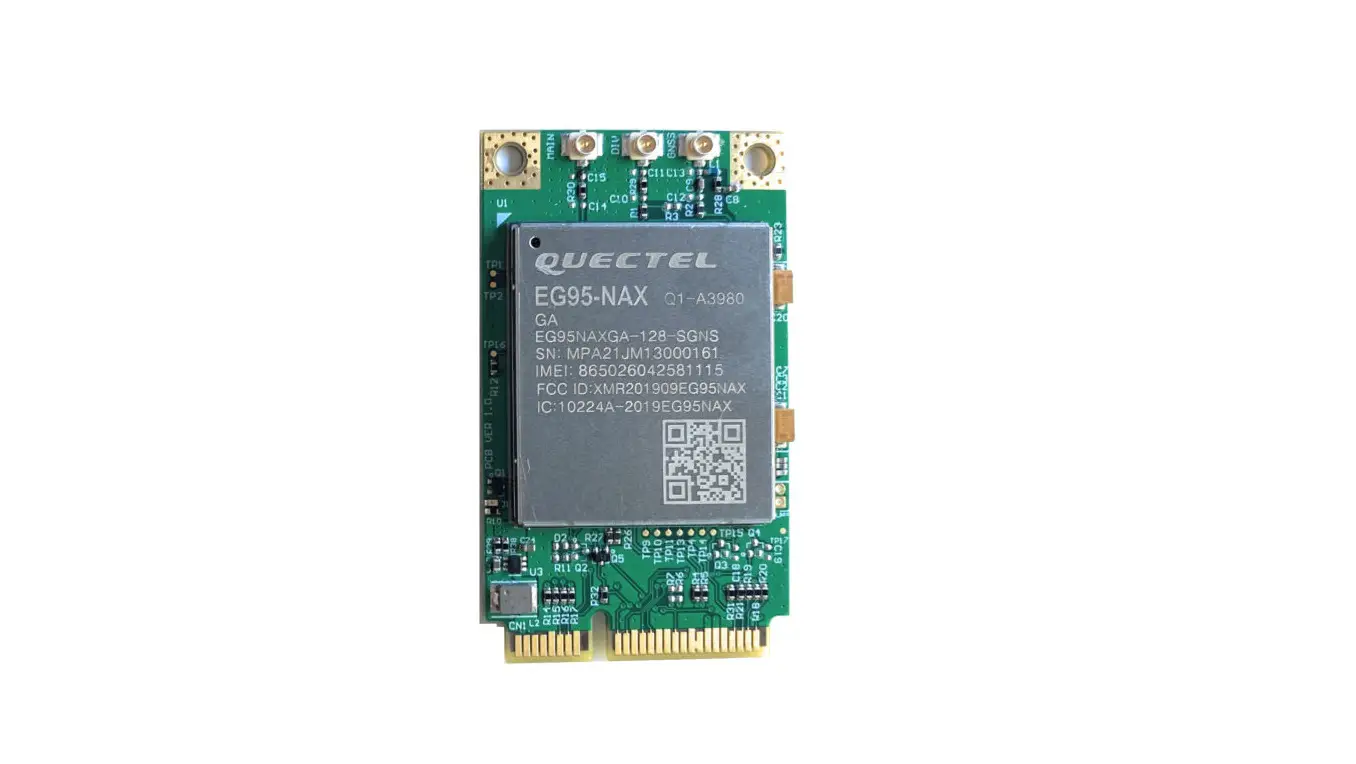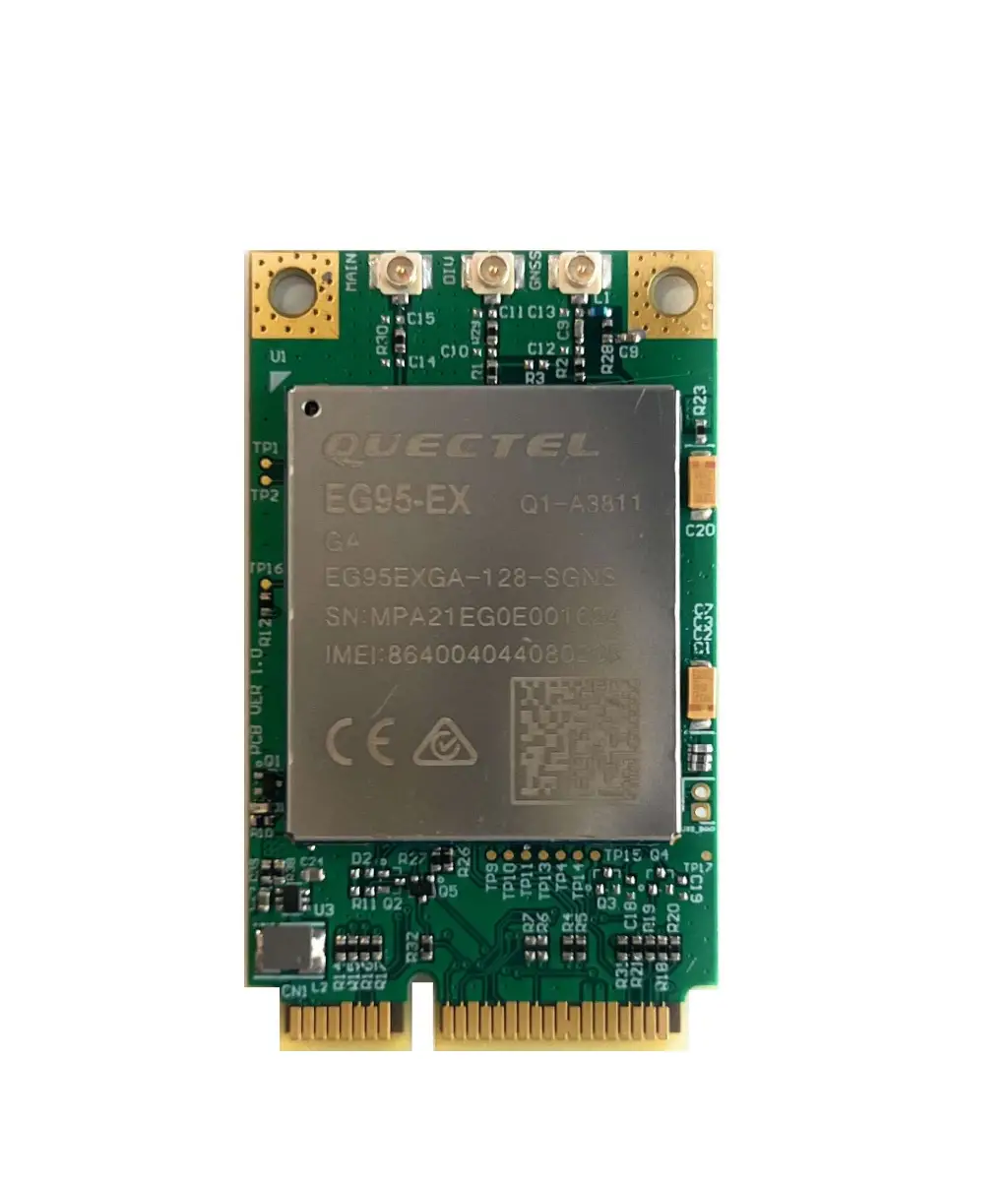
5G HUB TECHNOLOGIES EG95-EX LTE CAT 4 miniPCIe Module
Purpose of the Document
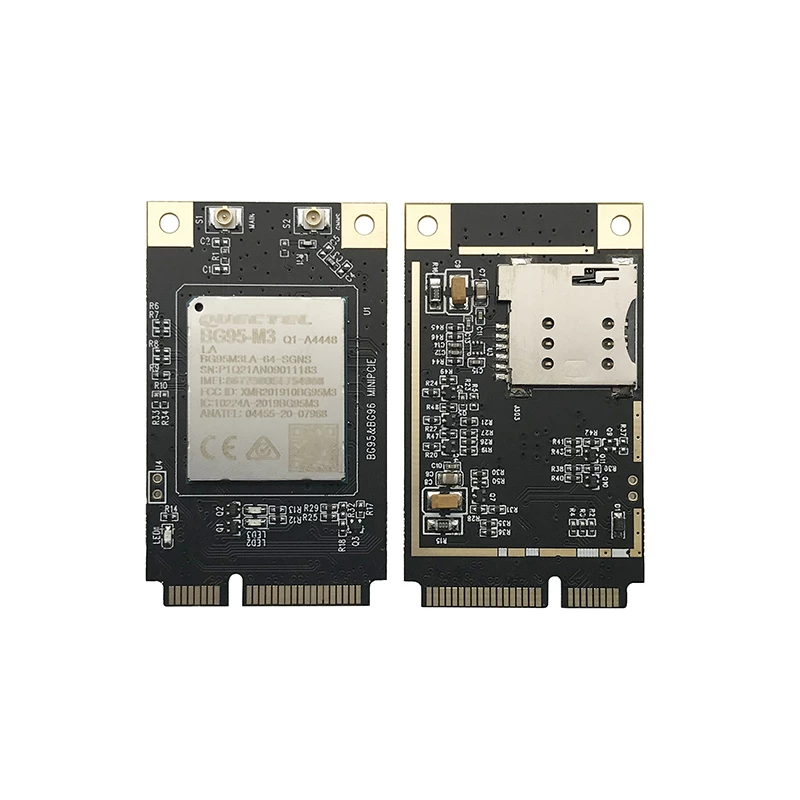
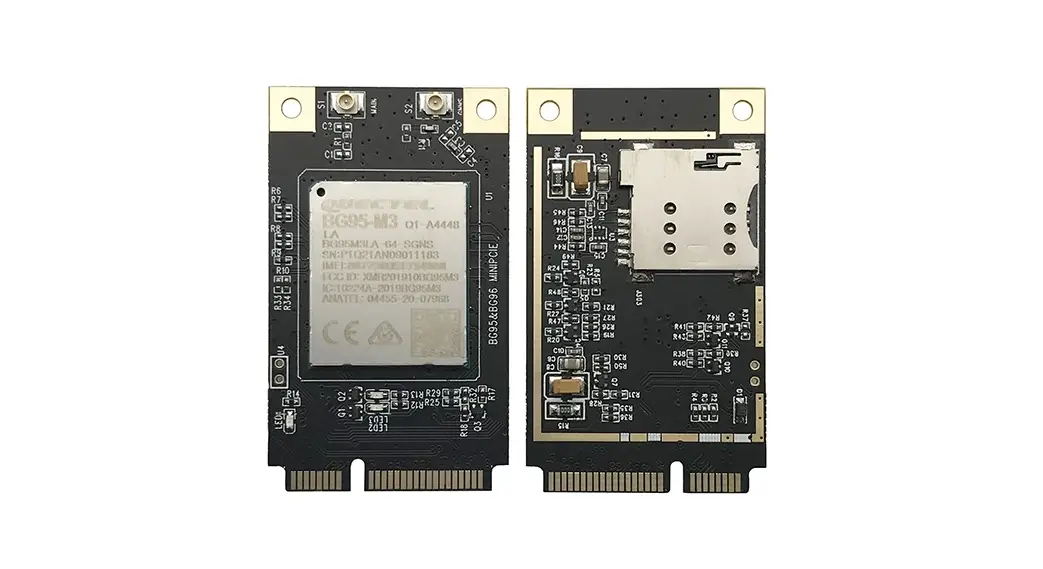
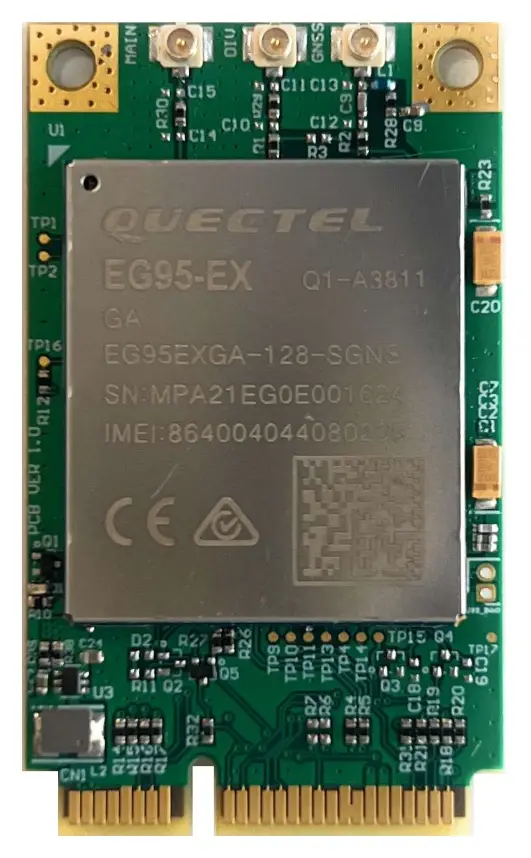
The purpose of this document is to explain the technical specifications and manual for using the miniPCIe EG95-EX LTE Cat 4 module for Europe, Middle East, and Africa.
Document History
| Version | Author | Date | Description |
| A | 5G HUB | 07.01.2022 | Initial Document |
Package Content
LTE Cat 4 miniPCIe Package:
- EG95-EX miniPCIe card.
Download
Download and Install LTE&GNSS modem driver for Windows OS: https://github.com/5ghub/5G-NB-IoT/tree/master/Driver
Download and Install QNavigator and QCOM tools for Quectel EG91 here: https://github.com/5ghub/5G-NB-IoT/tree/master/Tools
Arduino software can be downloaded from the following website: 5G-NB-IoT/KitSketches at master · 5ghub/5G-NB-IoT (github.com)
To use the board with Arduino IDE and starts running Arduino projects and sketches, install the following software:
Install Arduino IDE for Windows from the following web site https://www.arduino.cc/en/Main/Software
Download and install Arduino library (5G-NB-IoT_Arduino.zip) here: https://github.com/5ghub/5G-NB-IoT
All the following software can be installed from the GitHub location here: https://github.com/5ghub/5G-NB-IoT
General Description
Overview
EG95-EX miniPCIe is a series of LTE category 4 module for Europe, Middle East, and Africa adopting standard PCI Express Mini Card form factor (Mini PCIe). It is optimized specially for M2M and IoT applications and delivers 150Mbps downlink and 50Mbps uplink data rates.
EG95-EX miniPCIe supports Qualcomm® IZat™ location technology Gen8C Lite (GPS, GLONASS, BeiDou, Galileo and QZSS). The integrated GNSS greatly simplifies product design, and provides quicker, more accurate and more dependable positioning.
A rich set of Internet protocols, industry-standard interfaces, and abundant functionalities (USB serial drivers for Windows 7/8/8.1/10, Linux, Android) extend the applicability of the module to a wide range of M2M applications such as industrial router, industrial PDA, rugged tablet PC, video surveillance and digital signage
Key Features
- LTE category 4 module optimized for broadband IoT application
- Europe, Middle East, and Africa bands
- Worldwide LTE, UMTS/HSPA+ and GSM/GPRS/EDGE coverage
- Standard PCI Express® MiniCard form factor (miniPCIe) ideal for manufacturers to easily integrate wireless connectivity into their devices
- MIMO technology meets demands for data rate and link reliability in modem wireless communication systems
- Multi-constellation GNSS receiver available for applications requiring fast and accurate fixes in any environment
- LTE-FDD: B1/B3/B7/B8/B20/B28
- WCDMA: B1/B8
- GSM: B3/B8
Data Rate
- LTE
LTE FDD: Max 150Mbps (DL)/Max 50Mbps (UL) - UMTS:
DC-HSDPA: Max 42Mbps (DL)
HSUPA: Max 5.76Mbps (UL) - WCDMA:
Max 384Kbps (DL)/Max 384Kbps (UL) - GSM:
EDGE: Max 296Kbps (DL)/Max 236.8Kbps (UL)
GPRS: Max 107Kbps (DL)/Max 85.6Kbps (UL)
Interfaces
- USB 2.0 with High Speed up to 480Mbps
- Digital Audio through PCM
- 1.8V/3.0V (U)SIM Interface
- LED_WWAN# for Network Status Indication
- W_DISABLE# for Disabling RF Function
- UART × 1
- PERST# for Module Resetting
- Solder Pads for Main Antenna, Rx-diversity and GNSS Antennas
Software Features
- USB Serial Driver:
Windows 7/8/8.1/10, Linux 2.6/3.x/4.1~4.15,
Android 4.x/5.x/6.x/7.x/8.x/9.x - RIL Driver:
Android 4.x/5.x/6.x/7.x/8.x/9.x - NIDS Driver:
Windows 7/8/8.1/10 - ECM Driver*③:
Linux 2.6/3.x/4.1~4.15 - Gobinet Driver:
Linux 2.6/3.x/4.1~4.15 - Linux qmi wwan Driver:
3.x (3.4 or later)/4.1~4.15
Protocols
- TCP/UDP/PPP/FTP/FTPS/HTTP/HTTPS/NTP/PING/QMI/NITZ/MMS/SMTP/SSL/MQTT/FILE/CMUX */SMTPS*
General Features
- Temperature Range: -40°C ~ +80°C
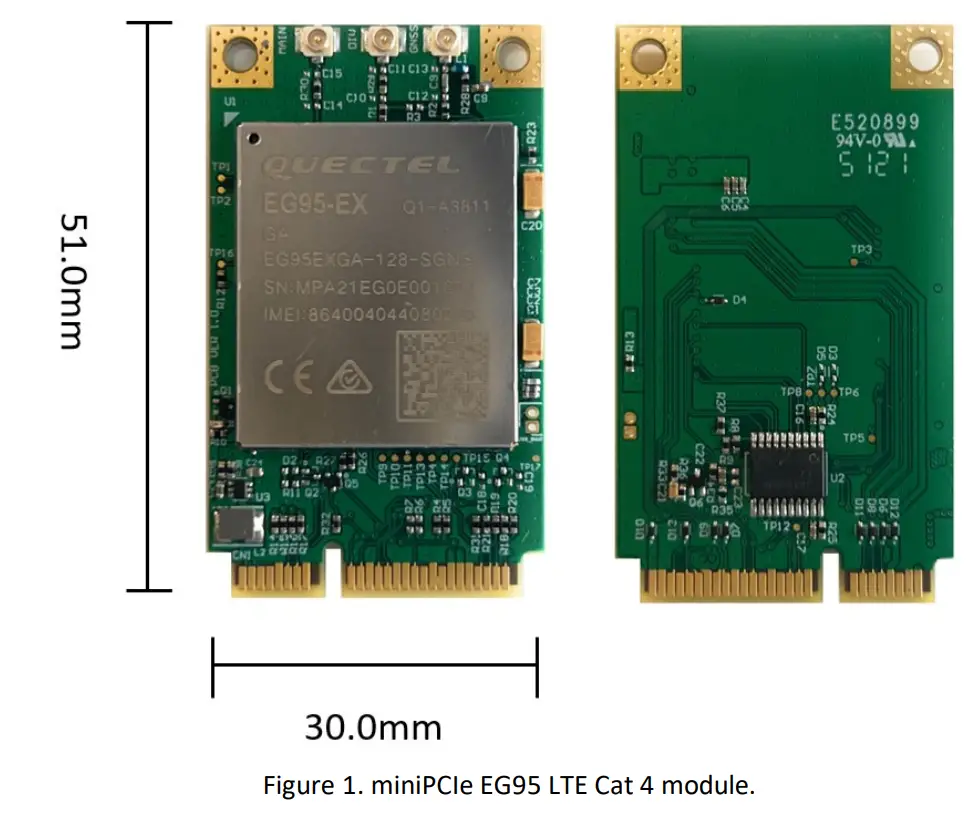
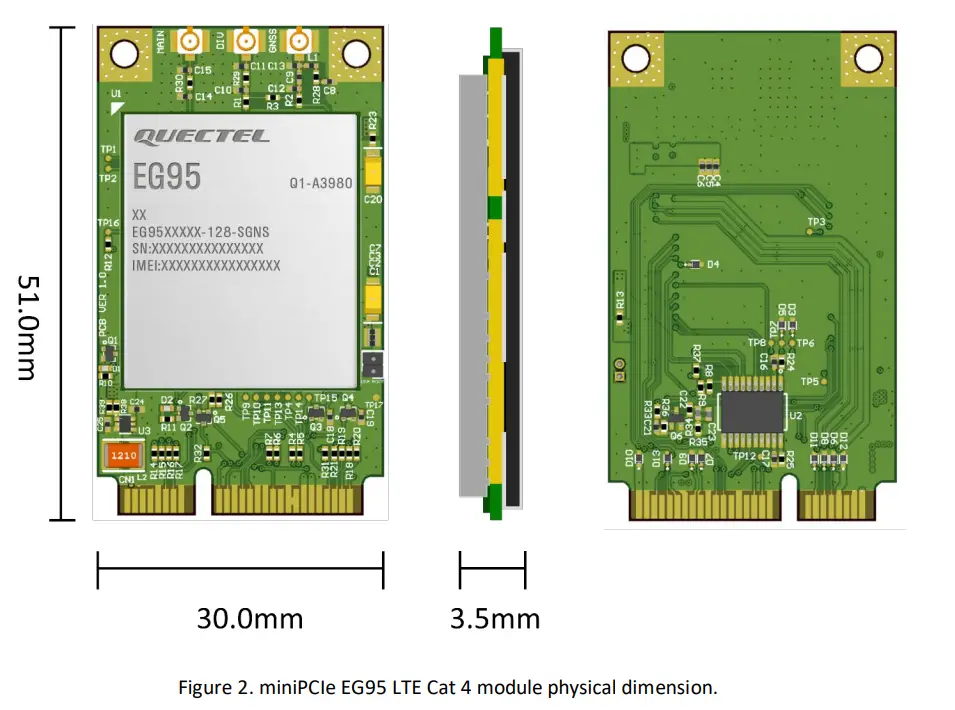
- Dimensions: 30.0mm x 51.0mm x 3.5mm
- Weight: Approx. 9.8g
- Mini PCIe Package
- Supply Voltage: 3.0V~3.6V, 3.3V Typ.
- Bandwidth: 1.4/3/5/10/15/20MHz
- 3GPP TS 27.007
Approvals
- Carrier:
Vodafone (Global)
Deutsche Telekom/Telefónica (Europe)
Verizon/AT&T/T-Mobile/U.S. Cellular (North America)
Rogers/Bell*/Telus* (Canada)
SKT/KT*/LGU+* (South Korea)
NTT DOCOMO/SoftBank/KDDI (Japan) - Regulatory:
GCF (Global)
CE (Europe)
FCC/PTCRB (North America)
IC (Canada)
Anatel (Brazil)
KC (South Korea)
NCC (Taiwan)
JATE/TELEC (Japan)
RCM (Australia/New Zealand)
FAC (Russia)
NBTC (Thailand)
ICASA (South Africa)
Others:
RoHS Compliant
WHQL
Overview Diagrams
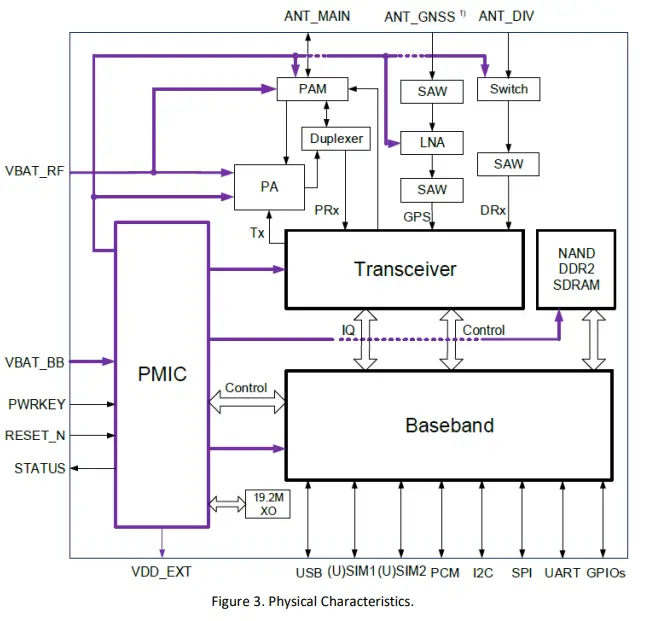
Functional Diagram
The following figure shows the block diagram of EG91 Mini PCIe.
miniPCIe PIN Diagram and Assignment
The physical connections and signal levels of EG91 miniPCIe comply with PCI Express Mini Card Electromechanical Specification.
- Power supply
- (U)SIM interface
- USB interface
- UART interfaces
- PCM and I2C interfaces
- Control and indication pins
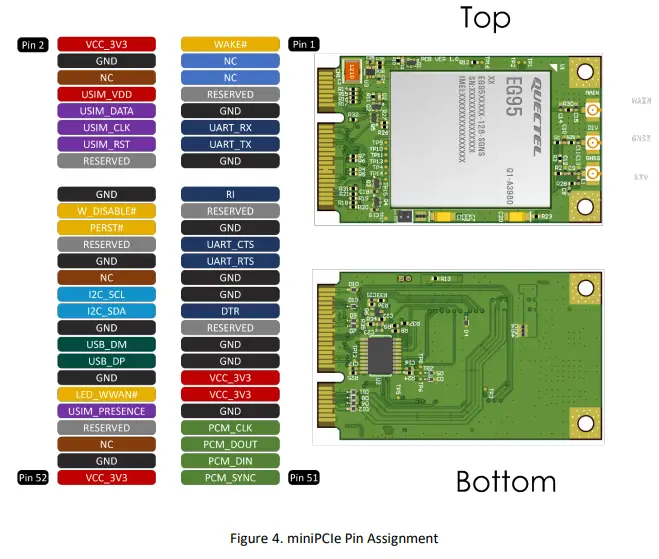
Pin Description
| 6 | NC | Not connected | |
| 7 | RESERVED | Reserved | |
| 8 | USIM_VDD | O | Power supply for the (U)SIM card |
| 9 | GND | ||
| 10 | USIM_DATA | I | Data signal of (U)SIM card |
| 11 | UART_RX | I | UART receive data |
| 12 | USIM_CLK | O | Clock signal of (U)SIM card |
| 13 | UART_TX | O | UART transmit data |
| 14 | USIM_RST | O | Reset signal of (U)SIM card |
| 15 | GND | ||
| 16 | RESERVED | ||
| 17 | RI | O | Ring indication |
| 18 | GND | ||
| 19 | RESERVED | ||
| 20 | W_DISABLE# | I | Airplane mode control |
| 21 | GND | ||
| 22 | PERST# | I | Fundamental reset signal |
| 23 | UART_CTS | I | UART clear to send |
| 24 | RESERVED | ||
| 25 | UART_RTS | O | UART request to send |
| 26 | GND | ||
| 27 | GND | ||
| 28 | NC | ||
| 29 | GND | ||
| 30 | I2C_SCL | OD | I2C serial clock |
| 31 | DTR | DI | Sleep mode control |
| 32 | I2C_SDA | OD | OD I2C serial data |
| 33 | RESERVED | ||
| 34 | GND | ||
| 35 | GND | ||
| 36 | USB_DM | IO | USB differential data (-) |
| 37 | GND | ||
| 38 | USB_DP | IO | USB differential data (+) |
| 39 | VCC_3V3 | I | 3.0V~3.6V, typically 3.3V DC supply |
| 40 | GND | ||
| 41 | VCC_3V3 | I | 3.0V~3.6V, typically 3.3V DC supply |
| 42 | LED_WWAN# | OC | LED signal for indicating the network status of the module |
| 43 | GND | ||
| 44 | NC | (U)SIM card insertion detection | |
| 45 | PCM_CLK | IO | PCM clock signal |
| 46 | RESERVED | ||
| 47 | PCM_DOUT | O | PCM data output |
| 48 | NC | ||
| 49 | PCM_DIN | I | PCM data input |
| 50 | GND | ||
| 51 | PCM_SYNC | IO | PCM frame synchronization |
| 52 | VCC_3V3 | PI | 3.0V~3.6V, typically 3.3V DC supply |
Operating Models
The following table briefly outlines the operating modes to be mentioned in the following chapters.
| Mode | Detail | |
| Normal Operation | Idle | Software is active. The module has registered on the network, and it is ready to send and receive data |
| Talk/Data | Network connection is ongoing. In this mode, the power consumption is decided by network setting and data transfer rate. | |
| Minimum Functionality Mode | AT+CFUN command can set the module to a minimum functionality mode without removing the power supply. In this case, both RF function and (U)SIM card will be invalid. | |
| Airplane Mode | AT+CFUN command or W_DISABLE# pin can set the module to airplane mode. In this case, RF function will be invalid. | |
| Sleep Mode | In this mode, the current consumption of the module will be reduced to the minimal level. In this mode, the module can still receive paging message, SMS, voice call and TCP/UDP data from the network normally | |
| Power Down Mode | In this mode, the power management unit shuts down the power supply. Software goes inactive. The serial interface is not accessible. Operating voltage remains applied | |
Power Saving
Sleep Mode
EG91 Mini PCIe can reduce its current consumption to a minimum value in sleep mode. There are three preconditions must be met to make the module enter sleep mode.
- Execute AT+QSCLK=1 to enable sleep mode
- Ensure the DTR is kept at high level or be kept open
- The host’s USB bus, which is connected with the module’s USB interface, enters suspend state
Airplane Mode
When the module enters airplane mode, the RF function will be disabled, and all AT commands related to it will be inaccessible.
miniPCIe EG95-EX V1.0
 5G HUB TECHNOLOGIES, INC – 5G HUB Technology
 GitHub: Let’s build from here · GitHub
 Software | Arduino