 OSSP Owner’s Manual
OPERATION
NOTE: Items in ( ) can be referenced in the Parts Illustrations and Parts Lists on pages 11-22.
FOLDING HANDLE
This unit is equipped with a folding upper handle for easier storage and transportation. The handle can be folded by sliding the handle lock loops (item 35) up. This releases the upper handle, allowing it to be folded over the unit.
ADJUSTING BLADE DEPTH
The depth of the blades can be raised or lowered by rotating the knob located at the rear of the machine. The relative depth of the blades can be gauged by using the depth scale located on the rear of the machine and the bar next to it. (See Fig. 1)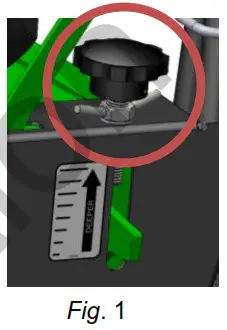
BLADE POSITION & DEPTH CONTROL LEVER
The blades can be raised or lowered into the ground by the height adjustment foot pedal at the rear of the unit. The blades will be in lowered position when the foot pedal is unlocked from the bracket and will be in transport position when the pedal is locked to the bracket. See Fig. 2 & 3 for operation. The resulting blade depth can be adjusted higher or lower.
Pressing on the outside tabs of the pedal will allow it to unlock from the bracket and lower into position. (See Fig. 2)
Pressing on the center of the pedal and pushing it into the bracket will allow it to be locked in transport position. (See Fig. 3)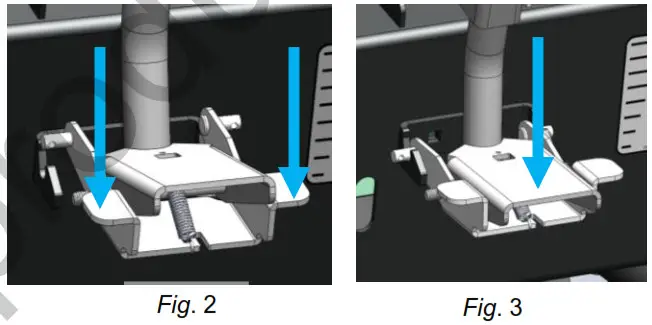
VERTI-CUTTING OPERATION
SET DEPTH: With engine off, set the raking depth so that the blades just touch on a flat surface (i.e. driveway, or sidewalk).
ENGAGE BLADES: Push the Reel Lever down on the operator handle (upper left side). NOTE: When engaging the blades in heavy load conditions (i.e. heavy thatch, or very uneven turf), push down on the operator handle lifting the front wheels slightly.
Engage the blades. Slowly lower the unit into the turf.
SLICE: Verti-cut a small test area and examine the results. Some thatch and cut stems should be removed and deposited on top of the healthy grass. Grass runners should be cut and ready for removal. If excessive damage occurs to healthy grass, adjust the blade depth to decrease damage. Continue raking the yard, working in one direction (i.e. north-south, or east-west).
NOTE: If a large drop in engine RPM occurs, or bounces during operation, the blade depth is set too low.
REMOVE THATCH/STEMS: After verti-cutting, a layer of thatch and cut stems will be deposited over the top of the lawn. We suggest the use of a lawn vacuum or wheeled blower for collection and removal of the thatch/stems.
OVERSEEDING OPERATION
DRY: Be sure grass is dry. Wet conditions can cause increased damage to healthy grass.
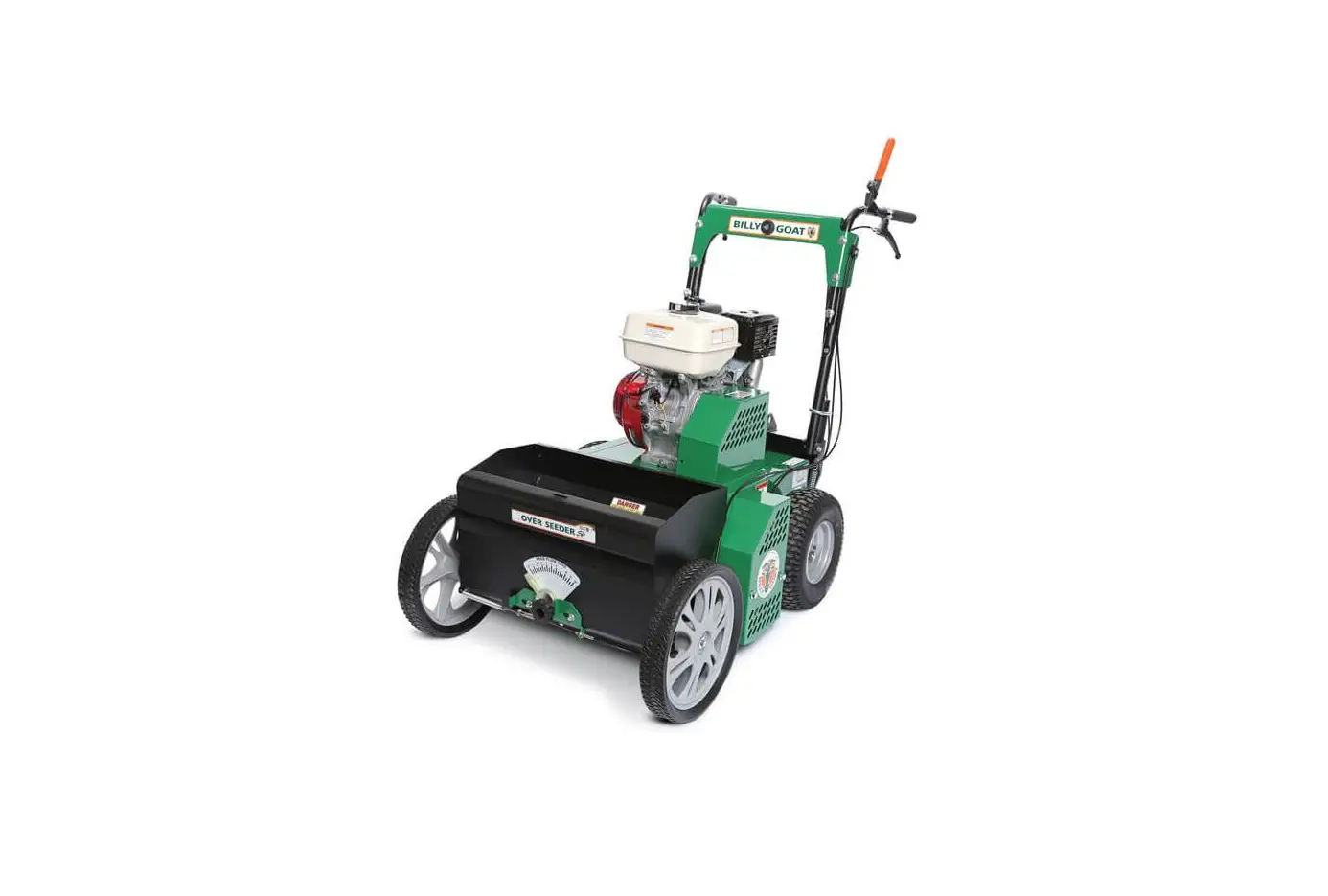
SEED: Spread grass seed according to the seed suppliers directions (e.g. 10 lbs. per 1000 ft²[4.5 kg. per 93 m²]) Adjustments to the seed drop is located on the front of the unit on the seed dial and should be used in conjunction with the seed chart on the console.
SET DEPTH: With engine off, set the raking depth so that the blades reach 1/4″-1/2″ (6-12 mm) below a flat surface (i.e. driveway, or sidewalk).
ENGAGE REEL AND SEED DROP: Push down on the reel lever on the operators handle.
NOTE: When engaging the reel in heavy load conditions (i.e. heavy thatch, or very uneven turf), push down on the operators handle lifting the front wheels slightly. Engage the reel. Slowly lower the unit into the turf.
SLICE: Run machine over the area that has been seeded to incorporate the seed into the soil. If excessive damage occurs to healthy grass, adjust the blade depth to decrease damage. Continue raking the yard, working in one direction (i.e. north-south, or east-west).
NOTE: If a large drop in engine RPM occurs, or bounces during operation, the blade depth is set too low.
WATER/FERTILIZE: After the seed has been worked into the soil, water and fertilize according to the seed supplier’s directions.
ADJUSTING SEED RATE
To set the seed flow rate, loosen the knob on the indicator dial and turn it to the corresponding stop setting on the seed application chart (below or on the console) for the type and amount of seed being used. (See Fig. 4)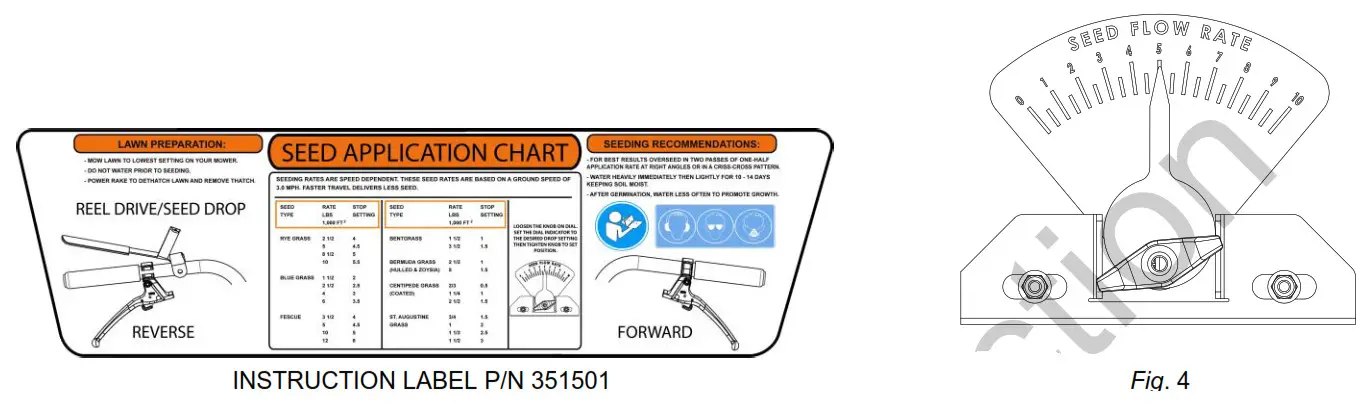
*****TIPS*****
Before beginning, it is best to evaluate the condition of the lawn by cutting one or more core samples from area to be treated. A core can be cut using a piece of PVC, or metal pipe. Hammer the pipe into the ground, remove it, push the core out of the pipe and inspect it to determine the depth of thatch in your yard.
MOW
Mow the lawn to its normal cut height. Be sure grass is dry. Wet conditions can cause increased damage to healthy grass.
INSPECT
Check the lawn before beginning work. Remove all rocks, wire, string, or other objects that can present a hazard during work.
IDENTIFY
Mark all fixed objects to be avoided during work, such as sprinkler heads, water valves, buried cables, or clothes line anchors, etc.
THATCH
Thatch is a dense layer of dead grass, clippings, and roots that builds up over time at the base of the lawn preventing air, water, and fertilizer from reaching the soil. This can cause shallow root development and make a lawn more susceptible to drought and disease.
Thatch also provides an ideal environment for insects to hide and multiply. Periodic removal of thatch will keep your lawn in good health.
HEAVY THATCH
Lawns with an excessive amount of thatch will require multiple treatments for effective removal. Trying to remove excessive thatch (greater than 3/4″[19 mm] deep) in one treatment will damage or destroy the living part of the lawn. It is best to remove heavy thatch in seasonal treatments (i.e. spring, and fall).
SLOPES
Rake slopes across not up and down the slope. This is much easier and safer for the operator and is better for the lawn. Raking across will help to reduce runoff during watering and allow the sloped ground to hold more seed, fertilizer, and water. The unit’s maximum operating slope is 35% or 19°.
DEPTH
The wide range of depth adjustment on your unit is provided to allow for blade wear. Setting the reel deeper will not produce better results.
The flail reel is intended to be set so it just touches the surface on flat ground. The slicing reel should be set even with the ground for vertislicing work, and set to a maximum 1/2″ depth for overseeding. Setting the reel deeper will only result in premature wear on the unit (i.e. failed belt). If you desire to work the ground deeper than the above guidelines, it should be done gradually in multiple passes.
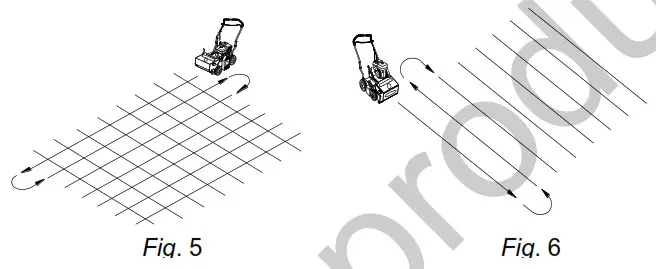
SLICING/OVERSEEDING: Mow the lawn to shorter than the normal cut height before starting (i.e. approximately 2″ tall for fescue grass). For the best result, slice/overseed in criss-cross pattern (See Fig. 5 & 6).
Part No 351520
Form No F082815A