
Owner’s Manual
CN301 MIDI Settings Manual
The term MIDI is an acronym for Musical Instrument Digital Interface, an international standard for connecting musical instruments, computers, and other devices to allow the exchange of performance data.
When the instrument is connected to a computer using a USB cable, the computer will recognize the instrument as a MIDI device, allowing the instrument to send and receive MIDI messages in the same manner as a normal MIDI interface.
Use a suitable USB cable to connect the USB type A port on the computer to the USB type B port on the digital piano. If there is no USB type A port on the computer, a conversion adapter may be required.
MIDI use case
When connected to a computer, the digital piano can be used to record and playback performances using sequencer software running on the computer. When the multi-timbral mode is enabled on the digital piano, it becomes possible to record and playback multi-track songs, with different sounds playing simultaneously on each MIDI channel.
 Multi-timbral Mode
▋ MIDI functions
The following functions are available with MIDI.
| Transmit/receive note information |
| Transmit/receive note information from a MIDI-connected musical instrument or device. |
| Transmit/receive Program Change number |
| Transmit/receive program change data to/from a MIDI-connected musical instrument or device. |
| Transmit/receive pedal data |
| Transmit/receive sustain, sostenuto, and soft pedal data from a MIDI-connected musical instrument or device. |
| Receive volume data |
| Receive MIDI volume data sent from a MIDI-connected musical instrument or device. |
| Transmit/receive channel settings |
| Specify transmit/receive channels within the range of 1 to 16. |
| Multi-timbral mode setting |
| Receive multiple channel MIDI data from a MIDI-connected musical instrument or device. * Multi-timbral mode setting must be enabled. |
| Transmit/receive exclusive data |
| Transmit/receive front panel or menu function settings as exclusive data. |
Copyright notice
Pieces of music based on existing works such as CDs, music files, SMF data, etc. should only be used for private listening, and for enjoying with friends and family. According to copyright law, it is not permitted to play commercial music publicly without permission from the copyright owner. Kawai is not liable for any copyright law infringement committed by the digital piano user. MIDI Implementation Chart
 “MIDI” is a registered trademark of the Association of Musical Electronics Industry.
MIDI settings
| Function name | Explanation | Default setting |
| MIDI Channel | This setting allows the transmit/receive channel to be specified. The selected channel will function as both the transmit and receive channel. Separate transmit/receive channels cannot be specified. | 1ch |
| Transmit Program Change Number | This function is used to transmit a program change number (ranging from 1 to 128) in order to change the sound of an external MIDI device. | 1 |
| Local Control | This setting determines whether the digital piano will play an internal sound when the keys are pressed. This setting is useful when using the digital piano to control an external MIDI device. When Local Control is set to “On”, the digital piano will play an internal sound and transmit information to an external MIDI device. | On |
| Transmit Program Change Number ON/OFF | This setting determines whether or not the digital piano will transmit program change information when sounds are changed. | On |
| Multi-timbral mode | This setting determines whether or not the digital piano is able to receive MIDI information on more than one MIDI channel simultaneously. This allows the instrument to play back multitrack, multi-timbral performance data sent from an external MIDI device. | Off |
| Channel Mute | This setting is enabled only when Multi-timbral Mode is ON. This setting deters- mines whether to receive information for each MIDI channel. | Play All |
▋ Entering MIDI settings
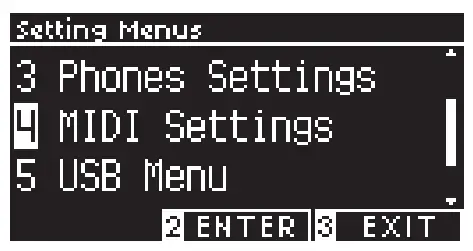
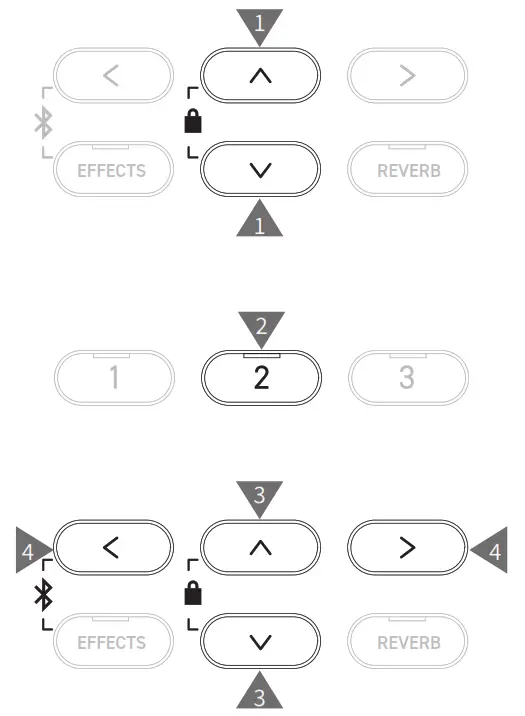
- On the Settings Menu screen, press the [UP]/[DOWN] button to select “MIDI Settings”.

- Press the [2] button to enter the MIDI Settings screen.
- Press the [UP]/[DOWN] button to select a setting.

- Press the [LEFT]/[RIGHT] button to set the value or type.
• Pressing the [LEFT]/[RIGHT] buttons simultaneously will restore the default setting.
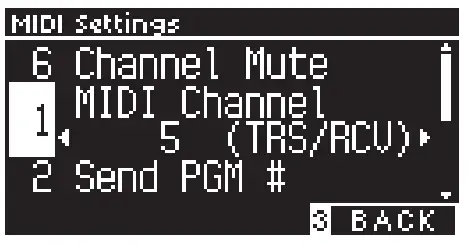
MIDI Channel
▋ Setting MIDI channel
With “MIDI Channel” selected, press the [LEFT]/[RIGHT] button to select the MIDI channel.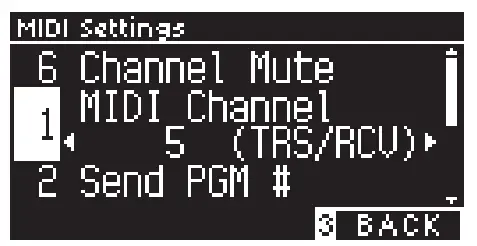
 The MIDI Channel setting is effective until the power is turned off.
- The preferred MIDI Channel setting can be stored in the Startup Setting memory for automatic selection when the instrument is turned on. Please refer to the Owner’s Manual page 50 for more information.
Omni mode
When the digital piano is turned on, the instrument is automatically set to “Omni mode on”, allowing MIDI information to be received on all MIDI channels (1~16). When the MIDI Channel setting is used to specify a transmit/receive channel, the instrument will be set to “Omni mode off”.
Multi-timbral mode and Split/Dual modes
- Using Split mode with Multi-timbral mode enabled
Notes played in the lower section of the keyboard will be transmitted on the channel that is 1 channel higher than the specified channel.
For example, if the MIDI channel is set to 3, notes played in the lower section of the keyboard will be transmitted on channel 4. (If the specified MIDI channel is 16, the lower section / layered part will be transmitted on channel 1.) - Using Dual mode with Multi-timbral mode enabled
Notes played will be transmitted on two channels: the specified channel and the channel that is 1 channel higher. For example, if the MIDI channel is set to 3, notes played on the keyboard will be transmitted on channels 3 and 4. (If the specified MIDI channel is 16, the lower section / layered part will be transmitted on channel 1.)
Transmit Program Change Number
▋ Turning to Transmit Program Number ON/OFF
With “Transmit PGM #” selected, press the [LEFT]/[RIGHT] button to turn the setting ON or OFF.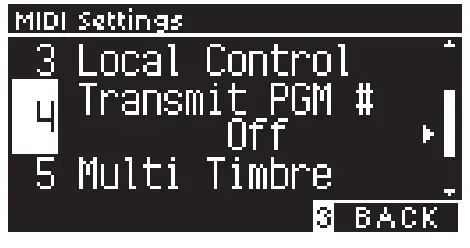
▋ Sending a Program Number
With “Send PGM #” selected, press the [LEFT]/[RIGHT] buttons to select the Program Number, then press the [2] button to send the selected number.
Program Numbers in the range of 1~128 can be sent.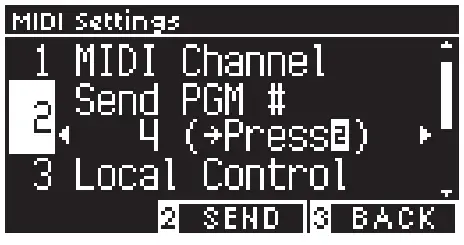
- The Transmit Program Number Change ON/OFF setting is effective until the power is turned off.
- Exclusive information is not sent if the Transmit Program Change Number setting is OFF.
- When using Dual or Split mode, On/Off information and sound type settings are transmitted as exclusive data, however, program change numbers will not be transmitted. Program change numbers will be transmitted when Multi-timbral mode is set to On1 or On2.
Local Control
▋ Setting Local Control
With “Local Control” selected, press the [LEFT]/[RIGHT] button to turn the setting ON or OFF.
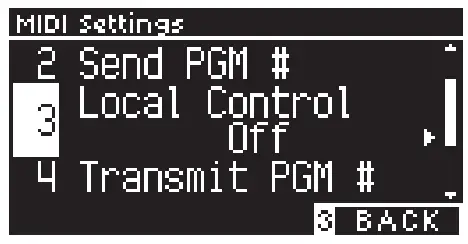
- The Local Control setting is effective until the power is turned off.
- The preferred Local Control setting can be stored in the Startup Setting memory for automatic selection when the instrument is turned on. Please refer to the Owner’s Manual page 50 for more information.
Multi-timbral Mode
▋ Setting Multi-timbral Mode
With “Multi Timbre” selected press the [LEFT]/[RIGHT] button to select “On1”, “On2, or “Off”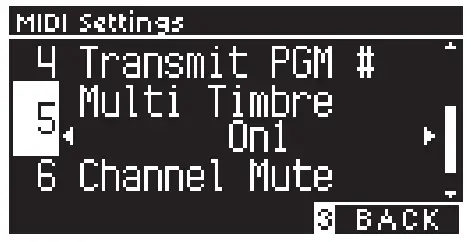
When “On1” or “Off” is set: The sound corresponding to the number on the left of the “Program Change Number List” is selected.
When “On2” is set: The sound corresponding to the number on the right of the “Program Change Number List” is selected.
• Whether to turn the sound ON or OFF can be set on each receive channel. Channel Mute
• All receive channels sound at full volume when Multi-timbral Mode is ON even in Split mode. The preferred Multi-timbral Mode setting can be stored in the Startup Setting memory for automatic selection when the instrument is turned on. Please refer to the Owner’s Manual page 50 for more information.
Channel Mute
▋ Setting Channel Mute
With the desired channel selected, press the [LEFT]/[RIGHT] button to select “Play” or “Mute”.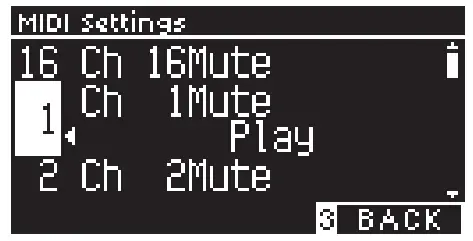
- The Channel Mute setting is effective until the power is turned off.
- The preferred Channel Mute setting can be stored in the Startup Setting memory for automatic selection when the instrument is turned on. Please refer to the Owner’s Manual page 50 for more information.
▋ Program Change Number List
| Sound name | Multi-timbral mode = off/on1 Program number | Multi-timbral mode = on2 Program number | Bank MSB | Bank LSB |
| PIANO1 | ||||
| SK-EX Concert Grand Piano | Concert | 1 | 1 | 121 | 0 |
| EX Concert Grand Piano | Concert | 2 | 1 | 95 | 27 |
| SK-5 Grand Piano | Classic | 3 | 1 | 95 | 30 |
| SK-EX Concert Grand Piano | Jazz | 4 | 1 | 121 | 1 |
| EX Concert Grand Piano | Standard | 5 | 1 | 95 | 16 |
| SK-EX Concert Grand Piano | Mellow | 6 | 1 | 121 | 2 |
| EX Concert Grand Piano | Mellow | 7 | 1 | 95 | 29 |
| PIANO2 | ||||
| Upright Piano | Classic | 8 | 1 | 95 | 25 |
| EX Concert Grand Piano | Pop | 9 | 1 | 95 | 28 |
| SK-5 Grand Piano | Pop | 10 | 1 | 95 | 31 |
| Upright Piano | Boogie | 11 | 1 | 95 | 26 |
| EX Concert Grand Piano | Modern | 12 | 2 | 121 | 0 |
| Upright Piano | Honky Tonk | 13 | 4 | 121 | 0 |
| E.PIANO | ||||
| Tine Electric Piano | 14 | 5 | 121 | 0 |
| Reed Electric Piano | 15 | 5 | 121 | 3 |
| Modern Electric Piano | 16 | 6 | 121 | 0 |
| Tine Electric Piano 2 | 17 | 5 | 121 | 1 |
| Modern Electric Piano 2 | 18 | 6 | 121 | 1 |
| ORGAN | ||||
| Jazz Organ | 19 | 18 | 121 | 0 |
| Blues Organ | 20 | 17 | 121 | 0 |
| Ballad Organ | 21 | 17 | 95 | 5 |
| Gospel Organ | 22 | 17 | 95 | 3 |
| Church Organ | 23 | 20 | 121 | 0 |
| Diapason | 24 | 20 | 95 | 7 |
| Diapason Octave | 25 | 20 | 95 | 6 |
| Principal Octave | 26 | 20 | 95 | 24 |
| HARPS & MALLETS | ||||
| Harpsichord | 27 | 7 | 121 | 0 |
| Clavi | 28 | 8 | 121 | 0 |
| Vibraphone | 29 | 12 | 121 | 0 |
| Marimba | 30 | 13 | 121 | 0 |
| Celesta | 31 | 9 | 121 | 0 |
| STRINGS | ||||
| Slow Strings | 32 | 45 | 95 | 1 |
| String Pad | 33 | 49 | 95 | 8 |
| Warm Strings | 34 | 49 | 95 | 1 |
| String Ensemble | 35 | 49 | 121 | 0 |
| VOCAL & PAD | ||||
| Choir | 36 | 53 | 121 | 0 |
| Choir 2 | 37 | 54 | 95 | 53 |
| New Age Pad | 38 | 89 | 121 | 0 |
| Atmosphere | 39 | 100 | 121 | 0 |
| BASS & GUITAR | ||||
| Wood Bass | 40 | 33 | 121 | 0 |
| Electric Bass | 41 | 34 | 121 | 0 |
| Fretless Bass | 42 | 36 | 121 | 0 |
| Wood Bass & Ride | 43 | 33 | 95 | 1 |
| Ballad Guitar | 44 | 26 | 95 | 6 |
| Pick Nylon Guitar | 45 | 25 | 95 | 3 |
▋ Program Change Number List (Played only when receiving MIDI)
| Sound name | Multi-timbral mode = off/on1 | Multi-timbral mode = on2 | ||
| Program number | Program number | Bank MSB | Bank LSB | |
| Glockenspiel | – | 10 | 121 | 0 |
| Music Box | – | 11 | 121 | 0 |
| Xylophone | – | 14 | 121 | 0 |
| Tubular Bells | – | 15 | 121 | 0 |
| Church Bells | – | 15 | 121 | 1 |
| Rock Organ | – | 19 | 121 | 0 |
| Accordion | – | 22 | 121 | 1 |
| Harmonica | – | 23 | 121 | 0 |
| Nylon Acoustic Guitar | – | 25 | 121 | 0 |
| Modern Jazz Guitar | – | 27 | 121 | 0 |
| Muted Electric Guitar | – | 29 | 121 | 0 |
| Cutting Guitar | – | 29 | 121 | 1 |
| Overdrive Guitar | – | 30 | 121 | 0 |
| Finger Slap Bass | – | 34 | 121 | 1 |
| Synth Bass | – | 39 | 121 | 0 |
| Violin | – | 41 | 121 | 0 |
| Viola | – | 42 | 121 | 0 |
| Cello | – | 43 | 121 | 0 |
| Contrabass | – | 44 | 121 | 0 |
| Pizzicato | – | 46 | 121 | 0 |
| Harp | – | 47 | 121 | 0 |
| Orchestra Hit | – | 56 | 121 | 0 |
| Trumpet | – | 57 | 121 | 0 |
| Trombone | – | 58 | 121 | 0 |
| Tuba | – | 59 | 121 | 0 |
| Muted Trumpet | – | 60 | 121 | 0 |
| French Horns | – | 61 | 121 | 0 |
| Brass Section | – | 62 | 121 | 0 |
| Synth Brass | – | 63 | 121 | 0 |
| Soprano Sax | – | 65 | 121 | 0 |
| Alto Sax | – | 66 | 121 | 0 |
| Tenor Sax | – | 67 | 121 | 0 |
| Baritone Sax | – | 68 | 121 | 0 |
| Oboe | – | 69 | 121 | 0 |
| English Horn | – | 70 | 121 | 0 |
| Bassoon | – | 71 | 121 | 0 |
| Clarinet | – | 72 | 121 | 0 |
| Piccolo | – | 73 | 121 | 0 |
| Flute | – | 74 | 121 | 0 |
| Pan Flute | – | 76 | 121 | 0 |
| Square | – | 81 | 121 | 0 |
| Sine | – | 81 | 121 | 2 |
| Sawtooth | – | 82 | 121 | 0 |
| Warm Pad | – | 90 | 121 | 0 |
| Pop Set | – | 1 | 120 | 0 |
| Room Set | – | 9 | 120 | 0 |
| Analog Set | – | 26 | 120 | 0 |
| Dance Set | – | 27 | 120 | 0 |
| Ambiance Set | – | 33 | 120 | 0 |
| Brush Set | – | 41 | 120 | 0 |
| Orchestra Set | – | 49 | 120 | 0 |
Can be selected only when Multi-timbral Mode is set to “On2”.
MIDI Exclusive Data Format
| 1st byte | 2nd byte | 3rd byte | 4th byte | 5th byte | 6th byte | 7th byte | 8th byte | 9th byte | 10th byte |
| 1 | 2 | 3 | 4 | 5 | 6 | 7 | 8 | 9 | 10 |
| Byte | ID | Description |
| 1 | F0 | Start code |
| 2 | 40 | Kawai ID number |
| 3 | 00 – 0F | MIDI channel |
| 4 | 10, 30 | Function code (30 when setting Multi-timbre On/Off) |
| 5 | 04 | Indicates that the instrument is an electric piano |
| 6 | 26 | Indicates that the piano is a CN301 model |
| 7 | data 1 | See table below |
| 8 | data 2 | |
| 9 | data 3 | |
| 10 | F7 | End code |
| data 1 | data 2 | data 3 | Function |
| 00 | 00 | – | Multi-timbre Off |
| 01 | 00 | – | Multi-timbre On 1 |
| 02 | 00 | – | Multi-timbre On 2 |
| 0F | 15 – 6C | – | Split Point: A0-C8 |
| 14 | 00 – 7F | – | Dual/Split balance |
| 16 | 1F – 60 | – | Tune, 40: 440 Hz |
| 17 | 00, 7F | – | 00: Program Change Off, 7F: Program Change On |
| 19 | 00 – 03 | – | Lower Octave Shift |
| 20 | 00 – 7F | 00 – 7F | Dual, data 2: Main sound, data 3: Layer sound |
| 21 | 00 – 7F | 00 – 7F | Split, data 2: Upper sound, data 3: Lower sound |
| 25 | 00 – 09 | 00 – 0B | data2: Temperament 00: Equal, 01: Pure Major, 02: Pythagorean, 03: Meantone, 04: Werkmeister, 05: Kirnberger, 07: Pure Minor, 09: User data3: Key |
| 26 | 00, 7F | 00 – 0F | Multi-timbre, data 2: 00 (Mute), 7F (Play), data 3: Channel |
MIDI Implementation Chart
Date: June 2022 Version: 1.0
| Function | Transmit | Receive | Remarks | |
| Basic channel | At power-up | 1 | 1 | |
| Settable | 1 – 16 | 1 – 16 | ||
| Mode | At power-up Message Alternative | Mode 3 X * * * * * * * * * | Mode 1 Mode 1, 3 X | Omni mode is on at power-up. Omni mode can be turned off through MIDI channel setting operations. |
| Note number | Range | 9 – 120** * * * * * * * * | 0 – 127 0 – 127 | * Including transpose |
| Velocity | Note on Note off | O O | O O | |
| After touch | Key specific Channel specific | X X | X O | |
| Pitch bend | X | O | ||
| Control change | 0,32 | O | O | Bank Select *1 |
| 1 | X | O | Modulation | |
| 5 | X | O | Portamento Time | |
| 6,38 | X | O | Data Entry | |
| 7 | O | O | Volume | |
| 10 | X | O | Panpot | |
| 11 | X | O | Expression Pedal | |
| 64 | O (Right pedal) | O | Sustain Pedal | |
| 65 | X | O | Portamento | |
| 66 | O (Middle pedal) | O | Sostenuto Pedal | |
| 67 | O (Left pedal) | O | Soft Pedal | |
| 71 | X | O | Resonance | |
| 72 | X | O | Release Time | |
| 73 | X | O | Attack Time | |
| 74 | X | O | Brightness | |
| 75 | X | O | Decay Time | |
| 76 | X | O | Vibrato Speed | |
| 77 | X | O | Vibrato Depth | |
| 78 | X | O | Vibrato Delay | |
| 91 | X | O | Reverb Send Level | |
| 93 | X | O | Chorus Send Level | |
| 100, 101 | X | O | RPN LSB, MSB | |
| Program change settable range | O (0 – 127) * * * * * * * * * | O | ||
| Exclusive | O | O | Transmission can be selected | |
| Common | Song position Song selection Tune | X X X | X X X | |
| Real-time | Clock Commands | X X | X X | |
| Other functions | Local On / Off All notes Off Active sensing Reset | X X X X | O O O X | |
| Remarks | ||||
Mode 1: Omni mode On, Poly Mode 2: Omni mode On, Mono
Mode 3: Omni mode Off, Poly Mode 4: Omni mode Off, Mono
O: Yes
X: No
SP00001570-R100