 Fabric Electric Piano
User Guide
Introduction
Thank you for purchasing the AIR Fabric Electric Piano plugin instrument. Fabric Electric Piano delivers the sonic characteristics of the flagship Stage EP instrument, but in a less CPU-intensive form. It includes a comprehensive set of editing features and built-in effects, such as the AIR Flavor effect for adding grit for a lo-fi sound.
This user guide explains how to use your plugin instrument. For more information on using other parts of the MPC software or hardware, please consult the respective MPC Software User Guide and MPC hardware User Guide.
System Requirements & Product Support
For complete system requirements and compatibility information, visit airmusictech.com.
For technical support, visit support.airmusictech.com.
Installation
- Double-click the .exe (Windows) or .pkg (macOS) file you downloaded. Follow the on-screen instructions to install the software.
- Open the plugin application.
- Click Sign In to sign into your in Music Brands Profile using your Internet browser. If you do not have an in Music Brands Profile yet, you will be prompted to create one.
- Once you have signed in, click Activate in the plugin window to enter your serial key to unlock the plugin. You can unlock each plugin on up to three devices at a time.
- If you do not have a serial key, you can click Try Unlicensed to explore the plugin with intermittent audio alerts. You can also click 10-Day Trial to initiate a free, fully featured trial of the plugin for 10 days.
If you would like to purchase a serial key, click the link to purchase a license at profile.inmusicbrands.com.
Operation
Overview
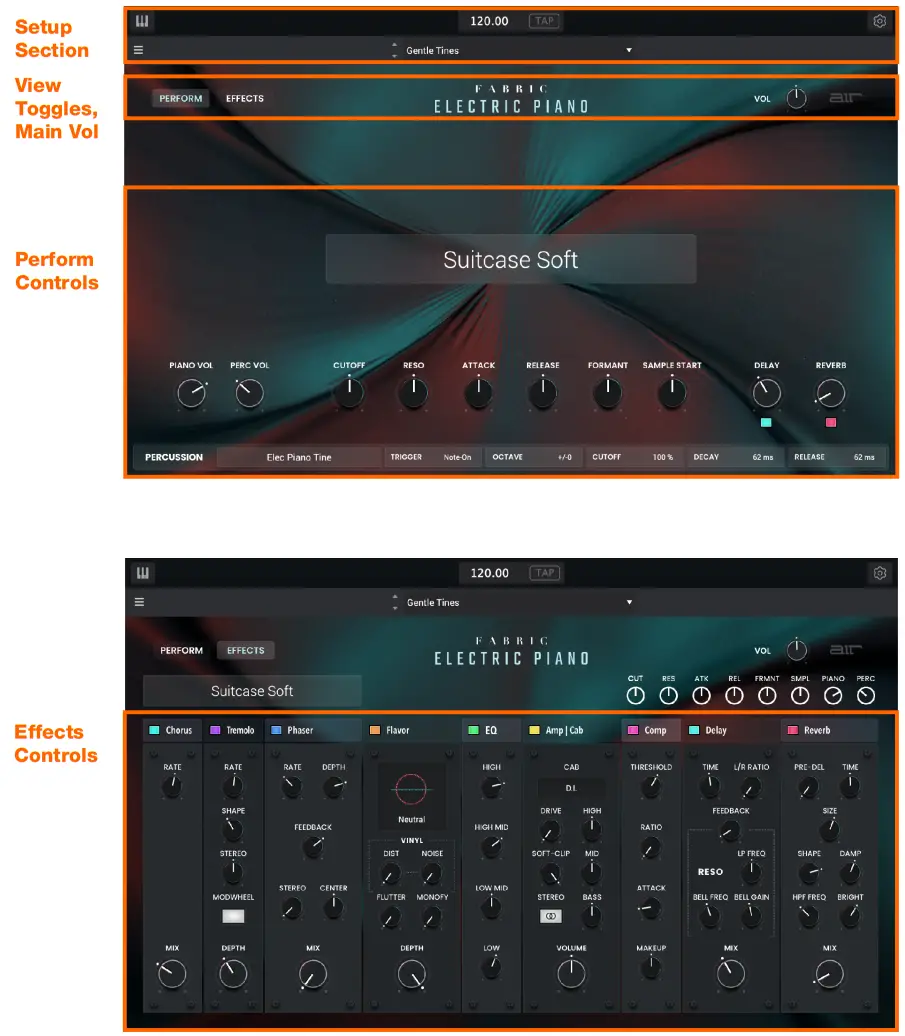
Setup Section

- Keyboard: Click this icon to enable or disable the virtual keyboard. When enabled, you can click these keys to input notes, or view notes being played on an external MIDI device.
- Tempo: Displays the current plugin tempo. To change the tempo:
• Click the number and use your keyboard to input a new value.
• Click and drag the tempo value up or down using your cursor.
• Click the Tap button at regular intervals. - Settings: Click this icon to open the Settings window, where you can set the following parameters:
• Output: Click this drop-down menu to select an audio hardware driver in your computer system. Click the Test button to play a test tone for checking your audio output settings. (Careful! You should lower the volume on your audio system beforehand.)
• Sample Rate: Click this drop-down menu to select the desired sample rate for your project. This depends on the available sample rates of the type of MPC hardware you are using or of your audio interface (i.e., select 96000 Hz only if your interface allows a 96 kHz sample rate).
• Audio Buffer Size: Click this drop-down menu to set your audio system’s latency. Lower values result in a more immediate playing response but also more CPU consumption. If you are working with larger projects, this may cause audible clicks and pops. Higher values are more CPU-friendly but can produce more delay between pressing a pad and hearing the corresponding sound. The ideal audio buffer size also depends on your computer’s CPU performance. Experiment with this to find the best setting for your system.
• Active MIDI Inputs: Displays available MIDI input devices. To enable a device, check the box next to its name.
• Bluetooth MIDI: Click this icon to open your system’s Bluetooth settings menu, where you can select a Bluetooth-enabled MIDI device to control the plugin. - Menu: Click this icon to open the menu, where you can find the following options:
• Scale: Click here to select a value to scale the plugin window to a new size.
• Load Preset: Click here to load a saved preset.
• Save Preset: Click here to save the current preset.
• Open User Guide: Click here to open this User Guide.
• About: Click here to view plugin version information.
5. Preset: Click this drop-down menu to view the list of included plugin presets. You can also click the up and down arrows next to this field to move to the previous or next preset.
Perform
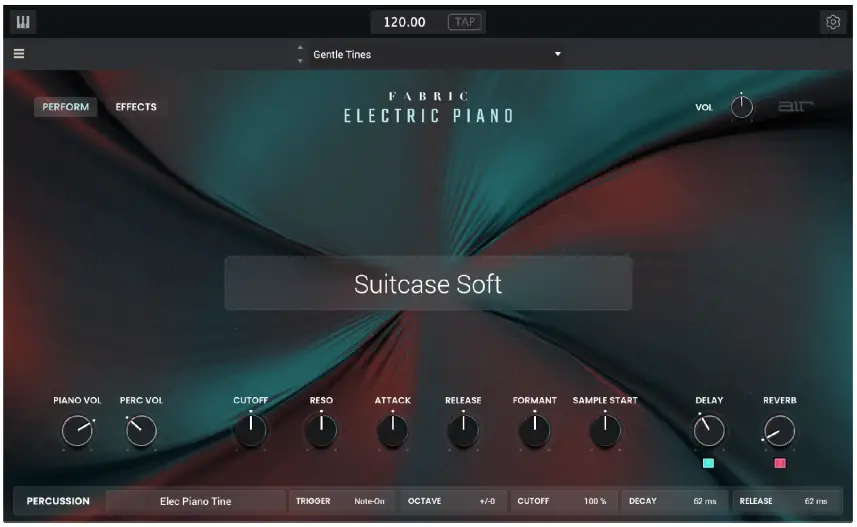
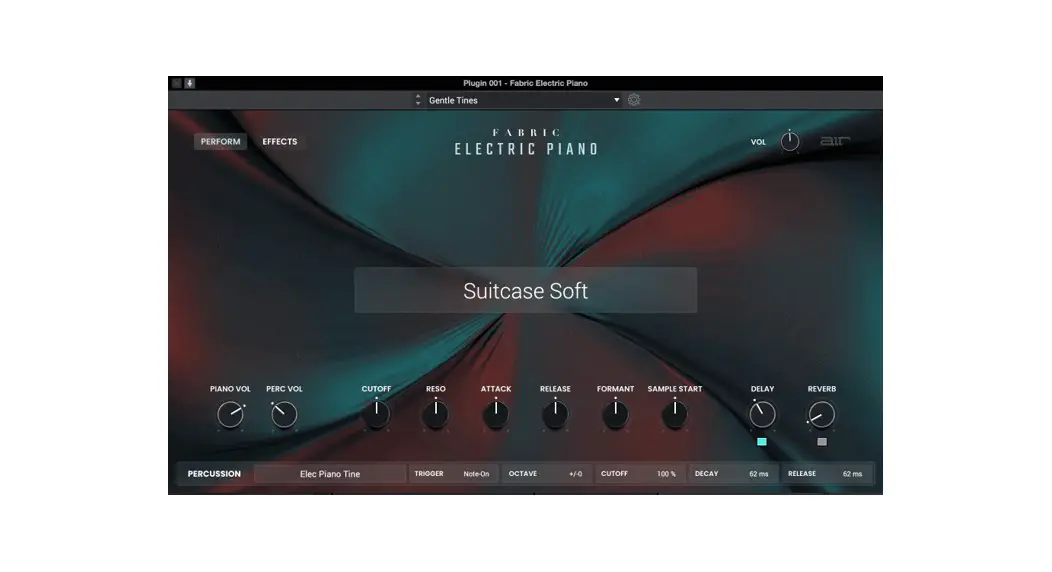
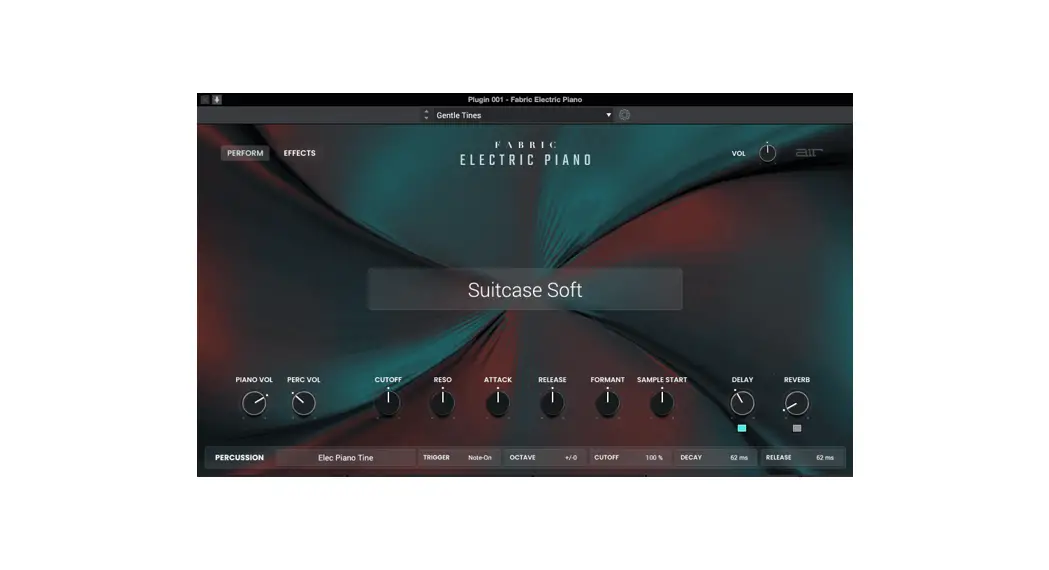
All settings in this view except Delay On/Off and Reverb On/Off are also available in the Effects view.
| Parameter | Description | Value Range |
| Main Vol | Overall level of the plugin. | -inf – 0.0 – +6.0 dB |
| Preset | Preset piano sound. | Varies |
| Piano Vol | Level of the electric piano sound. | -inf – 0.0 – +12.0 dB |
| Perc Vol | Level of the percussion sample. | -inf – 0.0 – +12.0 dB |
| Cutoff | Filter cutoff frequency. | -100 –– 0 –– +100% |
| Reso | Amount of resonance/emphasis of the filter cutoff point. | -100 –– 0 –– +100% |
| Attack | Amount of amplitude attack reduced from or added to the sound. | -100 –– 0 –– +100% |
| Release | Amount of amplitude release reduced from or added to the sound. | -100 –– 0 –– +100% |
| Formant | Decreases or increases resonant frequencies to adjust the timbre of the sound. | -100 –– 0 –– +100% |
| Sample Start | Starting point of the sample. | -100 –– 0 –– +100% |
| Delay | Enable or disable the delay effect. | Off, On |
| Delay Mix | Wet/dry amount of the delay effect. | 0–100% |
| Reverb | Enable or disable the reverb effect. | Off, On |
| Reverb Mix | Wet/dry amount of the reverb effect. | 0–100% |

| Parameter | Description | Value Range | |
| Percussion | Sample | Select the percussion sample used. | Varies |
| Trigger | Selects when the percussion sample is triggered. | Note-On, Note-Off | |
| Octave | Adjust pitch of the percussion sample. | -4 – 0 – +4 | |
| Cutoff | Cutoff frequency of the percussion sample. | 0–100% | |
| Decay | Length of time for the percussion sample to decay. | 0.0 ms – 32.0 s | |
| Release | Length of time for the percussion sample to become silent after being released. | 0.0 ms – 32.0 s | |
Effects
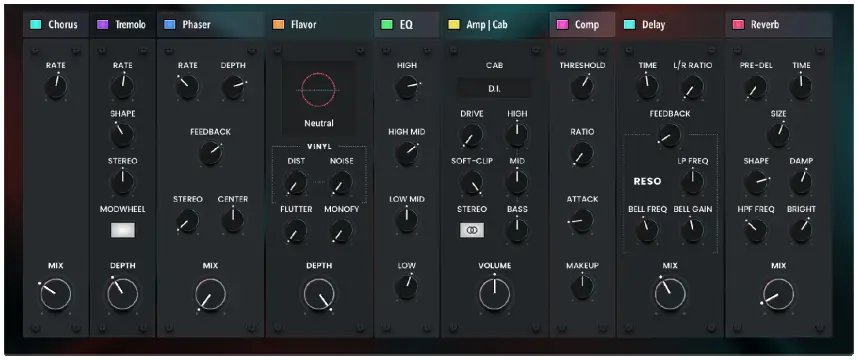
| Parameter | Description | Value Range | |
| Chorus | Use the button in the upper-left corner to enable or disable the chorus effect. | Off, On | |
| Rate | Modulation speed of the chorus effect. | 0.05 – 20.00 Hz | |
| Mix | Wet/dry amount of the chorus effect. | 0–100% | |
| Tremolo | Use the button in the upper-left corner of this section Off, On to enable or disable the tremolo effect. | ||
| Rate | Modulation speed of the effect. | 0.05 – 20.00 Hz | |
| Shape | Adjusts the modulation waveshape. | -100 – 0 – +100% | |
| Stereo | Degree of stereo spread of the effect. | 0–360 deg. | |
| Modwheel | Enable or disable tremolo control by the modwheel. | Off, On | |
| Depth | Modulation depth of the tremolo effect. | 0–100% | |
| Phaser | Use the button in the upper-left corner to enable or disable the phaser effect. | Off, On | |
| Rate | Modulation speed of the effect. | 0.05 – 20.00 Hz | |
| Depth | Amount of modulation applied. | 0–100% | |
| Feedback | Amount of phaser signal fed back into the phaser circuit. | 0–100% | |
| Stereo | Degree of stereo spread of the effect. | 0–360 deg. | |
| Center | Center frequency of the phaser filter. | 0–100% | |
| Mix | Wet/dry mix of the phaser effect. | 0–100% | |
| Parameter | Description | Value Range | |
| Flavor | Use the button in the upper-left corner of this section to enable or disable the flavor effect. | Off, On | |
| Timbre | Selects an emulation type to color the sound. | Varies | |
| Timbre Depth | Amount of timbre emulation applied to the sound. | 0–100% | |
| Vinyl Distortion | Amount of vinyl distortion noise applied to the signal. | 0–100% | |
| Vinyl Noise | Amount of vinyl noise such as clicks and pops applied to the signal. | 0–100% | |
| Flutter | Amount of speed fluctuation of the sound playback. | 0–100% | |
| Monofy | Reduces the stereo spread of the sound to mono. | 0–100% | |
| EQ | Use the button in the upper-left corner of this section to enable or disable the EQ effect. | Off, On | |
| Low | Amount of attenuation or boost applied to the low frequency band. | -12 – 0 – +12 dB | |
| Low Mid | Amount of attenuation or boost applied to the low- mid frequency band. | -20 – 0 – +20 dB | |
| High Mid | Amount of attenuation or boost applied to the high- mid frequency band. | -20 – 0 – +20 dB | |
| High | Amount of attenuation or boost applied to the high frequency band. | -12 – 0 – +12 dB | |
| Amp | Cab | Use the button in the upper-left corner to enable or disable the amp/cab effect. | Off, On | |
| Cab Model | Type of amplifier simulated. | D.I., Brit, 1×8”, 1×12”, 2×10”, 2×12”, 4×10”, 4×12”, 1×15” Bass, 4×10” Bass, Radio | |
| Drive | Amount of overdrive applied to the amp signal. | 0–100% | |
| Soft Clip | Amount of softening applied to the clipped signal to decrease high-frequency harmonics and add warmth. | 0–100% | |
| Mono/Stereo | Determines whether the simulation is mono or stereo. | Mono, Stereo | |
| High | Amount of high-range tone reduction or boost. | -100 – 0 – +100% | |
| Mid | Amount of mid-range tone reduction or boost. | -100 – 0 – +100% | |
| Bass | Amount of bass-range tone reduction or boost. | -100 – 0 – +100% | |
| Volume | Output level of the amp signal. | -12.0 – 0.0 – +12.0 dB | |
| Parameter | Description | Value Range | |
| Compressor | Use the button in the upper-left corner of this section to enable or disable the compressor. | Off, On | |
| Threshold | Signal level after which the compression will be applied. | -30.0 – 0.0 – +10.0 dB | |
| Ratio | Amount of compression applied. | 1.0:1 – 20.0:1 | |
| Attack | Length of time to apply the compression. | 0–100% | |
| Makeup | Amount of additional output gain for the compressed signal. | -20.0 – 0 – +20.0 dB | |
| Delay | Use the button in the upper-left corner of this section to enable or disable delay. | Off, On | |
| Time | Amount of time between the dry signal and the delayed signal. | 1/16 – 16/4 | |
| L/R Ratio | Reduces the delay Time in either the Left or Right stereo field. This is useful for creating offset, panned delays. | 50:100 – 100:100 – 100:50 | |
| Feedback | Amount of signal fed back into the delay line. | 0–100% | |
| Reso LP Freq | Low pass frequency for feedback resonance. | 100 – 16000 Hz | |
| Reso Bell Freq | Center frequency for feedback resonance. | 100 – 16000 Hz | |
| Reso Bell Gain | Amount of gain applied to the resonant frequency. | 0–100% | |
| Mix | Wet/dry amount of the delay effect. | 0–100% | |
| Reverb | Use the button in the upper-left corner of this section to enable or disable reverb. | Off, On | |
| Pre-Delay | Length of time between dry signal and reverberated signal. | 0 – 250 ms | |
| Time | Length of reverb tail. | 0.3 – 60.00 s | |
| Size | Size of the reverberation environment. | 0–100% | |
| Shape | Shape of the reverberation environment, which will alter the density of reverb reflections. At lower settings, the sound of individual reflections is more present. At higher settings, reflections are more uniform. | 0–100% | |
| Damp | Amount of frequency dampening applied to the reverberated signal. | 100–0% | |
| HPF Freq | Center frequency for reverb signal high-pass filter. | 0 – 2000 Hz | |
| Bright | Amount of high frequency decay. | -100–0% | |
| Mix | Wet/dry amount of the reverb effect. | 0–100% | |
Trademarks and Licenses
AIR Music Technology is a trademark of in Music Brands, Inc., registered in the U.S. and other countries.
macOS is a trademark of Apple Inc., registered in the U.S. and other countries.
Windows is a registered trademark of Microsoft Corporation in the United States and other countries.
All other product or company names are trademarks or registered trademarks of their respective owners.
airmusictech.com
Manual Version 1.1
 AIR | German-engineered virtual instruments and effects
 Customer Login
 Support : AIR