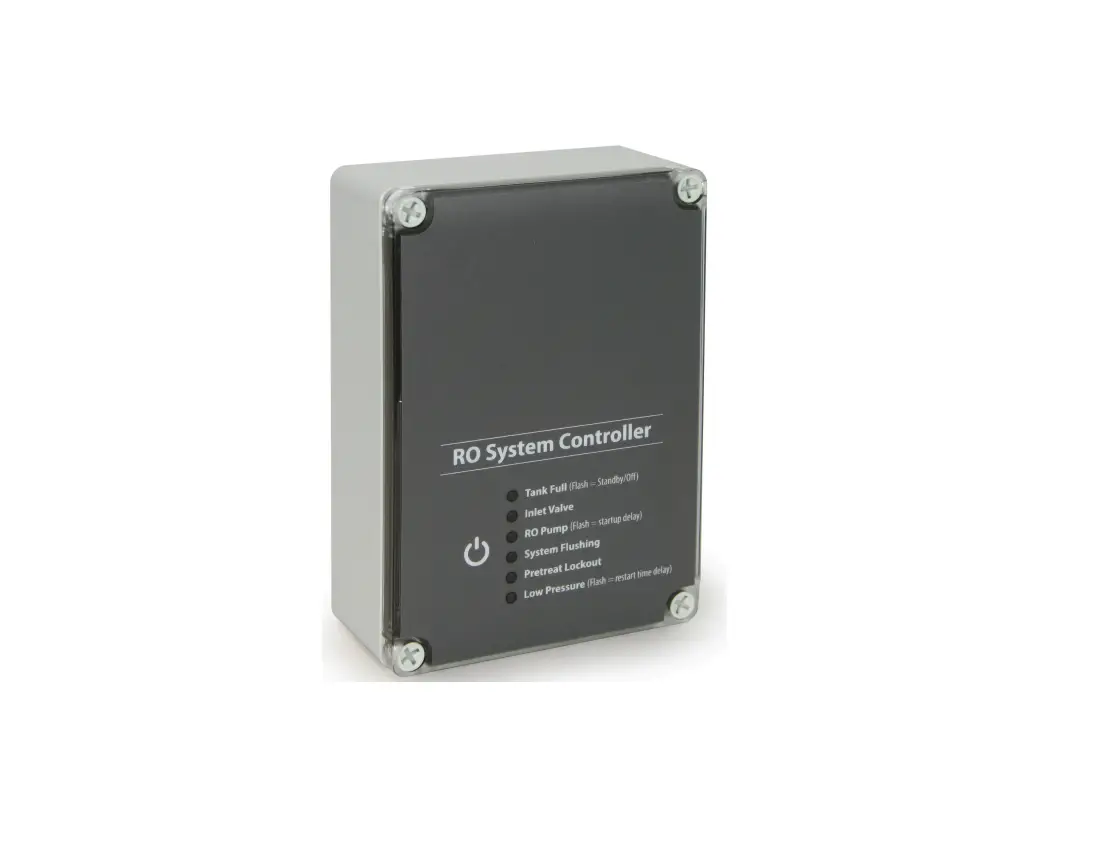
NRO-SIMPLX-1440 NRO SIMPLX Commercial Systems
Nelsen NRO SIMPLX Commercial Systems
Installation, Operation & Maintenance Manual
The Nelsen NRO SIMPLX Commercial Systems are high-quality
reverse osmosis systems designed and produced for the purification
of water only. These systems produce high-quality water and are
durable, with proper care lasting for many years. The components of
the system are of the highest quality, and this manual outlines
installation, operation, maintenance, and troubleshooting details
vital to the sustained performance of your system.
System Specifications
The Nelsen Commercial Reverse Osmosis System Specifications are
as follows:
| Model Number | Capacity (GPD) | Membrane Size (inches) | Permeate Flow Rate (GPM) | Rejection Rate (%) | Pump Size (HP) | Power Supply (V/Hz) | Amps | Feed Connection (inches) | Permeate Connection (inches) | Concentrate Connection (inches) | Dimensions (inches) | Weight (lbs) | Maximum Operating Pressure (psi) |
|---|---|---|---|---|---|---|---|---|---|---|---|---|---|
| NRO-SIMPLX-1440 | 1600 | 4 x 40 (1) | 1.11 | 6.0 19-23% | 3/4 HP | 14.8/7.4 | 25/15A | 3/4 | 1/2 | 1/2 | 22x17x55 | 97 lbs. | 160 psi |
| NRO-SIMPLX-2440 | 3200 | 4 x 40 (2) | 2.2 | 7.0 23-50% | 1 HP -/9.6 | 15A | 3/4 | 1/2 | 1/2 | 22x17x55 | 125 lbs. | 160 psi |
Minimum flow pressure of 35PSI.
WARNING: Please carefully read the information
contained in this Installation, Operation & Maintenance Manual
(IO&M Manual) before starting or operating this reverse osmosis
water purification system. Failure to do so may void warranty and
cause equipment damage, bodily injury or potentially death.
WARNING: This Reverse Osmosis System is
designed and produced for the purification of water only. Do not
use this equipment for any other purpose without express written
authorization from the manufacturer. Failure to follow these
guidelines may result in serious bodily injury or death.
WARNING: The RO System should be shielded from
the elements. Periodic rain and exposure to UV Rays will cause
irreparable damage to the unit and will not be covered by warranty.
Exposure to rain and high humidity environments may also cause
damage to the pump motor and electronic controls. This damage will
not be covered under warranty.
Reverse Osmosis Water Filtration Process
Reverse Osmosis removes dissolved inorganic solids (such as
salt) from water. The membrane allows only the permeate water, not
contaminants.
FIGURE 1
Concentrated Solution
Dilute Solution
Water diffuses through semi-permeable membrane toward region of
higher concentration to equalize solution strength. Ultimate height
difference column is osmotic pressure.
Concentrated Solution
Dilute Solution
Applied pressure in excess of osmotic pressure reverses water
flow direction, hence the term Reverse Osmosis.
Feed Water Requirements
Feed water quality has a huge effect on the performance of the
reverse osmosis system. It is important to supply the reverse
osmosis system with the feed water quality shown below.
Pretreatment may be required if the parameters below are not met.
Failure to meet feed water requirements may foul membranes, void
the system warranty, and affect the stated performance of the
system.
| Hardness | Free Chlorine | T.D.S.* | Turbidity | SDI | Ph | Iron | Silica | Hydrogen Sulfide | Manganese | Organics | Flow Pressure | Temperature |
|---|
Product Usage Instructions
- Read the Installation, Operation & Maintenance Manual
(IO&M Manual) carefully before starting or operating the
reverse osmosis water purification system. - Ensure that the feed water quality meets the recommended feed
water quality shown in Table 2. If the parameters are not met,
pretreatment may be required to avoid fouling of the membranes and
to maintain the stated performance of the system. - Shield the RO System from the elements to prevent damage to the
unit. Do not expose the system to periodic rain and UV rays, as
this will cause irreparable damage to the unit and will not be
covered by warranty. Exposure to rain and high humidity
environments may also cause damage to the pump motor and electronic
controls. This damage will not be covered under warranty. - Ensure that the minimum flow pressure of 35PSI is met.
- Use the reverse osmosis system for the purification of water
only. Do not use this equipment for any other purpose without
express written authorization from the manufacturer, as failure to
follow these guidelines may result in serious bodily injury or
death.
Nelsen NRO SIMPLX Commercial Systems
Installation, Operation & Maintenance Manual
NRO-SIMPLX-1440
Since 1954
NRO-SIMPLX-2440 1
2
Table of Contents
System Specifications Page 2 ………………………………………………………………………………………………………………………………………………………………………………………………………………………………………………………………………………………………………………. Introduction Page 3 ………………………………………………………………………………………………………………………………………………………………………………………………………………………………………………………………………………………………………………………………………………………. Feed Water Requirements Page 4 ………………………………………………………………………………………………………………………………………………………………………………………………………………………………………………………………………………………………… RO Membranes Page 5 ………………………………………………………………………………………………………………………………………………………………………………………………………………………………………………………………………………………………………………………………………… Recovery & Rejection Page 6 ………………………………………………………………………………………………………………………………………………………………………………………………………………………………………………………………………………………………………………….. System Requirements & Operation Guidelines Page 6 ……………………………………………………………………………………………………………………………………………………………………………………………………………………… RO Start-Up Page 7 ………………………………………………………………………………………………………………………………………………………………………………………………………………………………………………………………………………………………………………………………………………………. Operation & Maintenance Page 9 ………………………………………………………………………………………………………………………………………………………………………………………………………………………………………………………………………………………………….. Membrane Cleaning Page 11 ……………………………………………………………………………………………………………………………………………………………………………………………………………………………………………………………………………………………………………………….. Spare Parts Page 12 ………………………………………………………………………………………………………………………………………………………………………………………………………………………………………………………………………………………………………………………………………………………… Troubleshooting Page 13 ……………………………………………………………………………………………………………………………………………………………………………………………………………………………………………………………………………………………………………………………………….. Operation Log Page 14 ………………………………………………………………………………………………………………………………………………………………………………………………………………………………………………………………………………………………………………………………………………. Warranty Page 16 …………………………………………………………………………………………………………………………………………………………………………………………………………………………………………………………………………………………………………………………………………………………………
1
System Specifications
Nelsen Commercial Reverse Osmosis System Specifications
Model: Production GPD* Membrane Permeate GPM Feed GPM** % Recovery Pump FLA 60HZ 1Ø 110/220 Circuit Size Inlet Permeate Concentrate Floor Model Dims (DxWxH) Weight – Pounds Max Operating Pressure
NRO-SIMPLX-1440 1600
4″ x 40″ (1) 1.11 GPM
6.0 19-23% 3/4 HP 14.8/7.4 25/15A
3/4″ 1/2″ 1/2″ 22″x17″x55″ 97 lbs. 160 psi
NRO-SIMPLX-2440 3200
4″ x 40″ (2) 2.2 GPM
7.0 23-50%
1 HP -/9.6 15A 3/4″ 1/2″ 1/2″ 22″x17″x55″ 125 lbs. 160 psi
* The stated product performance is based on data taken after 30 minutes of operation at the following test conditions: · 2,000 mg/L NaCl solution at 225 psig ( 1.5 MPa) applied pressure · 15% recovery · 77o F (25o C) · pH 6.57.0
** Minimum flow pressure of 35PSI
WARNING: Please carefully read the information contained in this Installation, Operation & Maintenance Manual (IO&M Manual) before starting or operating this reverse osmosis water purification system. Failure to do so may void warranty and cause equipment damage, bodily injury or potentially death.
WARNING: This Reverse Osmosis System is designed and produced for the purification of water only. Do not use this equipment for any other purpose without express written authorization from the manufacturer. Failure to follow these guidelines may result in serious bodily injury or death.
WARNING: The RO System should be shielded from the elements. Periodic rain and exposure to UV Rays will cause irreparable damage to the unit and will not be covered by warranty. Exposure to rain and high humidity environments may also cause damage to the pump motor and electronic controls. This damage will not be covered under warranty.
2
Introduction
Nelsen Corporation’s commercial reverse osmosis NRO systems produce high quality water. The system is durable and with proper care will last for many years. Components are of the highest quality on our reverse osmosis systems. This manual outlines installation, operation, maintenance and troubleshooting details vital to the sustained performance of your system.
Reverse Osmosis Water
Filtration Process
Reverse Osmosis removes dissolved inorganic solids (such as salt) from water. The membrane allows only the permeate water, not contaminates
to pass through to Point of Use (POU). Reverse osmosis is considered to be the finest filtration process and was developed as a method for the desalination of seawater, but was later accepted by many manufacturing industries as a method of water purification. The process of reverse osmosis involves forcing water molecules through a semi-permeable membrane which is rolled up spirally around a hollow tube. High pressure exerted by the water forces the water through the membrane, separating it from the impurities. This process removes unwanted particles that are as small as dissolved ions. The impurities are flushed to drain.
FIGURE 1
Concentrated Solution
Dilute Solution
Water diffuses through semi-permeable membrane toward region of higher
concentration to equalize solution strength. Ultimate height difference column is “osmotic” pressure.
Concentrated Solution
Dilute Solution
Applied pressure in excess of osmotic pressure reverses water flow direction,
hence the term “Reverse Osmosis”.
3
Feed Water Requirements
Feed water quality has a huge effect on the performance of the reverse osmosis system. It is important to supply the reverse osmosis system with the feed water quality shown below. Pretreatment may be required if the parameters below are not met. Failure to meet feed water requirements may foul membranes, void the system warranty and affect the stated performance of the system.
Table 2: Recommended Feed Water Quality
Hardness Free Chlorine T.D.S.* Turbidity SDI Ph Iron Silica Hydrogen Sulfide Manganese Organics Flow Pressure
Temperature
<1 grain 0 ppm
<2000 ppm <5
3-11 <0.01 ppm
<1 ppm 0 ppm
<0.05 ppm <1 ppm
35 – 60 psi 40°F – 80°F 8°C – 27°C
*If TDS exceeds 2000 ppm, consult factory.
The RO feed water must be pretreated in order to prevent membrane damage and/or fouling. Proper pretreatment is essential for reliable operation of any RO system.
Pretreatment requirements vary depending on the quality of the feed water. Pretreatment equipment is sold seperatly. The most common forms of pretreatment are described below.
Media Filter – Used to remove large suspended solids (sediment) from the feed water. Backwashing the media removes the trapped particles. Backwash can be initiated by time or differential pressure.
Water Softener – Used to remove calcium and magnesium from the feed water in order to prevent hardness scaling. The potential for hardness scaling
is predicted by the Langelier Saturation Index (LSI). The LSI should be zero or negative throughout the unit unless approved anti-scalents are used. Softening is the preferred method of controlling hardness scale.
Carbon Filter – Used to remove chlorine and organics from the feed water. Free chlorine will cause rapid irreversible damage to the membranes.
The residual free chlorine present in most municipal water supplies will damage the thin film composite structure of the membranes used in this unit. Carbon filtration or sodium bisulfite injection should be used to completely remove the free chlorine residual.
Chemical Injection – Typically used to feed antiscalant, coagulant, or bisulfite into the feed water or to adjust the feed water pH.
Prefilter Cartridge – Used to remove smaller suspended solids and trap any particles that may be generated by the other pretreatment. The cartridge(s) should be replaced when the pressure drop across the housing increases 5 – 10 psi over the clean cartridge pressure drop. The effect of suspended solids is measured by the silt density index (SDI) test. An SDI of five (5) or less is specified by most membrane manufacturers and three (3) or less is recommended.
Iron & Manganese – These foulants should be removed to less than 0.1 ppm. Special media filters and/or chemical treatment is commonly used.
pH – The pH is often lowered to reduce the scaling potential.
Silica – Reported on the analysis as SiO2. Silica forms a coating on membrane surfaces when the concentration exceeds its solubility. Additionally, the solubility is highly pH and temperature dependent. Silica fouling can be prevented with chemical injection and/or reducing the recovery.
4
Reverse Osmosis Membranes
· Reverse Osmosis Unit: Required for the production of treated water, as per the daily requirements. Different capacities of the unit are available depending on the rate of production of purified water. For example, a 1600 gallon-per-day system produces purified water at the rate of 66 gallons per hour.
· Pretreatment Equipment: Filtration systems are necessary and should be installed along with the reverse osmosis system, especially if the water contains excessive mineral hardness.
· Storage Tank: Necessary for storage of permeate water. The storage tank stores the permeate water for later use.
· Re-pressurization System: Consists of a pump and bladder tank, which pressurizes water from storage tank and supplies water where there is a demand.
NOTES: NRO Commercial Tap Water System Performance is based on 500 ppm TDS & 77ºF temperature. Higher TDS or lower temperatures could affect permeate production.
Table 3: Typical Rejection Characteristics of Reverse Osmosis Membranes*
Sodium Lead Sulfate Arsenic Calcium Magnesium Potassium Nickel Nitrate Fluoride Iron Manganese Zinc Cadmium Mercury Barium Selenium Cyanide Phosphate Chloride
85-94% 95-98% 96-98% 92-96% 94-98% 94-98% 85-95% 96-98% 60-75% 85-92% 94-98% 94-98% 95-98% 95-98% 95-98% 95-98% 94-96% 84-92% 96-98% 85-92%
*May vary based on membrane type, water pressure, temperature, pH & TDS
Diagram of a Reverse Osmosis Membrane
FIGURE 2
5
Recovery & Rejection
Recovery is defined as the measure of the permeate flow to feed flow. A higher recovery rate means less concentrate going to the drain. A higher recovery can also cause soluble salts to precipitate out of the concentrate and onto the membrane surface.
%
Recovery
=
Permeate flow rate Feed flow rate
×
100
Feed Flow = Permeate Flow + Concentrate Flow
Example: If permeate flow is 10 GPM and concentrate flow is 15 GPM, then
Feed Flow = 10 + 15 = 25 GPM
% Recovery = (10/25) x 100 = 40%
The amount of total dissolved solids (TDS) rejected by membrane is expressed as a percentage (%). For example, a 99.6% rejection rate means that 99.6% of total dissolved solids do not pass through the membrane. To calculate the % rejection, use the following formula:
% Rejection = ((Feed TDS Permeate TDS) ÷ (Feed TDS)) × 100
Example: If feed water has 1500 TDS and permeate water has 20 TDS, then
% Recovery =
(1500 – 20) 1500
×
100 = 98.7%
System Requirements & Operation Guidelines
Electrical
The pump used on the NRO system is pump & motor
combination. The motor is available in 110/220 volt,
50 hertz, single. Each NRO system is equipped with
a 6 foot electrical cord.
WARNING: Ensure that all voltage supplies match the equipment being used. Failure to do so may cause death or serious injury. Proper breaker ratings must be used according to applicable local codes. Electrical service should be installed by a qualified, licensed technician. Ensure all ground connections are properly made to the complete system. All external connections to the RO System should be dry contact only. Float switches and pretreatment lockouts should not produce voltage applied to the electronic control box if so equipped. Ensure all electrical connections to float switches and pretreatment equipment are completed.
Failure to do so may cause system damage, property damage or bodily injury including death.
NOTE: Nelsen Corporation recommends that a licensed electrician install your unit in accordance to local and national codes.
Plumbing
The high-pressure pump and membrane(s) require a continuous flow of water with a minimum feed pressure of 35 PSI, not to exceed 105ºF. Run the concentrate piping to an open drain, with an air gap and free of blockage.
Pre-Filtration
NRO systems will filter most particles over 5 microns in size. Change the cartridge every month or when a 10 PSI pressure drop occurs. If prefilter becomes clogged and flow to pump becomes restricted, cavitation in pump could occur.
6
RO Start-Up
Pump
The pump must never run dry. Operating the pump without adequate feed water will damage the pump. Always supply pump with filtered water. Improper flow could cavitate the pump if it runs dry.
Mounting
The freestanding system should be bolted down in compliance to local regulation standards.
Installation
The NRO systems are free standing and require no special installation; however if placed on an uneven floor, the system may vibrate. If this occurs, place the system on a rubber mat to reduce the vibrations. Carefully inspect the system before start-up. Check all plumbing and electrical connections. Connections may have become loose during shipment.
Start-Up
· Membrane installation – some RO’s do not have membranes installed, if this is the case refer to page 10, Membrane Removal & Replacement.
· Before installing the 5 micron prefilter cartridge to the filter housing, do the following steps: ® Unscrew the housing, water may come out of the housing, so put a bucket under the area to catch any water that comes out. ® Inspect to see if any debris is inside of housing, if so rinse with water. ® Lubricate the o-ring around groove of housing with food grade lubricant and reinstall onto housing.
· Install the 5 micron cartridge provided, then reattach the housing onto the cap and hand tighten, then bump tighten with the included wrench.
· Locate the feed water inlet on the prefilter housing
· Attach the feed inlet tubing to the feed water source, located before the filter housing.
· Always maintain a sufficient flow of feed water during operation @ 35psi minimum pressure.
· Locate the permeate tubing.
· Attach the permeate tubing to permeate outlet. Make sure the permeate water flows freely and that there is no back-pressure. Back-pressure can cause damage to the membrane(s).
CAUTION: The plumbing in the permeate line can contaminate the high quality water produced by the NRO system. Ensure that the components are compatible with the application. The pH of the RO permeate water will normally be 1-2 points lower than the feed water pH. A pH of 6.5 or lower can be very aggressive to some plumbing materials, such as copper piping.
· Locate the concentrate tubing. This can be found on the outlet of the Concentrate Flow Meter.
· Attach drain line to the concentrate outlet.
· Run the concentrate line to the drain. Water should run freely, without any obstructions or debris. Ensure an air gap is present to stop siphoning.
· Make sure no back-pressure exists on the concentrate line.
· Check to make sure the electrical power supply matches your NRO system power supply.
· A level control switch located in a storage tank typically controls NRO systems. The liquid level switch turns the system on when water level in tank drops and off when tank is full. If the NRO system is equipped with an electrical control box, the level control is connected to the level control connections in box. Do not exceed the level control’s power rating. Liquid Level Switches can be obtained from original selling dealer. Two level controls are standard.
7
· Make sure both the Concentrate Control and the Throttle vavles are wide open and turn the system on.
· If a liquid level switch is used, O
O
install it at this time and turn
P
P
power to the NRO system on. E
E
Otherwise turn the system on N
N
by plugging in the power cord.
CONCENTRATE
Allow system to run for about 30 CONTROL VALVE
minutes, with the concentrate
control valve fully open (counter clockwise) to
purge air and preservatives
from the system.
· NRO permeate water that is being produced at this time should be discarded to the drain for the first 30 minutes of operation. Any impurities will be flushed from the system at this time.
THROTTLE VALVE
WARNING: This Reverse Osmosis System has been preserved with either food grade sodium metabisulfite or food grade glycol to protect from biological growth or freezing. The RO System should be thoroughly flushed for one hour before use of the product water. The concentrate and permeate outlets should be run to a suitable drain for flushing of the system. The system should be flushed at low pressure with high flows.
· Adjust the two valves, first one then the other until the desire permeate and concentrate flows are acchieved with the two flow meters.
· The exact operating pressure may vary depending on temperature and/or TDS of feed water. This flow rate is determined as followed:
GPM = GPD/1440 (min/day)
EXAMPLE: 1600 GPD NRO should produce 1.11 GPM Permeate water
WARNING: Never exceed maximum pressure rating of your membrane or pressure vessel.
Feed water enters the system through an automatic shut-off valve. Ensure that the valve opens when the system turns on, allowing water to flow through the system and closed when the system turns off, stopping water from flowing through the system. This saves water and prevents premature fouling of the RO membranes.
· Check for leaks. All NRO systems are fully tested, prior to shipment, but leaks may occur during transit.
· After all preservatives are flushed out of the system, connect the permeate line to the storage tank or point of use.
· Make sure no back pressure exists on permeate line. A check valve must be installed if back pressure is present.
· Begin to close the throttle valve until the conentrate flow meter moves; you should hear the pressure/flow change in the system.
· Dial in the concentrate valve untill you get the desired Permeate Flow.
8
Operation & Maintenance
Check your feed water chemistry. Pre-treatment and/or reducing the system recovery may be required to reduce fouling and scaling on membranes.
RO process causes concentration of impurities in the concentrate stream to increase. These impurities may precipitate (come out of solution) when their concentration reaches saturation levels.
NOTE: Precipitation can scale or foul membranes.
Permeate & Concentrate Flow Meter(s)
These flow meters indicate flow rates of permeate and concentrate water. When added together indicate the feed water flow rate.
PERMEATE
CONCENTRATE
Low Pressure Switch
The low-pressure switch
shuts off the system
when the feed water
pressure drops too low
for the system to function
properly. This will prevent
damage to the pump.
When pressure is restored, the system will restart automatically. If pressure
CONCENTRATE CONTROL VALVE
fluctuation is noticed, and
system is cycling off and
on repeatedly, turn the
system off and ensure
the proper feed flow* and
pressure are available into
the system.
Membrane Removal & Replacement
Membrane changing can be an easy process if you have the proper tools and information on hand. Follow the below instructions when removing and replacing membrane(s).
NOTE: Always remove & replace the membrane in the direction of the FEED flow. This protects the brine seal from folding over. The brine seal should always be on the FEED end of the pressure vessel.
WARNING: Depressurize the system until all pressure gauges read zero before proceeding. Before attempting, disconnect the power from the system and bleed all water pressure from the system.
· Remove the hoses and fittings from both ends of the pressure vessel.
· Remove end caps from the pressure vessel. This is done by removing the crescent wedge(s), using properly sized allen wrench.
· Thread a nipple and tee into the concentrate port. The nipple must extend past the end of the pressure vessel. Apply slight force to remove end caps. A “pickle fork” or ball joint separator can also be used to apply upward force on the end cap. Place a rag or towel between the tool and the edge of the vessel to prevent scarring and damage. Remove any fittings used to remove caps.
· Remove pressure vessel(s) from mounting clamps.
*Minimum 35psi Feed @ required GPM for system size
9
· After both ends are removed, membranes can be removed from pressure vessel. Note which side brine seal is on. All NRO RO units have flow indicator stickers on each vessel. The stickers indicate direction of feed flow and position of brine seal. The membrane must be removed and installed according to the arrow decal. The line on the decal references the position of the brine seal.
WARNING: Do not pull membranes using permeate tube, this may cause damage.
CAUTION: Wear gloves for the
following steps in order not to contaminate the membrane
· Replace the new membrane(s). Feed in direction of feed water flow. Failure to do so may damage or “roll” the brine seal. Make sure brine seal is on feed end of pressure vessel.
· Replace any damaged brine seals or o-rings. Lubricate o-rings with food grade glycerin for proper lubricant.
· Reinstall the end caps by gently twisting them while pushing onto vessel making sure to not pinch or damage any o-rings in the process. Make sure the outer diameter of the end cap is flush with the inner groove of the vessel.
· Replace crescent wedge(s) into the vessel grooves & tighten screws.
· Reattach pressure vessel(s) to mounting clamps.
· Reattach any fittings that may have been disconnected in the process.
· Refer to start-up directions to start system.
CAUTION: New or factory cleaned membranes are shipped in a preservative solution. Therefore the RO should be flushed at 50 PSI for 1 hour to remove the preservative from the membrane. See start up directions.
NOTE: Discard the permeate and concentrate water during this operation.
Cautionary Reminders
· Change the cartridge filters regularly
· Monitor the system and keep a daily log
· Run the system, as much as possible, on a continuous basis.
· Adjust the system recovery to the recommended value
· Always feed the pump with filtered water.
· DO NOT permit chlorine to enter or be present in the feed water.
· DO NOT shut down the system for extended periods.
· DO NOT close the throttle valve completely.
· DO NOT operate the system with insufficient feed flow.
· DO NOT operate the pump dry
· Keep Records – Record all operating data and onto a Operation Log. There is a log sheet on page 15.
10
Membrane Cleaning
Periodic cleaning of membranes can improve system performance. In normal conditions, mineral scale, biological matter, colloidal particles and organic substances can foul membranes.
WARNING: Cleaning chemicals are dangerous and can cause injury and damage. Read and comply with all safety and disposal precautions. It is the user’s responsibility to comply with all federal, state and local regulations that may apply.
Inorganic anti-fouling cleaning
Use an acid cleaning solution to remove inorganic salts such as CaCO3, CaSO4, BaSO4 and metal oxides, such as iron from reverse osmosis membranes. Do not use sulfuric acid because it may cause calcium sulfate to precipitate on the membranes. Recommended cleaning solutions for inorganic cleaning include:
· Solution of 0.2% hydrochloric acid (HCL)
· Solution of 0.5% phosphoric acid (H3PO4)
· Solution of 0.2% sulfamic acid
· Solution of 1.0% sodium hydrosulfite
Organic anti-fouling cleaning
Use alkaline cleaning solutions to remove silica, bio films and organic matter from membranes. Acceptable cleaning solutions for organic cleaning include:
· Solution of 0.1% sodium hydroxide (NaOH)
· Solution of 0.1% sodium hydroxide (NaOH) and 0.1% of tetra-sodium salt of ethylene diamine tetraacetic acid (Na-EDTA)
· Solution of 0.1% sodium hydroxide (NaOH) and 0.05% sodium salt of dodecyl-sulfate (NaDDS)
· Solution of 1.0% sodium triphosphate (STP), 1.0% trisodium phosphate (TSP) and 1.0% Na-EDTA
The pH of the solutions above should be approximately 12 and temperature of the solution less than 86°F.
Membrane cleaning directions
To set-up a cleaning station, follow these directions:
1. Record the amount and TDS of the permeate with the system set at normal operating pressure.
2. Prepare approximately 15 gallons of inorganic cleaning solution (with a pH of approximately 2) in a polypropylene or fiberglass reinforced plastic tank with a removable cover. Use RO water for make up water if possible.
3. Connect a hose from the cleaning solution tank to the inlet of the pre-filter on the RO unit. Ensure there is a flooded inlet to the pump or positive feed pressure. It will be necessary to use a feed pump to generate enough pressure to overcome the RO pressure switch. If a feed pump is not used, the pressure switch can be disconnected as long as the RO pump is primed before use and sufficient flow is available to the pump. The switch must be reconnected after the cleaning process to ensure pump protection.
4. Feed the permeate and the drain tubes back to the cleaning solution tank so that the solution will recirculate during cleaning.
5. Turn on the reverse osmosis pump. Adjust the concentrate control valve (drain restrictor) to a concentrate pressure of 50 psi (3.5 bar). Run the pump for approximately thirty (30) minutes.
6. Turn the system off and reconnect to the feed water supply.
11
7. Turn the system on and flush at 50 psi (3.5 bar) for 15 minutes. Discard all of the permeate and concentrate water.
8. Adjust the system to normal operating pressure and record the amount and TDS of the permeate water after the acid cleaning to assess any improvements in the system’s performance.
9. Repeat this procedure for organic cleaning solution (with a pH from 11 to 12).
10. Readjust the concentrate pressure to original operating pressure for normal operation. After the cleaning procedure is complete, check the amount and TDS of the permeate to evaluate the effectiveness of the cleaning process.
Disinfection
Hydrogen peroxide or renalin may be used for disinfection. Procedures are identical to the membrane cleaning directions described above, with the following exceptions:
NOTE: The prefilter cartridge should be replaced before AND after the cleaning is disinfection procedures.
1. Remove deposits on membranes and other system parts with an alkaline cleaner prior to disinfection.
2. Clean the RO system with an acid cleaner to remove iron from membranes. (Iron or other heavy metals catalyze membrane degradation when peroxide is present.) Flush with water after acid cleaning.
3. Circulate a solution of 0.2%-0.25% hydrogen peroxide or renalin and RO product water for 20 minutes. The solution temperature must not exceed 77° F (25° C) to prevent damage to membranes. (A pH of 3-4 optimal results and longer membrane life.)
4. Soak membranes in a disinfecting solution 2 – 12 hours. (Two hours is needed to kill 90% and 12 hours is needed to kill 99% of the bacteria present.)
Spare Parts
Spare parts can be ordered through your original selling dealer. · Prefilter Elements · Inlet Solenoid Valve · Concentrate Flow Meter with Valve · Pressure Gauges 0-300 · Pressure Switch Optional: · Membranes · Pump/Motor Combination · Pressure Vessel · Hoses
Table 4: Temperature Correction Factors*
Water temperature
Production Factor*
°F
°C (Using thin film membranes)
40
4
0.48
50
10
0.60
60
16
0.73
70
21
0.88
77
25
1.00
80
27
1.06
90
32
1.26
*Percent of rated production.
12
Nelsen Commercial NRO 440 Series Systems Troubleshooting
SYMPTOMS
POSSIBLE CAUSES
CORRECTIVE ACTION
Low Inlet Pressure
Low Permeate Flow High Permeate Flow Poor Permeate Quality
Membrane Fouling
Low supply pressure <35 psi Cartridge filter plugged Solenoid valve malfunction Leaks Motor may not be drawing correct current Concentrate valve might be damaged Pressure Loss across pre-treatment Low inlet flow Cold feed water Low operating pressure Defective membrane brine seal Fouled or Scaled Membrane Damaged product tube o-rings Damaged or Oxidized membrane Exceeding maximum feed water temperature Low operating pressure Damage product tube o-rings Damaged or Oxidized membrane Recovery too high
Metal Oxide Fouling
Colloidal Fouling
Scaling (CaSO4, CaSO3, BaSO4, SiO2)
Biological Fouling
Organic Fouling
Chlorine Oxidation
Abrasion of membrane by Crystalline Material
Increase inlet flow pressure to >35psi Change filters Replace solenoid valve and/or coil Fix any visible leaks Use clamp-on amp meter to check motor amp draw Replace concentrate valve Check all pre-treatment equipment Adjust concentrate valve See temperature correction Table 4 See low inlet pressure Inspect or replace brine seal Clean membranes Inspect and/or replace Replace Membrane
See temperature correction Table 4
See low inlet pressure Inspect and/or replace Replace Membrane Reduce amount of recovery Improve pretreatment to remove metals. Clean w/acid cleaners Optimize pretreatment for colloid removal, Clean with high pH anionic cleaners Increase acid addition and antiscalant dosage for CaVO3 & CaCO4. Reduce recovery. Clean w/acid cleaners Shock dosage of Sodium Bi-Sulfate. Continuous feed of Sodium Bi-sulfate at reduce pH. Chlorination and de-chlorination. Replace cartridge filters Activated Carbon or other pretreatment. Clean w/high pH cleaner Check Chlorine feed equipment and De-chlorination system Improve pretreatment. Check all filters for media leakage
13
Model Number: Week of: Date Time Hours Of Operation Inlet Pressure Post Pre-Filter Pressure Pressure Differential Permeate Pressure Feed Pressure First Array Feed Pressure Differential Pressure Permeate Flow Concentrate Flow Percent Recovery Feed Flow Feed Conductivity Permeate Conductivity Percent Rejection Feed pH Permeate pH Scale Inhibitor Feed Acid Feed Sodium Bisulfite Feed Feed Water:
Iron (ppm) Free Chlorine (ppm) Hardness (ppm, CaCo3) Turbidity (Ntu)
OPERATION LOG
Start-Up Date Last Cleaning Date
14
Model Number: Week of: Date Time Hours Of Operation Inlet Pressure Post Pre-Filter Pressure Pressure Differential Permeate Pressure Feed Pressure First Array Feed Pressure Differential Pressure Permeate Flow Concentrate Flow Percent Recovery Feed Flow Feed Conductivity Permeate Conductivity Percent Rejection Feed pH Permeate pH Scale Inhibitor Feed Acid Feed Sodium Bisulfite Feed Feed Water:
Iron (ppm) Free Chlorine (ppm) Hardness (ppm, CaCo3) Turbidity (Ntu)
OPERATION LOG
Start-Up Date Last Cleaning Date
15
NELSEN CORPORATION NRO COMMERCIAL REVERSE OSMOSIS SYSTEM
LIMITED WARRANTY
Nelsen Corporation (“Nelsen”) provides this limited warranty as described below (the “Limited Warranty”).
Limited Warranty
Subject to the terms of this Limited Warranty, Nelsen warrants to the original buyer (“Buyer”) of this Water Conditioner product (the “Product”) solely from a Nelsen authorized dealer that the Product will be free from defects in material or workmanship for a period of one (1) year after the date of original installation. This Limited Warranty shall apply only if the Product is installed, operated and maintained in strict accordance with Nelsen’s or the manufacturer’s guidelines and other legal requirements. The Product is sold with the understanding that Buyer has independently determined the suitability and compatibility of such Product for Buyer’s purposes. Any statements, technical information or recommendations concerning the Product or any parts therein by Nelsen are based upon data provided to Nelsen by its suppliers and believed to be accurate, but do not constitute a guarantee or warranty. This Limited Warranty shall not cover and shall be null and void if, in Nelsen’s discretion, the Product, or any parts therein, are: (a) manufactured by a third party manufacturer; (b) modified after sale or use of replacement parts not specified by manufacturer requirements; (c) improperly installed, stored, used, operated, handled or maintained; or (d) abused, misused or otherwise damaged for any reason, including due to negligence, weather, fire, lightning, power surges or other acts of God or exposure to freezing or hot water or the effects of normal wear and tear.
Third Party Warranties
In lieu of the above Limited Warranty, the Product, or any parts therein, may be covered by a third-party manufacturer’s warranty. Nelsen’s authorized dealer will provide Buyer with a copy of any third-party manufacturer warranty prior to purchase. Nelsen shall transfer and assign to Buyer any and all third-party manufacturer’s warranties on the Product, or any parts therein, subject to the conditions and exclusions in the manufacturer’s warranty. Buyer’s exclusive remedy under such third-party manufacturer’s warranty shall be against such third-party manufacturer and not Nelsen. Buyer may need to register the Product with a third party manufacturer in order to obtain its warranty.
Additional Conditions
· This Limited Warranty does not cover any membranes or filters.
· This Limited Warranty shall not cover the Product if operated at water pressures or water temperatures or with water contaminants that exceed manufacturer’s guidelines.
· The Product may include interconnecting piping that may have leaks, even if tested at the time of manufacture, due to pipe vibrations and handling. The installer of the goods is responsible for checking the system for leaks upon start-up and making any repairs if necessary.
· This Limited Warranty does not cover damage or failure of the Product, or any part therein, caused by friction, wear, chemical attack or debris build-up on wear parts. For purposes hereof, “wear parts” shall include, without limitation, end cap quad rings and parts requiring replacement under recommended maintenance procedures, including, without limitation, o-rings and gaskets.
Warranty Claims
All claims under this Limited Warranty shall be submitted by Buyer to the authorized Nelsen dealer who sold the Product in writing and shall include the Buyer’s name, address, telephone number, date of purchase of the Product, receipt evidencing proof of purchase and a copy of this Limited Warranty. Nelsen or its authorized dealer will investigate the claim. Buyer must fully cooperate in investigating and evaluating the claim, including, without limitation, providing
16
additional information upon request. TO BE ELIGIBLE FOR COVERAGE UNDER THIS LIMITED WARRANTY, BUYER MUST SUBMIT A CLAIM WITHIN SIXTY (60) DAYS OF THE DATE THAT THE ALLEGEDLY DEFECTIVE PRODUCT OR PART IS FIRST DISCOVERED BY BUYER AND, IN NO EVENT, LATER THAN SIXTY (60) DAYS AFTER THE WARRANTY PERIOD HEREIN.
Repair or Replacement/Credit
Subject to the conditions and limitations herein, if Nelsen determines that the Product, or any part therein, does not conform to this Limited Warranty, Nelsen will repair or replace the defective Product or part therein. Non-conforming Products or parts therein must be returned to Nelsen’s authorized dealer at Buyer’s cost. Any replaced Products, or any parts therein, shall be retained by and become the property of Nelsen. If Nelsen determines that the repair or replacement of the Product or part therein is not commercially practicable, Nelsen will issue a credit in favor of Buyer in an amount not to exceed the purchase price of the Product. Notwithstanding anything to the contrary herein, this Limited Warranty does not cover any cost or labor associated with the removal or re-installation of the replacement Product or part therein or any shipping costs associated with the returned Product or part therein, which remains the sole cost, risk and responsibility of Buyer, unless otherwise agreed in writing by Nelsen.
Eligibility/Non-Transferable
This Limited Warranty applies only to Buyer if the Product is purchased from a Nelsen authorized dealer. This Limited Warranty is personal to Buyer and may not be assigned or otherwise transferred by Buyer. Any attempt to transfer this Limited Warranty shall be null and void and not recognized by Nelsen.
Disclaimer of Other Warranties/Limitation on Liability
EXCEPT AS PROVIDED ABOVE AND TO THE EXTENT PERMITTED BY LAW, THERE ARE NO OTHER REPRESENTATIONS OR WARRANTIES WITH RESPECT TO THE PRODUCT, EITHER EXPRESS OR IMPLIED, WRITTEN OR ORAL, OR ARISING UNDER CUSTOM OF TRADE, INCLUDING, WITHOUT LIMITATION, THE IMPLIED WARRANTIES OF MERCHANTABILITY AND FITNESS FOR A PARTICULAR PURPOSE. NO REPRSENTATIONS OR WARRANTIES AT ANY TIME MADE BY ANY EMPLOYEE, AGENT OR REPRESENTATIVE OF NELSEN SHALL BE EFFECTIVE TO VARY OR EXPAND ANY WRITTEN WARRANTY OR THE TERMS HEREOF. TO THE EXTENT A WAIVER OF IMPLIED WARRANTIES IS PROHIBITED BY LAW, ANY IMPLIED WARRANTIES SHALL BE LIMITED TO THE DURATION OF ANY WRITTEN WARRANTY PROVIDED BY NELSEN.
IN NO EVENT SHALL NELSEN BE LIABLE TO BUYER OR TO ANY THIRD PARTY FOR CONSEQUENTIAL, INCIDENTAL, SPECIAL OR PUNITIVE DAMAGES, OR FOR LOST PROFITS OR LOSS OF USE, RESULTING FROM OR IN ANY MANNER RELATED TO THE PRODUCT, ITS DELIVERY, NON-DELIVERY, USE, OR INABILITY TO USE THE SAME, WHETHER SUCH DAMAGES BE CLAIMED UNDER CONTRACT, TORT OR ANY OTHER LEGAL THEORY.
NELSEN’S TOTAL LIABILITY UNDER THIS OR ANY OTHER WARRANTY, EXPRESS OR IMPLIED, IS LIMITED TO REPAIR OR REPLACEMENT OF, OR CREDIT FOR, THE PRODUCT OR ANY PART, AS STATED HEREIN.
Waiver of Class Action
ANY AND ALL CLAIMS ASSERTED BY BUYER OR ANY OTHER PERSON OR ENTITY SHALL BE RAISED IN AN INDIVIDUAL CAPACITY AND NOT AS A PLAINTIFF OR CLASS MEMBER IN ANY PURPORTED CLASS OR REPRESENTATIVE PROCEEDING, WHICH ARE HEREBY WAIVED.
Applicable Law
This Limited Warranty shall be interpreted and governed under the laws of the State of Ohio without giving effect to the choice of law rules thereof. Nelsen and Buyer irrevocably consent and submit to the exclusive jurisdiction and venue within the courts of Summit County, Ohio and/or the United States District Court for the Northern District of Ohio in connection with any litigation arising out of, or in any way relating to, this Limited Warranty or the Product, including, but not limited to, any and all claims for breach of warranty or products liability, and Nelsen and Buyer expressly waive any objection to the jurisdiction and/or venue of such courts.
17
© Nelsen Corporation
18
Part # NRO-SIMPLX-MAN — rev 0420