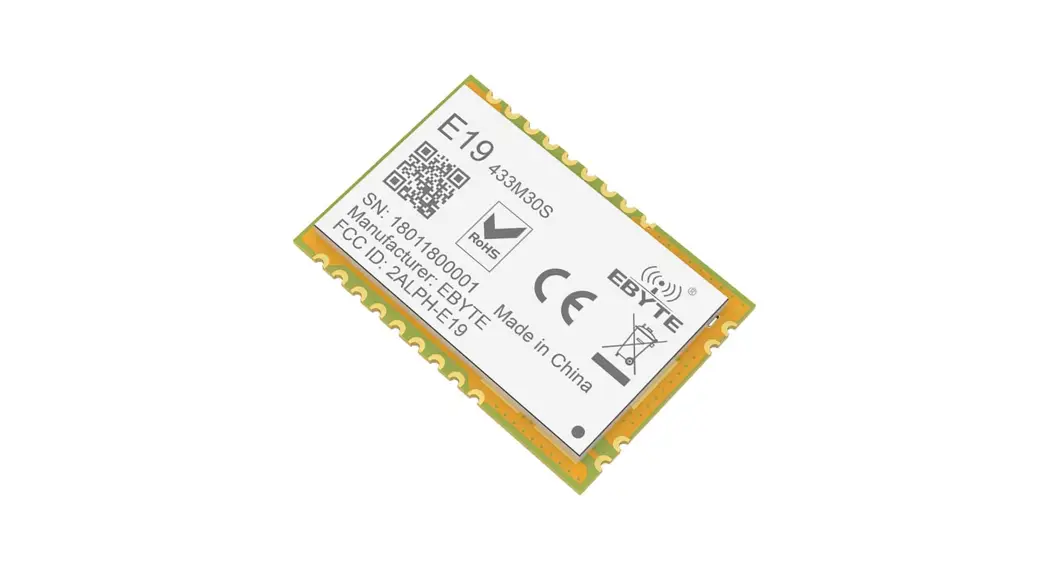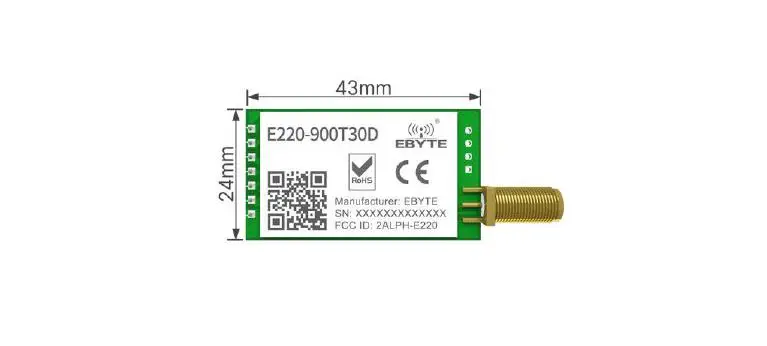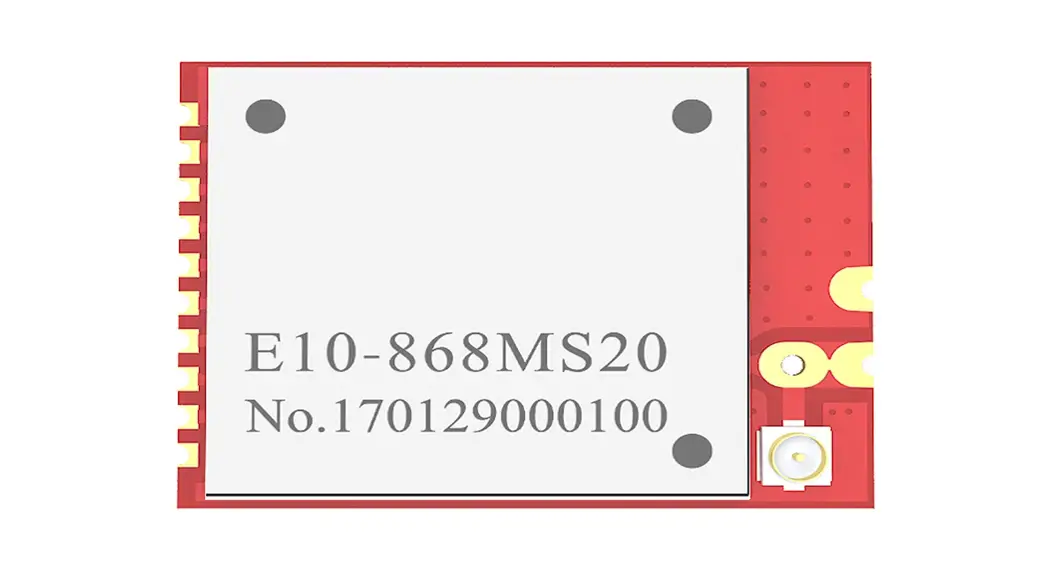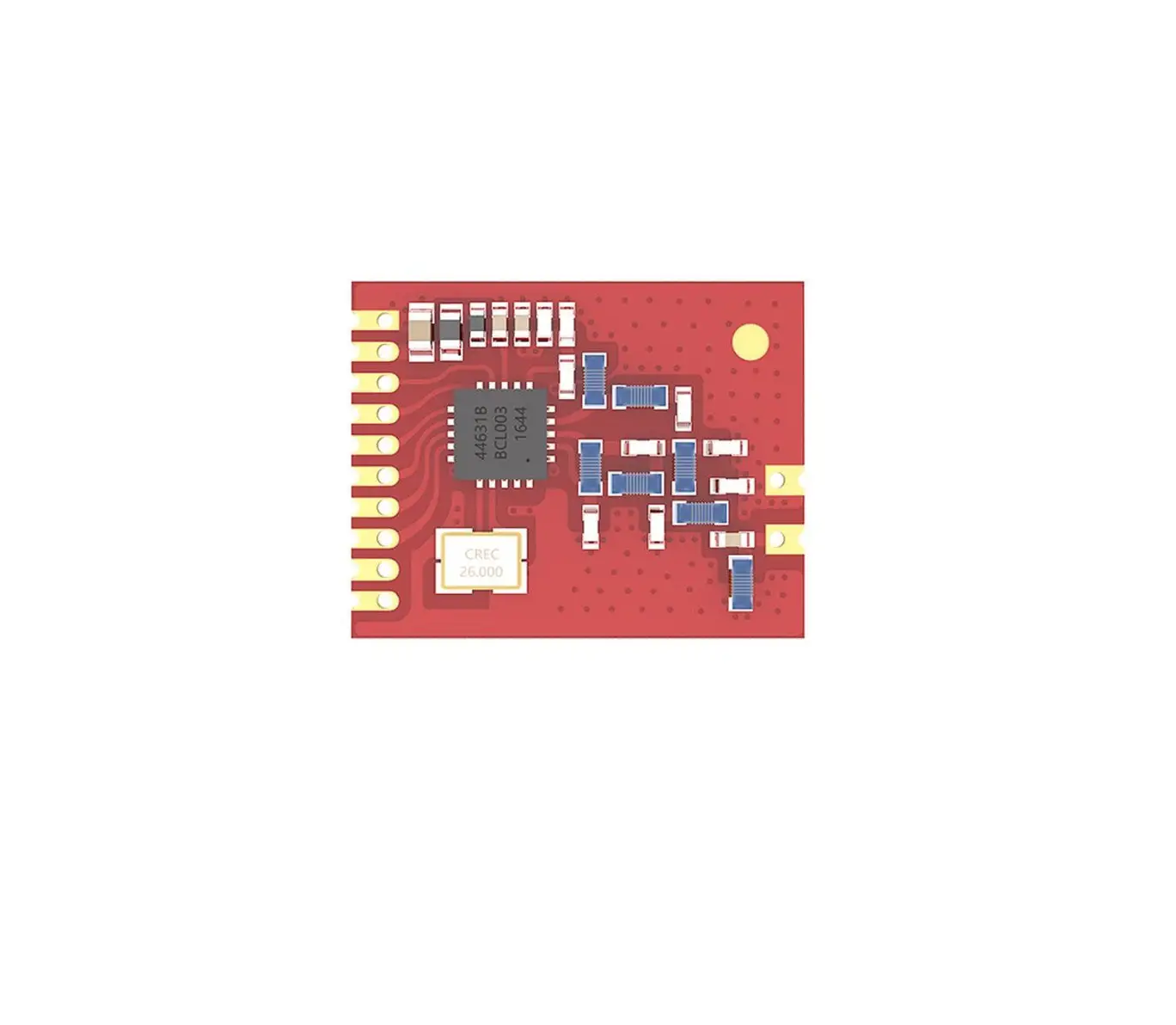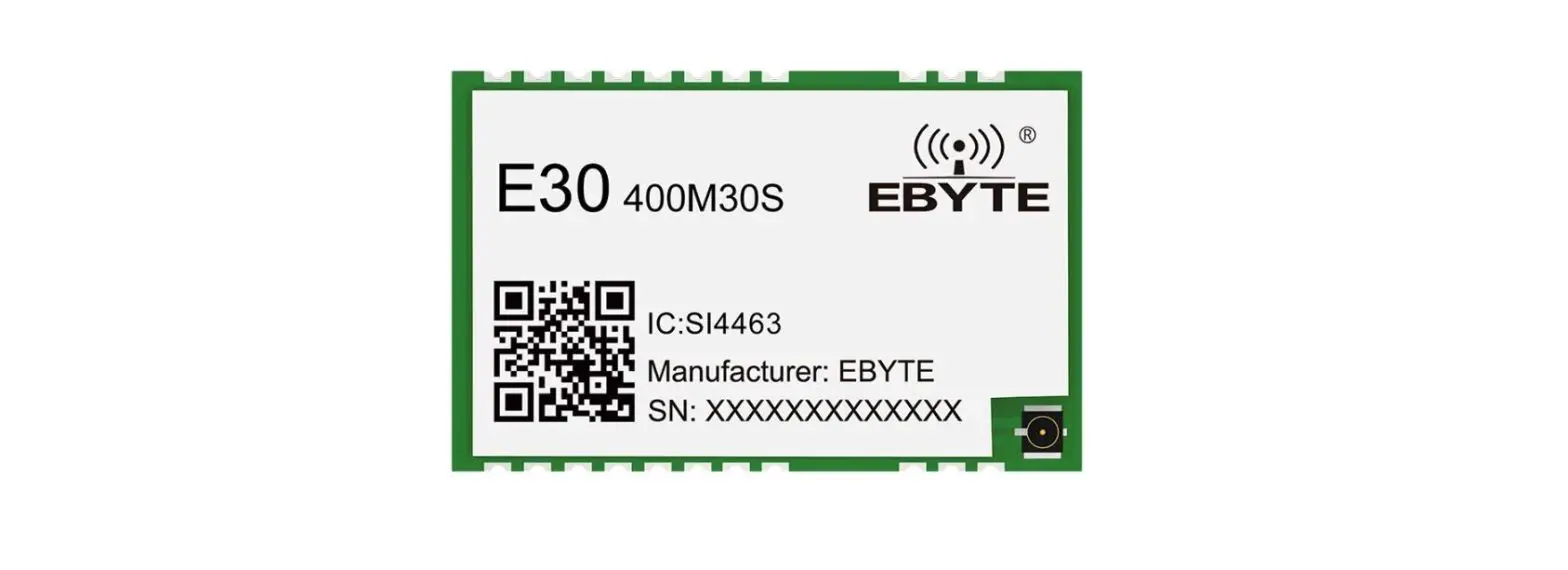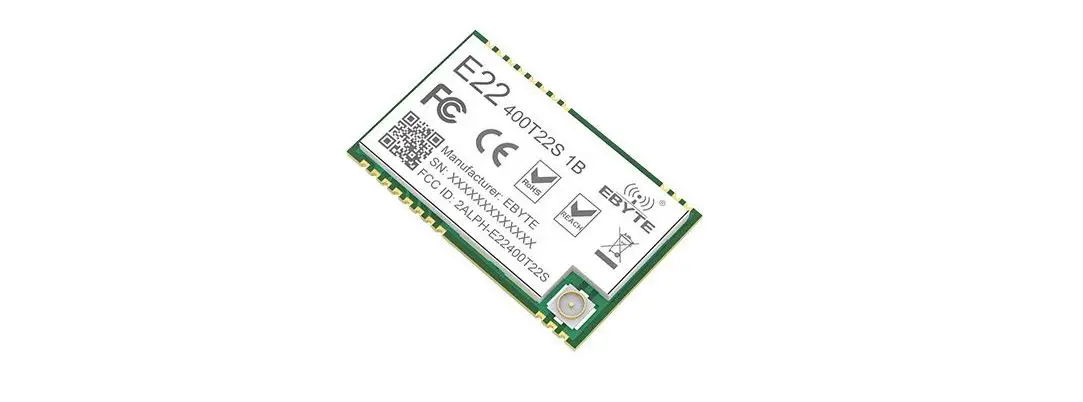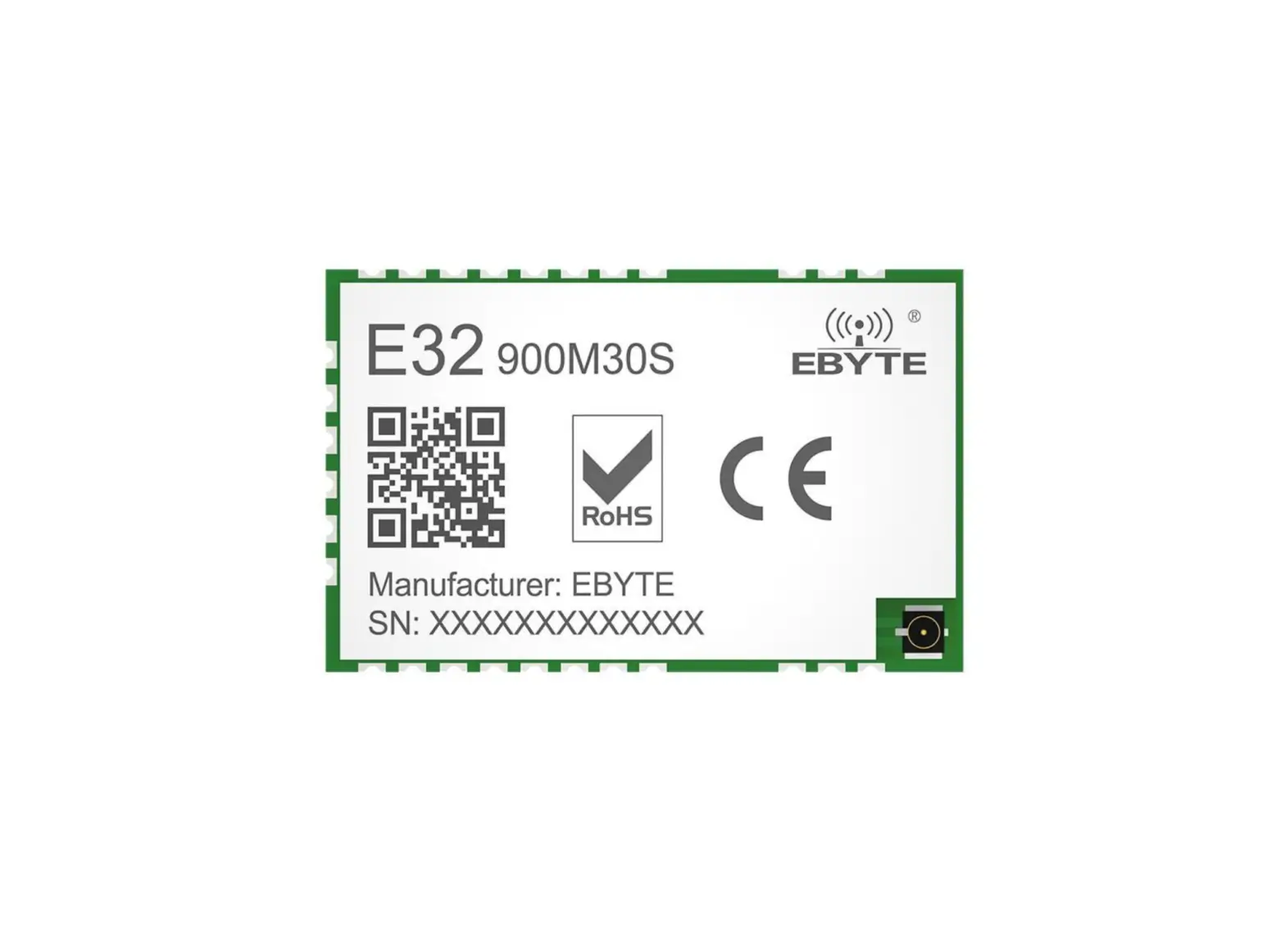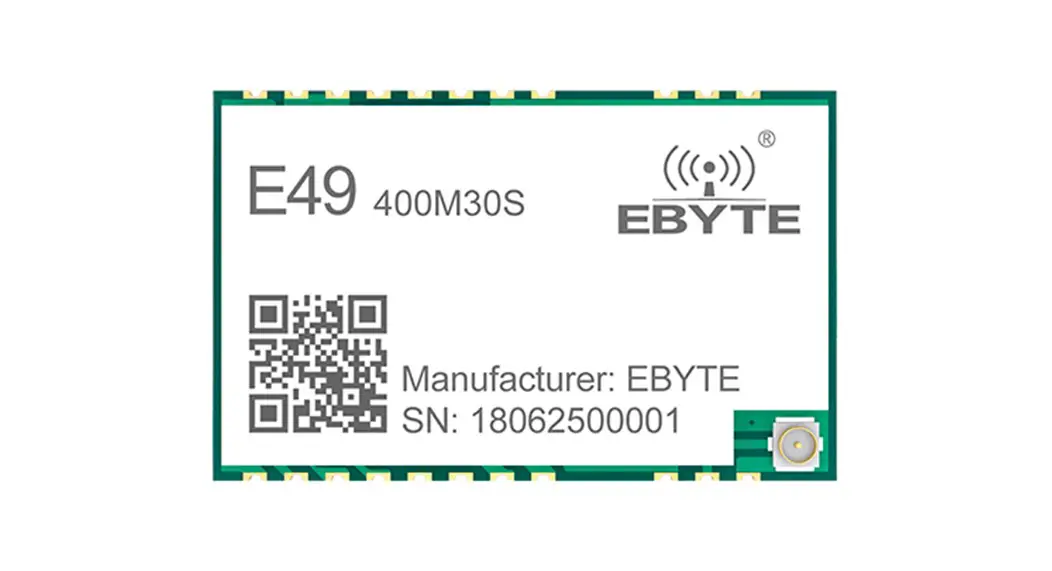

E49-400M30S User Manual
CMT2300A 433/470MHz Chip Hardware Wireless Module
Disclaimer
EBYTE reserves all rights to this document and the information contained herein.
Products, names, logos, and designs described herein may in whole or in part be subject to intellectual property rights. Reproduction, use, modification, or disclosure to third parties of this document or any part thereof without the express permission of EBYTE is strictly prohibited. The information contained herein is provided “as is” and EBYTE assumes no liability for the use of the information. No warranty, either express or implied, is given, including but not limited, with respect to the accuracy, correctness, reliability, and fitness for a particular purpose of the information. This document may be revised by EBYTE at any time. For most recent documents, visit www.ebyte.com.
Features
- The measured communication distance can reach 5.5km;
- Maximum transmitting power 1W, multi-level adjustable;
- Support global license-free ISM 433MHz band;
- Support data transmission rate between 0.5Kbps ~ 300Kbps;
- Supports low power mode, suitable for battery;
- Supports GFSK modulation and OOK,(G)MSK;
- Support 3.3V~5.5V power supply;
- Industrial standard design, support -40 ~ 85°C long time operating;
- Support IPEX/ stamp hole interface, users can choose according to their own needs.
Chapter 1 Overview
Brief introduction
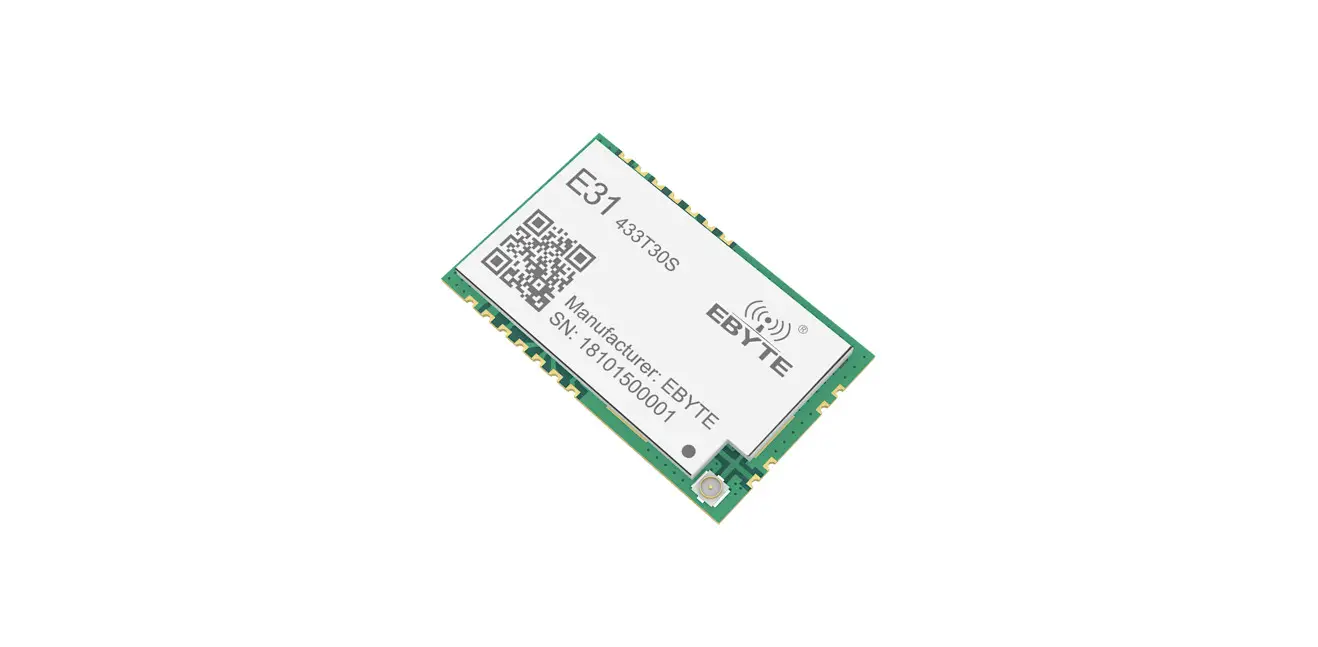
E49-400M30S is a super cost-effective wireless data transmission module launched by Chengdu YIBEST. It is a hardware module based on CMT2300A. Customers can develop and use it according to the working environment and the application conditions of MUC.
E49-400M30S supports a maximum transmission power of 30dBm, and users can set a lower output power to save consumption. The module works in 433/470MHz frequency band. It features small size and low power consumption.
Because this module is a pure RF transceiver module, you need to use MCU drive or specialized SPI debugging tools
Application
- Smart home and industrial sensors;
- Security system, positioning system;
- Wireless remote control, UAV;
- Wireless game remote control;
- Healthcare products;
- Wireless microphones, wireless headphones
- Automotive industry applications.
Chapter 2 Specification & parameter
Limit parameter
| Main parameters | Performance | Remark | |
| minimum | maximum | ||
| power supply voltage (V) | 0 | 6. | Permanently burn modules over 5.5V |
| Blocking power (dBm) | – | 10 | The burn rate is low when used at close range |
| Working temperature (°C) | -40 | +85 | Industrial-grade |
Operating parameter
| Main parameters | Performance | Remark | |||
| minimum | typical | maximum | |||
| Working voltage (V) | 3. | 5 | 6. | >5.5V Can cause permanent module damage | |
| communication level (V) | – | 3. | – | – | |
| Working temperature (°C) | -40 | – | +85 | Industrial-grade | |
| Working frequency (MHz) | 410 | 433 | 510 | – | |
| Power consumption | Emission current ( mA ) | – | 650 | – | – |
| Receive current ( inA ) | – | 17 | – | – | |
| Sleep current ( pA) | – | 2 | – | – | |
| Maximum transmitting power (dBm) | – | 30 | – | – | |
| Receiving sensitivity (dBm) | -12 I | -122 | -123 | The air rate 1.2kbps | |
| Main parameters | Description | Remark |
| Reference range | 5.5kM | Clear & empty, Antenna height 2.5m, data rate 2.4kbps |
| FOSC | 26MHz | – |
| package | SMD | – |
| Communication interface | SPI | SPI |
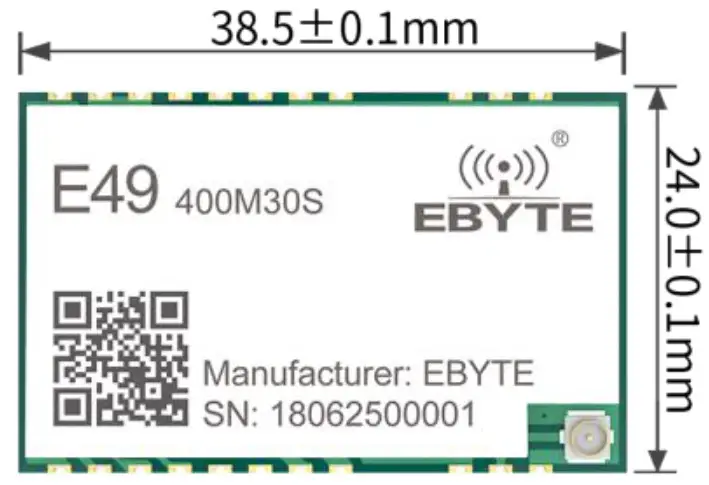
| Dimensions | 24*38.5mm | – |
| radio frequency interface | Stamp hole/IPEX | equivalent impedance about son |
Chapter 3 Size and pin definition
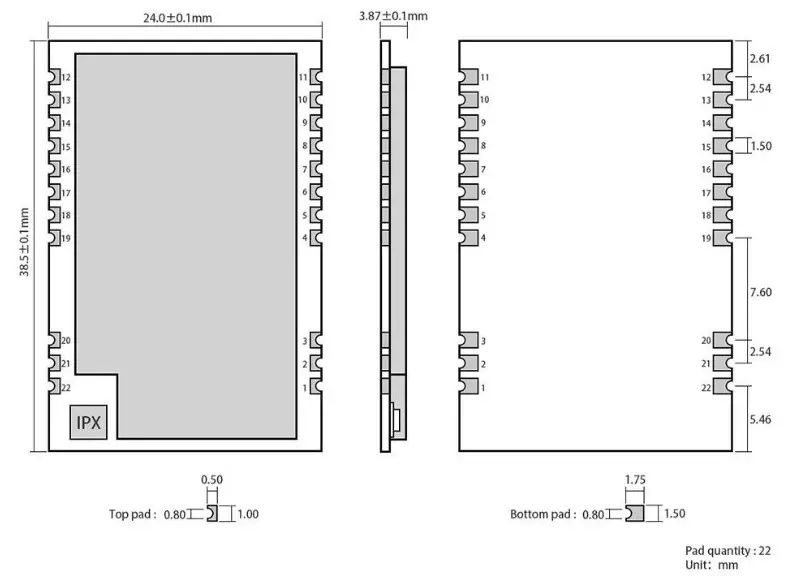
| Pin number | Item | Pin direction | Pin purpose |
| 1 | GND | – | Ground |
| 2 | GND | – | Ground |
| 3 | GND | – | Ground |
| 4 | GND | Ground | |
| 5 | GND | – | Ground |
| 6 | RXEN | input | RF switch receiving control pin, connected to external MCU 10, high level effective |
| 7 | TXEN | input | RF switch receiving control pin, connected to external MCU IO, high level effective |
| 8 | GPIO3 | Input/output | Configurable general I0 port (see CMT2300A manual for details) |
| 9 | VCC | _ | Power supply, range 3.3 — 5.5V (external ceramic filter capacitor is recommended) |
| 10 | VCC | Power supply, range 3.3 — 5.5V (external ceramic filter capacitor is recommended) | |
| 11 | GND | – | Ground |
| 12 | GND | – | Ground |
| 13 | GPIO2 | Input/output | Configurable general I0 port (see CMT2300A manual for details) |
| 14 | GPIO 1 | Input/output | Configurable general I0 port (see CMT2300A manual for details) |
| 15 | FCSB | input | SPI accesses FIFO slice selection |
| 16 | CSB | input | SPI accesses FIFO slice selection |
| 17 | SDIO | Input/output | SPI data input and output |
| 18 | SLCK | input | SPI clock pin |
| 19 | NC | – | – |
| 20 | GND | – | Ground |
| 21 | ANT | – | Antenna interface, stamp hole (50n characteristic impedance) |
| 22 | GND | – | Ground |
Chapter 4 Basic operation
Hardware design
- DC regulated power supply is recommended to power the module, the ripple coefficient of the power supply should be as small as possible, and the module should be reliably grounded;
- Please pay attention to the correct connection of the positive and negative poles of the power supply, such as the reverse connection may cause permanent damage to the module;
- Please check the power supply to ensure that between the recommended power supply voltage, if the maximum value is exceeded, it will cause permanent damage to the module;
- Please check the stability of the power supply. The voltage should not fluctuate greatly and frequently;
- In the design of power supply circuit for modules, it is often recommended to retain more than 30% of the allowance, which is conducive to long-term and stable work;
- The module should be far away from the power supply, transformers, high-frequency wiring and other parts with greater electromagnetic interference;
- High-frequency digital wiring, high-frequency analog wiring and power wiring must avoid the Bottom Layer of the module. If it is really necessary to pass through the Bottom Layer of the module, assuming that the module is welded on the Top Layer, the Top Layer in the contact part of the module must be copper paved (all copper paved and well grounded), close to the digital part of the module and wire in the Bottom Layer;
- It is also a mistake to assume that modules are soldered or placed in the Top Layer and that random wiring in the Bottom Layer or other layers will affect module stray and reception sensitivity to varying degrees; If there are devices with large electromagnetic interference around the module, it will also greatly affect the performance of the module. According to the intensity of the interference, it is recommended to stay away from the module appropriately. If the situation permits, appropriate isolation and shielding can be done;
- If there are wires (high frequency digital, high-frequency analog, power supply wiring) around the module that have large electromagnetic interference, it will also greatly affect the performance of the module. According to the intensity of the interference, it is recommended to stay away from the module appropriately. If the situation permits, appropriate isolation and shielding can be done;
- Try to stay away from part of the TTL protocol which is also 2.4GHz physical layer such as USB3.0;
- Antenna installation structure has a great impact on module performance, be sure to ensure that the antenna is exposed, preferably vertical upward. When the module is installed inside the housing, the antenna can be extended to the outside of the housing by using the high-quality antenna extension cord;
- Antenna must not be installed inside the metal shell, will lead to the transmission distance greatly weakened.
Programming
- This module is CMT2300A, and its drive mode is SPI. Users can operate in accordance with the CMT2300A chip book;
- GPIO1/GPIO2/GPIO3 is a general I/O port, see CMT2300A manual for detail
Chapter 5 Basic application
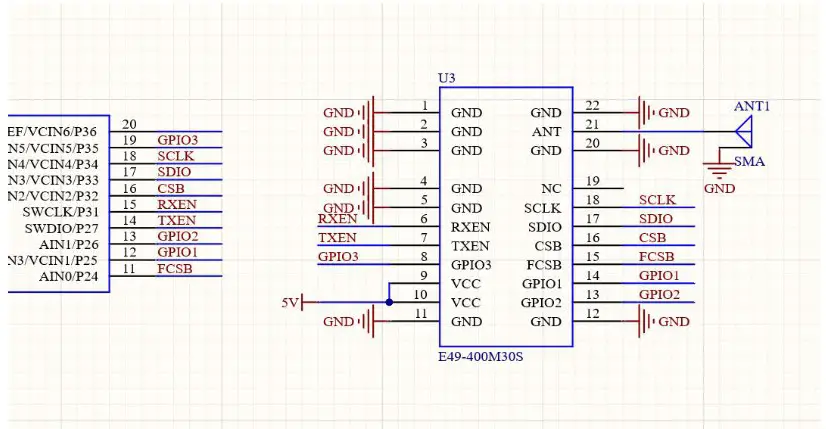
Hardware design & schematics
Chapter 6 FAQ
Transmission distance
- When there is a linear communication barrier, the communication distance will decay accordingly;
- Temperature, humidity and the same frequency interference will lead to the increase of communication packet loss rate;
- The ground absorbs and reflects radio waves, and the test results are poor near the ground;
- Sea water has a strong ability to absorb radio waves, so the seaside test results are poor;
- If there are metal objects near the antenna or placed in a metal shell, the signal attenuation will be very serious;
- Power register set wrong, air speed set too high (the higher the air speed, the closer the distance);
- At indoor temperature, the power supply low voltage is lower than the recommended value, the lower the voltage, the smaller the power;
- The use of antenna and module matching degree is poor or the quality of the antenna itself.
Module damage
- Please check the power supply to ensure that between the recommended power supply voltage, if the maximum value is exceeded, it will cause permanent damage to the module;
- Please check the stability of the power supply. The voltage should not fluctuate greatly and frequently;
- Please ensure anti-static operation during installation and use, and high-frequency devices are static sensitive;
- Please ensure that the humidity during installation and use is not too high. Some components are humidity sensitive devices;
- If there is no special requirement, it is not recommended to use at too high or too low temperature.
Bit error
- If there is interference of the same frequency signal nearby, keep away from the interference source or modify the frequency or channel to avoid interference;
- SPI clock waveform is not standard, check whether there is interference on SPI line, SPI bus wiring should not be too long;
- Power supply is not ideal may also cause garbled code, be sure to ensure the reliability of the power supply;
- Poor or too long extension line, feeder quality, will also cause high bit error rate.
Chapter 7 Welding instruction
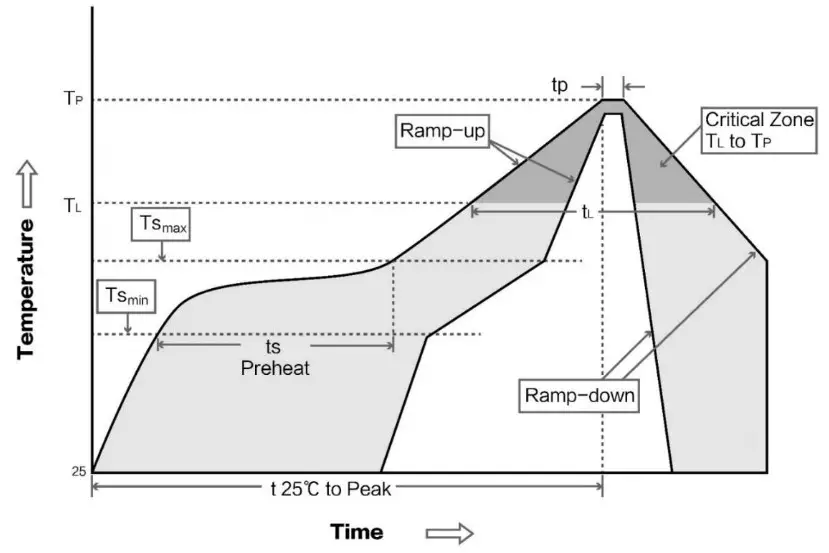
Reflow soldering temperature
| Profile Feature | Sn-Pb Assembly | Pb-Free Assembly |
| Solder Paste | Sn63/Pb37 | Sn96.5/Ag3/Cu0.5 |
| Preheat Temperature min (Tsmin) | 100°C | 150°C |
| Preheat temperature max (Tsmax) | 150°C | 200°C |
| Preheat Time (Tsmin to Tsmax)(ts) | 60-120 sec | 60-120 sec |
| Average ramp-up rate(Tsmax to Tp) | 3°C/second max | 3°C/second max |
| Liquidous Temperature (TL) | 183°C | 217°C |
| Time ( tL ) Maintained Above ( TL) | 60-90 sec | 30-90 sec |
| Peak temperature ( Tp ) | 220-235°C | 230-250°C |
| Aveage ramp-down rate (Tp to Tsmax) | 6°C/second max | 6°C/second max |
| Time 25°C to peak temperature | 6 minutes max | 8 minutes max |
Reflow soldering curve
Chapter 8 E49 series
| Product number | Chip | Working frequency | Transmission power | Test distance | Product size | Packaging form | Communication interface |
| Hz | dBm | km | mm | ||||
| E49-400T20S | CMT2300A | 410-450MHz | 20 | 3. | 26* 16 | SMD | UART |
| E49-400T20D | CMT2300A | 410-450MHz | 20 | 3. | 36*21 | DIP | UART |
| E49-400M20S | CMT2300A | 410-450MHz | 20 | 3. | 20*14 | SMD | SPI |
| E49-400M20S | CMT2300A | 410-450MHz | 20 | 3. | SMD | SPI |
Chapter 9 Antenna recommendation
Recommendation
Antenna is an important role in the communication process, and inferior antennas often have a great impact on the communication system. Therefore, our company recommends some antennas as the antennas with excellent performance and reasonable price supporting our wireless module.
| Product number | Type | frequency | Gain | Size | Feeder | interface | characteristics |
| Hz | dBi | mm | cm | ||||
| TX433-NP-4310 | Flexible PCB antenna | 433M | 2 | 43.8*9.5mm | – | SMA-J | Built-in flexible, FPC soft antenna |
| TX433-JW-5 | Rubber antenna | 433M | 21 | 50min | – | SMA-J | Bendable rubber, omnidirectional antenna |
| TX433-JWG-7 | Rubber antenna | 433M | 3. | 75mni | – | SMA-J | Bendable rubber, omnidirectional antenna |
| TX433-JK-20 | Rubber antenna | 433M | 3 | 2 1 Onini | – | SMA-J | Bendable rubber, omnidirectional antenna |
| TX433-JK- 1 1 | Rubber antenna | 433M | 3. | 1 I Omm | – | SMA-J | Bendable rubber, omnidirectional antenna |
| TX433-XP-200 | Sucker antenna | 433M | 4 | I 9cm | 200cm | SMA-J | Sucker antenna, high gain |
| TX433-XP-100 | Sucker antenna | 433M | 4. | 18.5cm | 100cm | SMA-J | Sucker antenna, high gain |
| TX433-XPH-300 | Sucker antenna | 433M | 6 | 96.5cm | 300cm | SMA-J | Vehicle-mounted sucker antenna, ultra-high gain |
| TX433-JZG-6 | Rubber antenna | 433M | 3. | 52mm | – | SMA-J | Ultra-short straight, omnidirectional antenna |
| TX433-JZ-5 | Rubber antenna | 433M | 2 | 52mm | – | SMA-J | Ultra-short straight, omnidirectional antenna |
| TX490-XP-100 | antenna | 490M | 50 | 12cm | 100cm | SMA-J | Sucker antenna, high gain |
| TX490-JZ-5 | Rubber antenna | 490M | 50 | 50mm | – | SMA-J | Ultra-short straight, omnidirectional antenna |
Revision history
| Version | Revision date | remark | Reviser |
| 1.0 | 2021-4-19 | initial version | Linson |
| 1. | 2021-6-23 | Error correction | Linson |
About us
Technical support: [email protected]
Documents and RF Setting download link: www.ebyte.com
Thank you for using Ebyte products!
Please contact us with any questions or suggestions: [email protected] ————————————————————————————————Phone: +86 028-61399028
Web: www.ebyte.com
Address: B5 Mould Park, 199# Xiqu Ave, High-tech District, Sichuan, China
Chengdu Ebyte Electronic Technology Co.,Ltd.
Copyright ©20122021Chengdu Ebyte Electronic Technology Co.,Ltd.
 LoRa/ZigBee/WiFi/蓝牙模块-数传电台-无线遥控开关-串口服务器-无线通信模块-成都亿佰特电子科技有限公司