 EKSELANS BY ITS 122013 MD HD EASY TWIN Digital Modulator With 2 Inputs
 EKSELANS BY ITS 122013 MD HD EASY TWIN Digital Modulator With 2 Inputs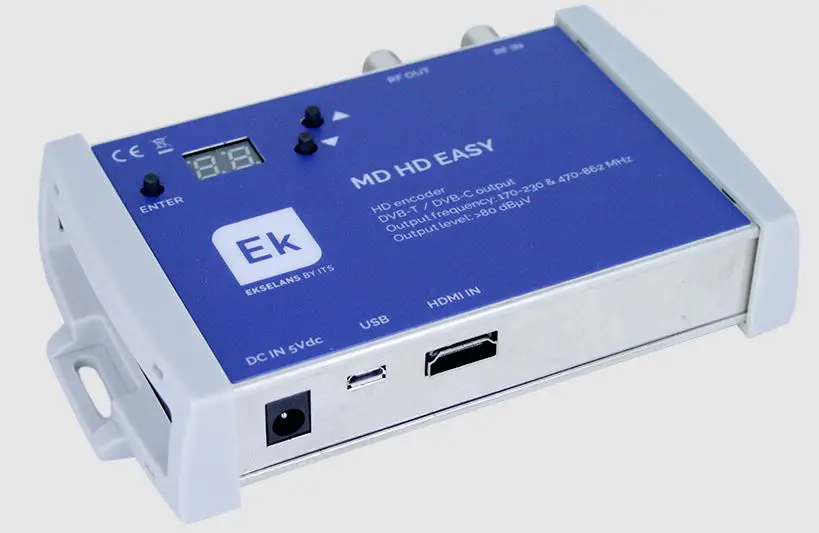
Introduction
Description
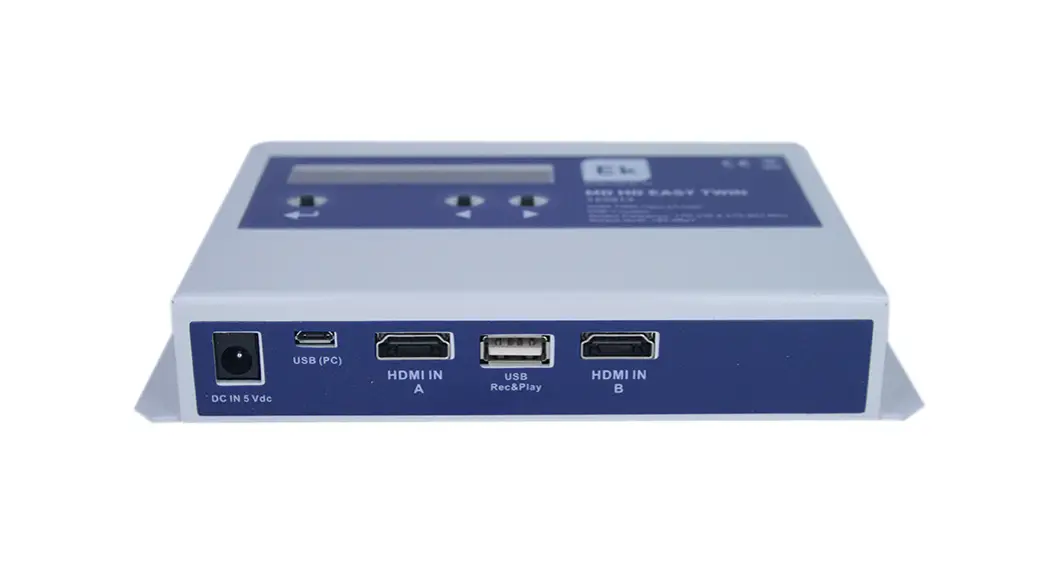
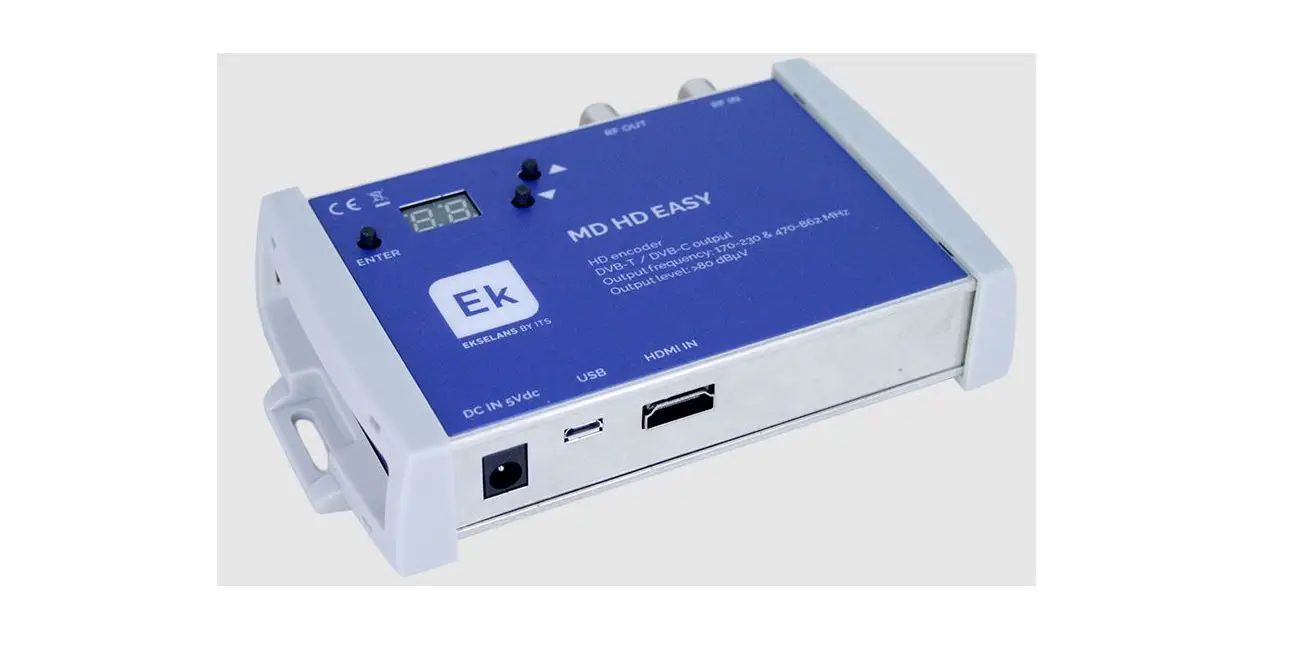
Double HD digital modulator 2x HDMI to COFDM. 2 HDMI input. USB 3.0 input PLAY & REC. Output frequency: 170-230 MHz + 470-862 MHz. Output level (DIN 45004B): >85dBμV. RF mix input.
- The MD HD EASY TWIN is a 2-HDMI input to a 1-channel DVB-T modulator
It has one USB input for recording and playing .ts files using a memory stick. This USB input is linked to HDMI input A. - The programming and adjustments of the modulator can be done completely by using the front buttons. Moreover, through MD HD Soft, software (available at www.ek.plus), these settings and further video playing & recording options can be performed.
- The USB input allows interaction in the following ways:
- Sequential single file recording and playing.
- Automatic play of the file “Autoplay.ts” stored on the USB memory stick when it is connected.
- Playing of several files “video1.ts”, “video2.ts”, “video3.ts sequentially and in bucle.
- Weekly scheduling of the files to be played or recorded (By using “MD HD Soft”).
Key features
- Excellent modulation quality. MER ≥33 dB. HD resolution up to 1080p.
- 2 HDMI inputs.
- Recorder / Player USB.
- Quick menu. Easy selection with buttons.
- Modulation in only one output MUX.
- Advanced programming via PC software.
Packaging content
- 1 x MD HD EASY TWIN.
- 1 x power supply 5V DC.
INTERFACES DISPLAY INFORMATION AND CONNECTION
Interfaces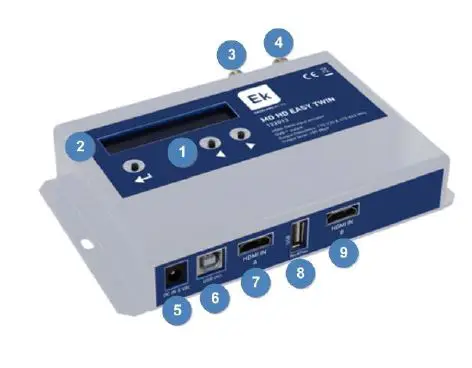
- Buttons.
- Display.
- RF output.
- RF input.
- Power adapter input (5Vdc).
- A-Type USB input for programming.
- HDMI “A” Input.
- B-Type USB input for memory stick.
- HDMI “B” Input.
Display information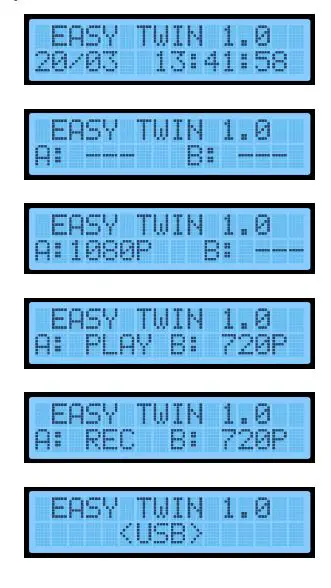
- Firmware version, date and time in main screen. Screen 1/2.
- A & B Inputs not connected. Screen 2/2.
- 1080p signal detected at input A. Screen 2/2.
- USB file being played and 720p signal detected at input B. Screen 2/2.
- USB file being recorded and 720p signal detected at input B. Screen 2/2.
- Modulator connected to PC. Front buttons are disabled. Screen 2/2.
Installation diagram
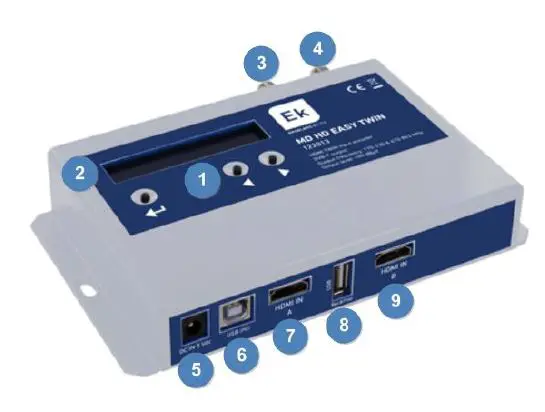
- Keys for configuring.
- Display.
- RF out.
- RF in for combining signal.
- Connect the external power supply.
- Connect to the PC if necessary, to configure with the MD HD SOFT application.
- connect modulated as “A”.
- connect USB containing TS file for video play.
- 9nnect modulated as “B”.

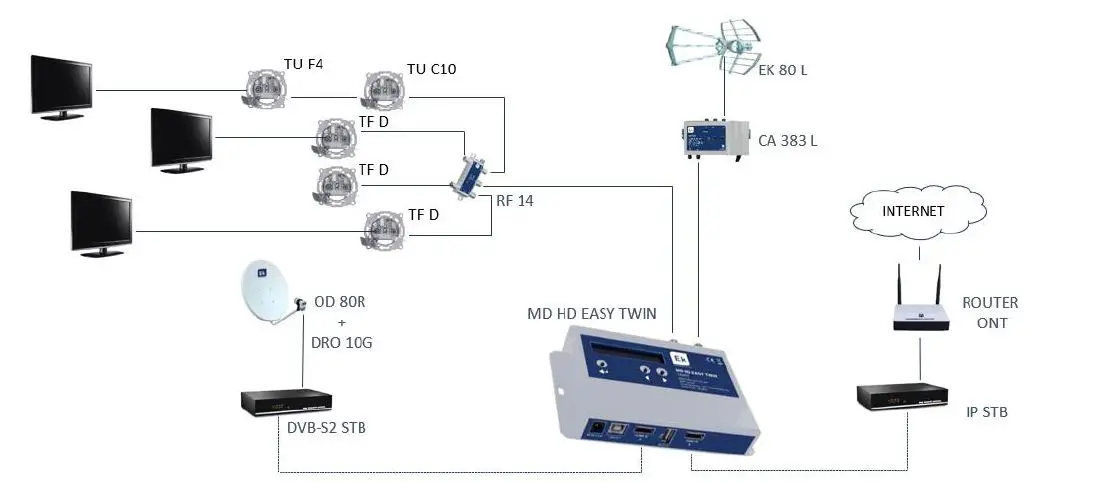
It is necessary to set different TS Id values in facilities with more than one modulator.
Basic programming using buttons
There are two menus for the settings of the modulator.
- Quick menu: It allows a fast set up of the modulator
- Advanced menu: It allows to perform advanced settings. Press
Quick menu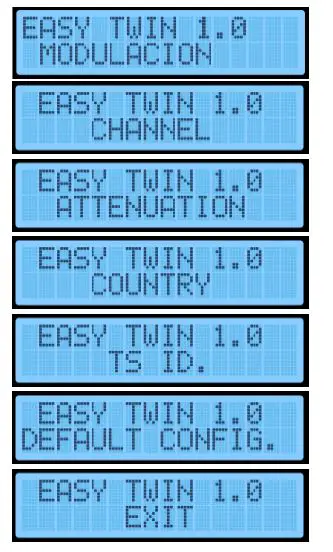
It allows us to select the type of output modulation. DVB-T (DTT1) or DVB-C (Cable TV). “ONLY AVAILABLE IN COMPATIBLE MODELS”. We select the channel with which the modulated signal comes out from 5 to 12 and from 21 to 69 (for example, configured with the country Spain). We can regulate the level of attenuation of the modulated signal from 0 to 15dB. We select the country we want for channel frequencies. Modify the TS ID. It must be modified if you have 2 modulators to differentiate them in the installation. Change the language for the display. Option to return to your factory settings.
Advanced menu
YES (access the following submenus) NO (we do not access the menus). 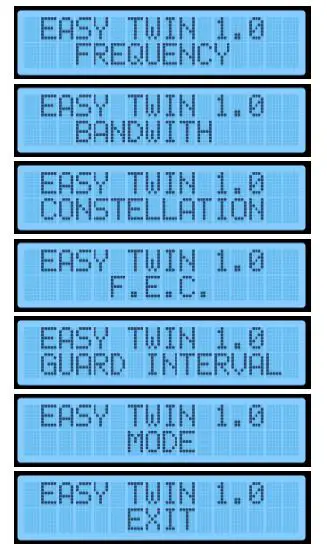
Set frequency in KHz. Allows you to modify the frequency of the selected channel. Modifies the bandwidth of channel 6. 7 or 8MHz. We can select different modes of constellation QPSK, QAM16 or QAM64. We select different FEC 1/2, 2/3, 3/4, 5/6, 7/8. We can select different guard intervals 1/4, 1/8, 1/16, and 1/32. We can select 2K or 8K mode. YES (we go out to the main menu).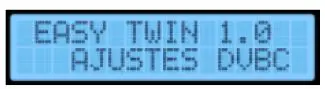
“ONLY AVAILABLE IN COMPATIBLE MODELS”. YES (access the following submenus) NO (we do not access the menus).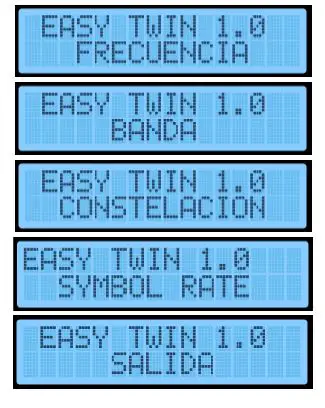
Set frequency in KHz. Allows you to modify the frequency of the selected channel. Modifies the bandwidth of channel 6. 7 or 8MHz. We can select different modes of constellation, QAM16, QAM 32, QAM64, QAM 128, QAM 256. We can define the symbol rate with which we want to work. YES (we go out to the main menu).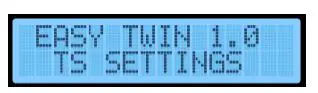
YES (access the following submenus) NO (we do not access the menus). 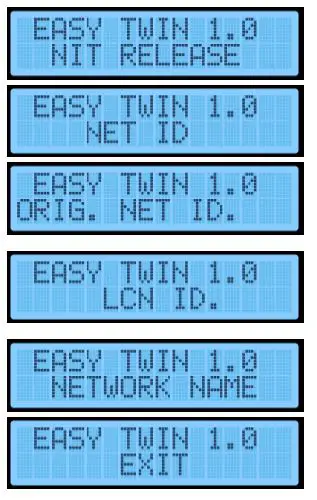
Modify the network ID. Modify the original NET ID. “Logic Channel Number” is used to automatically sort all channels by TV set, reordering them at the same time as we search. NORDIC, EACEM, ITC modes, Change the network name. YES (we go out to the main menu).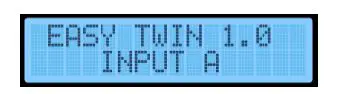
YES (access the following submenus) NO (we do not access the menus). 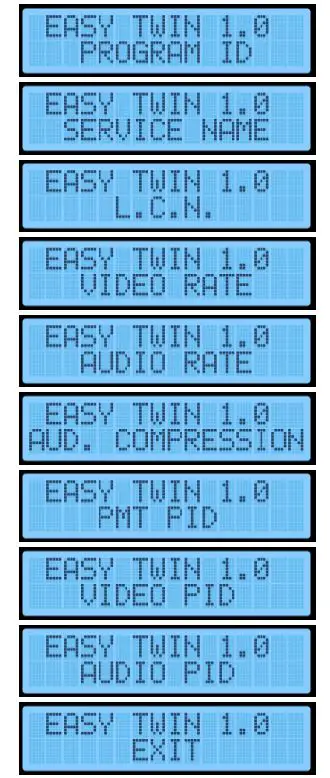
Input channel identifier A. Note that PROGRAM IDs within the same installation must be different. Program name of entry A. Logical Channel Number is used to set a specific order when an automatic sort of all channels in TV sets is required.
Modify video rates. Modify audio rates. Modifies different compression values. AAC-LC, MPEG1-L2, AAC-LC. Modify PMT PID. Modify VIEDO PID. Modify the AUDIO PID. YES (we go out to the main menu).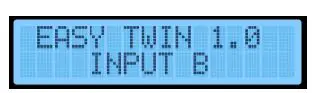
YES (access the following submenus) NO (we do not access the menus). 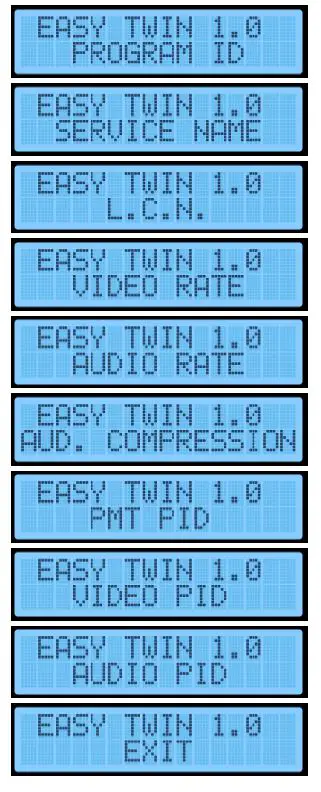
Input channel identifier B. Note that THE PROGRAM IDs within the same modulator must be different. Input program name B. Logical Channel Number is used to set a specific order when an automatic sort of all channels in TV sets is required.
Modify video rates. Modify audio rates. Modifies different compression values. AAC-LC, MPEG1-L2, AAC-LC. Modify PMT PID. Modify VIEDO PID. Modify the AUDIO PID. YES (we go out to the main menu).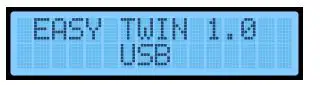
YES (access the following submenus) NO (we do not access the menus). 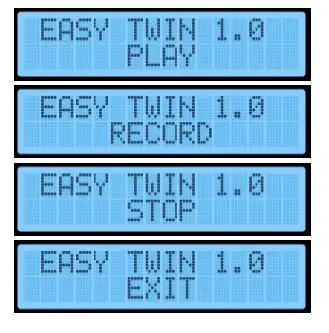
Allows you to play a video from the USB. Explained in its section. Allows you to record a video from the USB. Explained in its section. The use of a .ts (USB) file must be tended before starting any other file or being able to use the HDMI A input.
YES (we go out to the main menu).
YES (we leave the menu) NO (we stay in the advanced menu).
Advanced programming using MD HD Soft
Configurable parameters and options.
- For advanced programming, download the “MD HD Soft” Software from the website www.ek.plus.
- Connect the modulator and computer using a USB cable (Type A/ Type B).

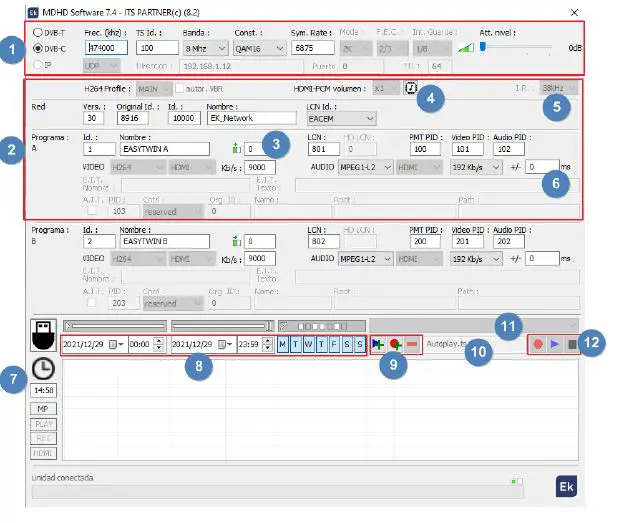
- RF Parameters.
- Video and TS parameters.
- This box can be used to adjust a horizontal shift on the input video. With some sources (rare cases), customers were facing a green part on the left of the picture. With this setting, the picture can be moved to the left to make this green bar disappear.
- Click the button on to write the EDID table in the modulator.
- Frequency of the remote controller that points to the TRC.
- The delay between audio and video of the output modulated signal. A delay of -999ms means that the video is almost 1s in front of the video.
- Current time and adjustment.
- Schedule by date, time and days of the week.
- Programming of scheduled events of recording and playing files to/from the USB memory stick.
- . Name of the file that the modulator expects in the connected USB memory stick for playing or overwriting.
- Selection of the .ts file stored inside the connected USB memory stick
- Control with MDHDSoft of the stored files in the USB memory stick. PLAY, STOP or Record.
- Panel where uploaded videos will be displayed.
Creating a Playlist or Recordlist.
As the device can be connected to an external USB memory stick and keeps the time, events of recording and playing can be programmed: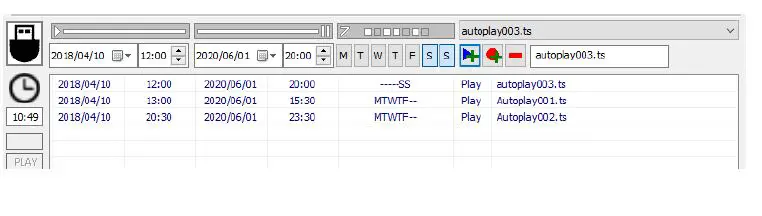
- Select initial and final date and time
- Select the days of the week.
- Select the file to be played or write the name of the file to be recorded
- Press or depending on if we want to play or record.
- In case of error, select the element and delete it .
The modulator allows recording and playing .ts files with the support of a USB memory stick. The selection of the files can be done both by using the front buttons or by “MD HD Soft” software. The use of the USB port is priority over the HDMI A input.The modulator allows recording and playing .ts files with the support of a USB memory stick. The selection of the files can be done both by using the front buttons or by “MD HD Soft” software. The use of the USB port is priority over the HDMI A input: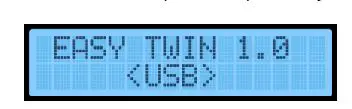
Recording and playing by front buttons
Connect a 3.0 USB memory stick and feed the module with the power adapter.
PLAY
Select the target file in the memory by using the advanced menu:
- Select the target file in the memory by using the advanced menu“Autoplay001.ts”, it will be played automatically when connecting the USB.
- In order to play a selection of files, name them with a numerical suffix. For example, “Autoplay001.ts”, “Autoplay002.ts”, “Autoplay003.ts”. When the playing of the selected file is ended, it will keep playing the following videos sorted by number. Once finished, will continue from the lowest suffix file,
- REC
Insert the name of the file to be stored character by character:
- STOP PLAYING / RECORDING
When using a .ts file stop it before using another file or using the HDMI A input.


USING THE USB MEMORY
- The modulator allows recording and playing .TS files.
- TS files must be stored on a USB 3.0 memory with FAT32 files system.
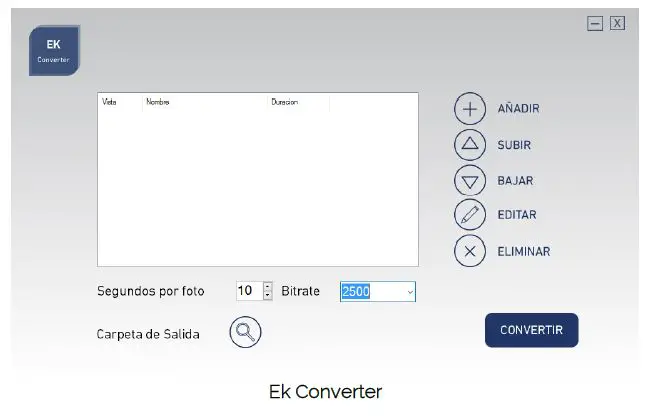
- The “EK Converter” software can be found on the website https://ek.plus/software/. This converts the most common video and image formats to .TS format.
- Use the MD HD Soft software to program play/record time slots.
- The file “Video01.ts” hosted in the root of the memory will be played cyclically.
- If there are other files “Autoplay001.ts”, and “Autoplay002.ts”… will be played consecutively.

- The recording and playing of files is priority over the HDMI input A. Make sure the TV is tuned over this program if want to view such files.
Technical specifications
| REFERENCE | MD HD EASY RC | |
| Code | 122013 | |
| Inputs | 2x HDMI (A /B) | |
| VÍDEO | ||
| Video resolution | 480p – 576p – 720p – 1080p | |
| Video compression | H.264 | |
| Vídeo rate | Kbps | 500-15000 |
| AUDIO | ||
| Audio compression | MPEG1-L2, AAC-LC | |
| Audio rate | Kbps | 128, 192, 256, 320 |
| MODULATION | ||
| DVB processing | NIT, PID | |
| DVB adjustment | NID, ONID, Network ID, Network name, TS ID, Program ID, Program name, PMT PID, Video PID, Audio PID | |
| Output frequency | MHz | 170-230 & 470-862 |
| Output channel | N. | 5…12 + 21…69 |
| Output level | dBµV | >80 |
| Attenuation | dB | 0…15 |
| MER | dB | ≥33 |
| Bandwith | MHz | 6, 7, 8 |
| Constellation | QPSK, 16QAM, 64QAM | |
| Mode | 2K, 8K | |
| FEC | 1/2, 2/3, 3/4, 5/6, 7/8 | |
| Guard interval | 1/4, 1/8, 1/16, 1/32 | |
| LCN | EACEM, ITC, NORDIG | |
| Loop RF | dB | -2 |
| USB | ||
| USB Connector | ts files Record & Play | |
| USB Connector B type | For PC programming | |
| GENERAL | ||
| Mains voltage | Vdc | +5 (RF OUT pass optional) |
| Power consumption | W | <5 |
| Dimensions | mm | 170 x 100 x 25 |
| Weigth | kg | 0,6 |
Frequency and channels table (Standard B/G)
- Band III. 7MHz Bandwidth.
- Band IV – V. 8MHz Bandwidth.
| BAND | Channel | Start Freq. | End Freq | Central Freq |
|
III | 5 | 174 MHz | 181 MHz | 177,5 MHz |
| 6 | 181 MHz | 188 MHz | 184,5 MHz | |
| 7 | 188 MHz | 195 MHz | 191,5 MHz | |
| 8 | 195 MHz | 202 MHz | 198,5 MHz | |
| 9 | 202 MHz | 209 MHz | 205,5 MHz | |
| 10 | 209 MHz | 216 MHz | 212,5 MHz | |
| 11 | 216 MHz | 223 MHz | 219,5 MHz | |
| 12 | 223 MHz | 230 MHz | 226,5 MHz |
| BAND | Channel | Start Freq. | End Freq | Central Freq |
|
IV | 21 | 470 MHz | 478 MHz | 474 MHz |
| 22 | 478 MHz | 486 MHz | 482 MHz | |
| 23 | 486 MHz | 494 MHz | 490 MHz | |
| 24 | 494 MHz | 502 MHz | 498 MHz | |
| 25 | 502 MHz | 510 MHz | 506 MHz | |
| 26 | 510 MHz | 518 MHz | 514 MHz | |
| 27 | 518 MHz | 526 MHz | 522 MHz | |
| 28 | 526 MHz | 534 MHz | 530 MHz | |
| 29 | 534 MHz | 542 MHz | 538 MHz | |
| 30 | 542 MHz | 550 MHz | 546 MHz | |
| 31 | 550 MHz | 558 MHz | 554 MHz | |
| 32 | 558 MHz | 566 MHz | 562 MHz | |
| 33 | 566 MHz | 574 MHz | 570 MHz | |
| 34 | 574 MHz | 582 MHz | 578 MHz | |
| 35 | 582 MHz | 590 MHz | 586 MHz | |
| 36 | 590 MHz | 598 MHz | 594 MHz | |
| 37 | 598 MHz | 606 MHz | 602 MHz |
| BAND | LTE | Channel | Start Freq. | End Freq | Central Freq |
|
V | 38 | 606 MHz | 614 MHz | 610 MHz | |
| 39 | 614 MHz | 622 MHz | 618 MHz | ||
| 40 | 622 MHz | 630 MHz | 626 MHz | ||
| 41 | 630 MHz | 638 MHz | 634 MHz | ||
| 42 | 638 MHz | 646 MHz | 642 MHz | ||
| 43 | 646 MHz | 654 MHz | 650 MHz | ||
| 44 | 654 MHz | 662 MHz | 658 MHz | ||
| 45 | 662 MHz | 670 MHz | 666 MHz | ||
| 46 | 670 MHz | 678 MHz | 674 MHz | ||
| 47 | 678 MHz | 686 MHz | 682 MHz | ||
| 48 | 686 MHz | 694 MHz | 690 MHz | ||
| 2 | 49 | 694 MHz | 702 MHz | 698 MHz | |
| 2 | 50 | 702 MHz | 710 MHz | 706 MHz | |
| 2 | 51 | 710 MHz | 718 MHz | 714 MHz | |
| 2 | 52 | 718 MHz | 726 MHz | 722 MHz | |
| 2 | 53 | 726 MHz | 734 MHz | 730 MHz | |
| 2 | 54 | 734 MHz | 742 MHz | 738 MHz | |
| 2 | 55 | 742 MHz | 750 MHz | 746 MHz | |
| 2 | 56 | 750 MHz | 758 MHz | 754 MHz | |
| 2 | 57 | 758 MHz | 766 MHz | 762 MHz | |
| 2 | 58 | 766 MHz | 774 MHz | 770 MHz | |
| 2 | 59 | 774 MHz | 782 MHz | 778 MHz | |
| 2 | 60 | 782 MHz | 790 MHz | 786 MHz | |
| 1 | 61 | 790 MHz | 798 MHz | 794 MHz | |
| 1 | 62 | 798 MHz | 806 MHz | 802 MHz | |
| 1 | 63 | 806 MHz | 814 MHz | 810 MHz | |
| 1 | 64 | 814 MHz | 822 MHz | 818 MHz | |
| 1 | 65 | 822 MHz | 830 MHz | 826 MHz | |
| 1 | 66 | 830 MHz | 838 MHz | 834 MHz | |
| 1 | 67 | 838 MHz | 846 MHz | 842 MHz | |
| 1 | 68 | 846 MHz | 854 MHz | 850 MHz | |
| 1 | 69 | 854 MHz | 862 MHz | 858 MHz |
 Ekselans by ITS
 Software - Ekselans by ITS