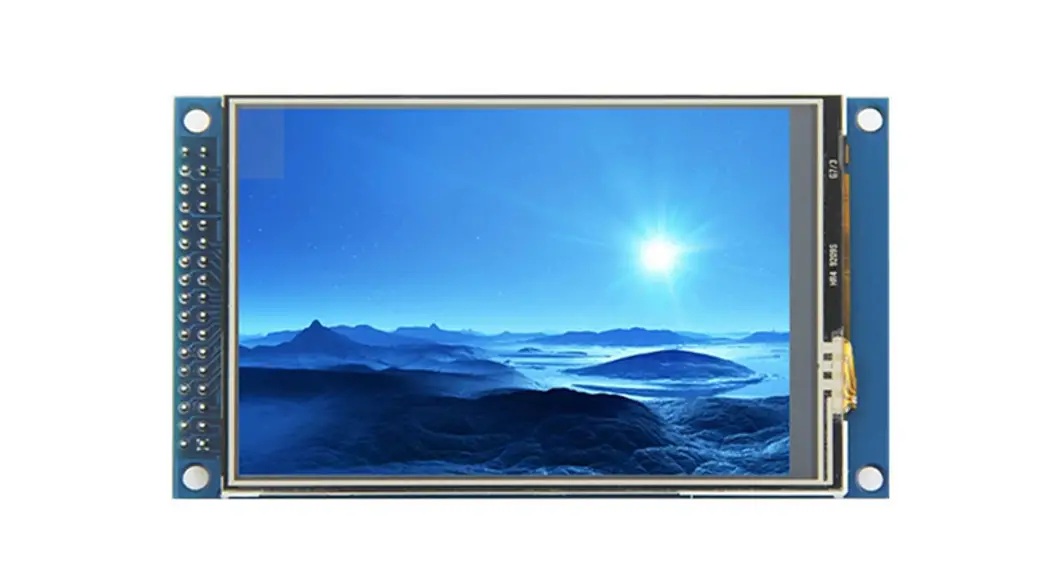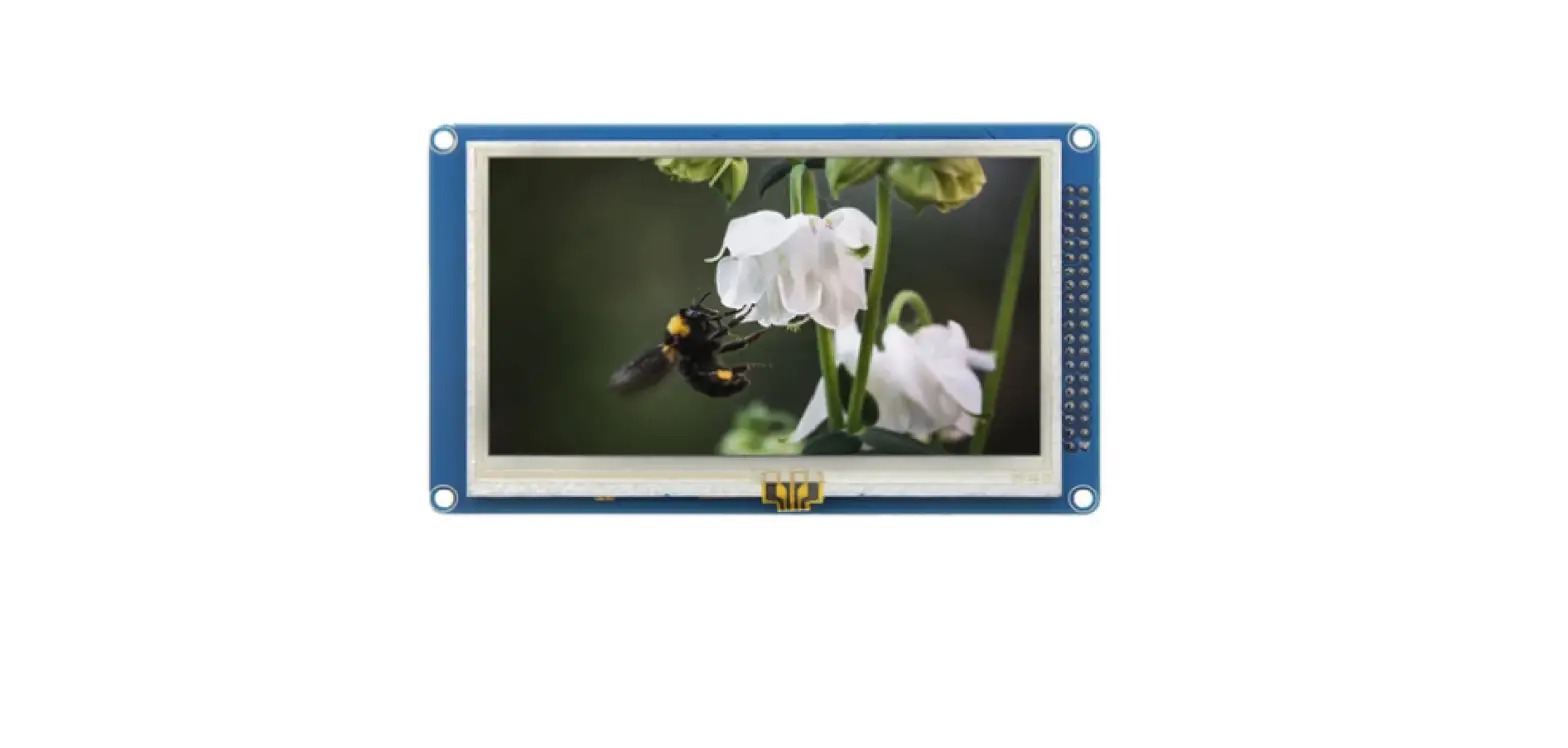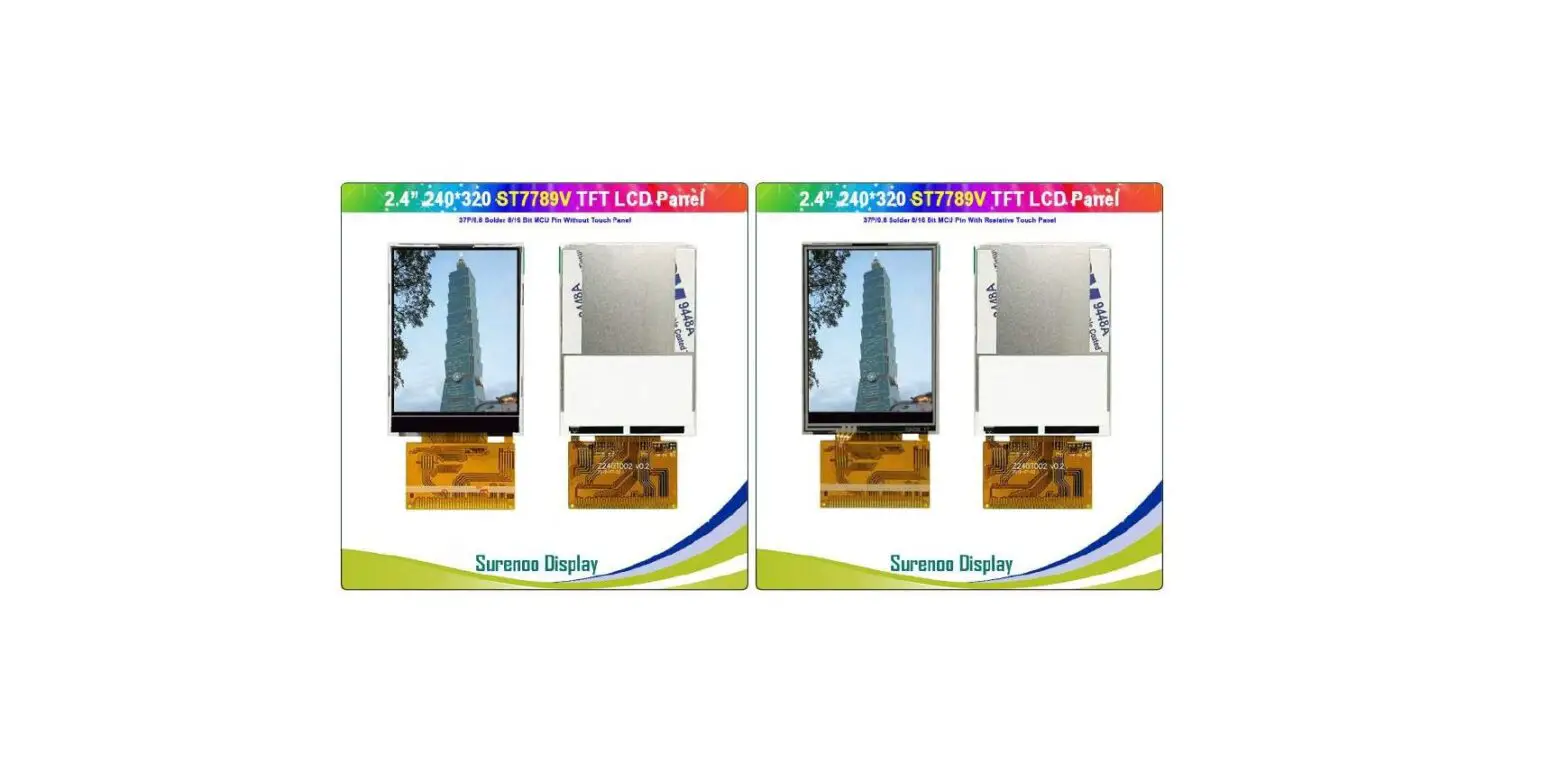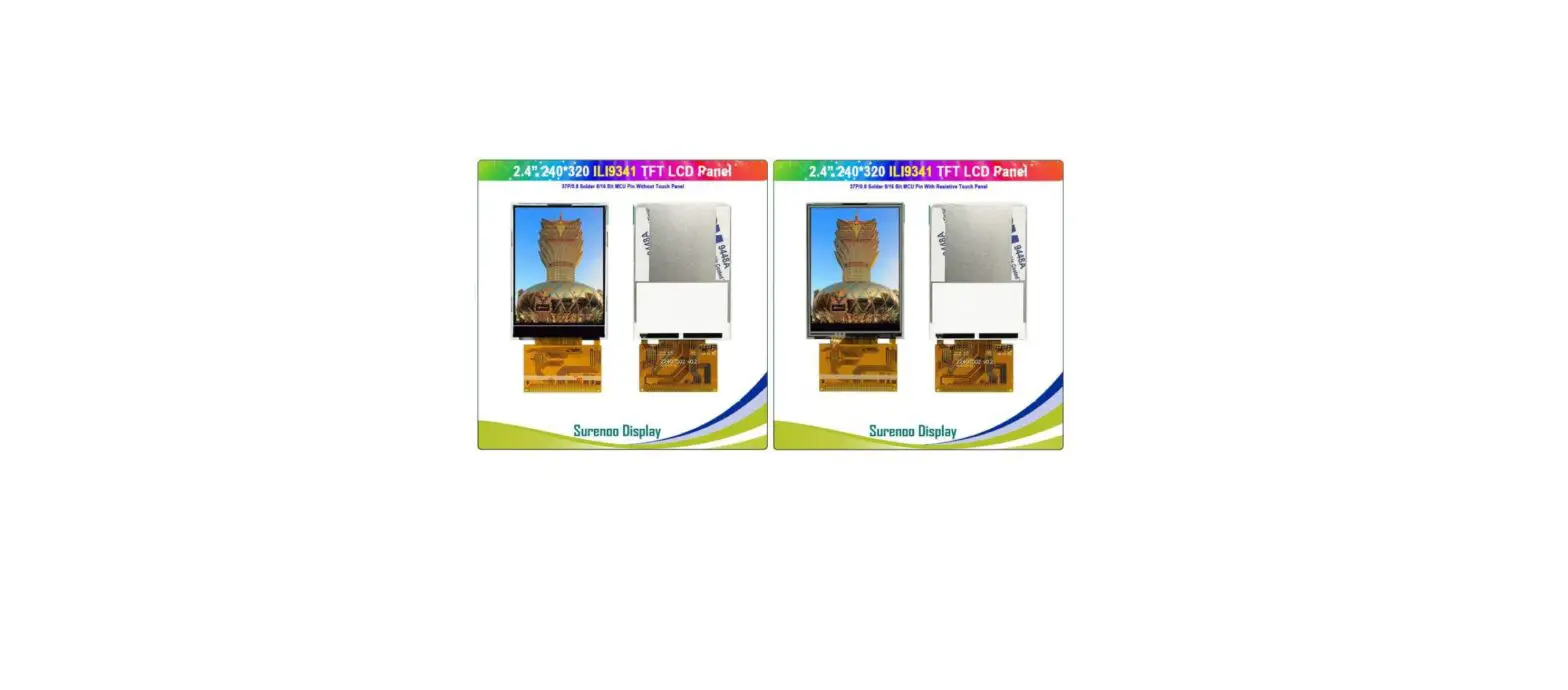

Surenoo SMC0240A-240320 Series MCU Interface TFT LCD Module
Shenzhen Surenoo Technology Co.,Ltd.
www.surenoo.com
Skype: Surenoo365
Reference Controller Datasheet
MCU Interface LCD Module Selection Guide
ILI9341
Product Description
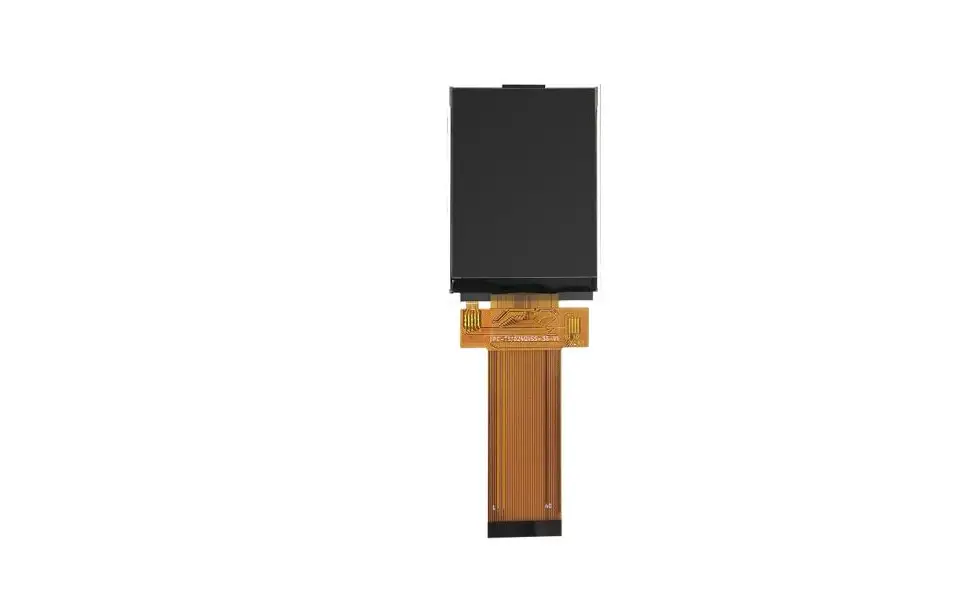
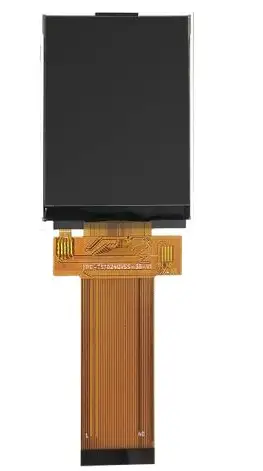
The product is a 2.4-inch TFT LCD module ,it has the 320×240 resolution and supports 16BIT RGB 65K color display, the internal driver IC is ILI9341. Its hardware supports 8-bit and 16-bit parallel port data bus mode switching, the default use 16-bit parallel port data bus mode. The module includes LCD display, resistive touch screen, SD card slot and PCB backplane. It can be Insert directly the STM32 series development board and supports SD card expansion.
Product Features
- 2.4-inch color screen, support 16BIT RGB 65K color display, display rich colors
- 240×320 resolution for clear display
- Support 8-bit and 16-bit parallel data bus mode switching, default 16-bit parallel bus transmission, fast transmission speed
- Supports ALIENTEK STM32 Mini, Elite, WarShip, Explorer, and Apollo development boards for direct plug-in use
- Support for touch function
- Support SD card function expansion
- Provides a rich sample program for STM32 and C51 platforms
- Military-grade process standards, long-term stable work
- Provide underlying driver technical support
Product Parameters
| Name | Description |
| Display Color | RGB 65K color |
| SKU | MRB2408 |
| Screen Size | 2.4(inch) |
| Screen Type | TFT |
| Driver IC | ILI9341 |
| Resolution | 320*240 (Pixel) |
| Module Interface | 8bit or 16Bit parallel interface |
| Active Area | 48.96*36.72(mm) |
| Touch Screen Type | resistive touch screen |
| Touch IC | XPT2046 |
| Module PCB Size | 44.25×76.00 (mm) |
| Operating Temperature | -20℃~70℃ |
| Storage Temperature | -40℃~70℃ |
| Operating Voltage | 3.3V / 5V |
| Power Consumption | TBD |
| Product Weight | TBD |
Interface Description
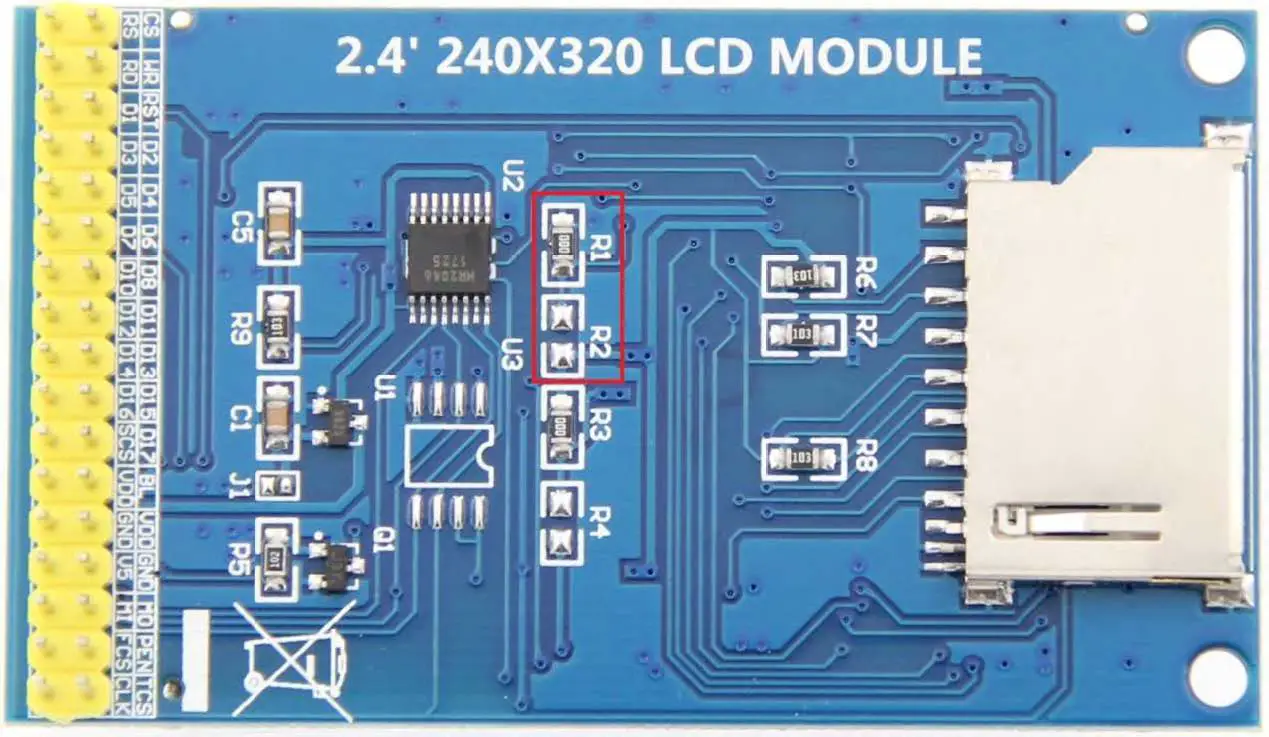
Picture1. Module Pin silk screen picture
Note:
- The module hardware supports 8-bit and 16-bit parallel port data bus mode switching (as sho wn by the red box in Picture 1 ab ove), as follows:
- Solder R1 with 0Ω resistor or short circuit directly, and disconnect R2:
Select 16-bit parallel port data bus mode, use D1~D8, D10~D17 data pins - Solder R2 with 0Ω resistor or short circuit directly, and disconnect R1:
Select 8-bit parallel port data bus mode, use D10~D17 data pins
- Solder R1 with 0Ω resistor or short circuit directly, and disconnect R2:
Important Note:
- The following pin numbers 1~34 are the pin number of Module pin with PCB backplane of our company. If you purchase a bare screen, please refer to the pin definition of the bare screen specification, refer to the wiring according to the signal type instead of directly Wire according to the following module pin numbers. For example: CS is 1 pin on our module. It may be x pin on different size bare screen.
- About VCC supply voltage: If you buy a module with PCB backplane, VCC/VDD power supply can be connected to 5V or 3.3V (module has integrated ultra low dropout 5V to 3V circuit), but it is recommended to connect 3.3V, because connecting 5V will lead to circuit Increased heat generation, affecting module life; if you buy a bare screen LCD, remember to only connect 3.3V.
- About the backlight voltage: The module with the PCB backplane has integrated triode backlight control circuit, which only needs to input the high level of the BL pin or the PWM wave to illuminate the backlight. If you are buying a bare screen, the LEDAx is connected to 3.0V-3.3V and the LEDKx is grounded.
| Number | Module Pin | Pin Description |
| 1 | CS | LCD reset control pin( low level enable) |
| 2 | RS | LCD register / data selection control pin (high level: register, low level: data) |
| 3 | WR | LCD write control pin |
| 4 | RD | LCD read control pin |
| 5 | RST | LCD reset control pin( low level reset) |
| 6 | D1 | LCD data bus low 8-bit pin(If 8-bit mode is |
| 7 | D2 | selected, the lower 8-bit data pins are not used.) |
| 8 | D3 | |
| 9 | D4 | |
| 10 | D5 | |
| 11 | D6 | |
| 12 | D7 | |
| 13 | D8 | |
| 14 | D10 | LCD data bus high 8-bit pin |
| 15 | D11 | |
| 16 | D12 | |
| 17 | D13 | |
| 18 | D14 | |
| 19 | D15 | |
| 20 | D16 | |
| 21 | D17 | |
| 22 | SCS | SD card selection control pin (used when using the SD card expansion function, this test program is not used) |
| 23 | BL | LCD backlight control pin(High level light) |
| 24 | VDD | Module power positive pin (module has integrated voltage regulator IC, so the power supply can be connected to 5V or 3.3V) |
| 25 | VDD | |
| 26 | GND | Module power ground pin |
| 27 | GND | |
| 28 | V5 | LCD backlight power positive pin (default shared onboard backlight power supply, this pin can not be connected) |
| 29 | MO | Touch screen SPI bus data input pin |
| 30 | MI | Touch screen SPI bus data output pin |
| 31 | PEN | Touch screen interrupt detection pin (Low level when a touch occurs) |
| 32 | FCS | Flash chip select control pin (used when using the Flash extension function, this test program is not used) |
| 33 | TCS | Touch screen IC chip select control pin(Low level enable) |
| 34 | CLK | Touch screen SPI bus clock control pin |
Hardware Configuration
The LCD module hardware circuit comprises five parts: an LCD display control circuit, a resistive touch screen sampling circuit, an SD card interface circuit, a Data bus mode switching circuit and a backlight control circuit.
LCD display control circuit for controlling the pins of the LCD, including control pins and data transfer pins.
The resistive touch screen sampling circuit is used for detecting a touch event, performing AD conversion on the touch data, and transmitting touch coordinate values.
SD card control circuit is used for SD card function expansion, controlling SD card identification, reading and writing.
Data bus mode switching circuit for switching 8-bit or 16-bit parallel port data bus mode switching.
Backlight control circuit for controlling backlight brightness and power supply selection.
Working principle
Introduction to ILI9341 Controller
The ILI9341 controller supports a maximum resolution of 240*320 and has a 172800-byte GRAM. It also supports 8-bit, 9-bit, 16-bit, and 18-bit parallel port data buses. It also supports 3-wire and 4-wire SPI serial ports. Since the supported resolution is relatively large and the amount of data transmitted is large, the parallel port transmission is adopted, and the transmission speed is fast. ITI9341 also supports 65K, 262K RGB color display, display color is very rich, while supporting rotating display and scroll display and video playback, display in a variety of ways.
The ILI9341 controller uses 16bit (RGB565) to control a pixel display, so it can display up to 65K colors per pixel. The pixel address setting is performed in the order of rows and columns, and the incrementing and decreasing direction is determined by the scanning mode. The ILI9341 display method is performed by setting the address and then setting the color value.
Introduction to parallel port communication
The parallel port communication write mode timing is as shown below:
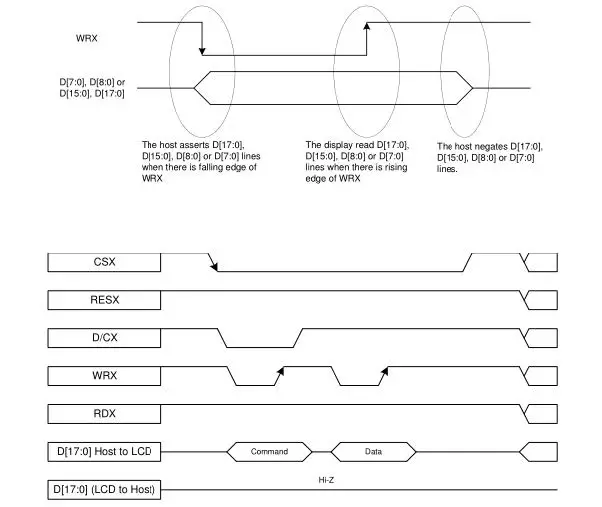
The timing of the parallel port communication read mode is shown in the figure below:
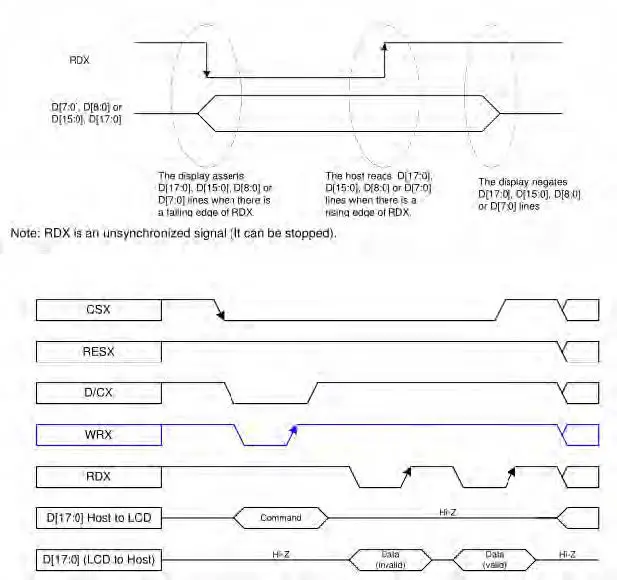
CSX is a chip select signal for enabling and disabling parallel port communication, active low
RESX is an external reset signal, active low
D/CX is the data or command selection signal, 1-write data or command parameters, 0-write command
WRX is a write data control signal
RDX is a read data control signal
D[X:0] is a parallel port data bit, which has four types: 8-bit, 9-bit, 16-bit, and 18-bit.
When performing a write operation, on the basis of the reset, first set the data or command selection signal, then pull the chip select signal low, then input the content to be written from the host, and then pull the write data control signal low. When pulled high, data is written to the LCD control IC on the rising edge of the write control signal. Finally, the chip select signal is pulled high and a data write operation is completed.
When entering the read operation, on the basis of the reset, first pull the chip select signal low, then pull the data or command select signal high, then pull the read data control signal low, and then read the data from the LCD control IC. And then The read data control signal is pulled high, and the data is read out on the rising edge of the read data control signal. Finally, the chip select signal is pulled high, and a data read operation is completed.
Instructions for use
STM32 instructions
Wiring instructions:
See the interface description for pin assignments.
Note:
- This module can be directly inserted into the TFTLCD slot of the punctual atom development board, no manual wiring is required.
- The following internal plug-in pins of the corresponding MCU refer to the MCU pins directly connected to the TFTLCD slot inside the development board, only for reference.
| MiniSTM32 development board TFTLCD socket in-line instructions | |||
| Number | Module Pin | Corresponding TFTLCD socket pin | Corresponding to STM32F103RCT6 microcontroller internal connection pin |
| 1 | CS | CS | PC9 |
| 2 | RS | RS | PC8 |
| 3 | WR | WR | PC7 |
| 4 | RD | RD | PC6 |
| 5 | RST | RST | PC4 |
| 6 | D1 | D0 | PB0 |
| 7 | D2 | D1 | PB1 |
| 8 | D3 | D2 | PB2 |
| 9 | D4 | D3 | PB3 |
| 10 | D5 | D4 | PB4 |
| 11 | D6 | D5 | PB5 |
| 12 | D7 | D6 | PB6 |
| 13 | D8 | D7 | PB7 |
| 14 | D10 | D8 | PB8 |
| 15 | D11 | D9 | PB9 |
| 16 | D12 | D10 | PB10 |
| 17 | D13 | D11 | PB11 |
| 18 | D14 | D12 | PB12 |
| 19 | D15 | D13 | PB13 |
| 20 | D16 | D14 | PB14 |
| 21 | D17 | D15 | PB15 |
| 22 | SCS | Not used | GND |
| 23 | BL | BL | PC10 |
| 24 | VDD | 3.3 | 3.3V |
| 25 | VDD | 3.3 | 3.3V |
| 26 | GND | GND | GND |
| 27 | GND | GND | GND |
| 28 | V5 | Not used | 5V |
| 29 | MO | MISO | PC2 |
| 30 | MI | MOSI | PC3 |
| 31 | PEN | PEN | PC1 |
| 32 | FCS | Not used | NC |
| 33 | TCS | TCS | PC13 |
| 34 | CLK | CLK | PC0 |
| Elite STM32 development board TFTLCD socket in-line instructions | |||
| Number | Module Pin | Corresponding TFTLCD socket pin | Corresponding to STM32F103ZET6 microcontroller internal connection pin |
| 1 | CS | CS | PG12 |
| 2 | RS | RS | PG0 |
| 3 | WR | WR | PD5 |
| 4 | RD | RD | PD4 |
| 5 | RST | RST | reset pin |
| 6 | D1 | D0 | PD14 |
| 7 | D2 | D1 | PD15 |
| 8 | D3 | D2 | PD0 |
| 9 | D4 | D3 | PD1 |
| 10 | D5 | D4 | PE7 |
| 11 | D6 | D5 | PE8 |
| 12 | D7 | D6 | PE9 |
| 13 | D8 | D7 | PE10 |
| 14 | D10 | D8 | PE11 |
| 15 | D11 | D9 | PE12 |
| 16 | D12 | D10 | PE13 |
| 17 | D13 | D11 | PE14 |
| 18 | D14 | D12 | PE15 |
| 19 | D15 | D13 | PD8 |
| 20 | D16 | D14 | PD9 |
| 21 | D17 | D15 | PD10 |
| 22 | SCS | Not used | GND |
| 23 | BL | BL | PB0 |
| 24 | VDD | VDD | 3.3V |
| 25 | VDD | VDD | 3.3V |
| 26 | GND | GND | GND |
| 27 | GND | GND | GND |
| 28 | V5 | Not used | 5V |
| 29 | MO | MISO | PB2 |
| 30 | MI | MOSI | PF9 |
| 31 | PEN | PEN | PF10 |
| 32 | FCS | Not used | NC |
| 33 | TCS | TCS | PF11 |
| 34 | CLK | CLK | PB1 |
| WarShip STM32 development board TFTLCD socket in-line instructions | ||||
| Number | Module Pin | Corresponding TFTLCD socket pin | Corresponding to STM32F103ZET6 microcontroller internal connection pin | |
| V2 | V3 | |||
| 1 | CS | CS | PG12 | |
| 2 | RS | RS | PG0 | |
| 3 | WR | WR | PD5 | |
| 4 | RD | RD | PD4 | |
| 5 | RST | RST | reset pin | |
| 6 | D1 | D0 | PD14 | |
| 7 | D2 | D1 | PD15 | |
| 8 | D3 | D2 | PD0 | |
| 9 | D4 | D3 | PD1 | |
| 10 | D5 | D4 | PE7 | |
| 11 | D6 | D5 | PE8 | |
| 12 | D7 | D6 | PE9 | |
| 13 | D8 | D7 | PE10 | |
| 14 | D10 | D8 | PE11 | |
| 15 | D11 | D9 | PE12 | |
| 16 | D12 | D10 | PE13 | |
| 17 | D13 | D11 | PE14 | |
| 18 | D14 | D12 | PE15 | |
| 19 | D15 | D13 | PD8 | |
| 20 | D16 | D14 | PD9 | |
| 21 | D17 | D15 | PD10 | |
| 22 | SCS | Not used | GND | |
| 23 | BL | BL | PB0 | |
| 24 | VDD | VDD | 3.3V | |
| 25 | VDD | VDD | 3.3V | |
| 26 | GND | GND | GND | |
| 27 | GND | GND | GND | |
| 28 | V5 | Not used | 5V | |
| 29 | MO | MISO | PF8 | PB2 |
| 30 | MI | MOSI | PF9 | |
| 31 | PEN | PEN | PF10 | |
| 32 | FCS | Not used | NC | |
| 33 | TCS | TCS | PB2 | PF11 |
| 34 | CLK | CLK | PB1 | |
| Explorer STM32F4 development board TFTLCD socket in-line instructions | |||
| Number | Module Pin | Corresponding TFTLCD socket pin | Corresponding to STM32F407ZGT6 microcontroller internal connection pin |
| 1 | CS | CS | PG12 |
| 2 | RS | RS | PF12 |
| 3 | WR | WR | PD5 |
| 4 | RD | RD | PD4 |
| 5 | RST | RST | reset pin |
| 6 | D1 | D0 | PD14 |
| 7 | D2 | D1 | PD15 |
| 8 | D3 | D2 | PD0 |
| 9 | D4 | D3 | PD1 |
| 10 | D5 | D4 | PE7 |
| 11 | D6 | D5 | PE8 |
| 12 | D7 | D6 | PE9 |
| 13 | D8 | D7 | PE10 |
| 14 | D10 | D8 | PE11 |
| 15 | D11 | D9 | PE12 |
| 16 | D12 | D10 | PE13 |
| 17 | D13 | D11 | PE14 |
| 18 | D14 | D12 | PE15 |
| 19 | D15 | D13 | PD8 |
| 20 | D16 | D14 | PD9 |
| 21 | D17 | D15 | PD10 |
| 22 | SCS | Not used | GND |
| 23 | BL | BL | PB15 |
| 24 | VDD | VDD | 3.3V |
| 25 | VDD | VDD | 3.3V |
| 26 | GND | GND | GND |
| 27 | GND | GND | GND |
| 28 | V5 | Not used | 5V |
| 29 | MO | MISO | PB2 |
| 30 | MI | MOSI | PF11 |
| 31 | PEN | PEN | PB1 |
| 32 | FCS | Not used | NC |
| 33 | TCS | TCS | PC13 |
| 34 | CLK | CLK | PB0 |
| Apollo STM32F4/F7 development board TFTLCD socket in-line instructions | |||
| Number | Module Pin | Corresponding TFTLCD socket pin | Corresponding to STM32F429IGT6、 STM32F767IGT6、STM32H743IIT6 microcontroller internal connection pin |
| 1 | CS | CS | PD7 |
| 2 | RS | RS | PD13 |
| 3 | WR | WR | PD5 |
| 4 | RD | RD | PD4 |
| 5 | RST | RST | reset pin |
| 6 | D1 | D0 | PD14 |
| 7 | D2 | D1 | PD15 |
| 8 | D3 | D2 | PD0 |
| 9 | D4 | D3 | PD1 |
| 10 | D5 | D4 | PE7 |
| 11 | D6 | D5 | PE8 |
| 12 | D7 | D6 | PE9 |
| 13 | D8 | D7 | PE10 |
| 14 | D10 | D8 | PE11 |
| 15 | D11 | D9 | PE12 |
| 16 | D12 | D10 | PE13 |
| 17 | D13 | D11 | PE14 |
| 18 | D14 | D12 | PE15 |
| 19 | D15 | D13 | PD8 |
| 20 | D16 | D14 | PD9 |
| 21 | D17 | D15 | PD10 |
| 22 | SCS | Not used | GND |
| 23 | BL | BL | PB5 |
| 24 | VDD | VDD | 3.3V |
| 25 | VDD | VDD | 3.3V |
| 26 | GND | GND | GND |
| 27 | GND | GND | GND |
| 28 | V5 | Not used | 5V |
| 29 | MO | MISO | PG3 |
| 30 | MI | MOSI | PI3 |
| 31 | PEN | PEN | PH7 |
| 32 | FCS | Not used | NC |
| 33 | TCS | TCS | PI8 |
| 34 | CLK | CLK | PH6 |
Operating Steps:
- Connect the LCD module(As shown in Picture 1) and the STM32 MCU according to the above wiring instructions, and power on;
- Select the C51 test program to be tested, as shown below: (Test program description please refer to the test program description document in the test package)
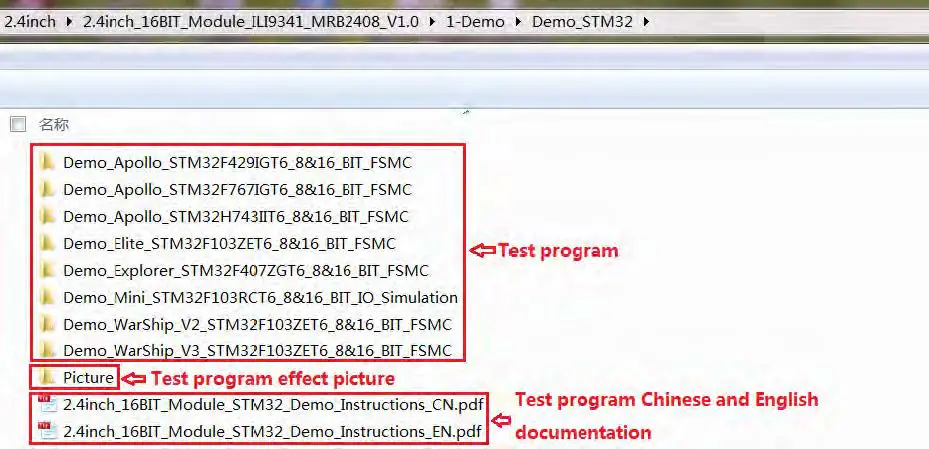
- Open the selected test program project, compile and download;
detailed description of the STM32 test program compilation and download can be found in the following document:
http://www.lcdwiki.com/res/PublicFile/STM32_Keil_Use_Illustration_EN.pdf - If the LCD module displays characters and graphics normally, the program runs successfully;
C51 instructions
Wiring instructions:
See the interface description for pin assignments.
| STC12C5A60S2 microcontroller test program wiring instructions | ||||
| Number | Module Pin | Corresponding to STC12 development board wiring pin | ||
| 1 | CS | P13 | ||
| 2 | RS | P12 | ||
| 3 | WR | P11 | ||
| 4 | RD | P10 | ||
| 5 | RST | P33 | ||
| 6 | D1 | P00 | ||
| 7 | D2 | P01 | ||
| 8 | D3 | P02 | ||
| 9 | D4 | P03 | ||
| 10 | D5 | P04 | ||
| 11 | D6 | P05 | ||
| 12 | D7 | P06 | ||
| 13 | D8 | P07 | ||
| 14 | D10 | P20 | ||
| 15 | D11 | P21 | ||
| 16 | D12 | P22 | ||
| 17 | D13 | P23 | ||
| 18 | D14 | P24 | ||
| 19 | D15 | P25 | ||
| 20 | D16 | P26 | ||
| 21 | D17 | P27 | ||
| 22 | SCS | No need to connect | ||
| 23 | BL | P32 | ||
| 24 | VDD | 3.3V/5V | ||
| 25 | VDD | 3.3V/5V | ||
| 26 | GND | GND | ||
| 27 | GND | GND | ||
| 28 | V5 | No need to connect | ||
| 29 | MO | P35 | ||
| 30 | MI | P34 | ||
| 31 | PEN | P40 | ||
| 32 | FCS | No need to connect | ||
| 33 | TCS | P37 | ||
| 34 | CLK | P36 | ||
| STC89C52RC microcontroller test program wiring instructions | ||||
| Number | Module Pin | Corresponding to STC89 development board wiring pin | ||
| 1 | CS | P13 | ||
| 2 | RS | P12 | ||
| 3 | WR | P11 | ||
| 4 | RD | P10 | ||
| 5 | RST | P14 | ||
| 6 | D1 | P30 | ||
| 7 | D2 | P31 | ||
| 8 | D3 | P32 | ||
| 9 | D4 | P33 | ||
| 10 | D5 | P34 | ||
| 11 | D6 | P35 | ||
| 12 | D7 | P36 | ||
| 13 | D8 | P37 | ||
| 14 | D10 | P20 | ||
| 15 | D11 | P21 | ||
| 16 | D12 | P22 | ||
| 17 | D13 | P23 | ||
| 18 | D14 | P24 | ||
| 19 | D15 | P25 | ||
| 20 | D16 | P26 | ||
| 21 | D17 | P27 | ||
| 22 | SCS | No need to connect | ||
| 23 | BL | 3.3V | ||
| 24 | VDD | 3.3V/5V | ||
| 25 | VDD | 3.3V/5V | ||
| 26 | GND | GND | ||
| 27 | GND | GND | ||
| 28 | V5 | No need to connect | ||
| 29 | MO | No need to connect | ||
| 30 | MI | No need to connect | ||
| 31 | PEN | No need to connect | ||
| 32 | FCS | No need to connect | ||
| 33 | TCS | No need to connect | ||
| 34 | CLK | No need to connect | ||
Note:
- Since the STC89C52RC microcontroller does not have a push-pull output function, the backlight control pin needs to be connected to a 3.3V power supply to be properly lit.
- Since the STC89C52RC microcontroller’s Flash capacity is too small (less than 25KB), the program with touch function cannot be downloaded, so the touch screen does not need wiring.
Operating Steps:
- Connect the LCD module (As shown in Picture 1)and the C51 MCU according to the above wiring instructions, and power on;
- Select the C51 test program to be tested, as shown below:
(Test program description please refer to the test program description document in the test package)
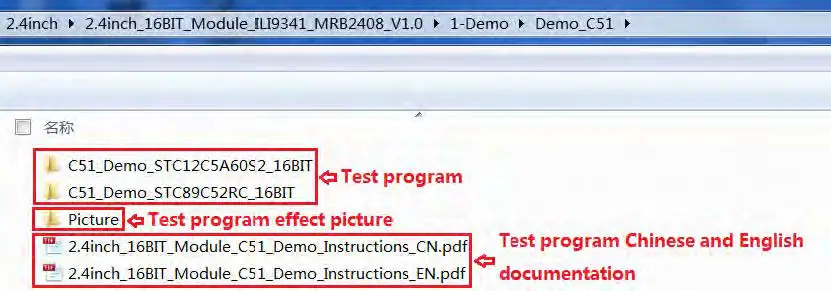
- Open the selected test program project, compile and download;
detailed description of the C51 test program compilation and download can be found in the following document:
http://www.lcdwiki.com/res/PublicFile/C51_Keil%26stc-isp_Use_Illustration_EN.pdf - If the LCD module displays characters and graphics normally, the program runs successfully;
Software Description
Code Architecture
C51 and STM32 code architecture description The code architecture is shown below:
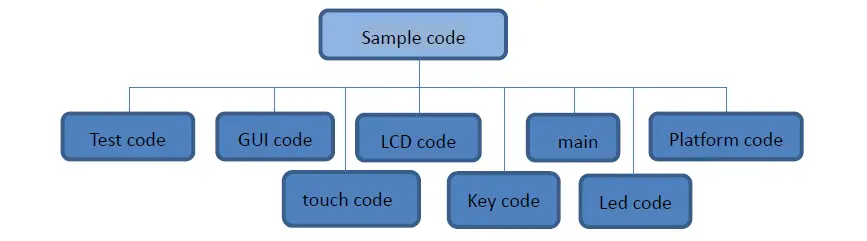
The Demo API code for the main program runtime is included in the test code; LCD initialization and related bin parallel port write data operations are included in the LCD code; Drawing points, lines, graphics, and Chinese and English character display related operations are included in the GUI code; The main function implements the application to run; Platform code varies by platform; Touch screen related operations are included in the touch code; The key processing related code is included in the key code (the C51 platform does not have a button processing code); The code related to the led configuration operation is included in the led code(the C51 platform does not have a led processing code);
GPIO definition description
STM32 test program GPIO definition description
The GPIO definition of the LCD screen of the STM32 test program is placed in the lcd.h file, which is defined in two ways:
- STM32F103RCT6 microcontroller test program uses IO analog mode (it does not support FSMC bus)
- Other STM32 MCU test programs use FSMC bus mode
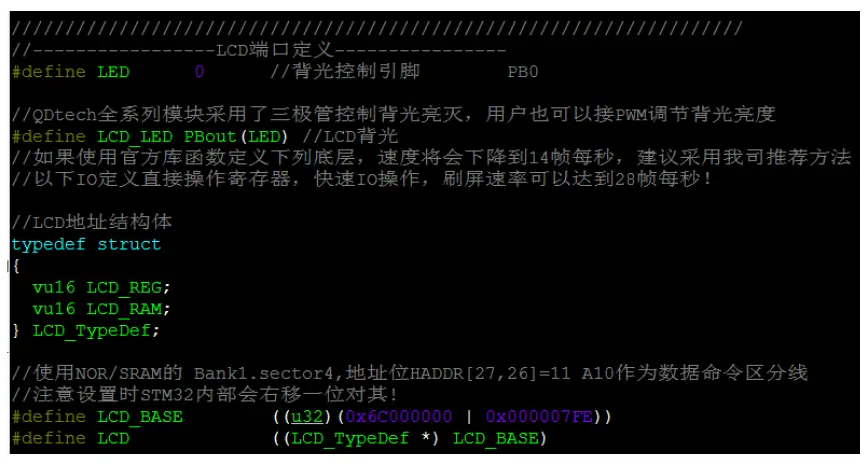
STM32F103RCT6 MCU IO analog test program LCD screen GPIO definition as shown below: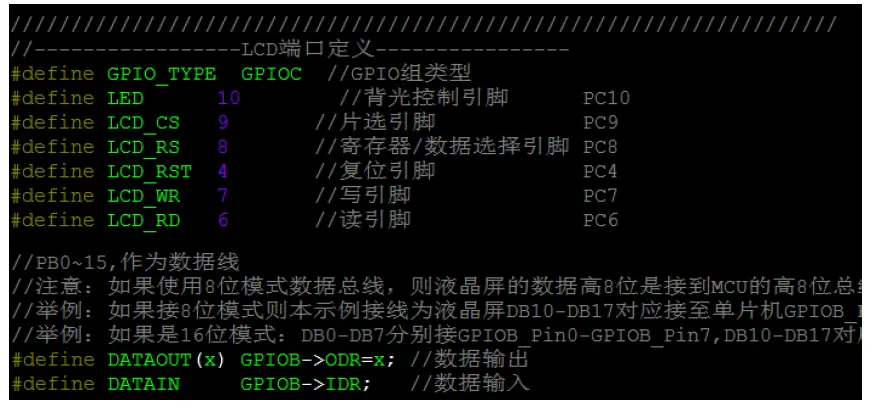 FSMC test program lcd screen GPIO is defined as shown below (take STM32F103ZET6 microcontroller FSMC test program as an example):
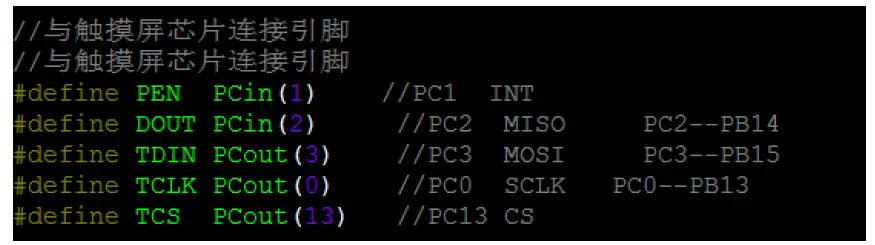
The GPIO definition related to the STM32 touch screen is placed in the touch file as shown below (take the STM32F103RCT6 microcontroller IO simulation test program as an example):
 C51 test program GPIO definition description
C51 test program lcd screen GPIO definition is placed in the lcd.h file, as shown below(Taking the STC12C5A60S2 microcontroller test program as an example):
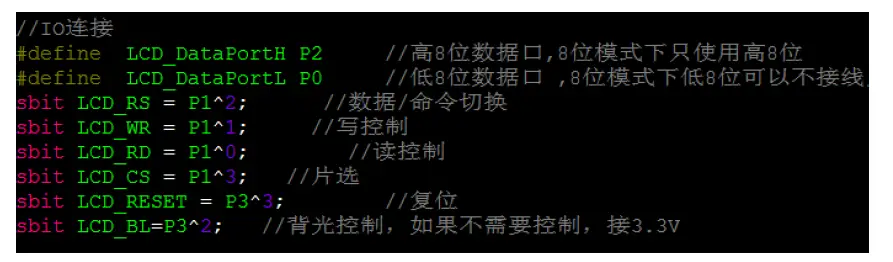
Parallel pin definition needs to select the whole set of GPIO port groups, such as P0, P2, etc., so that when transferring data, the operation is convenient.Other pins can be defined as any free GPIO. The touch screen related GPIO definition is placed in the touch.h file, as shown below (take the STC12C5A60S2 microcontroller test program as an example):
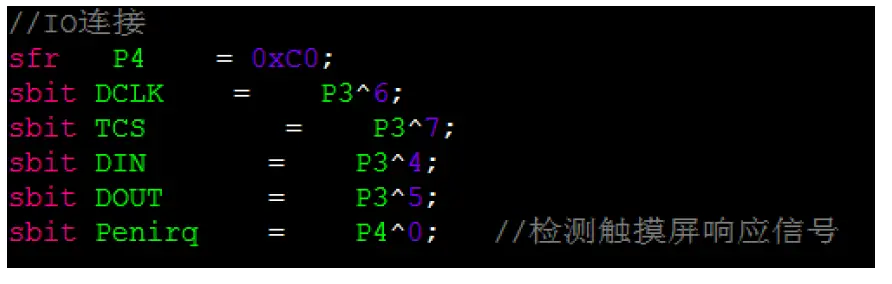
The GPIO definition of the touch screen can be modified and can be defined as any other free GPIO.
If the microcontroller does not have a P4 GPIO group, penirq can be defined as other GPIOs.
Parallel port communication code implementation
A. STM32 test program parallel port communication code implementation
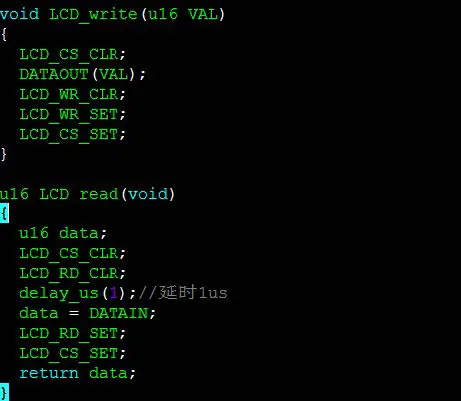
The STM32 test program parallel port communication code is placed in the LCD.c file, which is implemented in two ways:
- STM32F103RCT6 microcontroller test program uses IO analog mode (it does not support FSMC bus)
- Other STM32 MCU test programs use FSMC bus mode
The IO simulation test program is implemented as shown below:
The FSMC test program is implemented as shown below:
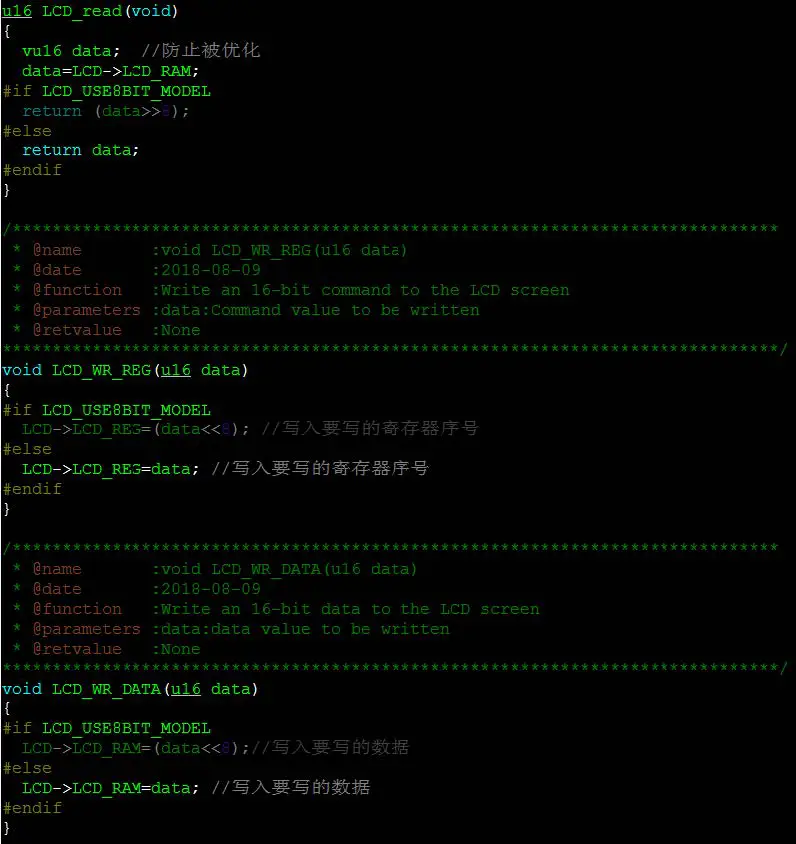
Both 8- and 16-bit command writes and 8- and 16-bit data writes and reads are implemented.
C51 test program parallel port communication code implementation The relevant code is implemented in the LCD.c file as shown below:
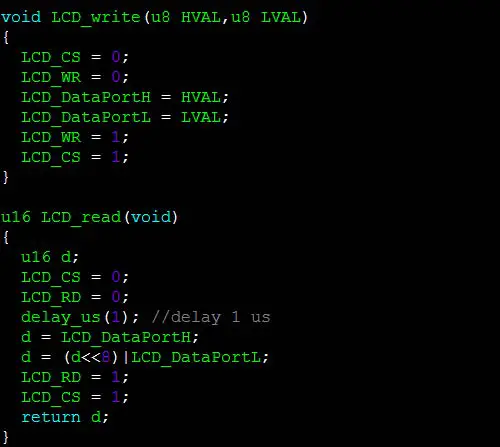
Implemented 8-bit and 16-bit commands and 8-bit and 16-bit data write and read.
touch screen calibration instructions
A. STM32 test program touch screen calibration instructions
The STM32 touch screen calibration program automatically recognizes whether calibration is required or manually enters calibration by pressing a button.
It is included in the touch screen test item. The calibration mark and calibration parameters are saved in the AT24C02 flash. If necessary, read from the flash. The calibration process is as shown below:
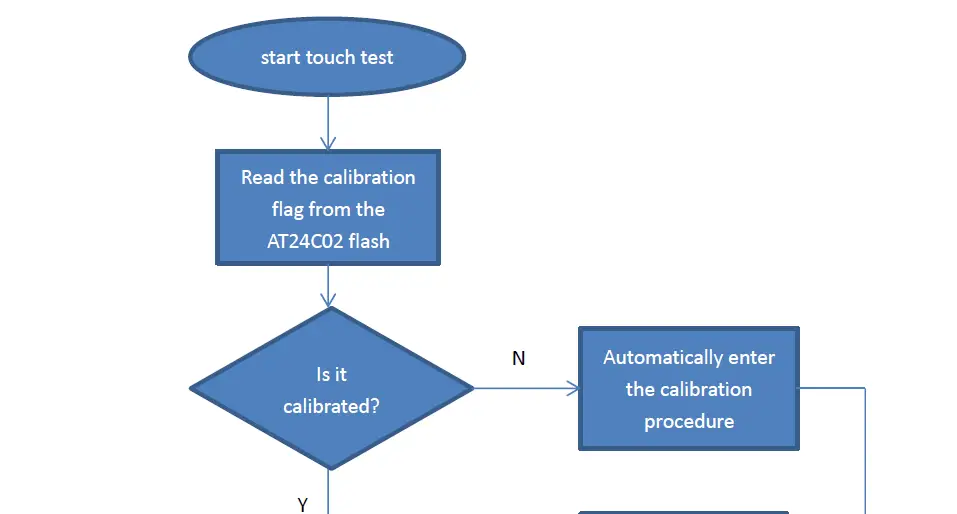
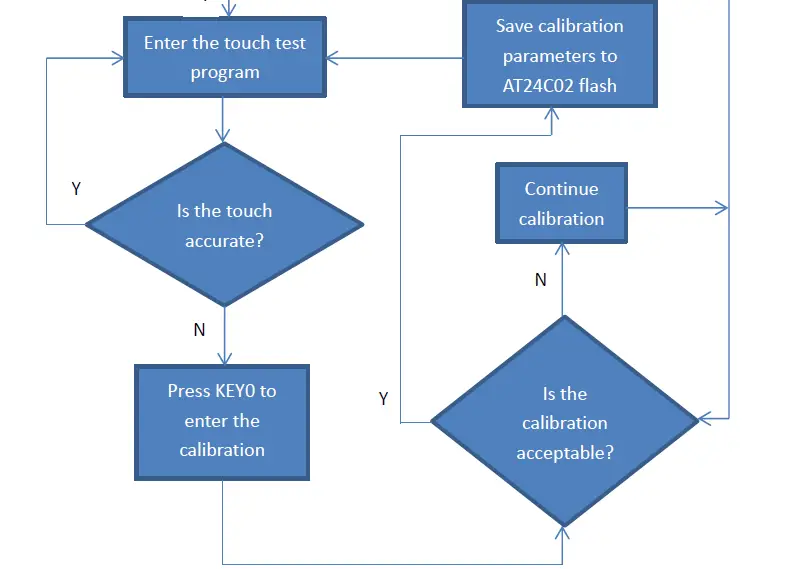
C51 test program touch screen calibration instructions
The C51 touch screen calibration needs to execute the Touch_Adjust test item (only available in the STC12C5A60S2 test program), as shown below: C51 test program touch screen calibration instructions
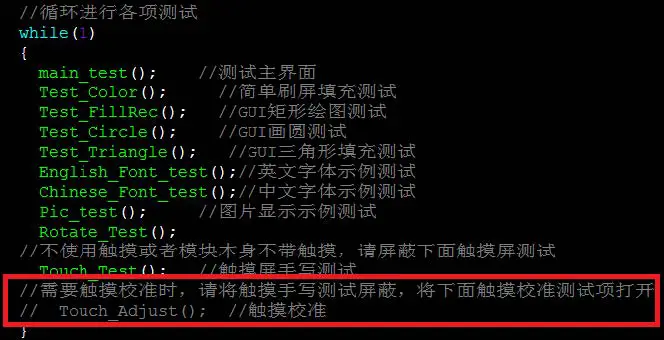
After the touch calibration is passed, you need to save the calibration parameters displayed on the screen in the touch.c file, as shown below:

Common software
This set of test examples requires the display of Chinese and English, symbols and pictures, so the modulo software is used. There are two types of modulo software: Image2Lcd and PCtoLCD2002. Here is only the setting of the modulo software for the test program.
The PCtoLCD2002 modulo software settings are as follows:
Dot matrix format select Dark code
the modulo mode select the progressive mode
Take the model to choose the direction (high position first)
Output number system selects hexadecimal number
Custom format selection C51 format
The specific setting method is as follows:
http://www.lcdwiki.com/Chinese_and_English_display_modulo_settings
Image2Lcd modulo software settings are shown below:
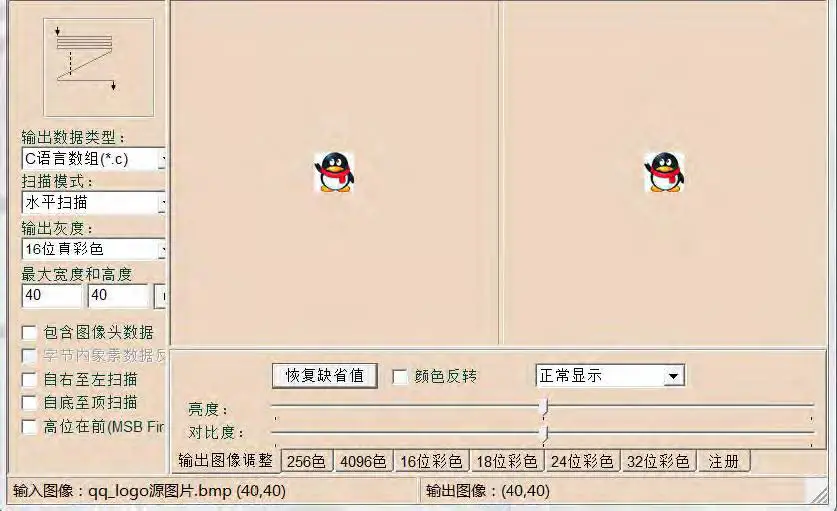
The Image2Lcd software needs to be set to horizontal, left to right, top to bottom, and low position to the front scan mode.
 Chinese and English display modulo settings - LCD wiki
 Surenoo Tech: Professional LCD Module Supplier Since 2005