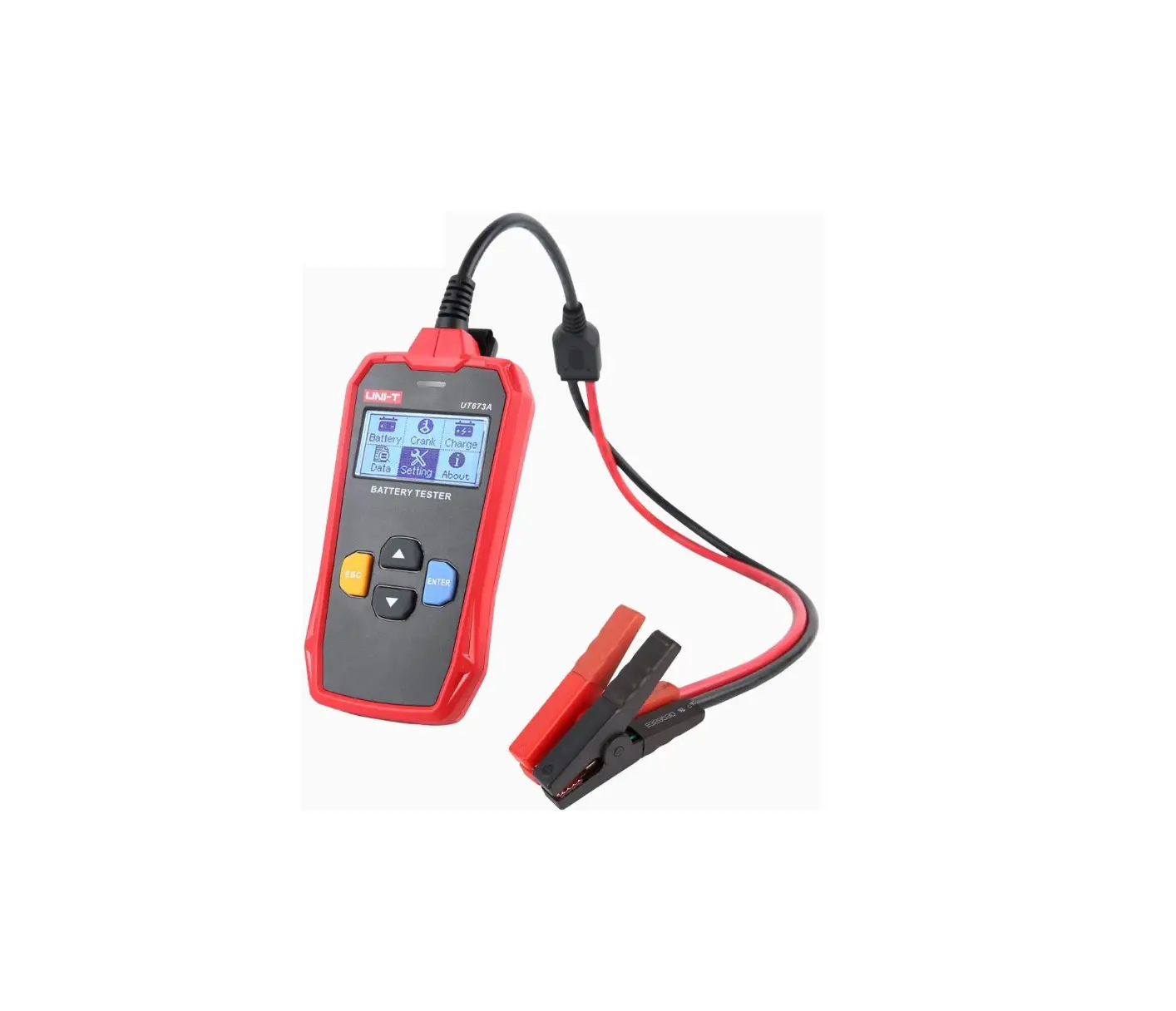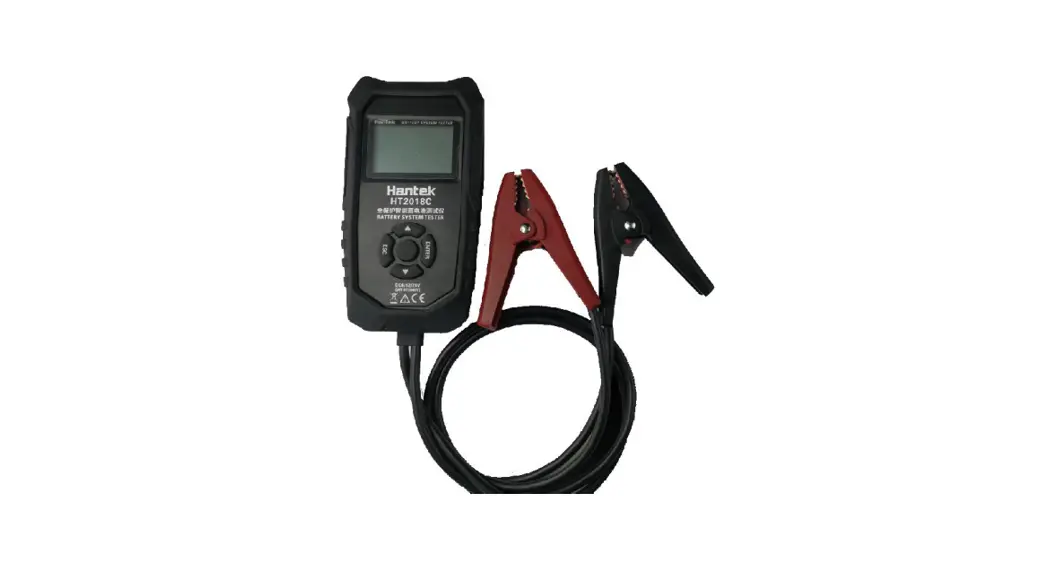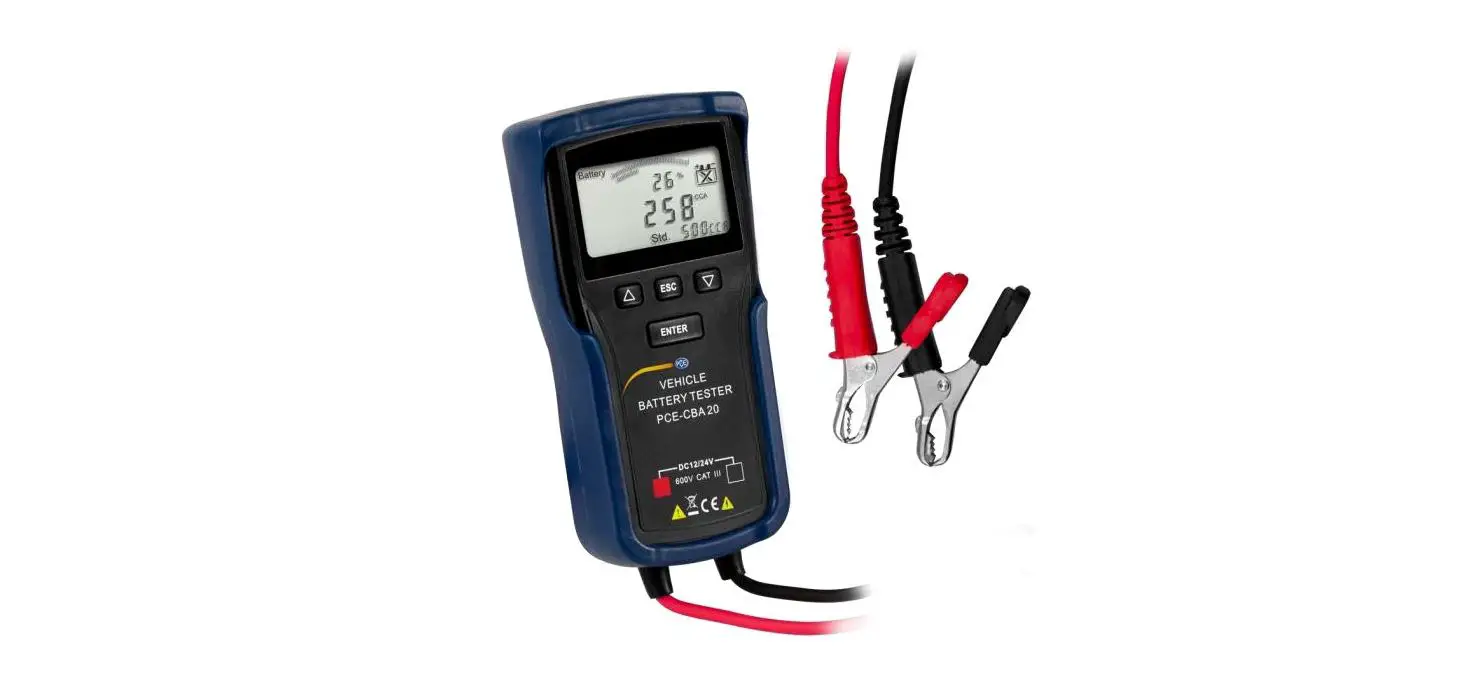

PCE Instruments PCE-CBA 20 Car Battery Tester
Safety Notes
- Please read this manual carefully and completely before you use the device for the first time. The device may only be used by qualified personnel and repaired by PCE Instruments personnel. Damage or injuries caused by non-observance of the manual are excluded from our liability and not covered by our warranty.
- The device must only be used as described in this instruction manual. If used otherwise, this can cause dangerous situations for the user and damage to the meter.
- The instrument may only be used in the environmental conditions (temperature, relative humidity, are within the ranges stated in the technical specifications. Do not expose the device to extreme temperatures, direct sunlight, extreme humidity, or moisture.
- Do not expose the device to shocks or strong vibrations.
- The case should only be opened by qualified PCE Instruments personnel.
- Never use the instrument when your hands are wet.
- You must not make any technical changes to the device.
- The appliance should only be cleaned with a damp cloth. Use only pH-neutral cleaner, no abrasives or solvents.
- The device must only be used with accessories from PCE Instruments or equivalent.
- Before each use, inspect the case for visible damage. If any damage is visible, do not use the device.
- Do not use the instrument in explosive atmospheres.
- The measurement range as stated in the specifications must not be exceeded under any circumstances.
- Non-observance of the safety notes can cause damage to the device and injuries to the user.
- Only test batteries the parameters of which you can set.
- We do not assume liability for printing errors or any other mistakes in this manual.
- We expressly point to our general guarantee terms which can be found in our general terms of business.
- If you have any questions please contact PCE Instruments. The contact details can be found at the end of this manual.
Specifications
| Specification | Description |
| Measurement object | 12 V / 24 V starter batteries |
| Battery standards | DIN, JIS, EN, SAE |
| Test time | 3 … 10 s |
| Cold-cranking ampere CCA | 100 … 1700 A |
| Display | 2.75“ LCD |
| Power supply | 9 … 35 V DC via test voltage |
| Connection | Kelvin terminals |
| Dimensions | 185 x 95 x 41 mm |
| Cable length | approx. 70 cm |
| Weight | approx. 250 g |
Delivery contents
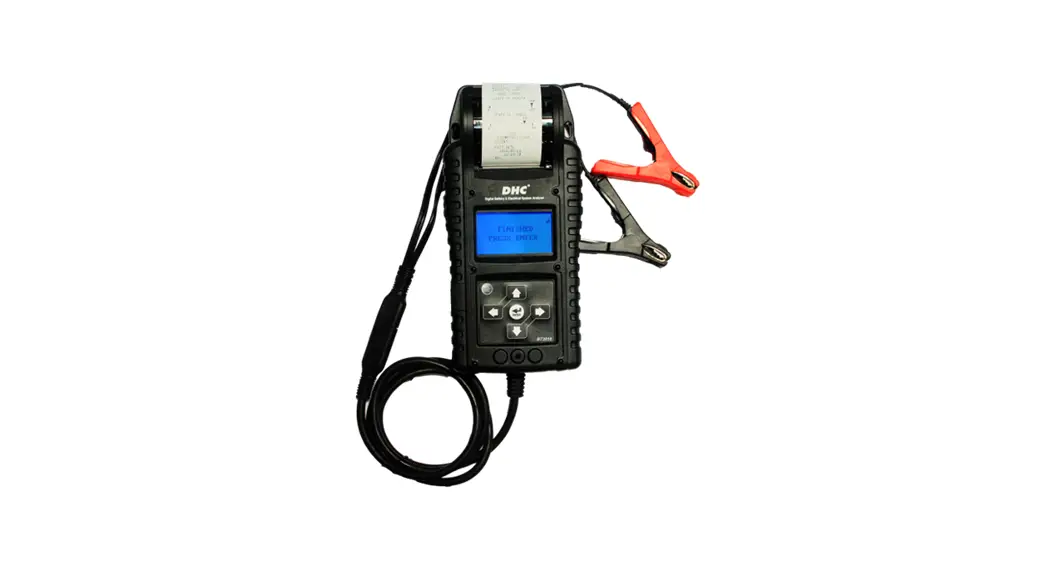
1 x car battery tester PCE-CBA 20 1 x user manual
System description
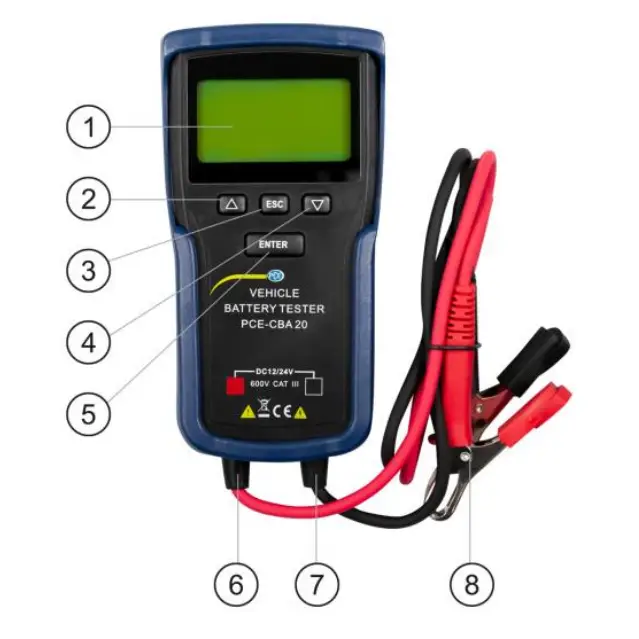
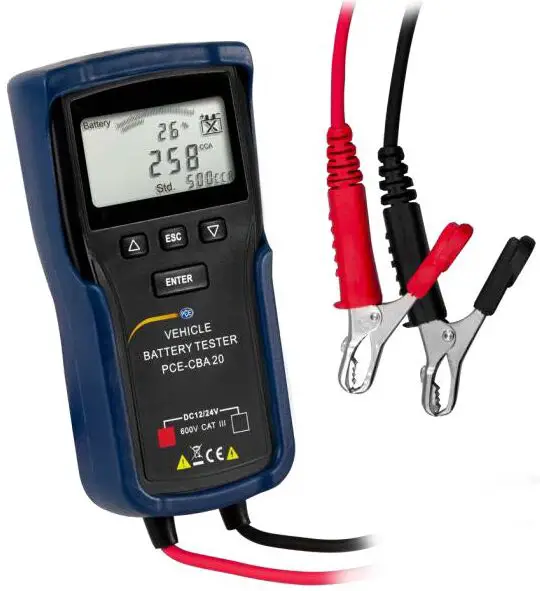
- Display
- Ups △
- Back „ESC“
- Down ▽
- ENTER
- Test lead red plus
- Test lead black minus
- Crocodile clamps
Operation
You can make the following battery tests
- Battery capacity
- Battery voltage at engine start
- Charge voltage at maximum load
- Charge voltage
Please always ensure that the contact surfaces for the alligator clips are clean. Contamination can lead to incorrect measurement results. Always connect the black crocodile clip to the negative terminal first and then the red crocodile clip to the positive terminal of the battery.
Battery capacity
Switch off the engine and the ignition. If the vehicle was in operation immediately before the battery test, the battery voltage is still at charging voltage level. In this case, switch on the vehicle lights for approx. 3 minutes to bring the battery voltage up to normal level.
Measuring procedure
- First, connect the black crocodile clip to the negative terminal and then the red crocodile clip to the positive terminal of the battery.
- The meter switches on when connected to the battery.
- If necessary, change the setting to battery voltage with the “Up/Down” keys and confirm the selection with “ENTER”.
- Select function 1 with the “Up / Down” keys and confirm with “ENTER”.
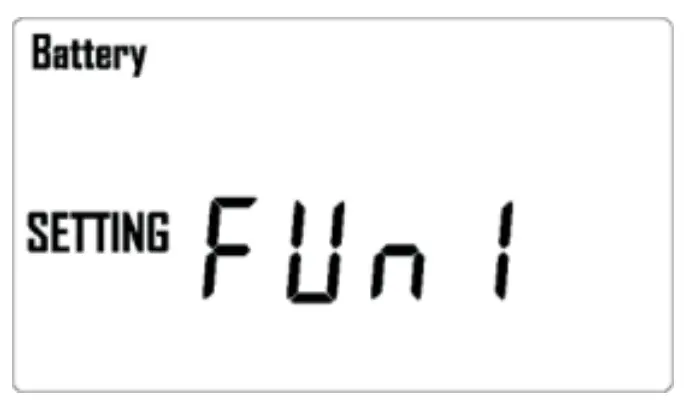
- Use the “Up / Down” keys to select the battery standard of the battery to be tested and confirm this with the “ENTER” key. (Sticker or imprint on the battery)
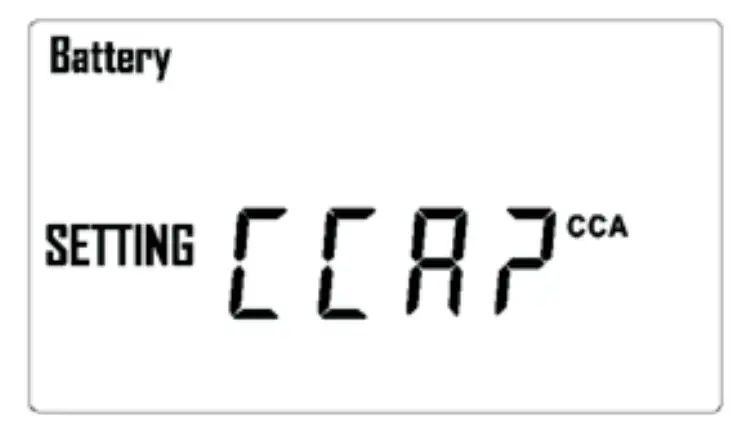
- Now enter the respective number using the “Up / Down” keys. Confirm the selection with “ENTER”. Press and hold the key to accelerate the search.
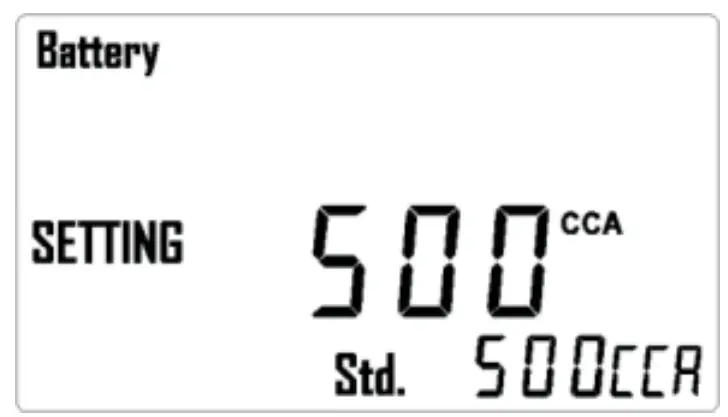
Examples
- 12V 280A 60Ah DIN
- 12V 70Ah CCA(SAE) 570A
- 410 Cold Cranking Amps
- 480 EN/SAE
- Setting: EN 480 Setting: CCA 570 Setting: CCA 410
- Confirm the selection and start the measurement with “ENTER”.
- After completion of the test, the following results are available cold-cranking amperage, the internal resistance of the battery, and battery voltage. Use the “Up / Down” keys to view the results.
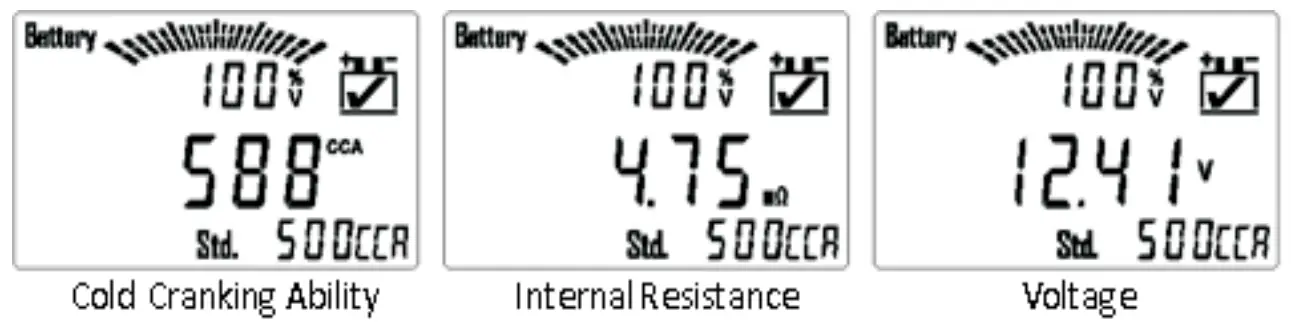
- Notes on the test results Battery capacity normal
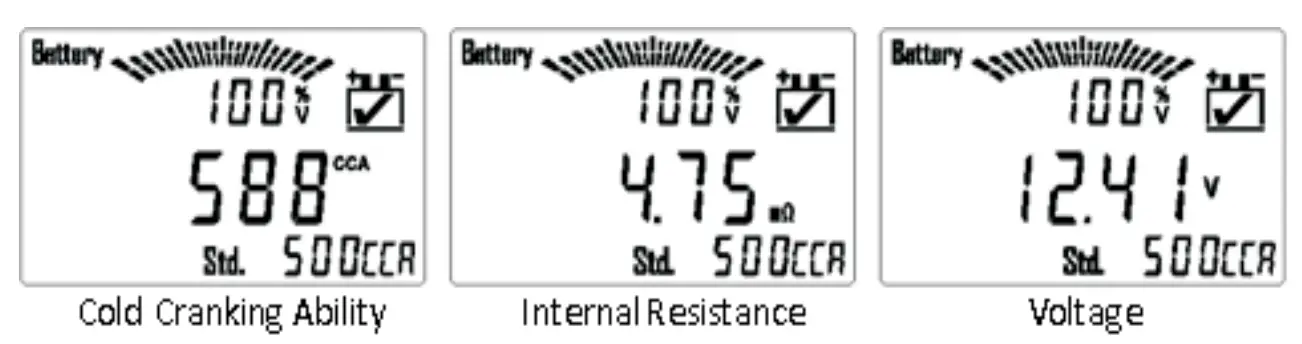
Battery voltage – Battery capacity
- Charge level 100 % 12.78 V
- 75 % 12.54 V
- 50 % 12.30 V
- 25 % 12.12 V
- Flat 11.94 V
| Battery capacity | |
| >80 % | Good |
| >60 % | OK |
| >45 % | The condition must be monitored |
| <45 % | Replace battery |
In the case of the 24 V measurement (two batteries connected in series), CCA corresponds to the average value of the two batteries.
Internal resistance
- As a rule, the higher the CCA value, the lower the internal resistance of the battery. There is no standard value for the internal resistance.
- Depending on the battery manufacturer, the value can vary. Batteries from the same manufacturer should have approximately the same internal resistance.
- For the 24 V measurement (two batteries connected in series), the internal resistance corresponds to the sum of the two batteries.
Examples
Replace the battery when capacity is too low.
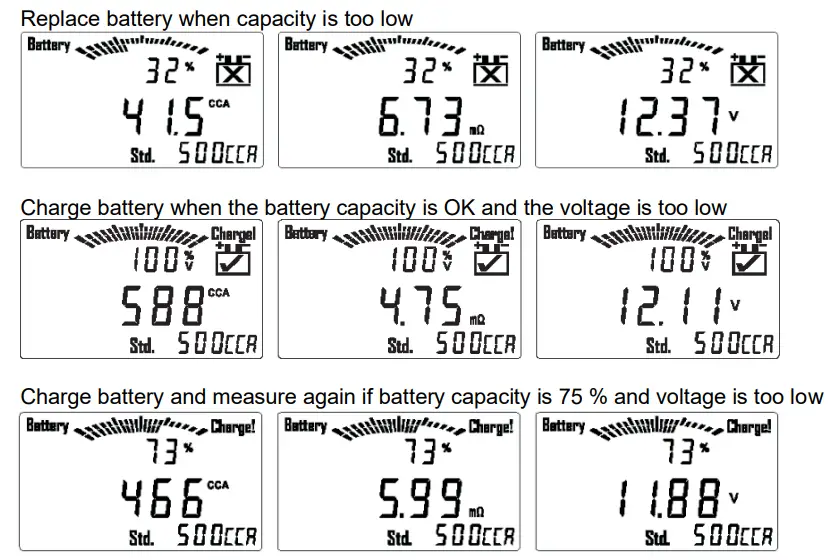
You can return to the function selection by pressing the ”ESC“ key.
Battery voltage at engine start
Turn off the engine and the ignition. If the vehicle was in operation immediately before the battery test, the battery voltage is still at the charging voltage level. In this case, switch on the vehicle lights for approx. 3 minutes to bring the battery voltage up to the normal level.
Measuring procedure
- First, connect the black crocodile clip to the negative terminal and then the red crocodile clip to the positive terminal of the battery.
- The meter switches on when connected to the battery.
- If necessary, change the setting to battery voltage with the “Up/Down” keys and confirm the selection with “ENTER”.
- Select function 2 with the “Up / Down” keys and confirm with “ENTER”.
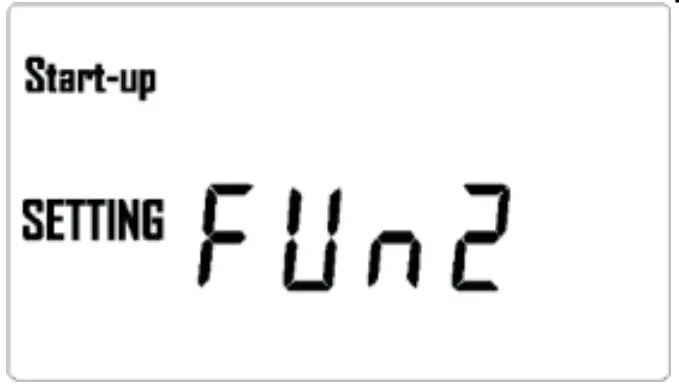
Start the engine. The unit displays the battery voltage before and the lowest voltage during the start-up process.
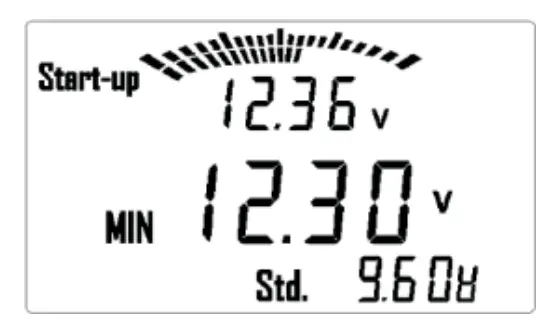
The lowest voltage during the start-up process should not fall below 9.6 V for one battery (12 V) and 16 V for two batteries (24 V).
Reference chart starting voltage
| >10.7 V | good | Can still be used |
| 10.2 … 10.7 V | normal | Watch the condition |
| 9.6 … 10.2 V | critical | Replace soon |
| <9.6 V | poor | Replace immediately |
With the “ESC“ key, you can return to the function selection.
Charging voltage at maximum load
Start the engine.
- First, connect the black crocodile clip to the negative terminal and then the red crocodile clip to the positive terminal of the battery. Make sure that you and the meter do not get in contact with moving parts.
- The meter switches on when connected to the battery.
- If necessary, change the setting to battery voltage with the “Up/Down” keys and confirm the selection with “ENTER”.
- Switch on all electrical appliances in the car (lighting, ventilation/air conditioning, etc.).
- Increase the engine speed to 2000 rpm.
- Select function 3 with the “Up / Down” keys and confirm with “ENTER”.
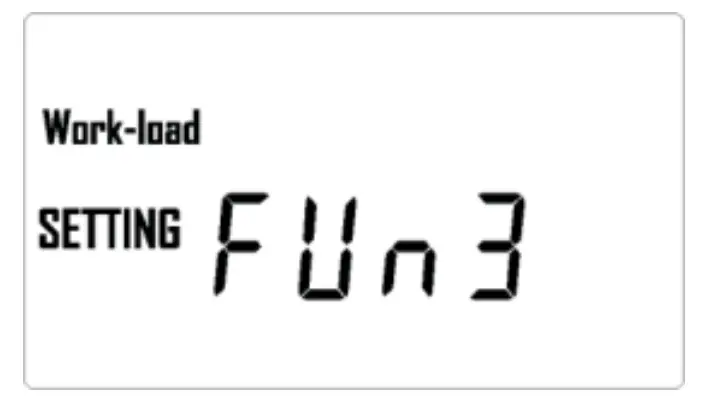
The unit displays the current charging voltage, the minimum measured charging voltage, and the target voltage at maximum load.
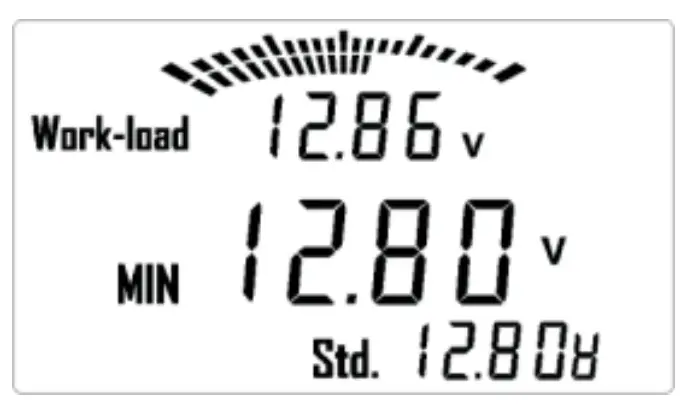
The minimum charging voltage at maximum load should not fall below 12.80 V for one battery (12 V system) and 25.60 V for two batteries (24 V system). If the voltage falls below this value, check the V-belt / tooth belt and the alternator for damage and function. With the “ESC“ key, you can return to the function selection.
Charging voltage
Start the engine.
- First, connect the black crocodile clip to the negative terminal and then the red crocodile clip to the positive terminal of the battery. Make sure that you and the meter do not get in contact with moving parts.
- The meter switches on when connected to the battery.
- If necessary, change the setting to battery voltage with the “Up/Down” keys and confirm the selection with “ENTER”.
- Increase the engine speed to 3000 rpm.
- Switch off all electrical appliances in the vehicle.
- Select function 4 with the “Up / Down” keys and confirm with “ENTER”.
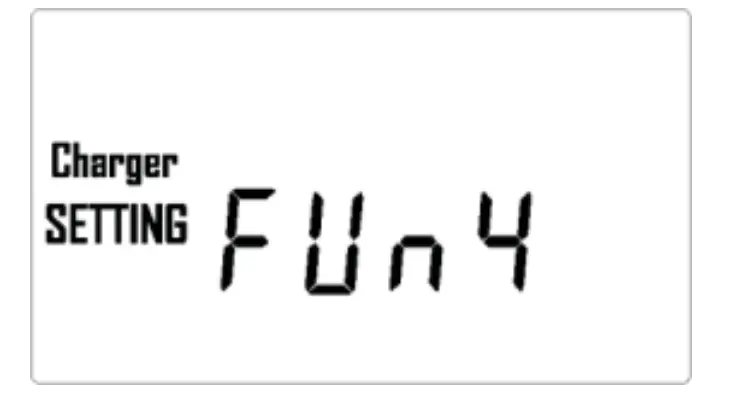
- After completion of the test, the following results are available
- Target value charging voltage, maximum value charging voltage, maximum limit value, and target value charging voltage, minimum value charging voltage, and minimum limit value.
- Use the “Up / Down” keys to view the results.
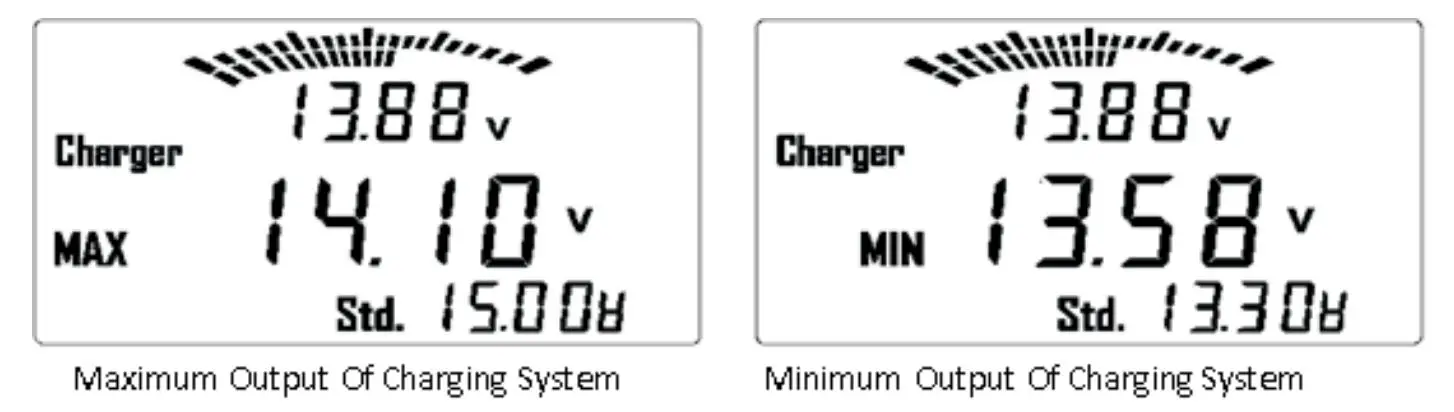
- The maximum charging voltage should not exceed 15.00 V for one battery (12 V system) and 30.00 V for two batteries (24 V system).
- The minimum charging voltage should not fall below 13.30 V for one battery (12 V system) and 36.60 V for two batteries (24 V system).
- The target charging voltage should be 13.88 V for one battery (12 V system) and 27.76 V for two batteries (24 V system).
- If the max/min values are undercut or exceeded, check the voltage regulator and the alternator for damage and function.
- With the “ESC“ key, you can return to the function selection.
Comparison charts
JIS
| Battery | CCA | Battery | CCA | ||||||
| JIS new | JIS old | MF* | CMF* | JIS new | JIS old | MF* | CMF* | ||
| 26Al7R | 200 | 55B24RS | NT 80-S6S | 430 | 420 | 500 | |||
| 26A 17L | 200 | 55B24LS | NT80-S6LS | 430 | 420 | 500 | |||
| 26Al9R | 12N24-4 | 200 | 220 | 264 | 55D26R | N50Z | 350 | 440 | 525 |
| 26Al9L | l 2N24-3 | 200 | 220 | 264 | 55D26L | N5 0ZL | 350 | 440 | 525 |
| 28Al9R | NT50-N24 | 250 | 60D23R | 520 | |||||
| 28A19L | NT5 0-N24L | 250 | 60D23L | 520 | |||||
| 32A l9R | NX60-N24 | 270 | 295 | 65D23R | 420 | 540 | 580 | ||
| 32A19L | NX60-N24L | 270 | 295 | 65D23L | 420 | 540 | 580 | ||
| 26B17R | 200 | 65D26R | NS70 | 415 | 520 | 625 | |||
| 26B17L | 200 | 65D26L | NS70L | 415 | 520 | 625 | |||
| 28B17R | 245 | 65D31R | N70 | 390 | 520 | 630 | |||
| 28B17L | 245 | 65D31L | N70L | 390 | 520 | 630 | |||
| 28B19R | NS40S | 245 | 70D23R | 35-60 | 490 | 540 | 580 | ||
| 28B19L | NS40LS | 245 | 70D23L | 25-60 | 490 | 540 | 580 | ||
| 32B20R | NS40 | 270 | 75D23R | 500 | 520 | 580 | |||
| 32B20L | NS40L | 270 | 75D23L | 500 | 520 | 580 | |||
| 32C24R | N4 0 | 240 | 325 | 400 | 75D26R | F10 0-5 | 490 | ||
| 32C24L | N40L | 240 | 325 | 400 | 75D26L | F l00 -5L | 490 | ||
| 34B17R | 280 | 75D31R | N70Z | 450 | 540 | 735 | |||
| 34B 1 7L | 280 | 75D31L | N70ZL | 450 | 540 | 735 | |||
| 34B19R | NS40ZA | 270 | 325 | 400 | 80D23R | 580 | |||
| 34B19L | NS40ZAL | 270 | 325 | 400 | 80D26L | 580 | |||
| 36B20R | NS40Z | 275 | 300 | 360 | 85B60K | 500 | |||
| 36B20L | NS40ZL | 275 | 300 | 360 | 85BR60K | 500 | |||
| 36B20RS | NS40ZS | 275 | 300 | 360 | 95D31R | NX1 20-7 | 620 | 660 | 850 |
| 36B20LS | NS40ZLS | 275 | 300 | 360 | 95D31L | NX12 0-7L | 620 | 660 | 850 |
| 38B20R | NX60-N24 | 330 | 340 | 410 | 95E41R | NI00 | 515 | 640 | 770 |
| 38B20RS | NT60-N24S | 330 | 340 | 410 | 95E41L | NI00L | 515 | 640 | 770 |
| 38B20L | NX60-24L | 330 | 340 | 410 | 105E41R | Nl00 Z | 580 | 720 | 880 |
| 38B20LS | NX60-24LS | 330 | 340 | 410 | 105E41L | Nl00ZL | 580 | 720 | 880 |
| 40B20L | 330 | 105F51R | NI00 Z | 580 | |||||
| 40B20R | 330 | 105F51L | Nl00ZL | 580 | |||||
| 42B20R | 330 | 115E41R | NS120 | 650 | 800 | 960 | |||
| 42B20L | 330 | 115E41L | NS120L | 650 | 800 | 960 | |||
| 42B20RS | 330 | 115F51R | N1 20 | 650 | 800 | 960 | |||
| 42B20LS | 330 | 115F51L | N120L | 650 | 800 | 960 | |||
| 46B24R | NS60 | 325 | 360 | 420 | 130E41R | NX200-10 | 800 | ||
| 46B24L | NS60L | 325 | 360 | 420 | 130E41L | NX200-10L | 800 | ||
| 46B24RS | NS60S | 325 | 360 | 420 | 130F51R | 800 | |||
| 46B24LS | NS60LS | 325 | 360 | 420 | 130F51L | 800 | |||
| 46B26R | 360 | 145F51R | NS150 | 780 | 920 | ||||
| 46B26L | 360 | 145F51L | NS150L | 780 | 920 | ||||
| 46B26RS | 360 | 145G51R | N150 | 780 | 900 | 1100 | |||
| 34B19RS | NS40ZAS | 270 | 325 | 400 | 80D26R | NXl10-5 | 580 | 580 | 630 |
| 34B19LS | NS40ZALS | 270 | 325 | 400 | 80D26L | NX110-5L | 580 | 580 | 630 |
| 46B26LS | 360 | 145G51L | N150L | 780 | 900 | 1100 | |||
| 48D26R | N50 | 280 | 360 | 420 | 150F51R | NT200-12 | 640 | ||
| 48D26L | N50L | 280 | 360 | 420 | 150F51L | NT200-12L | 640 | ||
| 50D20R | 310 | 380 | 480 | 165G51R | NS200 | 935 | 980 | ||
| 50D20L | 310 | 380 | 480 | 165G51L | NS200L | 935 | 980 | ||
| 50D23R | 85BR60K | 500 | 170F51R | NX250-12 | 1045 | ||||
| 50D23L | 85B60K | 500 | 170F51L | NX250-12L | 1045 | ||||
| 50B24R | NT80-S6 | 390 | 180G51R | NT250-15 | 1090 | ||||
| 50B24L | NT80-S6L | 390 | 180G51L | NT250-15L | 1090 | ||||
| 50D26R | 50D20R | 370 | 195G51R | NX300-51 | 1145 | ||||
| 50D26L | 50D20L | 370 | 195G51L | NX300-51L | 1145 | ||||
| 55D23R | 355 | 480 | 500 | 190H52R | N200 | 925 | 1100 | 1300 | |
| 55D23L | 355 | 480 | 500 | 190H52L | N200L | 925 | 1100 | 1300 | |
| 55B24R | NXl00-S6 | 435 | 420 | 500 | 245H52R | NX400-20 | 1530 | 1250 | |
| 55B24L | NX100-S6L | 435 | 420 | 500 | 245H52L | NX400 20L | 1530 | 1250 |
DIN / EN
| Model | Same model | DIN | EN | Model | Same model | DIN | EN | ||
| 52805 | 25815 | 180 | 240 | 56420 | 56322 | 88066 | 300 | 510 | |
| 53517 | 175 | 300 | 56530 | 56618 | 56638 | 300 | 510 | ||
| 53520 | 53512 | 53522 | 175 | 240 | 56618 | 56619 | 56620 | 300 | 510 |
| 53625 | 53638 | 53836 | 175 | 300 | 56633 | 56647 | 56641 | 300 | 510 |
| 53646 | 53621 | 88038 | 175 | 300 | 56820 | 56821 | 56828 | 315 | 540 |
| 53653 | 53624 | 53890 | 175 | 300 | 57024 | 57029 | 315 | 540 | |
| 54038 | 54039 | 175 | 300 | 57113 | 57539 | 400 | 680 | ||
| 54323 | 175 | 300 | 57114 | 56821 | 88074 | 400 | 680 | ||
| 54313 | 54324 | 54464 | 220 | 330 | 57218 | 57219 | 420 | 720 | |
| 54317 | 54312 | 88146 | 210 | 360 | 57220 | 57217 | 420 | 720 | |
| 54437 | 54466 | 54459 | 210 | 360 | 57230 | 380 | 640 | ||
| 54459 | 54434 | 88064 | 210 | 360 | 57412 | 57413 | 57412 | 400 | 680 |
| 54469 | 54449 | 54465 | 210 | 360 | 57512 | 57513 | 57521 | 350 | 570 |
| 54519 | 54533 | 54612 | 210 | 360 | 58515 | 58424 | 450 | 760 | |
| 54523 | 54524 | 220 | 300 | 58521 | 58513 | 320 | 540 | ||
| 54537 | 54545 | 54801 | 190 | 300 | 58522 | 58514 | 320 | 540 | |
| 54551 | 54580 | 220 | 300 | 58815 | 58821 | 395 | 640 | ||
| 54533 | 54577 | 54579 | 220 | 300 | 58820 | 58515 | 58527 | 395 | 640 |
| 54584 | 54578 | 220 | 300 | 58827 | 400 | 640 | |||
| 54590 | 210 | 330 | 58838 | 58833 | 88092 | 400 | 680 | ||
| 54827 | 240 | 360 | 59040 | 59017 | 59018 | 360 | 600 | ||
| 55040 | 88056 | 265 | 450 | 59218 | 59219 | 290 | 480 | ||
| 55041 | 55042 | 220 | 360 | 59226 | 59215 | 450 | 760 | ||
| 55044 | 55414 | 88056 | 265 | 450 | 59514 | 320 | 540 | ||
| 55046 | 300 | 510 | 59518 | 59519 | 395 | 640 | |||
| 55056 | 320 | 540 | 59615 | 59616 | 360 | 600 | |||
| 55057 | 54827 | 88156 | 320 | 540 | 60018 | 60019 | 250 | 410 | |
| 55068 | 55069 | 55548 | 220 | 390 | 60026 | 58811 | 440 | 720 | |
| 55218 | 255 | 420 | 60044 | 60038 | 500 | 760 | |||
| 55414 | 55415 | 55421 | 265 | 450 | 60527 | 60528 | 410 | 680 | |
| 55422 | 55566 | 55040 | 265 | 450 | 61017 | 61018 | 400 | 680 | |
| 55428 | 55423 | 55427 | 300 | 510 | 61023 | 62529 | 450 | 760 | |
| 55457 | 265 | 450 | 61047 | 61048 | 450 | 760 | |||
| 55529 | 220 | 360 | 62034 | 62038 | 62045 | 420 | 680 | ||
| 55531 | 55545 | 55559L | 255 | 420 | 63013 | 470 | 680 | ||
| 55559 | 55530 | 88056 | 255 | 420 | 63545 | 63549 | 420 | 680 | |
| 55564 | 55552 | 55563 | 255 | 420 | 64020 | 64317 | 6431 8 | 325 | 550 |
| 55564 | 55565 | 55548 | 255 | 420 | 64028 | 64035 | 520 | 760 | |
| 55570 | 55567 | 55565L | 255 | 420 | 64036 | 460 | 760 | ||
| 56012 | 230 | 390 | 64317 | 64318 | 64323 | 540 | 900 | ||
| 56048 | 56068 | 56069 | 250 | 390 | 65513 | 540 | 900 | ||
| 56049 | 56069 | 56073 | 250 | 390 | 65514 | 65515 | 570 | 900 | |
| 56077 | 56030 | 300 | 510 | 67043 | 67045 | 600 | 1000 | ||
| 56091 | 55811 | 360 | 540 | 68032 | 68034 | 600 | 1000 | ||
| 56111 | 55048 | 300 | 540 | 70029 | 70038 | 70027 | 630 | 1050 | |
| 56218 | 56092 | 300 | 510 | 70036 | 68040 | 68021 | 570 | 950 | |
| 56219 | 56216 | 300 | 510 | 71014 | 71015 | 700 | 1150 | ||
| 56220 | 280 | 510 | 72512 | 680 | 1150 | ||||
| 56225 | 56323 | 300 | 510 | 73011 | 740 | 1200 | |||
| 56318 | 56312 | 56311 | 300 | 510 |
Warranty
You can read our warranty terms in our General Business Terms which you can find here: https://www.pce-instruments.com/english/terms.
Disposal
- For the disposal of batteries in the EU, the 2006/66/EC directive of the European Parliament applies. Due to the contained pollutants, batteries must not be disposed of as household waste. They must be given to collection points designed for that purpose.
- In order to comply with the EU directive 2012/19/EU, we take our devices back. We either re-use them or give them to a recycling company that disposes of the devices in line with the law.
- For countries outside the EU, batteries, and devices should be disposed of in accordance with your local waste regulations.
- If you have any questions, please contact PCE Instruments.
PCE Instruments contact information

References
 France.fr : Actualités, destinations et infos du tourisme en France
-
iberica.es
-
instruments.cn
 Make an offer on the domain instruments.co.uk - Domains.co.uk
-
Computer Instruments | Home
 Discover Italy: Official Tourism Website - Italia.it
 PCE(北京)科技有限公司
-
Industrial Measurement Products and Solutions | PCE Instruments
-
PCE Deutschland GmbH Prüfgeräte vom Hersteller | PCE Instruments
-
PCE Brookhuis B.V. | PCE Instruments
-
PCE Americas Inc. : Test Instruments | PCE Instruments
-
PCE Iberica S.L. Instrumentación | PCE Instruments
-
PCE Instruments France | PCE Instruments
-
PCE Italia s.r.l. / Strumenti di Misura | PCE Instruments
-
PCE Teknik Cihazlar Paz. Tic. Ltd.Şti. | PCE Instruments
-
PCE Americas Inc. : Test Instruments | PCE Instruments
 France.fr : Actualités, destinations et infos du tourisme en France
 iberica.es
 instruments.cn
 Make an offer on the domain instruments.co.uk - Domains.co.uk
 Computer Instruments | Home
 Discover Italy: Official Tourism Website - Italia.it
 PCE(北京)科技有限公司
 Industrial Measurement Products and Solutions | PCE Instruments