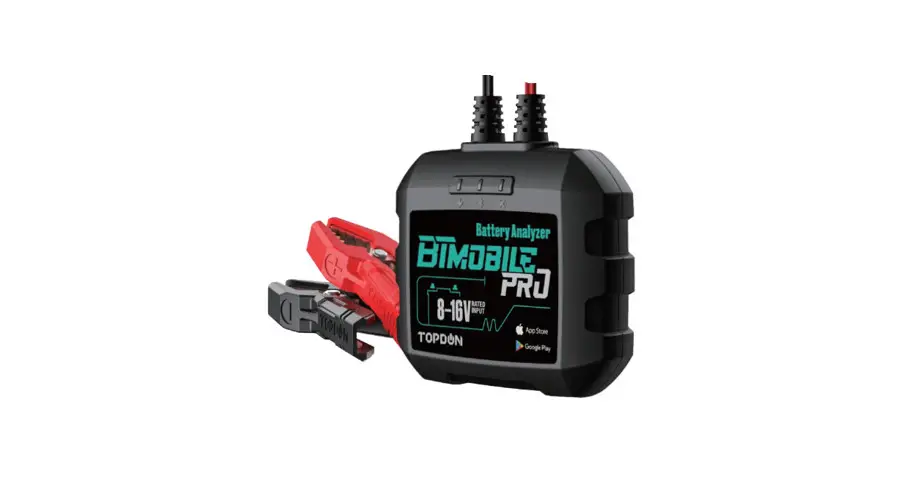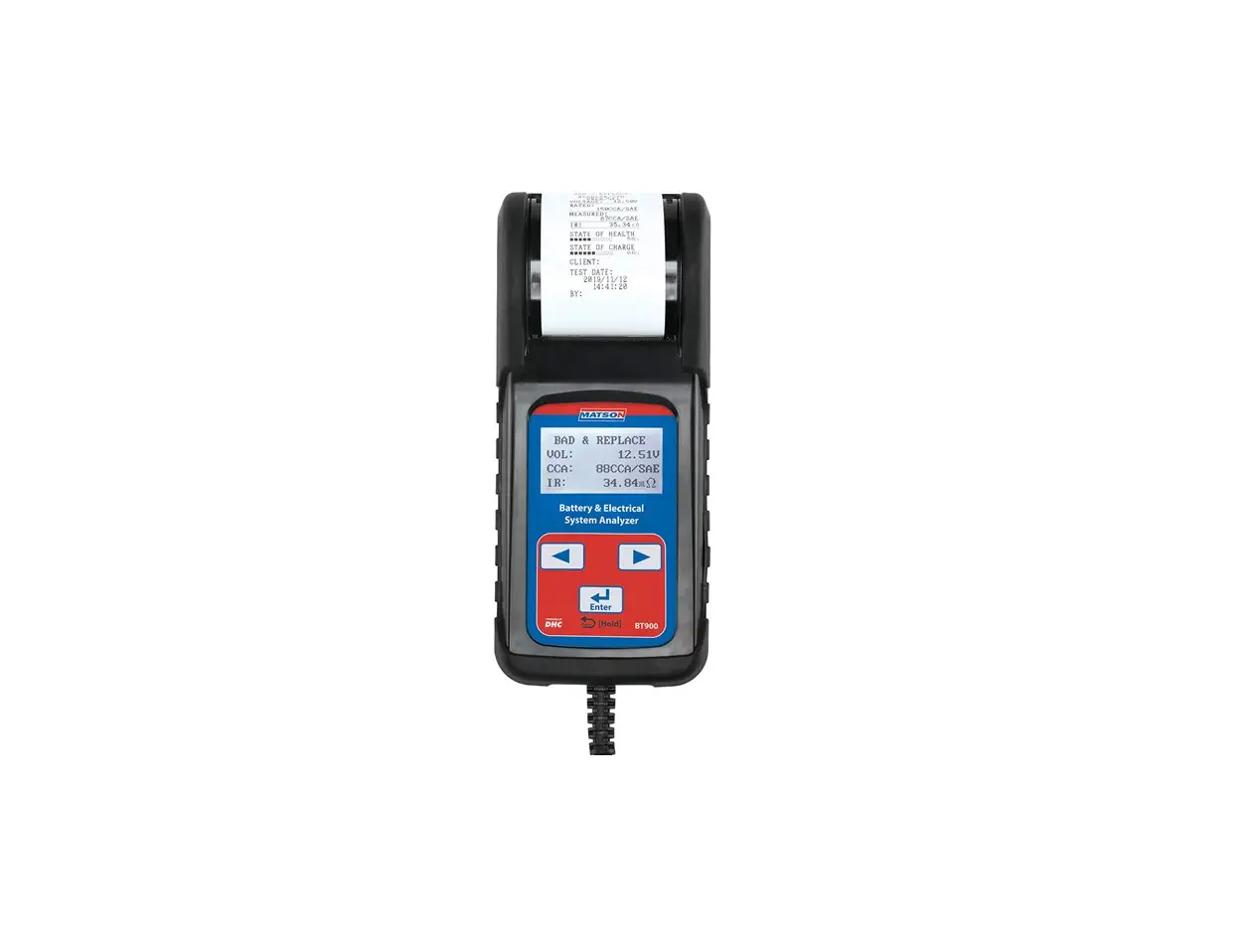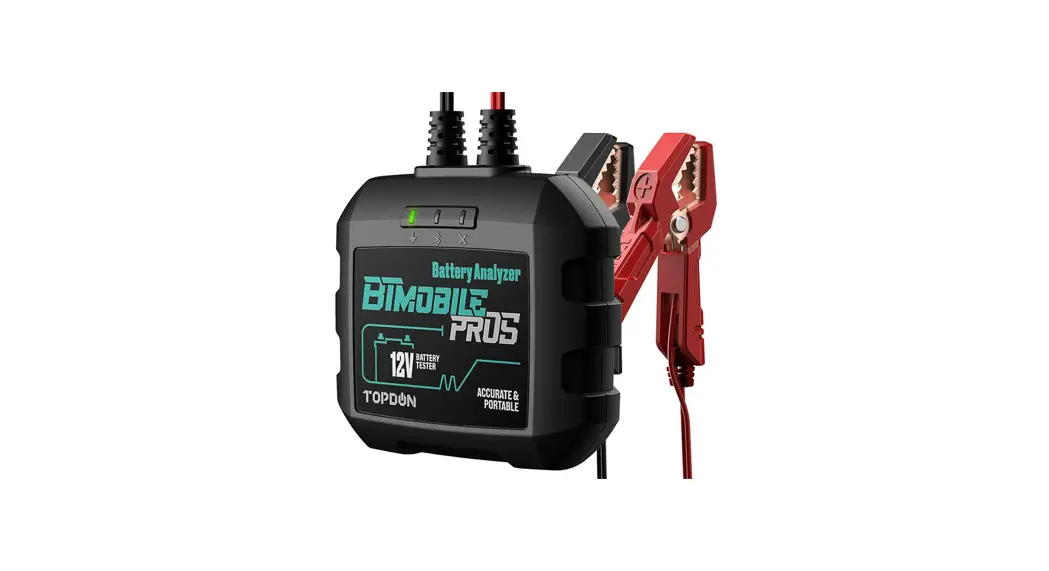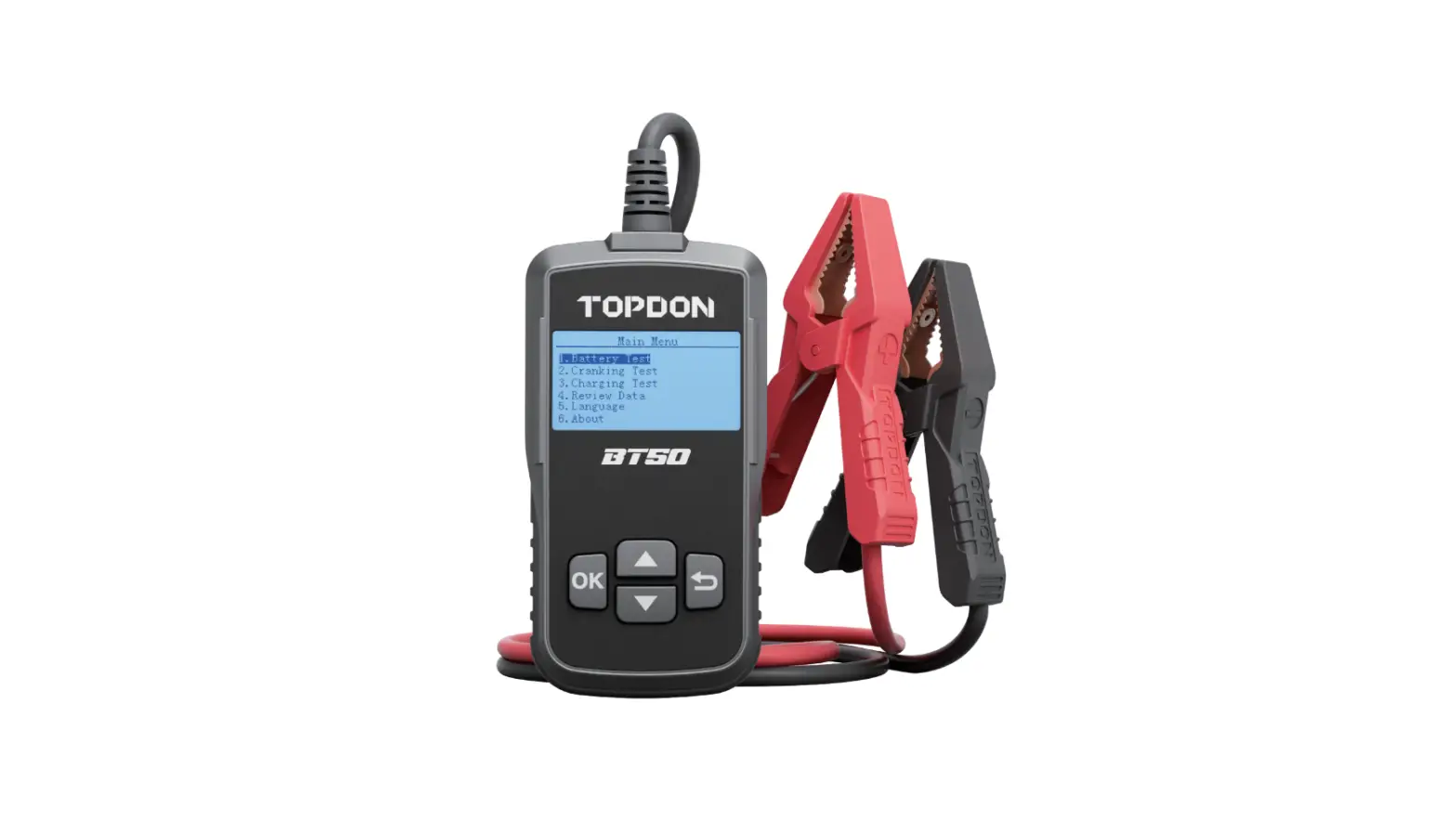
 HT2018B C Battery System Tester
User Manual
Manual V1.2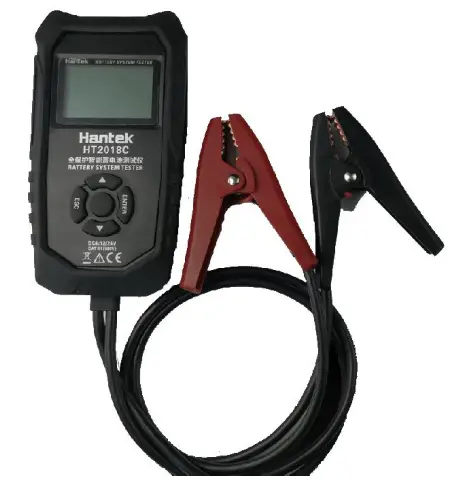
HT2018B(C) Battery System Tester
Brief Introduction
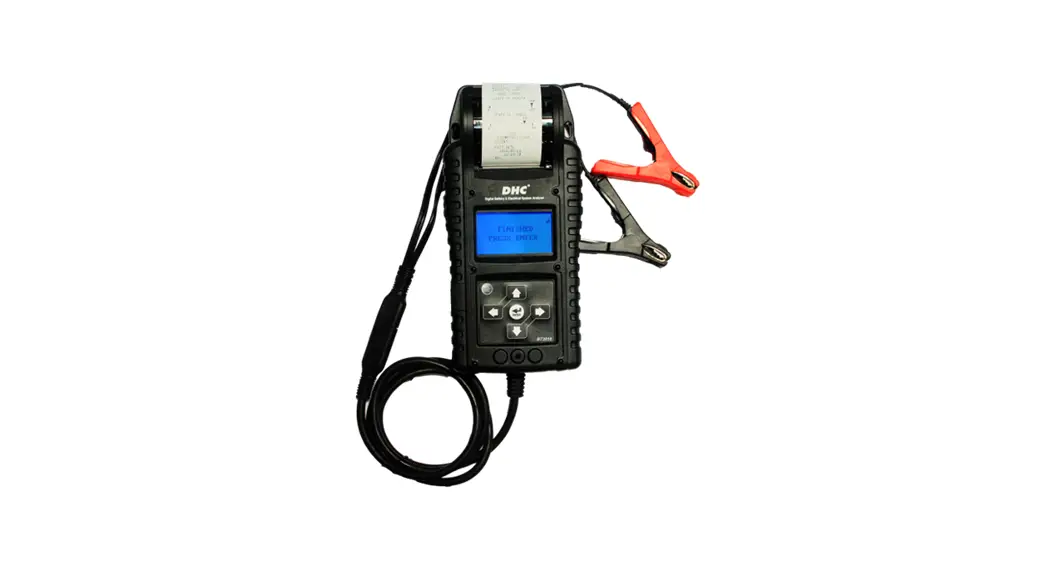
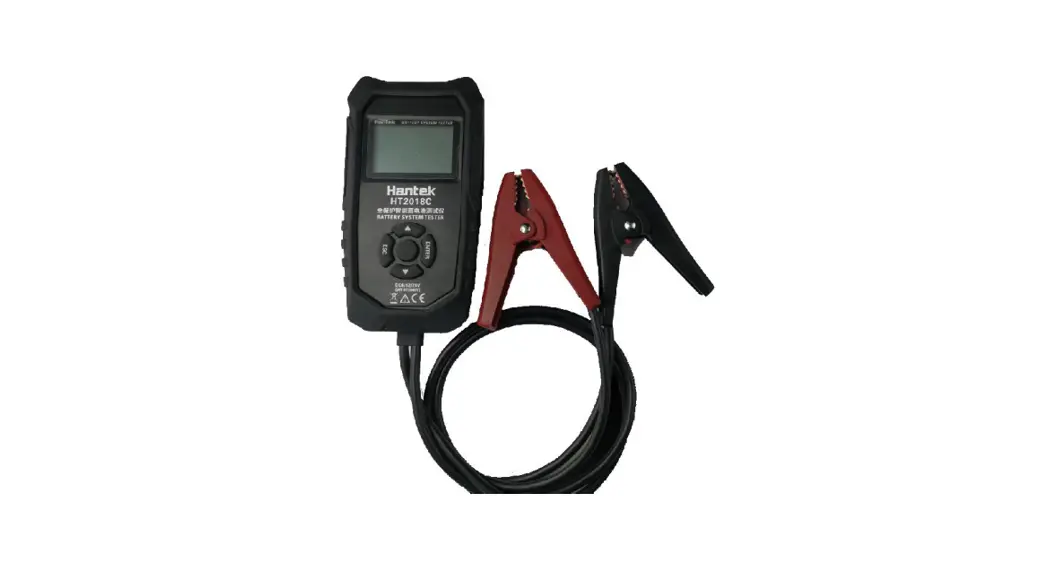
HT2018B/C Series Battery System Tester is a performance testing tool for startup lead-acid batteries. It is a testing tool for measuring the startup process, charging process, and battery performance during the electric load process. HT2018C has the Bluetooth printing function for the startup process test reports.
This product can be used for battery production and sales, auto parts maintenance, and various equipment systems related to the use of lead-acid batteries on the performance of lead-acid battery testing tools.
Features:
- The instrument is excellent in design, easy to operate, accurate in reading, and complete in functions.
- The instrument adopts a large screen dot matrix liquid crystal display.
- The internal use of accurate circuits and a powerful digital processing unit, using a four-wire Kelvin test connection method to complete a series of complex data acquisition and operation, and obtain each test data.
- The instrument strengthens the protection of the input signal line against mistakes and input characteristics, so as to prevent polarity reversal, prevent high voltage connection, and bad contact of the test clamp head, in order to use in the process safer and more convenient.
Safety Requirements
This manual includes the use of instrument instructions and safety operation warnings and how to maintain them. Using instruments without manuals may damage the instrument. This instrument is designed and manufactured strictly according to the safety requirements of GB4793.1 electronic measuring instrument and IEC/EN61010-1 safety standard. It meets the double insulation overvoltage standard CAT III 600V and pollution level 2 safety standard design.
- HT2018B/C is suitable for detecting 6V, 12V, and 24V batteries;
- The working voltage range of HT2018B/C is DC 4.5V ~30V;
- The battery voltage will be slightly higher than the normal value at just full state, please turn on the headlamp for 2-3 minutes, and when the voltage drops back to the normal value, now measure again;
- Check the test fixture before use. The insulation layer is intact, with no breakage, nudity, or disconnection. It is forbidden to use the front cover before it is covered, otherwise, it will be in danger of electric shock;
- Don’t use and store instruments in high temperature, high humidity, inflammable, explosive, and strong electromagnetic fields;
- Please do not change the instrument’s internal circuit at random, so as not to damage the instrument and safety;
- Wear a qualified eye patch when testing or repairing cars to prevent the engine from carrying foreign matter into the eyes;
- Please operate and repair vehicles in a well-ventilated environment to prevent inhalation of toxic gases;
- If the car engine is running, do not put the instruments and accessories beside the engine or exhaust pipe to avoid high-temperature damage;
- Pay attention to car manufacturers’ warnings and precautions and maintenance procedures when repairing automobiles;
- Selectable battery standards:
Exact test
CCA:100~1700
IEC:100~1000
EN:100~1700
DIN:100~1000
JIS: Need to check the table CCA
Quick test
3AH~250AH
International electrical symbols
 | DC |
 | AC |
 | DC/AC |
 | Warning caution safety sign |
 | Dangerous voltage (danger of electric shock) |
 | GND |
 | Double-insulated and highly insulated |
 | Fuse |
 | Battery |
Product icons and instructions
Function keys and test forceps:
<  > <
> <  >: Recurring, decreasing, up and down page keys;
<ESC>: Cancel, return key;
<ENTER>: Confirm, enter and test key.
Intermediate key: Enter the printing interface;
Red test clamp: Positive connection test clamp;
HT2018B(C) Battery System Tester
Functions
5.1 Battery voltage type
The battery tester can test 6V, 12V, and 24V batteries. Voltage type can be selected after the instrument is powered on.
After the battery is connected correctly, the battery startup capability test, startup load test, maximum load test, and charging system test can be selected.
5.2 Battery Test
Quick Test
5.2.1 Preparation before testing
- If the car is in motion, please turn off the fire and turn the key to the OFF position.
- When the vehicle is running at one end of the road, the battery is just full, and the voltage will be slightly higher than the normal value. Please turn on the headlight for
2-3 minutes, and when the voltage drops back to the normal value, now measure again.
5.2.2 Operation
- Connect the red test clamp to the battery-positive pole; connect the black test clamp to the battery-negative pole. Attention must be made to good contact so as not to affect test results.
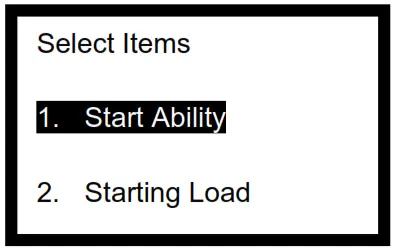
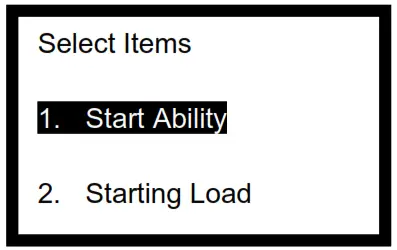
- Press < > < > button to select the battery startup ability test item and press <ENTER> to enter the selection, as follows:

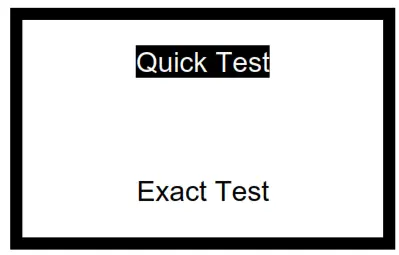
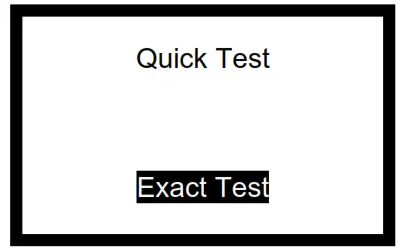
- According to the nameplate on the battery, press the < > < > button to select the quick test or exact test. Select Quick Test here and press <ENTER> to proceed to the next step.

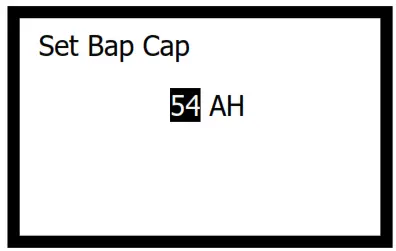
- According to the battery capacity value, press the < > < > button to adjust the battery capacity value, as shown in the figure.

- Adjust the reference standard value of the battery test and press the <ENTER> button to start the test.
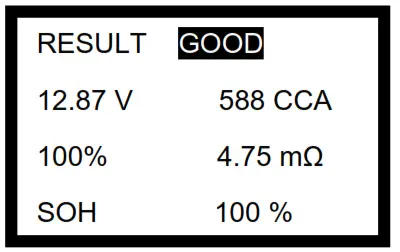
- When the test is completed, the display area will display the test results.

Exact Test
- Connect the red test clamp to the battery-positive pole, and connect the black test clamp to the battery-negative pole. Attention must be made to good contact so as not to affect test results.
- Press < > < > button to select the battery startup ability test item and press <ENTER> to enter the selection, as follows:

- According to the nameplate on the battery, press < > < > button to select the quick test or exact test. Select Exact Test here and press <ENTER> to proceed to the next step.

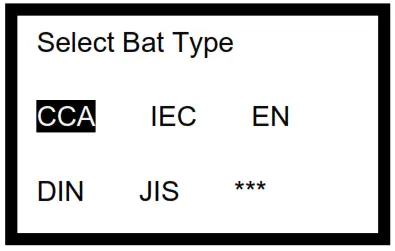
- According to the battery standard and press < > < > button to choose the battery type. If the battery is JIS standard, select CCA (SAE) as the test standard after consulting the table and comparing CCA. After choosing the battery type, now press <ENTER> to enter the selection, as follows:

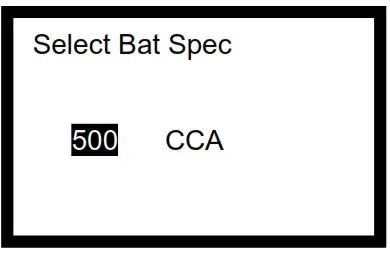
- According to the standard value expressed on the battery, pressing < > < > button to adjust the battery specification and long press < > < > button to realize the numerical adjustment. As follows:

- Adjust the reference standard value of the battery test and press the <ENTER> button to start the test.
- When the test is completed, the display area will display the test results.

- Now press the middle button to enter the print test report interface (refer to Section
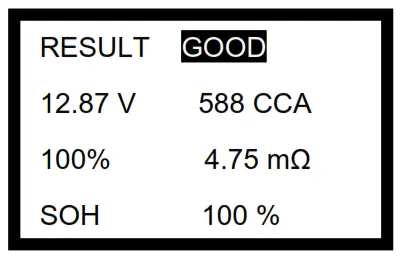
5.6), press the < ESC > button will return to step (4).
Note: only HT2018C has Bluetooth printing function.
5.2.3 Battery test results instruction
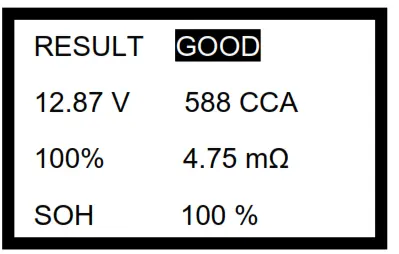
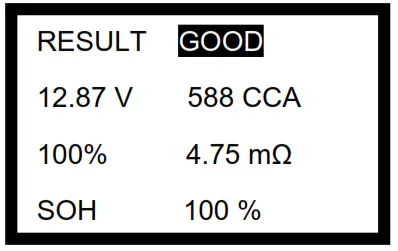
- The normal test result
 Battery voltage 12.85V
Full power 100% 12.78V 75% 12.54V 50% 12.30V 25% 12.12V Fully discharged 11.94V CCA value 588CCA
• The test to determine the state of the battery.
• When testing a 24V battery, CCA is 1/2 of the sum of the two 12V batteries in series.
Internal resistance 4.75mΩ
• The battery CCA value is greater, and the resistance will be smaller in general.
• The internal resistance of the standard is different because of the different materials battery, so there is no certain standard. But the same type of battery with the same manufacturer does not differ greatly in resistance out of the factory.
• When testing a 24V battery, the internal resistance is the resistance sum of the two 12V batteries in series.
Life Shows the usage state of the battery. It is recommended to replace the battery when the life of the battery is less than 45%.Life Test Result Comment >80% Good The battery is in good condition. >60% Common The battery condition is acceptable. >45% Attention The battery will be exhausted. Pay attention. <45% Replace The battery is exhausted. Please replace it. - Replace
 The test result shows that the battery life is only 32%, and the performance is poor.
Recommended to replace. - Life is normal and voltage is low
 The test result shows that the battery life is 100% and the performance is excellent, but the battery voltage is only 12.11V. Recommended charging.
 - Life is normal and voltage is too low
 The test result shows that the battery voltage is only 11.88V, battery voltage is too low. That may affect the test results. It is recommended to test again after charging.
 Battery voltage 12.85V
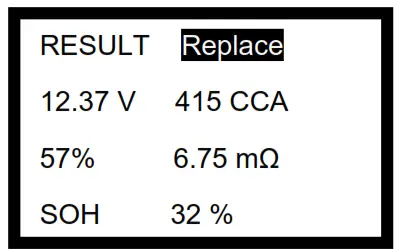 The test result shows that the battery life is only 32%, and the performance is poor.
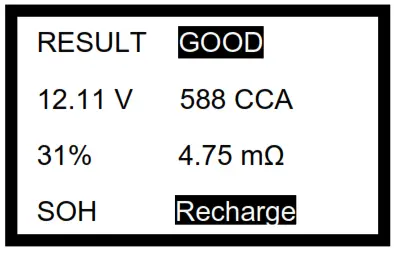 The test result shows that the battery life is 100% and the performance is excellent, but the battery voltage is only 12.11V. Recommended charging.
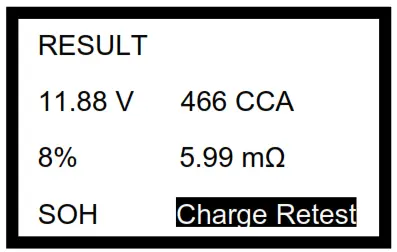 The test result shows that the battery voltage is only 11.88V, battery voltage is too low. That may affect the test results. It is recommended to test again after charging.
5.3 Startup Load Test
5.3.1 Preparation before testing
If the car is in motion, please turn off the fire and turn the key to the OFF position.
5.3.2 Operation
- Connect the red test clamp to the battery-positive pole, and connect the black test clamp to the battery-negative pole. Attention must be made to good contact so as not to affect test results.
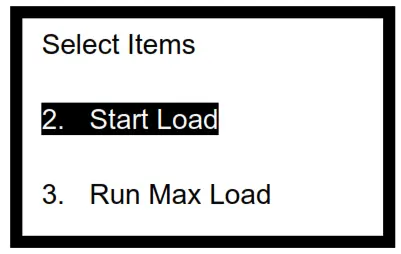
- Press < > < > button to select Start Load Test, and press <ENTER> to enter the selection, as follows:

- The test result will be displayed as follows:
 The diagram respectively shows the current test voltage (static voltage) is 12.36V, the standard voltage is 9.6V (for a 6V system, the standard voltage is 4.8V; for a 24V system, the standard voltage is 16V), and the lowest start-up voltage is 12.30V during startup.
 - Start the car, the tester will automatically test and record the minimum voltage that the battery output during starting the car.
- Press the < ESC > button will return to step (2).
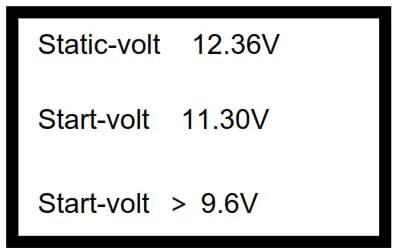 The diagram respectively shows the current test voltage (static voltage) is 12.36V, the standard voltage is 9.6V (for a 6V system, the standard voltage is 4.8V; for a 24V system, the standard voltage is 16V), and the lowest start-up voltage is 12.30V during startup.
5.3.3 Start load test results instruction
| Data reference table (12V system) | ||
| Startup voltage | battery discharge performance | Treatment |
| Above 10.7V | Good | need to observe |
| 10.2-10.7V | Common | need to observe |
| 9.6-10.2V | Bad | need to be replaced recently |
| Below 9.6V | Very Bad | need to be replaced immediately |
5.4 Maximum Load Test
5.4.1 Preparation before testing
If the car is flameout, please start the car.
5.4.2 Operation
- When the car is in the starting state, connect the red test clamp to the battery-positive pole, and connect the black test clamp to the battery-negative pole. Attention must be made to good contact so as not to affect test results.
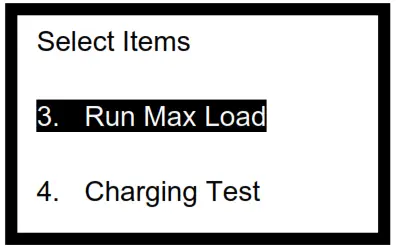
- Press < > < > button to select Maximum Load Test, as follows:

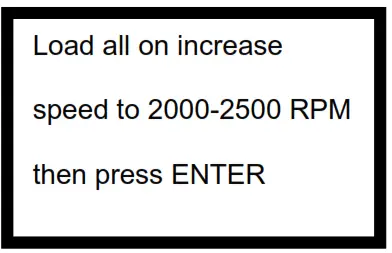
- Press <ENTER> to enter, The instrument will show the following picture:

- According to the prompt in Step 3 to operate, press <ENTER> to enter. The test result will be displayed as follows:
 The tester respectively shows the current-voltage 12.86V, and the standard voltage is 12.80V (for a 6V system, the standard voltage is 6.40V; for a 24V system, the standard
voltage is 25.60V), and the minimum voltage is 12.30V.| - The lowest voltage. If the voltage is greater than 12.8V (for a 6V system, the voltage is greater than 6.40V; for a 24V system, the voltage is greater than 25.60V), the system is normal.
- Press the < ESC > button will return to step (2).
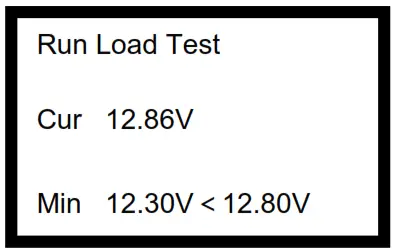 The tester respectively shows the current-voltage 12.86V, and the standard voltage is 12.80V (for a 6V system, the standard voltage is 6.40V; for a 24V system, the standard
5.4.3 System problematic
If the voltage is less than 12.8V (for a 6V system, the voltage is less than 6.40V; for 24V the system, the voltage is less than 25.60V), please check whether the generator belt is worn out and can not be used and whether the wire is short-circuited.
5.5 Charging System Test
5.5.1 Preparation before testing
If the car is flameout, please start the car.
5.5.2 Operation
- When the car is in the starting state, connect the red test clamp to the battery-positive pole, and connect the black test clamp to the battery-negative pole. Attention must be
made good contact so as not to affect test results. - Press < > < > button to select Charging System Test, as follows:

- Press <ENTER> to enter, The instrument will show the following picture:

- According to the prompt in Step 3 to operate, press <ENTER> to enter. The test result will be displayed as follows:
 The current voltage is 13.88V, the standard maximum voltage is 15.00V (for a 6V system, the standard maximum voltage is 7.50V; for the 24V system, the standard maximum voltage is 30.00V), and the maximum voltage is 14.10V.
The current voltage is 13.88V, the standard minimum voltage is 13.30V (for a 6V system, the standard minimum voltage is 6.6V; for a 24V system, the standard minimum voltage is 26.60V), and the minimum voltage is 13.58V. - Press the < ESC > button will return to step (2).
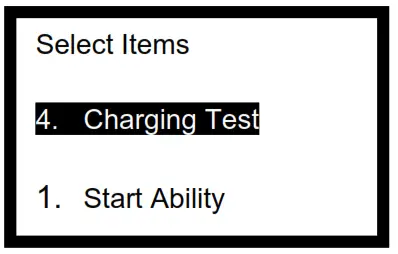
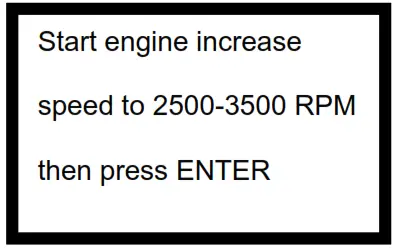
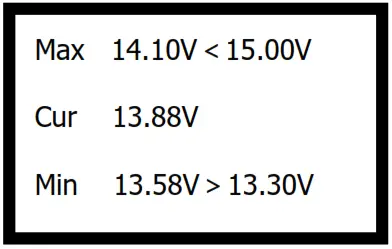 The current voltage is 13.88V, the standard maximum voltage is 15.00V (for a 6V system, the standard maximum voltage is 7.50V; for the 24V system, the standard maximum voltage is 30.00V), and the maximum voltage is 14.10V.
5.5.3 Charging system problematic
- If the voltage is greater than 15.0V (for a 6V system, the voltage is greater than 7.50V; for a 24V system, the voltage is greater than 30.00V), please check the voltage regulator.
- If the voltage is less than 13.3V (for a 6V system, the voltage is less than 6.6V; for a 24V system, the voltage is less than 26.60V), please check the connection point, wire, and dynamotor.
| Data reference table (12V system) | ||
| status | Battery voltage | engine performance |
| No headlight and air cooler (need to step on the accelerator to test) | Above 13.5 | Normal |
| 13.2-13.5 | Common | |
| 13.0-13.2 | Attention | |
| Below 13 | Need to examine and repair immediately | |
| Turn on the headlight and air conditioner (need to step on the accelerator to test) | 13.4-14.6 Normal | |
| 13.2-13.4 | Common, attention | |
| Below 13.2 | Need to examine and repair immediately | |
| The above data are for reference. If there is any problem with the battery, the data will also be affected. | ||
5.6 Print Test Report
HT2018C battery tester has the kinetic energy to print test reports, for recording and checking test results. You need to connect the Bluetooth printer to the tester for print.
Note: Bluetooth printer is optional, the user can purchase from our company or find other ways to buy.
The matching printer models are the XINYE XP-58IIH Bluetooth printer and the Hejie XMNAP-1 CB58B Bluetooth printer.
Operation:
- After the instrument test in the battery startup test, the screen stays at the following interface.

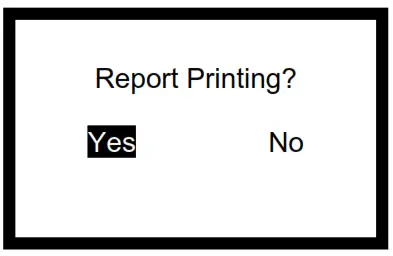
- Now press the middle button to enter the inquiry “Print the test report?” Press the <ENTER> button to print or press the <ESC> button to exit.

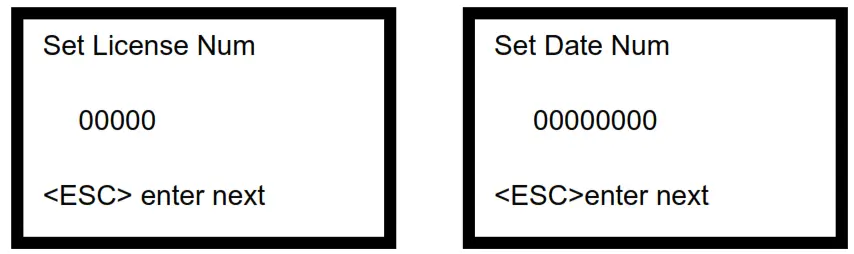
- Then prompt to enter the license plate number, and test date/number. If you do not need to record, press the <ESC> button to skip.

- After setting up, press <ENTER> or <ESC> button to print.

- After printing, the instrument will return to the battery startup test.
5.7 Language
Press <ESC> and <ENTER> two buttons at the same time and power up. Or after powering up, press <ESC> and <ENTER> two buttons for more than one second. The device will enter the language-switching interface. Press < > < > button to select language, then press the <ENTER> button to enter the test interface, or press the <ESC> button to exit.
The common problems
6.1 The measurement principle of the tester
As time goes on, the battery will gradually age. The main reason is that the surface of the battery plate is aging and no effective chemical reactions can be carried out. This is the main reason why most batteries can not continue to use. The International Association of Electrical and Electronic Engineers (IEEE) formally takes the conductance test method as one of the testing standards for lead-acid batteries. In IEEE standard 1118-1996, it is clearly stated that “the measurement of battery conductance is to add the
AC signal with known frequency and amplitude to both ends of the battery, and then measure the produced alternating current. AC conductance is the ratio of AC current
(that has the same phase as AC voltage) to AC voltage. This product is based on such a judgment basis and developed.
6.2 The reverse current is installed on the vehicle, will it affect the test result?
All inverse currents will affect the test results of the instrument, so please remove the reverse current to measure to ensure the accuracy of the test result.
6.3 Can this product accurately predict when the battery will fail?
The internal resistance of sealed lead-acid batteries is complex and includes ohmic internal resistance, concentration polarization internal resistance, electrochemical reaction internal resistance, and the interference effect of double-layer capacitor charging.
The composition and the relative content in the internal resistance values measured by different methods and at different times are different. So The measured internal resistance values are also different. There is no strict mathematical relationship between the internal resistance (or conductance) of sealed lead-acid batteries and the capacity of
batteries. It is impossible to predict the service life of batteries according to the internal resistance (or conductance) of a single battery. However, the sudden increase in internal
resistance or sudden decrease in conductance indicates that the battery life is about to end.
6.4 Is the CCA measured by this product correct?
CCA is a control standard for battery production. The cumulative results show that the CCA value measured by the new battery will be higher than the labeled value (10-15%). With the user’s use, the CCA value will be closer to the labeled value, and then the CCA value will be lower than the labeled value.
6.5 The difference between the product test method and the load test method:
According to the physical formula R = V / I, the test equipment allows the battery to force a large constant DC current (currently used 40A ~ 80A high current) in a short time (usually 2 ~ 3 seconds), measure the voltage at both ends of the battery, and calculate the current battery internal resistance according to the formula.
This method has obvious shortcomings:
- Only large-capacity batteries or storage batteries can be measured, and small-capacity batteries cannot load 40A-80A high current in 2-3 seconds.
- When the battery passes through a high current, the electrode inside the battery will polarize and produce polarization resistance. Therefore, the measuring time must be very short, otherwise, the error of the measured internal resistance is very large.
- The large current will damage the electrodes inside the battery.
This product measurement method: Because the battery is actually equivalent to active resistance, so we apply a fixed frequency and a fixed current (small current) to the
battery, and then sample its voltage, after rectification, filtering and a series of processing, finally calculate the internal resistance value of the battery through the arithmetic circuit.
The advantages and disadvantages of this method:
- Using this measurement method can measure almost all batteries, including small-capacity batteries. The internal resistance of notebook batteries is measured by this
method. - Measuring with this method will not cause much damage to the battery itself.
Specifications
| Function | Range | Model | ||
| HT2018B | HT2018C | |||
| Cold start current | CCA | 100-1700 | √ | √ |
| DEC | 100-1000 | √ | √ | |
| EN | 100-1700 | √ | √ | |
| DIN | 100-1000 | √ | √ | |
| JIS | 100-1700 | √ | √ | |
| Battery internal resistance | 0.00m0-99.99m0 | √ | √ | |
| Battery Voltage | 4.5V-30V | √ | √ | |
| x | √ | |||
| 6V, 12V, 24V battery test | √ | √ | ||
| Startup load test | √ | √ | ||
| Charging system test | √ | √ | ||
| Maximum load test | √ | √ | ||
| Prevent reverse function | √ | √ | ||
| LCD | √ | √ | ||
| The cable length | 600mm | 600mm | ||
| Size | 143x77x28 (mm) | |||
| Weight | 270g | |||
Battery Specification Table
8.1 JIS code conversion table
| Model | Cold Start Current | Model | Cold Start Current | ||||||
| JIS New | JIS Old | MF | CMF | JIS New | JIS Old | MF | CMF | ||
| 26A17R | 200 | 55B24RS | N180-56S | 430 | 420 | 500 | |||
| 26A17L | 200 | 55B24LS | NT80-S6LS | 430 | 420 | 500 | |||
| 26A19R | 12N24-4 | 200 | 220 | 264 | 55D26R | N5OZ | 350 | 440 | 525 |
| 26A19L | 12N24-3 | 200 | 220 | 264 | 55D26L | N5OZL | 350 | 440 | 525 |
| 28A19R | NT5O-N24 | 250 | 60D23R | 520 | |||||
| 28A19L | NT5O-N24L | 250 | 60D23L | 520 | |||||
| 32A19R | NX60-N24 | 270 | 295 | 65D23R | 420 | 540 | 580 | ||
| 32A19L | NX60-N24L | 270 | 295 | 65D23L | 420 | 540 | 580 | ||
| 26B17R | 200 | 65D26R | NS70 | 415 | 520 | 625 | |||
| 26B17L | 200 | 65D26L | NS7OL | 415 | 520 | 625 | |||
| 28B17R | 245 | 65D31R | N70 | 390 | 520 | 630 | |||
| 28B17L | 245 | 65D31L | N7OL | 390 | 520 | 630 | |||
| 28B19R | NS4OS | 245 | 70D23R | 35-60 | 490 | 540 | 580 | ||
| 28B19L | NS4OLS | 245 | 70D23L | 25-60 | 490 | 540 | 580 | ||
| 32B20R | NS40 | 270 | 75D23R | 500 | 520 | 580 | |||
| 32B20L | NS4OLS | 270 | 75D23L | 500 | 520 | 580 | |||
| 32C24R | N40 | 240 | 325 | 400 | 75D26R | F100-5 | 490 | ||
| 32C24L | N4OL | 240 | 325 | 400 | 75D26L | F100-5L | 490 | ||
| 34B17R | 280 | 75D31R | N7OZ | 450 | 540 | 735 | |||
| 34B17L | 280 | 75D31L | N7OZL | 450 | 540 | 735 | |||
| 34B19R | NS4 OZA | 270 | 325 | 400 | 80D23R | 580 | |||
| 34B19L | NS4OZAL | 270 | 325 | 400 | 80D26L | 580 | |||
| 36B20R | NS4OZ | 275 | 300 | 360 | 85B60K | 500 | |||
| 36B20L | NS4OZL | 275 | 300 | 360 | 85BR60K | 500 | |||
| 36B20RS | NS4 OZS | 275 | 300 | 360 | 95D31R | NX120-7 | 620 | 660 | 850 |
| 36B20L5 | NS4OZLS | 275 | 300 | 360 | 95D31L | NX120-7L | 620 | 660 | 850 |
| 38B20R | NX60-N24 | 330 | 340 | 410 | 95E41R | N100 | 515 | 640 | 770 |
| 38B20RS | NT60- N24S | 330 | 340 | 410 | 95E41L | N100L | 515 | 640 | 770 |
| 38B20L | NX60-24L | 330 | 340 | 410 | 105E41R | N100Z | 580 | 720 | 880 |
| 38B20L5 | NX60-24LS | 330 | 340 | 410 | 105E41L | N100ZL | 580 | 720 | 880 |
| 40B20L | 330 | 105F51R | N100Z | 580 | |||||
| 40B20R | 330 | 105F51L | N100ZL | 580 | |||||
| 42B20R | 330 | 115E41R | NS120 | 650 | 800 | 960 | |||
| 42B20L | 330 | 115E41L | NS120L | 650 | 800 | 960 | |||
| 40620RS | 330 | 115F51R | N120 | 650 | 800 | 960 | |||
| 40B20L5 | 330 | 115F51L | N120L | 650 | 800 | 960 | |||
| 46B24R | NS60 | 325 | 360 | 420 | 130E41R | NX200-10 | 800 | ||
| 46B24L | NS6OL | 325 | 360 | 420 | 130E41L | NX200-10L | 800 | ||
| 46B24 RS | NS6OS | 325 | 360 | 420 | 130F51R | 800 | |||
| 46B24 LS | NS6OLS | 325 | 360 | 420 | 130F51L | 800 | |||
| 46B26R | 360 | 145F51R | NS150 | 780 | 920 | ||||
| 46B26L | 360 | 145F51L | NS150L | 780 | 920 | ||||
| 46B26RS | 360 | 145G51R | N150 | 780 | 900 | 1100 | |||
| 34 B19RS | NS4OZAS | 270 | 325 | 400 | 80D26R | NX-110-5 | 580 | 280 | 630 |
| 34B19LS | NS4OZALS | 270 | 325 | 400 | 80D26L | NX110-5L | 580 | 280 | 630 |
| 46B26LS | 360 | 145G51L | N150L | 780 | 900 | 1100 | |||
| 48D26R | N50 | 280 | 360 | 420 | 150F51R | N1200-12 | 640 | ||
| 48D26L | N5OL | 280 | 360 | 420 | 150F51L | N1200-12L | 640 | ||
| 50D20R | 310 | 380 | 480 | 165G51R | NS200 | 935 | 980 | ||
| 50D20L | 310 | 380 | 480 | 165G51L | NS200L | 935 | 980 | ||
| 50D23R | 85BR6OK | 500 | 170F51R | NX250-12 | 1045 | ||||
| 50D23L | 85B60K | 500 | 170F51L | NX250-12L | 1045 | ||||
| 50B24R | N180-S6 | 390 | 180G51R | N1250-15 | 1090 | ||||
| 50B24L | N180-S6L | 390 | 180G51L | N1250-15L | 1090 | ||||
| 50D26R | 50D20R | 370 | 195G51R | NX300-51 | 1145 | ||||
| 50D26L | 50D20L | 370 | 195G51L | NX300-51L | 1145 | ||||
| 55D26R | 355 | 480 | 500 | 1901-152R | N200 | 925 | 1100 | 1300 | |
| 55D23L | 355 | 480 | 500 | 190H52L | N200L | 925 | 1100 | 1300 | |
| 55B24R | NX100-S6 | 435 | 420 | 500 | 245H52R | NX400-20 | 1530 | 1250 | |
| 55B24L | NX100-56L | 435 | 420 | 500 | 2451-152L | NX400-20L | 1530 | 1250 |
8.2 DIN/EN model comparison table
| Model | DIN | EN | Model | DIN | EN | ||||
| 52805 | 52815 | 180 | 240 | 56420 | 56322 | 88066 | 300 | 510 | |
| 53517 | 175 | 300 | 56530 | 56618 | 56638 | 300 | 510 | ||
| 53520 | 53521 | 53522 | 150 | 240 | 56618 | 56619 | 56620 | 300 | 510 |
| 53625 | 53638 | 53836 | 175 | 300 | 56633 | 56647 | 56641 | 300 | 510 |
| 53646 | 53621 | 88038 | 175 | 300 | 56820 | 56821 | 315 | 540 | |
| 53653 | 53624 | 53890 | 175 | 300 | 57024 | 57029 | 315 | 540 | |
| 54038 | 54039 | 175 | 300 | 57113 | 57539 | 400 | 680 | ||
| 54232 | 175 | 300 | 57114 | 56821 | 88074 | 400 | 680 | ||
| 54313 | 54324 | 54464 | 220 | 330 | 57218 | 57219 | 420 | 720 | |
| 54317 | 54312 | 88146 | 210 | 360 | 57220 | 57217 | 420 | 720 | |
| 54437 | 54466 | 54459L | 210 | 360 | 57230 | 380 | 640 | ||
| 54459 | 54434 | 88046 | 210 | 360 | 57412 | 57413 | 57412L | 400 | 680 |
| 54469 | 54449 | 54465 | 210 | 360 | 57512 | 57513 | 57531 | 350 | 570 |
| 54519 | 54533 | 54612 | 210 | 360 | 58515 | 58424 | 450 | 760 | |
| 54523 | 54524 | 220 | 300 | 58521 | 58513 | 320 | 540 | ||
| 54537 | 54545 | 54801 | 190 | 300 | 58522 | 58514 | 320 | 540 | |
| 54551 | 54580 | 220 | 300 | 58815 | 58821 | 395 | 640 | ||
| 54533 | 54577 | 54579 | 220 | 300 | 58820 | 58515 | 58527 | 395 | 640 |
| 54584 | 54578 | 220 | 300 | 58827 | 400 | 640 | |||
| 54590 | 210 | 330 | 58838 | 58833 | 88092 | 400 | 680 | ||
| 54827 | 240 | 360 | 59040 | 59017 | 59018 | 360 | 600 | ||
| 55040 | 88056 | 265 | 450 | 59218 | 59219 | 290 | 480 | ||
| 55041 | 55042 | 220 | 360 | 59226 | 59215 | 450 | 760 | ||
| 55044 | 55414 | 88056 | 265 | 450 | 59514 | 320 | 540 | ||
| 55046 | 300 | 510 | 59518 | 59519 | 395 | 640 | |||
| 55056 | 320 | 540 | 59615 | 59616 | 360 | 600 | |||
| 55057 | 54827 | 88156 | 320 | 540 | 60018 | 30019 | 250 | 410 | |
| 55068 | 55069 | 55548 | 220 | 390 | 60026 | 58811 | 440 | 720 | |
| 55218 | 255 | 420 | 60044 | 60038 | 500 | 760 | |||
| 55414 | 55415 | 55421 | 265 | 450 | 60527 | 60528 | 410 | 680 | |
| 55422 | 55566 | 55040 | 265 | 450 | 61017 | 61018 | 400 | 680 | |
| 55428 | 55423 | 55427 | 300 | 510 | 61023 | 62529 | 450 | 760 | |
| 55457 | 265 | 450 | 61047 | 61048 | 450 | 760 | |||
| 55529 | 220 | 360 | 62034 | 62038 | 62045 | 420 | 680 | ||
| 55531 | 55545 | 55559L | 255 | 420 | 63013 | 470 | 680 | ||
| 55559 | 55530 | 88056 | 255 | 420 | 63545 | 63549 | 420 | 680 | |
| 55564 | 55552 | 55563 | 255 | 420 | 64020 | 64317 | 64318 | 325 | 550 |
| 55564 | 55565 | 55548 | 255 | 420 | 64028 | 64035 | 520 | 760 | |
| 55570 | 55567 | 55565L | 255 | 420 | 64036 | 460 | 760 | ||
| 56012 | 230 | 390 | 64317 | 64318 | 64323 | 540 | 900 | ||
| 56048 | 56068 | 56069 | 250 | 390 | 65513 | 540 | 900 | ||
| 56049 | 56069 | 56073 | 250 | 390 | 65514 | 65515 | 570 | 900 | |
| 56077 | 56530 | 300 | 510 | 67043 | 67045 | 600 | 1000 | ||
| 56091 | 55800 | 360 | 540 | 68032 | 68034 | 600 | 1000 | ||
| 56111 | 55048 | 300 | 540 | 70029 | 70038 | 70027 | 630 | 1050 | |
| 56218 | 55092 | 300 | 510 | 70036 | 68040 | 68021 | 570 | 950 | |
| 56219 | 56216 | 300 | 510 | 71014 | 71015 | 700 | 1150 | ||
| 56220 | 280 | 510 | 72512 | 680 | 1150 | ||||
| 56225 | 56323 | 300 | 510 | 73011 | 740 | 1200 | |||
| 56318 | 56312 | 56311 | 300 | 510 |