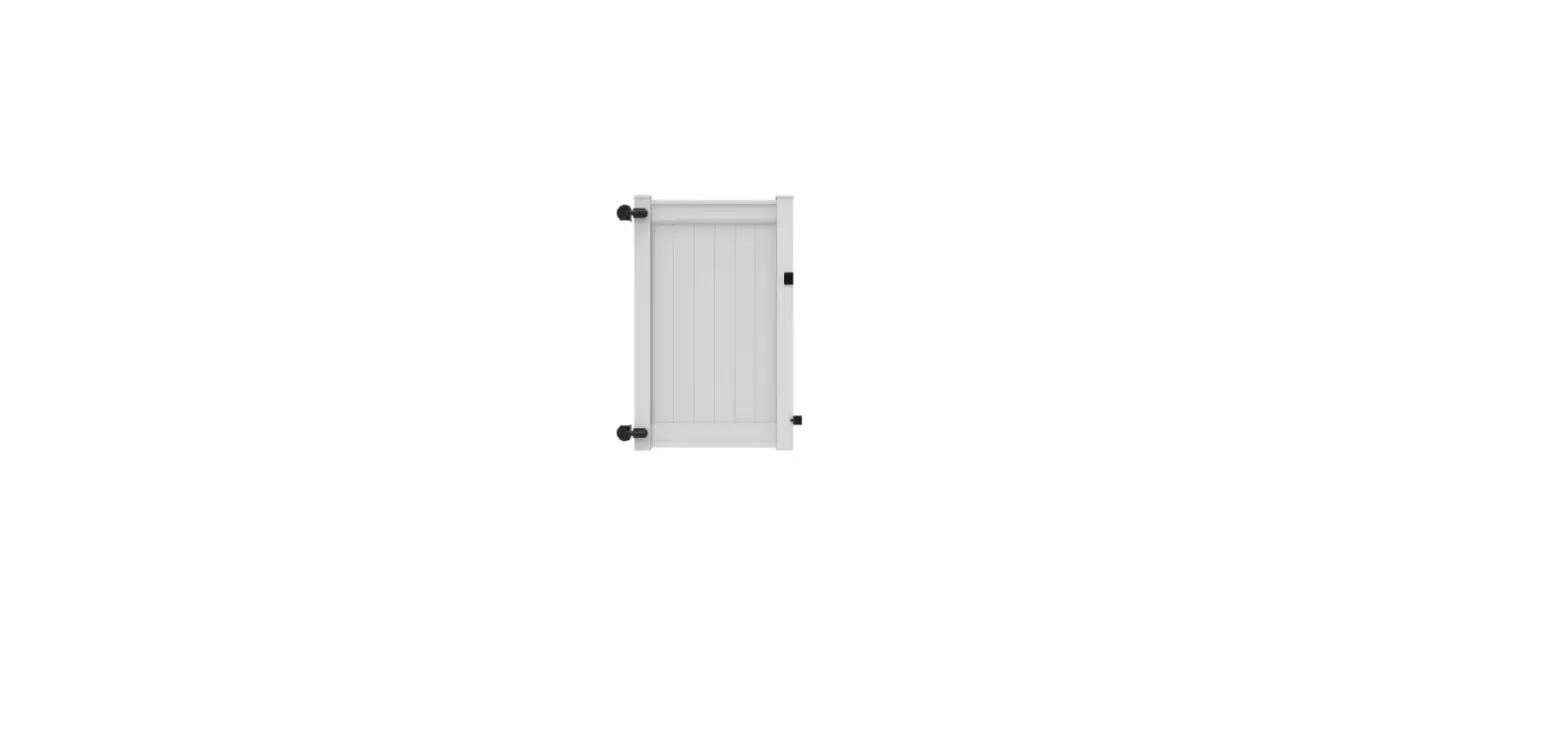
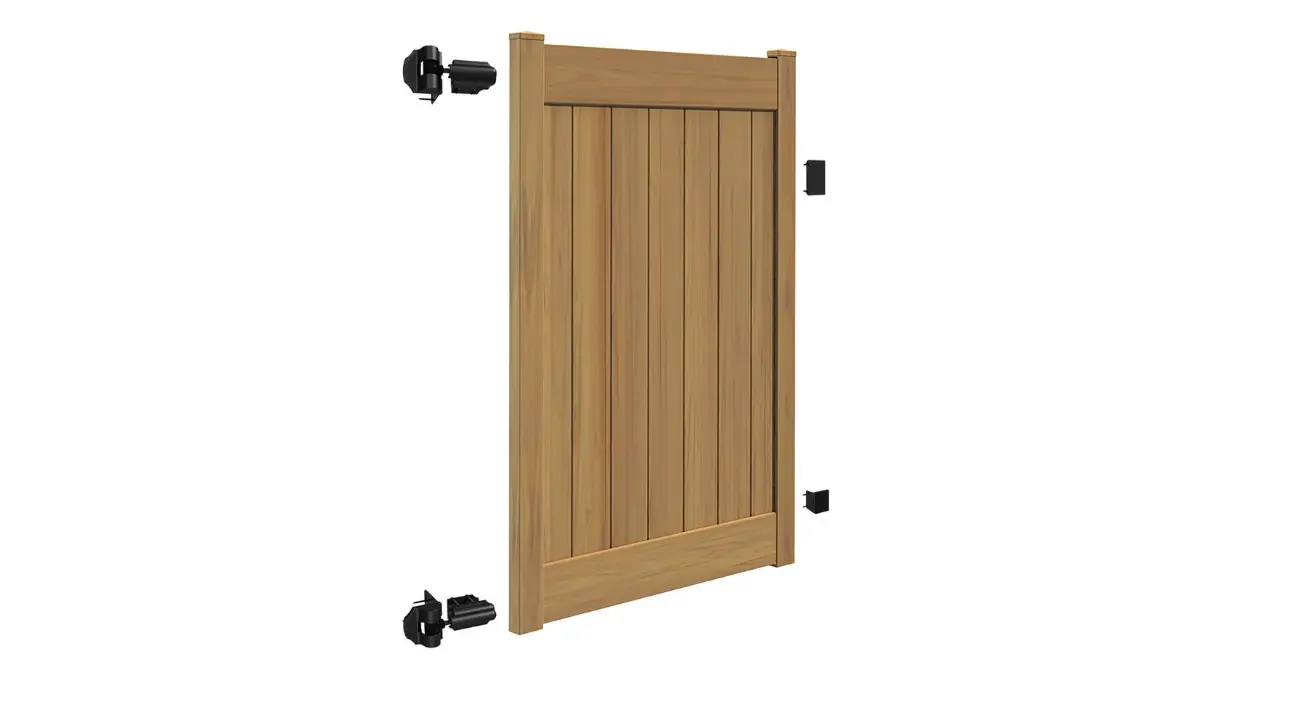
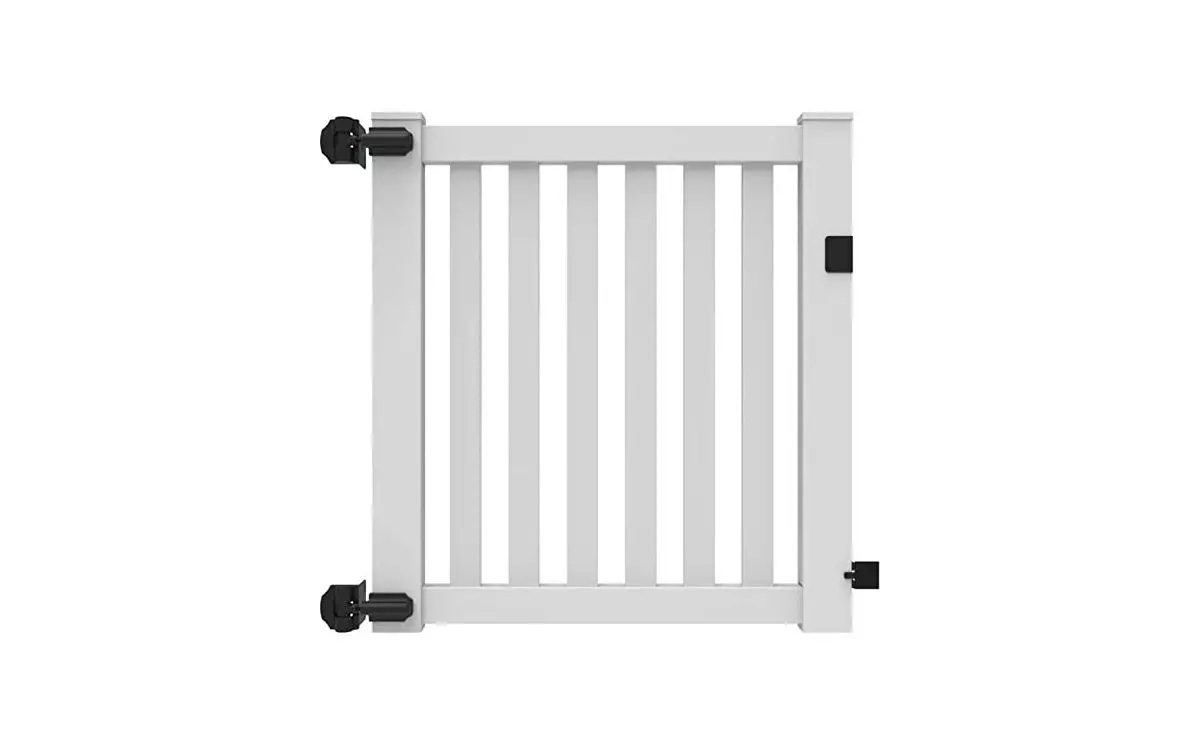
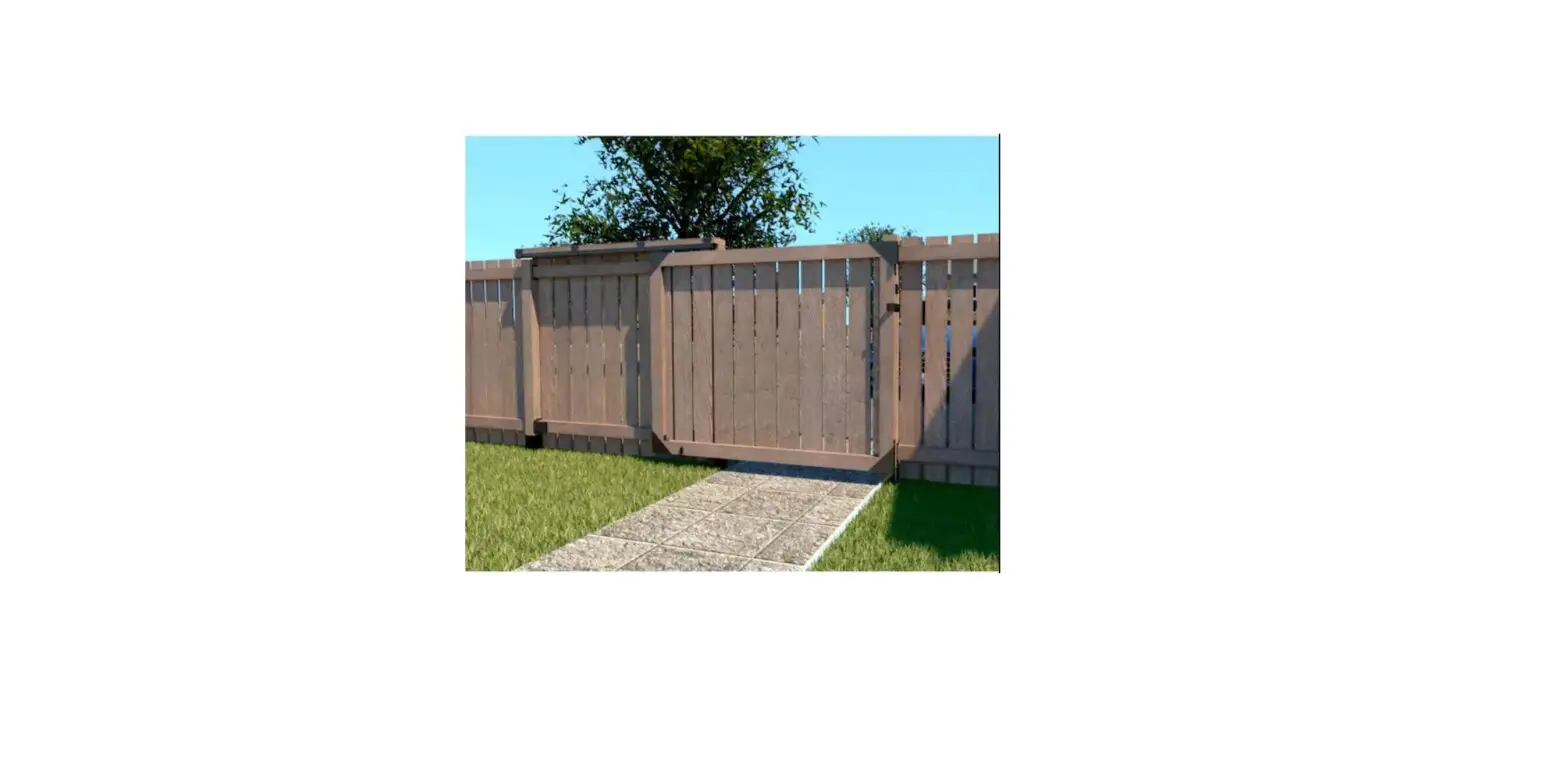
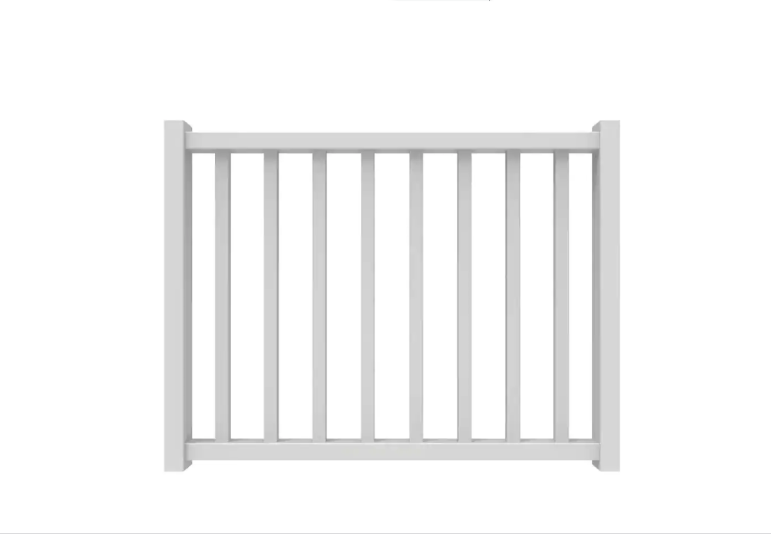
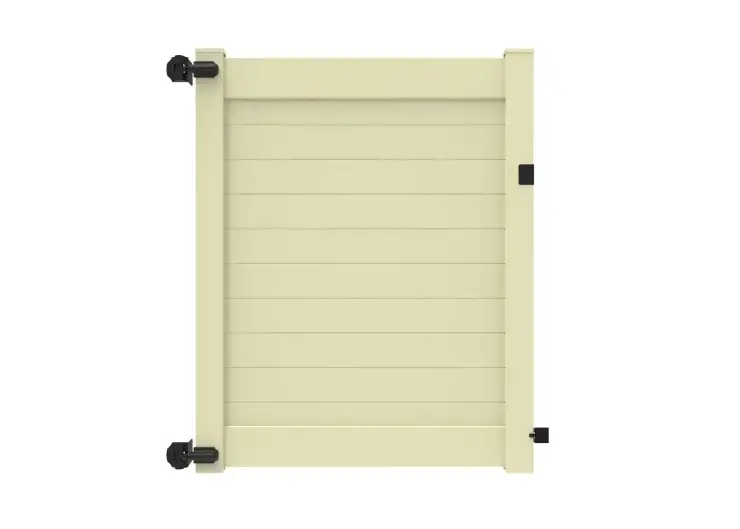
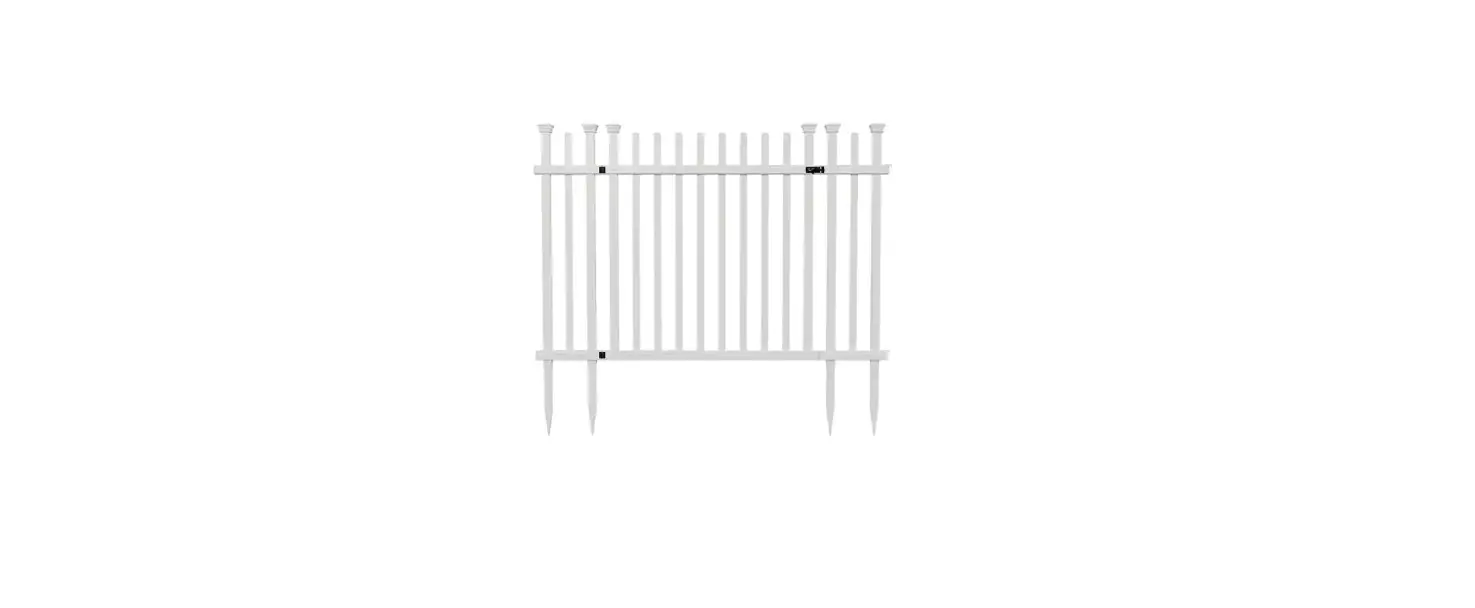
181977 Tan Vinyl Fence Gate
Product Information:
The Somerset 6’x42″ Privacy Gate is a durable and secure gate
designed for privacy fencing. The gate is made of high-quality
materials and features a patented PicketLockTM technology for a
glue and fastener-free connection between the pickets and rails.
The gate dimensions are 68.5 inches in height and 41.5 inches in
width.
Product Usage Instructions:
Step 1:
- Take the bottom rail and align one of the pickets with the
channel in the bottom rail. Slide the picket into the channel. - Insert the remaining pickets into the channel of the bottom
rail, making sure to align the tongue of each picket into the
groove of the next one. Continue sliding the pickets to the
opposite side of the bottom rail until all are inserted into the
channel.
Items you may need:
- Soapy water: Spray soapy water onto components to help them
slide more easily into their corresponding channels. - Non-marring rubber mallet: Use a non-marring rubber mallet to
gently tap components more firmly into place.
Preparation:
- Check local ordinances and regulations before building your
fence. - Contact your local utility companies to mark any underground
cables and pipelines. - Discuss plans with neighbors along your proposed fence
line.
Step 2:
- At the top of the gate assembly, slide the second rail over the
top of the pickets.
Step 3:
- Place gate jambs on both sides of the rails and align the
hinges with the rails. Use the supplied bracket and follow the same
steps for the hinged brackets as well. Ensure the rails are fully
inserted in the jamb before drilling. The bolts need to go through
the jamb and rail to function properly.
Installing the Gate:
- Dig a post hole for the hinge post, with a diameter of 18 to 24
inches and a depth of 36 to 42 inches (depending on local
ordinances or expected frost depth in winter). Insert a piece of
4×4 treated lumber to support the gate hinge post. - Check the measurement of the gate. The actual width of the gate
is 41-1/2 inches, and the inside post-to-post dimension is 42-3/4
inches, leaving a 5/8 inch gap on both sides of the gate to the
posts. Double-check all measurements. - Measure to ensure that you can install the gate to the post
with approximately a 2 inch gap from the ground to the bottom of
the gate. Align the rails on the gate to the rails on the fence
panels. - Hang the gate between the posts using a 5/8 inch spacer between
the gate and the posts. Secure in place with shims under the gate
or by clamping the gate jamb to the post. Ensure that the gate is
level and square. - Attach hinge brackets to the gate post with the provided
screws. - Remove any clamps and shims, and attach the latch using the
provided screws.
SOMERSET 6’X42″ PRIVACY GATE ASSEMBLY INSTRUCTIONS
ACTUAL SIZE: 68.5 in. H x 41.5 in. W
Step 1
Take the bottom rail and align one of the pickets with the channel in the bottom rail. Slide the picket into the channel (fig. 1).
Begin to insert the remaining pickets into the channel of the bottom rail (fig. 2). Because the pickets have a tongue-and-groove design, be sure to insert each in the same direction. Tightly align the tongue of each picket into the groove of the next one as they slide into the channel. Continue to slide the pickets to the opposite side of the bottom rail until all are inserted into the channel.
fig. 1
fig. 2
Items you may need:
· Soapy water · Non-marring
rubber mallet · Wooden wedge
· Power drill · 1/4″ drill bit · 7/16″ wrench · Shims
NOTE: PicketLockTM is a patented technology that provides a glueand fastener-free connection between the pickets and rails. You may spray soapy water onto components to help them slide more easily into their corresponding channels. A non-marring rubber mallet may also be used to gently tap components more firmly into place.
PREPARATION: Check local ordinances and regulations before building your fence. Before construction, contact your local utility companies to mark any underground cables and pipelines. In addition, it is a good idea to discuss plans with any neighbors along your proposed fence line.
Step 2
At the top of the gate assembly, slide the second rail over the top of the pickets (fig. 3).
Step 3
Place gate jambs on both sides of the rails place the hinges on the
gate jamb so they are aligned with the rails. Using the bracket as a
guide, drill the four (4) necessary ¼” holes for the bracket bolts. Repeat
these steps for the hinged brackets as well (fig. 4). Ensure the rails are
fully inserted in the jamb before drilling. The bolts need to go through
the jamb and rail to function
properly.
fig. 3
Slide the hinged bracket and bracket on the top and bottom of the gate jambs. Attach hinges to jambs with the supplied through bolts. Connect bolts with the supplied cap nuts. Ensure the gate is square before all bolts are tight. When square, tighten all bolts with a 7/16″ wrench.
Gate Cap Screw Gate Cap
Cap Nuts
Hinged Bracket
Through Bolts Gate Jamb
Bracket
fig. 4
PG. 1
SOMERSET 6’X42″ PRIVACY GATE INSTALLATION INSTRUCTIONS
Digging Post Holes
Dig post hole for the hinge post 18″ to 24″ in diameter and 36″ to 42″ deep (depending on local ordinance or expected frost depth in winter). We recommend that you insert a piece of 4×4 treated lumber to support the gate hinge post (fig. 5).
Check measurement of gate. Actual width of the gate is 41-1/2″. The inside post-to-post dimension is 42-3/4″. This will give you a 5/8″ gap on both sides of the gate to the posts. DOUBLE-CHECK ALL MEASUREMENTS!
Installing the Gate
Measure to be sure you can install the gate to the post with approximately a 2″ gap from the ground to the bottom of the gate. Align the rails on the gate to the rails on the fence panels.
Hang the gate between the posts. Use a 5/8″ spacer between the gate and the posts (fig. 6). Secure in place with shims under the gate or clamp the gate jamb to the post. Make sure the gate is level and square. Attach hinge brackets to the gate post with the provided screws (fig. 7).
Remove any clamps and shims. Attach latch using screws provided (fig. 8).
Install a post cap on each post using PVC cement or an exterior adhesive.
NOTE: The gate latch is designed to be used on the left- or right-hand side of the gate, depending on customer preference or design. The latch is assembled, ready to be installed on the right-hand side of the gate. If you desire to switch the latch follow these simple steps:
· Remove the 2 shoulder bolts and spring
· Change the orientation of the striker
· Reattach the spring and insert the shoulder bolts
· Shoulder bolts must be fully tightened. Thread-locking adhesive is recommended.
Hinge Post
Hinge Bracket
Striker
fig. 5
Latch Latch Post
5/8″ Spacer
Ground Line
fig. 6
Hinged Brackets Center on Top and
Bottom Rails
fig. 7
fig. 8
THE DIAGRAMS AND INSTRUCTIONS IN THIS BROCHURE ARE FOR ILLUSTRATION PURPOSES ONLY AND ARE NOT MEANT TO REPLACE A LICENSED PROFESSIONAL. ANY CONSTRUCTION OR USE OF THE PRODUCT MUST BE IN ACCORDANCE WITH ALL LOCAL ZONING AND/OR BUILDING CODES. THE CONSUMER ASSUMES ALL RISKS AND LIABILITY ASSOCIATED WITH THE CONSTRUCTION OR USE OF THIS PRODUCT. THE CONSUMER OR CONTRACTOR SHOULD TAKE ALL NECESSARY STEPS TO ENSURE THE SAFETY OF EVERYONE INVOLVED IN THE PROJECT, INCLUDING, BUT NOT LIMITED TO, WEARING THE APPROPRIATE SAFETY EQUIPMENT. EXCEPT AS CONTAINED IN THE WRITTEN LIMITED WARRANTY, THE WARRANTOR DOES NOT PROVIDE ANY OTHER WARRANTY, EITHER EXPRESS OR IMPLIED, AND SHALL NOT BE LIABLE FOR ANY DAMAGES, INCLUDING CONSEQUENTIAL DAMAGES.
©2022 UFP Retail Solutions, LLC. All rights reserved. Outdoor Essentials is a registered trademark of UFP Industries, Inc.
PicketLock is a trademark of UFP Industries, Inc. | 2801 East Beltline NE, Grand Rapids, MI 49525 | (844) 529-5882
OutdoorEssentialProducts.com
14510_10/22
PG. 2
SOMERSET BARRIÈRE INTIMITÉ DE 1,83 X 1,07 M (6 PI X 42 PO)
INSTRUCTIONS D’ASSEMBLAGE
Étape 1
Prenez la traverse inférieure et alignez une des lattes avec le profilé dans la traverse inférieure. Glissez la latte dans le profilé (fig. 1). Commencez à insérer le reste des lattes dans le profilé de la traverse inférieure (fig. 2). Parce que les lattes ont une conception d’assemblage à rainure et languette, veillez à les insérer dans la même direction. Alignez fermement la languette de chaque latte dans la rainure de la suivante, à mesure qu’elles glissent dans le profilé. Continuez à glisser les lattes du côté opposé de la traverse inférieure, jusqu’à ce qu’elles soient toutes insérées dans le profilé.
fig. 1
fig. 2
Étape 2
Au haut de l’ensemble de la barrière, glissez la seconde traverse par-dessus le haut des lattes (fig. 3).
Taille réelle : 1,74 h. x 1,05 m lar. (68-1/2 po h x 41-1/2 po l)
Articles dont vous pourriez avoir besoin :
· Eau savonneuse · Maillet en caoutchouc
non marquant · Coins de bois · Perceuse électrique
· Foret de perceuse de 1/4 po
· Clé de 7/16 po · Cales
REMARQUE : PicketLockTM est une technologie brevetée qui offre un lien sans colle ni attaches entre les lattes et les longerons. Vous pouvez pulvériser de l’eau savonneuse sur les composants afin de les aider à glisser plus facilement sur leurs profilés correspondants. Un maillet en caoutchouc non marquant peut aussi être utilisé afin de
doucement frapper les composants pour qu’ils soient bien en place.
Étape 3
Placez les montants de la barrière sur les deux côtés des traverses et placez les charnières sur les montants de la barrière afin qu’elles soient alignées avec les traverses. Utilisez les supports comme guide et percez les quatre (4) trous de 6 mm (1/4 po) nécessaires aux boulons des supports. Répétez également ces étapes pour les supports à charnière (fig. 4). Veillez à ce que les traverses soient complètement insérées dans le montant avant de percer. Les boulons ont besoin de traverser le montant et la traverse pour fonctionner correctement.
Glissez les supports à charnière
fig. 3
sur la partie supérieure et inférieure
des montants de la barrière. Fixez
les charnières aux montants à
l’aide des boulons traversants.
Attachez les boulons avec les
écrous borgnes. Veillez à ce que la
barrière soit à l’équerre avant de
serrer tous les boulons. Une fois à
l’équerre, serrez tous les boulons
avec une clé 7/16 po.
PRÉPARATION : Consultez vos ordonnances et réglementtions locales avant de bâtir votre clôture. Avant de commencer à construire, veuillez contacter vos compagnies locales de services publics pour marquer tous câbles et pipelines souterrains. C’est aussi une bonne idée de discuter des plans avec vos voisins le long de la ligne proposée de la clôture.
fig. 4
INSTRUCTIONS D’INSTALLATION
Creuser les trous pour les poteaux
Creusez un trou de 46-61 cm (18-24 po) de diamètre pour le poteau des charnières et de 0,91 à 1,07 m (36 à 42 po) de profondeur (selon les ordonnances locales ou la profondeur de gel attendu en hiver). Nous vous recommandons d’insérer une pièce de bois traité 4×4 afin de soutenir le poteau des charnières de la barrière (fig. 5).
Vérifiez les mesures de la barrière. Sa largeur réelle est de 1,05 m (41-1/2 po). La dimension intérieure d’un poteau à l’autre est de 1,09 m (42-3/4 po). Ceci vous laissera un espace de 1,6 cm (5/8 po) des deux côtés de la barrière par rapport aux poteaux. VÉRIFIEZ À NOUVEAU TOUTES LES MESURES!
Installer la barrière
Mesurez pour vous assurer de pouvoir installer la barrière au poteau
avec un espace d’environ 5 cm (2 po) entre le sol et le bas de la barrière. Alignez les traverses de la barrière avec les traverses des panneaux de
fig. 5
la clôture.
Suspendez la barrière entre les poteaux. Utilisez un espaceur de 1,6 cm (5/8 po) entre la barrière et les poteaux (fig. 6). Fixez en place à l’aide de cales sous la barrière ou immobilisez le montant de la barrière au poteau avec un serre-joint. Veillez à ce que la barrière soit à niveau et à l’équerre. Attachez les supports à charnière au poteau de la barrière à l’aide des vis fournies (fig. 7).
Retirez les serre-joints et les cales. Fixez le verrou à l’aide des vis fournies (fig. 8).
Installez un capuchon de poteau sur chaque poteau en utilisant un ciment à PVC ou un adhésif pour l’extérieur.
REMARQUE : Le verrou de la barrière est conçu pour être utilisé du côté gauche ou droit de la barrière, selon la conception ou les préférences du client. Le verrou est assemblé et prêt à être installé du côté droit de la barrière. Si vous désirez placer le verrou de l’autre côté, suivez les étapes suivantes :
· Retirez les 2 boulons à épaulement et le ressort.
fig. 6
· Changez l’orientation de la gâche.
· Fixez à nouveau le ressort et insérez les boulons à épaulement.
· Les boulons à épaulement doivent être complètement serrés. Un adhésif bloqueur de filets est recommandé.
fig. 7
fig. 8
LES DIAGRAMMES ET INSTRUCTIONS DE CETTE BROCHURE SONT À DES FINS D’ILLUSTRATION SEULEMENT ET NON PAS POUR REMPLACER UN PROFESSIONNEL AGRÉÉ. TOUTE CONSTRUCTION OU UTILISATION DE CE PRODUIT DOIT ÊTRE CONFORME AUX RÈGLEMENTS DE ZONAGE ET/OU AUX CODES LOCAUX DU BÂTIMENT. LE CONSOMMATEUR ASSUME TOUS LES RISQUES ET LES RESPONSABILITÉS EN LIEN AVEC LA CONSTRUCTION OU À L’UTILISATION DE CE PRODUIT. LE CLIENT OU L’ENTREPRENEUR DOIT PRENDRE TOUTES LES MESURES NÉCESSAIRES À ASSURER LA SÉCURITÉ DE TOUTE PERSONNE IMPLIQUÉE DANS LE PROJET, INCLUANT, MAIS SANS S’Y LIMITER, AU PORT D’UN ÉQUIPEMENT DE SÉCURITÉ APPROPRIÉ. SAUF INDICATION DANS LA GARANTIE LIMITÉE ÉCRITE, LE GARANT NE FOURNIT AUCUNE AUTRE GARANTIE, FORMELLE OU TACITE, ET NE SERA PAS TENU RESPONSABLE DE TOUS DOMMAGES, INCLUANT LES DOMMAGES INDIRECTS.
©2022 UFP Retail Solutions, LLC. Tous droits réservés. Outdoor Essentials est une marque déposée de UFP Industries, Inc.
PicketLock est une marque de commerce de UFP Industries, Inc. | 2801 East Beltline NE, Grand Rapids, MI 49525
OutdoorEssentialProducts.com
14510_10/22
 Home
Home