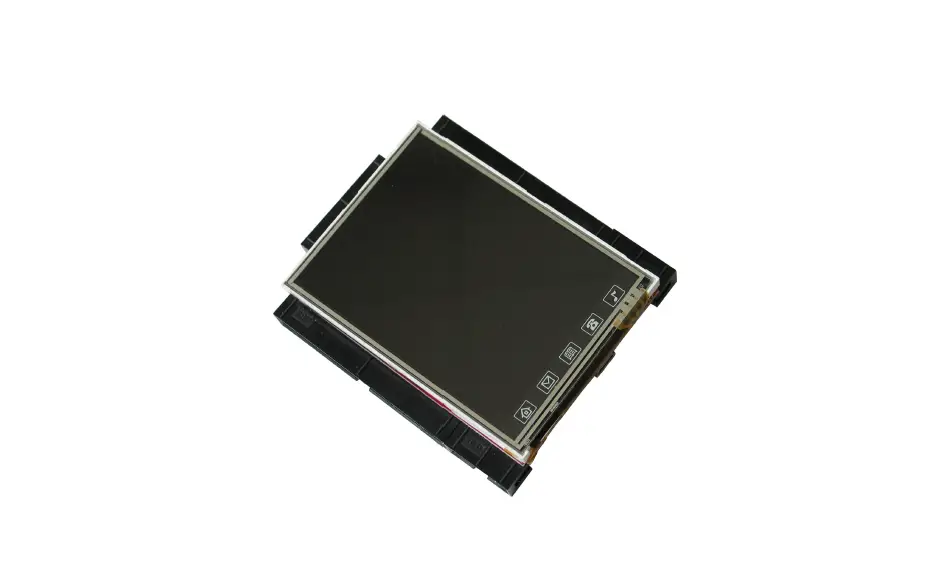

OUMEX STM32-LCD Development Board 
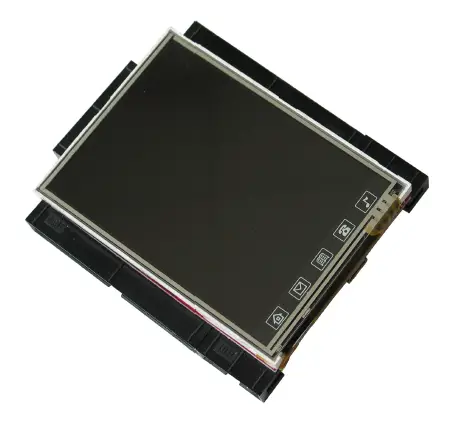
INTRODUCTION:
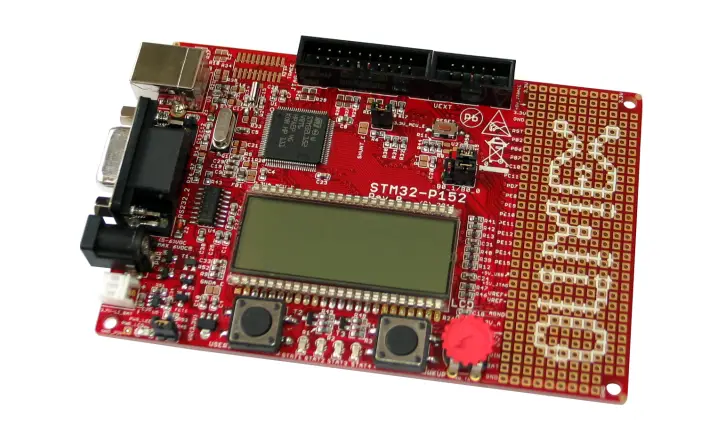
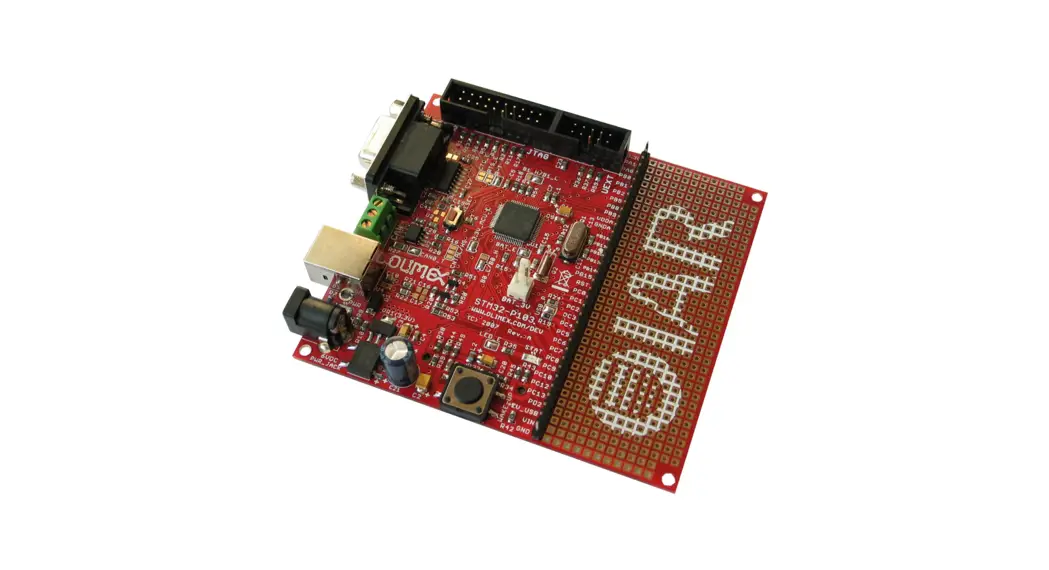
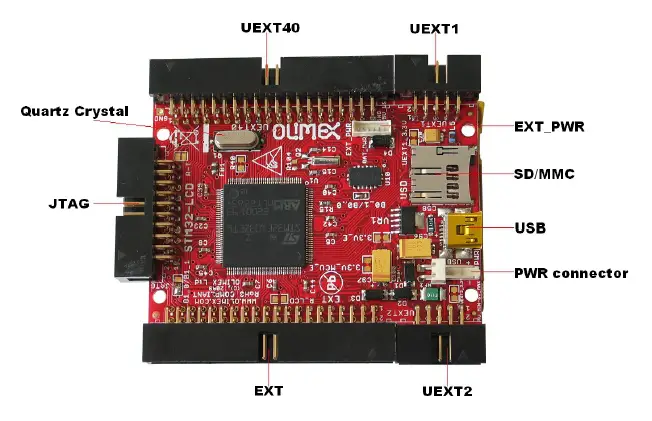
STM32-LCD is a development prototype board with an STM32F103ZE micro-controller from STMicroelectronics. This powerful microcontroller supports various serial interfaces such as USB, USART, SPI. In addition, you will find also an accelerometer, JTAG, TFT LCD, mini SD/MMC card connector on this board and most of the GPIOs are on extension headers where you can connect your additional circuits. All this allows you to build a diversity of powerful applications to be used in a wide range of situations.
BOARD FEATURES:
- Microcontroller – STM32F103ZE – high-performance ARM® Cortex™-M3 32-bit RISC core operating at a 72 MHz frequency, high-speed embedded memories (Flash memory – 512 Kbytes and SRAM – 64 Kbytes), and an extensive range of enhanced I/Os and peripherals connected to two APB buses.
- JTAG connector
- EXT connector
- UEXT40 connector
- UEXT1 connector
- UEXT2 connector
- EXT_PWR connector
- Mini SD/MMC
- Mini USB
- LCD TFT 320×240 pixels colored with touch screen
- Power source connector
- Accelerometer
- 8 MHz crystal oscillator
- Reset circuit
- Clock circuit
- PCB: FR-4, 1.5 mm (0,062″), solder mask, silkscreen component print
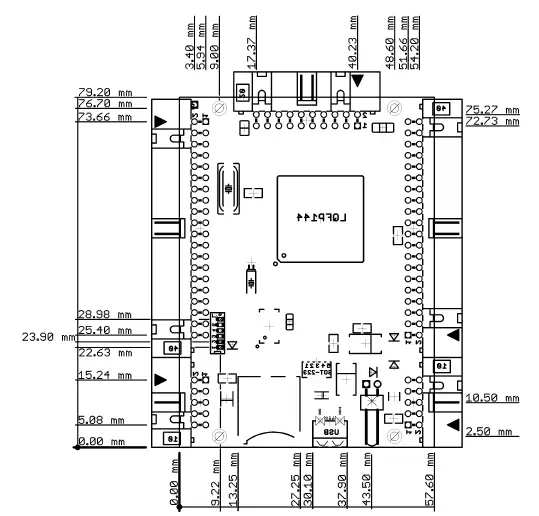
- Dimensions 79.2×57.6 mm (3.12×2.27)”
ELECTROSTATIC WARNING:
The STM32-LCD board is shipped in protective anti-static packaging. The board must not be subject to high electrostatic potentials. General practice for working with static sensitive devices should be applied when working with this board.
BOARD USE REQUIREMENTS:
Cables: The required cables depend on the programmer/debugger that you use. Additionally, you might need USB mini cable for USB connection
Hardware: You need a JTAG or SWD debugger or programmer to be able to program the board. The board has a standard 20-pin JTAG connector and typical layout (further detailed later in the document).
You may check on our products ARM-JTAG-COOCOX, ARM-USB-OCD-H, and ARM-USB-TINY-H.
PROCESSOR FEATURES:
STM32-LCD use a High-density performance line ARM-based 32-bit MCU with these features:
- Core: ARM 32-bit Cortex™-M3 CPU
- 72 MHz maximum frequency, 1.25 DMIPS/MHz (Dhrystone 2.1) performance at 0 wait state memory access
- Single-cycle multiplication and hardware division
- Memories
- 512 Kbytes of Flash memory
- 64 Kbytes of SRAM
- Flexible static memory controller with 4 Chip Select. Supports Compact Flash, SRAM, PSRAM, NOR and NAND memories
- LCD parallel interface, 8080/6800 modes
- Clock, reset and supply management
- 2.0 to 3.6 V application supply and I/Os
- POR, PDR, and programmable voltage detector (PVD)
- 4-to-16 MHz crystal oscillator
- Internal 8 MHz factory-trimmed RC
- Internal 40 kHz RC with calibration
- 32 kHz oscillator for RTC with calibration
- Low power
- Sleep, Stop and Standby modes
- VBAT supply for RTC and backup registers
- 3 × 12-bit, 1 µs A/D converters (up to 21 channels)
- Conversion range: 0 to 3.6 V
- Triple-sample and hold capability
- Temperature sensor
- 2 × 12-bit D/A converters
- DMA: 12-channel DMA controller
- Supported peripherals: timers, ADCs, DAC, SDIO, I2Ss, SPIs, I2Cs and USARTs
- Debug mode
- Serial wire debug (SWD) & JTAG interfaces
- Cortex-M3 Embedded Trace Macrocell™
- 112 fast I/O ports
- 112 I/Os, all mappable on 16 external interrupt vectors, all 5 V-tolerant except for analog inputs
- 11 timers
- four 16-bit timers, each with up to 4 IC/OC/PWM or pulse counter and quadrature (incremental) encoder input
- 2 × 16-bit motor control PWM timers with dead-time generation and emergency stop
- 2 × watchdog timers (Independent and Window)
- SysTick timer: a 24-bit down counter
- 2 × 16-bit basic timers to drive the DAC
- 13 communication interfaces
- 2 × I2C interfaces (SMBus/PMBus)
- 5 USARTs (ISO 7816 interface, LIN, IrDA capability, modem control)
- 3 SPIs (18 Mbit/s), 2 with I2S interface multiplexed
- CAN interface (2.0B Active)
- USB 2.0 full speed interface
- SDIO interface
- CRC calculation unit, 96-bit unique ID
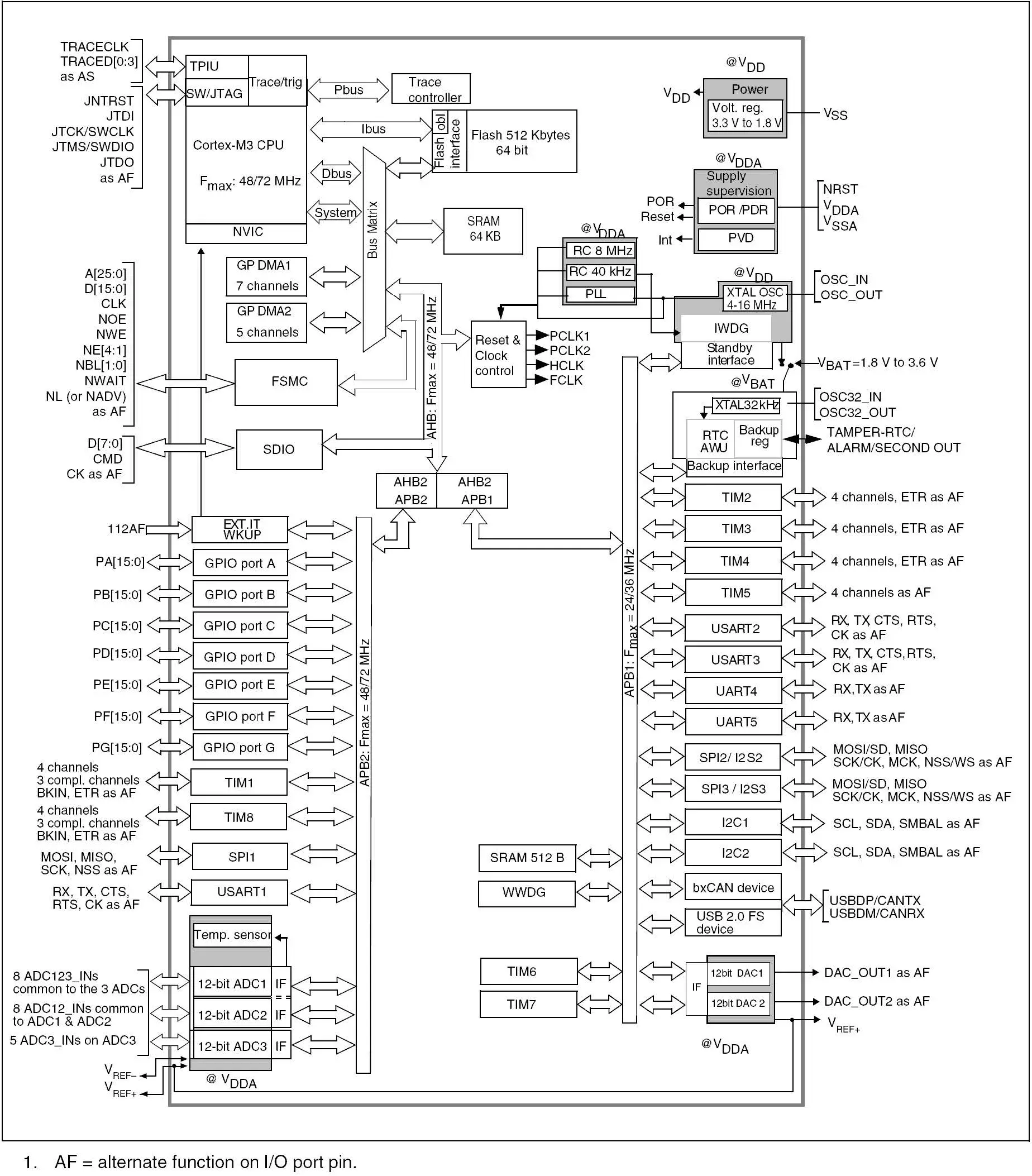
BLOCK DIAGRAM:
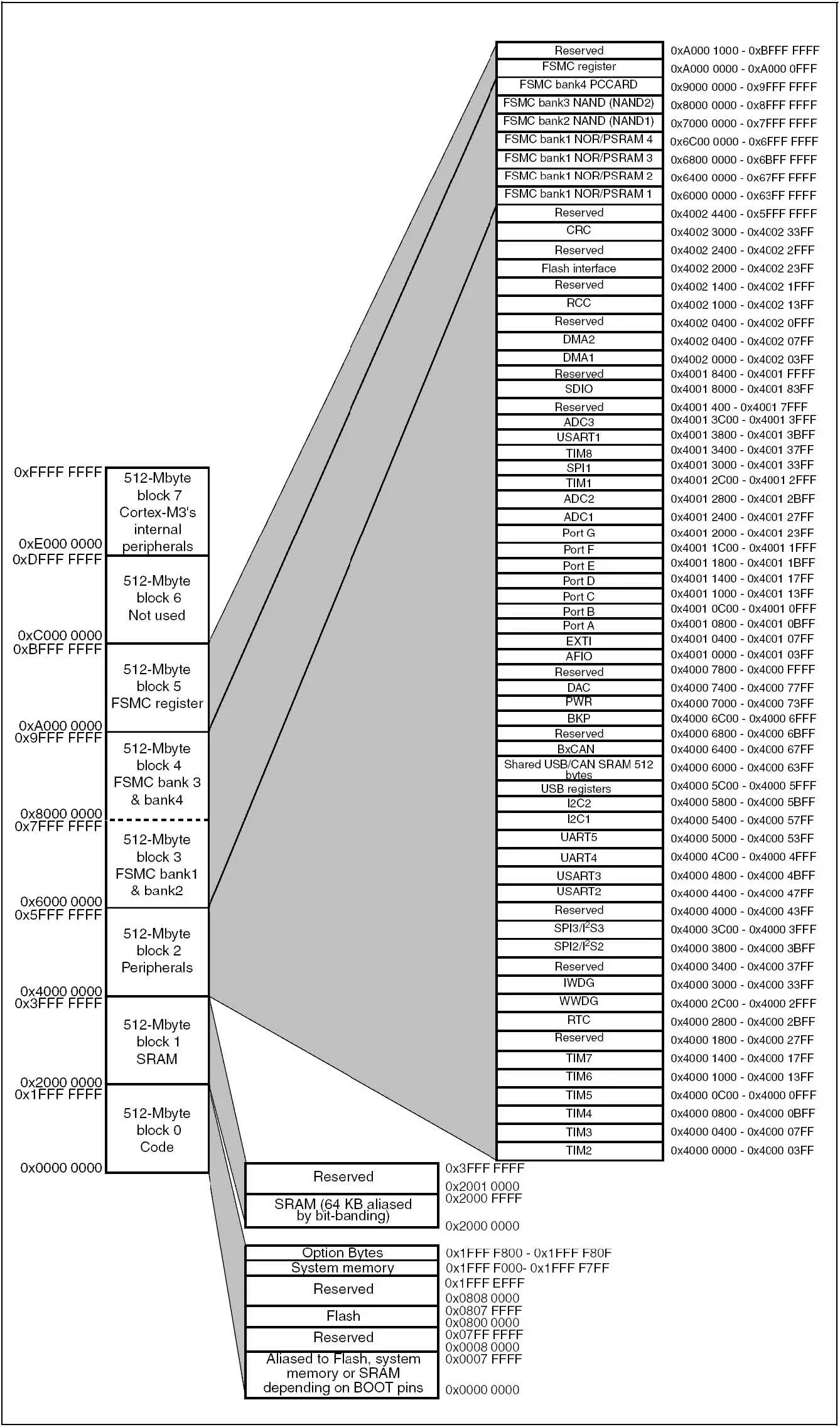
MEMORY MAP:
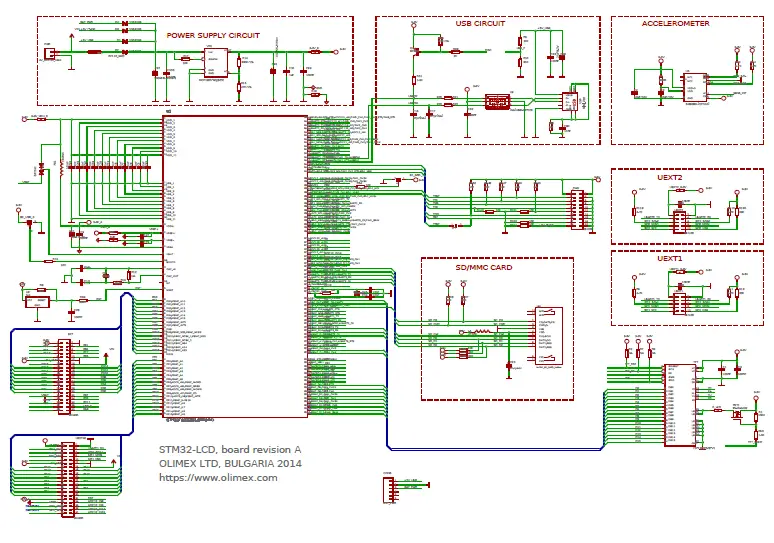
SCHEMATIC:
BOARD LAYOUT
POWER SUPPLY CIRCUIT:
STM32-LCD can take power from four sources:
- Power connector – 4V – 6V DC.
- BAT_PWR from EXT_PWR – 4V DC.
- +5V_J-LINK from JTAG connector
- +5V_USB from USB connector
The programmed board power consumption is about 200 mA.
RESET CIRCUIT:
STM32-LCD reset circuit includes R8 (10k), R69 (560 Ohm), C28 (100nF) pin 15 of JTAG connector, EXT pin 32, UEXT40 pin 32 and STM32F103ZE pin 25 (NRST).
CLOCK CIRCUIT:
Quartz crystal 8 MHz is connected to STM32F103ZE pin 23 (OSC_IN) and pin 24 (OSC_OUT).
Quartz crystal 32.768 kHz is connected to STM32F103ZE pin 8 (PC14/OSC32_IN) and pin 9 (PC15/OSC32_OUT).
JUMPER DESCRIPTION:
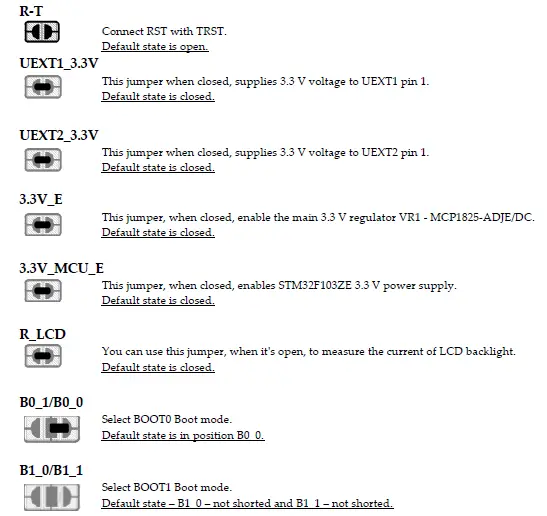
| Boot mode selection pins | Boot Mode | Aliasing | |
| BOOT1 | BOOT0 | ||
| x | 0 | Main Flash memory | Main Flash memory is selected as boot space |
| 0 | 1 | System memory | System memory is selected as boot space |
| 1 | 1 | Embedded SRAM | Embedded SRAM is selected as boot space |
INPUT/OUTPUT:
– LCD TFT 320×240 pixels colored with touch screen.
EXTERNAL CONNECTORS DESCRIPTION:
UEXT1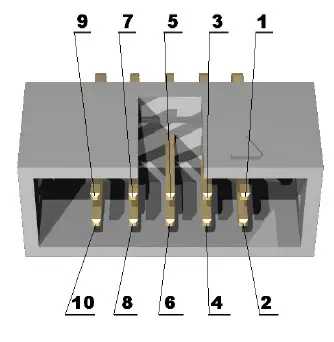
| Pin # | Signal Name |
| 1 | 3.3V |
| 2 | GND |
| 3 | USART1_TX |
| 4 | USART1_RX |
| 5 | I2C1_SCL1 |
| 6 | I2C1_SDA1 |
| 7 | SPI1_MISO |
| 8 | SPI1_MOSI |
| 9 | SPI1_SCK |
| 10 | SPI1_NSS |
UEXT2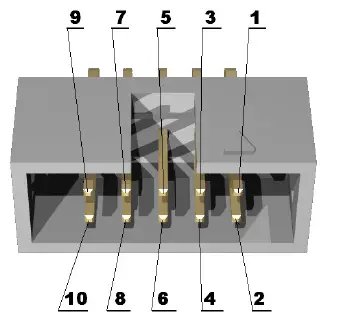
| Pin # | Signal Name |
| 1 | 3.3V |
| 2 | GND |
| 3 | USART2_TX |
| 4 | USART2_RX |
| 5 | I2C1_SCL2 |
| 6 | I2C1_SDA2 |
| 7 | SPI2_MISO |
| 8 | SPI2_MOSI |
| 9 | SPI2_SCK |
| 10 | SPI2_NSS |
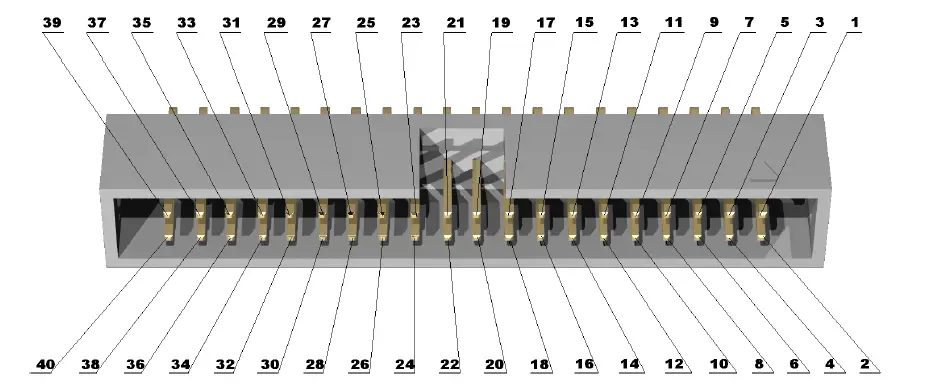
| Pin # | Signal Name | Pin # | Signal Name |
| 1 | 3.3 V | 2 | GND |
| 3 | PE0 | 4 | PE1 |
| 5 | PE5 | 6 | PE6 |
| 7 | PC6 | 8 | PC7 |
| 9 | PC13 | 10 | PB5 |
| 11 | 3.3 V | 12 | GND |
| 13 | +5V_USB | 14 | VIN |
| 15 | PG15 | 16 | PG14 |
| 17 | PG13 | 18 | PG12 |
| 19 | PG11 | 20 | PG10 |
| 21 | PG9 | 22 | PG8 |
| 23 | PG7 | 24 | PG6 |
| 25 | PG5 | 26 | PG4 |
| 27 | PG3 | 28 | PG2 |
| 29 | PG1 | 30 | PG0 |
| 31 | VBAT | 32 | RST |
| 33 | GND | 34 | PD6 |
| 35 | PD12 | 36 | PD11 |
| 37 | PB2 | 38 | USB_P |
| 39 | PA1 | 40 | PA8 |
UEXT40
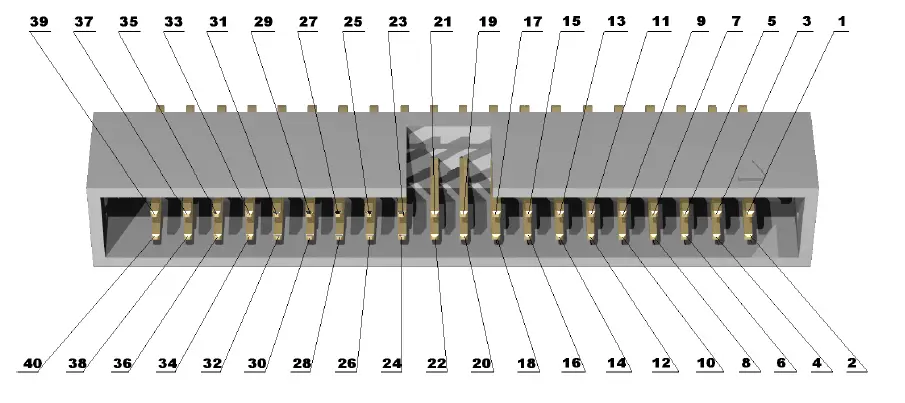
| Pin # | Signal Name | Pin # | Signal Name |
| 1 | 3.3 V | 2 | GND |
| 3 | USART1_TX | 4 | USART1_RX |
| 5 | I2C1_SCL1 | 6 | I2C1_SDA1 |
| 7 | SPI1_MISO | 8 | SPI1_MOSI |
| 9 | SPI1_SCK | 10 | SPI1_NSS |
| 11 | 3.3 V | 12 | GND |
| 13 | +5V_USB | 14 | VIN |
| 15 | PF15 | 16 | PF14 |
| 17 | PF13 | 18 | PF12 |
| 19 | PF11 | 20 | PF10 |
| 21 | PF9 | 22 | PF8 |
| 23 | PF7 | 24 | PF6 |
| 25 | PF5 | 26 | PF4 |
| 27 | PF3 | 28 | PF2 |
| 29 | PF1 | 30 | PF0 |
| 31 | 3.3V_A | 32 | RST |
| 33 | AGND | 34 | ADC12_IN8 |
| 35 | VREF+ | 36 | ADC12_IN9 |
| 37 | SPI1_NSS | 38 | ADC12_IN14 |
| 39 | SPI1_SCK | 40 | ADC12_IN15 |
JTAG:
The JTAG connector allows a debugger or programmer to talk via a JTAG (Joint Test Action Group) port directly to the core. Instructions may be inserted and executed by the core thus allowing STM32F103ZE memory to be programmed with code and executed step by step by the host software.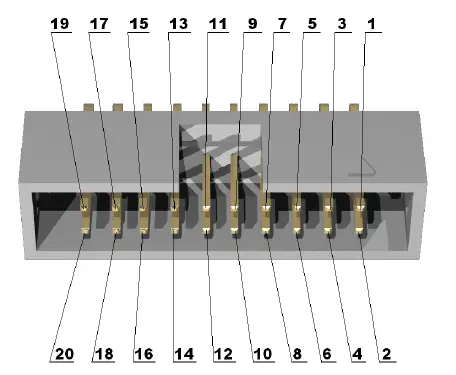
| Pin # | Signal Name | Pin # | Signal Name |
| 1 | 3.3V | 2 | 3.3V |
| 3 | TRST | 4 | GND |
| 5 | TDI | 6 | GND |
| 7 | TMS | 8 | GND |
| 9 | TCK | 10 | GND |
| 11 | pull-down | 12 | GND |
| 13 | TDO | 14 | GND |
| 15 | RST | 16 | GND |
| 17 | pull-down | 18 | GND |
| 19 | +5V J-LINK | 20 | GND |
USB
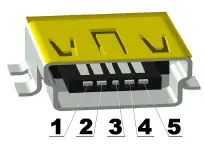
| Pin # | Signal Name |
| 1 | +5V_USB |
| 2 | USBDM |
| 3 | USBDP |
| 4 | NC |
| 5 | GND |
PWR
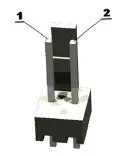
| Pin # | Signal Name |
| 1 | VIN (4 – 6) V DC |
| 2 | GND |
SD/MMC
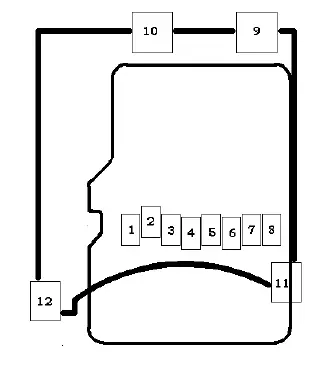
| Pin # | Signal Name |
| 1 | SD_D2 |
| 2 | SD_D3 |
| 3 | SD_CMD |
| 4 | VDD (3.3V) |
| 5 | SD_CLK |
| 6 | GND |
| 7 | SD_D0 |
| 8 | SD_D1 |
| 9 | Not connected |
| 10 | Not connected |
| 11 | Not connected |
| 12 | Not connected |
MECHANICAL DIMENSIONS
AVAILABLE DEMO SOFTWARE
- EW-ARM general demo code – the code of the initial STM32-LCD demo
- EW-ARM Demo code for MOD-GSM and MOD-GSM-EDGE – (high speed) GSM modules connected to STM32-LCD
ORDER CODE: STM32-LCD – assembled and tested board
How to order?
You can order directly from us or from any of our distributors.
Please check our website https://www.olimex.com for more info.
Revision history:
Manual revision: Rev. Initial, May 2009 Rev. A, June 2011 – changed schematically Rev. B, October 2011 – added more detailed mechanical dimensions
Rev. C, May 2014 – updated board schematic, added board revision history, updated disclaimer, updated links Board revision: Rev. Initial, May 2009 Rev. A, May 2014
- The analog GND got properly connected to the digital GND through a 0 Ohm resistor
- Fixed the JTAG label (was “JATG” before)
- The LCD GND got properly connected
- The cathodes of the LCD’s backlight got connected to GND
- C1 i C3 is moved further away from the LCD connector
- The accelerometer is changed from LISxx to SMB380
- Added RC filter to the power supply of SMB380
Disclaimer:
2014 Olimex Ltd. Olimex®, logo, and combinations thereof, are registered trademarks of Olimex Ltd. Other product names may be trademarks of others and the rights belong to their respective owners.
The information in this document is provided in connection with Olimex products. No license, express or implied or otherwise, to any intellectual property right is granted by this document or in connection with the sale of Olimex products.
It is possible that the pictures in this manual differ from the latest revision of the board.
The product described in this document is subject to continuous development and improvements. All particulars of the product and its use contained in this document are given by OLIMEX in good faith. However, all warranties implied or expressed including but not limited to implied warranties of merchantability or fitness for purpose are excluded. This document is intended only to assist the reader in the use of the product. OLIMEX Ltd. shall not be liable for any loss or damage arising from the use of any information in this document or any error or omission in such information or any incorrect use of the product.
This evaluation board/kit is intended for use for engineering development, demonstration, or evaluation purposes only and is not considered by OLIMEX to be a finished end-product fit for general consumer use. Persons handling the product must have electronics training and observe good engineering practice standards. As such, the goods being provided are not intended to be complete in terms of required design-, marketing-, and/or
manufacturing-related protective considerations, including product safety and environmental measures typically found in end products that incorporate such semiconductor components or circuit boards.
Olimex currently deals with a variety of customers for products, and therefore our arrangement with the user is not exclusive. Olimex assumes no liability for applications assistance, customer product design, software performance, or infringement of patents or services described herein.
THERE IS NO WARRANTY FOR THE DESIGN MATERIALS AND THE COMPONENTS USED TO CREATE STM32-LCD. THEY ARE CONSIDERED SUITABLE ONLY FOR STM32-LCD.
References
 OLIMEX LTD - OLinuXino Arduino Maple Pinguino ARM Open Source Hardware Development Boards
-
OLIMEX LTD - OLinuXino Arduino Maple Pinguino ARM Open Source Hardware Development Boards
-
ARM-JTAG-COOCOX - Open Source Hardware Board
-
ARM-USB-OCD-H
-
ARM-USB-TINY-H
-
olimex.com/Products/ARM/ST/STM32-LCD/resources/STM32-LCD-GSM.rar
 OLIMEX LTD - OLinuXino Arduino Maple Pinguino ARM Open Source Hardware Development Boards