 GS-3 Multiple-inlet Cyclone
Cat. Nos. 225-100 and 225-103
Operating Instructions
863 Valley View Road, Eighty Four, PA
724-941-9701
skcinc.com
Introduction
Description
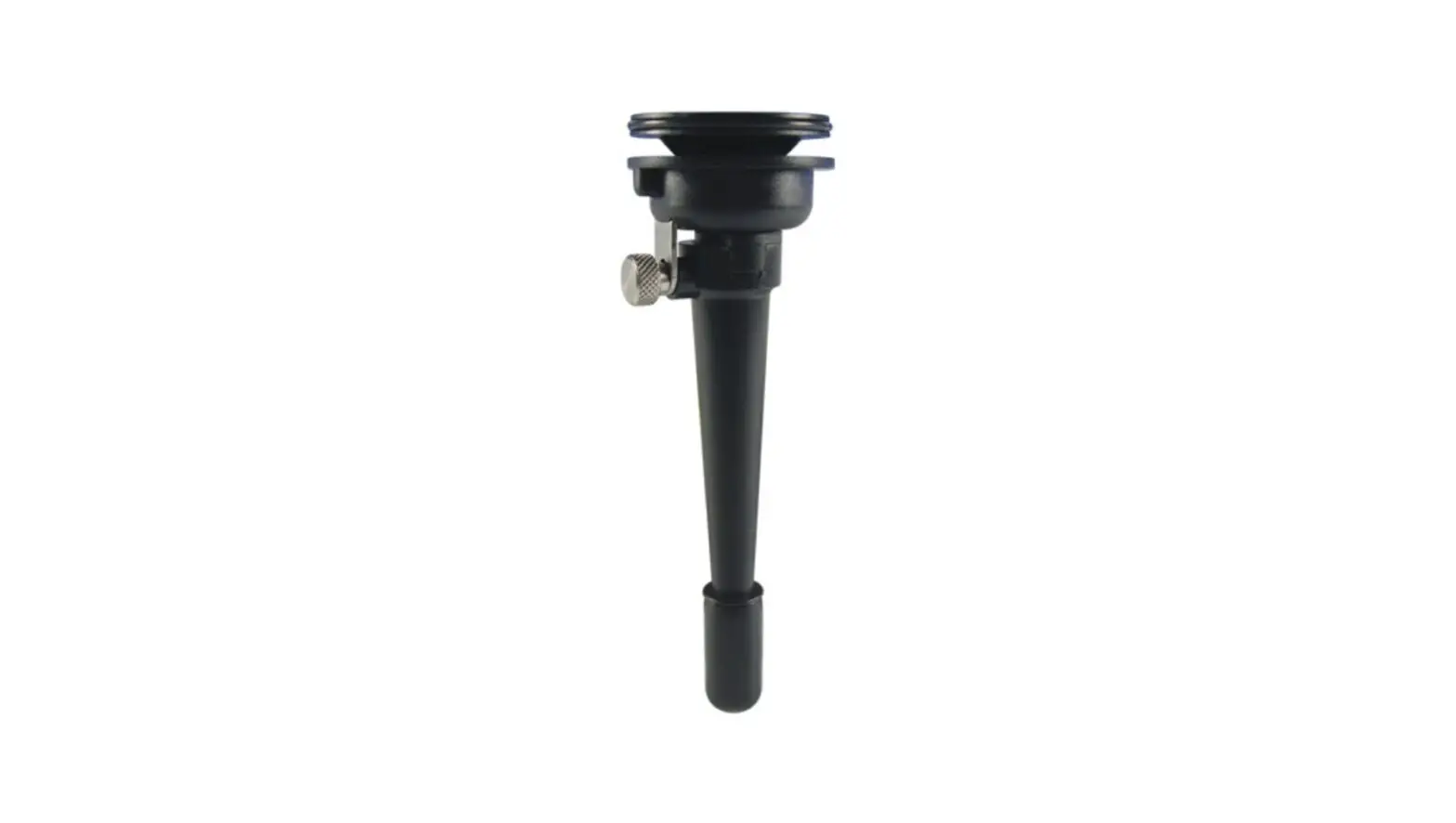
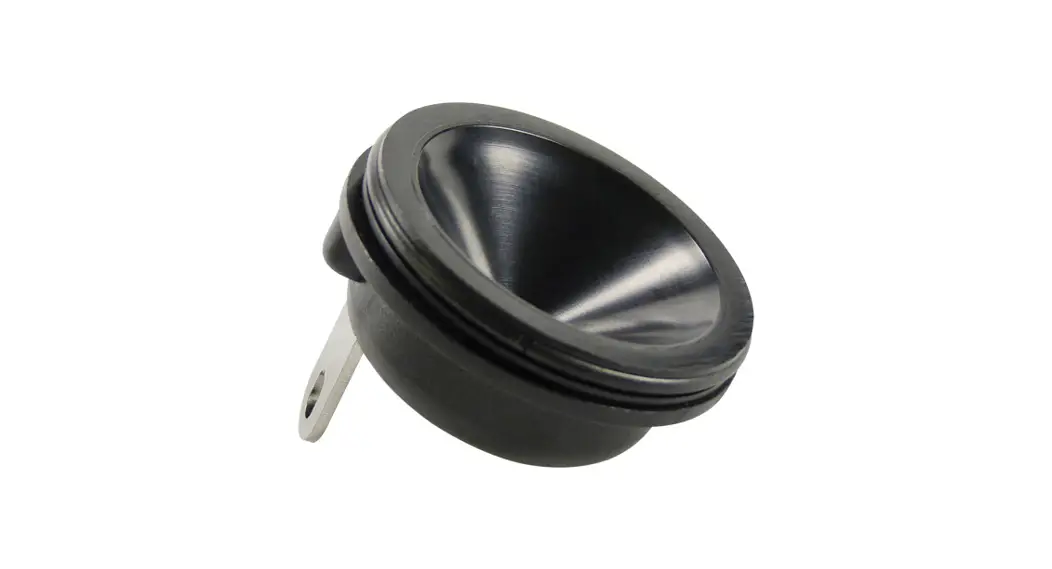
The GS-3 Cyclone is a 10-mm lightweight conductive plastic sampler with multiple inlets that uses a standard three-piece 25 or 37-mm cassett e and fi lter for collecting respirable dust particles.
The GS-3 Cyclone conforms to the ISO 7708/CEN criteria of a 4-μm 50% cut-point at 2.75 L/min* with minimum bias meeting the performance criteria in OSHA’s final silica rule. Other flow rates may be used to achieve cut-points for alternative applications. The GS-3 Cyclone is supplied with cassette adapter, bowl adapter, and grit pot.
* Calibrated at UK Health and Safety Laboratories. Visit www.skcinc.com to view the collection efficiency curve.
Required Equipment
 Sample pump capable of specie ed fl ow rate 1/4-inch ID (3/8-inch OD) Tigon® tubing for calibration train Electronic calibrator Calibration Jar (Cat. No. 225-111) Cassette e Holder (Cat. No. 225-1) Filter Cassette es sampling media (225 Series)
Getting Started
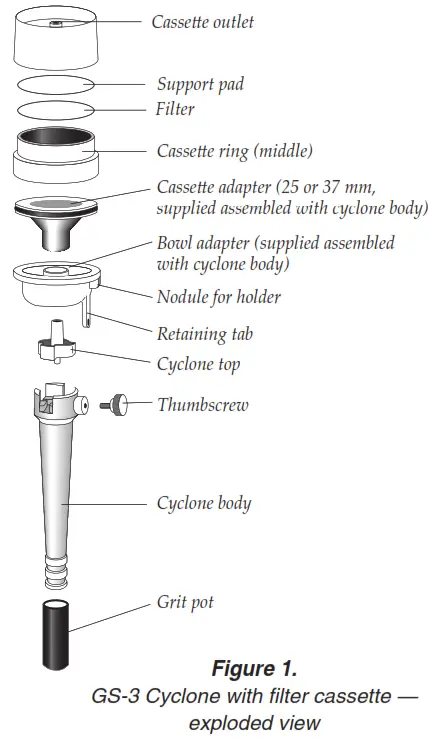
Assembling Cyclone with Cassette (Figure 1)
The GS-3 Cyclone is supplied fully assembled with bowl adapter and 37 or 25-mm cassette adapter dependent upon model (Cat. Nos. 225-100 and 225-103, respectively).
Replacement cassette adapters are available, allowing the user to adapt whichever model they are using to another cassette size.
- Disassemble a three-piece cassette and set aside inlet section (usually marked “inlet”). Keep inlet section for closing the cassette after sampling.
- Select a filter and support pad as specified in the sampling method. Place support pad into cassette outlet and place filter on top of support pad. Insert cassette ring (middle) section into cassette outlet. Ensure a firm seal.
- Hold cyclone upside down (cassette adapter facing downward). Insert cassette adapter into cassette middle ring section. Press until a firm seal is established.
- Ensure thumbscrew on cyclone is secure and that the grit pot remains on the cyclone body during calibration and sampling.
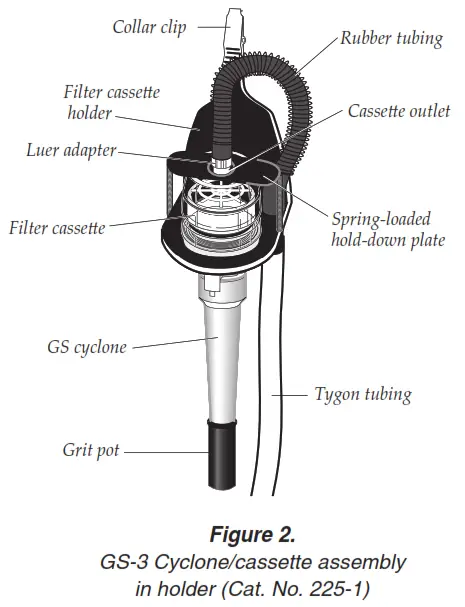
Inserting Cyclone/Cassette Assembly in Cassette Holder (Figure 2)
- Insert the cyclone body through the large opening of the cassette holder.
- Ensure the cyclone/cassette assembly is seated firmly in the holder by inserting the small round nodule on the rim of the bowl adapter into the notch in the cassette holder.
- Remove the plug from the cassette outlet.
- Secure the cyclone/cassette assembly in the holder by stretching the spring-loaded hold-down plate over the cassette outlet.
- Insert the holder’s Leer adapter (located on the end of the spring-supported rubber tubing) into the cassette outlet.
Operation
Calibration
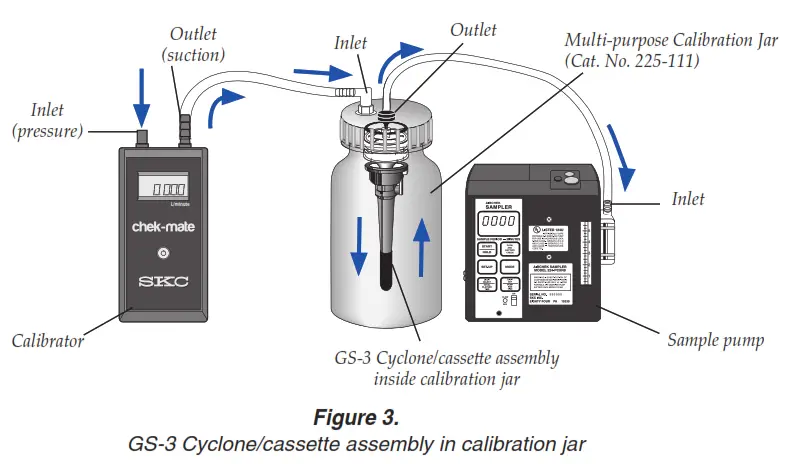
- Prepare a cyclone/cassette assembly (Figure 1). Ensure grit pot remains on cyclone body during calibration.
 SKC recommends using the smallest calibration jar possible. To achieve this, do NOT use Cassette Holder Cat. No. 225-1 during calibration.
 - Place cyclone/cassette assembly into an airtight calibration jar that contains an inlet and outlet (Cat. No. 225-111, Figure 3).
- Using flexible tubing, connect outlet of calibrator to inlet of calibration jar.
- Run tubing from outlet of cyclone/cassette assembly through the outlet of the calibration jar and to the inlet of a sample pump. If using the Calibration Jar (Cat. No. 225-111), connect the Leer adapter inside the jar lid to the cassette outlet. Connect jar outlet tubing to the sample pump inlet.

- Turn on pump and calibrate to desired fl ow rate following directions in the pump and calibrator operating instructions.
Flow rate:
• 2.75 L/min for a 4-μm cut-point*
* Calibrated at UK Health and Safety Laboratories. See the collection efficiency curve at www.skcinc.com/products/gs-3-conductive-plastic-respirable-dust-cyclone-37-mm. - After calibration, disassemble calibration jar, remove cyclone/cassette assembly, and replace cassette used for calibration with a fresh (unused) cassette to be used for sampling.
Sampling
- Ensure the flow rate has been set properly (see Calibration). Leave grit pot in place during calibration and sampling.
- Ensure a fresh cassette has been installed on the cyclone and the cyclone/cassette assembly has been inserted into the cassette holder (see Inserting Cyclone/Cassette Assembly in Cassette Holder).
- Connect the Tigon tubing attached to the cassette holder to the inlet of a constant fl ow personal sampling pump.
- Clip the holder with the cyclone/cassette assembly onto a worker’s collar or pocket as close to the breathing zone as possible.
- Clip the pump onto the worker’s belt or place it in a protective pouch. Start the pump and record pertinent details.
- At the end of the sampling period, stop the pump and record pertinent details.
- Remove the cyclone/cassette assembly from the cassette holder and immediately cap cassette outlet.
- Separate cassette from cyclone. Immediately replace the inlet section of the cassette, and cap inlet with provided plug.
- Package cassette and send it with all data to a laboratory for analysis. Discard particles that were collected in the cyclone’s grit pot.
Maintenance
Cleaning
After sampling, clean all parts of the cyclone, including the interior of the grit pot, with mild soapy water. The cyclone can be wiped with a clean dust-free tissue, air dried, blown dry, or wiped with isopropyl alcohol. Do not use strong solvents to clean the cyclone.p
References
Gautam, M. and Sreenath, A., “Performance of a Respirable Multi-Inlet Cyclone Sampler,” J. Aerosol
Sci., Vol. 28. No. 7, pp. 1265-1281, 1997, http://doi.org/fhsgrz
Trakumas, S., et al., Performance Assessment of Personal Respirable Cyclone Samplers,
AIHce Presentation 191, 2003, https://bit.ly/3GqxJ1C (PowerPoint presentation)
OSHA Final Rule on Respirable Crystalline Silica, www.osha.gov/silica/
Accessories/Replacement Parts
| Description | Cat. No. |
| Replacement Cassette Adapter 25 mm 37 mm | 225-101 225-102 |
| Replacement Bowl Adapter | 225-108 |
| Replacement Grit Pots, pk/25 | P225012 |
| Filter Cassette/Cyclone Holder for standard 25 or 37-mm 3-piece cassettes with or without a cyclone | 225-1 |
| Standard-size Multi-purpose Calibration Jar | 225-111 |
SKC Limited Warranty and Return Policy
SKC products are subject to the SKC Limited Warranty and Return Policy, which provides SKC’s sole liability and the buyer’s exclusive remedy. To view the complete SKC Limited Warranty and Return Policy, go to skcinc.com/warranty.
skcinc.com
Form 37097 Rev 221117
References
 bit.ly/3GqxJ1C
 SKC, Inc. | Industrial Hygiene and Occupational Safety Products and Technology
-
Warranty Information | Learn More About Industrial Hygiene & Occupational Safety Products at SKC, Inc.
-
Silica, Crystalline - Overview | Occupational Safety and Health Administration
-
SKC, Inc. | Industrial Hygiene and Occupational Safety Products and Technology
-
GS-3 Conductive Plastic Respirable Dust Cyclone, 37 mm | Order High-Quality GS-3 Conductive Plastic Respirable Dust Cyclone, 37 mm Products at SKC, Inc.
-
bit.ly/3GqxJ1C
-
Warranty Information | Learn More About Industrial Hygiene & Occupational Safety Products at SKC, Inc.
-
GS-3 Conductive Plastic Respirable Dust Cyclone, 37 mm | Order High-Quality GS-3 Conductive Plastic Respirable Dust Cyclone, 37 mm Products at SKC, Inc.
 bit.ly/3GqxJ1C
 SKC, Inc. | Industrial Hygiene and Occupational Safety Products and Technology
 Silica, Crystalline - Overview | Occupational Safety and Health Administration
 SKC, Inc. | Industrial Hygiene and Occupational Safety Products and Technology