PAS Airpack 1 Airline Breathing Air Supply System
Product Information
The PAS AirPack 1 is a pneumatic system that is available in
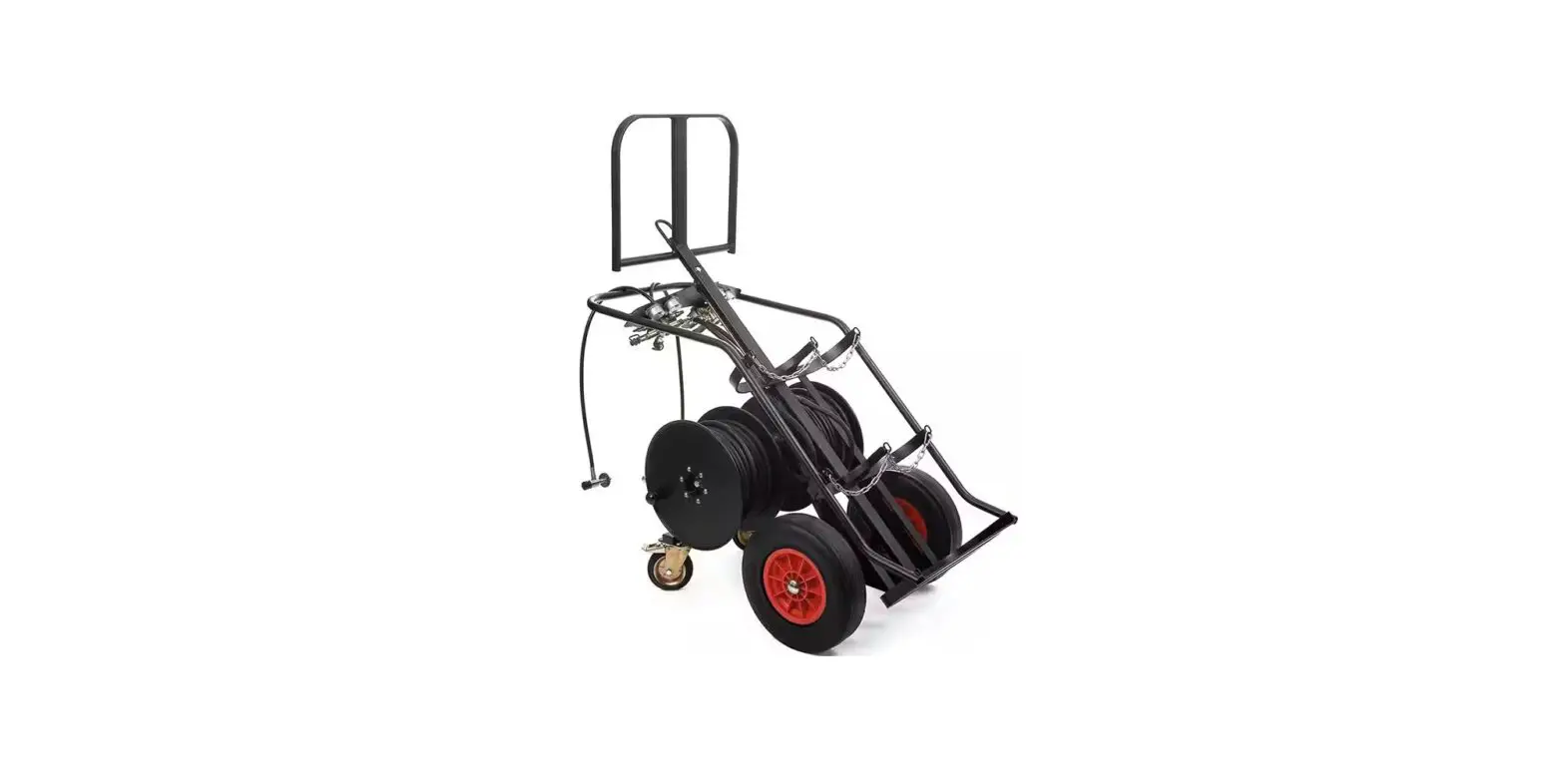
three versions: a two-wheeled trolley version with an integral hose
reel, a two-wheeled trolley version without a hose reel, and a
carrying-frame version without a hose reel. The system features
high-pressure input connectors, a medium-pressure input connector
with an internal non-return valve, and a medium-pressure output
connector on the hose reel. It allows the user to remove depleted
cylinders and replace them with fully charged cylinders to provide
an uninterrupted air supply to the attached breathing apparatus
wearers. It is intended to be used with breathing air cylinders and
an external breathing air supply to provide a medium-pressure
output. The product is approved according to European standards,
guidelines, and directives for use in potentially explosive
atmospheres.
Product Usage Instructions
- For your safety: Before using this product,
carefully read the Instructions for Use and strictly follow them.
Ensure that you fully understand the instructions. - Definitions of alert icons: Alert icons are
used in this document to provide and highlight text that requires a
greater awareness by the user. A definition of the meaning of each
icon is as follows:- WARNING: Indicates a potentially hazardous
situation which, if not avoided, could result in death or serious
injury. - CAUTION: Indicates a potentially hazardous
situation which, if not avoided, could result in physical injury or
damage to the product or environment. It may also be used to alert
against unsafe practices.
- WARNING: Indicates a potentially hazardous
- Intended use: The PAS AirPack 1 is intended to
be used with only the air cylinders connected (self-contained use),
or with the air cylinders and an external medium-pressure supply
connected (external-supply use). When used with approved airline
equipment, it supplies breathing air to one or two breathing
apparatus wearers. - Use in potentially explosive atmospheres: The
PAS AirPack Series is type tested as suitable for use in
potentially explosive atmospheres. The breathing apparatus and the
compressed air cylinders which are used in combination with the
Airline Systems each have to meet the applicable requirements of
the equipment categories and explosion groups relevant to the
respective Airline System. - Special conditions for safe use: Ensure that
the product is used with approved airline equipment and that the
breathing apparatus and compressed air cylinders used in
combination with the Airline Systems meet the applicable
requirements of the equipment categories and explosion groups
relevant to the respective Airline System.
PAS® AirPack 1 Airline breathing air supply system
i Instructions for Use
1 For your safety
1.1 General safety statements
Before using this product, carefully read the Instructions for Use. Strictly follow the Instructions for Use. The user must fully understand
and strictly observe the instructions. Use the product only for the purposes specified in the Intended Use section of this document. Do not dispose of the Instructions for Use. Ensure that they are retained and appropriately used by the product user. Only fully trained and competent users are permitted to use this product. Comply with all local and national rules and regulations associated with this product. Only trained and competent personnel are permitted to inspect, repair and service the product. Dräger recommends a Dräger service contract for all maintenance activities and that all repairs are carried out by Dräger. Properly trained service personnel must inspect and service this product as detailed in the Maintenance section of this document. Use only genuine Dräger spare parts and accessories, or the proper functioning of the product may be impaired. Do not use a faulty or incomplete product, and do not modify the product. Notify Dräger in the event of any component fault or failure. The air supply shall meet the requirements for breathing air according to EN 12021.
1.2 Definitions of alert icons
Alert icons are used in this document to provide and highlight text that requires a greater awareness by the user. A definition of the meaning of each icon is as follows:
WARNING
! Indicates a potentially hazardous situation which, if not avoided,
could result in death or serious injury.
CAUTION
! Indicates a potentially hazardous situation which, if not avoided,
could result in physical injury or damage to the product or environment. It may also be used to alert against unsafe practices.
2 Description
2.1 Product overview
The Dräger PAS AirPack 1 is a compact air supply system that uses breathing air inputs to provide a medium-pressure output (independent air supply) for one or two breathing apparatus wearers.
There are three PAS AirPack 1 versions available: A two-wheeled trolley version with an integral hose reel (Fig 1). A two-wheeled trolley version without a hose reel. A carrying-frame version without a hose reel (Fig 2).
Breathing air inputs are from high and/or medium-pressure sources. The high-pressure input is from one or two breathing air cylinders the equipment has storage capacity for two 4.7 to 12 litre cylinders. The medium-pressure input is a regulated external supply from a factory airline or compressor.
Referring to Fig 1, the features and components of the PAS AirPack 1 pneumatic system are: The high-pressure input connectors (7) are standard cylinder-type
threaded connectors. The medium-pressure input connector (9) is a male quick connector
which has an internal non-return valve. There is a medium-pressure output connector on the hose reel (11) if
fitted, and on the body of the pneumatic assembly (4). Each is a female quick connector, which has a valve that self-seals when disconnected. A high-pressure gauge (1) indicates cylinder pressure. A medium-pressure gauge (2) indicates output pressure. A high-pressure whistle (10) sounds to indicate low cylinder pressure. A medium-pressure whistle (3) sounds to indicate low output pressure. If the PAS AirPack 1 is using an external medium-pressure supply, the whistle indicates that the external supply pressure is low. An internal pressure reducer converts the high-pressure input to a medium-pressure output. A relief valve (5) in the medium-pressure system and bleed valves (8) on the high-pressure connectors release air from the system when operated. If fitted, the hose reel has 50 m of hose on a rotating drum. The drum has an inertia brake that prevents overrun of the drum as the hose is pulled out.
The PAS AirPack 1 pneumatic system allows the user to remove depleted cylinders and replace them with fully charged cylinders when required. Repeatedly replacing alternate depleted cylinders can provide an uninterrupted air supply to the attached breathing apparatus wearers. Internal non-return valves (Fig 1, Item 6) ensure that air from the other cylinder can not escape when a depleted cylinder is removed.
2.2 Intended use
The PAS AirPack 1 is used with breathing air cylinders and an external breathing air supply (factory airline or compressor) to provide a mediumpressure output. When used with approved airline equipment, it supplies breathing air to one or two breathing apparatus wearers.
It is intended to be used with only the air cylinders connected (self-contained use), or with the air cylinders and an external medium-pressure supply connected (external-supply use). When it is used with an external supply the cylinders provide a backup air supply.
The breathing apparatus, cylinders and other accessories used with this product must be assembled in an approved configuration. See Section 10 for the compatible airline equipment and configurations. Contact Dräger for further information.
2.3 Approvals
The European standards, guidelines, and directives according to which this product is approved are specified in the declaration of conformity (see declaration of conformity or www.draeger.com/product-certificates).
1
1
2
11
10
3
9
4
3754
8
7
65
2
3753
3
4
3228
3248
5
6
3
2
1
3226
3227
2.4 Use in potentially explosive atmospheres
The PAS AirPack Series is type tested as suitable for use in potentially explosive atmospheres. The combinations are suitable for use in
hazardous areas of Zone 1 and 2 for explosion group IIA and IIB and
for Zone 21 and 22.
2.4.1 Special conditions for safe use
The Airline Systems shall not be used in the vicinity of processes where high charges are generated if explosive atmospheres are present (for example, where rapid filling processes are carried out big bag filling or many actions of fast limit surface separation are done). In such cases, hazardously high charges of the Airline Systems may occur due to electrostatic induction.
The breathing apparatus and the compressed air cylinders which are used in combination with the Airline Systems each have to meet the applicable requirements of the equipment categories and explosion groups relevant to the respective Airline System.
The Airline Systems have to be moved manually inside explosive atmospheres by the user (pushing or pulling). It is mandatory to use floors in Zone 1 and Zone 21 that are able to discharge electricity where dusts of minimum ignition energies < 10 mJ are present.
If air supply hoses are used with a total length > 50 m, then the couplings which are connected to the hoses in a conductive manner have to be provided with an additional earth contact (after a hose length of 50 m) and integrated into the operating eqipotential bonding.
Do not charge the cylinder in a potentially explosive atmosphere.
2.5 Explanation of marking and symbols
Refer to the relevant authority for explanation of approval body symbols and markings. Examples of other marking on the product:
BRBA-1359
08/09
3353261
HP
MP
Dräger serial number Month and year of manufacture Dräger part number High pressure Medium pressure Medium-pressure input Medium-pressure output Relief valve
Where appropriate, the marking “F” on the apparatus and CAST (compressed-air supply tube) indicates that both can be used where flammability may be a risk. Marking on the compressed-air supply tube indicates that the tube is heat resistant (H) and/or antistatic (S).
3 Use
WARNING
! The cylinder and airline air quality shall meet the requirements for
breathing air according to EN 12021. Do not use oxygen or oxygenenriched air. The moisture content of breathing air should be controlled within the EN 12021 limits to avoid freezing the apparatus.
Carry out a risk assessment of the workplace to ensure that it is not possible to connect to any airline supply other than breathable air (e.g. Nitrox).
Before using airline equipment, ensure that the air supply meets the air quality requirements, and complies with the airline pressure, flow and hose requirements (see Section 8 and Section 10), and has been issued with a permit for use if necessary.
Position the PAS AirPack 1 in a safe and uncontaminated area where it cannot be damaged.
Dräger recommend that the user carries out a risk assessment to establish local procedures to be followed in the event of failure of the air supply.
Do not attempt to lift or carry the PAS AirPack 1 carrying frame version on your own. Observe the relevant manual handling and safety procedures when moving the carrying frame. The weight without cylinders is approximately 11.5 kg.
CAUTION
! Impact damage to the pneumatic assembly may prevent valve
connection or cause an air leak. Handle the equipment with care.
When remote wearers are connected to the PAS AirPack 1, a controller must be appointed to monitor the gauges and whistles of the product throughout the operation. The controller must maintain the air supply to the wearers and must ensure that any precautionary or emergency signals are conveyed to the remote wearers in line with local procedures and these Instructions for Use.
3.1 Preparation for use
1. Carry out a visual inspection (see Section 3.4.1). 2. Fit the air cylinder or cylinders (see Section 3.4.2). 3. Carry out a full functional test (see Section 3.4.5).
WARNING
! Incorrect airline equipment configurations may result in insufficient
air flow to breathing apparatus wearers or increase the possibility of air supply failure. See Section 10 for the compatible airline equipment and configurations.
Prepare the breathing apparatus for use (see the Instructions for Use supplied with the breathing apparatus). Observe the safety information and carry out all preparation and functional testing tasks before use.
Do not use the PAS AirPack 1 to supply air to more than two breathing apparatus wearers at any time. If a controller is appointed, and is required to wear breathing apparatus and to connect to the equipment then only one other user is permitted.
4. Connect the airline equipment (extension hoses, Y-piece, etc.) as follows: On hose reel versions, pull out the hose as required and connect the airline equipment to the output connector on the hose reel (Fig 1, Item 11). Use the output connector on the pneumatic assembly (Fig 1, Item 4) for connecting the controller if required. On versions without a hose reel, connect the airline equipment to the output connector on the pneumatic assembly (Fig 3).
5. Depending on the required use, do one of the following: Self-contained use Fully open one cylinder valve. External-supply use Connect the external supply (see Section 3.4.4). Ensure that both cylinder valves are fully closed.
6. Put on the breathing apparatus and connect to the airline equipment (Fig 4 shows a typical breathing apparatus connector).
3.2 During use
WARNING
! An appointed controller or the breathing apparatus wearers must
monitor the PAS AirPack 1 gauges and whistles during use. Procedures to warn and evacuate remote users must be in place.
The effective working duration of the equipment is dependent on the initial air supply available and the breathing rate of the wearers. Do not commence any operation using a cylinder that is less than 80 per cent full.
At very high work rates the pressure in the face mask of a breathing apparatus wearer may become negative at peak inhalation flow.
Breathe normally and proceed to the work area taking care with any airline equipment.
On receipt of an evacuation signal, withdraw immediately to a safe area (see local instructions for full evacuation procedures).
When the task is complete, withdraw to a safe area before removing the breathing apparatus.
The high-pressure and medium-pressure whistles indicate that there is low pressure in the associated system. If a warning whistle sounds, carry out the necessary actions depending on the configuration of the PAS AirPack 1 (see Section 3.2.1 to 3.2.3).
3.2.1 Medium-pressure whistle sounds during external-supply use
Fully open one cylinder valve, and disconnect the external supply from the PAS AirPack 1. Continue the task as a self-contained use task.
3.2.2 Medium-pressure whistle sounds during self-contained use
Breathing apparatus wearers must proceed in line with breathing apparatus Instructions for Use and local procedures.
3.2.3 High-pressure whistle sounds during self-contained use
If there is a second/offline fully-charged cylinder connected to the PAS AirPack 1, proceed as follows: a. Fully open the valve of the second/offline cylinder.
PAS® AirPack 1 Airline breathing air supply system
i Instructions for Use
b. Close the valve of the empty cylinder and then open its bleed valve.
c. If a replacement cylinder is available, immediately remove the empty cylinder (see Section 3.4.3) and fit a replacement (fully charged) cylinder (see Section 3.4.2).
If the second/offline cylinder is empty, or there is no second/offline cylinder connected: breathing apparatus wearers must proceed in line with breathing apparatus Instructions for Use and local procedures.
3.3 After use
WARNING
! Do not remove the breathing apparatus until in a safe breathing
environment.
1. Once in a safe area, remove all breathing equipment. 2. Disconnect the external supply from the PAS AirPack 1 and fully close
all cylinder valves. 3. Pull the handle of the relief valve (Fig 1, Item 5) to vent all air from the
system. 4. Disconnect any airline equipment from the PAS AirPack 1 and fit all
protection caps. 5. Carefully rewind the hose reel if necessary. Clean the hose (see
Section 5.3) during rewinding. 6. Disconnect and remove the air cylinders if necessary (see
Section 3.4.3). 7. Carry out the after use maintenance tasks in the maintenance table
(see Section 5.1).
3.4 Common user tasks
3.4.1 Visual inspection
Check that the PAS AirPack 1 is clean and undamaged, paying particular attention to pneumatic components, hoses and connectors. Typical signs of damage that may affect the operation of the PAS AirPack 1 include impact damage, abrasion, cutting, corrosion and discolouration. Report damage to service personnel or Dräger and do not use the PAS AirPack 1 until faults are rectified.
3.4.2 Fitting air cylinders
Only fit fully charged cylinders that are approved for use, fully serviceable and in date. Use 4.7 to 12 litre, 200 bar or 300 bar, steel or composite, breathing air cylinders with compatible connectors (see Section 8). Cylinders must be matched for pressure do not mix 200 bar and 300 bar cylinders.
1. Position the PAS AirPack 1 as follows: Place trolley versions in the upright position (Fig 1). Place the carrying frame version in the horizontal position (Fig 2).
2. Check the outlet port of the air cylinder and ensure that the O-ring (Fig 5, Item 1) and the sintered filter (Fig 5, Item 2) are clean and undamaged.
3. Insert the cylinder through the cylinder strap, and locate the rounded end of the cylinder on to the bars on the base of the frame.
4. Align the input connector with the cylinder valve ensuring a smooth curve of the high-pressure hose. Tighten the hand wheel hand tight. Do not use tools or over tighten.
5. Take up the slack in the cylinder strap. Pull the strap over the cylinder to operate the cam lock and secure using the hook-and-loop fastening.
6. Close the cylinder bleed valve (Fig 5, Item 3) (turn it fully clockwise).
3.4.3 Removing air cylinders
WARNING
! High-pressure air release may cause injury to the user or other
personnel near the breathing apparatus. Close the cylinder valve and fully vent the system before attempting to disconnect an air cylinder.
1. Position the PAS AirPack 1 as follows. Place trolley versions in the upright position (Fig 1). Place the carrying frame version in the horizontal position (Fig 2).
2. Close the cylinder valve and then open the bleed valve. 3. Disconnect the high-pressure input connector from the cylinder valve. 4. Pull the cylinder strap to release the cam lock and then remove the
cylinder.
3.4.4 Connecting to an external supply
CAUTION
! The cylinder valves must remain fully closed during external-
supply use. If cylinder valves are open, air from the cylinders will be used.
A compatible external air supply is a regulated medium-pressure input of breathing air (see Section 8 and Section 10).
1. Select a suitable air supply and adaptor hose. 2. Check that the supply outlet, adaptor hose, and input connector are
clean and undamaged. 3. Connect the external supply to the medium-pressure input connector
of the PAS AirPack 1 (Fig 6). 4. Check that the pressure indicated on the medium-pressure gauge
(Fig 1, Item 2) is 6 bar to 10 bar. If necessary, adjust the pressureregulating device of the external supply (the nominal setting is 8 bar). (If the pressure is below 8 bar, a low whistle or hiss may be heard from the high-pressure whistle during use. This is normal operation for the unit, and does not affect the functionality of the product.)
3.4.5 Functional testing
WARNING
! If the breathing equipment fails to meet any of the standards or
parameters described in the functional tests, or if an immediate leak is evident, there is a system fault. Report the fault to trained service personnel or contact Dräger. Do not use the breathing equipment until the fault condition is rectified.
1. Ensure that the cylinder valves and bleed valves are fully closed. 2. Fully open only one of the cylinder valves. 3. Check the pressures indicated on the pressure gauges:
The high-pressure gauge must indicate at least 80% of the cylinder maximum pressure.
The medium-pressure gauge must indicate 6 bar to 10 bar. 4. Fully open the bleed valve of the second/offline cylinder. Ensure that
there is no audible leak and then re-close the bleed valve. 5. Fully close the online cylinder valve.
6. Wait one minute and then observe the high-pressure gauge and reopen the cylinder valve. The gauge must not show an increase in pressure of more than 10 bar. If there is any leak, investigate and repair the leak before use (see Section 4). If necessary, use a soapy solution to locate the leak.
7. Fully close the online cylinder valve again. 8. Pull the handle of the relief valve (Fig 1, Item 5) to vent the air slowly
and observe the high-pressure gauge. The high-pressure whistle should begin to sound within the range 60 bar to 50 bar. 9. Release the handle of the relief valve immediately when the whistle commences. Allow the whistle to fully vent the high-pressure side of the reducer. 10. Again pull the handle of the relief valve to vent the air slowly and observe the medium-pressure gauge. The medium-pressure whistle should begin to sound within the range 5 bar to 4 bar. 11. Repeat Steps 2 to 7 for the opposite cylinder. 12. Pull the handle of the relief valve to fully vent the system.
4 Troubleshooting
Disconnect or replace any associated equipment and retest before referring to the troubleshooting table.
Contact service personnel or Dräger when the remedy information indicates a service task, or if the symptom remains after all remedy actions have been attempted.
Symptom
High-pressure or medium-pressure air leak
High or low medium-pressure
Poor sounding whistle
Whistle not functioning correctly
Fault
Remedy
Loose/damaged connector or faulty seal
Reconnect or tighten connectors and retest.
Pressure reducer or hose Service task leak
Pressure reducer out of Service task specification
Dirt
Clean and retest
Defective activation mechanism
Service task
5 Maintenance
5.1 Maintenance table
Service and test the PAS AirPack 1, including out-of-use equipment, in accordance with this table. Record all servicing and testing details in the equipment log book. See also the maintenance information for any associated breathing equipment.
Additional inspection and testing may be required in the country of use to ensure compliance with national regulations.
Component/ Task System
Complete equipment
Highpressure input connectors Pressure reducer
Cylinder
Cylinder valve
Visual inspection (see Note 1 and Section 3.4.1)
Functional test (see Section 3.4.5)
Renew the O-ring and sintered filter (see Note 2)
Overhaul. Contact Dräger for the Repair Exchange (REX) service
Charge to correct pressure (see Section 5.2)
Check the initial test date stamped on the cylinder
Cylinder pressure test and recertification
Basic overhaul
After Every Every Every use month year six
years
Carry out in line with national regulations During cylinder pressure test or on condition
Notes
Dräger Recommendations
1. Clean the equipment if it is dirty. If it the equipment has been exposed to contaminants, disinfect any components that come into direct and prolonged contact with the skin.
2. These maintenance tasks may only be carried out by Dräger or trained service personnel. Details of the tests are contained in the technical manual which is issued to service personnel that have attended a relevant Dräger maintenance course.
5.2 Air cylinder charging
WARNING
! Air quality for compressed-air cylinders must conform to
requirements of EN 12021.
Refer also to the instructions supplied with the cylinder and the charging unit for recharging the cylinder.
Only charge compressed-air cylinders which: Conform to national standards. Feature the original manufacturer’s test date and test mark. Have not exceeded the test date indicated on the cylinder by the last testing station. Are not damaged.
To prevent ingress of moisture into the cylinder, ensure that the cylinder valve remains closed until connected to the charging unit.
Recharge to the rated working pressure of the cylinder. Dräger recommend a charge rate of 27 bar/minute (rapid charging will increase the temperature resulting in an incomplete charge).
To prevent overcharging of the cylinder, Dräger recommend using a pressure-limiting device on the charging compressor.
5.3 Cleaning and disinfecting
CAUTION
! Cleaning agents and disinfectants listed below are not
manufactured by Dräger and have been reviewed only for compatibility when used to clean or disinfect the subject Dräger product(s). Read and comply with all safety precautions provided by the manufacturers of such agents and disinfectants.
Do not immerse the PAS AirPack 1 in water or cleaning solutions and do not place the PAS AirPack 1 in a heated drying facility.
For information about suitable cleaning and disinfecting agents and their specifications refer to document 9100081 on www.draeger.com/IFU.
Refer also to the Instructions for Use for the lung demand valve, face mask and other associated equipment.
Use only clean lint-free cloths
1. Clean the PAS Airpack 1 manually using a cloth moistened with cleaning solution to remove excess dirt.
2. Apply disinfecting solution to all internal and external surfaces. 3. Rinse all components thoroughly with clean water to remove all
cleaning and disinfecting agents. 4. Dry all components using a dry cloth, or in air. 5. Contact service personnel or Dräger if disassembly of pneumatic or
electronic components is required.
6 Storage
Store the equipment between -15 °C and +25 °C. Ensure that the environment is dry, free from dust and dirt, and does not subject the equipment to wear or damage due to abrasion. Do not store the equipment in direct sunlight. Store trolley versions in the upright position (Fig 1); store carrying frame versions in the horizontal position (Fig 2).
7 Disposal
When required, dispose of the PAS AirPack 1 in accordance with national or local regulations for waste disposal.
8 Technical data
Operating conditions Temperature: -30 to +60 °C. Usage area: suitable for indoor and outdoor use.
High pressure Input connector: 200 bar or 300 bar, standard G5/8″ connector as per
EN 144-2. Input: 4.7 to 12 litre, 200 bar or 300 bar, breathing air cylinder.
Medium pressure Input and output connectors: Dräger quick connectors (compatible
with CEJN 344 and Rectus 95KS series). Input and output: 6 bar to 10 bar (8 bar nominal) breathing air at a flow
rate of >600 litres/min. Important note: do not exceed 10 bar.
Whistle operation High-pressure whistle commences in the range: 60 bar to 50 bar. Medium-pressure whistle commences in the range: 5 bar to 4 bar. Whistles cease in the range: 1.75 bar to 0 bar. Whistle volume: >90 dBA.
9 Order list
Description Dräger Quad Pack kit (for use with four cylinders)
10 Compatible airline configurations
Quantity 1
Order code 3353471
equipment and
Breathing air supply equipment
External medium-pressure supply (see Section 8 for specification and connector type)
High-pressure supply (see Section 8 for specification and connector type)
Dräger supply, control and monitoring equipment Dräger PAS AirPack 1 trolley
Dräger PAS AirPack 1 trolley without hose reel
Dräger PAS AirPack 1 carrying frame without hose reel
Airline equipment (approved to the relevant EN standard)
Extension hose (lengths ranging from 3 m to 50 m available from Dräger)
Y-piece
Hose reel (Dräger hose reel has 50 m of hose)
Airline filter unit
‘
In-line medium-pressure whistle
3352691 (A3-D-P) Page 2 of 3
PAS® AirPack 1 Airline breathing air supply system
Breathing apparatus
Airline set (EN 14593-1)
Escape/airline set with automatic switch-over valve (ASV) and airline connector (EN 402/EN 14593-1)
Working set with automatic switchover valve (ASV) and airline connector (EN 137/EN 14593-1)
10.1 Airline equipment configurations
WARNING
! Airline equipment must allow the input pressure and flow specified
in the breathing apparatus instructions to be met. Incorrect configurations may result in insufficient air flow to breathing apparatus wearers or increase the possibility of air supply failure.
10.1.1 Dräger airline equipment and breathing apparatus
No more than five connections are permitted per line on the output side of the PAS AirPack 1 (a Y-piece is treated as two connections). Additionally, the maximum combined length of the extension hoses is 100 m. The figures below (not to scale) show some examples of the maximum number of connections (C1 to C5) and maximum hose lengths that are permissible in an output configuration using Dräger equipment.
C1
C2
C3
C4
C5
45 m
45 m
5 m
5 m
3240
One breathing apparatus wearer
10 m
C5
C4
C1
C2
C3
C4 C5
50 m (HOSE REEL)
15 m
15 m
10 m
3241
Two breathing apparatus wearers (with integral hose reel)
10 m
C5 C4
C1
C2
C3
C4 C5
30 m
50 m
10 m
(HOSE REEL)
3241
Two breathing apparatus wearers (with stand-alone hose reel)
10.1.2 Medium-pressure Input
The medium-pressure input is from a factory airline or compressor using a suitable extension hose, and filter unit if required. Any airline equipment that is used in the input line must allow the medium-pressure input requirement to be met (see Section 8).
3244
Input with extension hose
‘
3243
Input with airline filter unit
i Instructions for Use
3352691 (A3-D-P) Page 3 of 3
 Draeger.Web WWW - Draeger Master