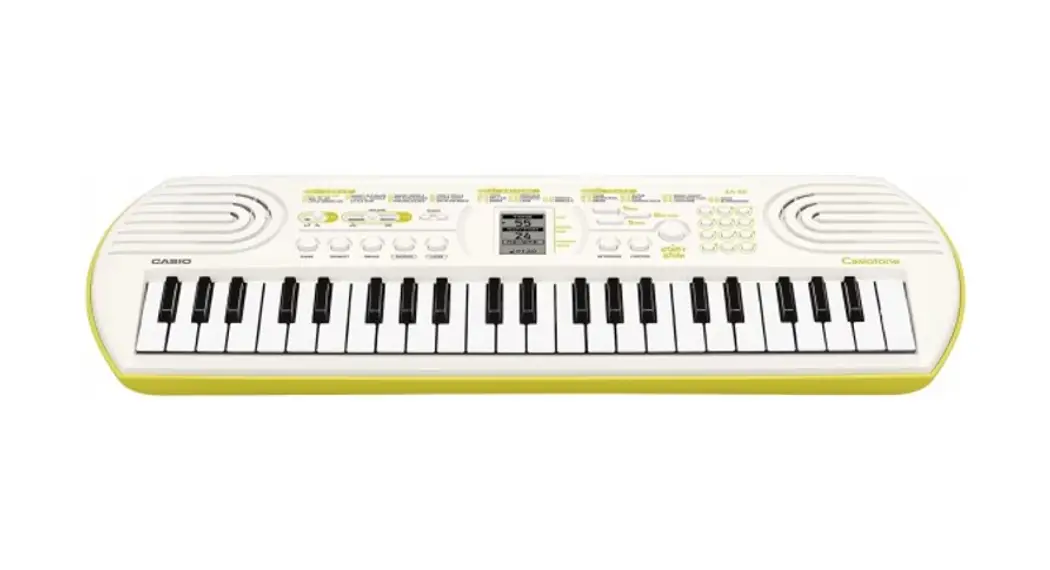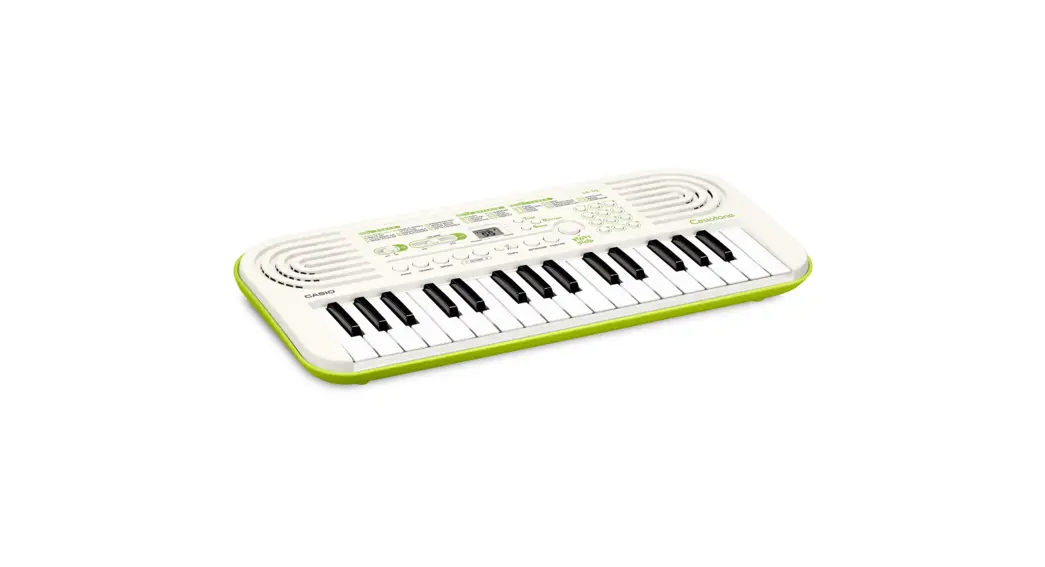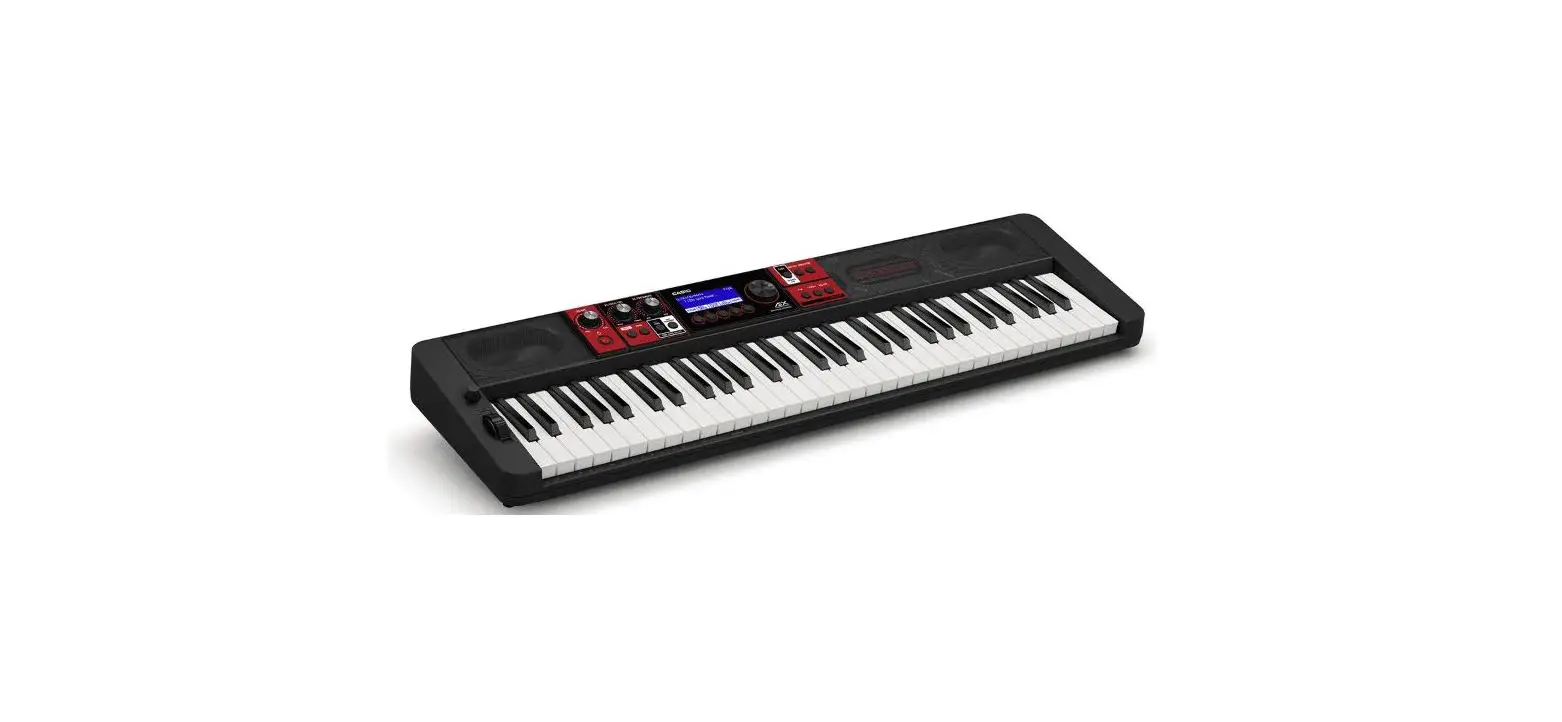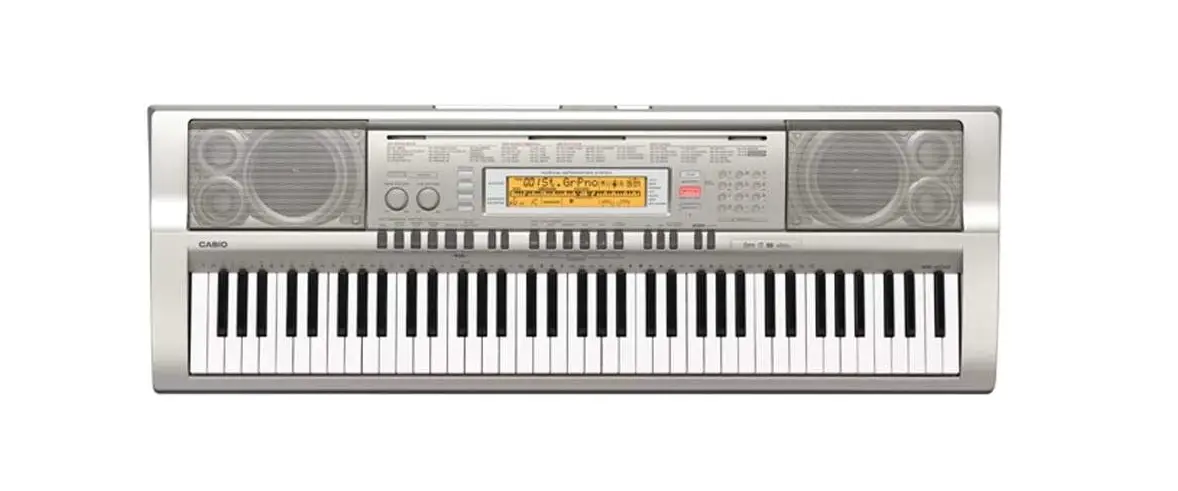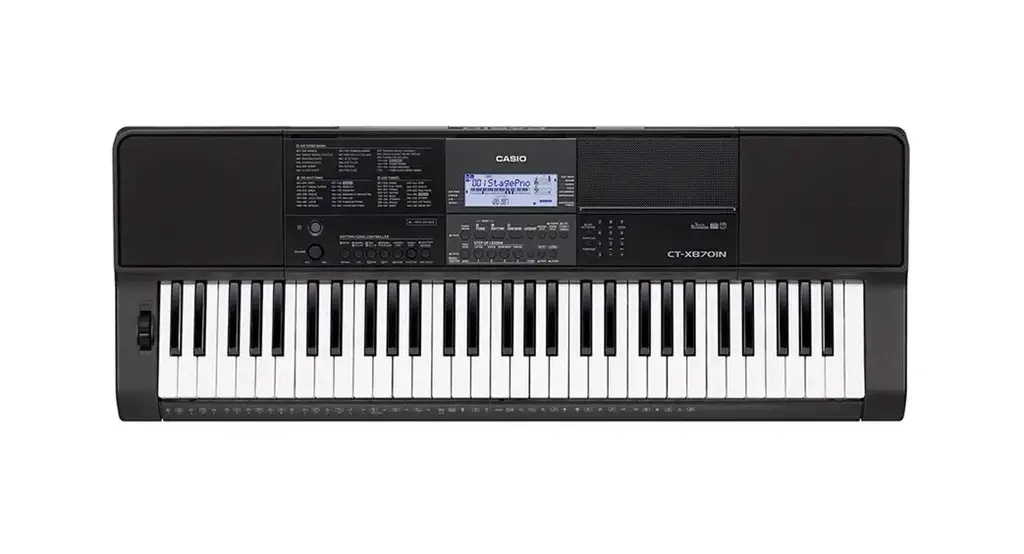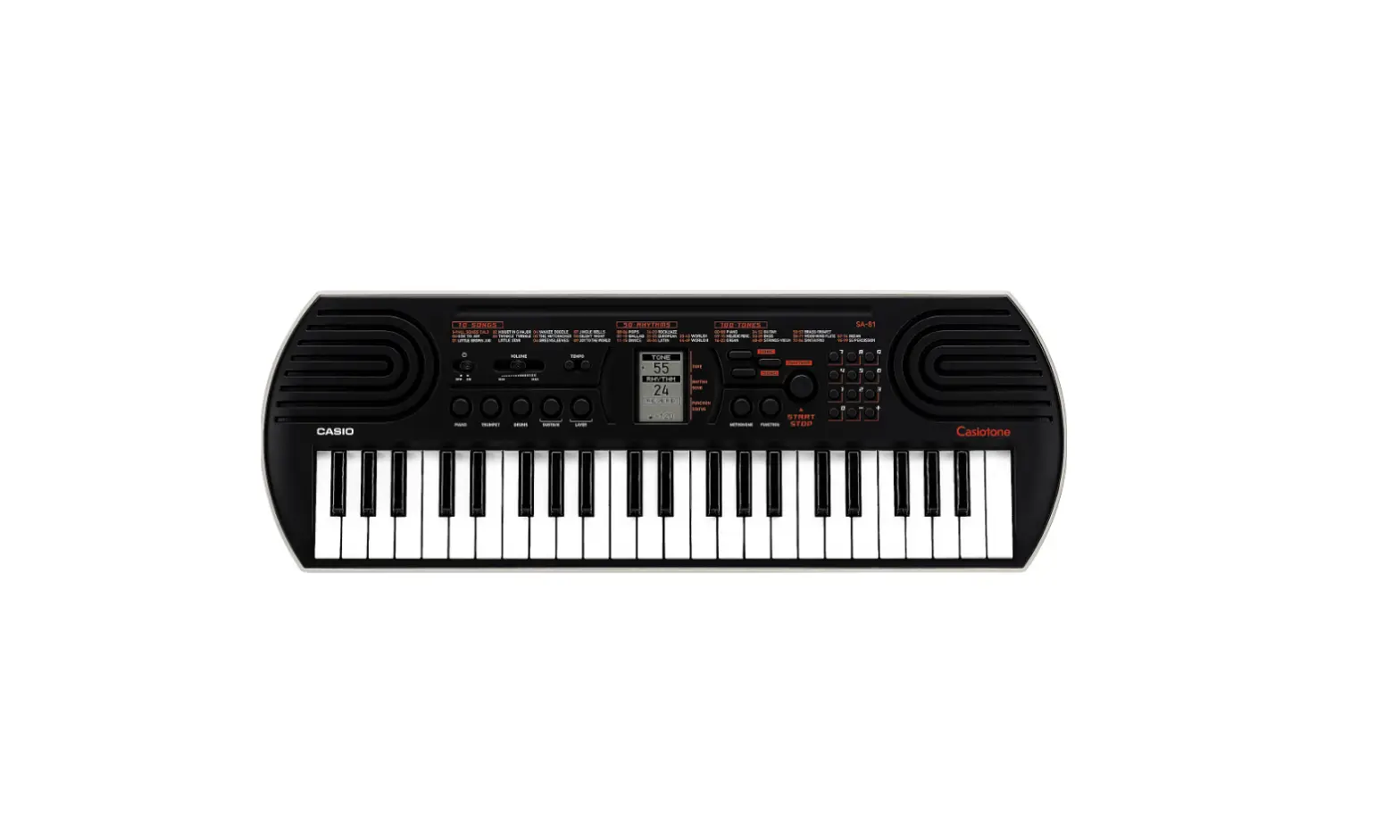

CASIO SA-81 Mini Portable Keyboard Piano
Product Information
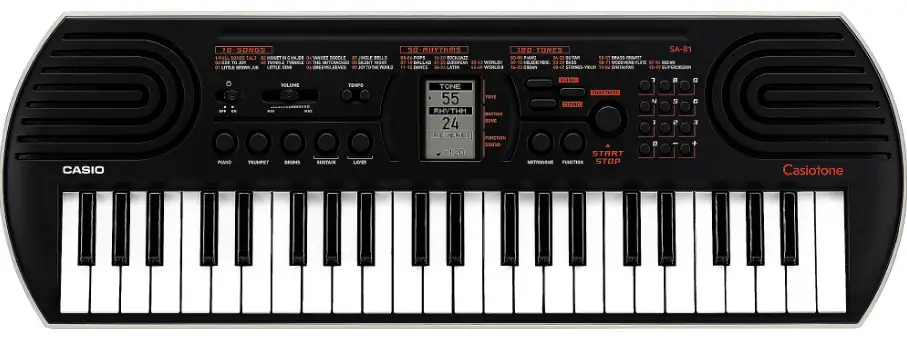
The product is a digital keyboard manufactured by Casio. The model name of the product is SA-80 and SA-81. The product is designed to be used for playing music using the keyboard, tones,and rhythms. The product has a LCD panel, tone list, rhythm list,power speaker, volume control, sustain button, metronome, and various tone buttons such as piano, trumpet, and drums.
Product Usage Instructions
Playing Something on the Digital Keyboard
- Set (P) to ON to switch on the digital keyboard.
- Use (Keyboard) to make a sound.
- Use (VOLUME) to adjust the volume.
Playing Using Tones
- Press (TONE) to select a tone number.
- The selected tone will be set as the original setting.
- Use (Keyboard) to play the tone you chose.
- You can quickly and easily select the GRAND PIANO (00), TRUMPET (50), and DRUM SET (99) tones using the tone buttons.
Sustaining Notes After Keyboard Keys Are Released
- Press (SUSTAIN) to enable sustain.
- Choose your favorite tone from the tone list or the user manual and enter its number.
Power Supply
The product can be powered by either a household power outlet or batteries. To use a household power outlet, make sure to use only the AC adaptor specified for this keyboard. The specified AC adaptor is AD-E95100L (JEITA Standard plug). To use batteries, open the battery cover on the bottom of the digital keyboard, load the batteries, and then close the cover.
Safety Precautions
Be sure to read the Safety Precautions in the separate READ THIS! sheet and use the product correctly to avoid any personal injury or damage to the product. Failure to comply with the safety precautions can result in distorted sound, sudden loss of power,power immediately cuts out after being restored, failure to start up, or failure to operate correctly.
- Any reproduction of the contents of this manual, either in part or its entirety, is prohibited. Except for your own, personal use, any
other use of the contents of this manual without the consent of CASIO is prohibited under copyright laws. - IN NO EVENT SHALL CASIO BE LIABLE FOR ANY DAMAGES WHATSOEVER (INCLUDING, WITHOUT LIMITATION, DAMAGES
FOR LOSS OF PROFITS, BUSINESS INTERRUPTION, LOSS OF INFORMATION) ARISING OUT OF THE USE OF OR INABILITY
TO USE THIS MANUAL OR PRODUCT, EVEN IF CASIO HAS BEEN ADVISED OF THE POSSIBILITY OF SUCH DAMAGES. - The contents of this manual are subject to change without notice.
- The actual appearance of the product may be different from that shown in the illustrations in this User’s Guide.
- Company and product names used in this manual may be registered trademarks of others.
Getting Ready
Power Supply
Prepare a household power outlet or batteries.
IMPORTANT
- Be sure to comply with the “Safety Precautions” provided in the separate “READ THIS!” sheet. Incorrect use of this product creates the risk of electric shock and fire.
- Always make sure that the Digital Keyboard is turned off before plugging in or unplugging the AC adaptor, or before loading or removing batteries.
Using a Household Power Outlet
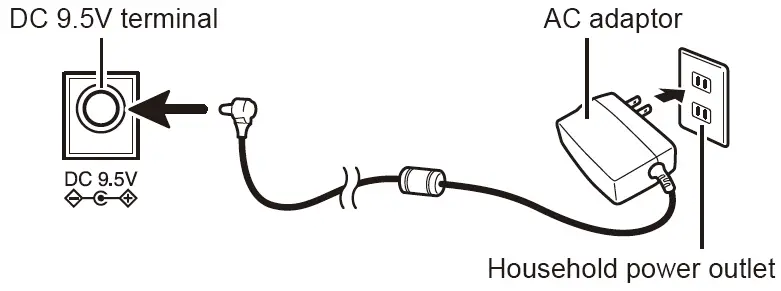
Make sure that you use only the AC adaptor specified for this keyboard. Use of a different type of AC adaptor can cause malfunction.
Specified AC Adaptor: AD-E95100L
(JEITA Standard plug)
IMPORTANT
- The AC adaptor will become warm to the touch after very long use. This is normal and does not indicate malfunction.
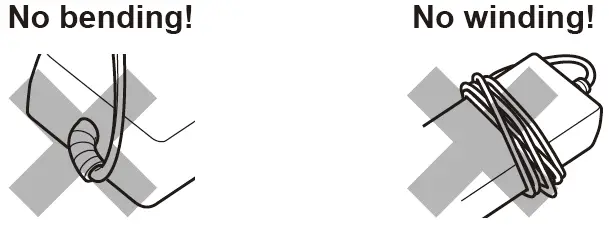
- To prevent breaking of the wire, take care to avoid putting any type of load on the power cord.
Using Batteries
Use 6 commercially available size AA alkaline batteries or NiMH rechargeable batteries.
- Commercially available size AA manganese batteries can also be used, but because some types of usage may require high power consumption, the use of alkaline batteries or NiMH rechargeable batteries is recommended.
Note the precautions below when using rechargeable batteries.
- Use Panasonic Group AA-size eneloop rechargeable batteries. Do not use any other type of batteries.
- Use only the specified charger to charge batteries.
- Rechargeable batteries must be removed from the product for charging.
- For information about using eneloop batteries or their specified charger, be sure to read the user documentation and precautions that come with each item, and use them only as directed.
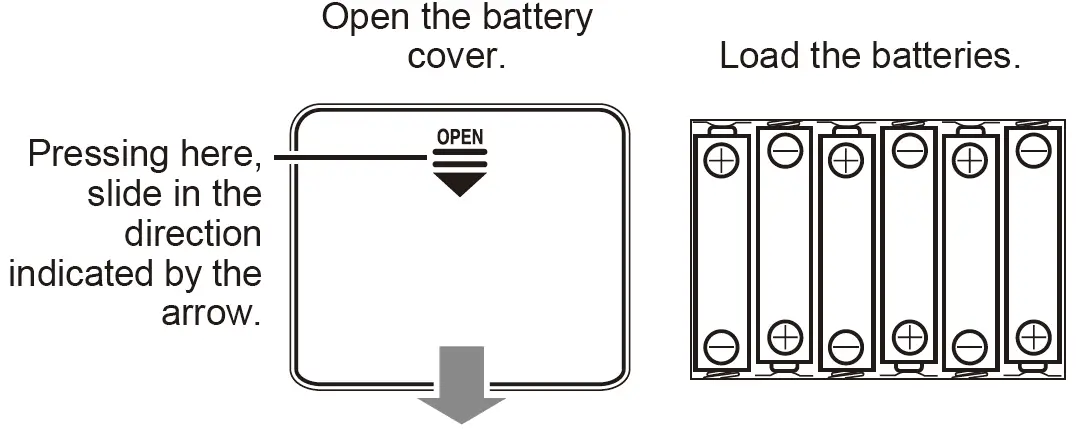
Open the battery cover on the bottom of the Digital Keyboard, load the batteries, and then close the cover.
- Take care to ensure that the positive + and negative – ends of the batteries are facing correctly.
IMPORTANT
- Battery life is approximately 12 hours of continuous use (based on alkaline batteries, normal play). Any of the symptoms below may indicate batteries are low and need to be replaced as soon as possible.
Distorted sound ● Sudden loss of power
Power immediately cuts out after being restored
Failure to start up ● Failure to operate correctly
NOTE
- The Digital Keyboard will turn off automatically to preserve battery power if you do not perform any operation for about six minutes (Auto Power Off). Hold down the TONE button while turning on the keyboard to disable Auto Power Off.
Using Headphones or Audio Equipment
Connect headphones or audio equipment to the PHONES/OUTPUT jack on the back of the Digital Keyboard.
- If the plug you are using does not match the jack, use a commercially available adaptor plug.
Commercially available headphones
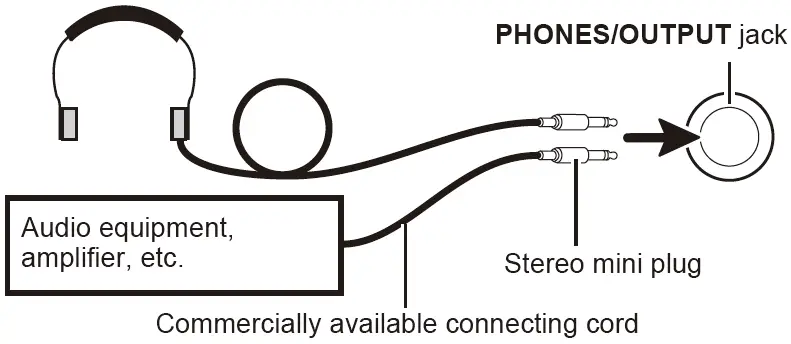
IMPORTANT
- Do not listen to very high volume output over headphones for long periods. Doing so creates the risk of hearing damage.
- When connecting a musical instrument amplifier, set the Digital Keyboard volume to a low level and use the amplifier’s volume control to adjust to the desired volume level.
Reference
Troubleshooting
- There is no sound when I press keyboard keys.
- Check to make sure batteries are loaded or that the AC adaptor is connected correctly. (See “Power Supply”.)
- Unplug the plug from the 20 (PHONES/OUTPUT) jack if one is connected.
- The sound is distorted. The power suddenly cuts out.
- Battery power may be low. See “Power Supply”.
Specifications
- Keyboard: 44 mini-size keys, 3.5 octaves
- Polyphony: 32 notes maximum
- Tones: 100
- Preset Rhythms: 50
- Preset Songs: 10 tunes; melody off
- Tuning: A4 = 415.5 to 440.0 to 465.9 Hz
- Other Functions: Transpose, Octave Shift, Reverb,
Scale Tuning (Temperament) - Speakers : φ 8 cm × 2 (output: 0.8 W + 0.8 W)
- Power Jack : DC 9.5V
- Phones/Output jack: Stereo mini jack
Output Impedance: 120 Ω
Output Voltage: 500 mV (RMS) MAX
Power Supply: 2-way
- Batteries: 6 AA-size alkaline batteries or AA-size rechargeable nickel-metal hydride batteries
- Battery Life: Approximately 12 hours (alkaline batteries), approximately 10 hours (rechargeable nickel-metal hydride batteries)*
- AC Adaptor: AD-E95100L
- Auto Power Off: Approximately 6 minutes after last key operation
- Power Consumption: 9.5 V = 3.8 W
- Dimensions : 60.4 × 21.1 × 5.7 cm
(23 3/4 × 8 5/16 × 2 1/4 inch) - Weight: Approximately 1.4 kg (3.1 lbs) (without batteries)
Measured values while using eneloop batteries.
eneloop is a registered trademark of Panasonic Group.
NOTE
Design and specifications are subject to change without notice.
- You can get information about accessories that are separately for this product from the CASIO keyboard catalog available from your retailer, and from the CASIO website at the following URL. https://world.casio.com/
For information about the product and its music scores,visit the CASIO website. https://support.casio.com/global/en/emi/manual/SA-80/
Scale Tuning List
| Setting | Scale Tuning Name |
| 00 | Equal |
| 01 | Pure Major |
| 02 | Pure Minor |
| 03 | Pythagorean |
| 04 | Kirnberger 3 |
| 05 | Werckmeister |
| 06 | Mean-Tone |
| 07 | Rast |
| 08 | Bayati |
| 09 | Hijaz |
| 10 | Saba |
| 11 | Dashti |
| 12 | Chahargah |
| 13 | Segah |
| 14 | Gurjari Todi |
| 15 | Chandrakauns |
| 16 | Charukeshi |
Built-in Music Data Lists
Tone List
| PIANO | |
| 00 | GRAND PIANO |
| 01 | BRIGHT PIANO |
| 02 | STRINGS PIANO |
| 03 | ELEC.GRAND PIANO |
| 04 | ELEC.PIANO 1 |
| 05 | ELEC.PIANO 2 |
| 06 | HARPSICHORD |
| 07 | CLAVI |
| 08 | THUMB PIANO |
| MELODIC PERC. | |
| 09 | VIBRAPHONE |
| 10 | MARIMBA |
| 11 | XYLOPHONE |
| 12 | CELESTA |
| 13 | GLOCKENSPIEL |
| 14 | TUBULAR BELL |
| 15 | STEEL DRUMS |
| ORGAN | |
| 16 | ELEC.ORGAN |
| 17 | PERC.ORGAN |
| 18 | ROCK ORGAN |
| 19 | PIPE ORGAN |
| 20 | REED ORGAN |
| 21 | ACCORDION |
| 22 | HARMONICA |
| 23 | BANDONEON |
| GUITAR | |
| 24 | NYLON STR.GUITAR |
| 25 | STEEL STR.GUITAR |
| 26 | JAZZ GUITAR |
| 27 | CLEAN GUITAR |
| 28 | MUTE GUITAR |
| 29 | OVERDRIVE GT |
| 30 | DISTORTION GT |
| 31 | GT HARMONICS |
| 32 | BANJO |
| BASS | |
| 33 | ACOUSTIC BASS |
| 34 | FINGERED BASS |
| 35 | PICKED BASS |
| 36 | FRETLESS BASS |
| 37 | SLAP BASS |
| 38 | SYNTH-BASS 1 |
| 39 | SYNTH-BASS 2 |
| STRINGS | |
| 40 | VIOLIN |
| 41 | CELLO |
| 42 | CONTRABASS |
| 43 | PIZZICATO |
| 44 | HARP |
| 45 | KOTO |
| 46 | STRINGS |
| 47 | SLOW STRINGS |
| 48 | SYNTH-STRINGS |
| 49 | ORCHESTRA HIT |
| BRASS | |
| 50 | TRUMPET |
| 51 | TROMBONE |
| 52 | TUBA |
| 53 | MUTE TRUMPET |
| 54 | FRENCH HORN |
| 55 | BRASS |
| 56 | SYNTH-BRASS 1 |
| 57 | SYNTH-BRASS 2 |
| WOOD WIND | |
| 58 | ALTO SAX |
| 59 | TENOR SAX |
| 60 | SOPRANO SAX |
| 61 | BARITONE SAX |
| 62 | OBOE |
| 63 | ENGLISH HORN |
| 64 | BASSOON |
| 65 | CLARINET |
| 66 | FLUTE |
| 67 | PICCOLO |
| 68 | RECORDER |
| 69 | PAN FLUTE |
| 70 | WHISTLE |
| 71 | OCARINA |
| SYNTH/PAD | |
| 72 | SQUARE LEAD |
| 73 | SAW LEAD |
| 74 | CALLIOPE |
| 75 | VOICE LEAD |
| 76 | BASS+LEAD |
| 77 | CHOIR AAHS |
| 78 | VOICE DOO |
| 79 | SYNTH-VOICE |
| 80 | WARM PAD |
| 81 | SPACE CHOIR |
| 82 | METAL PAD |
| 83 | RAIN DROP |
| 84 | SOUND TRACK |
| 85 | ATMOSPHERE |
| 86 | BRIGHTNESS |
| INDIAN | |
| 87 | SITAR |
| 88 | HARMONIUM 1 |
| 89 | HARMONIUM 2 |
| 90 | SANTUR |
| 91 | TABLA |
| 92 | PIPE ORGAN (INDIAN) |
| 93 | HARMONICA (INDIAN) |
| 94 | TRUMPET (INDIAN) |
| SE/PERCUSSION | |
| 95 | SEASHORE/BIRD |
| 96 | HELICOPTER/GUNSHOT |
| 97 | WOOD BLOCK/TAIKO |
| 98 | MELODIC TOM/ SYNTH-DRUM |
| 99 | DRUM SET |
Rhythm List
| POPS | |
| 00 | STRAIGHT 8 BEAT |
| 01 | 8 BEAT POP |
| 02 | MELLOW 8 BEAT |
| 03 | 60’s 8 BEAT |
| 04 | 16 BEAT 1 |
| 05 | 16 BEAT 2 |
| 06 | 16 BEAT SHUFFLE |
| BALLAD | |
| 07 | POP BALLAD |
| 08 | MODERN BALLAD |
| 09 | 16 BEAT BALLAD |
| 10 | 6/8 BALLAD |
| DANCE | |
| 11 | EDM |
| 12 | TECHNO POP |
| 13 | TRANCE |
| 14 | MODERN DANCE |
| 15 | DISCO SOUL |
| ROCK/JAZZ | |
| 16 | STRAIGHT ROCK |
| 17 | BLUES |
| 18 | SLOW ROCK |
| 19 | MIDDLE BIG BAND |
| 20 | JAZZ WALTZ |
| EUROPEAN | |
| 21 | POLKA |
| 22 | WALTZ |
| 23 | TANGO |
| 24 | MARCH 1 |
| 25 | MARCH 2 |
| LATIN | |
| 26 | BOSSA NOVA |
| 27 | BEGUINE |
| 28 | SAMBA |
| 29 | CHA-CHA-CHA |
| 30 | MERENGUE |
| 31 | SALSA |
| 32 | REGGAE |
| 33 | CUMBIA |
| 34 | REGGAETON |
| WORLD I | |
| 35 | BLUEGRASS |
| 36 | DIXIE |
| 37 | FAST GOSPEL |
| 38 | PASODOBLE |
| 39 | ADANI |
| 40 | BALADI |
| 41 | MUS |
| 42 | KRONCONG |
| 43 | DANGDUT |
| WORLD II | |
| 44 | BHANGRA |
| 45 | DADRA |
| 46 | KEHARWA |
| 47 | TEEN TAAL |
| 48 | BHAJAN |
| 49 | INDIAN POP |
Drum Map
| Key | 99:DRUM SET |
| F1- E2 | – |
| F2 | Synth Kick |
| F{2 | Synth Snare 1 |
| G2 | Synth Snare 2 |
| G{2 | Dance Kick 2 |
| A2 | Dance Kick 1 |
| B}2 | Dance Snare 1 |
| B2 | Dance Snare 2 |
| C3 | Dance Clap |
| C{3 | Snare 3 |
| D3 | Brush Snare Slap |
| E}3 | Brush Snare Sweep |
| E3 | Kick 2 |
| F3 | Kick 1 |
| F{3 | Side Stick |
| G3 | Snare 1 |
| G{3 | Closed Hi-Hat |
| A3 | Snare 2 |
| B}3 | Open Hi-Hat |
| B3 | Low Tom |
| C4 | Mid Tom |
| C{4 | Crash Cymbal |
| D4 | High Tom |
| E}4 | Ride Cymbal |
| E4 | Xiao Luo |
| F4 | Vibraslap |
| F{4 | Tambourine |
| G4 | Maracas |
| G{4 | Triangle Close |
| A4 | Triangle Open |
| B}4 | Claves |
| B4 | Mute Cuica |
| C5 | Open Cuica |
| C{5 | Mute High Conga |
| D5 | Open High Conga |
| E}5 | Open Low Conga |
| E5 | High Agogo |
| F5 | Low Agogo |
| F{5 | High Whistle |
| G5 | Low Whistle |
| G{5 | Tabla Ge |
| A5 | Tabla Ka |
| B}5 | Tabla Te |
| B5 | Tabla Na |
| C6 | Tabla Tun |
| C{6 | High Timbale |
| D6 | Low Timbale |
| E}6 | High Bongo |
| E6 | Low Bongo |
| F6 | Long Guiro |
| F{6 | Short Guiro |
| G6 | Cowbell |
| G{6 | High Wood Block |
| A6 | Low Wood Block |
| B}6 | Cabasa |
| B6 | Shaker |
| C7 | Hand Clap |
General Guide
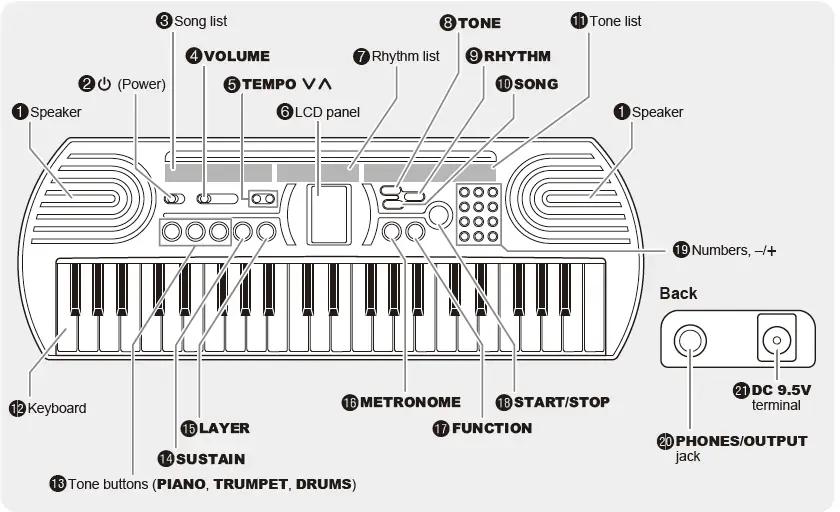
Playing Something on the Digital Keyboard
- Set 2 (
 ) to “ON”.
The Digital Keyboard switches on. - Use 12 (Keyboard) to make a sound.
- Use 4 (VOLUME) to adjust the volume.
 ) to “ON”.
Playing Using Tones
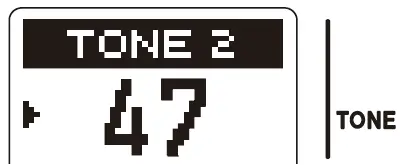
- Press 8 (TONE).

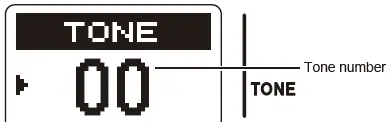
- Choose your favorite tone from the 11 (Tone list) or from the tone list in this User’s Guide, and then enter its number using the numbers or the plus (+) and minus (–) buttons 19.
- Enter a 2-digit tone number.
For example, to select “05 ELEC.PIANO 2”, press “0” and then “5”. - You can also use plus (+) and minus (–) buttons to change the number. (“+” increases the number and “–” decreases the number.) Holding the button down changes the number continuously.
- Press “+” and “–” at the same time to return to the original setting.
- Enter a 2-digit tone number.
- Use 12 (Keyboard) to play the tone you chose.
NOTE
- You can use 13 (PIANO, TRUMPET, DRUMS) to quickly and easily select the GRAND PIANO (00),TRUMPET (50) and DRUM SET (99) tones.
Sustaining Notes After Keyboard Keys Are Released
- Press 14 (SUSTAIN).
This enables sustain.
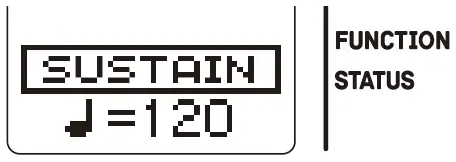
NOTE
Changing the tone cancels sustain.
Layering Two Tones
You can use the procedure below to layer two tones and output the resulting sound. The part that is played using a single tone is the main part, while the second part that is layered over the main part is the layer part.
- Press 15 (LAYER).
This enables layering.
- Use the numbers or plus (+) and minus (–) buttons 19 to change the tone of the layer part.
- To cancel the layer, press 15 (LAYER) again or press 13 (PIANO, TRUMPET, DRUMS).
Playing Using the Metronome
- Press 16 (METRONOME).
The metronome starts up. - Press 16 (METRONOME) again to stop the metronome.
NOTE
For information on how to change the metronome tempo, see “Changing the Speed (Tempo) of a Rhythm or Built-in Song”.
Changing the Beat
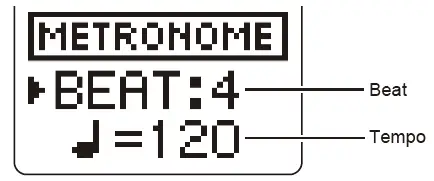
You can use the procedure below to configure the settings so that the Digital Keyboard sounds a chime on the first beat of each measure and a click on the remaining beats.
- Press 16 (METRONOME).

- Use the numbers or the plus (+) and minus (–) buttons 19 to enter the beat.
- Choose a beat setting from 0-9.
- If you choose “0”, no chime sounds on the first beat.
Playing Using a Rhythm
You can have rhythms from various musical genres play as backing while you play the Digital Keyboard.
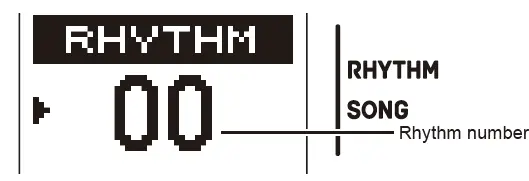
- Press9 (RHYTHM).

- Choose your favorite rhythm from 7 (Rhythm list) or from the rhythm list in this User’s Guide, and then enter its number using the numbers or the plus (+) and minus (–) buttons 19.
- The procedure for entering the number is the same as for tone numbers.
- Press 18 (START/STOP) to play the rhythm you chose.
- To stop the rhythm, press 18 (START/STOP) again.
NOTE
For information on how to change the tempo of the rhythm, see “Changing the Speed (Tempo) of a Rhythm or Built-in Song”.
Listening to Built-in Songs
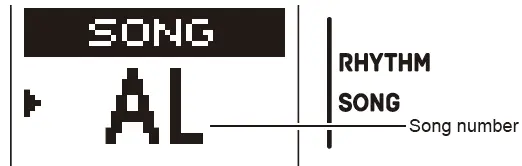
- Press 10 (SONG).

- Choose a song from 3 (Song list) and then enter its number using the numbers or the plus (+) and minus (–) buttons 19.
- When using numbers to choose a song, start by entering “0”. The procedure for entering the number is the same as for tone numbers.
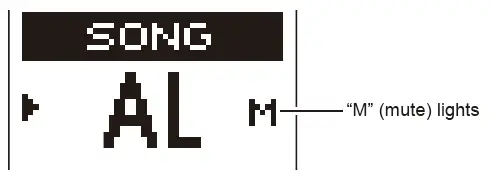
- To listen through all the songs, display “AL” on the LCD panel. To display “AL”, either use the plus (+) and minus (–) buttons, or just press one of the number buttons “1-9” without first pressing “0”.
- Press 18 (START/STOP) to play the song you chose.
- To stop the song, press 18 (START/STOP) again.
NOTE
- For information on how to change the tempo of the rhythm, see “Changing the Speed (Tempo) of a Rhythm or Built-in Song”.
- If you change the tempo, tone or any other setting for a song while listening to all the songs “AL”, the changed song settings revert to their initial values when the next song is played.
Muting the Song Melody So You Can Play it Yourself
- Hold down 10 (SONG).
This mutes the melody for built-in songs.
- Press 18 (START/STOP).
The melody is not played, so you can play it yourself on the keyboard 12.
Changing the Speed (Tempo) of a Rhythm or Built-in Song
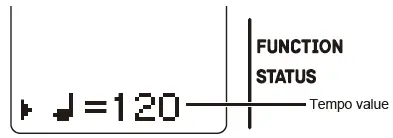
- Press 5 (TEMPO yt).

- Use 5 (TEMPO yt) or the numbers or plus (+) and minus (–) buttons 19 to change the tempo value.
- You can change the tempo in increments of 10 using 5 (TEMPO yt) or in single increments using the plus (+) and minus (–) buttons 19.
- You can set any value between 20 and 255.
Changing the Function Settings
Use the procedure below to change the function settings.
- Press 17 (FUNCTION).
- The setting changes each time you press 17 (FUNCTION).
 is displayed to the left of the set value.
Display Description OCTAVE Raise or lower pitch in octave units. Setting: –1 to +1 TRANS. Raises or lowers the overall pitch in semitone steps. Setting: –12 to 0 to +12
REVERB Uses Reverb type to change the sound’s reverberation. Setting: OFF, ROOM, HALL1, HALL2, STADIUM
SCALE TYPE Allows you to change the keyboard scale by selecting your preferred scale from the 17 preset scales in the Scale Tuning List in the User’s Guide. SCALE BASE Changes the scale tuning base note. Setting: C through B TUNING Fine tunes the overall pitch by changing the frequency of A4 in 0.1 Hz units. Setting: 415.5 Hz to 440.0 Hz to 465.9 Hz
- The setting changes each time you press 17 (FUNCTION).
- Use the numbers or the plus (+) and minus (–) buttons 19 to enter a value.
- You can also change the base note setting for a scale tuning by pressing a key on the keyboard 12.
- Press “+” and “–” at the same time to return to the original setting.
- The original display returns after a few moments.
 is displayed to the left of the set value.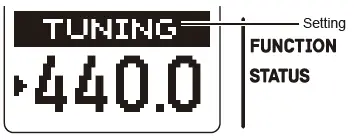
Making the Screen Easier to See
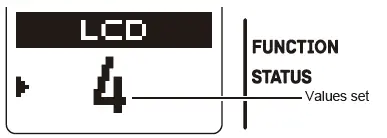
You can adjust the contrast of the LCD panel.
- Hold down 17 (FUNCTION) and press “0” in 19.

- Use the numbers or the plus (+) and minus (–) buttons 19 to enter a value.
- You can set any value between 1 and 8.
- Press any button other than the numbers or plus (+) and minus (–) buttons 19 to exit the setting.
NOTE
The LCD contrast setting is retained even if you switch the Digital Keyboard off.
Settings at Power Off
When you turn the Digital Keyboard off, all settings such as the tone numbers and song numbers revert to their original settings. You cannot save your settings before turning the Digital Keyboard off.
NOTICE
This equipment has been tested and found to comply with the limits for a Class B digital device, pursuant to Part 15 of the FCC Rules.
These limits are designed to provide reasonable protection against harmful interference in a residential installation. This equipment generates, uses and can radiate radio frequency energy and, if not installed and used in accordance with the instructions, may cause harmful interference to radio communications. However, there is no guarantee that interference will not occur in a particular installation. If this equipment does cause harmful interference to radio or television reception, which can be determined by turning the equipment off and on, the user is encouraged to try to correct the interference by one or more of the following measures:
- Reorient or relocate the receiving antenna.
- Increase the separation between the equipment and receiver.
- Connect the equipment into an outlet on a circuit different from that to which the receiver is connected.
- Consult the dealer or an experienced radio/TV technician for help.
FCC WARNING
- Changes or modifications not expressly approved by the party responsible for compliance could void the user’s authority to operate the equipment.
Declaration of Conformity
- Model Name: SA-80, SA-81
- Trade Name: CASIO COMPUTER CO., LTD.
- Responsible party: CASIO AMERICA, INC.
- Address: 570 MT. PLEASANT AVENUE, DOVER, NEW JERSEY 07801
- Telephone number: 973-361-5400
This device complies with Part 15 of the FCC Rules, Operation is subject to the following two conditions:
- This device may not cause harmful interference, and
- this device must accept any interference received, including interference that may cause undesired operation.
TO REDUCE THE RISK OF FIRE OR ELECTRIC SHOCK, REFER SERVICING TO QUALIFIED SERVICE PERSONNEL.
Important Information for Parents!
Parents should please note the following important information before letting children use this product.
- Before using the AD-E95100L adaptor to power the unit, be sure to check the AC adaptor for any damage first. Carefully check the power cord
for breakage, cuts, exposed wire and other serious damage. Never let children use an AC adaptor that is seriously damaged. - Never mix batteries of different types.
- Never mix old batteries with new ones.
- Use recommended batteries or equivalent types.
- Always make sure that positive (+) and negative (–) poles are facing correctly as indicated near the battery compartment.
- Replace batteries as soon as possible after any sign they are getting weak.
- Do not short-circuit the battery terminals.
- The product is not intended for children under 3 years.
- Use only CASIO AD-E95100L adaptor.
- Be sure to disconnect the AC adaptor before cleaning the product.
Be sure to read the “Safety Precautions” in the separate “READ THIS!” sheet, and use the product correctly.
CASIO COMPUTER CO.;LTD.
6-2, Hon-machi 1-chome
Shibuya-ku, Tokyo 151-8543, Japan
C MA2208-A Printed in China
© 2022 CASIO COMPUTER CO., LTD.
 SA-80/81 - CASIO
 Corporate | CASIO