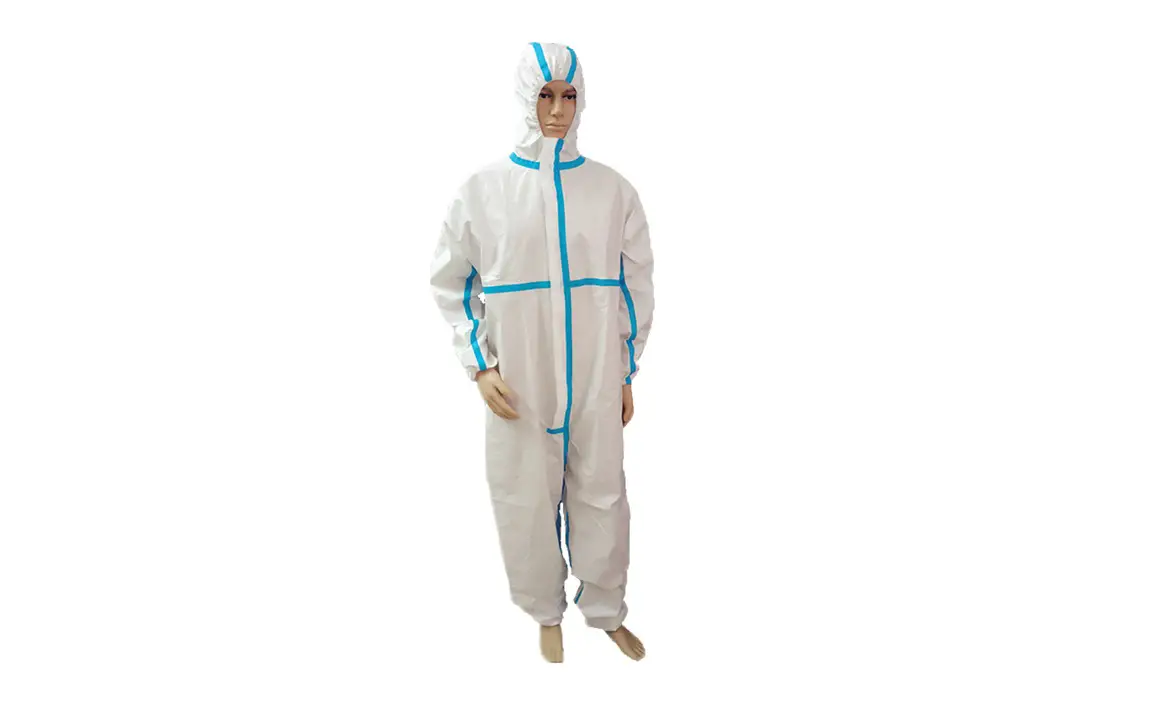
GIMA 21074 Basic Insulation Coverall Instruction Manual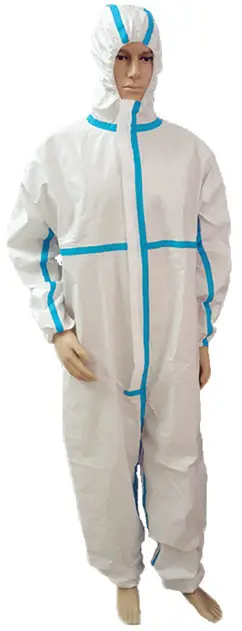
PROTECTIVE CLOTHING CATEGORY
NSTRUCTIONS FOR USE (PRODUCT CODE: HXCR-04)
Marking
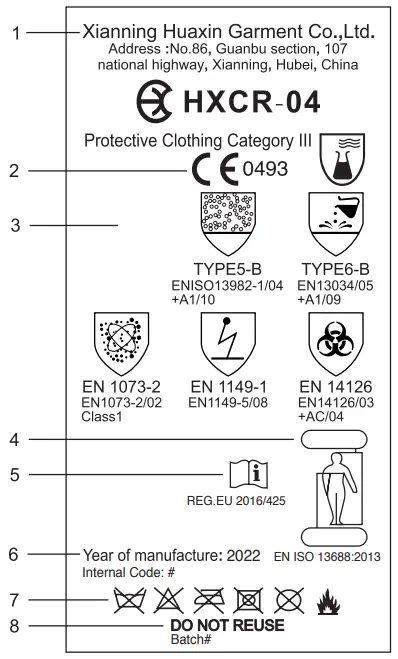
Each coverall is identified with an inside label, this indicates the type of protection offered and other points of information.
- Manufacture’s name.
- CE marking – Coverall complies with requirements for category Ⅲ personal protective equipment according to REGULATION (EU) 2016/425. The testing of the prototype and subsequent CE registration was made at Shirley® Certification Services (Notify Body Number 2895).
- Full-body protection “Types” achieved by Xianning Huaxin Garment Co., Ltd. defined by the European standards for Chemical Protective Clothing: Type 5:EN 13982-1:2004,Type 6:EN 13034:2005. Coveralls are tested against biological(EN14126:2003) and radioactive(EN1073-2:2002) hazards, and antistatic (EN1149 5:2018),and must be used with compatible accessories and work particles to be effective
- This garment is limited use protective clothing manufactured to meet standard EN ISO 13688:2013 protective clothing general requirements.
Coverall size.Size Chest (cm) Height (cm) S 84-92 164-170 M 92-100 170-176 L 100-108 176-182 XL 108-116 182-188 XXL 116-124 188-194 - Wearer should read these instructions for use.
- Year of manufacturing.
- International care symbols: Do not wash, iron, machine dry, dry clean or bleach. Keep away from flames and heat.
- Suitable for single use only-do not re-use.
PERFORMANCE CHART
| Fabric Physical Properties | Class | |
| Abrasion Resistance Flex Cracking Resistance Trapezoidal Tear Resist. MDXD Puncture resistance Tensile Strength MDXD Radioactive Protection Infective Resistance (solid particles) Resistance to ignition | EN 530 Meth.2 | Class 1 |
| ISO 7854 B | Class 4 | |
| ISO 9073-4 | Class 2 | |
| Class 2 | ||
| EN863 | Class 1 | |
| ISO 13934-1 | Class 1 | |
| Class 1 | ||
| EN1073-2:2002 | Class 2 | |
| ISO 22612 | Class 3 | |
| EN 13274-4 | Pass | |
| Fabric Chemical Properties Test Method | Penetration | Repellency |
| Resistance to chemical | ||
| EN ISO 6530 | Class 3 | Class 3 |
| Sulphuric acid 30% | Class 3 | Class 3 |
| Sodium Hydroxide 10% | Class 3 | Class 3 |
| o-Xylene | Class 3 | Class 3 |
| Butance-1-ol | ||
| Whole suit test performance | ||
| Type 5 Inward leakage | IL 82/90≤30%&TILS 8/10≤15% | |
| Method as defined by | ||
| EN ISO 13982-1:2004 | Pass | |
| Type 6 Light spray | ||
| Method as defined by | ||
| EN 13034:2005 | Pass | |
| En 14126:2003 | ||
| Barrier to infective agents | Pass | |
| En 1073-2:2002 | ||
| Barrier to radioactive particulates | Pass | |
| EN 1149-5:2018 Anti-static | Pass | |
| Protection against Infective Agents EN14126 | ||
| ISO 16603 | Class 6 | |
| ISO 16604 | Class 6 | |
| EN ISO 22610 | Class 6 | |
| ISO 22611 | Class 3 | |
Areas of use
Coveralls designed for protection against hazardous substances and contamination of both product and personnel. They are typically used for protection against dry particles and low hazardous splashes and sprays. The determination for suitability of coverall is the final responsibility of the user. The suit may be contaminated on removal, and should be removed so as to avoid contamination of the user
Limitations
When using the coverall with other PPE and in order to comply fully with EN requirement for Type5/6 garment all openings such as wrist, ankles, neck etc., should be securely taped. The user shall be the sole judge of the suitability for the type of protection required and the correct combinations of coveralls accessories and ancillary equipment. Upon contamination, wear or damage, the coverall should be removed and appropriately disposed of at the earliest opportunity. The wearer should always ensure to check the integrity of the coverall before wearing it. The possibility of heat stress should be considered in very warm conditions. Heat stress can be reduced or eliminated by the appropriate use of undergarments and ventilation equipment. Extreme of heat and cold may adversely affect the performance of this garment. The coverall should not be used where there is a risk to certain hazardous chemicals that have not been tested against. Although limited protection can be offered from various chemicals, please refer to the physical performance of the coverall in relation to Type 5 and 6 testing. The user must also wear compatible chemical resistant gloves, boots and respiratory protection. The gloves should cover the elastic cuffs. An appropriate size should be selected by the user to allow for unrestricted movement for the intended risk. If necessary please contact Manufacturer/Distributor for advice.
Storage and Disposal
The coverall can be stored in accordance with normal storage practices, but we recommend storage in a dry place away from sources of light, heat and direct sunlight. Restrictions on the disposal depend solely on the contamination during use. The manufacturer cannot accept responsibility for any improper use or disposal of garments.
Expiration
It is recommended that the product be used within a period of 3 years from the date of manufacture/production written on the packaging.
Approvals
CE Approvals by: (Notified Body: 2895) Shirley® Port Tunnel Business Park, Office 13 Unit 21, Dublin 17, ROI Ireland
 | Product code |
 | Lot number |
 | Manufacturer |
 | Consult instructions for use |
 | Date of manufacture |
 | Expiration date |
 | Requirements for category Ⅲ personal protec- tive equipment according to REGULATION (EU) 2016/425 |
HXCR-04(S) (GIMA 21070) BASIC INSULATION COVERALL
S – disposable XCR-04(M) (GIMA 21071) BASIC INSULATION COVERALL M – disposable HXCR-04(L) (GIMA 21072) BASIC INSULATION COVERALL L – disposable HXCR-04(XL) (GIMA 21073) BASIC INSULATION COVERALL XL – disposable HXCR-04(XXL) (GIMA 21074) BASIC INSULATION COVERALL XXL – disposable
Garment Co., Ltd. NO. 86, Section,107 National Highway city, Hubei Province, China Made in China
Support
Imported by:
Gima S.p.A.
Via Marconi, 1 – 20060 Gessate (MI) Italy
[email protected]
[email protected]
www.gimaitaly.com

 Portal Home - Registrar of domains names s.r.o.
 Gima, articoli medicali, apparecchi per medicina, elettromedicali, endoscopi, misuratori medicali, arredo ambulatorio, elettrobisturi, articoli per il pronto soccorso, articoli per la sterilizzazione