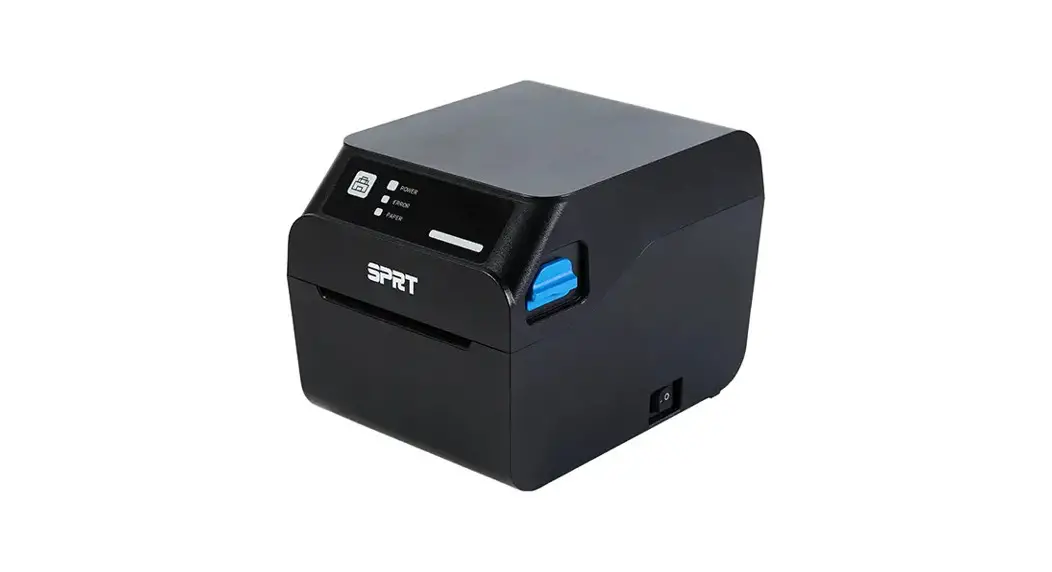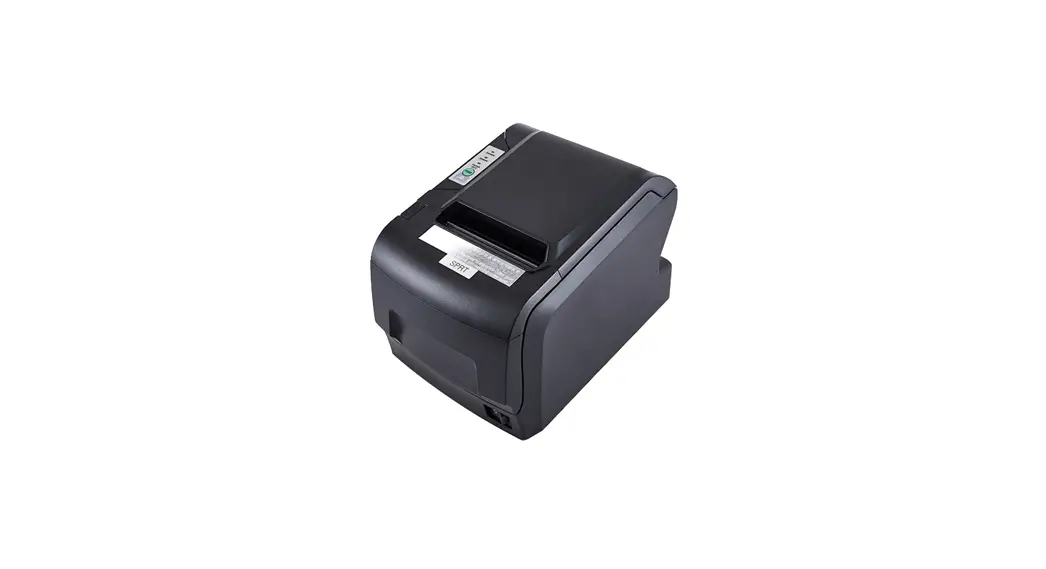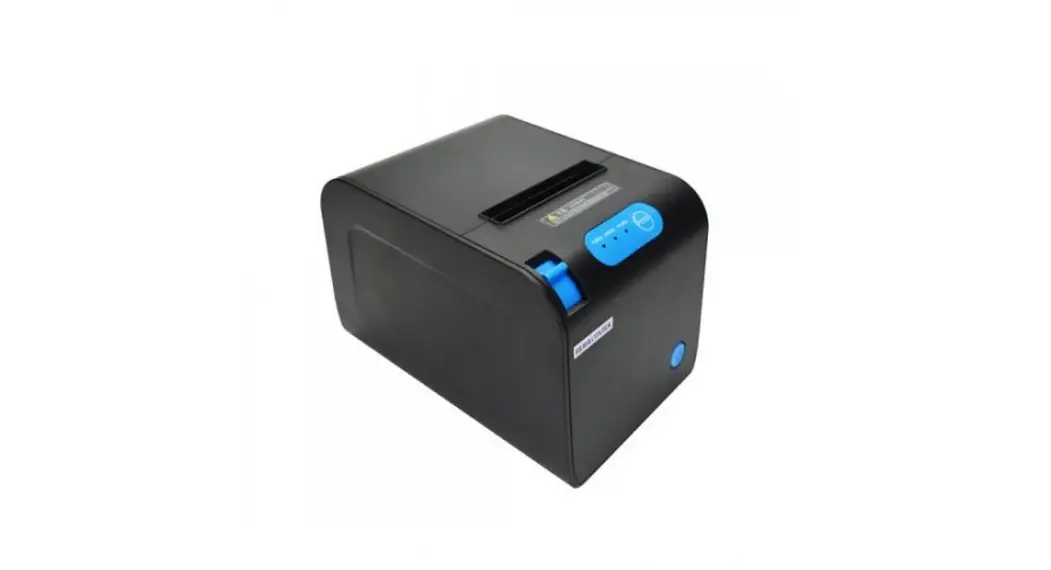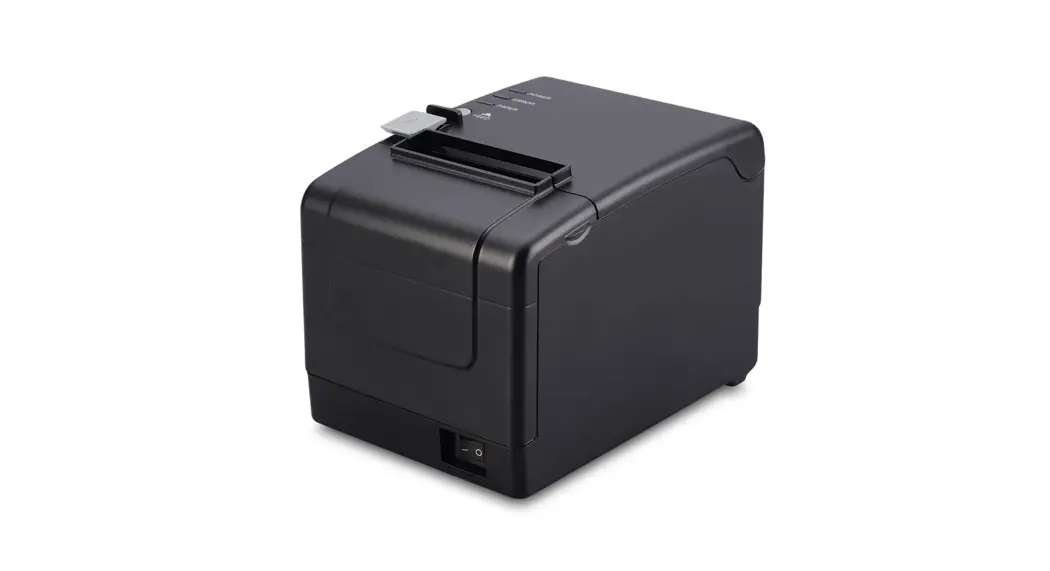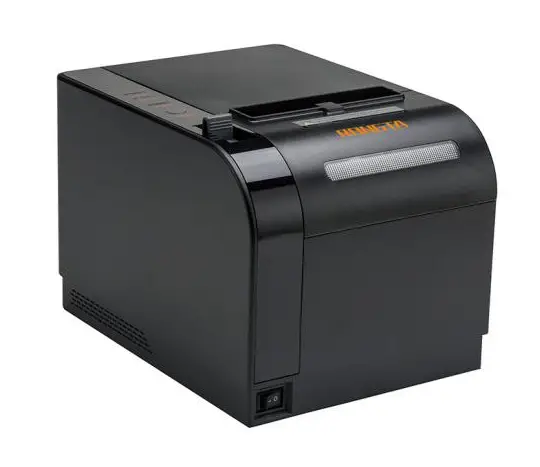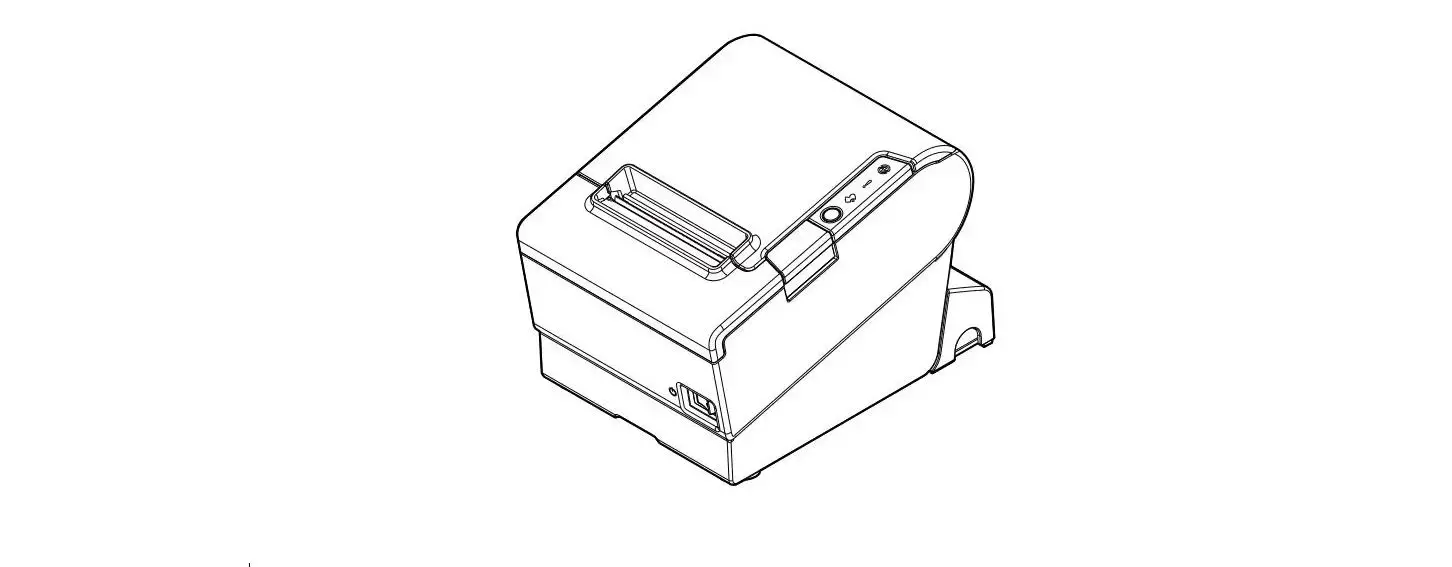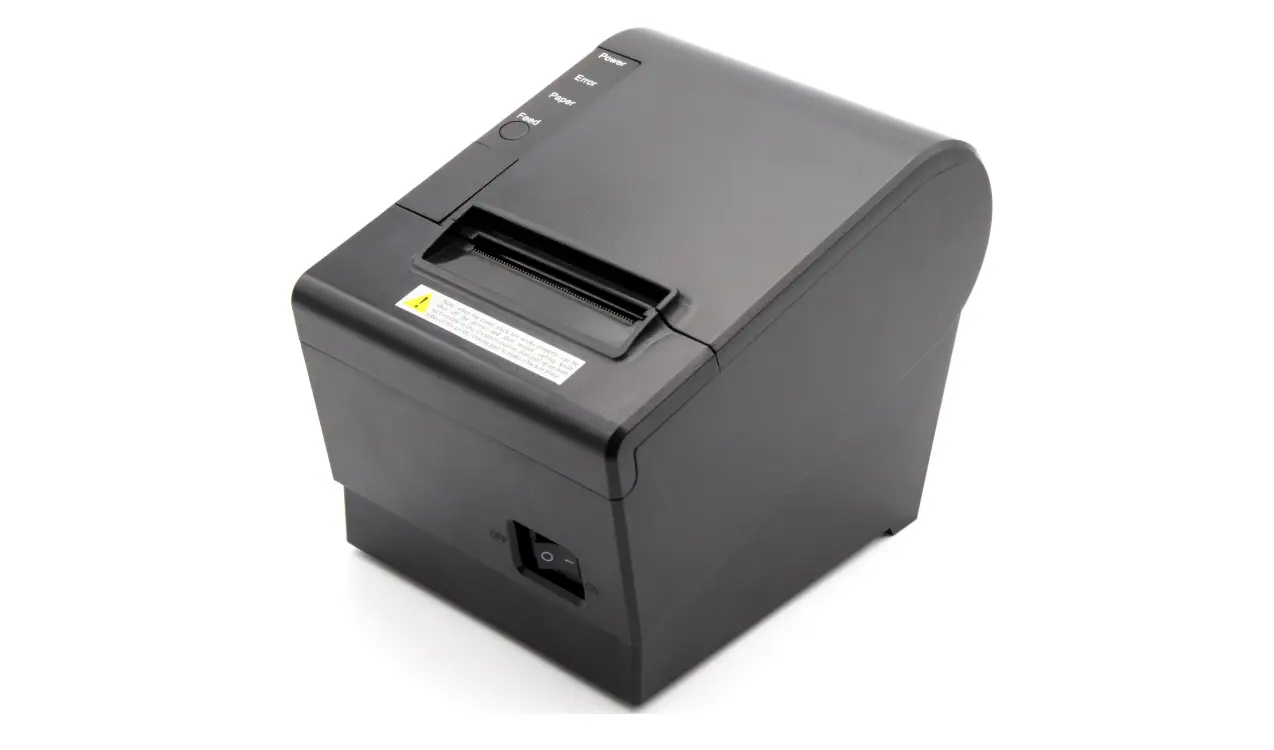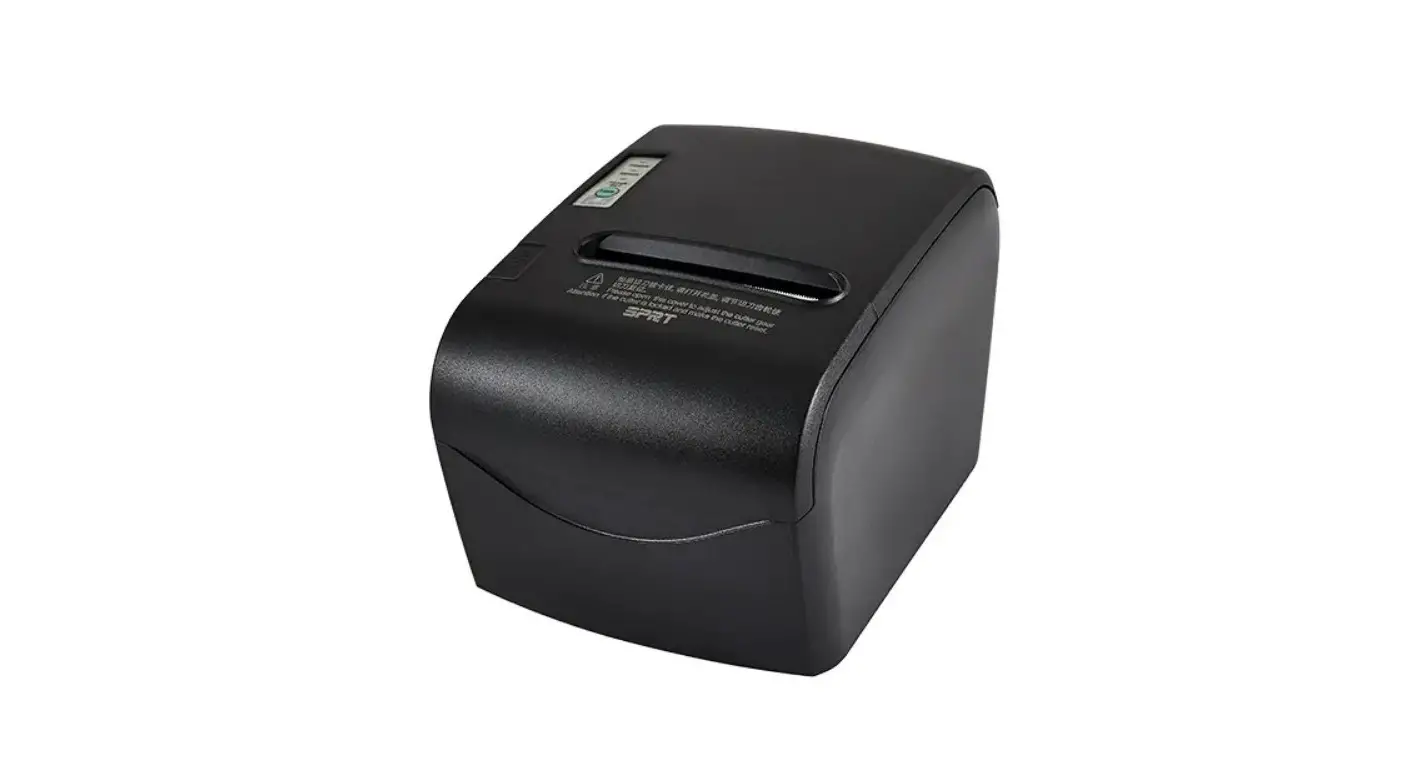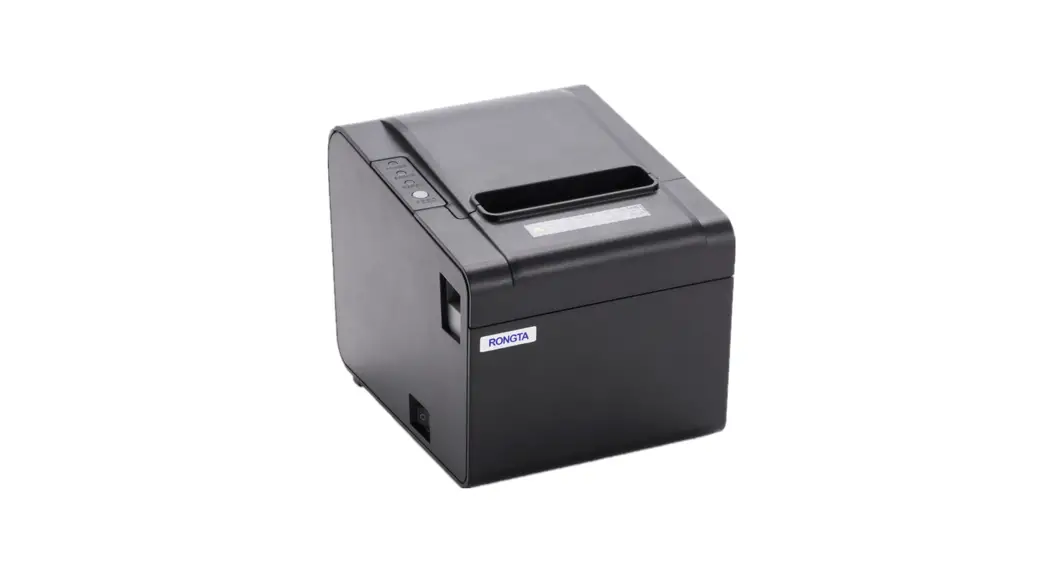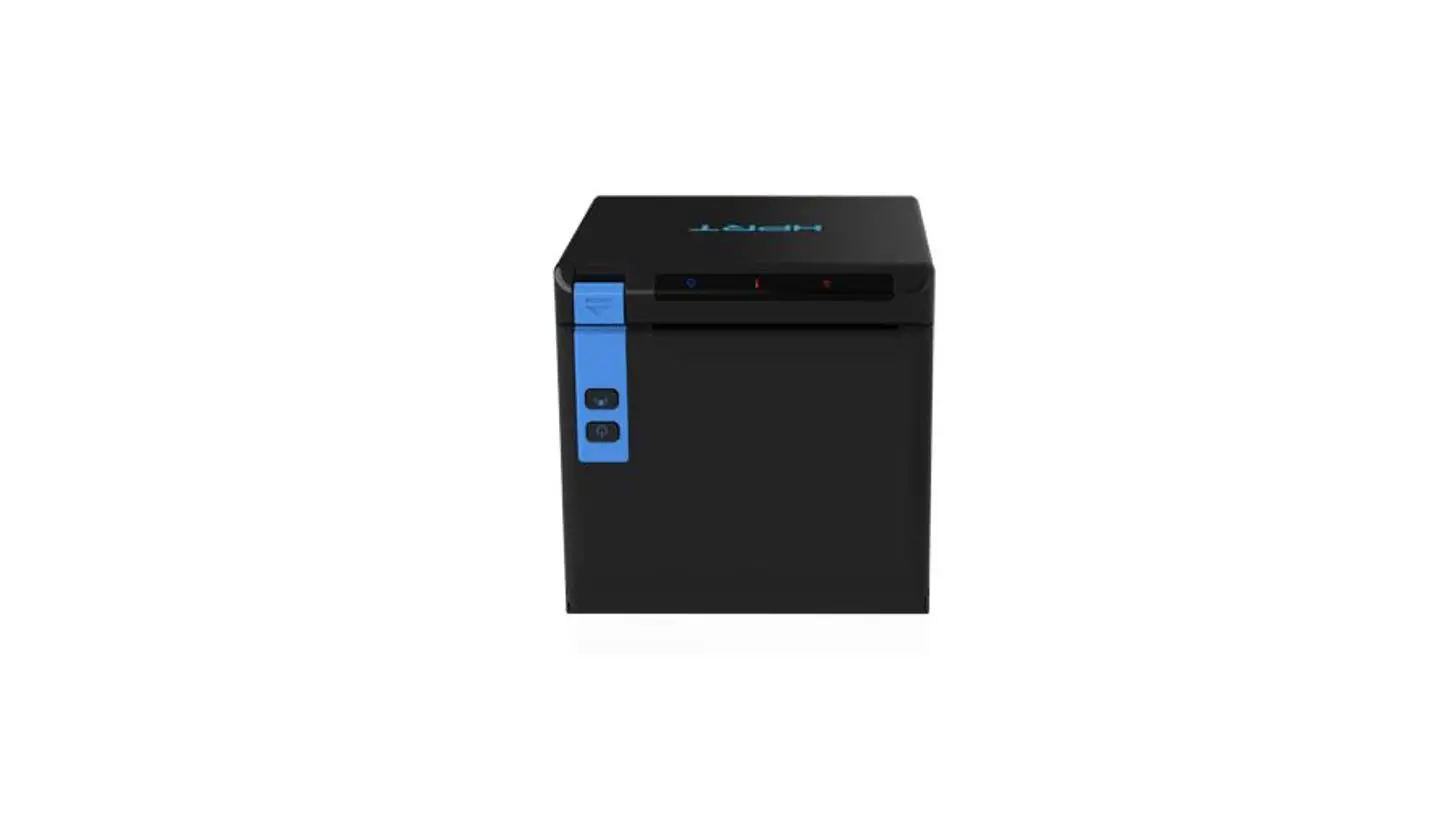

HPRT TP808 Thermal Receipt Printer
Statement
This manual content may be altered without permission, and Xiamen Hanin Electronic Technology Co., Ltd. reserves the rights to make changes without notice in technology, spare parts, hardware and software of the products. If more information is needed about the products, please contact Xiamen Hanin Electronic Technology Co., Ltd. Without any written permission from the company, any section of this manual is prohibited to be copied or transferred in any form.
Copyright
This manual is printed in 2020, the copyright belongs to Xiamen Hanin Electronic Technology Co. Ltd.
Printed in China
Version 1.7
Warnings
This must be complied with in order to avoid any damage to the human body and to the equipment.
This is showing the important information and tips for the printer operating.
Note
Due to continuous update of product, please take in kind of real machine, such as accessories, programs etc.
Important Safety Instructions
- Safety Warning
Warnings: The print head will become very hot during printing; avoid contact with the print head after printing has finished.
Warnings: Do not touch the printer head and connector in case static damage the printer head. - Instructions
Carefully read the installation and operating instructions provided with the printer before starting up your printer.- Place the printer on a flat and stable surface.
- Leave enough space around printer for operation and maintenance.
- Do not place the printer on or near a heat source.
- Do not use the printer near water. Never spill liquid into the printer.
- Do not expose the printer to high temperatures, direct sunlight or dust.
- Protect the printer from shock, impact and vibration.
- Be certain the power source is within the voltage rating and frequency listed for the printer.
- Switch off the printer power supply when won’t use it for a long time.
- Do not place the power cord where it can be stepped on. If the power cord becomes damaged or frayed, replace it immediately.
- To ensure the print quality and reliability, you are suggested to use the recommended paper or the same quality paper.
- Please switch off the power supply when connect/disconnect all the ports or it will cause damage to the printer control circuit.
- Never carry out maintenance or repair work yourself. Always contact a qualified service technician.
- Keep this User Manual in a place which is easily accessible at all times.
- Other Precautions
The copyright for this user manual and various other manuals is property of our company. Any copying or conversion into electronic form and saving of this material without the express written permission is strictly prohibited. Use of the information contained in this manual is not subject to any patent liability. This manual has been prepared with utmost care and attention to detail but may contain certain errors and/or omissions. Our company is not legally liable for any damages resulting from the use of the information in this manual. Our company and its affiliates are not legally liable (United States excluded) for any damages, loss, costs, and/or expenses that result from the breakdown, malfunction, and/or misuse of the product due to violation or neglect of the operation and maintenance information and instructions provided by our company, as well as from the unauthorized alteration, repair, and/or modification of the product by the user and/or third party. We are not legally liable for any damages and/or issues resulting from the use of options and/or parts that are not authentic or authorized products. - .WEEE (Waste Electrical and Electric Equipment)
This mark shown on the product or its literature indicates that the corresponding item should not be discarded at the end of its working life with others household waste. To prevent possible harm to the environment or human health from uncontrolled waste disposal, please separate marked items from other types of waste and recycle them responsibly to promote the sustained reuse of material resources. Household users should contact either the retailer where they purchased this product, or their local government office for details of where and how they can conduct environmentally safe recycling of such items. Commercial users should contact their suppliers and check the terms and conditions of purchase contracts. This product should not be combined with other commercial waste for disposal.
OVERVIEW
Introductions
TP808 is a thermal receipt printer, featured by high print quality, high print speed, high stability, etc. It can be used in commercial POS system, food industry and occasions which need real-time field print receipts.
This printer can connect with other equipment through USB, cash drawer and Wi-Fi interfaces. And the printer drivers are available for the WINDOWS XP/WINDOWS 7/WINDOWS 8/WINDOWS 10/Linux operating system.
The Main Features
- Low noise
- High print speed
- Easy paper loading
- Support page mode printing
- Compatible with various width paper
- Cash drawer interface
- Communication interfaces optional
GETTING STARTED
Packing List
After receiving your printer, please check for possible shipping damage:
- Inspect the outside of both the box and the printer for possible damage.
- Check whether you have received the following accessories together with the printer, if there are any items missing, please contact your local dealer.
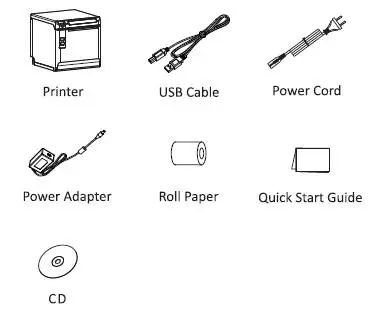
Notes
- The Power adapter and power cord vary by region.
- items in the package are dependent on the actual order.
Appearance and Components
Front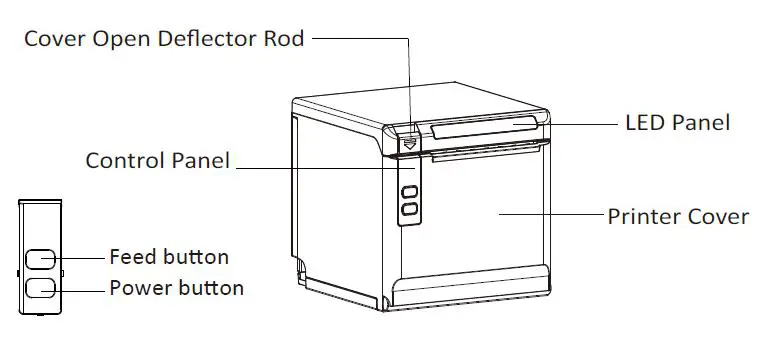
Rear 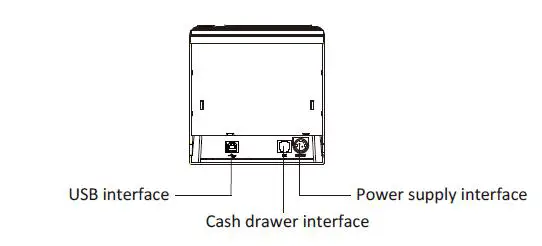
Inside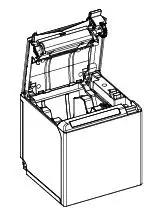
SPECIFICATION
Printer Specification
Table3-1 General Specification
| Item | Parameter | |
|
Printing Parameter | Printing Method | Direct thermal line printing |
| Resolution | 203DPI,8dots/mm | |
| Printing Width | 72mm | |
| Print Speed | Max. 260mm/s | |
| Interface | USB, Cash drawer, Wi-Fi | |
| Print density | Adjustable from level 1 to level 4 | |
| Page Mode | Support | |
| Memory | RAM | 2MB |
| Flash | 4MB | |
|
Fonts | Chinese | GBK 24×24 |
| Alphanumeric | ASCⅡ9×17,12×24. | |
| User-defined | Support | |
|
Code page | PC437(std.Europe), Katakana, PC850(Multilingual), PC860(Portuguese), PC863(Canadian), PC865(Nordic), PC857(Turkish), PC737(Greek), ISO08859-7(Greek), WPC1252, PC866(Cyrillic #2), PC852(Latin 2), PC858(Euro), KU42(Thai), TIS11(Thai), TIS18(Thai), PC720(Arabic), WPC775(Baltic Rim), PC855(Cyrillic), PC862(Hebrew), PC864(Arabic), ISO8859-2(Latin2), ISO8859-15(Latin9), WPC1250(Latin 2), WPC1251(Cyrillic), WPC1253(Greek), WPC1254(Turkish), WPC1255(Hebrew), WPC1256(Arabic), WPC1257(Baltic Rim), WPC1258(Vietnamese), MIK(Cyrillic), PC755(Latin 2), Iran, Iran II, Latvian, ISO-8859-1(WestEur), ISO-8859-3(Latin 3), ISO-8859-4(Baltic), ISO-8859-5(Cyrillic), ISO-8859-6(Arabic), ISO-8859-8(Hebrew), ISO-8859-9(Turkish), PC856, PC3848(ABICOMP), MONGOLIAN, VISCII | |
Table3-1 General Specification(Continued)
| Item | Parameter | |
| Barcode | 1D | UPC-A, UPC-E, EAN8, EAN13, CODE39, ITF, CODEBAR, CODE128, CODE93 |
| 2D | PDF417, QR code | |
| Graphics | Support varied density bitmap and download bitmap printing Max size of each bitmap is 40K, the total size of bitmap is 256K. | |
| Detection | Sensors | Paper end detection, Cover open detection |
| LED Indicator | Power LED | Blue |
| Paper LED | Orange | |
| Error LED | Red | |
| Power Supply | Input | AC100V-240V |
| Output | DC24V, 2.5A | |
|
Paper | Paper type | Specified Thermal Paper |
| Paper width | 58+0 mm/ 80+0 mm -1 -1 | |
| Paper thickness | 0.056~0.13mm | |
| Roll paper diameter | Max. OD ф83mm | |
| Paper load | Easy-loading structure of forward open cover or upward open cover | |
| Paper cut | Partial cut / full cut | |
|
Physical Spec. | Operating condition | 0℃~50℃,20%~85%RH |
| Storage condition | -20℃~70℃,5%~95%RH | |
| Dimensions | 137.3(L)*132(W)*130.5(H)mm | |
| Weight | 1.33kg | |
| Command | ESC/POS | |
| Software | Driver | Windows2000/XP/Vista/Win7/Win8/Win10/POSReady/Linux CUPS/OPOS/ JavaPOS |
| SDK | WinCE, Win Mobile, Android, iOS | |
| Agency Approvals | FCC, CE | |
Printing Media Specification
Continuous Thermal Paper Specification
Paper Type
Specified Thermal Paper
Paper Width
5810 mm/8010 mm
Paper Outer Diameter
Max. 83 mm
Paper Thickness
0.056 ~ 0.13m
| Paper Type | Manufacturer |
| FD210,PD150R,PD160R | OJI Paper CO.,LTD. |
Notes
- Please use the recommended thermal paper or same quality paper, otherwise it will influence the printing quality and decrease the thermal printer head life;
- Don’t stick the paper on the roll paper mandril;
- If the thermal paper is polluted by chemical or oil, the thermal paper heat sensibility decreases, which will influence the printing quality;
- Don’t use finger nail or hard articles to touch the surface of thermal paper, otherwise it will cause color fading;
- When the environment temperature is higher than 70°C, the thermal paper color will fade, so pay attention to the influence of temperature, humidity and sunlight.
Printing and Cutting Position
Printing position
800 mm Print Paper
580 mm Print Paper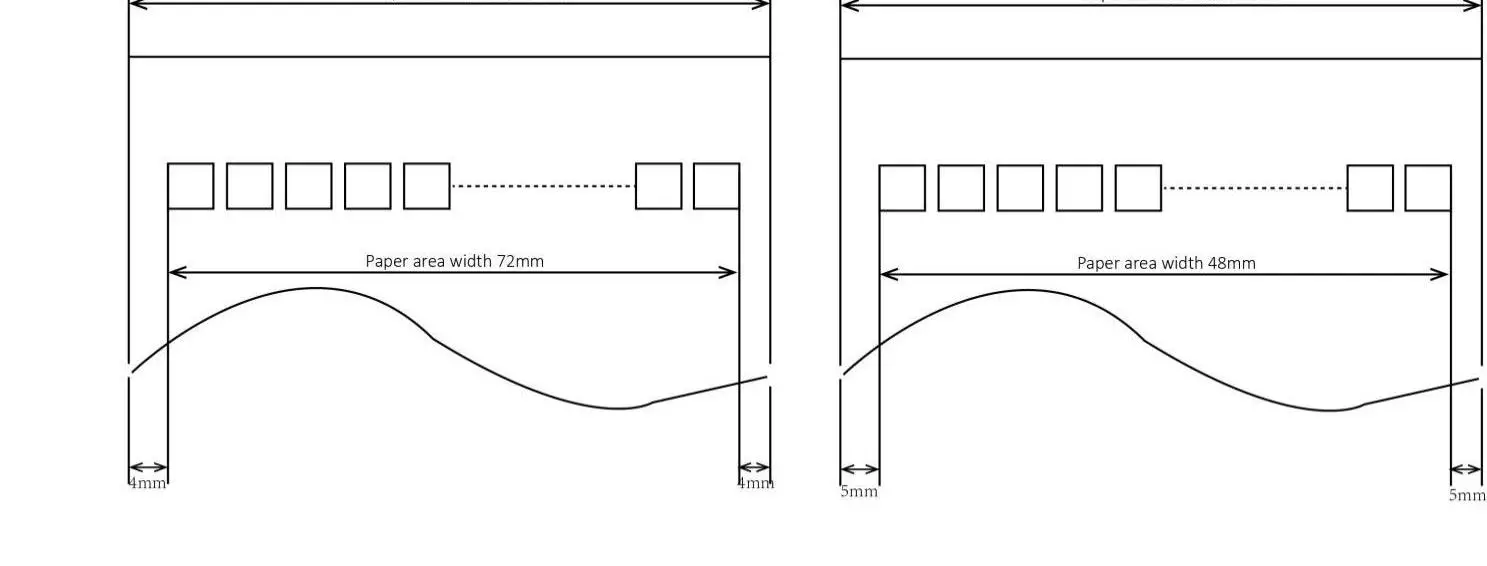
Cutting Position 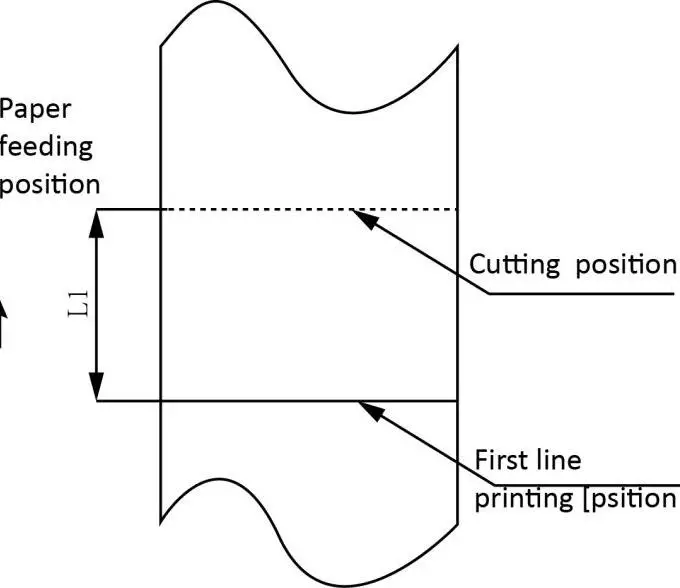
| Type | Paper Cutting Position(L1) |
| TP808 | 11.6mm |
INSTALLATION AND USAGE
Media Loading
Paper Confirmation
- When using 80mm(width) roll paper, take down the paper guide of both sides.
- When using 58mm(width) roll paper, insert the paper guide to each side.
Note: Roll paper should be placed in the middle.
Paper Installation (Forward Paper-out Direction)
- Pull the deflector rod to open the printer cover.
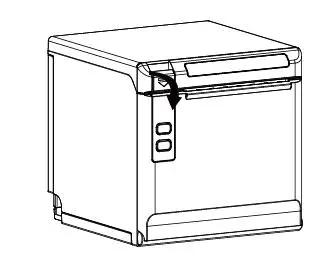
- In the correct direction of the roll paper, insert the paper.
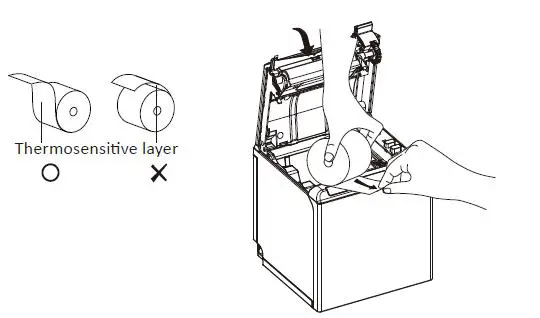
- Pull out some roll paper, and close the printer cover.
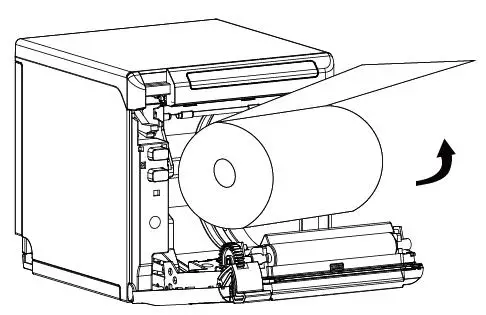
- Tear the extra paper in the direction of the printer.
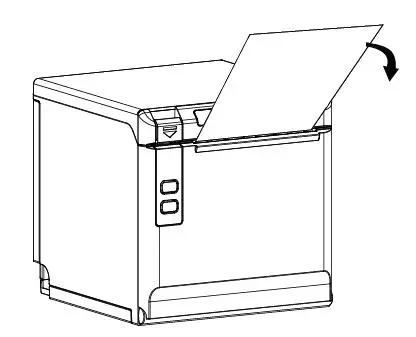
Notes
- Adjust the paper guide according to the paper size;
- Make sure the paper inside is at tight status, or it will cause paper jam or other trouble.
LED Indication and Beeper
Function specification of indicated light and beeper.
| Name | Status | Specification |
| POWER LED (Blue) | ON | The printer works well |
| OFF | The printer does not work | |
| ERROR LED (Red) | Flashing | The printer is in an error state |
| OFF | The printer is in an normal state | |
| PAPER LED (Orange) | ON | The printer is in paper end state |
| OFF | The printer is in an normal state |
| Description | POWER LED | ERROR LED | PAPER LED | Beeper |
| Open the printer cover | ON | ON | ON | “Beep, Beep—, Beep” |
| Paper sufficient | ON | OFF | OFF | Silent |
| No paper | ON | ON | ON | “Beep Beep Beep”. |
| Cutter jam | ON | Flash | OFF | ”Beep—,Beep—” |
Notes
The printer uses a thermistor to detect the temperature of the print head. If the temperature of print head is higher than 65° C, printer will send a warning. If the temperature of print head is higher than 80° C, printer will stop working until the temperature is lower than 60° C.
Power Connection
- Connect power adapter to printer;
- Connect power adapter to power cord;
- Plug the other side of power cord into the socket outlet.
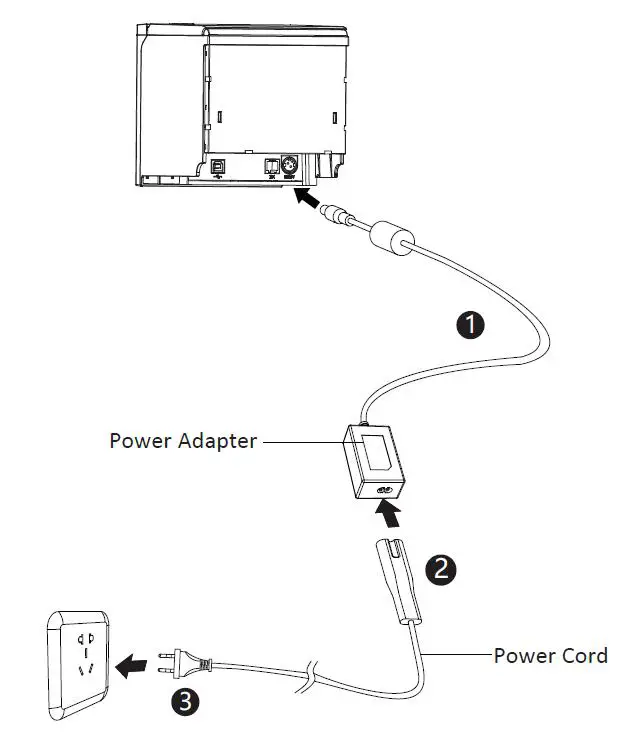
Note: The Power adapter and power cord vary by region.
When pulling out the adapter, please pinch the shell of power adapter and pull the switch up, when the switch is fully opened then pull out the power adapter.
Don’t pull the plug by holding at any other place of the power adapter. Because it is more difficult to pull it out and easy to damage the cable.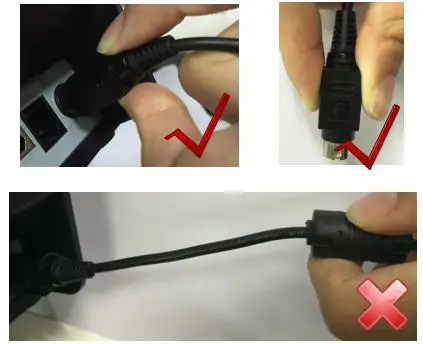
Notes:
- Please only use the power adapter recommended by supplier or equivalent products.
- When disconnecting the power adapter plug, handhold plug connector shell to avoid pulling on the cable in force.
- Avoid dragging the power adapter cable, otherwise it will damage the cables, causing fire and shock.
- avoid putting power adapter around a heating device, otherwise the cable may melt, causing fire and shock.
- If you do not use the printer in a long time, disconnect the power supply of printer power adapter.
Interface Cable Connection
- Make sure the printer’s power switch is turned off;
- Put the interface cable into the matched interface and fixed with screws (or spring) on the plug;
- Connect the other end of the interface cable to the host.
Cash Drawer Connection
- make sure the printer’s power switch is turned off;
- Connect the cash drawer cable into the cash drawer interface on the rear side of the printer.
Warning
Cash drawer interface can only be connected to a voltage of 24V cash drawer device (can’t connect to the phone line, etc.)
Wi-Fi Settings
The printer factory default Wi-Fi mode is AP mode with IP address “192.168.1.1” and SSID
“POS_WIFI”. After the PC or mobile phone is connected with printer successfully, users can set
the parameters through the below link:
Link: http://192.168.1.1/
Access password: 12345678
Please refer to the Wi-Fi Operation Manual for details
Print Test
Print Self-Test
The self-test checks the printer’s current settings, status and whether the printer has any problem.
- Make sure the power is connected and paper is loaded properly.
- Make sure the printer is off and top cover is closed properly.
- Press the paper feed button and power button simultaneously to turn the printer on. The printer is ready to receive data as soon as it completes the self-test.
Printing of Windows Driver Program
- Install the Windows Driver program. (Please refer to the Windows Driver Manual)
- Please set the “Interface” as the type you use.
- Use the Windows Driver Program to print out the “Print Test Page”.
INTERFACES
This printer supports cash drawer interface, USB interface and Wi-Fi interfaces.
USB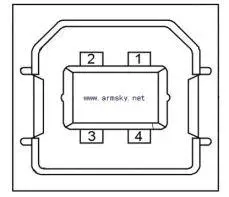
| PIN | SIGNAL NAME |
| 1 | VBUS |
| 2 | D- |
| 3 | D+ |
| 4 | GND |
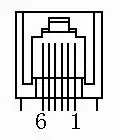
| PIN NO. | Signal Name |
| 1 | FG |
| 2 | Drawer 1 |
| 3 | DRSW |
| 4 | VDR |
| 5 | Drawer 2 |
| 6 | GND |
Electrical characteristics
- Driving voltage:DC 24 V
- Driving current: Maximum 0.8 A ( In 510 ms)
- Drawer check signal:“L” = 0~0.5 V “H” = 3~5 V
Power Supply Interface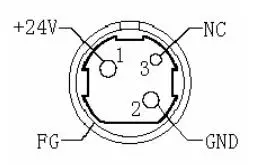
| PIN No. | Signal Name |
| 1 | +24V |
| 2 | GND |
| 3 | N.C |
| SHELL | F.G |
Printer end: Unetop DC-002 or other products of the same type.
User end: Unetop DP-002 or other products of the same type.
TROUBLESHOOTING
Your printer is very reliable, but occasionally problems may occur. This chapter provides information on some common problems you may encounter and how to solve them. If you encounter problems that you can not resolve, contact your dealer for assistance.
Printer Not Working
| Problem Description | Probable Reason | Solution |
| LED does not light, printer is not working | Printer has no power | Connect printer to the power supply |
| Printer is not on | Turn on the printer | |
| Circuit board is broken | Contact with the dealer |
LED Indicator and Beeper
| Problem Description | Probable Reason | Solution |
| Paper LED is always on | Paper near end | The roll paper is near end, the printer can work normally |
| Error LED is always on and beeper alarms | Printer cover is open | Close the printer cover |
| Paper LED and Error LED are always on and beeper alarms | Paper end | Reload the roll paper |
|
Error LED blinks and beeper alarms | Thermal print head is overheated | Turn the printer off and resume when it cools |
| Over-voltage | Print with specified voltage | |
| Low-voltage | Print with specified voltage |
Troubles Occur During Printing
| Problem Description | Probable Reason | Solution |
| Coloured stripe in the paper | Paper near end | Reload the roll paper |
|
Blurred printing or spot | Incorrect roll paper loading | Check if the roll paper is installed |
| Unqualified roll paper | Use recommended thermal roll paper | |
| Dirty thermal head or print roller | Clean the thermal head or print roller | |
| Low print density | Increase the print density level | |
| Paper is not feeding normally | Paper jam | Open the printer cover, check the paper path and remove jammed paper |
| Vertical print words are missing | Dirty thermal head or print roller | Clean the thermal head or print roller |
| Thermal head is damaged | Contact with your dealer for assistance |
Note: Regarding the density of setting, please refer to “Utility Tool Manual”.
Problems Emerge During the Paper Cutting
| Problem Description | Probable Reason | Resolution |
|
Cutter jam, the movable cutter cannot go back | Cutter abrasion, insufficient cutting | Replace the cutter |
| Worn gear and worn wheel abrasion | Replace the worn gear and worn wheel | |
| Motor is burnt | Replace the motor | |
| Paper scraps | Clean the paper scraps on the transmission system | |
| Insufficient cutting | Cutter edge abrasion, paper is too thick | Replace the cutter |
|
Paper jam | Thermal printer head is over-heated | Reduce the density of printing |
| Driving too fast | Reduce the printer speed to the limit of thermal printer head | |
| Wrong paper feeding position | Put the paper parallel with the paper mount and insert into the space between platen roller and the thermal printer head. |
Note: The density of setting, please refer to “Utility Tool Manual”
Removing Jammed Paper
Warning:Do not touch the thermal print head because it becomes very hot after printing.
If the printer cover can be opened, operate it according to the next steps.
- Turn off the printer and pull the deflector rod to open the print cover.
- Remove jammed paper, reload the paper roll, and close the printer cover.
PRINTER CLEANING AND MAINTENANCE
Print quality might be degraded by dust, foreign substance, adhesive substance, or other polluted materials stuck on the printer head or inside the printer.
When printer is dirty, clean the print head as follows:
CAUTION
- Make sure to turn off the printer before cleaning.
- As the print head gets hot during printing, turn the printer off and wait approximately 2~3 minutes before starting cleaning.
- When cleaning the print head, take care not to touch the heated portion of the print head. Print head may be damaged by static electricity, etc.
- Avoid the print head being scratched and/or damaged in any way.
Cleaning Head
- Open the Printer Cover and use a cotton stick with medical alcohol to clean the head in the direction from the center of the head to the edges.
- After cleaning the head, do not use the printer until the alcohol used for cleaning evaporates completely (1~2 min) and the printer is absolutely dry.
Cleaning Sensors, Roller and/or Paper Path
- Open the printer cover and then remove the paper.
- Use dry cloth or cotton swab to remove any dust or foreign substance .
- Soak the cloth or cotton swab in medical-use alcohol and use it to remove adhesive foreign substances or other polluted materials.
- After cleaning the parts, do not use the printer until the alcohol evaporates completely (1~2 min) and the printer is completely dry.
Clean the parts whenever print quality or paper detection degraded.
DOWNLOAD SOFTWARES FROM HPRT WEBSITE
Under URL http://www.hprt.com/Downloads.html,take the following steps to download softwares from HPRT website:
- Choose model name of product -> Choose type -> Choose system
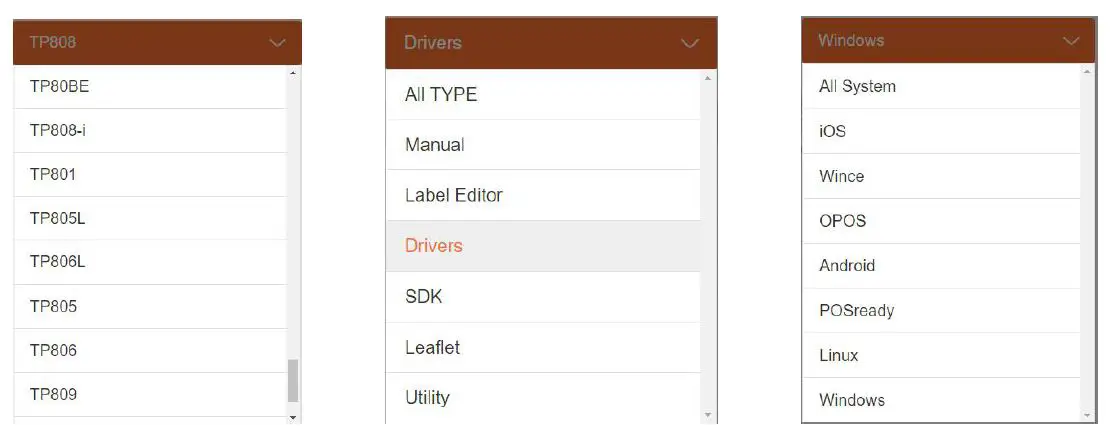
- Click “download”
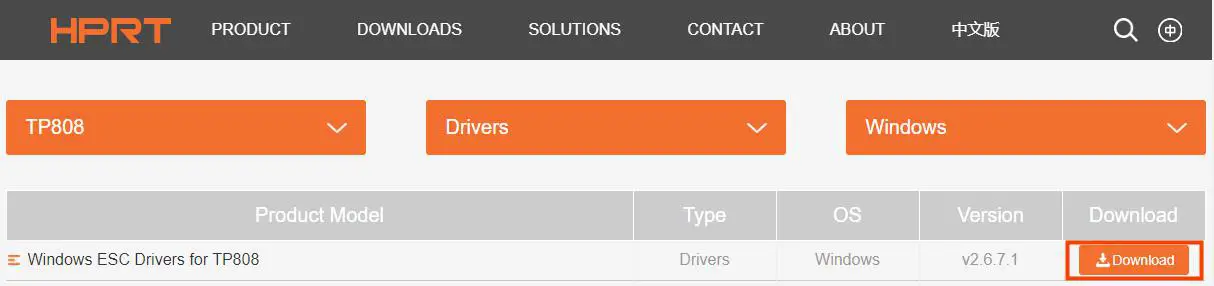
FCC WARNING
This device complies with part 15 of the FCC Rules. Operation is subject to the following two conditions: (1) this device may not cause harmful interference, and (2) this device must accept any interference received, including interference that may cause undesired operation.
Any changes or modifications not expressly approved by the party responsible for compliance could void the user’s authority to operate the equipment.
NOTE: This equipment has been tested and found to comply with the limits for a Class B digital device, pursuant to Part 15 of the FCC Rules. These limits are designed to provide reasonable protection against harmful interference in a residential installation. This equipment generates, uses and can radiate radio frequency energy and, if not installed and used in accordance with the instructions, may cause harmful interference to radio communications. However, there is no guarantee that interference will not occur in a particular installation.
If this equipment does cause harmful interference to radio or television reception,
which can be determined by turning the equipment off and on, the user is encouraged to try to correct the interference by one or more of the following measures:
- Reorient or relocate the receiving antenna.
- Increase the separation between the equipment and receiver.
- Connect the equipment into an outlet on a circuit different
- from that to which the receiver is connected.
- Consult the dealer or an experienced radio/TV technician for help.
To maintain compliance with FCC’s RF Exposure guidelines, This equipment should be installed and operated with minimum distance between 20cm the radiator your body: Use only the supplied antenna.
EC DECLARATION OF CONFORMITY
The manufacturer certifies that the following designated product
Type of product
Direct Thermal Line Printing It is in conformity with the standards
Test standard information
Under the Council Directive: (LVD) Directive 2014/35/EU relating to electrical equipment designed for use within Low Voltage Directive.
EN 62368-1:2014+A11:2017
Under the Council Directive: (EMC) Directive 2014/30/EU relating to Electro Magnetic Compatibility.
EN 55032: 2015+AC:2016
EN 55035: 2017
EN 61000-3-2: 2014
EN 61000-3-3: 2013
We declare herewith that as a result of the manner in which the device designated Below was designed, the type of construction and the devices which, as a result, have been brought on to the general market comply with the relevant fundamental regulations of the EC Rules for Safety. And we declare herewith the below-mentioned model is in conformity with Directive 2014/30/EU and 2014/35/EU. In the event of any alteration which has not been approved by us being made to any device as designated below, this statement shall thereby be made invalid.
The declaration is the sole responsibility of the manufacturer Name of the manufacturer
 HPRT | Printer, Label Printer, QR Code Scanner Manufacturer