 Operation & Maintenance Manual
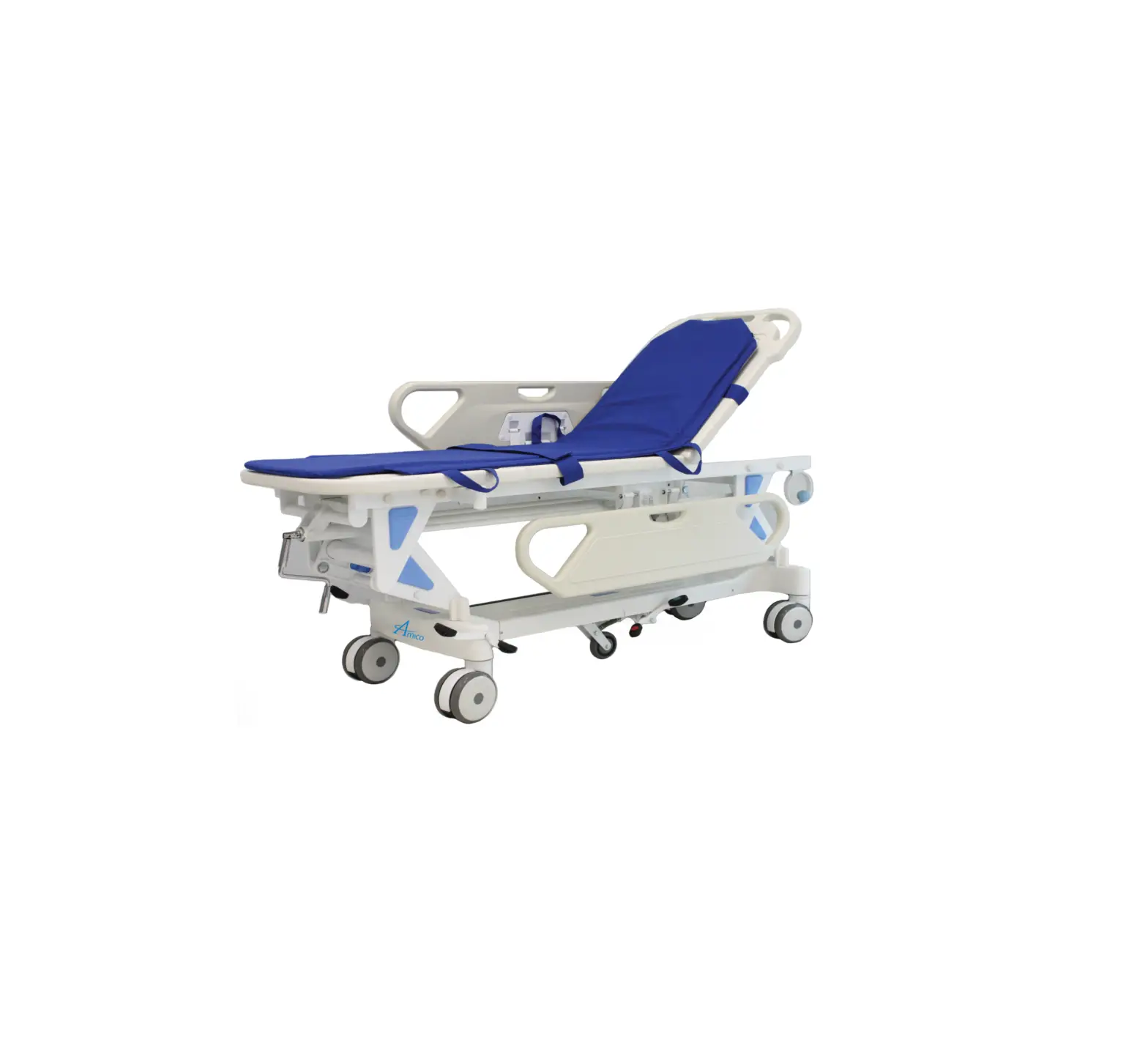
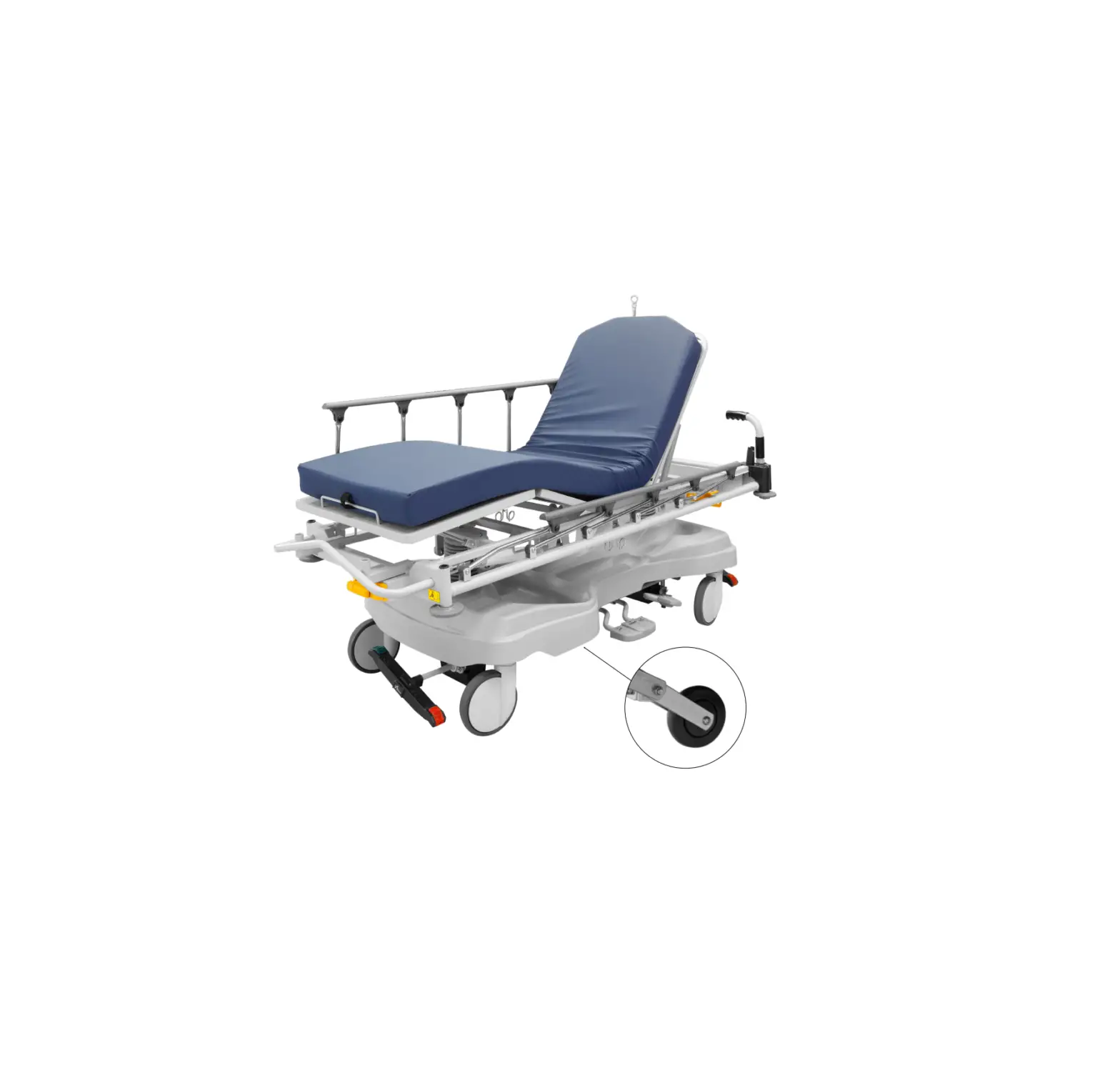
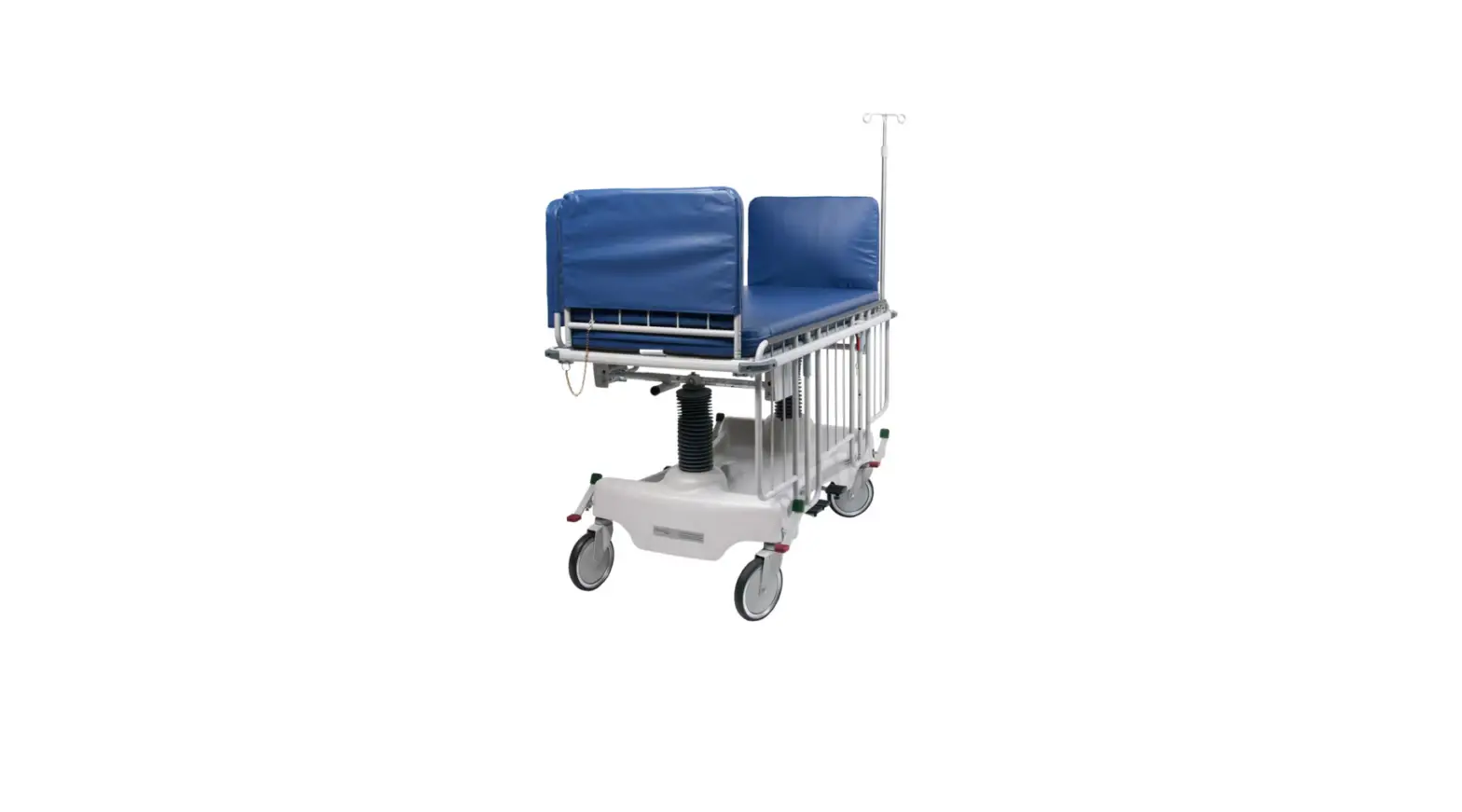
Hydraulic Patient Transfer Stretcher
S-H-300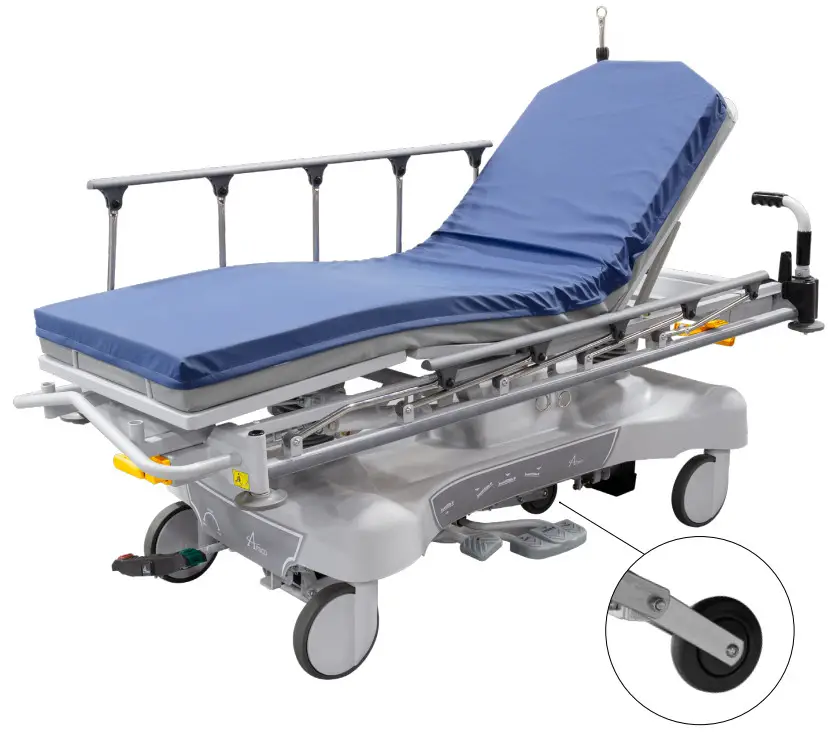
Intended Use
The Amico Hydraulic Patient Transfer Stretcher (S-H-300) is intended for patients in all areas of the hospital and in ambulatory surgical centers.
Introduction
This manual provides instructions required for normal operation of the Hydraulic Patient Transfer Stretcher (S-H-300) from Amico Beds Corporation. Prior to operation of this stretcher, it is important that this manual is read to ensure that all safety aspects contained in this manual are strictly adhered to.
The Hydraulic Patient Transfer Stretcher (S-H-300) is designed to be user-friendly and incorporates distinctive features which bring efficiency to the medical and surgical environment.
The movements of the Hydraulic Patient Transfer Stretcher (S-H-300) are controlled by the caregivers via pedals located around the center of the base. Pedals are located on each side of the stretcher. One pedal is used to raise the stretcher and the other pedal is used to either lower or set the stretcher in Trendelenburg or reverse Trendelenburg position.
The stretcher also features several standard functions such as a central brake locking system, adjustable fowler section, radiolucent board, adjustable knee section, and roller bumpers.
Description of Symbols
This document contains different typefaces and symbols designed to improve readability and increase understanding of its content.
WARNING AND CAUTION WARNING: Identifies situations or actions that may affect patient or user safety. Disregarding a warning could result in patient or user injury. CAUTION: Points out special procedures or precautions that personnel must follow to avoid equipment damage.
CAUGHT HAZARD WARNING This symbol highlights a CAUGHT HAZARD WARNING.
| Symbol | Description |
 | Type B applied part according to IEC 60601-1 (UL 60601-1). |
 | According to IEC 60529, rating for protection against fluid ingress and identified as equipment that is protected against spraying and splashing water. |
 | Ordinary equipment not rated for fluid ingress per IEC60529. This applies to exam light control box ONLY. |
 | CAUTION: Consult accompanying documents. |
 | Medical electrical equipment classified by Underwriters Laboratories inc. with respect to electric shock, fire, and mechanical hazards only in accordance with UL60601-1, CAN/CSA C22.2 No. 601.1, IEC60601-1-2-38, and IE60601-2-46. |
 | CPR control – Activates the CPR function. |
 | Stretcher down control – Shows which way the stretcher will move when the pedal is pressed. |
 | Stretcher up control – Shows which way the stretcher will move when the pedal is pressed. |
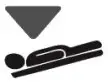 | Trendelenburg control – Puts the stretcher in the Trendelenburg position. |
 | Reverse Trendelenburg control – Puts the stretcher in the reversed Trendelenburg position. |
 | Siderail latch release – To lower the siderail. |
 | Keep hands clear. |
 | Safe working load – Shows the safe working load of the stretcher. |
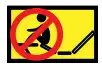 | CAUTION: Do not sit on foot section of stretcher while knee section is raised. |
Specifications
| Model Number | Model Identification Description | |
| S-H-300 | Manual Stretcher with Hydraulics | |
| Feature | Dimension (inches) | Dimension (cm) |
| Total Length | 85. | 214 |
| Maximum Width | 33 | 84 |
| Mattress to Siderail Height | 12 | 30 |
| Maximum Under Bed Clearance | 6 | 15 |
| Surface Dimensions | ||
| Surface Width | 25 | 64 |
| Surface Length | 75 | 191 |
| Surface Mattress Thickness | 4 | 10 |
| Litter Section | ||
| Fowler Length | 29. | 72 |
| Fowler Width | 25. | 62. |
| Seat Length | 12. | 31 |
| Seat Width | 25. | 62. |
| Knee Gatch Length | 12. | 31 |
| Knee Gatch Width | 25. | 62. |
| Foot Section Length | 20 | 51 |
| Foot Section Width | 25 | 62. |
| Caster Size | 8″ diameter | 20 cm diameter |
| Stretcher Lift Capacity | 550 lbs | 250 kg |
| Total Weight without Surface | 300 lbs max 136 kg maximum | |
| Head Section Inclination (maximum) | 80° ± 5 | |
| Knee Section Inclination (maximum) | 30° ± 5 | |
| Stretcher Height Range, Lowest Position* | 22. | 55 |
| Stretcher Height Range, Highest Position* | 34 | 86 |
| Trendelenburg Position (maximum) | 16° | |
| Reverse Trendelenburg Position (maximum) | 16° | |
| Environmental Conditions for Transport and Storage | ||
| Temperature | -40° F to 158° F (-40° C to 70° C) | |
| Relative Humidity | 95% non-condensing | |
| Pressure | 50 kPa to 106 kPa | |
| Environmental Conditions for Use | ||
| Temperature | 50° F to 95° F (10° C to 35°C) | |
| Relative Humidity | 20% to 85% non-condensing | |
| Pressure | 70 kPa to 106 kPa | |
| Classification and Standards | ||
| UL 60601-1 | ||
| CSA C22.2 No 601.1-M90 | ||
| IEC/EN 60601-1 | ||
| Equipment Classification per IEC 60601-1 | Type B | |
| Level of Protection Against Ingress of Water | IPX4 | |
Features
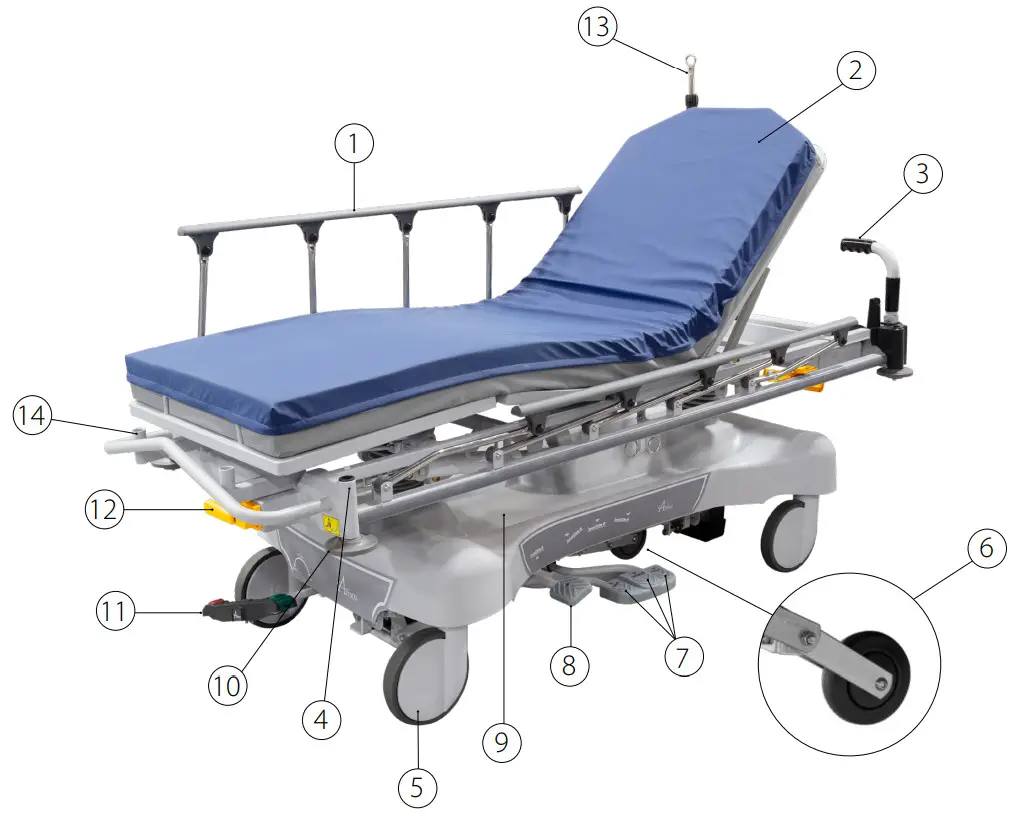
| Item | Description |
| 1 | Retractable siderails with full length bumper |
| 2 | Mattress |
| 3 | Transport handles |
| 4 | IV pole mounting socket |
| 5 | 8″ (203 mm) urethane casters |
| 6 | Fifth wheel |
| 7 | Down/Trendelenburg/reverse Trendelenburg/low control pedals |
| 8 | Pump pedal |
| 9 | Oxygen tank holder and patient item storage |
| 10 | Corner bumpers |
| 11 | Brake & neutral pedal |
| 12 | Knee surface articulation crank |
| 13 | Permanent IV pole |
| 14 | Utility tray mounting sockets |
Siderail Positions
WARNING: Evaluate patients for entrapment risk according to facility protocol and monitor patients
appropriately. Ensure that all siderails are fully latched when in the raised position. Failure to do either of
these could result in serious injury or death.
NOTES: Siderails are intended to be a reminder to the patient of the unit’s edges, not a patient-restraining device.
When appropriate, Amico recommends that medical personnel determine the proper methods necessary to ensure a
patient remains safely in the stretcher.
TO RAISE A SIDERAIL
a. Pull the siderail up until it locks into place. A “click” will be heard as the rail lock engages.
b. To make sure the siderail is fully latched, try pivoting the siderail down.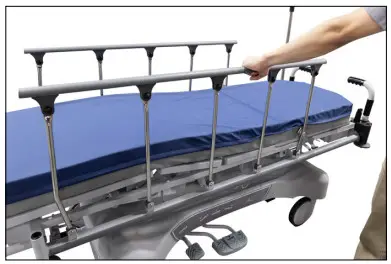 TO LOWER A SIDERAIL
a. Grasp the top of the siderail and pull it slightly towards the foot of the stretcher.
b. Locate and depress the siderail lever.
c. Rotate the siderail down while the siderail lever is depressed.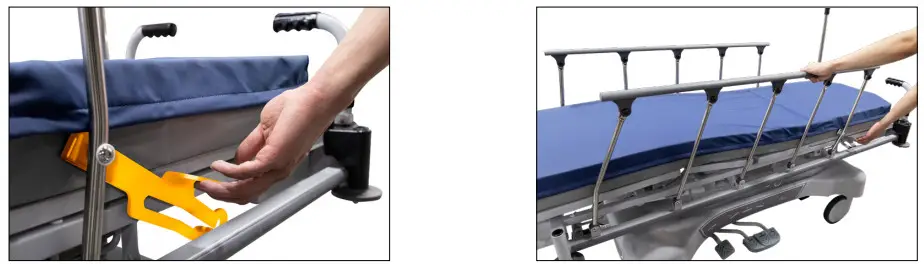
IV Pole Mounting Sockets
An IV pole mounting socket is located at each corner of the stretcher.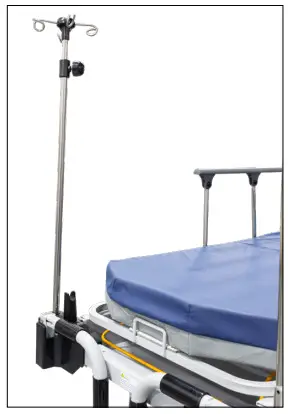 Mattresses
WARNING: Only mattresses that meet Amico specifications and recommendations should be used. Failure to do so could reduce the effectiveness of the safety features and systems incorporated into the stretcher.
Personal injury or equipment damage could occur.
Push Handles
The push handles located at the head and foot ends of the stretcher are used to move the stretcher.
a. Lift up the push handle and rotate it into the push position. The handle should automatically drop into its locked position for pushing.
b. Lower the push handle by pulling up on the handle and rotating it to the stored position.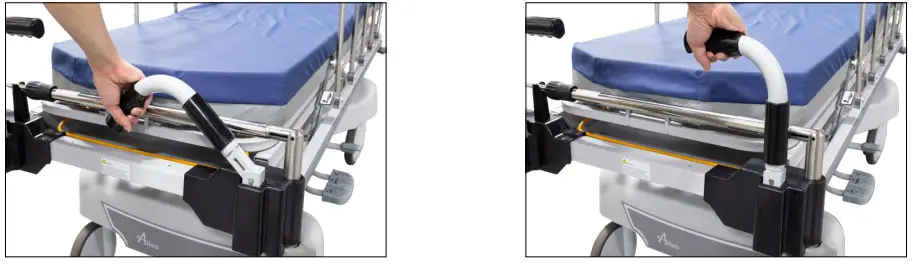 Brake/Steer System
The brake/steer pedals are located at both the head and foot of the Hydraulic Patient Transfer Stretcher (S-H-300) and it is equipped with a central brake system.
WARNING: Unless transporting the patient, always set the brakes when the stretcher is occupied. Reconfirm that the brakes are set before any patient transfer. Failure to do so may result in injury or equipment damage.
To set the brakes, press on the RED side of the brake pedal. All four casters will lock.
To set the stretcher to steer, press on the GREEN side of the brake pedal. This will activate fifth wheel. This is used to keep the stretcher moving in a straight line and to make it easier to turn corners.
To set the stretcher to neutral, set the brake pedal to the middle position. When in neutral, the brake pedal will be horizontal. This allows the stretcher to move in a side-to-side motion.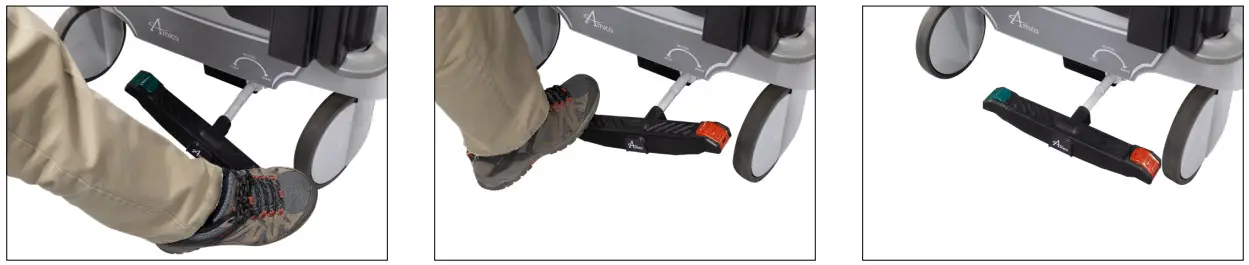
Hi-Lo Control
The Hi-Lo function foot pedals are on each side of the stretcher.
TO RAISE THE STRETCHER
Press the up control pedal and pump it until the desired height is reached.
TO LOWER THE STRETCHER
Press and hold the down control pedal until the desired height is reached.
WARNING: It is recommended that the stretcher be in the lowest position when the patient is unattended. This may help reduce the severity of any injuries resulting from patient falls. WARNING: Use caution when lowering the stretcher. Make sure items in the storage compartment do not interfere with the upper frame or siderail mounting brackets otherwise equipment damage could occur.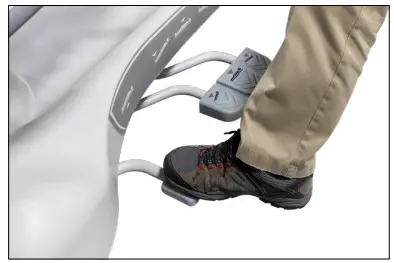
Down/Trendelenburg/Reverse Trendelenburg
WARNING: When changing the stretcher’s position, make sure hands, feet, and equipment are clear of the stretcher’s frame assemblies. Failure to do so could result in injury or equipment damage.
The Trendelenburg/reverse Trendelenburg function control pedals are located on each side of the stretcher.
TO PUT THE STRETCHER IN THE TRENDELENBURG POSITION
a. Put the stretcher in its raised position (see “Hi-Lo Control” on page 10).
b. Press the Trendelenburg control pedal, and hold it until the desired angle is reached.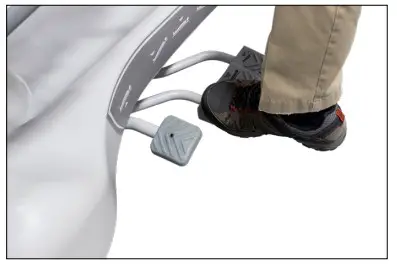 TO PUT THE STRETCHER IN THE REVERSE TRENDELENBURG POSITION
a. Put the stretcher in its raised position (see “Hi-Lo Control” on page 10).
b. Press reverse Trendelenburg control pedal, and hold it until the desired angle is reached.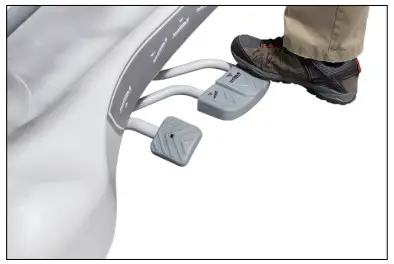 TO LEVEL THE SLEEP SURFACE
a. Press the down control pedal to lower the stretcher to its lowest position. The sleep surface levels automatically.
b. If the stretcher is in the Trendelenburg position, press the reverse Trendelenburg control pedal until the stretcher is level.
c. If the stretcher is in the reverse Tredelenburg position, press the Trendelenburg control pedal until the stretcher is level. 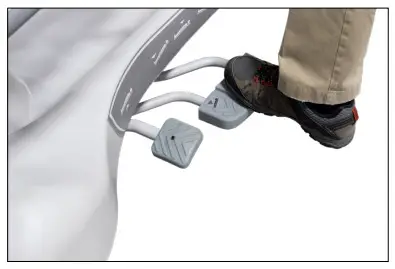
Head Section Articulation
WARNING: Surface positions that cause the patient’s torso to be at an angle less than 90° to the legs could reduce circulatory efficiency in the lower extremities. Such positions are not recommended for extended periods of time and should be under medical supervision. Patient injury could occur. WARNING: Make sure to fully control the lift mechanism when there is little or no weight on it. Failure to do so could cause it to rise quickly and cause injury or equipment damage.
TO RAISE THE HEAD SECTION
a. Squeeze the bar under the head section and lift up on the head section.
b. Release the bar when the desired position is reached. The head section locks in place.
TO LOWER THE HEAD SECTION
a. Squeeze the bar under the head section and push down on the head section.
b. Release the bar when the desired position is reached. The head section locks in place.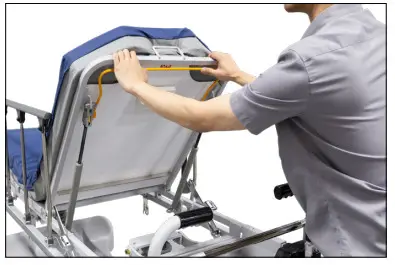
Knee Surface Articulation Crank
TO RAISE THE KNEE SURFACE
a. Pull out the crank handle from its stored position under the foot section.
b. Turn the crank handle clockwise until the knee surface reaches the desired position.
TO LOWER THE KNEE SURFACE
a. Pull out the crank handle from its stored position under the foot section.
b. Turn the crank handle counter-clockwise until the knee surface reaches the desired position.
After raising or lowering the knee surface, return the crank to its stored position. 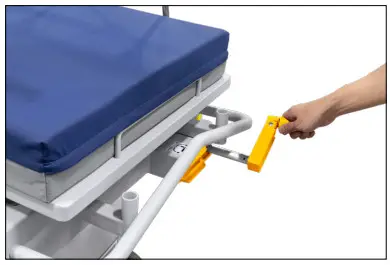
Permanent Telescopic IV Pole
The permanent IV pole is available as an option on the Hydraulic Patient Transfer Stretcher (S-H-300).WARNING: Do not exceed the load capacity of the IV pole. If the IV pole is overloaded, personal injury or equipment damage may occur. The safe working load of the pole is 30 lbs.
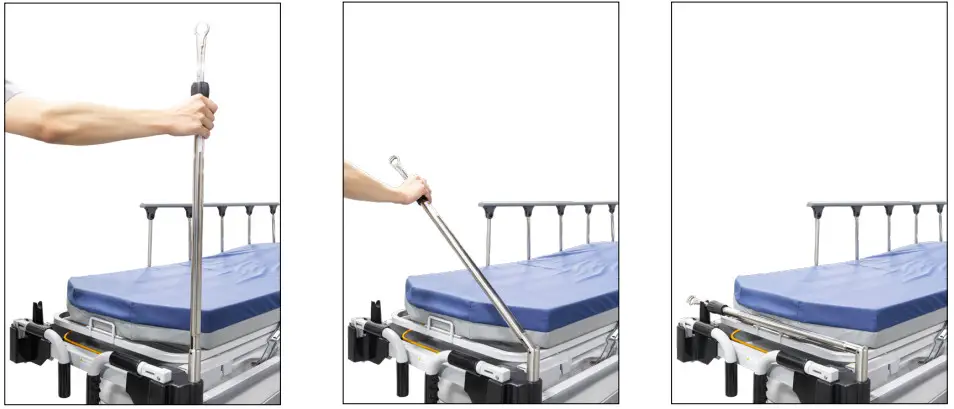
TO RAISE THE PERMANENT IV POLE
a. Grasp the stored IV pole and raise it from its stored position. Make sure it is secure in its support bracket, with the sleeve over the support bracket.
b. Grasp the top section of the IV pole, and raise it until the desired height is reached. Screw back knob to hold the IV pole in position.
TO LOWER THE PERMANENT IV POLE
a. Unscrew the knob to release the IV pole.
b. Manually lower the top section of the pole until it fully collapses.
c. Screw back knob to hold the IV pole in position.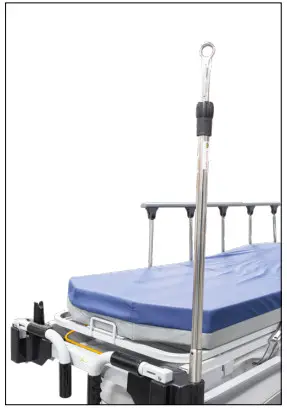
Safety Tips
BRAKES WARNING: Unless transporting the patient, always set the brakes when the stretcher is occupied. Reconfirm that the brakes are set before any patient transfer. Failure to do so may result in injury or equipment damage. Patients often use the stretcher for support when getting out of the stretcher and could be injured if the stretcher moves unexpectedly. After setting the brakes, push and pull the stretcher to make sure it is stable.
SIDERAILS/RESTRAINTS/PATIENT MONITORING WARNING: Evaluate patients for entrapment risk according to facility protocol and monitor patients appropriately. Make sure that all siderails are fully latched when in the raised position. Failure to do either of these could result in serious injury or death.
NOTE: Siderails are intended to be a reminder to the patient of the stretcher’s edge, not a patient-restraining device. When appropriate, Amico recommends that medical personnel determine the proper methods necessary to make sure a patient remains safely in the stretcher.
Siderails may serve several beneficial uses including providing an edge reminder and stretcher exit assist. The uses of siderails may also provide a sense of security. The use of siderails in any position should be appropriate for the patient’s need, after assessing any risk factors according to the facility protocols for safe positioning.
When raising the siderails, a click indicates that the siderails are completely raised and locked in place. Once the click is heard, gently pull on the siderail to make sure it is latched correctly in position.
WARNING: Patient restraints are not intended as substitutes for good nursing practices. Physical restraints, even properly installed, can result in entanglement, physical injury, or death, particularly with agitated and disoriented patients. Monitor patients when using physical restraints in accordance with legal requirements and facility protocols.
- Develop guidelines for all patients, indicating:
• Which patients may need to be restrained and the appropriate restraint to utilize.
• The proper method to monitor a patient, whether restrained or not, including time interval, visual check of restraint, etc. - Develop training programs for all caregivers concerning the proper use and application of restraints.
- Clarify the need for restraint devices to families or guardians.
- Set the stretcher at its lowest position whenever a caregiver is not in the room.
For restraining devices, consult the restraint manufacturer to verify the correct application of each restraining device.
PARTS AND ACCESSORIES
Use only Amico parts and accessories. Modification of the stretcher shall be at the customer’s risk and liability.
OPERATING STRETCHER/SURFACE PRECAUTIONS WARNING: Do not operate the stretcher in the presence of flammable gas or vapors. Doing so could result in
personal injury or equipment damage. WARNING: Only use oxygen administering equipment of the nasal, mask, or ventilator type, or oxygen tents
that can be contained within the perimeter of the siderails in the stretcher. Failure to do so could result in
personal injury or equipment damage. WARNING: Operate the stretcher within the stated environmental conditions (see “Specifications” on
page 3). Failure to do so could result in patient injury or equipment damage.
TRANSPORT CAUTION: Before moving the stretcher, make sure that power cords, hoses, and other equipment are properly stored. Failure to do so could result in equipment damage. CAUTION: Do not push or pull the stretcher by IV poles, siderails, or other equipment. Use the push handles located at the head or foot of the stretcher. Use only the transport handles (if installed) to move the stretcher. Failure to do so could result in equipment damage.
Make sure the patient, equipment, and all lines are securely placed within the perimeter of the stretcher for intrahospital transport. Patients should only be transported with the foot end of the stretcher facing forward.
Fully extended IV poles could impact doorways or ceiling fixtures. IV poles should be lowered prior to patient transport.
SLEEP SURFACE/MATTRESS
WARNING: Sleep surface impermeability could be affected by needle sticks. Caregivers should be instructed to avoid punctures caused by improper use of X-Ray cassette holders and/or needle sticks. Failure to do so could result in cross-infection and patient injury.
The sleep surface should be regularly inspected for punctures, rips, tears, or other such damage. Replace the surface as necessary.
FLAMMABILITY WARNING: Patients should not be allowed to smoke in the stretcher. Sheets and pillows generally do not have flame retardant properties. Personal injury or equipment damage could occur.
Reduce the possibility of fires by observing fire prevention rules and regulations. Make sure facility personnel follow the safety tips in the FDA Public Health Notification: Safety Tips for Preventing Hospital Bed Fires.
SPRAY WASHING CAUTION: Do not directly spray the hydraulic cylinders. Equipment damage could occur. CAUTION: Do not exceed 25 psi (172 kPa) when spray washing. Equipment damage could occur.
The stretcher can be spray washed as necessary. Use a maximum nozzle pressure of 25 psi (172 kPa) at a distance of 6″ (152 mm). Spray wash comprised of water only should not exceed a temperature of 180° F (82° C). Spray wash comprised of detergent or solvents (no bleach) should not exceed a temperature of 120° F (50° C). After washing, seal any exposed chipped steel parts, or oxidized areas with a coat of touch-up paint.
Replacements Parts
| Description | Part Number |
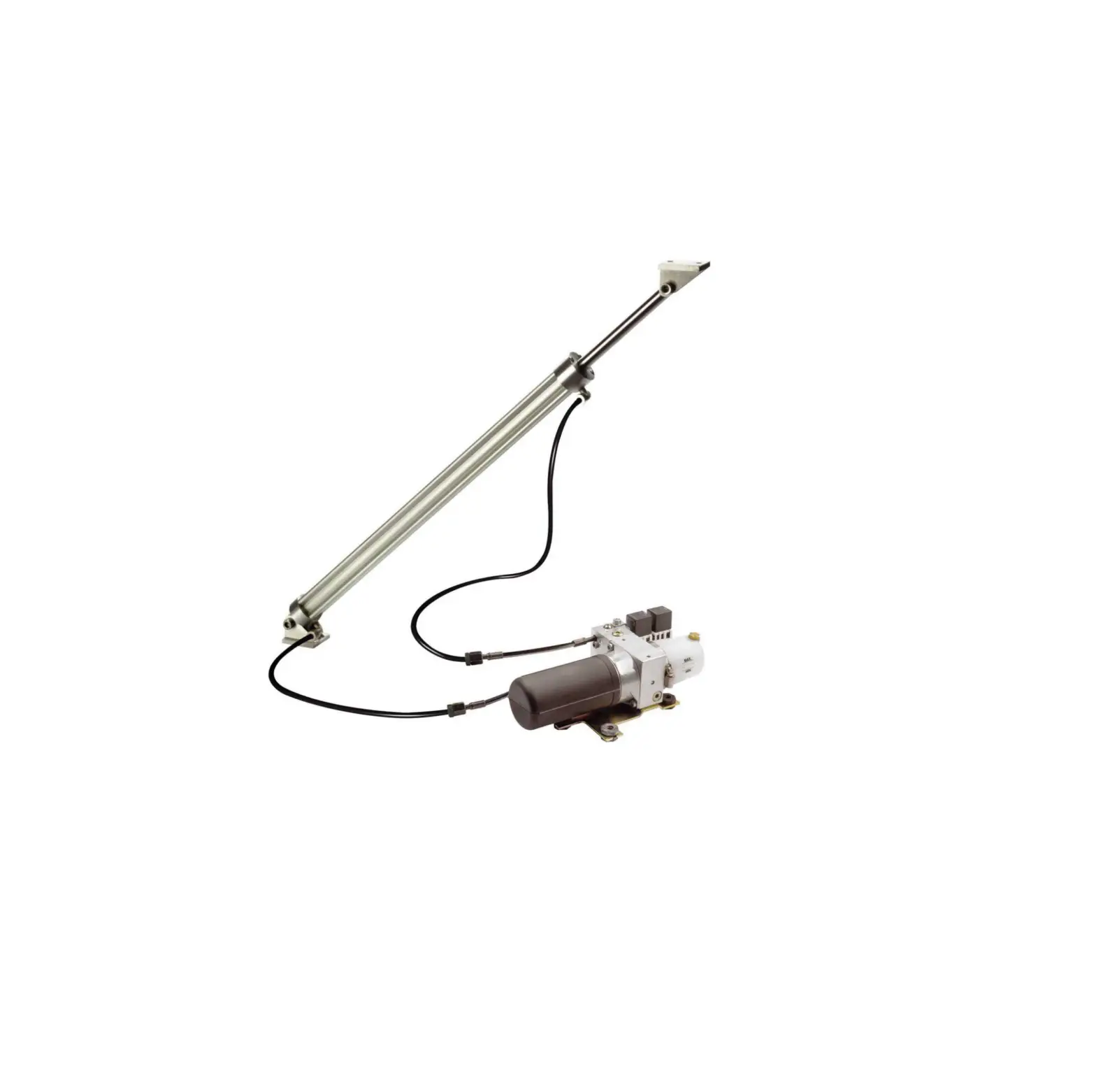
| Hydraulic Actuator | B-ST-ACT-01 |
| Siderail Assembly | S-SIDERAIL-001 |
| Base Cover | S-X-COVER-BASE-01 |
| Roller Bumper | S-X-ROLLER-BUMPER |
| Oil Pan | S-X-OILPAN |
| Tente® Wheel Caster | S-CAS-ST-08B1 |
| IV Hook | S-X-IVHOOK |
| Brake Pedal | NS-H300-BRAKEPEDAL |
Preventive Maintenance
WARNING: Only facility-authorized personnel should service the Hydraulic Patient Transfer Stretcher (S-H-300). Servicing performed by unauthorized personnel could result in injury or equipment damage.
The Hydraulic Patient Transfer Stretcher (S-H-300) requires an effective maintenance program. We recommend that you perform annual preventive maintenance (PM) and testing for Joint Commission on Accreditation of Health Care Organizations (JCAHO). PM and testing not only meet JCAHO requirements but will help ensure a long, operative life for the Hydraulic Patient Transfer Stretcher (S-H-300). PM will minimize downtime due to excessive wear.
Perform annual preventive maintenance procedures to make sure all Hydraulic Patient Transfer Stretcher (S-H-300) components are functioning as originally designed. Pay particular attention to safety features, including but not limited to the following:
- Siderail latching mechanisms
- Caster braking systems
- Integrity of sleep surface ticking
- Hydraulic functionality
- Integrity of warning/caution labels
- Oil leakage from hydraulic piston
Cleaning
BLEACH CLEANING INSTRUCTIONS
If none of the approved cleaning products provide the disinfectant level required then use a solution of 5.25% Sodium Hypochlorite diluted to 1 part bleach to 50 parts water (1,000 ppm) (volume to volume).
Bleach products are corrosive and degrading in nature and may cause damage to your product. If bleach is used, measures must be taken to ensure the product is rinsed thoroughly with clean water and thoroughly dried. Failure to rinse and dry the product will leave a corrosive residue on the surface possibly causing corrosion.
- Failure to follow the above directions may void the product’s warranty.
- Do not immerse the product in water.
- Do not attempt to clean or degrease the steel shafts of the hydraulic actuators.
- Use only approved cleaning products. If bleach is being applied to the product, strictly adhere to the Bleach Cleaning Instructions.
- Do not use a water temperature of more than 50° C or F.
All Surfaces
- For mattresses please refer to mattress cleaning instructions.
Before Cleaning
- Set the stretcher on brake by pressing on the brake pedals to the brake position.
During Cleaning
- Do not use abrasive cleaning products.
- Do not use oil based products.
- Do not use a steam cleaner, washing tunnel, high-pressure spray, or hose.
To Wash
- Wipe with a sponge or soft cloth wetted with warm water containing soap or mild detergent.
To Dry
- Thoroughly wipe with a dry sponge or soft cloth.
To Disinfect
- Wash the surface with one of the approved cleaners or refer to the Bleach Cleaning Instructions on page 16 if bleach needs to be used.
- Wipe off residue with water using a soft cloth or sponge.
- Thoroughly dry.
MATTRESS CLEANING INSTRUCTIONS
To Wash
- Wipe with a sponge or soft cloth wetted with warm water containing soap or mild detergent.
To Rinse
- After washing, rinse cover with warm water to remove residue.
To Dry
- Thoroughly wipe with a dry sponge or soft cloth.
To Disinfect
- Wash the surface with one of the approved cleaners or refer to the Bleach cleaning instructions if bleach needs to be used.
- Wipe off residue with water using a soft cloth or sponge.
- Thoroughly dry.
Before Cleaning
- Disconnect or unplug the power cord from the mains supply (If electric).
- Set the bed brake on by pressing on the brake pedals to the brake position.
During Cleaning
- Do not use abrasive cleaning products.
- Do not use oil based products.
- Do not use a steam cleaner, washing tunnel, high-pressure spray, or hose.
Warranty Policy
Amico Beds Corporation warrants its Patient Equipment to be free from defects in material and workmanship for a period of twelve (12) months from the date of shipment. Within this period Amico Beds Corporation will provide the parts for repair or replacement of defective parts at Amico Beds Corporation cost.
Shipping and Installation costs after the first twelve (12) months will be borne by the Customer.
This warranty is valid only when the product has been properly installed according to Amico Beds Corporation specifications, used in a normal manner and serviced according to factory recommendations. It does not cover failures due to damage which occurs in shipments or failures which result from accidents, misuse, abuse, neglect, mishandling, alteration, misapplication or damage that may be attributable to acts of God.
Amico Beds Corporation shall not be liable for incidental or consequential damages resulting from the use of the equipment.
www.amico.com
Amico Beds Corporation
85 Fulton Way, Richmond Hill, ON L4B 2N4, Canada
Toll Free Tel: 1.877.462.6426
Tel: 905.764.0800
Fax: 905.764.0862
Email: [email protected]
www.amico.com
AB-IM-S-H-300-HYDRAULIC-PATIENT-TRANSFER-STRETCHER 12.19.2022
 Amico Group of Companies | Home Page