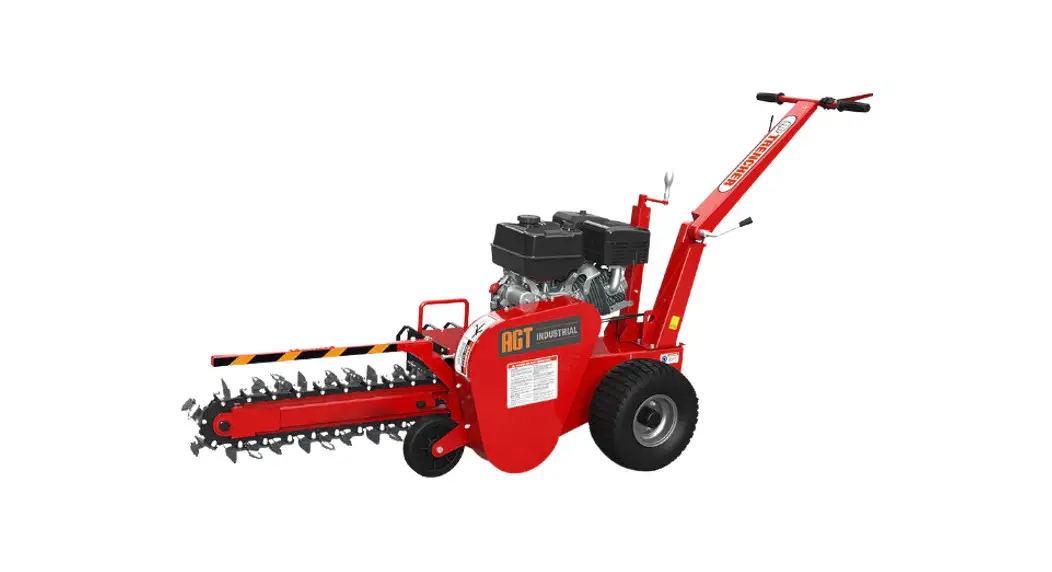
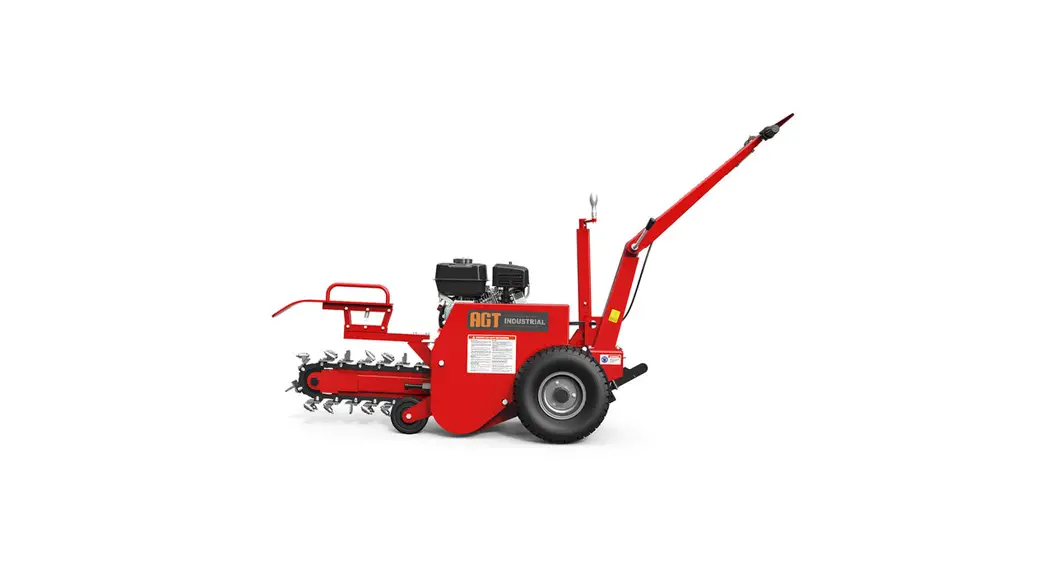
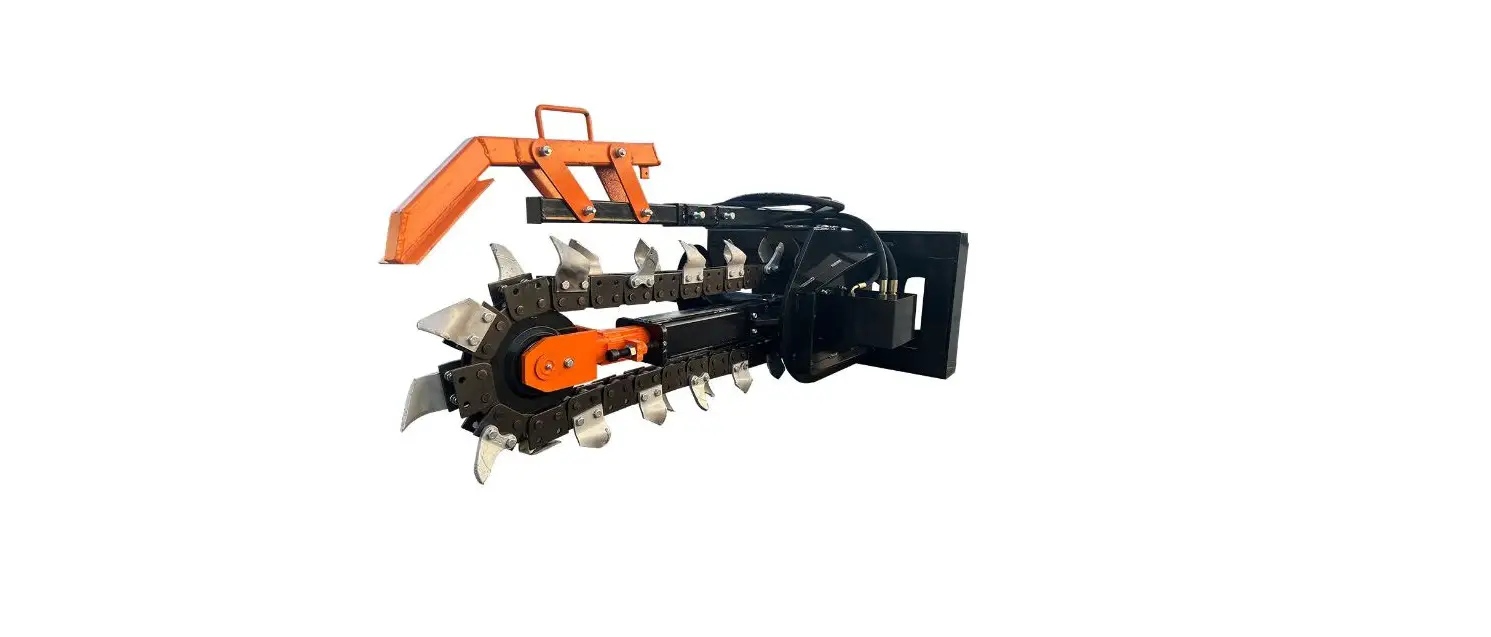
AGT-TCR650 Trencher
AGT-TCR650 TRENCHER
This trencher is a high-powered machine designed solely for
digging trenches. It should only be used by trained operators who
are familiar with the content of the user manual. Any use of this
equipment beyond its rated capacity can result in damage to the
machine or property, and potentially hazardous situations.
General Safety Rules
Before using the Trencher, operators must be fully trained and
the user manual should be read and understood. Blades must be in
good condition and securely fastened, and all fasteners should be
checked for tightness. When using the Trencher, maintain strict
discipline at all times and service the machine at specified
periods. Keep body parts, foreign objects, and clothing clear of
the rotating auger and digging chain. Contact appropriate utility
representatives to determine if/where electrical cables, gas lines,
water lines, etc. are buried BEFORE operation. DO NOT operate the
machine whilst under the influence of alcohol or drugs.
Protecting Yourself and Those around You
Always take precautions when using this machine as it has moving
parts operating with high energy. The operator or user is
responsible for accidents or hazards occurring to other people,
their property, and themselves. Always wear protective goggles or
safety glasses with side shields while using the Trencher to
protect your eyes from possible thrown debris. Avoid wearing loose
clothing or jewelry that can catch on moving parts. Wear shoes with
non-slip treads when using your Trencher.
Additional Information and Potential Changes
The manufacturer reserves the right to discontinue, change, and
improve its products at any time without notice or obligation to
the purchaser. The descriptions and specifications contained in
this manual were in effect at printing. Equipment described within
this manual may be optional. Some illustrations may not be
applicable to your machine.
Installation, Operation, and Repair
It is important to note that this equipment cannot be installed,
operated, or repaired without reading the instructions. Electricity
must be hooked up by certified electrician. If there are any
missing parts or questions on assembly, please contact the
manufacturer.
PRODUCT MANUAL
AGT-TCR650 TRENCHER
WARNING
This equipment can not be installed, operated or repaired without reading instructions.
Electricity must be hooked up by certified electrician. Do not use this equipment beyond its rated capacity. Missing parts or questions on assembly? Please contact us.
Table of Contents
Table of Contents
PART I: General Safety Rules …………………………………………………………………………………………….. 2 PART II: Familiar with Your Trencher ………………………………………………………………………………….. 7 PART III: Operating the Trencher ………………………………………………………………………………………… 9 PART IV: Maintaining Your Trencher ………………………………………………………………………………….12 PART V: Troubleshooting and Parts List …………………………………………………………………………….. 14
Conventions used in this manual
WARNING
This indicates a hazardous situation, which, if not avoided, could result in death or serious injury.
CAUTION
This indicates a hazardous situation, which, if not avoided, could result in minor or moderate injury.
NOTICE
This information is important in proper using of your machine. Failure to follow this instruction could result in damage to your machine or property.
Additional Information and Potential Changes
We reserve the right to discontinue, change, and improve its products at any time without notice or obligation to the purchaser. The descriptions and specifications contained in this manual were in effect at printing. Equipment described within this manual may be optional. Some illustrations may not be applicable to your machine.
1
Part I: General Safety Rules
PART I: General Safety Rules
Safety Labels May Be Found on Your Unit
2
Part I: General Safety Rules
WARNING
This machine can cause serious injury to the operator and bystanders. The warning and safety instructions in this manual must be followed to provide reasonable safety and efficiency in using and storing. The operator is responsible for following the warnings and instructions in this manual and the trencher. Read the entire Operator’s Manual before using this trencher! Restrict the use of this trencher to persons who read, understand, and follow the warnings and instructions in this manual and on the trencher. If you have not read and understand the warnings and instructions in this manual and on the trencher, you are not qualified to operate this trencher! Become familiar with the operation and service recommendations to ensure the best performance of your machine.
Propose
CAUTION
This machine is designed solely to dig trench and must not be used for any other purpose. It should only be used by trained operators who are familiar with the content of this manual. It is potentially hazardous to fit or use any parts other than your dealer parts. We disclaim all liability for the consequences of such use, which in addition voids the machine warranty.
3
Part I: General Safety Rules
Before using the Trencher
NOTICE
AOperators must be fully trained before using this machine. BUser Manual is read and understood. C Blades are in good condition and secure. All blades are sharpened or replaced in
sets. DAll fasteners are checked for tightness.
When using the Trencher
WARNING
A. Maintain strict discipline at all times and service machine at specified periods. B. Keep body parts, foreign objects and clothing clear of rotating auger and digging chain. C. Coming into contact with buried utilities while digging can cause severe injuries or
DEATH. D. Contact appropriate utility representatives to determine if/where electrical cables, gas
lines, water lines, etc. are buried BEFORE operation. E. DO NOT operate the machine whilst under the influence of alcohol or drugs.
Protecting Yourself and Those around You
WARNING
This is a high-powered machine, with moving parts operating with high energy. You must operate the machine safely. Unsafe operation can create a number of hazards for you, as well as anyone else in the nearby area. Always take the following precautions when using this machine: A. Keep in mind that the operator or user is responsible for accidents or hazards occurring
to other people, their property, and themselves. B. Always wear protective goggles or safety glasses with side shields while using the
Trencher to protect your eyes from possible thrown debris. C. Avoid wearing loose clothing or jewelry, which can catch on moving parts. D. Wear shoes with non-slip treads when using your Trencher. If you have safety shoes, we
recommend wearing them. Do not use the machine while barefoot or wearing open sandals. E. Keep bystanders at least 50 feet away from your work area at all times. Stop the engine when another person or pet approaches.
Safety for Children and Pets
WARNING
Tragic accidents can occur if the operator is not alert to the presence of children and pets. Children are often attracted to the machine and the digging activity. Never assume that
4
Part I: General Safety Rules
children will remain where you last saw them. Always follow these precautions: A. Keep children and pets at least 50 feet from the working area and ensure they are under
the watchful care of a responsible adult. B. Be alert and turn the machine off if children or pets enter the work area. C. Never allow children to operate the Trencher.
Safety with Gasoline – Powered Machines
WARNING
Gasoline is a highly flammable liquid. Gasoline also gives off flammable vapor that can be easily ignited and cause a fire or explosion. Never overlook the hazards of gasoline. Always follow these precautions: A. Never run the engine in an enclosed area or without proper ventilation as the exhaust
from the engine contains carbon monoxide, which is an odorless, tasteless, and a deadly poisonous gas. B. Store all fuel and oil in containers specifically designed and approved for this purpose and keep away from heat and open flame, and out of the reach of children. C. Replace rubber fuel lines and grommets when worn or damaged and after 5 years of use. D. Fill the gasoline tank outdoors with the engine off and allow the engine to cool completely. Don’t handle gasoline if you or anyone nearby is smoking, or if you’re near anything that could cause it to ignite or explode. Reinstall the fuel tank cap and fuel container cap securely. E. If you spill gasoline, do not attempt to start the engine. Move the machine away from the area of the spill and avoid creating any source of ignition until the gas vapors have dissipated. Wipe up any spilled fuel to prevent a fire hazard and properly dispose of the waste. F. Allow the engine to cool completely before storing in any enclosure. Never store a machine that has gasoline in the tank, or a fuel container, near an open flame or spark such as a water heater, space heater, clothes dryer or furnace. G. Never make adjustments or repairs with the engine running. Shut down the engine, disconnect the spark plug wire, keeping it away from the spark plug to prevent accidental starting, wait 5 minutes before making adjustments or repairs. H. Never tamper with the engine’s governor setting. The governor controls the maximum safe operation speed and protects the engine. Over-speeding the engine is dangerous and will cause damage to the engine and to the other moving parts of the machine. If required, see your authorized dealer for engine governor adjustments. I. Keep combustible substances away from the engine when it is hot. J. Never cover the machine while the muffler is still hot. K. Do not operate the engine with the air cleaner or the carburetor air intake cover removed. Removal of such parts could create a fire hazard. Do not use flammable solutions to clean the air filter.
5
Part I: General Safety Rules
L. The muffler and engine become very hot and can cause a severe burn; do not touch.
General Safety
WARNING
Operating this Trencher safely is necessary to prevent or minimize the risk of death or serious injury. Unsafe operation can create a number of hazards for you. Always take the following precautions when operating: A. Your Trencher is a powerful tool, not a plaything. Exercise extreme caution at all times.
The machine is designed to dig trench. Do not use it for any other purpose. B. Know how to stop the Trencher quickly. C. Exercise caution to avoid slipping or falling. D. See manufacturer’s instructions for proper operation and installation of accessories. E. Never use the machine without ensuring that all guards and shields are in place. F. Never, under any conditions, remove, bend, cut, fit, weld, or otherwise alter standard
parts on the Trencher. This includes all shields and guards. Modifications to your machine could cause personal injuries and property damage and will invalid your warranty. G. If the machine start to make an unusual noise or vibrate, shut down the engine, disconnect the spark plug wire, keeping it away from the spark plug to prevent accidental starting, wait 5 minutes for engine to cool down, then inspect for damage. Vibration is generally a warning of trouble. Check damaged parts and clean, repair and/or replace as necessary. H. Never tamper with safety devices. Check their proper operation regularly. I. Before performing any maintenance or inspection procedure, shut down the engine, disconnect the spark plug wire keeping it away from the spark plug to prevent accidental starting, wait 5 minutes for machine to cool down. J. Never allow people who are unfamiliar with these instructions to use the Trencher. Allow only responsible individuals who are familiar with these rules of safe operation to use your machine. K. Never overload or attempt to dig trenches beyond the manufacturer’s recommendation. It could result in personal injury or damage to the machine. L. While using, don’t hurry or take things for granted. When in doubt about the equipment or your surroundings stop the machine and take time to look things over. M. Never operate the machine when under the influence of alcohol, drugs, or medication. N. Use the machine only in daylight. O. Stay alert for hidden hazards or traffic. P. Keep all nuts and bolts tight and keep the equipment in good operating condition.
A Note to All Users
List of warnings and cautions cannot be all-inclusive. If situations occur that are not covered by this manual, the operator must apply common sense and operate this TRENCHER in a safe manner. Contact the dealers for assistance in your area.
6
Part II: Familiar with Your Trencher
PART II: Familiar with Your Trencher
It may be helpful to familiarize yourself with the controls and features of the Trencher. If you have any question, please contact the dealers in your area.
TECHNICAL SPECIFICATIONS
PARAMETER
Model Start Engine Power Trench Capacity Trench Width Trench Depth Blade Chain Length Chain Speed(Max) Tire Overall Height Overall Length Overall Width Weight Sound Level
SPECIFICATION
TCR650 Recoil Start 5KW four strokes, 3600rpm Gasoline/petrol 60m/hour 100mm 150,250,340,450mm 21 carbide alloy blades 1600mm 550m/min 145/7.0-6 800mm 1560mm 700mm 135kgs 107dB
7
Part II: Familiar with Your Trencher
NOTICE
A. It is your responsibility as the operator of this piece of equipment to know what specific requirements, precautions and work hazards exist. You must read and understand all of the information contained in the user manual.
B. The trencher is a small, operator propelled, chain-type trencher designed for the installation of lines that require a narrow shallow trench. It has more than enough power to trench through the toughest soils, however, because of its small size, low horse power and trench capacity, it is limited in what it is capable of doing. The job site, soil conditions, job specifications and operator experience may dictate that a different tool or method be used to do the job.
C. The digging chain has a tendency to pull the trencher in the opposite direction you want to dig. For this reason, be sure that the digging teeth are not in contact with the ground or other objects while starting the engine and that the wheel lock device engages before lowering the digging bar into the ground. Be sure that you have a firm grip on the machine and are ready to control it when the digging bar comes in contact with the ground.
D. The trencher has a tendency to “hop” or “buck” under certain conditions. This can be the result of certain soil conditions or buried objects that the trencher cannot cut through or lift to the surface. The trencher must be stopped and the object removed, or restarts the trench beyond the object.
8
Part IV: Maintaining The Thencher
PART III: Operating the Trencher
It may be helpful to better familiarize yourself with the features of your Trencher before beginning the steps outlined in this chapter.
CAUTION
A. Read and understand all instructions, safety precautions, and/or warnings listed in “PART I: General Safety Rules” before operating the TRENCHER. If any doubt or question arises about the correct or safe method of performing anything found in this manual, please contact the dealers in your area.
B. Before loading and operating the Trencher, always wear protective gear, including safety goggles, hearing protection, tight-fitting gloves without draw strings or loose cuffs, and steel-toed shoes.
Assembling
Step 1: Assembling the handle system
9
Part IV: Maintaining The Thencher
Ref.No.
1 3 4 6 13
14
47 48 49 53
Description
main frame assembly lock cotter pin chain chain frame chain cover upper handle M16 bolt lower handle angle arm
Ref.No.
55 65 67 68 69 70 82 84 88
Description
M12 bolt adjustable handle M8*45 hexagon bolt M8*20 hexagon bolt coil fixation chain cover fixation support chip of bearing tube rocker arm bearing tube
a. Secure lower handle(49) to the main frame(1) tightly. b. Assemble upper handle(47) to the lower handle(49), secure them with bolt(48) and angle
arm(53) tightly. c. Plug shift arm(39) to the right place as figure shows and hold them with bolt(41) and
spring(39), then secure another side of spring with pin(4) to the arm(39). d. Assemble Coil fixation(69) to the main frame(1) and secure with bolt(68) tightly.
Step 2: Assembling the blade system
Ref.No.
2
3
4
6 13
Description
chain axle plate assembly lock cotter pin chain chain adapter
Ref.No.
14 55 67 70
Description
chain cover M12 bolt M8*45 hexagon bolt chain cover fixation
10
Part IV: Maintaining The Thencher
a. Plug chain adapter(13) to the chain axle(2); b. Hold the chain(6) around chain adapter(13) and axle(2), then secure two head of the
chain with chain pin(4) and chain lock(3); c. Secure bolt(55) until the chain is tight enough; d. Assemble chain cover(14) to the fixation(70) and secure with bolt(67) tightly.
Starting
Be sure the depth control is in the “0” depth position and move both stop switches to the “ON” position. Always stand to the rear of the trencher, away from the side delivery auger and digging chain while starting the engine. Always start the trencher at the job site and allow it to warm up. While the machine is running, check that all controls are working properly before using.
Start the engine following the procedures:
1. Make sure the fuel shut-off valve is in the “ON” position. 2. Move the choke control lever to the “CHOKE” position (should only be needed if the
engine is cold). 3. Move the throttle control lever to the “FAST” position. 4. Recoil Start: Turn the Ignition Switch to the “On” position. Push the handle of flameout
switch and grasp the recoil starter handle and slowly pull until you feel resistance. Let the cord retract a little bit then pull the cord rapidly to start the engine. One or two pulls usually starts the engine. 5. Move the choke control lever (if used for cold engine) slowly back to the “RUN” position when the engine is running well. 6. If the Trencher has not been running (cold engine), warm up the engine by running the engine at half throttle for 3 to 4 minutes, then advance the engine throttle control to the maximum speed.
11
Part IV: Maintaining The Thencher
PART IV: Maintaining Your Trencher
Regular maintenance is the way to ensure the best performance and long life of your machine. Please refer to this manual and the engine manufacturer’s user manual for maintenance procedures.
Maintenance Safety
NOTICE
A. Before performing any maintenance procedure or inspection, stop the engine, wait five minutes to allow all parts to cool.
B. Disconnect the spark plug wire, keeping it away from the spark plug. Disconnect the Battery Terminals (Electric start only).
C. Stop engine before removing fuel cap. D. Use only genuine replacement parts of the engine manufacturer.
Regular Maintenance Checklist
Procedure
Check engine oil level Check general equipment condition Check wedge for sharpness Check belts Check tire pressure Clean engine exterior and cooling Change Engine Oil
Replace air filter Replace spark plug
Before Each Use
First time 5hours
Every 3 Hours
Every 25 Hours
Every 100 Hours
Engine Service
Refer to the engine manufacturer’s user manual for engine maintenance.
12
Part IV: Maintaining The Thencher
Lubrication
Recommended engine oil 4-stroke gasoline engine oil SF under API service classification or SAE10W-30(equivalent to SG class).
NOTICE
All Bearings of Trencher are sealed units and should have sufficient lubricant to last the life of your machine with normal use.
Transportation and Storing
NOTICE
A. Always shut off the fuel valve and engine. B. Always allow the engine to cool. C. Store trencher and fuel where fuel vapors cannot reach sources of combustion like,
water heaters, electric motors, switches, furnaces, etc. D. Always secure this trencher with tie downs or similar restraints when transporting. E. The trencher shall be stored in a manner that prevents it from falling, rolling or tipping
over.
13
Part V: Troubleshooting and Parts List
PART V: Troubleshooting and Parts List
Most problems are easy to fix. Consult the Troubleshooting Table below for common problems and their solutions. If you continue to experience problems, contact the dealers in your area.
WARNING
Before performing any maintenance procedure or inspection, stop the engine, wait five
minutes to allow all parts to cool. Disconnect the spark plug wire, keeping it away from the
spark plug.
Troubleshooting Table
SYMPTOM The engine won’t start.
(Please refer to the engine user manual for engine-specific procedures.) The engine lacks power or is not running smoothly.
(Please refer to the engine user manual for engine-specific procedures.)
Engine smokes.
(Please refer to the engine user manual for engine-specific procedures.)
POSSIBLE CAUSE Is the ignition switch in the “ON” position?
Is the fuel shut-off valve on? Are you using fresh, clean gas? If the gas is old, change it. Use a fuel stabilizer if you keep gas longer than 30 days. Is the spark plug clean? If the spark plug is dirty or cracked, change it. If it’s oily, leave it out, hold a rag over the plug hole and pull the recoil cord several times to blow out any oil in the cylinder, then wipe off the plug and reinsert it.
Check that the Throttle Lever is in the “Run” position. Is the air filter clean? If it’s dirty, change it following the procedure in the engine manufacturer’s owner’s manual. Is the spark plug clean? If it’s fouled or cracked, change it. If it’s oily, leave it out, hold a rag over the plug hole and pull your recoil cord several times to blow out any oil in the cylinder, then wipe off the plug and reinsert it. Are you using fresh, clean unleaded gasoline? If it’s old, change it. Use a fuel stabilizer if you keep gasoline longer than 30 days. Does your engine have the right amount of clean oil? If it’s dirty, change it following the procedure in the engine manufacturer’s owner’s manual. Check the oil level and adjust as needed.
Check the oil level and adjust as needed. Check the air filter and clean or replace if needed. You may be using the wrong oil–too light for the temperature. Refer to your Engine Owner’s Manual for detailed information. Clean the cooling fins if they’re dirty.
14
Part V: Troubleshooting and Parts List
Explosion View and Parts List 1. Chain System
Ref.No.
1 2 3 4 5 6
7 8 9 10
Description
main frame chain axle plate assembly lock cotter pin blade chain M20 bolt gear cap chain spacer 6204 bearing
Ref.No.
11 12 13 14 70 77 78 79
Description
front gear M20 nut chain adapter chain cover chain cover fixation square steel of chain cover square tube of chain cover blade
15
Part V: Troubleshooting and Parts List
2. Gear System
Ref.No.
1 2 15 16 17 18 19 20 21
Description
main frame chain axle plate ridge ridge spacer back gear gear axle 8*7 keyway 8*7 keyway 35 outer circlip
Ref.No.
22 23 24 25 26 27 28 29
Description
taper bearing flange spacer taper bearing upper part taper bearing base 70 seal 72 outer circlip taper bearing spacer gear wheel M30 screw nut
16
Part V: Troubleshooting and Parts List
3. Drive System
Ref.No.
1 28 30 31 32 33
Description
main frame gear wheel drive chain clutch belt belt cover
Ref.No.
34 35 36 37 38 80
Description
pulley 5*5 keyway pulley axle bearing bearing cover base support of bearing block
17
Part V: Troubleshooting and Parts List
4. Depth Control System
Ref.No.
1 2 4 43 44 65 81 82
Description
main frame chain axle plate cotter pin pin shift rod depth control handle rotating part support chip of bearing tube
Ref.No.
Description
83
tube of rotating part
84
rocker arm
85
adjustable tube
86
trapezoidal screw
87
6002 bearing
88
bearing tube
18
Part V: Troubleshooting and Parts List
5. Main Frame
Ref.No.
1 45
46
48 49 50 51 53 54
Description
main frame handle cover throttle cable M16 bolt lower handle 20 washer wheel angle arm handle of flameout switch
Ref.No.
57 71 72 82 91 92 93 94
Description
butter bean M20 round nut ridger cover support chip of bearing tube M12*140 bakelite bolt fixed mount of front wheel 4.1-4 tire spacer bush
19
Part V: Troubleshooting and Parts List
6. Ratchet Assembly
Ref.No.
4 7
55
56
57 58
Description
cotter pin M20 bolt M12 bolt M12 nut ratchet wheel pin
Ref.No.
59 60 61 64
Description
M10 nut halt frame spring M10 headed screw
20
Part V: Troubleshooting and Parts List
Part List:
Ref.No.
1 2 3 4 5 6 7 8 9 10 11 12 13 14 15 16 17 18 19 20 21 22 23 24 25 26 27 28 29 30 31 32 33 34 35 36
Description
main frame chain axle plate assembly lock cotter pin blade chain M20 bolt gear cap chain spacer 6204 bearing front gear M20 nut chain adapter chain cover ridge ridge spacer back gear gear axle 8*7 keyway 8*7 keyway 35 outer circlip taper bearing flange spacer taper bearing upper part taper bearing base 70 seal 72 outer circlip taper bearing spacer gear wheel M30 screw nut drive chain clutch belt belt cover pulley 5*5 keyway pulley axle
Ref.No.
45 46 47 48 49 50 51 53 54 55 56 57 58 59 60 61 64 65 67 68 69 70 71 72 77 78 79 80 81 82 83 84 85 86 87 88
Description
handle cover throttle cable upper handle M16 bolt lower handle 20 washer wheel angle arm handle of flameout switch M12 bolt M12 nut ratchet wheel pin M10 nut halt frame spring M10 headed screw depth control handle M8*45 hexagon bolt M8*20 hexagon bolt coil fixation chain cover fixation M20 round nut ridger cover square steel of chain cover square tube of chain cover blade base support of bearing block rotating part support chip of bearing tube tube of rotating part rocker arm adjustable tube trapezoidal screw 6002 bearing bearing tube
21
Part V: Troubleshooting and Parts List
37
bearing
38
bearing cover
43
pin
44
shift rod
91
M12*140 bakelite bolt
92
fixed mount of front wheel
93
4.1-4 tire
94
spacer bush
22
 IIS7
IIS7