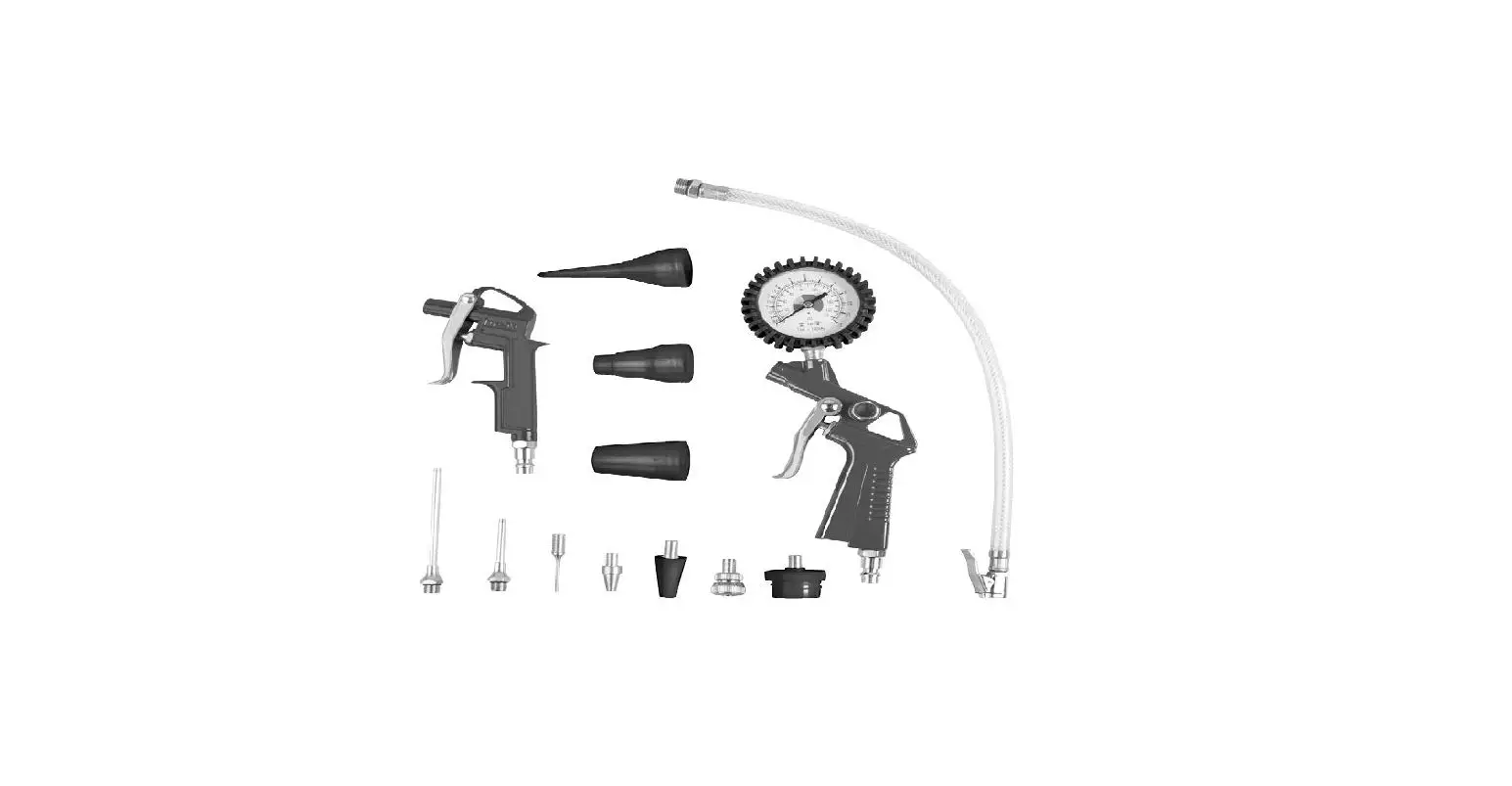
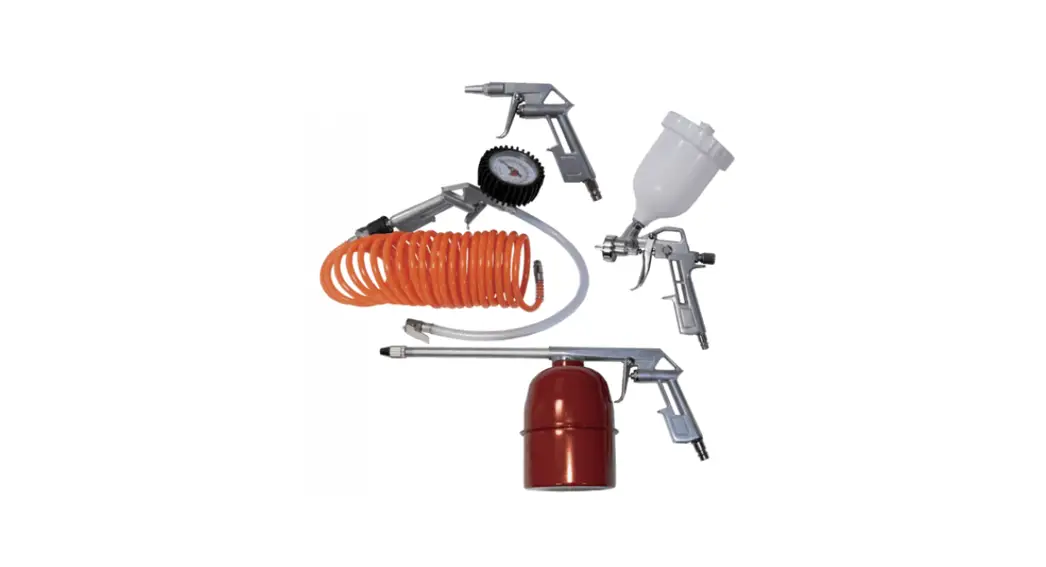
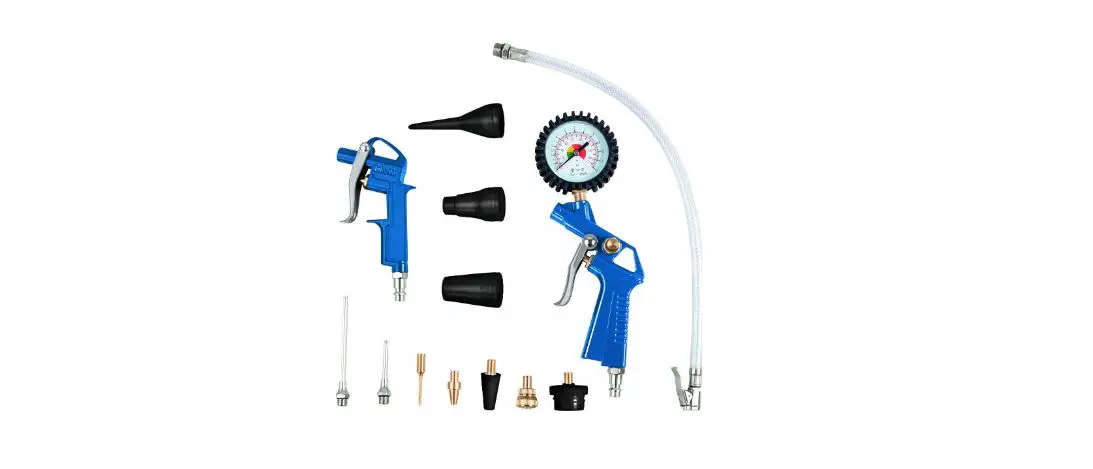
1024736-18-2023 5 Parts Compressed Air Tools Set
Product Information
Product Name: 5-teiliges Druckluft-Werkzeug-Set
Product Number: Art.Nr. 3906101704
Edition Number: AusgabeNr. 3906101704_2001
Revision Number: Rev.Nr. 24/03/2022
Product Description: The 5-piece compressed air tools set
includes a color spray gun, a blow gun, a spiral hose, a quick
coupling adapter, and an air tool adapter.
Languages Available: German, English, French, Slovenian,
Hungarian, Czech, Slovak, Turkish, Spanish, and Portuguese
Product Usage Instructions
Step 1: Check the safety instructions provided in the manual
before using the product.
Step 2: Connect the compressed air tool adapter (5b) to the
quick coupling adapter (5a).
Step 3: Attach the spiral hose (3c) to the compressed air tool
adapter (5b).
Step 4: Connect the other end of the spiral hose (3c) to the
compressed air source.
Step 5: Adjust the working pressure according to the tool’s
specifications.
Step 6: Use the color spray gun to apply paint or other coatings
to surfaces. Adjust the material flow rate using the regulator
(1c).
Step 7: Use the blow gun for cleaning or drying surfaces. Adjust
the air pressure using the regulator (4b).
Step 8: After use, turn off the air supply and release the
pressure from the spiral hose (3c).
Step 9: Store the tools in a dry and safe place.
Step 10: Follow the instructions for maintenance and cleaning
provided in the manual.
Art.Nr.
3906101704
AusgabeNr.
3906101704_2001
Rev.Nr.
24/03/2022
5-teiliges Druckluft-Werkzeug-Set
DE
5-teiliges Druckluft-Werkzeug-Set
Originalbedienungsanleitung
GB
5 parts compressed air tools set
Translation of original instruction manual
FR
Ensemble 5 accessoires pneumatiques
Traduction des instructions d’origine
SI
5-delni komplet pnevmatskega orodja
Prevod originalnih navodil za uporabo
HU
5 részes srített levegs szerszámkészlet
Az eredeti használati útmutató fordítása
4
CZ
5-dílná sada pneumatických nástroj
Peklad originálního návodu k obsluze
53
14
SK
5-dielna súprava pneumatických nástrojov
Preklad originálu návodu na obsluhu
62
24
TR
5 parçali basinçli hava takimi seti
Orjinal operasyon el kitabindan çevirilmitir
72
34
Juego de herramientas de aire comprimido de
ES 5 piezas
82
Traducción del manual de instrucciones original
43
PT
Jogo de ferramentas pneumáticas de 5 peças
Tradução do manual de operação original
93
Nachdrucke, auch auszugsweise, bedürfen der Genehmigung. Technische Änderungen vorbehalten. Abbildungen beispielhaft!
2 www.scheppach.com
1
2a
2b 1d
2d
1e
1f 1a 1b 1c
2c 2e
3a 4a
3b
3c
3d 5a
psi
bar
5b
4b
4c
3
www.scheppach.com
Erklärung der Symbole auf dem Gerät
Bedienungsanleitung beachten! Gehörschutz benutzen! Augenschutz benutzen! Handschutz benutzen!
4 | DE
www.scheppach.com
Inhaltsverzeichnis:
Seite:
1. Einleitung……………………………………………………………………….. 6 2. Gerätebeschreibung………………………………………………………… 6 3. Lieferumfang ………………………………………………………………….. 6 4. Bestimmungsgemäße Verwendung …………………………………… 7 5. Sicherheitshinweise…………………………………………………………. 7 6. Technische Daten……………………………………………………………. 9 7. Vor Inbetriebnahme …………………………………………………………. 10 8. Bedienung ……………………………………………………………………… 10 9. Wartung und Reinigung……………………………………………………. 12 10. Lagerung ……………………………………………………………………….. 13 11. Entsorgung und Wiederverwertung …………………………………… 13
www.scheppach.com
DE | 5
1. Einleitung
Hersteller:
Scheppach GmbH Günzburger Straße 69 D-89335 Ichenhausen
Verehrter Kunde, Wir wünschen Ihnen viel Freude und Erfolg beim Arbeiten mit Ihrem neuen Gerät.
Hinweis: Der Hersteller dieses Gerätes haftet nach dem geltenden Produkthaftungsgesetz nicht für Schäden, die an diesem Gerät oder durch dieses Gerät entstehen bei: · unsachgemäßer Behandlung, · Nichtbeachtung der Bedienungsanleitung, · Reparaturen durch Dritte, nicht autorisierte Fach-
kräfte, · Einbau und Austausch von nicht originalen Ersatz-
teilen, · nicht bestimmungsgemäßer Verwendung,
Beachten Sie: Lesen Sie vor der Montage und vor Inbetriebnahme den gesamten Text der Bedienungsanleitung durch. Diese Bedienungsanleitung soll es Ihnen erleichtern, Ihr Elektrowerkzeug kennenzulernen und dessen bestimmungsgemäßen Einsatzmöglichkeiten zu nutzen. Die Bedienungsanleitung enthält wichtige Hinweise, wie Sie mit dem Elektrowerkzeug sicher, fachgerecht und wirtschaftlich arbeiten, und wie Sie Gefahren vermeiden, Reparaturkosten sparen, Ausfallzeiten verringern und die Zuverlässigkeit und Lebensdauer des Elektrowerkzeugs erhöhen. Zusätzlich zu den Sicherheitsbestimmungen dieser Bedienungsanleitung müssen Sie unbedingt die für den Betrieb des Elektrowerkzeugs geltenden Vorschriften Ihres Landes beachten. Bewahren Sie die Bedienungsanleitung, in einer Plastikhülle geschützt vor Schmutz und Feuchtigkeit, bei dem Elektrowerkzeug auf. Sie muss von jeder Bedienungsperson vor Aufnahme der Arbeit gelesen und sorgfältig beachtet werden. An dem Elektrowerkzeug dürfen nur Personen arbeiten, die im Gebrauch des Elektrowerkzeugs unterwiesen und über die damit verbundenen Gefahren unterrichtet sind. Das geforderte Mindestalter ist einzuhalten. Neben den in dieser Bedienungsanleitung enthaltenen Sicherheitshinweisen und den besonderen Vorschriften Ihres Landes sind die für den Betrieb von baugleichen Maschinen allgemein anerkannten technischen Regeln zu beachten.
Wir übernehmen keine Haftung für Unfälle oder Schäden, die durch Nichtbeachten dieser Anleitung und den Sicherheitshinweisen entstehen.
2. Gerätebeschreibung
Farbspritzpistole 1a Düseneinsatz 1b Farbmengenregulierer 1c Abzugshebel 1d Farbbehälter 1e Luftregler 1f Schnellkupplungsanschluss
Reifenfüllmesser 2a Manometer 2b Luftablasstaste 2c Schnellkupplungsanschluss 2d Abzugshebel 2e Ventilsteckverbindung
Sprühpistole mit Saugbecher 3a Düse 3b Materialbehälter 3c Abzugshebel 3d Schnellkupplungsanschluss
Ausblaspistole 4a Düse 4b Abzugshebel 4c Schnellkupplungsanschluss
Druckluftspriralschlauch 5a Druckluftwerkzeuganschluss 5b Schnellkupplungsanschluss
3. Lieferumfang
· Öffnen Sie die Verpackung und nehmen Sie das Gerät vorsichtig aus der Verpackung.
· Entfernen Sie das Verpackungsmaterial sowie Verpackungs-/ und Transportsicherungen (falls vorhanden).
· Überprüfen Sie, ob der Lieferumfang vollständig ist.
· Kontrollieren Sie das Gerät und die Zubehörteile auf Transportschäden. Bei Beanstandungen muss sofort der Zubringer verständigt werden. Spätere Reklamationen werden nicht anerkannt.
· Bewahren Sie die Verpackung nach Möglichkeit bis zum Ablauf der Garantiezeit auf.
· Machen Sie sich vor dem Einsatz anhand der Bedienungsanweisung mit dem Gerät vertraut.
· Verwenden Sie bei Zubehör sowie Verschleiß- und Ersatzteilen nur Original-Teile. Ersatzteile erhalten Sie bei Ihrem -Fachhändler.
· Geben Sie bei Bestellungen unsere Artikelnummern sowie Typ und Baujahr des Gerätes an.
6 | DE
www.scheppach.com
m ACHTUNG! Gerät und Verpackungsmaterial sind kein Kinderspielzeug! Kinder dürfen nicht mit Kunststoffbeuteln, Folien und Kleinteilen spielen! Es besteht Verschluckungs- und Erstickungs-gefahr!
4. Bestimmungsgemäße Verwendung
Druckluftspriralschlauch Der Druckluftspriralschlauch ist geeignet zur Luftversorgung von Druckluftwerkzeugen.
Ausblaspistole Die Ausblaspistole ist geeignet zum Reinigen und Ausblasen von Hohlräumen oder schwer zugänglichen Stellen, sowie zum Reinigen von verschmutzen Arbeitsgeräten. Der stufenlos bedienbare Abzugshebel ermöglicht eine exakte Dosierung der Druckluft.
Reifenfüllmesser Der Reifenfüllmesser ermöglicht ein einfaches und genaues Befüllen von Reifen. Das Manometer dient zur Kontrolle des Reifendrucks. Mit dem integrierten Ablassventil ist es möglich einen zu hohen Reifendruck zu senken. Überprüfen Sie nach dem Befüllen den eingestellten Reifendruck mit einem geeichten Messgerät, z.B. an einer Tankstelle.
Farbspritzpistole Die Farbspritzpistole mit Fließbecher ist geeignet zum Versprühen von Farben und Lacken. Die Farbspritzpistole eignet sich hervorragend für alle kleineren Grundierungs- und Lackierarbeiten. Die Einstellung der Luft- und Farbmenge, helfen Ihnen ein hervorragendes Arbeitsergebnis zu erzielen. Die Farbspritzpistole, mit der stufenlosen Einstellung von Breit- auf Rundstrahl, ist sowohl für große Flächen als auch für Ecken und Kanten bestens geeignet. Überprüfen Sie die Einstellung anhand einer Probelackierung. Beachten Sie, dass schmirgelnde, säure und benzinhaltige Materialien nicht verarbeitet werden dürfen.
Sprühpistole mit Saugbecher Geeignet zum Ein- und Versprühen von Kaltreiniger, Sprühöl, usw.. Der stufenlos bedienbare Abzugshebel ermöglicht eine exakte Dosierung des Sprühmaterials. Mit der drehbaren Düse lässt sich das Verhältnis der zu spritzenden Flüssigkeit zur Luftmenge einstellen. Tipp: Vor Arbeitsbeginn sollte ein kurzer Test an einem Zeitungspapier durchgeführt werden, damit sich der optimale Arbeitsdruck finden lässt.
Das Gerät darf nur nach ihrer Bestimmung verwendet werden. Jede weitere darüber hinaus-gehende Verwendung ist nicht bestimmungsgemäss. Für daraus hervorgerufene Schäden oder Verletzungen aller Art haftet der Benutzer/Bediener und nicht der Hersteller.
Bitte beachten Sie, dass unsere Geräte bestimmungsgemäß nicht für den gewerblichen, handwerklichen oder industriellen Einsatz konstruiert wurden. Wir übernehmen keine Gewährleistung, wenn das Gerät in Gewerbe-, Handwerks- oder Industriebetrieben sowie bei gleichzusetzenden Tätigkeiten eingesetzt wird.
5. Sicherheitshinweise
In dieser Bedienungsanweisung haben wir Stellen, die Ihre Sicherheit betreffen, mit diesem Zeichen versehen: m
Außerdem enthält die Betriebsanleitung andere wichtige Textstellen, die durch das Wort “ACHTUNG!” gekennzeichnet sind.
m Achtung! Beim Benutzen von Geräten müssen einige Sicherheitsvorkehrungen eingehalten werden, um Verletzungen und Schäden zu verhindern. Lesen Sie diese Bedienungsanleitung / Sicherheitshinweise deshalb sorgfältig durch. Falls Sie das Gerät an andere Personen übergeben sollten, händigen Sie diese Bedienungsanleitung / Sicherheitshinweise bitte mit aus. Wir übernehmen keine Haftung für Unfälle oder Schäden, die durch Nichtbeachten dieser Anleitung und den Sicherheitshinweisen entstehen.
m GEFAHR
Bei Nichtbeachtung dieser Anweisung besteht höchste Lebensgefahr bzw. die Gefahr lebensgefährlicher Verletzungen.
m WARNUNG
Bei Nichtbeachtung dieser Anweisung besteht Lebensgefahr bzw. die Gefahr schwerer Verletzungen.
m VORSICHT
Bei Nichtbeachtung dieser Anweisung besteht leichte bis mittlere Verletzungsgefahr.
m HINWEIS
Bei Nichtbeachtung dieser Anweisung besteht die Gefahr einer Beschädigung des Gerätes oder anderen Sachwerten.
www.scheppach.com
DE | 7
Allgemeine Sicherheitshinweise 1. Halten Sie Ihren Arbeitsbereich in Ordnung
· Unordnung im Arbeitsbereich kann Unfälle zur Folge haben.
2. Berücksichtigen Sie Umgebungseinflüsse · Sorgen Sie beim Arbeiten für ausreichende Beleuchtung.
3. Halten Sie andere Personen fern · Lassen Sie andere Personen, insbesondere Kinder und Jugendliche, nicht an das Gerät. Halten Sie diese von Ihrem Arbeitsbereich fern.
4. Bewahren Sie unbenutzte Geräte sicher auf · Unbenutzte Geräte sollten an einem trockenen, hochgelegenen oder abgeschlossenen Ort, außerhalb der Reichweite von Kindern, gelagert werden.
5. Vermeiden Sie abnormale Körperhaltung · Sorgen Sie während der Benutzung des Gerätes für ausreichenden sicheren Stand.
6. Arbeiten Sie bei vollem Bewusstsein · Niemals unter Einfluss von Alkohol, Drogen, Medikamenten oder anderen Substanzen arbeiten, die das Sehvermögen, die Geschicklichkeit und das Urteilsvermögen beeinträchtigen können.
7. Personen mit eingeschränkten physischen, sensorischen oder geistigen Fähigkeiten dürfen die Geräte nicht benutzen, es sei denn sie werden durch eine Betreuerin/einen Betreuer beaufsichtigt und unterwiesen.
8. Richten Sie die Druckluft-Werkzeuge niemals auf sich selbst oder andere Personen oder auf Tiere.
9. Löse- oder Verdünnungsmittel können die Haut, Lunge und die Augen verätzen.
10. Verbinden Sie den Druckluftanschluss nur über die Schnellverschlusskupplung mit dem Druckluftwerkzeug und regulieren Sie die Arbeitsdruckeinstellung über einen Druckminderer.
11. Der maximal zulässige Arbeitsdruck darf niemals überschritten werden, siehe hierzu die Technischen Daten.
12. Verwenden Sie als Energiequelle niemals Sauerstoff, brennbare Gase oder halogenierten Kohlenwasserstoff.
13. Kontrollieren Sie sämtliche Anschlüsse und Schläuche auf guten Sitz und Funktionstüchtigkeit. Lose Schläuche können eine ernsthafte Verletzungsgefahr darstellen. Benutzen Sie nur Sicherheitskupplungen.
14. Lösen Sie zuerst den Schlauch von der Druckluftquelle und entfernen Sie erst danach den Versorgungsschlauch von dem Gerät. So vermeiden Sie ein unkontrolliertes Herumwirbeln bzw. Rückstoß des Versorgungsschlauches.
15. Trennen Sie vor Einstellungsarbeiten, vor Störungsbeseitigung, bei längerem Nichtgebrauch und bei Wartungsarbeiten das Druckluft-Gerät von der Druckluftquelle.
16. Schutzausrüstung ist unbedingt erforderlich. 17. Beachten Sie, dass Dämpfe und bestimmte Ma-
terialien giftig sind. Diese können Ausschläge verursachen oder auf andere Weise gesundheitsschädlich sein. 18. Die auf den Umverpackungen der verarbeiteten Materialien aufgebrachten Angaben und Kenn-
zeichnungen der Gefahrstoffverordnung sind zu beachten. 19. Benutzen Sie immer Atemschutzgeräte und Schutzkleidung. 20. Die Schutzstufe der Geräte muss dem jeweils verarbeiteten Material entsprechen. Gegebenenfalls sind zusätzliche Schutzmaßnahmen zu treffen, insbesondere geeignete Kleidung und Masken zu tragen. Tragen Sie auch immer Handschuhe beim Lackieren und beim Reinigen des Gerätes. 21. Wir empfehlen beim Spritzlackieren immer einen Gehör,- und Sichtschutz zu tragen. 22. Beachten Sie, dass Spritzgeräte, die mit hohem Druck arbeiten Rückstöße erzeugen, welche in bestimmten Situation Überlastungsschäden beim Bedienen verursachen können. 23. Wenn mit explosionsgefährdetem Material gearbeitet wird, beachten Sie, dass beim Durchfluss von Flüssigkeiten und/oder Luft durch Schläuche, beim Spritzlackieren und beim Reinigen von nichtleitenden Teilen mit Lappen statische Aufladungen entstehen können. 24. Verwenden Sie die Geräte nicht, wenn sie nicht korrekt arbeiten oder beschädigt wurden. Unternehmen Sie keine eigenen Reparaturversuche. Wenden Sie sich an unseren Kundendienst. 25. Überschreiten Sie niemals den maximal zulässigen Arbeitsdruck von 8 bar. Verwenden Sie zur Einstellung des Arbeitsdruckes einen Druckminderer. 26. Knicken Sie nicht den Schlauch des Gerätes. Andernfalls kann dieser beschädigt werden.
Sicherheitshinweise zum Arbeiten mit Druckluft und Ausblaspistolen
· Verdichter und Leitungen erreichen im Betrieb hohe Temperaturen. Berührungen führen zu Verbrennungen.
· Die vom Verdichter angesaugten Gase oder Dämpfe sind frei von Beimengungen zu halten, die in dem Verdichter zu Bränden oder Explosionen führen können.
· Beim Lösen der Schlauchkupplung ist das Kupplungsstück des Schlauches mit der Hand festzuhalten, um Verletzungen durch den zurückschnellenden Schlauch zu vermeiden.
· Bei Arbeiten mit der Ausblaspistole Schutzbrille tragen. Durch Fremdkörper und weggeblasene Teile können leicht Verletzungen verursacht werden.
· Mit der Ausblaspistole keine Personen anblasen oder Kleidung am Körper reinigen.
8 | DE
www.scheppach.com
Sicherheitshinweise beim Farbspritzen · Keine Lacke oder Lösungsmittel mit einem Flamm-
punkt von weniger als 55° C verarbeiten. · Lacke und Lösungsmittel nicht erwärmen, da leicht
entflammbar. Lösemittel und Beschichtungsstoffe können leicht entflammbar oder brennbar sein, wenn diese verspritzt oder versprüht werden. Beachten Sie immer die Warn- und Sicherheitshinweis des Lack- oder Lösungsmittelherstellers. · Speisen und Getränke nicht im Arbeitsraum aufbewahren oder verzehren. Farbdämpfe sind schädlich. · Der Arbeitsraum muss größer als 30 m3 sein und es muss ausreichender Luftwechsel beim Spritzen und Trocknen gewährleistet sein. Nicht gegen den Wind spritzen. Grundsätzlich beim Verspritzen von brennbaren bzw. gefährlichen Spritzgütern die Bestimmungen der örtlichen Polizeibehörde beachten. · In Verbindung mit dem PVC-Druckschlauch keine Medien wie Testbenzin, Butylalkohol und Methylenchlorid verarbeiten (verminderte Lebensdauer). · Halten Sie die Arbeitsumgebung sauber. Nehmen Sie nur soviel an Farb- und Verdünnungsmittel zum Lackierplatz, wie Sie für den Lackiervorgang benötigen. Lassen Sie Lack- und Verdünnungsmittel nicht offen stehen, sondern bewahren Sie die Produkte an einem sicheren, durch andere Personen nicht ohne weiteres zugänglichen Ort auf. · Beim Lackieren darf im Arbeitsbereich keine Zündquelle (z.B. offenes Feuer, brennende Zigaretten, nicht explosionsgeschützte Lampen, usw.) vorhanden sein, da beim Lackieren leicht entzündliche Gemische entstehen. Vorsicht bei brennbaren Materialien. Funkenschlag kann das Material entzünden.
Wartungs-/ Service Sicherheit · Bei täglichem Gebrauch, reinigen Sie die Farb-
spritzpistole bzw. die Sprühpistole vorzugsweise mit einer Wascheinrichtung für Spritzgeräte. Lassen Sie die Farbspritzpistole nicht für lange Zeit in der Wascheinrichtung. · Verwenden Sie keine Chlorkohlenwasserstoffe (Trichloräthylen etc.) bzw. säure oder alkalische Kohlenwasserstoffe als Löse- bzw. Reinigungsmittel, da diese Substanzen mit Komponenten der Farbspritzpistole reagieren und gefährliche Abbauprodukte erzeugen können (Trichloräthan mit etwas Wasser ergibt Salzsäure). Durch Oxidation besteht Explosionsgefahr!
Restgefahren und Schutzmaßnahmen
Vernachlässigung ergonomischer Grundsätze Nachlässiger Gebrauch persönlicher Schutzausrüstung (PSA) Nachlässiger Gebrauch oder Weglassen persönlichen Schutzausrüstung können zu schweren Verletzungen führen. · Vorgeschriebene Schutzausrüstung tragen.
Menschliches Verhalten, Fehlverhalten · Stets bei allen Arbeiten voll konzentriert sein. m Restgefahr – Kann nie ausgeschlossen werden.
Gefährdung durch Lärm Gehörschädigungen Längeres ungeschütztes Arbeiten mit dem Gerät kann zu Gehörschädigungen führen. · Grundsätzlich einen Gehörschutz tragen.
Verhalten im Notfall Bei einem eventuell eintretenden Unfall leiten Sie die entsprechend notwendigen Erste-Hilfe- Maßnahmen ein und fordern Sie schnellstmöglich qualifizierte ärztliche Hilfe an.
Wenn Sie Hilfe anfordern, geben Sie folgende Angaben: 1. Wo es geschah 2. Was geschah 3. Wie viele Verletzte 4. Welche Verletzungsart 5. Wer meldet!
6. Technische Daten
Farbspritzpistole
Arbeitsdruck bar
0-8
Max. Betriebsdruck bar
8
Max. Luftverbrauch l/min
180
Farbbehälter Kapazität l
0,6
Reifenfüllmesser
Arbeitsdruck bar
3-8
Max. Betriebsdruck bar
8
Sprühpistole mit Saugbecher
Arbeitsdruck bar
0-8
Max. Betriebsdruck bar
8
Materialbehälter Kapazität l
0,9
Ausblaspistole
Arbeitsdruck bar
3-8
Max. Betriebsdruck bar
8
Druckluftspiralschlauch
Arbeitsdruck bar
0-8
www.scheppach.com
DE | 9
Max. Betriebsdruck bar
8
Länge m
5
7. Vor Inbetriebnahme
Anschließen: Schieben Sie den Nippel Ihres Druckluftschlauches in die Schnellkupplung, Hülse springt automatisch nach vorn.
Trennen: Ziehen Sie die Hülse zurück und entfernen Sie den Schlauch.
m WARNUNG
Beim Lösen der Schlauchkupplung ist das Kupplungsstück des Schlauches mit der Hand festzuhalten, um Verletzungen durch den zurückschnellenden Schlauch zu vermeiden.
Der Druckluftschlauch ist ebenfalls mit einer Schnellkupplung ausgestattet, mit der das Zubehör wie oben beschrieben angeschlossen werden kann.
Verwendung des Druckluftspiralschlauchs · Verwenden Sie den Druckluftspiralschlauch zur
Verbindung des Druckluftwerkzeuges mit der Druckluftquelle. · Verbinden Sie den Schnellkupplungsanschluss (5b) mit der Druckluftquelle und den Druckluftwerkzeuganschluss (5a) mit Ihrem Druckluftwerkzeug.
Verwendung der Farbspritzpistole · Vorbereitung der zu lackierenden Fläche
Das zu lackierende Objekt, bzw. die Fläche, etc. muss sauber, staubfrei, fettfrei und trocken sein. Metalloberflächen müssen rostfrei sein. Da sich die sehr fein zerstäubte Farbe hauchdünn auf die Fläche legt, würden Unebenheiten das Lackierergebnis negativ beeinflussen. · Viskositätsprüfung Viskosität ist die Fließgeschwindigkeit eines Materials. Mit einem Viskositäts- Messbecher (nicht im Lieferumfang enthalten) kann diese wie folgt gemessen werden: 1. Verdünnen Sie die Farbe gemäß Hersteller-
Empfehlung. Am besten zuerst etwas weniger Verdünnung zugeben und später nochmals verdünnen. 2. Mischen Sie die Farbe gut durch. Gießen Sie die Farbe in den Messbecher bzw. tauchen Sie den Messbecher bis über den Rand in die Farbe hinein.
3. Messen Sie die Zeit in Sekunden, bis der Flüssigkeitsfaden beim Auslaufen abreißt. Diese Auslaufzeit bezeichnet man als DIN-s. Verdünnen Sie das Material so lange, bis der Flüssigkeitsfaden die max. Zeit von 20 Sekunden erreicht hat.
· Farbstrahl-Einstellung – Für einen breiten Strahl (waagerecht), stellen Sie die Düse (1a) senkrecht. – Für einen Hochstrahl (senkrecht), stellen Sie die Düse (1a) waagrecht. Benutzen Sie diese Einstellungen für größere Flächen. – Verwenden Sie zum Einstellen der Düse ggf. eine Flachzange.
Verwendung des Reifenfüllmesser
m HINWEIS
· Der optimale Luftdruck im Autoreifen sorgt nicht nur für sicheres Fahrverhalten und lange Haltbarkeit Ihrer Reifen durch den richtigen, vom Fahrzeughersteller empfohlenen Reifendruck, sparen Sie auch Kraftstoff.
· Die Angaben zum komfortablen Mindestdruck Ihrer Reifen finden Sie in der Bedienungsanleitung Ihres Fahrzeuges oder z.B. am Türholm oder hinter der Tankklappe.
· Die zum Auffüllen des Reifens benötigte Druckluft muss ölfrei sein. Es darf kein Öler vor dem Gerät angeschlossen sein. Verwenden Sie am besten einen eigenen Druckluftschlauch nur für die Arbeit mit dem Reifenfüllmesser, da sich in anderen Druckluftschläuchen evtl. noch Ölreste befinden könnten.
Verwendung der Sprühpistole · Die Sprühpistole arbeitet nach dem Saugprinzip.
Der Materialbehälter steht deshalb nicht unter Druck. Die Druckluft, die das Spritzgut fördert, wird am Druckluftanschluss angeschlossen und durch den Pistolenkörper geführt. Durch die Betätigung des Abzugshebels gelangt die Luft zur Düse, wo sie durch die hohe Strömungsgeschwindigkeit einen Unterdruck erzeugt. Infolge dessen wird das Spritzgut angesaugt, durch das Sprührohr gefördert und gleichzeitig zerstäubt.
8. Bedienung
Farbspritzpistole 1. Prüfen Sie vor Arbeitsbeginn, ob der Abzugshe-
bel (1c) frei beweglich ist. 2. Verbinden Sie die Farbspritzpistole mit dem
Druckluftanschluss. Die Luftversorgung sollte reguliert und gefiltert sein. Stellen Sie den Luftdruck gemäß den Angaben des zu verarbeitenden Materials ein.
10 | DE
www.scheppach.com
3. Beachten Sie die Herstellerangaben des zu benutzenden Beschichtungsmaterials. Gießen Sie das zu verarbeitende Material in den Farbbehälter (1d) und verschließen Sie den Behälter sorgfältig mit dem Deckel. Achten Sie beim Lackieren auf den Druckluftschlauch. Halten Sie den Schlauch mit der einen Hand fest, während Sie mit der anderen Hand die Pistole führen. Der Schlauch darf nicht geknickt werden, hängen bleiben und es darf nicht auf den Schlauch getreten werden, da dies zu Tröpfchenflug führt.
4. Drücken Sie den Abzugshebel (1c) und führen Sie an einigen Probestücken einen Spritztest durch. So können Sie die optimale Farbmenge und die verschiedenen Sprühstrahleinstellungen ausprobieren.
– Das Tempo der Lackierbewegung hängt von der Einstellung des Farbmengenregulierers (1b) ab.
– Bei wenig Farbe führen Sie langsame Bewegungen durch und bei viel Farbe schnelle Bewegungen. Sprühen Sie nicht im Bogen auf die zu behandelnden Oberfläche und halten Sie während des Sprühens nicht an, da ungleichmäßig viel bzw. zu wenig Material auf die Oberfläche gesprüht wird. Der empfohlene Spritzabstand sollte ca. 15 20 cm betragen.
– Wenn der Auftrag zu trocken ist, reduzieren Sie die Luftzufuhr mit dem Luftregler (1e). Drehen Sie den Luftregler stufenlos im Uhrzeigersinn, um den maximal möglichen Einlassluftdruck herabsetzen.
– Wenn der Auftrag zu nass ist, reduzieren Sie die Materialzufuhr mit dem Farbmengenregulierer
(1b). – Wenn die Zerstäubung zu grob ist, erhöhen Sie
den Einlassluftdruck mit dem Luftregler (1e). Ist die Zerstäubung dagegen zu fein, reduzieren Sie den Einlassluftdruck. – Halten Sie die Farbspritzpistole immer in einem gleichbleibenden Abstand zur Oberfläche. – Halten Sie die Bohrung am Deckel des Farbbehälters immer offen, um Funktionsstörungen zu vermeiden. 5. Halten Sie die Farbspritzpistole senkrecht zur behandelnden Oberfläche und bewegen Sie die Pistole gleichmäßig und parallel von einer Seite zur anderen. 6. Beginnen Sie zuerst mit Hohlräumen und Ecken des Objektes. Falls erforderlich, legen Sie nach jedem Lackiervorgang eine kurze Pause ein, damit der Lack ablüften kann. Jede Bahn sollte um mindestens 50 % überlappen. Bewegen Sie die Pistole gleichmäßig und immer waagerecht zum Objekt. Arbeiten Sie immer von oben nach unten. Bewegen Sie die Farbspritzpistole immer über den Rand des Objektes hinaus, damit auch die Kanten genügend Farbe bekommen.
7. Wenn Sie die Farbspritzpistole kurzzeitig nicht verwenden, drehen Sie die Luftversorgung ab und lassen Sie den Druck ab.
8. Kontrollieren Sie den Lackiervorgang von allen Seiten, bevor Sie die Pistole reinigen. Entleeren Sie nach Beendigung der Arbeit das Beschichtungsmaterial in einen geeigneten Behälter. Entsorgen Sie nicht mehr benötigtes Beschichtungsmaterial sachgerecht. Frisch behandelte Oberflächen dürfen nicht direkter Sonneneinstrahlung, zu hohen bzw. zu niedrigen Temperaturen, Wind, Staub, Wasser oder Regen ausgesetzt werden.
Reifenfüllmesser Der Reifenfüllmesser erfüllt drei Funktionen: 1. Messen 2. Auffüllen 3. Ablassen von Luft
Messen 1. Setzen Sie die Ventilsteckverbindung (2e) auf das
Reifenventil. Drücken Sie dazu den Hebel herunter, um den Klemmmechanismus zu entriegeln. Sobald Sie den Hebel loslassen, klemmt sich der Stecker am Ventil fest. 2. Lesen Sie den vorhandenen Druck auf dem Manometer ab. Auf dem äußeren Rand der Skala finden Sie die Einheit bar (1 bar=100 kPa). Im inneren Rand der Skala finden Sie die Angaben für psi.
Füllen 1. Schließen Sie den Schnellkupplungsanschluss
(2c) des Reifenfüllmessers an eine Druckluftleitung an. 2. Setzen Sie die Ventilsteckverbindung (2e) auf das Reifenventil. 3. Drücken Sie den Abzugshebel (2d). Druckluft strömt in den Reifen. Im Moment des Auffüllens zeigt das Manometer einen leicht über dem tatsächlichen Reifendruck liegenden Druck an. Sobald Sie den Abzugshebel loslassen, können Sie den tatsächlichen Reifendruck auf dem Manometer ablesen. Tipp: Durch Erhöhung des Reifendrucks von ca. 0,2 bar können Sie den Kraftstoffverbrauch positiv beeinflussen.
Ablassen Sollte der Reifendruck zu hoch sein, drücken Sie die Luftablasstaste (2b) und lassen langsam Druckluft ab. Senken Sie den Reifendruck bis auf den gewünschten Wert.
www.scheppach.com
DE | 11
Sprühpistole 1. Prüfen Sie vor Arbeitsbeginn, ob der Abzugshe-
bel (3c) frei beweglich ist. 2. Verbinden Sie die Sprühpistole über den Schnell-
kupplungsanschluss (3d) mit dem Druckluftgenerator. Die Luftversorgung sollte reguliert und gefiltert sein. Stellen Sie den Luftdruck gemäß den Angaben des zu verarbeitenden Materials und gemäß den Angaben in den Technischen Daten ein. 3. Gießen Sie das zu verarbeitende Material in den Materialbehälter (3b) und schrauben Sie diesen fest auf den Schraubanschluss der Sprühpistole. Oder verbinden Sie die gewünschte Einwegdose mit dem Schraubanschluss der Sprühpistole. Achten Sie bei der Arbeit auf den DruckluftSchlauch. Halten Sie den Schlauch mit der einen Hand fest, während Sie mit der anderen Hand die Sprühpistole führen. Der Schlauch darf nicht geknickt werden, hängen bleiben und es darf nicht auf den Schlauch getreten werden, da dies zu Tröpfchenflug führt. 4. Drücken Sie den Abzugshebel (3c) und führen Sie an einigen Probestücken einen Spitztest durch. So können Sie die optimale Sprühstärke und die verschiedenen Sprühstrahleinstellungen ausprobieren.
m HINWEIS
· Halten Sie beim Sprühen mit der Pistole den Materialbehälter immer nach unten, um zu vermeiden, dass das Sprühgut ausläuft.
· Verwenden Sie keine schmirgelnde, säure- und benzinhaltige Mittel.
· Verwenden Sie nur einen lösemittelbeständigen und druckfesten Druckluftschlauch (min. 10 bar).
Ausblaspistole · Die Ausblaspistole ist mit einem Schnellkupplungs-
anschluss (4c) ausgestattet. Verbinden Sie den Druckluftkompressor über den Schnellkupplungsanschluss mit der Ausblaspistole. · Nehmen Sie den Druckluftgenerator in Betrieb. · Drücken Sie auf den Abzughebel (4b), um die Luftzufuhr zu starten. Je weiter der Abzugshebel eingedrückt wird, desto stärker wird der Luftstrahl. · Lassen Sie den Abzugshebel los, um die Luftzufuhr zu stoppen. · Trennen Sie das Werkzeug nach der Arbeit vom Druckluftgenerator.
9. Wartung und Reinigung
m VORSICHT
Trennen Sie das Gerät unbedingt von der Druckluftversorgung, bevor Sie es reinigen. · Um eine einwandfreie Funktion und lange Le-
bensdauer zu gewährleisten, sind gewissenhafte Schmierung und Wartung unerlässlich. · Zum Betrieb von Druckluftwerkzeugen wird saubere Luft benötigt. Korrosionsrückstände, Staub und Schmutz aus der Versorgungsleitung beeinträchtigen die Leistung und schaffen technische Probleme. · Reinigen Sie die Geräte und das Zubehör gegebenenfalls mit einem feuchten Tuch. · Benutzen Sie keine chemischen Reinigungsmittel, die aggressive Substanzen enthalten, wie Benzin, Verdünnung u. a., da sie den Kunststoff angreifen können. · Lassen Sie keine Flüssigkeiten in die Druckluftzufuhr der Werkzeuge gelangen und tauchen Sie diese nicht in Flüssigkeiten. Wasser in der Druckluftzufuhr kann Schäden am Gerät verursachen. Entwässern Sie Ihren Kompressor oder Ihr Leitungssystem regelmäßig! Reinigen Sie den Luftfilter ihrer Anlage ebenfalls regelmäßig.
Reinigung der Farbspritzpistole Reinigung (bei Verwendung von wasserlöslichen Substanzen) Bei der Benutzung von wasserlöslichem Beschichtungsmaterial genügt es, alle Teile der Farbspritzpistole gründlich mit Wasser zur reinigen.
Intensivreinigung (bei nicht wasserlöslichen Substanzen) · Bitte beachten Sie, dass der Ausbau und die inten-
sive Reinigung der Farbspritzpistole unumgänglich sind, da es sonst zu Ablagerungen und zu einem unsauberen Spritzergebnis kommen kann, wenn Beschichtungsmaterialien, wie Lacke oder Grundierungen benutzt werden. · Reinigen Sie die Pistole und den Farbbecher nach jedem Einsatz mit geeigneten Verdünnungs- bzw. Reinigungsmitteln. Entleeren Sie den Inhalt. Füllen Sie ein wenig Verdünnung in den Becher und spülen Sie den Becher aus. Entleeren Sie den Farbbecher und wiederholen Sie den Vorgang noch einmal mit sauberer Verdünnung. Sprühen Sie kurz die saubere Verdünnung durch die Pistole. · Tragen Sie während der Reinigung bitte unbedingt eine Maske und lösemittelbeständige Handschuhe! Tragen Sie auch eine Schutzbrille, da Spritzer von Lösungsmitteln zu Augenirritationen führen können. · Die Pistole darf niemals für längere Zeit bzw. über Nacht in Lösemittel gelegt werden!
12 | DE
www.scheppach.com
· Benutzen Sie niemals harte oder spitze Gegenstände zum Entfernen von Lackresten. Die Düse muss immer sauber sein, Ablagerungen aus getrocknetem Lack können den Spritzstrahl verfälschen und die Pistole beschädigen.
· Nach der gründlichen Reinigung, spülen Sie alle Teile gut ab und trocken Sie die Farbspritzpistole. Bauen Sie die Pistole wieder zusammen. Füllen Sie etwas Verdünnung in den Becher und blasen Sie mit Druckluft die Verdünnung durch die Farbspritzpistole.
Reinigung des Reifenfüllmesser · Achten Sie darauf, dass keine Fremdkörper oder
Schmutz in die Druckluftöffnung eindringen. · Setzen sie das Manometer keinen Erschütterun-
gen oder mechanischem Druck aus. · Geben Sie ab und zu einige Tropfen Öl an die Ab-
zugstift-Dichtung. Ansonsten ist der Reifenfüllmesser wartungsfrei
Reinigung und Wartung der Sprühpistole · Trennen Sie die Sprühpistole vor der Wartung und
Reinigung immer erst von der Druckluftquelle. · Spülen Sie die Pistole mit Verdünner oder Reini-
gungsmittel gut durch. Durch Versprühen einer geringen Menge Reinigungsmittel können Steigrohr, Düse und Sprührohr von innen gereinigt werden. · Geben Sie ab und zu einige Tropfen Öl an die Abzugstift-Dichtung. Ansonsten ist die Sprühpistole wartungsfrei.
Luftdruck und Luftmenge · Die Druckluft-Werkzeuge sollten mit dem Druck,
der jeweils in den Technischen Daten angegeben ist und mit einem Kompressor mit einem Luftvolumen von min. 200 l/min betrieben werden. Ein größerer Druck als der max. zulässige Druck würde aufgrund höherer Belastung die Lebensdauer der Geräte verkürzen. Ideal ist die Verwendung eines Kompressors mit einem Luftvolumen von 300 – 400 l/min. · Verwenden Sie nur Anschlussschläuche mit einem Innendurchmesser von mindestens 9 mm. Bedenken Sie bitte beim Einstellen des Luftdrucks, dass der Druck bei einer Schlauchlänge von 10 m und einem Innendurchmesser von 9 mm um ca. 0,6 bar absinkt.
10. Lagerung
1. Führen Sie alle allgemeinen Wartungsarbeiten durch, welche im Abschnitt Wartung in der Bedienungsanleitung stehen.
2. Bei längerer Nichtbenutzung ölen Sie mit etwas dünnflüssigem, säurefreiem Öl die komplette Farbspritzpistole von innen und außen. Vor der nächsten Benutzung füllen Sie etwas Verdünnung in den Farbbecher und blasen mit Druckluft die Verdünnung durch die Farbspritzpistole, um so das Öl zu entfernen.
3. Lagern Sie alle Teile des Sets an einem vor Staub und Schmutz geschützten, trockenen Ort.
11. Entsorgung und Wiederverwertung
Das Gerät befindet sich in einer Verpackung um Transportschäden zu verhindern. Diese Verpackung ist Rohstoff und ist somit wieder verwendbar oder kann dem Rohstoffkreislauf zurückgeführt werden. Das Gerät und dessen Zubehör bestehen aus verschiedenen Materialien, wie z.B. Metall und Kunststoffe. Führen Sie defekte Bauteile der Sondermüllentsorgung zu. Fragen Sie im Fachgeschäft oder in der Gemeindeverwaltung nach!
Altgeräte dürfen nicht in den Hausmüll! Dieses Symbol weist darauf hin, dass dieses Produkt gemäß Richtlinie über Elektro- und Elektronik-Altgeräte (2012/19/EU) und nationalen Gesetzen nicht über den Hausmüll ent-
sorgt werden darf. Dieses Produkt muss bei einer dafür vorgesehenen Sammelstelle abgegeben werden. Dies kann z. B. durch Rückgabe beim Kauf eines ähnlichen Produkts oder durch Abgabe bei einer autorisierten Sammelstelle für die Wiederaufbereitung von Elektro- und Elektronik- Altgeräte geschehen. Der unsachgemäße Umgang mit Altgeräten kann aufgrund potentiell gefährlicher Stoffe, die häufig in Elektro- und Elektronik-Altgeräten enthalten sind, negative Auswirkungen auf die Umwelt und die menschliche Gesundheit haben. Durch die sachgemäße Entsorgung dieses Produkts tragen Sie außerdem zu einer effektiven Nutzung natürlicher Ressourcen bei. Informationen zu Sammelstellen für Altgeräte erhalten Sie bei Ihrer Stadtverwaltung, dem öffentlich-rechtlichen Entsorgungsträger, einer autorisierten Stelle für die Entsorgung von Elektround Elektronik-Altgeräten oder Ihrer Müllabfuhr.
www.scheppach.com
DE | 13
Explanation of the symbols on the equipment
Read the operating instructions! Wear ear-muffs! Wear safety goggles! Use work gloves!
14 | GB
www.scheppach.com
Table of contents:
Page:
1. Introduction…………………………………………………………………….. 16 2. Layout……………………………………………………………………………. 16 3. Scope of delivery…………………………………………………………….. 16 4. Proper use……………………………………………………………………… 17 5. Safety instructions…………………………………………………………… 17 6. Technical data ………………………………………………………………… 19 7. Before first use ……………………………………………………………….. 19 8. Operation……………………………………………………………………….. 20 9. Maintenance and cleaning ……………………………………………….. 21 10. Storage………………………………………………………………………….. 22 11. Disposal and recycling …………………………………………………….. 22
www.scheppach.com
GB | 15
1. Introduction
Manufacturer:
Scheppach GmbH Günzburger Straße 69 D-89335 Ichenhausen
Dear customer, We hope your new tool brings you much enjoyment and success.
Note: According to the applicable product liability laws, the manufacturer of the device does not assume liability for damages to the product or damages caused by the product that occurs due to: · Improper handling, · Non-compliance of the operating instructions, · Repairs by third parties, not by authorized service
technicians, · Installation and replacement of non-original spare
parts, · Application other than specified,
We recommend: Read through the complete text in the operating instructions before installing and commissioning the device. The operating instructions are intended to help the user to become familiar with the machine and take advantage of its application possibilities in accordance with the recommendations. The operating instructions contain important information on how to operate the machine safely, professionally and economically, how to avoid danger, costly repairs, reduce downtimes and how to increase reliability and service life of the machine. In addition to the safety regulations in the operating instructions, you have to meet the applicable regulations that apply for the operation of the machine in your country. Keep the operating instructions package with the machine at all times and store it in a plastic cover to protect it from dirt and moisture. Read the instruction manual each time before operating the machine and carefully follow its information. The machine can only be operated by persons who were instructed concerning the operation of the machine and who are informed about the associated dangers. The minimum age requirement must be complied with. In addition to the safety notices contained in this operating manual and the particular instructions for your country, the generally recognised technical regulations for the operation of identical devices must be complied with. We accept no liability for damage or accidents which arise due to non-observance of these instructions and the safety information.
2. Layout
Paint spray gun with gravity-feed can 1a Nozzle 1b Paint Flow Regulator 1c Trigger 1d Paint Container 1e Flow Regulator 1f Quick Coupling Connector
Tire pressure gauge 2a Manometer 2b Deflation Button 2c Quick Coupling Connector 2d Trigger 2e Valve Connection
Compressed-air gun + suction-feed can 3a Nozzle 3b Container 3c Trigger 3d Quick Coupling Connector
Compressed-air gun 4a Nozzle 4b Trigger 4c Quick Coupling Connector
Compressed-air hose 5a Air Tool Connection 5b Quick Coupling Connector
3. Scope of delivery
· Open the packaging and remove the device carefully.
· Remove the packaging material as well as the packaging and transport bracing (if available)
· Check that the delivery is complete. · Check the device and its spare parts for possible
damage caused by transportation. In the event of complaints, you must contact the distributor without delay. Claims at a later stage will not be accepted. · If possible, store the packaging until the warranty period has expired · Before handling the device, make yourself familiar with it by reading the operating instructions. · For accessories, consumables and spare parts, only use original parts. Spare parts are available from your stockist. · Include our item number, the device model and year of manufacture in your order. m ATTENTION! The device and packaging materials are not toys! Children must not be allowed to play with plastic bags, film and small parts! There is a risk of swallowing and suffocation!
16 | GB
www.scheppach.com
4. Proper use
Compressed-air hose The compressed-air hose is designed for supplying air to air tools.
Compressed-air gun The blow-out pistol is designed for cleaning and blowing out hollow spaces or hard-to-reach areas, as well as for cleaning soiled equipment. The infinitely variable trigger lever allows an exact dosing of compressed air.
Tire pressure gauge The tire pressure gauge allows you to inflate tires easily and exactly. Use the pressure gauge to check the tire pressure. If the tire pressure is too high, you can reduce the pressure with the integrated relief valve. After filling with air, please check the set tire pressure with a calibrated gauge, for example at a petrol station.
Paint spray gun with gravity-feed can The paint spray gun with cup is designed for spraying paints and lacquers. The pain spray gun is ideal for all small scale priming and painting work. The adjustment of the air and paint volumes helps to achieve outstanding results. The paint spray gun, with an infinite adjustment from wide to round jet, is ideal for both large areas and for corners and edges. Check the setting on a sample painting. Note that abrasive, acid and fuel-containing materials must not be processed.
Compressed-air gun + suction-feed can Suitable for spraying cold cleaner, spray oil, etc. The infinitely variable trigger lever allows an exact dosing of the spray material. The rotating nozzle allows you to adjust the ratio of fluid to the volume of air. Tip: Before starting work, you should conduct a small test on newspaper to find the ideal settings for achieving perfect results.
Please note that our equipment has not been designed for use in commercial, trade or industrial applications. Our warranty will be voided if the machine is used in commercial, trade or industrial businesses or for equivalent purposes.
The machine is to be used only for its prescribed purpose. Any other use is deemed to be a case of misuse. The user / operator and not the manufacturer will be liable for any damage or injuries of any kind caused as a result of this.
5. Safety instructions
These operating instructions provide places concerning your safety which are marked with this indication: m
Furthermore this manual contains other important sections which are marked with the word ,,Attention!”.
m Attention! When using the equipment, a few safety precautions must be observed to avoid injuries and damage. Please read the complete operating instructions and safety regulations with due care. If you give the equipment to any other person, hand over these operating instructions and safety regulations as well. We cannot accept any liability for damage or accidents which arise due to a failure to follow these instructions and the safety instructions.
m DANGER
Failure to follow these instructions may cause serious danger to life of danger or fatal injuries.
m WARNING
Failure to follow these instructions may cause danger to life or danger of serious injuries.
m CAUTION
Failure to follow these instructions may cause light to medium risk of injury.
m NOTE
Failure to follow these instructions may cause danger of damage of the engine or other property values.
General safety informations 1. Keep your work area tidy
· Disorder in the work area can lead to accidents. 2. Take environmental influences into account
· Make sure that the work area is well illuminated. 3. Keep other persons away
· Do not allow other persons to work with the device especially children and young people.
4. Securely store unused electric tools · Unused tools should be stored in a dry, elevated or closed location out of the reach of children.
5. Avoid abnormal working postures · In use of the device ensure on your secure footing.
www.scheppach.com
GB | 17
6. Work in full consciousness · Do not work with the device when you are under the influence of alcohol, drugs, medication or other substances which might compromise the vision, dexterity and judgment.
7. This tool is not intended for use by persons (including children) with reduced physical, sensory or mental capabilities, or lack of experience and knowledge, unless they have been given supervision or instruction concerning use of the tool by a person responsible for their safety (local regulations can restrict the age of the operator)
8. Align the air tools away from yourself or other people or animals. Solvents or diluents can etch skin, lungs and eyes.
9. For your own safety always use the quick coupling adaptor to connect the air tools to the air supply and always regulate the working pressure by using a pressure regulator.
10. Do not exceed the max. permitted working air pressure. Please refer to the Technical Data.
11. Do not use oxygen or flammable gases as source of energy.
12. Check if all connections and hoses are mechanically secured and if they are functioning properly. Loose hoses may cause severe injuries. Only use quick coupling adaptors.
13. First remove the hose from the compressed air source and disconnect the supply hose from the unit, to avoid uncontrolled spinning or recoil of the supply hose.
14. Disconnect the air tool from the compressed air source before doing any maintenance work or when not in use.
15. Always wear personal safety equipment when using the spray gun.
16. Toxic fumes and certain materials can be poisonous. Those materials may create irritation or be otherwise harmful to health.
17. Follow the recommendations shown on the signs or written on the data sheets.
18. Always wear a respiratory protection. 19. The safety class of the system has to be in ac-
cordance with the processed materials. Always wear safety gloves when processing varnish or when cleaning the unit. 20. We suggest wearing ear and eye protection when operating the spray gun. 21. Please keep in mind that the spray gun causes strong vibrations which can lead to repetitive strain injuries in some cases. Keep sufficient rests. 22. When working with potentially explosive material, keep in mind that static charges may result from circumstances such as cleaning of non-con-
ductive parts with cloth, the flow of liquids or air through hoses, when spray painting, etc.
23. Do not continue using damaged air tools. Do not open the units and do not try to repair them yourself. Contact a professional or our customer service.
24. Never exceed the maximum allowable working pressure of 8 bar. To adjust the working pressure use a pressure reducer.
25. Do not bend the hose of the device. Otherwise it can be damaged.
Safety instructions for working with compressed air and blasting guns · Compressors and lines reach high temperatures
during operation. Avoid contact! Risk of burns! · Gases or vapours drawn in by the compressor have
to be kept free of constituents that may cause fire or explosions inside the compressor. · When you disconnect the hose coupling, hold the coupling element in your hand to prevent injury from the whiplashing hose. · Wear goggles when working with the blow-out gun. Injuries may easily result from foreign bodies and blasted parts. · Never point the blow-out gun at other persons and never use it to clean clothes that are still being worn.
Safety information for paint spraying · Never process paints or solvents with a flash point
below 55°C. · Do not heat lacquers and solvents as they are highly
inflammable. Solvent and coating materials may be flammable or combustible when they are sprayed or atomized. Always observe the warning and safety information of paint or solvent manufacturer. · Do not keep or consume food and drink in the work room. Paint vapours are harmful. · The work room has to be bigger than 30 m3 and have sufficient ventilation for spraying and drying. Never spray into the wind. It is always imperative to observe the regulations of your local police authorities when spraying combustible or hazardous substances. · Never process media such as white petroleum spirit, butyl alcohol and methylene chloride with the PVC pressure hose (reduced life span). · Keep your working area tidy. Only take as much paint and thinner to your working area as required for completing the job. Do not keep paint and thinners in open containers; store them in a safe place which is not easily accessible to others. · During painting no ignition source (e.g. open flames, lid cigarettes, lamps not protected against explosion etc.) may be present, because during painting explosive gases may be formed.
18 | GB
www.scheppach.com
Safety requirements for maintenance and service · With daily use, clean the air spray guns prefera-
bly with a washing device for spray equipment. Do not let the spray gun for a long time in the washing machine. · Do not use solvents or cleaning fluids based on halogenated hydrocarbons, such as Trichlorethane and Methylenechloride, chemical reactions can occur on the gun as well as on galvanized parts (Trichlorethane with small quantities of water reacts to hydrochloric acid). Thus the parts may oxidate; in the worst case the reaction cause an explosion!
Residual risks and accident prevention standards
Neglect of ergonomic principles Negligent handling of personal protective equipment (PPE) Negligent handling or ommission of the personal protective equipment may cause serious injuries. · Wear prescribed personal protection equipment.
Human behaviour, misbehaviour · For any work be fully concentrated. m Residual risks – Cannot be entirely excluded.
Danger from noise Hearing damage Prelonged unprotected work with the device may cause hearing damage. · Always wear ear-muffs.
In case of emergency In case of a possibly occuring accident take the necessary first aid steps as appropriate and obtain qualified medical aid as quickly as possible.
If you obtain aid please give the following informations: 1. Where did it happen 2. What happend 3. How many injured 4. Type of injury 5. Who is reporting!
6. Technical data
Air Spray Gun
Operating Pressure bar
0-8
Max. Operating Pressure bar
8
Max. Air Consumption l/min
180
Paint Container Capacity l
0,6
Tyre Inflator
Operating Pressure bar
3-8
Max. Operating Pressure bar
8
Air Spray Gun
Operating Pressure bar
0-8
Max. Operating Pressure bar
8
Container Capacity l
0,9
Blow-out Gun
Operating Pressure bar
3-8
Max. Operating Pressure bar
8
Air Spiral Hose
Operating Pressure bar
0-8
Max. Operating Pressure bar
8
Length m
5
7. Before first use
Connect: Push the nipple on your compressed air hose into the quick-release coupling, the sleeve will automatically spring forwards.
Disconnect: Pull back the sleeve and remove the hose.
m WARNING
As you release the hose coupling, hold the hose coupling part in your hand to prevent injuries caused by the hose being thrown backwards.
The compressed air hose is also fitted with a quicklock coupling to which accessories can be connected as described above.
Using of the Compressed-air hose · Use the air spiral hose to connect the compressed
air tool with the compressed air supply. · Connect the quick coupling connector (5b) with the
air supply and connect the air tool connection (5a) with the compressed air tool.
Using of the Paint spray gun with gravity-feed can · Preparing the Surface to be painted
The object to be painted, or the surface, etc. has to be clean, dry and free of grease and dust. Metal surfaces must be stainless. Since the fine sprayed paint is dispersed in a very thin layer on the surface, roughness would have a negative effect on the paint result. · Viscosity testing Viscosity is the flow rate of a material. Measure the viscosity with a viscosity cup (not included) as follows:
www.scheppach.com
GB | 19
1. Thin the paint according to the manufacturer`s recommendation. Start with less thinner so you still can and add some thinner later.
2. Mix the paint thoroughly. Pour the paint into the viscosity cup or dip the cup to the edge into the paint.
3. Measure the time in seconds until the liquid thread breaks off. This flow time is called DINs. Thin the material as much as necessary until the liquid thread already breaks off after 20 seconds.
· Paint Jet Adjustment – For a wide jet (horizontally), align the nozzle (1a) vertically. – For a high jet (vertically), align the nozzle (1a) horizontally. Use this setting for spraying larger areas. – Use flat-nose pliers to adjust the nozzle if necessary.
Using of the tire pressure gauge
m Note
· The optimum air pressure of the car tyre not only provides safe performance and durability of your tyres using the right tyre pressure, recommended by the automobile manufacturer, also can safe fuel.
· You will find the details on the comfortable minimum pressure for your tyres in the instruction manual of your vehicle or e.g. at the door pillar or behind the petrol cap.
· The compressed air, to refill the tyre, has to be oil free. Do not connect an oiler ahead of the unit. It is recommended to use a separate compressed air hose only for working with the tyre inflator, because there may be oil residues on other compressed air hoses.
Using of the Compressed-air gun + suction-feed can · The compressed air spray gun operates on the
suction principle. Therefore the material container is not under pressure. The compressed air, which delivers the spraying material, is connected to the air inlet and is lead through the gun body. The air passes the nozzle when pressing the trigger. An underpressure is generated by the high air flow speed. As a result, the spraying material is drawn and delivered through the spraying tube and atomised at the same time.
8. Operation
Paint spray gun with gravity-feed can 1. Before starting to work, check the trigger (1c) to
make sure it moves freely. 2. Connect the paint spray gun to the compressed
air supply. The air should be regulated and filtered. Setup the air pressure according to the parameters supplied with the paint to be processed. 3. Note the parameters given by the manufacturer of the coating materials to be used. Pour the material to be processed in the paint container (1d) and carefully close the container with the lid. Pay attention to the air hose when painting. Hold the hose firmly with one hand while operating the paint spray gun with the other hand. The hose must not be bent. Do not step on it, as this will lead to formation of droplets. 4. Press the trigger (1c) and perform test runs on some test pieces. This way you can determine the optimum amount of paint and the different paint jet adjustments. · The movement speed of the spray gun depends
on the setting of the paint flow regulator (1b). With little paint, move the spray gun slowly. With plenty of paint move it faster. Do not spray in an arc on the surface and do not interrupt
spraying as this will lead to uneven or too little paint distribution onto the surface. The general recommended spraying distance is about 15 20 cm. · If the finish is too dry, use the flow regulator (1e) to reduce the air supply. Turn the air regulator steplessly clockwise to reduce the max. possible air pressure. · If the finish is too wet, reduce the amount of paint with the paint flow regulator (1b). · If the atomisation is too coarse, increase the intake air pressure with the flow regulator (1e). If the atomisation is too fine, reduce the intake air pressure. · Always keep the spray gun in a constant distance to the surface to be sprayed. · Always keep the hole on the lid of the paint container open to avoid malfunctions. 5. Hold the spray gun vertically to the surface to be sprayed and move the spray gun evenly and in parallel lanes from one side to the other. 6. Start spraying openings and corners of the object. If necessary, take a short break after each spraying process, so the paint may evaporate. Each lane should overlap to at least 50%. Move the gun evenly and always horizontal to the object. Always work from top to bottom. Move the spray gun over the edges of the object so that the edges
get enough paint.
20 | GB
www.scheppach.com
7. If you do not use the paint spray gun for a short time, turn off the air supply and release the pressure.
8. Check the paintwork on all sides, before cleaning the spray gun. After work empty the paint container into an appropriate bin. Properly dispose of coating material that is no longer needed. Recently treated surfaces must not be exposed to direct sunlight, to very high or low temperatures, wind, dust, water or rain.
Tire pressure gauge The tyre pressure gauge features three functions: 1. Measuring 2. Filling 3. Deflation of air.
Measuring 1. Put the valve connection (2e) on the tyre valve. To
do this, please press down the lever to unlock the clamping mechanism. As soon as you release the lever, the plug clamps at the valve. 2. Read the existing pressure from the manometer. On the outer rim of the scale, you can read the value in the unit bar. (1 bar=100 kPa). On the inner rim of the scale, you can read the value in the unit psi.
Filling 1. Connect the quick coupling connector (2c) of the
tyre inflator with a compressed air supply. 2. Put the valve connection (2e) on the tyre valve. 3. Press the trigger (2d), compressed air flows into
the tyre. The moment you are filling in the air, the manometer shows a pressure that is a little bit higher than the actual tyre pressure. When you release the trigger, you can read the actual tyre pressure on the manometer. Note: Increasing the tyre pressure by max. 0.2 bar, will have a positive effect on the fuel consumption of your car.
Deflation of Air If the tyre pressure is too high, use the deflation button (2b) and slowly reduce the air pressure to the desired value.
Compressed-air gun + suction-feed can 1. Before starting to work, check the trigger (3c) and
make sure it moves freely. 2. Connect the quick coupling connector (3d) of the
air spray gun to the compressed air supply. The air should be regulated and filtered. Setup the air pressure according to the parameters supplied with the material to be processed and according to the technical data.
3. Fill the container (3b) with the material to be processed. Firmly screw on the container to the spray gun. Alternatively connect the desired disposable material can to the screwed connection of the spray gun. Pay attention to the air hose while operating the spray gun. Hold the hose with one hand while you are operating the spray gun with the other hand. The hose must not be bent. Do not step on it, as this will lead to formation of droplets.
4. Press the trigger (3c) and perform test runs on some test pieces. This way you can determine the optimum spraying strength and the different jet adjustments.
m Note
· Always keep down the material container when spraying with the gun to prevent spraying material from spilling and running out.
· Do not process abrasive, acid and petrol. · Only use a solvent-resistant and pressure-resistant
air hoses (min. 10 bar).
Compressed-air gun · The blow-out gun is equipped with a quick coupling
connector (4c). Use the quick coupling connector to connect the blow-out gun with the compressed air supply. · Activate the compressed air generator. · Press the trigger (4b) to start the delivery of the air. The farther the trigger is pressed, the stronger the air jet will be. · Release the trigger to stop the delivery of air. · After work disconnect the tool from the compressed air generator.
9. Maintenance and cleaning
m CAUTION
Disconnect the device from the compressed air supply before cleaning it. · To ensure proper functionality and a long lifetime,
diligent lubrication and maintenance is essential. · For operating pneumatic tools clean air is required.
Corrosion residues, dust and dirt from the pneumatic pipes reduce the efficiency of the tool and will cause technical problems. · If necessary clean the units and the accessory with a moist cloth. · Do not use abrasive or aggressive chemicals as benzene or thinner, which may dissolve plastic parts.
www.scheppach.com
GB | 21
· Do not allow liquids to enter the tools and never immerse them into liquids. Water in the compressed air inlet can damage the machine. Therefore it is recommended to drain the air lines and the compressor in regular intervals! Also clean the air filters in regular intervals.
Cleaning of the Paint spray gun with gravity-feed can Cleaning (by using of water soluble material) When using water-soluble coating material, simply clean all parts of the air paint spray gun thoroughly with water.
Intensive Cleaning (by using of non water soluble material) · Please note that disassembling and intensive
cleaning of the paint spray gun are inevitable, as otherwise it can lead to debris and to a bad spray result, if lacquer and priming coats are used as coating material. · Clean the paint spray gun and the paint container after each use with appropriate paint thinners or cleaning agents. Empty the contents. Fill a little paint thinner into the paint container and rinse it. Empty the paint container and repeat the process again with clean paint thinner. Spray the clean paint thinner in short strokes. · During cleaning please always wear a mask and solvent-resistant gloves! Also wear eye protection, as splashes of solvents can cause injuries of your eyes. · Never put the paint spray gun into solvents for a longer period of time or overnight. · Never use hard or sharp objects to remove paint residues. The nozzle must always be kept clean. Debris of dried paint can distort the paint jet and damage the spray gun.
· Rinse all parts well after intensive cleaning and dry the paint spray gun. Assemble the gun. Fill a small amount of paint thinner into the paint container and blow it with compressed air through the spray gun.
Cleaning of the Tire pressure gauge · Do not allow foreign substances and dirt to enter
the compressed air nozzle. · Do not expose the manometer to vibrations or me-
chanical stress. · Add a few drops of oil to the sealing of the trigger
pin in regular intervals. Apart from that the tyre inflator is maintenance free.
Cleaning and maintenance of the compressed-air gun · Before cleaning or maintaining, first disconnect the
air spray gun from the air supply. · Thoroughly rinse the spray gun with thinner or
cleaning agents. By spraying a small amount of detergent, riser pipe, nozzle and spraying tube can be cleaned from inside. · Add a few drops of oil to the sealing of the trigger pin in regular intervals. Apart from that the air spray gun is maintenance free.
Air Pressure and Air Volume · Operate the air tools with the pressure stated in
the technical data using a compressor with an air suction capacity of at least 200 l/min. When using higher pressure than the max. permitted pressure for operating the air tool, its self life will be reduced drastically. The ideal capacity is provided by compressors with a suction capacity of 300 – 400 l/min. · Only use air hoses with an inner diameter of at least 9 mm. When setting up the air pressure, always keep in mind that the pressure will decrease approx. 0.6 bar when using a 10 m long hose with an inner diameter of 9 mm.
10. Storage
1. Perform all general maintenance, which are in the User’s Guide in the Maintenance section.
2. If you do not use the paint spray gun for a longer period of time, lubricate the complete spray gun from inside and outside with a little thin-fluid, acidfree oil. Before next use, fill the paint container with a little thinner and blow it with compressed air through the spray gun in order to remove the oil.
3. Store all parts of the set in a dust and dirt-free location.
11. Disposal and recycling
The equipment is supplied in packaging to prevent it from being damaged in transit. The raw materials in this packaging can be reused or recycled. The equipment and its accessories are made of various types of material, such as metal and plastic. Defective components must be disposed of as special waste. Ask your dealer or your local council.
22 | GB
www.scheppach.com
Old devices must not be disposed of with household waste!
This symbol indicates that this product must not be disposed of together with domestic waste in compliance with the Directive (2012/19/EU) pertaining to waste electrical and electronic equipment (WEEE). This product must be disposed of at a designated collection point. This can occur, for example, by handing it in at an authorised collecting point for the recycling of waste electrical and electronic equipment. Improper handling of waste equipment may have negative consequences for the environment and human health due to potentially hazardous substances that are often contained in electrical and electronic equipment. By properly disposing of this product, you are also contributing to the effective use of natural resources. You can obtain information on collection points for
waste equipment from your municipal administration, public waste disposal authority, an authorised body for the disposal of waste electrical and electronic equipment or your waste disposal company.
www.scheppach.com
GB | 23
Légende des symboles figurant sur l’appareil
Respectez les instructions d`utilisation! Portez une protection de l’ouïe! Portez des lunettes de protection! Porter des gants de travail!
24 | FR
www.scheppach.com
Table des matières:
Page:
1. Introduction…………………………………………………………………….. 26 2. Description de l’appareil …………………………………………………… 26 3. Ensemble de livraison ……………………………………………………… 26 4. Utilisation conforme…………………………………………………………. 27 5. Notes importantes …………………………………………………………… 27 6. Caractéristiques techniques……………………………………………… 30 7. Avant la mise en service ………………………………………………….. 30 8. Commande…………………………………………………………………….. 31 9. Maintenance et nettoyage ………………………………………………… 32 10. Stockage ……………………………………………………………………….. 33 11. Mise au rebut et recyclage ……………………………………………….. 33
www.scheppach.com
FR | 25
1. Introduction
Fabricant:
Scheppach GmbH Günzburger Straße 69 D-89335 Ichenhausen
Cher client, Nous espérons que votre nouvelle machine vous apportera de la satisfaction et de bons résultats.
Remarque: Selon la loi en vigueur sur la responsabilité du fait des produits, le fabricant n’est pas tenu pour responsable de tous les dommages subis par cet appareil et pour tous les dommages résultant de son utilisation, dans les cas suivants:
· Mauvaise manipulation, · Non-respect des instructions d`utilisation, · Travaux de réparation effectués par des tiers, par
des spécialistes non agréés, · Remplacement et montage de pièces de re-
change qui ne sont pas d`origine. · Utilisation non conforme,,
Nous vous recommandons: De lire intégralement le manuel d’utilisation, avant d’effectuer le montage et la mise en service. Le présent manuel d`utilisation vous facilitera la prise en main et la connaissance de la machine, tout en vous permettant d`en utiliser pleinement le potentiel dans le cadre d’une utilisation conforme. Les instructions importantes qu’il contient vous apprendront comment travailler avec la machine de manière sûre, rationnelle et économique ; comment éviter les dangers, réduire les coûts de réparation et réduire les periods d’indisponibilité ; comment enfin augmenter la fiabilité et la durée de vie de la machine. En plus des consignes de sécurité continues dans ce manuel d`utilisation, vous devez respecter scrupuleusement les réglementations et les lois applicables lors de l`utilisation de la machine dans votre pays. Conservez le manuel d`utilisation dans une pochette plastique pour le protéger de la saleté et de l`humidité, sur la machine. Avant de commencer à travailler avec la machine, chaque utilisateur doit lire le manuel d`utilisation puis le suivre attentivement. Seules les personnes formées à l`utilisation de la machine et conscientes des risques associés sont autorisées à travailler avec la machine. L`âge minimum requis doit être respecté. En plus des consignes de sécurité contenues dans ce manuel d`utilisation et des réglementations spécifiques de votre pays, vous devez respecter les règles techniques généralement reconnues pour l`utilisation de la machine.
Nous déclinons toute responsabilité pour les accidents et dommages dus au non-respect de ce mode demploi et des consignes de sécurité.
2. Description de l’appareil
Pistolet à peinture avec godet dalimentation 1a Ensemble de buses 1b Régulateur de débit de peinture 1c Levier de pulvérisation 1d Godet de peinture 1e Régulateur d’air 1f Raccord rapide
Pistolet de gonflage à manomètre 2a Manomètre 2b Touche de sortie d’air 2c Raccord rapide 2d Levier de débit d`air 2e Connexion à la valve
Pistolet à peinture avec godet dalimentation 3a Buse 3b Godet de peinture 3c Levier de pulvérisation 3d Raccord rapide
Pistolet de soufflage 4a Buse 4b Levier de sortie d`air 4c Raccord rapide
Tuyau à air comprimé 5a Raccordement d’outil pneumatique 5b Raccord rapide
3. Ensemble de livraison
· Ouvrez l`emballage et sortez l`appareil de l`emballage avec précaution.
· Retirez le matériel d`emballage tout comme les sécurités d`emballage et de transport (s`il y en a).
· Vérifiez si la livraison est bien complète. · Après le déballage, vérifiez que toutes les pièces
sont exemptes d`éventuels dommages liés au transport. En cas de réclamations, le livreur doit en être informé immédiatement. Les réclamations ultérieures ne seront pas acceptées. · Conservez l`emballage autant que possible jusqu`à la fin de la période de garantie. · Familiarisez-vous avec I’appareil avant son utilisation en lisant le guide d’utilisation. · N`utilisez que des pièces originales pour les accessoires ainsi que les pièces d`usure et de rechange. Vous trouverez les pièces de rechange chez votre distributeur spécialisé.
26 | FR
www.scheppach.com
· Lors de la commande, indiquez nos numéros d`article ainsi que le type et l`année de construction de l`appareil.
m ATTENTION ! L’appareil et les matériaux d’emballage ne sont pas des jouets ! Les enfants ne doivent en aucun cas jouer avec les sacs en plastique, films d’emballage et pièces de petite taille! Il y a un risque d’ingestion et d’asphyxie!
4. Utilisation conforme
Tuyau à air comprimé Le tuyau à air comprimé convient pour lalimentation en air doutils à air comprimé.
Pistolet de soufflage Pour nettoyer / souffler des creux ou les endroits difficilement accessibles et pour nettoyer les appareils encrassés. Le levier de soutirage à commande continue permet de doser avec précision lair comprimé.
Pistolet de gonflage à manomètre Le pistolet de gonflage à manomètre permet de remplir les pneus avec précision et en toute simplicité. Le manomètre sert au contrôle de la pression de gonflage. La soupape dévacuation intégrée permet de diminuer la pression de gonflage lorsquelle est trop importante Après le remplissage, contrôlez la pression réglée des pneus en utilisant un appareil de mesure étalonné, par exemple dans une station essence.
Pistolet à peinture avec godet dalimentation Le pistolet à peinture convient à la pulvérisation de peintures et de vernis. Le pistolet à peinture convient impeccablement à tous les petits travaux de vernissage et de peinture de base. Le réglage de lair et de peinture vous aident à obtenir un résultat impeccable. Le pistolet à peinture, avec son réglage en continu du jet plat à celui à section circulaire, convient tout aussi bien aux grandes surfaces quaux angles et arêtes. N’utilisez pas de produit abrasif ou contenant de l’acide ou de l’essence.
Pistolet à peinture avec godet dalimentation Convient à la vaporisation de nettoyant à froid, dhuile de vaporisation, etc. Le levier de soutirage à commande continue per met de doser avec précision le matériau à vapo riser. La buse rotative (c) permet de régler le rapport du liquide à vaporiser et du volume dair. Astuce : Avant de commencer à travailler, effec tuez un bref essai sur du papier journal pour vous permettre de trouver la pression de fonctionnement optimale.
La machine doit exclusivement être employée conformément à son affectation. Chaque utilisation allant au-delà de cette affectation est considérée comme non conforme. Pour les dommages en résultant ou les blessures de tout genre, le producteur décline toute responsabilité et lopérateur/lexploitant est responsable.
Veillez au fait que nos appareils, conformément à leur affectation, nont pas été construits, pour être utilisés dans un environnement professionnel, industriel ou artisanal. Nous déclinons toute responsabilité si lappareil est utilisé professionnellement, artisanalement ou dans des sociétés industrielles, tout comme pour toute activité équivalente.
5. Notes importantes
Dans ces instructions de service, nous avons marqué les passages relatifs à la sécurité avec le symbole: m
Cette notice comporte également d’autres informations importantes qui sont signalées par le mot: Attention!
m Attention! Lors de lutilisation dappareils, il faut respecter certaines mesures de sécurité afin déviter des blessures et dommages. Veuillez donc lire attentivement ce mode demploi/ces consignes de sécurité. Veillez à le conserver en bon état pour pouvoir accéder aux informations à tout moment. Si lappareil doit être remis à dautres personnes, veillez à leur remettre aussi ce mode demploi/ces consignes de sécurité. Nous déclinons toute responsabilité pour les accidents et dommages dus au non-respect de ce mode demploi et des consignes de sécurité.
m DANGER
Le non-respect de cette consigne met votre vie en péril et peut être à l’origine de blessures mortelles
m ATTENTION
Le non-respect de cette consigne met votre vie en péril et peut être à l’origine de graves blessures.
m PRECAUTION
Le non-respect de cette consigne peut être à l’origine de blessures plus ou moins graves.
m REMARQUE
Le non-respect de cette consigne peut être à l’origine d’une avarie du moteur et d’autres éléments.
www.scheppach.com
FR | 27
Consignes de sécurité générales
1. Maintenir l`ordre dans la zone de travail · Le désordre régnant dans la zone de travail peut entraîner des accidents.
2. Prendre en compte les facteurs environnementaux
· Veillez à avoir un éclairage adéquat. 3. Maintenez les tierces personnes à distance
· Ne laissez pas les tierces personnes s’appro-
cher de la machine, en particulier les enfants et les adolescents. Veillez à ce qu’ils ne se trouvent pas dans la zone de travail. 4. Conserver les outils non utilisés en sécurité · Les outils non utilisés doivent être conservés dans un lieu sec, en hauteur ou fermé, hors de portée des enfants. 5. Évitez de prendre une posture anormale · Veillez à toujours conserver votre équilibre pendant le travail avec la machine. 6. Ne travaillez pas si vous ne disposez pas de tous vos moyens · Ne travaillez jamais sous l’influence de l’alcool, de drogues , de médicaments ou d’autre substances, qui influenceraient votre vue, vos réflexes et votre capacité de réflexion. 7. Les personnes dont les capacités physiques, sensorielles et mentales sont déficientes ne doivent pas utiliser l’outil, à moins qu’elles ne soient assistées et informées par une personne leur prêtant assistance. 8. Ne dirigez jamais les outils à air comprimé vers vous, vers des tierces personnes ou vers des animaux. 9. Les solvants et diluants peuvent provoquer des réactions cutanées et porter atteinte aux poumons et aux yeux. 10. Raccordez l’outil à air comprimé exclusivement en utilisant le raccord rapide et réglez la pression de travail à l’aide d’un réducteur de pression. 11. La pression maximale au travail ne doit jamais être dépassée, consultez les caractéristiques techniques. 12. N’utilisez jamais d’oxygène, de gaz inflammables ou d’hydrocarbure halogéné en guise d’énergie. 13. Vérifiez que toutes les connexions et que tous les tuyaux sont convenablement raccordés et correctement en place pour fonctionner correctement. 14. Les tuyaux mal fixés peuvent être à l’origine de graves blessures. N’utilisez que des raccords de sécurité. 15. Déconnecter tout d’abord le tuyau de la source de production d’air comprimé et enlevez seulement ensuite le tuyau de l’outil. Vous éviterez ainsi que l’appareil ne se mette à virevolter et éviterez le recul du tuyau d’alimentation.
16. Avant d’effectuer des travaux de réglage, avant de remédier à des pannes, après une longue période de non utilisation et lors de travaux d’entre-
tien, découplez systématiquement l’appareil de la source d’alimentation en air comprimé. 17. Il est impératif de porter des équipements de protection. Veillez au fait que les vapeurs et certaines substances sont nocives. Elles peuvent provoquer des réactions ou porter atteinte à la santé d’une autre manière. 18. Les indications apposées sur les emballages des produits employés et les règles de sécurité applicables aux produits dangereux doivent être respectées. Utilisez toujours un masque respiratoire et portez des vêtements de protection. 19. Les classes de protection des appareils utilisés doivent correspondre aux produits employés. Le cas échéant, il est nécessaire de prendre des mesures de protection supplémentaires, en particulier de porter des vêtements de sécurité et masques respiratoires appropriés. 20. Portez systématiquement des gants lorsque vous appliquez de la peinture et lorsque vous effectuez le nettoyage des appareils. 21. Nous vous recommandons de toujours porter une protection auditive et des lunettes de protection
lorsque vous pulvérisez de la peinture 22. Faites attention au fait que les appareils de pul-
vérisation, qui travaillent sous de fortes pressions peuvent occasionner un recul qui peut être à l’origine de problèmes dans certaines conditions d’utilisation. 23. Lorsqu’un produit risquant de provoquer des explosions est appliqué, soyez conscient du fait que lors du passage du liquide et/ou de l’air dans les tuyaux, lors de la pulvérisation et lors du nettoyage des pièces non conductrices avec un chiffon, des décharges électrostatiques peuvent se produire. 24. N’utilisez pas les appareils, lorsqu’ils ne fonctionnent pas correctement ou sont endommagés. N’essayez pas d’entreprendre des réparations vous-même, adressez-vous à un spécialiste. 25. Ne dépassez jamais la pression de travail maximum de 8 Bar. Utilisez un régulateur de pression pour régler la pression de travail. 26. Ne pliez jamais le tuyau, cela pourrait l’endommager.
28 | FR
www.scheppach.com
Consignes de sécurité relatives au travail avec
de lair comprimé et des pistolet à air · Le compresseur et les conduites atteignent de
hautes températures pendant le fonctionnement. Vous pouvez vous brûler en les touchant. · Maintenez les gaz ou fumées aspirés par le compresseur libres dimpuretés; elles pourraient prendre feu ou exploser dans le compresseur. · En desserrant le raccord souple, maintenez la pièce daccouplement du tuyau avec la main pour empêcher des blessures dûes au rebondissement du tuyau. · Portez des lunettes de sécurité pendant les travaux de pistolage. Les corps étrangers et les pièces éjectées peuvent facilement provoquer des blessures. · Ne dirigez le pistolet à air ni sur des personnes ni ne lutilisez pour nettoyer les vêtement que vous portez.
Consignes de sécurité lors de la peinture au pis-
tolet
· Nutilisez ni laques ni solvants à un point dinflammation inférieur à 55° C.
· Ne chauffez pas la laque et le détergent, étant donné quils sont facilement inflammables. Les solvants et les peintures sont facilement inflammables ou combustibles, lorsque vous les pulvérisez ou pistolez. Observez toujours les indications de mise en garde et de sécurité dispensées par les fabricants de la peinture ou du solvant.
· Ne gardez ni ne mangez daliments ou de boissons dans le local de travail. Les fumées de peinture sont nocives.
· Le local de travail doit être plus grand que 30 m3; assurez un changement dair suffisant pendant les travaux de pistolage et de séchage. Ne pas pulvériser contre le vent. Respectez par principe les règlements de la police locale lors du pistolage de pro-
duits inflammables ou dangereux. · Nutilisez pas de fluides tels que white-spirit, al-
cool butylique et dichlorométhane en contact avec le tuyau à pression en chlorure de polyvinyle (durée de vie réduite). · Veillez à maintenir votre poste de travail propre. Ne préparez que la quantité de peinture et de solvant nécessaire pour le travail à effectuer. Ne laissez pas les contenants de peinture et de solvant ou-
verts, conservez ces produits dans un lieu sûr, non accesible aux tiers. · Lors de la pulvérisation aucune source produisant des étincelles ne doit être présente (par exemple un feu ouvert, une cigarette allumée, des ampoules non protégées contre les explosions, etc.) car lors de la pulvérisation des vapeurs de produit facilement inflammables sont produites. Attention ! Une étincelle peut enflammer les produits facilement inflammables.
Entretien / Sécurité · Il est préférable d’effectuer le nettoyage du pisto-
let à chaque utilisation au moyen d’un équipement de nettoyage pour pistolets. Ne laissez pas le pistolet séjourner longtemps dans le bain de rinçage. · N’utilisez par d’hydrocarbures chlorés (trichloréthylène, etc.), d’acides ou de solutions alcalines en guise de solvant ou de produit de nettoyage, ces substances peuvent réagir avec les pièces du pistolet et produire des résidus dangereux (le trichloréthylène additionné d’eau produit de l’acide chlorhydrique). L’oxydation peut provoquer une explosion!
Risques résiduels et mesures de protection
Non-respect des principes ergonomiques de base Utilisation négligente de l’équipement de protection individuelle (EPI) La mauvaise ou la non-utilisation d’équipement de protection individuelle peuvent être à l’origine de graves traumatismes. · Portez les équipements prescrits.
Comportement, mauvaise manipulation · Soyez toujours concentré sur ce que vous faites. m Les risques résiduels – ne peuvent pas être tous prévenus.
Dangers liés au bruit Lésions de l`audition Un séjour prolongé à proximité immédiate du générateur en marche peut endommager l’audition. · Portez toujours une protection auditive.
Conduite en cas d’urgence Effectuez les premiers gestes de secours et appelez rapidement les premiers secours.
Si vous appelez les secours, fournissez les renseignements suivants: 1. Lieu de l`accident 2. Type d`accident 3. Nombre de blessés 4. Type de blessure 5. Nommez-vous !
FR | 29
www.scheppach.com
6. Caractéristiques techniques
Pistolet à peinture
Pression de travail bar
0-8
Pression de travail maxi bar
8
Quantité d’air maxi l/min
180
Capacité du godet l
0,6
Manomètre de gonflage des pneus
Pression de travail bar
3-8
Pression de travail maxi bar
8
Pistolet avec godet
Pression de travail bar
0-8
Pression de travail maxi bar
8
Capacité du godet l
0,9
Soufflette
Pression de travail bar
3-8
Pression de travail maxi bar
8
Tuyau d’air comprimé spiralé
Pression de travail bar
0-8
Pression de travail maxi bar
8
Longueur m
5
7. Avant la mise en service
Raccorder: Poussez l’embout de votre tuyau d’air comprimé dans l’accouplement rapide, la douille saute automatiquement vers l’avant.
Séparer: Tirez la douille en arrière et retirez le tuyau.
m ATTENTION
Lorsque vous defaites le raccord, tenez bien la pièce d’accouplement du tuyau de la main, cela evitera des blessures occasionnées par un tuyau qui rebondit.
Le tuyau dair comprimé est également doté dun accouplement rapide avec lequel les accessories peuvent être raccordés comme indiqué plus haut.
Utilisation du tuyau d’air comprimé spiralé · Utilisation du tuyau d’air comprimé spiralé pour rac-
corder l’outil pneumatique à une source de production d’air comprimé. · Raccordez la connexion rapide (5b) à la source d’air comprimé et le raccord ( 5a) à votre outil.
Utilisation du pistolet de peinture · Préparation de la surface à peindre
L’objet ou la surface à peindre ou autre, doit être propre, net de poussière, net de graisse et sec. Les surfaces métalliques ne doivent pas être rouillées, La peinture très finement atomisée se déposant en couche très fine sur la surface peinte, toute aspérité nuirait à l’aspect final. · Contrôle de la viscosité La viscosité est la vitesse d’un fluide. Vous pouvez la viscosité en utilisant un viscosimètre (non compris dans la livraison) en procédant comme suit: 1. Diluez la peinture selon les conseils du fabri-
cant. Au mieux en utlisant un peu moins de solvant et en diluant de nouveau plus tard. 2. Mélangez correctement la peinture. Faites couler la peinture dans le viscosimètre ou trempez le viscosimètre dans la peinture en le remplissant à ras bord. 3. Mesurez en secondes le temps mis par le produit à s’écouler du viscosimètre jusqu’à ce que le fluide ne s’écoule plus de manière continue. Ce temps d’écoulement est appelé DIN-s. Diluez le produit jusqu’à ce que le temps d’écoulement ait atteint 20 secondes maximum. · Réglage de la pulvérisation – Pour obtenir un jet large (horizontalement), placez la buse (1a) verticalement. – Pour obtenir un jet long (vertical), placez la buse (1a) horizontalement. Utilisez ce réglage pour les grandes surfaces. – Pour régler la buse utilisez le cas échéant une pince plate.
Utilisation du gonfleur de pneu
m REMARQUE
· La pression optimale de gonflage des pneus rend la conduite plus sûre tout en allongeant la durée de vie des pneumatiques. Le maintien à la pression de gonflage précise, préconisée par le constructeur vous permettra en plus d’économiser du carburant.
· Les indications de la pression confortable minimum de vos pneus se trouvent dans la notice d’utilisation de votre véhicule ou par exemple sur le montant de porte ou la trappe à essence.
· L’air comprimé nécessaire au gonflage des pneus ne doit pas être chargé d’huile. Il ne fut pas brancher un graisseur en amont de l’appareil. Utilisez de préférence un tuyau à air comprimé réservé au gonflage des pneus, sachant que des résidus de graisse peuvent s’être déposés dans les tuyaux utilisés à d’autres fins.
30 | FR
www.scheppach.com
Utilisation du pistolet de pulvérisation · Le pistolet de pulvérisation travaille par aspiration.
Le réservoir de fluide.n’est donc pas sous pression. L’air qui propulse le fluide est branché à l’air comprimé et passe par le pistolet. Lorsque le levier de dispersion est actionné l’air passe par la buse et provoque une dépression engendrée par la grande vitesse du débit d’air, ce qui provoque l’aspiration du fluide, le transporte dans le tuyau de pulvérisation et l’atomise simultanément.
8. Commande
Pistolet à peinture avec godet dalimentation 1. Avant de commencer le travail, vérifiez si le levier
de pistolage (1c) fonctionne librement. 2. Branchez le pistolet au raccord d’air comprimé.
L’alimentation en air comprimé doit être régulée et filtrée. Réglez l’air comprimé conformément aux prescriptions du produit à pulvériser. 3. Tenez compte des indications du fabricant du produit à employer. Versez le produit à appliquer dans le récipient (1d) et refermez-le convenablement avec le couvercle. Pendant la pulvérisation, surveillez le tuyau d’air comprimé. Maintenez le tuyau fermement d’une main pendant que vous guidez le pistolet de l’autre main.Le tuyau ne doit pas être plié, il doit rester droit, il ne faut pas marcher sur ce tuyau, cela entraînerait la projection de gouttellettes. 4. Appuyez sur le levier (1c) et effectuez un test de pulvérisation sur quelques échantillons. De cette manière, vous pourrez réglez la quantité de peinture de façon optimale et essayer les différents réglages de pulvérisation. · Le rythme de pistolage dépend du réglage de
la quantité de peinture appliquée (1b). Lorsque peu de peinture est pulvérisée, effectuez des mouvements lents et lorsque la quantité est plus importante travaillez plus vite. Ne pistolez pas en arc de cercle sur la surface à peindre et ne vous arrêtez pas pendant le processus de pistolage, ceci conduirait à un résultat irrégulier sur la surface peinte. La distance de pistolage à observer est de 15 à 20 cm par rapport à la surface à peindre. · Si le dépôt de peinture est trop sec, réduisez l’alimentation en air à l’aide du régulateur (1e). Tournez le régulateur dans le sens des aiguilles d’une montre, afin de réduire l’arrivée d’air comprimé au maximum. · Si le dépôt est trop humide, réduisez le débit de peinture à l’aide du régulateur de débit (1b). · Si la pulvérisation est trop grossière, augmentez le débit d’air à l’aide du régulateur (1e) et si la pulvérisation est trop fine, réduisez l’admission d’air comprimé.
· Maintenez toujours le pistolet à une distance égale de la surface à peindre.
· Veillez à ce que l’orifice du bouchon du godet soit toujours ouvert afin d’éviter tout défaut de fonctionnement.
5. Maintenez le pistolet verticalement par rapport à la surface à recouvrir et effectuez des mouvements réguliers et parallèles en le déplaçant régulièrement de droite à gauche et de gauche à droite.
6. Commencez toujours par les orifices et les coins de l`objet. Si nécessaire, faites une pause après chaque application, afin que la peinture se tende. Chaque passage devrait recouvrir le précédent à 50% au minimum. Déplacez le pistolet en effectuant des mouvements réguliers et toujours horizontaux par rapport à l’objet à peindre. Travaillez toujours du haut vers le bas. Dépassez toujours le bord de l’objet à peindre, afin que les bords soient également couverts avec suffisamment de peinture.
7. Si le pistolet n’est pas utilisé pendant un court laps de temps, fermez l’arrivée d’air et réduisez la pression d’air.
8. Vérifiez l’application de peinture sur toutes les faces avant de procéder au nettoyage du pistolet. A la fin du travail, videz la peinture du godet dans un récipient. Éliminez le surplus de peinture conformément à la réglementation. Les surfaces fraîchement peintes ne doivent pas être exposées immédiatement aux rayons solaires ainsi qu’à de trop fortes ou trop basses températures, au vent, à la poussière, à l’eau ou à la pluie.
Pistolet de gonflage à manomètre La poignée de gonflage des pneus remplit 3 fonctions: 1. Mesurer 2. Gonfler 3. Dégonfler
Mesurer 1. Placez le connecteur (2e) sur la valve du pneu.
Appuyez simultanément sur le levier afin de déverrouiller le mécanisme de blocage. Dès que vous relâchez le levier, le connecteur se verroullle sur la valve. 2. Lisez la pression affichée sur le manomètre. Les graduations extérieures indiquent la pression en bar ( 1 bar = 100 kPa) Les graduations intérieures indiquent la pression en psi.
Gonfler 1. Branchez le raccord rapide du tuyau d’air compri-
mé (2c) de la poignée de gonflage à une conduite d’air comprimé. 2. Placez le raccord rapide (2e) sur la valve du pneu.
FR | 31
www.scheppach.com
3. Appuyez sur le levier (2d). L’air comprimé entre dans le pneu. Lors du gonflage, le manomètre indique une pression légèrement supérieure à la pression réelle. Dès que vous lâchez le levier, vous pouvez lire la pression de gonflage réelle sur la manomètre. Tipp: En augmentant la pression de 0,2 bar environ, vous pouvez améliorer positivement la consommation de carburant
Dégonfler Si la pression est trop forte, appuyez sur le levier (2b) et libérez lentement de l’air jusqu’à atteindre la pression désirée.
Pistolet à peinture avec godet dalimentation 1. Avant de commencer le travail, vérifiez si le levier
de pistolage (3c) fonctionne librement. 2. Branchez le pistolet au raccord d’air comprimé
(3d) du compresseur. L’alimentation en air comprimé doit être régulée et filtrée. Réglez l’air comprimé conformément aux prescriptions du produit à pulvériser et des indications des caractéristiques techniques. 3. Versez le produit à appliquer dans le récipient (3b) et vissez-le convenablement au pistolet. Vous povez également utiliser un récipient jetable en le vissant au pistolet Pendant la pulvérisation, surveillez le tuyau d’air comprimé. Maintenez le tuyau fermement d’une main pendant que vous guidez le pistolet de l’autre main. Le tuyau ne doit pas être plié, il doit rester droit, il ne faut pas marcher sur ce tuyau, cela entraînerait la projection de gouttellettes. 4. Appuyez sur le levier (3c) et effectuez un test de pulvérisation sur quelques échantillons. De cette manière, vous pourrez réglez la quantité de peinture de façon optimale et essayer les différents réglages de pulvérisation.
m REMARQUE
· Lors de la pulvérisation avec le pistolet, maintenez toujours le godet en bas, pour éviter que la peinture ne s’échappe.
· N’utilisez pas de produit abrasif ou contenant de l’acide ou de l’essence.
· Utilisez toujours un tuyau d’air comprimé résistant aux solvants et à la pression ( mini 10 bar).
Pistolet de soufflage · La soufflette est équipée d’un raccord rapide (4c).
Raccordez ce raccord au compresseur au moyen du raccord rapide dela soufflette. · Mettez le compresseur en marche.
· Appuyez sur le levier (4b) afin de libérer de l’air. Plus vous appuyez sur le levier, plus la quantité d’air libéré est forte.
· Lâchez le levier pour stopper le débit d’air. · Débranchez la soufflette du compresseur à la fin
du travail.
9. Maintenance et nettoyage
m PRECAUTION
Il est impératif de débrancher l’appareil du compresseur avant d`entreprendre le nettoyage. · Afin de garantir un bon fonctionnement et une
grande longévité, il est important de procéder au graissage et à l’entretien des outils. · Pour garantir un bon fonctionnement des outils pneumatiques, l’air utilisé doit être propre. La poussière et les impuretés transmises par la conduite d’air comprimé réduisent la puissance et occasionent des problèmes techniques. · Nettoyez les outils et les accessoires avec un chiffon humide si nécessaire. · N’utilisez pas de produits de nettoyage chimiques comportant des substances aggressives, tels que l’essence ou du solvant entre autres, car ces substances peuvent attaquer le plastique. · Ne laissez pas de liquide s’introduire dans les conduites d’air comprimé des outils et ne le trempez pas dans des liquides. L’eau contenue dans les conduites d’air comprimé peut endommager l’appareil. Purgez les conduites et le compresseur régulièrement ! Nettoyez également réguliérement le filtre à air de votre équipement.
Nettoyage du pistolet de peinture Nettoyage lors de l’utilisation de peintures diluables à l’eau Lors de l’utilisation de peintures à l’eau, il suffit de nettoyer à fond tous les éléments du pistolet à l’eau.
Nettoyage intensif (lors de l’utilisation de peintures ne contenant pas d`eau) · Tenez compte du fait , qu’il est impératif de pro-
céder au démontage et au nettoyage complet du pistolet pour éviter que des résidus se déposent à l’intérieur , ce qui entraînerait un mauvais résultat lors de l’application de peintures et d’apprêts. · Nettoyez le pistolet et le godet après chaque utilisation en utilisnat le solvant approprié ou le produit de nettoyage correspondant. Videz le contenu. Versez un peu de solvant dans le godet et rincez-le.Videz le godet et répétez l’opération de nouveau avec du solvant propre. Procédez à une rapide pulvérisation du solvant propre avec le pistolet.
32 | FR
www.scheppach.com
· Portez toujours un masque et des gants résistant au solvant pendant que vous effectuez le nettoyage ! Portez également deslunettes de protection, car des éclaboussures de solvant pourraient irriter vos yeux.
· Le pistolet ne doit jamais rester immergé dans le solvant pendant une durée prolongée et même pendant une seule nuit.
· N’utilisez jamais d’outils durs ou pointus pour éliminer les résidus de peinture. La buse doit toujours être propre, les dépôts de peinture sèche peuvent déformer le jet de pulvérisation et endommager le pistolet.
· Après le nettoyage complet, rincez toutes les pièces correctement et séchez le pistolet et ré-assemblez-le. Versez un peu de solvant dans le godet et pulvériser le en utilisant le pistolet
Nettoyage de la poignée de gonflage · Veillez à ce qu’aucun corps étrangers ou de rési-
dus ne pénètrent dans le tuyau d’air comprimé. · N’exposez pas le manomètre à des vibrations ou à
une pression mécanique. · Introduisez de temps à autre quelques gouttes
d’huile dans le joint du levier.A part cela, la poignée de gonflage ne nécessite pas d’entretien
Nettoyage et entretien du pistolet de pulvérisation · Commencez toujours par débrancher le pistolet
du compresseur avant d`entreprendre les travaux d’entretien et de nettoyage. · Rincez le pistolet avec du solvant ou du liquide de nettoyage à fond. En pulvérisant une quantité réduite de produit de nettoyage, le tuyau d’aspiration, la buse et le tuyau de pulvérisation seront nettoyés de l’intérieur. · Introduisez de temps à autre quelques gouttes d’huile dans le joint du levier.A part cela, le pistolet de pulvérisation ne nécessite pas d’entretien.
Pression d’air et débit d`air · Les outils pneumatiques doivent être utilisés à la
pression indiquée dans les caractéristiques techniques correspondantes et à l’aide d’un compresseur ayant un débit d’air de 200l/min minimum. Une pression supérieure à la pression maximale admissible entraînera une usure prématurée des outils du fait de la surcharge induite. De façon idéale, on utilisera un compreseru ayant un débit d’air de 300 à 400 l/min. · N’utilisez que des raccords d’air comprimé dont le diamètre intérieur est de 9 mm minimum. Lors du réglage de la pression, pensez que la pression baisse d’environ 0,6 bar lors de l’utilisation d’un tuyau de 10 m et de 9 mm de diamètre intérieur.
10. Stockage
1. Effectuez les travaux d’entretien indiqués au paragraphe « entretien « de la notice d’utilisation.
2. Lors d’une longue durée d’inutilisation, huilez tout le pistolet de peinture (intérieur et extéreur) avec un peu d’huile fluide ne contenant pas d’acide. Avant une nouvelle utilisation versez un peu de solvant dans le godet et pulvérisez-le à l’aide du pistolet afin d’éliminez l’huile restante.
3. Rangez tous les éléments de cet équipement à l’abri de la poussière et protégés des salissures.
11. Mise au rebut et recyclage
L’appareil se trouve dans un emballage permettant d’éviter les dommages dus au transport. Cet emballage est une matière première et peut donc être réutilisé ultérieurement ou être réintroduit dans le circuit des matières premières. L’appareil et ses accessoires sont en matériaux divers, comme par ex. des métaux et matières plastiques. Éliminez les composants défectueux dans les systèmes d’élimination des déchets spéciaux. Renseignez-vous dans un commerce spécialisé ou auprès de l’administration de votre commune!
Ne pas jeter les vieux appareils avec les déchets ménagers!
Ce symbole indique que conformément à la directive relative aux déchets d’équipements électriques et électroniques (2012/19/UE) et aux lois nationales, ce produit ne doit pas être jeté avec les déchets ménagers. Ce produit doit être remis à un centre de collecte prévu à cet effet. Le produit peut par ex. être retourné à l’achat d’un produit similaire ou être remis à un centre de collecte autorisé pour le recyclage d’appareils électriques et électroniques usagés. En raison des substances potentiellement dangereuses souvent contenues dans les appareils électriques et électroniques usagés, la manipulation non conforme des appareils usagés peut avoir un impact négatif sur l’environnement et la santé humaine. Une élimination conforme de ce produit contribue en outre à une utilisation efficace des ressources naturelles. Pour plus d’informations sur les centres de collecte des appareils usagés, veuillez contacter votre municipalité, le service communal d’élimination des déchets, un organisme agréé pour éliminer les déchets d’équipements électriques et électroniques ou le service d’enlèvement des déchets.
www.scheppach.com
FR | 33
Obrazlozitev simbolov na napravi
Upostevajte navodila za uporabo! Nosite zascito za usesa! Nosite zascitna ocala! Uporabljajte delovne rokavice
34 | SI
www.scheppach.com
Kazalo:
Stran:
1. Uvod ……………………………………………………………………………… 36 2. Opis naprave ………………………………………………………………….. 36 3. Obseg dostave ……………………………………………………………….. 36 4. Predpisana namenska uporaba ………………………………………… 37 5. Varnostni napotki…………………………………………………………….. 37 6. Tehnicni podatki ……………………………………………………………… 39 7. Pred prvim zagonom ……………………………………………………….. 39 8. Uporaba…………………………………………………………………………. 40 9. Vzdrzevanje in ciscenje……………………………………………………. 41 10. Skladiscenje …………………………………………………………………… 42 11. Odstranjevanje in ponovna uporaba ………………………………….. 42
www.scheppach.com
SI | 35
1. Uvod
Proizvajalec:
Scheppach GmbH Günzburger Straße 69 D-89335 Ichenhausen
Spostovani kupec, zelimo vam veliko veselja in uspeha pri delu z vasim novim strojem.
Ob vestilo: V skladu z veljavnim zakonom o varnosti izdelkov proizvajalec te naprave ni odgovoren za poskodbe nastale na napravi ali z uporabo te naprave zaradi: · neprimerne uporabe, · neupostevanja navodil za uporabo, · popravila s strani nepooblascenihin neusposoblje-
nih oseb, · vgradnje in zamenjave neoriginalnih rezervnih de-
lov, · neprimerne uporabe.
Priporo cila: Pred sestavo in uporabo stroja preberite celotna navodila za uporabo. Navodila so namenjena vasemu lazjemu spoznavanju s strojem, njegovo pravilno rabo ter nacini uporabe. Prirocnik za uporabo vsebuje pomembna navodila o tem kako varno, ustrezno in ekonomicno delati z vasim strojem, kako se izogniti nevarnosti, prihraniti stroske in skrajsati cas popravila ter izboljsati zanesljivost in podaljsati zivljenjsko dobo vasega stroja. Poleg navodil za varno delovanje nastetih v tem prirocniku, morate vedno upostevati vse predpise za varno delo, ki veljajo v vasidrzavi. Navodila za uporabo hranite v blizini stroja. Hranite jih v prozorni plasticni mapi in jih s tem zascitite pred vlago in umazanijo. Z navodili mora biti seznanjen vsak posameznik pred pricetkom dela s strojem. Stroj lahko uporabljajo le osebe, ki so bile usposobljene za njegovo uporabo in so seznanjene z nevarnostmi povezanimi z uporabo stroja. Upostevati je potrebno minimalno starostno mejo za delo s strojem. Poleg tukaj navedenih varnostnih navodil in posebnih predpisov, ki veljajo v vasi drzavi, je potrebno pri delu s strojem upostevati se splosno uveljavljena tehnicna pravila za rokovanje z napravami za obdelovanje lesa. Ne prevzemamo nikakrsne odgovornosti za nezgode in poskodbe, nastale zaradi neupostevanja teh navodil in varnostnih napotkov.
2. Opis naprave
Brizgalna pistola za barvo 1a nastavek za sobo 1b regulator kolicine barve 1c sprozilni vzvod 1d posoda za barvo 1e regulator zraka 1f prikljucek s hitro spojko
Pistola za polnjenje pnevmatik 2a manometer 2b gumb za izpust zraka 2c prikljucek s hitro spojko 2d sprozilni vzvod 2e vticni spoj za ventil
Pistola za prsenje s sesalno posodo 3a soba 3b posoda za material 3c sprozilni vzvod 3d prikljucek s hitro spojko
Pistola za izpihovanje 4a soba 4b sprozilni vzvod 4c prikljucek s hitro spojko
Spiralna cev za stisnjen zrak 5a prikljucek za orodje na stisnjen zrak 5b prikljucek s hitro spojko
3. Obseg dostave
· · Odprite embalazo in napravo previdno vzemite ven. · Odstranite ovojnino ter ovojna in transportna varo-
vala (ce obstajajo). · Preverite, ali je obseg dobave celovit. · Preverite, ce so se naprava in deli pribora poskodo-
vali med transportom. IV primeru reklamacij morate takoj obvestiti prevoznika. Kasnejsih reklamacij ne bomo priznali. · Po moznosti embalazo shranite do preteka garancijskega casa. · Pred uporabo morate s pomocjo navodil za uporabo spoznati napravo. · Kot pribor, obrabne in nadomestne dele uporabljajte samo originalne dele. Nadomestne dele dobite pri svojem specializiranem trgovcu. · Pri narocanju navedite naso stevilko artikla in tip ter leto izdelave naprave. m POZOR! Naprava in ovojnina niso otroske igrace! Otroci se ne smejo igrati s plasticnimi vreckami, folijami in majhnimi delci! Obstaja nevarnost da delce pogoltnejo in se zadusijo!
36 | SI
www.scheppach.com
4. Predpisana namenska uporaba
Spiralna cev za stisnjen zrak Spiralna cev za stisnjen zrak je primerna za dovajanje zraka orodjem na stisnjen zrak.
Pistola za izpihovanje Pistola za izpihovanje je primerna za ciscenje in izpihovanje votlih prostorov ali tezko dostopnih mest, pa tudi za ciscenje umazanih delovnih orodij. Z brezstopenjskim sprozilnim vzvodom lahko kolicino stisnjenega zraka natancno dozirate.
Pistola za polnjenje pnevmatik Pistola za polnjenje pnevmatik omogoca enostavno in natancno polnjenje pnevmatik. Z manometrom lahko nadzorujete tlak v pnevmatikah. Ce je tlak previsok, ga lahko z vgrajenim izpustnim ventilom znizate. Po polnjenju tlak v pnevmatikah preverite z umerjeno merilno napravo, npr. na bencinski crpalki.
Brizgalna pistola za barvo Brizgalna pistola za barvo s posodo je primerna za prsenje barv in lakov. Brizgalna pistola je nadvse primerna za vsa manjsa dela, ki obsegajo nanasanje temeljnih plasti ali laka. Z nastavitvami kolicin zraka in barve lahko dosezete odlicne rezultate. Brizgalna pistola za barvo ima brezstopenjsko nastavitev curka, od sirokega do okroglega, zato je primerna tako za velike povrsine kot tudi za vogale in robove. Nastavitev preverite s pomocjo poskusnega lakiranja. Upostevajte, da se materialov, ki vsebujejo smirek, kisline ali bencin, ne sme obdelovati.
Pistola za prsenje s sesalno posodo Primerna za prsenje in razprsevanje sredstev za hladno ciscenje, prsilnih olj ipd. Brezstopenjski sprozilni vzvod omogoca natancno doziranje sredstva, ki ga prsite. Z vrtljivo sobo lahko nastavite razmerje med tekocino, ki jo prsite, in kolicino zraka. Namig: Preden zacnete z delom, opravite hiter preizkus s casopisnim papirjem, da najdete najprimernejsi tlak.
Ta stroj se lahko uporablja le v skladu z njegovo namembnostjo. Vsaka druga uporaba steje kot nenamenska nedovoljena uporaba. Za kakrsnekoli poskodbe ali skodo, ki bi nastale zaradi nedovoljene uporabe, nosi odgovornost uporabnik/upravljalec in ne proizvajalec.
Prosimo, da upostevate, da nase naprave niso bile konstruirane za namene uporabe v obrtnistvu ali industriji. Ne prevzemamo nobene odgovornosti, ce je bila naprava uporabljana v obrtnistvu ali industriji ter v podobnih dejavnostih.
5. Varnostni napotki
V teh navodilih smo mesta, ki se ticejo vase varnosti, oznacili s tem znakom: m
Poleg tega so v navodilih tudi druga pomembna mesta, ki so oznacena z besedo »POZOR!«.
m Pozor! Pri uporabi naprav morate upostevati nekatere varnostne ukrepe, da preprecite telesne poskodbe in materialno skodo. Skrbno preberite ta navodila za uporabo oz. varnostne napotke. Ce boste napravo predali drugim osebam, jim izrocite tudi ta navodila za uporabo oz. varnostne napotke. Ne prevzemamo nikakrsne odgovornosti za nezgode in poskodbe, nastale zaradi neupostevanja teh navodil in varnostnih napotkov.
m NEVARNOST
Pri neupostevanju teh navodil obstaja velika smrtna nevarnost oz. nevarnost smrtno nevarnih poskodb.
m OPOZORILO
Pri neupostevanju teh navodil obstaja smrtna nevarnost oz. nevarnost hudih poskodb.
m PREVIDNO
Pri neupostevanju teh navodil obstaja majhna do srednja nevarnost poskodb.
m NAPOTEK
Pri neupostevanju teh navodil obstaja nevarnost poskodbe naprave ali drugih vrednostnih predmetov.
Splosni varnostni napotki 1. Vzdrzujte Vase delovno obmocje v dobrem redu
· Nered v delovnem obmocju predstavlja nevarnost za nezgodo.
2. Upostevajte vplive okolja · Poskrbite za dobro osvetljavo.
3. Otroci naj se ne nahajajo v blizini · Ne dovolite, da bi se druge osebe dotikale orodja ali kabla, naj se ne nahajajo v Vasem delovnem obmocju.
4. Dobro shranjujte Vase orodje · Neuporabljano orodje morate shranjevati v suhem, zaprtem in za otroke nedostopnem prostoru.
5. Izogibajte se nenaravni drzi telesa · Med uporabo naprave poskrbite, da boste primerno varno stali.
www.scheppach.com
SI | 37
6. Delajte pri polni zavesti · Nikoli ne delajte pod vplivom alkohola, drog, zdravil ali drugih snovi, ki lahko okrnijo vas vid, spretnost in razsodnost.
7. Osebe z omejenimi telesnimi, zaznavnimi ali dusevnimi sposobnostmi naprav ne smejo uporabljati, razen ce so pod nadzorom spremljevalca, ki jim daje napotke.
8. Orodij na stisnjen zrak nikoli ne usmerjajte vase, v druge osebe ali zivali. Topila ali razredcila lahko razzrejo kozo, pljuca in oci.
9. Prikljucek z orodjem na stisnjen zrak povezite le s hitro spojko in nastavitev delovnega tlaka regulirajte z reducirnim ventilom.
10. Najvisjega dovoljenega delovnega tlaka se ne sme preseci (glejte tehnicne podatke).
11. Kot vir energije nikoli ne uporabljajte kisika, vnetljivih plinov ali halogeniranega ogljikovodika.
12. Redno preverjajte vse prikljucke in cevi, ce so dobro pritrjeni in pravilno delujejo. Zrahljane cevi lahko pomenijo resno nevarnost poskodb. Uporabljajte le varnostne spojke.
13. Cev najprej sprostite z vira stisnjenega zraka in sele potem odstranite dovodno cev z naprave. Tako preprecite nenadzorovano opletanje oz. povratni sunek dovodne cevi.
14. Pred spreminjanjem nastavitev, odpravljanjem napak, daljsimi obdobji neuporabe in vzdrzevalnimi deli vedno izvlecite omrezni vtic naprave na stisnjen zrak iz vticnice.
15. Nujno je treba uporabljati zascitno opremo. 16. Upostevajte, da so hlapi in doloceni materiali
strupeni. Povzrocijo lahko izpuscaje ali kako drugace skodujejo zdravju. 17. Upostevati je treba podatke in oznake uredbe o nevarnih snoveh na dodatnih ovojninah obdela-
nih materialov. 18. Vedno uporabljajte dihalni aparat in zascitna ob-
lacila. 19. Stopnja zascite naprav mora ustrezati materialu,
ki ga obdelujete. Po potrebi je treba sprejeti dodatne zascitne ukrepe, zlasti nosenje primernih oblacil in mask. 20. Pri lakiranju in ciscenju naprave vedno uporabljajte rokavice. 21. Priporocamo, da si pri lakiranju s prsenjem vedno zascitite sluh in vid. 22. Upostevajte, da lahko brizgalne naprave, ki delajo pod visokim tlakom, povzrocijo povratne sunke, ki lahko v dolocenih razmerah med uporabo povzrocijo poskodbe zaradi preobremenitve. 23. Ce delate s potencialno eksplozivnimi materiali, upostevajte, da lahko pri pretoku tekocin in/ali zraka skozi cevi, lakiranju s prsenjem in ciscenju neprevodnih delov s krpo pride do staticnih nabojev.
24. Naprav ne uporabljajte, ce ne delujejo pravilno ali so poskodovane. Ne poskusajte sami izvajati popravil. Obrnite se na naso servisno sluzbo.
25. V nobenem primeru ne smete prekoraciti najvisjega dovoljenega delovnega tlaka 8 bar. Za nastavitev delovnega tlaka uporabljajte reducirni ventil.
26. Ne prepogibajte cevi naprave. V nasprotnem primeru se lahko poskoduje.
Varnostni napotki za delo s stisnjenim zrakom in izpihovalno pistolo · Crpalke kompresorja in vodi se med obratovanjem
mocno segrejejo. Ob dotiku le the lahko pride do opeklin. · Zrak, ki ga vsesava kompresor, ne sme vsebovati primesi, ki bi lahko v crpalki kompresorja povzrocile pozar ali eksplozijo. · Pri odstranjevanju cevne objemke z rook pridrzite spojko gibke cevi. Tako preprecite poskodbe zaradi povratnega udarca gibke cevi. · Pri delu z izpihovalno pistolo uporabljajte zascitna ocala. Tujki in delci, ki jih zrak lahko razpiha, lahko povzrocijo poskodbe. · Izpihovalne pistole ne usmerjajte na osebe ali z njo cistite oblacila na telesu. Nevarnost poskodb!.
Varnostni napotki pri prsenju barve · Ne uporabljajte lakov ali razredcil s plamtiscem pod
55 °C. Nevarnost eksplozije! · Lakov ali topil ne segrevajte, ker so hitro vnetljivi.
Topila in premazi so lahko pri prsenju ali razprsevanju hitro vnetljivi ali gorljivi. Vedno upostevajte varnostna opozorila in napotke proizvajalca laka ali topila. · Hrane in pijace ne hranite ali uzivajte v delovnem prostoru. Hlapi barve so zdravju skodljivi. · Delovni prostor mora biti vecji od 30 m3 in v njem mora biti med prsenjem in susenjem zagotovljeno zadostno prezracevanje. Ne prsite proti vetru. Pri prsenju gorljivih oz. Nevarnih prsil upostevajte dolocila krajevne policije. · V povezavi s tlacnimi gibkimi cevmi iz PVC-ja ne uporabljajte medijev, kot so testni bencin, butil alkohol in metil klorid. Ti mediji namrec unicijo tlacne gibke cevi. · Delovna okolica naj bo cista. Na mesto lakiranja vzemite le toliko barve in razredcila, kolikor ju potrebujete za lakiranje. Lakov in razredcil ne puscajte v odprtih posodah, ampak jih shranite na varnem mestu, do katerega druge osebe nimajo dostopa. · Med lakiranjem v delovni okolici ne sme biti virov vziga (npr. odprtega ognja, gorecih cigaret, svetilk brez zascite pred eksplozijo ipd.), saj pri lakiranju nastanejo hitro vnetljive mesanice. Z vnetljivimi materiali bodite previdni. Zaradi isker se lahko vnamejo.
38 | SI
www.scheppach.com
Varnost vzdrzevanja in servisov · Pri vsakodnevni uporabi brizgalno pistolo za barvo
oz. pistolo za prsenje ocistite, po moznosti z napravo za pranje brizgalnih naprav. Brizgalne pistole ne pustite predolgo v napravi za pranje. · Za topilo oz. cistilo ne uporabljajte kloriranih ogljikovodikov (trikloretilen itd.) oziroma kislih ali alkalnih ogljikovodikov, saj lahko te snovi reagirajo z deli brizgalne pistole za barvo in povzrocijo nastanek nevarnih razgradnih produktov (iz trikloretana z malo vode nastane solna kislina). Zaradi oksidacije obstaja nevarnost eksplozije!
Preostale nevarnosti in zascitni ukrepi
Zanemarjanje ergonomskih nacel Malomarna uporaba osebne zascitne opreme Malomarna uporaba ali neuporaba osebne zascitne opreme lahko vodi do hudih poskodb. · Nosite predpisano zascitno opremo.
Clovesko ravnanje, napacno ravnanje · Pri vseh delih bodite popolnoma zbrani. m Preostala nevarnost – nikoli je ni mogoce popolnoma izkljuciti.
Ogrozenost zaradi hrupa Poskodbe sluha Daljse nezasciteno delo z napravo lahko privede do poskodb sluha. · Vedno uporabljajte zascito sluha.
Ravnanje v sili Ce pride do nesrece, izvedite ustrezen postopek prve pomoci in cim prej poklicite usposobljeno zdravnisko pomoc.
Ko poklicete pomoc, navedite naslednje informacije: 1. Kje se je zgodilo 2. Kaj se je zgodilo 3. Koliko je poskodovanih 4. Kaksne vrste poskodb 5. Kdo klice!
6. Tehnicni podatki
Brizgalna pistola za barvo
Delovni tlak v bar
0-8
Maks. obratovalni tlak v bar
8
Maks. poraba zraka v l/min
180
Kapaciteta posode za barvo v l
0,6
Pistola za polnjenje pnevmatik
Delovni tlak v bar
3-8
Maks. obratovalni tlak v bar
8
Pistola za prsenje s sesalno posodo
Delovni tlak v bar
0-8
Maks. obratovalni tlak v bar
8
Kapaciteta posode za material v l
0,9
Pistola za izpihovanje
Delovni tlak v bar
3-8
Maks. obratovalni tlak v bar
8
Spiralna cev za stisnjen zrak
Delovni tlak v bar
0-8
Maks. obratovalni tlak v bar
8
Dolzina v m
5
7. Pred prvim zagonom
Prikljucevanje: Nastavek cevi za stisnjen zrak potisnite v hitro spojko, tulec samodejno skoci naprej.
Locevanje: Tulec potegnite nazaj in snemite cev.
m OPOZORILO
Od odvitju spojke za gibko cev je treba spojni kos cevi dobro prijeti z roko, da se izognete poskodbam, do katerih bi lahko prislo, ce bi cev skocila nazaj. Cev za stisnjen zrak je opremljena s hitro spojko, s katero jo lahko prikljucite na razlicno opremo, kot je opisano zgoraj.
Uporaba spiralne cevi za stisnjen zrak · Spiralna cev se uporablja za povezavo orodja na
stisnjen zrak z virom stisnjenega zraka. · Prikljucek s hitro spojko (5b) povezite z virom stis-
njenega zraka, prikljucek za orodje na stisnjen zrak (5a) pa z orodjem.
Uporaba brizgalne pistole za barvo · Priprava povrsine za lakiranje. Predmet oz. povrsi-
na, ki jo boste lakirali, mora biti cista, brez prahu, brez mascob in suha. Na kovinskih povrsinah ne sme biti rje. Ker se na povrsino nanese izjemno tanka plast zelo na drobno razprsene barve, bi neravna mesta poslabsala rezultat lakiranja. · Preizkus viskoznosti Viskoznost je hitrost pretakanja materiala. S pomocjo merilne posode za viskoznost (ni prilozena v kompletu) lahko viskoznost izmerite na naslednji nacin: 1. Barvo razredcite v skladu s priporocili proizva-
jalca. Najbolje je, da jo najprej razredcite manj in pozneje malo bolj. 2. Barvo dobro premesajte. Vlijte jo v merilno posodo ali pa posodo povsem potopite v barvo.
www.scheppach.com
SI | 39
3. V sekundah izmerite, koliko casa traja, da se tanki curek tekocine med iztekanjem prekine. Ta cas iztekanja oznacujemo z oznakami DIN. Barvo razredcite dovolj, da bo curek tekocine dosegel maksimalni cas 20 sekund.
· Nastavitev curka za barvanje – Za sirok (vodoraven) curek obrnite sobo (1a) navpicno. – Za visok (navpicen) curek obrnite sobo (1a) vodoravno. Te nastavitve uporabljajte za vecje povrsine. – Za nastavitev sobe lahko uporabite ploscate klesce.
Uporaba pistole za polnjenje pnevmatik
m NAPOTEK
· Ustrezen tlak v avtomobilskih pnevmatikah ne zagotavlja le varne voznje in dolge zivljenjske dobe vasih pnevmatik s pravim tlakom, ki ga priporoca proizvajalec vozila, prihranite tudi gorivo.
· Najnizji tlak za udobno voznjo je naveden v navodilih za uporabo vasega vozila ali npr. na robu vrat ali notranji strani pokrova rezervoarja za gorivo.
· Stisnjen zrak za polnjenje pnevmatik ne sme vsebovati olja. Na napravo pred polnjenjem ne smejo biti prikljucene oljne mazalke. Najbolje je, da za pistolo za polnjenje pnevmatik uporabljate posebno cev za stisnjen zrak, saj so lahko v drugih ceveh ostanki olja.
Uporaba pistole za prsenje · Pistola za prsenje deluje po nacelu sesanja. Poso-
da za material zato ni pod tlakom. Stisnjen zrak, ki poganja material za prsenje, je povezan s prikljuckom za stisnjen zrak in speljan skozi telo pistole. S pritiskom na sprozilni vzvod pride zrak do sobe in tam zaradi velike hitrosti pretoka ustvari podtlak. Ta vsesa material za prsenje, ga potisne skozi cev in ga hkrati tudi razprsi.
8. Uporaba
Brizgalna pistola za barvo 1. Pred zacetkom dela preverite, ali je mogoce spro-
zilni vzvod (1c) prosto premikati. 2. Brizgalno pistolo priklopite na prikljucek za stis-
njen zrak. Dovod zraka naj bo reguliran in filtriran. Zracni tlak nastavite v skladu z napotki za material, ki ga boste obdelovali. 3. Upostevajte napotke proizvajalca za premaz, ki ga boste uporabili. Material vlijte v posodo za barvo (1d), ki jo skrbno zaprite s pokrovom. Pri lakiranju pazite na cev za stisnjen zrak. Cev trdno drzite z eno roko, medtem ko z drugo roko upravljate pistolo. Cev se ne sme prepogniti ali obviseti in nanjo se ne sme stopiti, saj to povzroci uhajanje kapljic.
4. Pritisnite na sprozilni vzvod (1c) in na preizkusnem mestu opravite preizkus brizganja. Tako lahko preizkusite najprimernejso kolicino barve in razlicne nastavitve curka barve. · Hitrost lakiranja je odvisna od nastavitve regulatorja kolicine barve (1b). Pri majhni kolicini barve so potrebni pocasni gibi, pri veliki kolicini pa hitri. Barve na obdelovano povrsino ne brizgajte v loku in se med brizganjem ne ustavljajte, saj boste sicer barvo na povrsino nanesli neenakomerno ali je boste nanesli premalo. Priporocena razdalja brizganja je priblizno 1520 cm. · Ce je nanos barve presuh, z regulatorjem zraka (1e) zmanjsajte dovod zraka. Regulator zraka brez stopenj zavrtite v smeri urnega kazalca, ce zelite maksimalno zmanjsati vstopni zracni tlak. · Ce je nanos barve premoker, z regulatorjem kolicine barve (1b) zmanjsajte dovod barve. · Ce je razprsevanje pregrobo, z regulatorjem zraka (1e) dvignite vstopni zracni tlak. Ce pa je razprsevanje predrobno, vstopni zracni tlak znizajte. · Brizgalno pistolo vedno drzite na enakomerni razdalji od povrsine. · Odprtina na pokrovu posode za barvo naj bo vedno odprta, da preprecite motnje delovanja.
5. Brizgalno pistolo drzite pravokotno na obdelovano povrsino in jo z enakomernimi gibi vzporedno premikajte od ene strani do druge.
6. Najprej zacnite z votlimi prostori in koti predmeta. Po potrebi po vsakem lakiranju naredite krajsi odmor, da se lak prezraci. Vsak pas barve se mora najmanj 50-odstotno prekrivati s prejsnjim pasom. Pistolo premikajte enakomerno in vedno vodoravno po povrsini. Vedno delajte od zgoraj navzdol. Brizgalno pistolo vedno premaknite cez rob povrsine, da bodo tudi robovi ustrezno pobarvani.
7. Ce brizgalne pistole krajsi cas ne uporabljate, izklopite dovod zraka in izpustite tlak.
8. Preden pistolo ocistite, z vseh strani preverite polakirano povrsino. Po koncu dela preostali premaz prelijte v primerno posodo. Premaz, ki ga ne potrebujete vec, pravilno zavrzite. Sveze premazanih povrsin ne izpostavljajte neposredni soncni svetlobi, previsokim ali prenizkim temperaturam, vetru, prahu, vodi ali dezju.
Pistola za polnjenje pnevmatik
Pistola za polnjenje pnevmatik ima tri funkcije: 1. merjenje, 2. polnjenje, 3. izpuscanje zraka.
40 | SI
www.scheppach.com
Merjenje 1. Vticni spoj za ventil (2e) namestite na ventil na
pnevmatiki. Pri tem vzvod pritisnite navzdol, da sprostite prijemalni mehanizem. Cim vzvod spustite, se vtic prime ventila. 2. Na manometru preverite trenutni tlak. Na zunanjem robu lestvice najdete enoto bar (1 bar = 100 kPa). Na notranjem robu lestvice najdete enoto psi.
Polnjenje 1. Prikljucek s hitro spojko (2c) pistole za polnjenje
pnevmatik priklopite na vod stisnjenega zraka. 2. Vticni spoj za ventil (2e) namestite na ventil na
pnevmatiki. 3. Pritisnite na sprozilni vzvod (2d). V pnevmatike
tece stisnjen zrak. Med dodajanjem zraka manometer kaze tlak, ki je rahlo visji od dejanskega tlaka v pnevmatikah. Cim sprozilni vzvod izpustite, lahko z manometra odcitate dejanski tlak v pnevmatikah. Namig: Ce tlak v pnevmatikah zvisate za priblizno 0,2 bar, boste zmanjsali porabo goriva.
Izpuscanje zraka Ce je tlak v pnevmatikah previsok, pritisnite gumb za izpust zraka (2b) in pocasi izpuscajte tlak. Tlak v pnevmatikah znizajte na zeleno vrednost.
Pistola za prsenje 1. Pred zacetkom dela preverite, ali je mogoce spro-
zilni vzvod (3c) prosto premikati. 2. Prikljucek s hitro spojko (3d) pistole za prsenje
priklopite na vir stisnjenega zraka. Dovod zraka naj bo reguliran in filtriran. Zracni tlak nastavite v skladu z napotki za material, ki ga boste obdelovali, in v skladu z napotki v tehnicnih podatkih. 3. Material vlijte v posodo za material (3b), ki jo trdno privijte na navoj na pistoli. Na navoj na pistoli lahko privijete tudi plocevinko za enkratno uporabo. Pri delu pazite na cev za stisnjen zrak. Cev trdno drzite z eno roko, medtem ko z drugo roko upravljate pistolo. Cev se ne sme prepogniti ali obviseti in nanjo se ne sme stopiti, saj to povzroci uhajanje kapljic. 4. Pritisnite na sprozilni vzvod (3c) in na preizkusnem mestu opravite preizkus prsenja. Tako lahko preizkusite najprimernejso moc prsenja in razlicne nastavitve curka.
m NAPOTEK
· Med prsenjem pistolo vedno drzite s posodo za material navzdol, da preprecite uhajanje materiala za prsenje.
· Ne uporabljajte sredstev, ki vsebujejo smirek, kislino ali bencin.
· Uporabljajte le cev za stisnjen zrak, ki je odporna na topila in tlak (najmanj 10 bar).
Pistola za izpihovanje · Pistola za izpihovanje je opremljena s prikljuckom
s hitro spojko (4c). Prikljucek s hitro spojko pistole za izpihovanje priklopite na vir stisnjenega zraka. · Vkljucite vir stisnjenega zraka. · Pritisnite na sprozilni vzvod (4b), da sprozite dovod zraka. Mocneje ko pritisnete na vzvod, mocnejsi bo curek zraka. · Ce zelite prekiniti dovod zraka, spustite sprozilni vzvod, Po koncu dela orodje odklopite od vira stisnjenega zraka.
9. Vzdrzevanje in ciscenje
m PREVIDNO
Pred ciscenjem napravo obvezno odklopite od vira stisnjenega zraka. · Da bi zagotovili brezhibno delovanje in dolgo
zivljenjsko dobo, sta nujna skrbno mazanje in vzdrzevanje. · Za delovanje orodij na stisnjen zrak je potreben cist zrak. Ostanki korozije, prah in umazanija v napajalnem vodu vplivajo na ucinkovitost delovanja in povzrocajo tehnicne tezave. · Naprave in pribor po potrebi ocistite z vlazno krpo. · Ne uporabljajte kemicnih cistilnih sredstev, ki vsebujejo agresivne snovi, kot so bencin, razredcila ipd., saj lahko te razzrejo plastiko. · Pazite, da v dovod stisnjenega zraka orodij ne pridejo tekocine. Dovoda tudi ne potapljajte v tekocine. Voda v dovodu stisnjenega zraka lahko poskoduje napravo. Iz kompresorja in napeljave redno odstranjujte vodo! Prav tako redno cistite zracni filter naprave.
Ciscenje brizgalne pistole za barvo Ciscenje (pri uporabi vodotopnih snovi) Pri uporabi vodotopnih premazov zadosca, ce vse dele brizgalne pistole temeljito ocistite z vodo.
Intenzivno ciscenje (pri uporabi nevodotopnih snovi) · Upostevajte, da sta razstavljanje in intenzivno ci-
scenje brizgalne pistole nujno potrebna, sicer lahko pride do nalaganja snovi in necistega brizganja, ce uporabljate premaze, kot so laki ali temeljni premazi. · Pistolo in posodo za barvo po vsaki uporabi ocistite z ustreznimi razredcili oz. cistili. Izpraznite vsebino. V posodo za barvo vlijte malo razredcila in jo izperite. Posodo izpraznite in postopek se enkrat ponovite s svezim razredcilom. Razredcilo na hitro vbrizgajte skozi pistolo.
www.scheppach.com
SI | 41
· Med ciscenjem vedno nosite masko in zascitne rokavice, odporne na topila! Nadenite si tudi zascitna ocala, saj lahko brizgi topila povzrocijo drazenje oci.
· Pistole ne smete nikoli za daljsi cas ali cez noc pustiti v topilu! Za odstranjevanje ostankov laka nikoli ne uporabljajte trdih ali konicastih predmetov. Soba mora biti vedno cista, saj lahko obloge posusenega laka izkrivijo curek in poskodujejo pistolo.
· Po temeljitem ciscenju vse delo dobro izperite in brizgalno pistolo posusite. Pistolo ponovno sestavite. V posodo vlijte nekaj razredcila in ga s stisnjenim zrakom pozenite skozi pistolo.
Ciscenje pistole za polnjenje pnevmatik · Pazite, da v odprtino za stisnjen zrak ne zaidejo
tujki ali umazanija. · Manometra ne izpostavljajte sunkom ali mehan-
skim pritiskom. · Na tesnilo izpustnega zatica obcasno nanesite par
kapljic olja. Sicer pistole za polnjenje pnevmatik ni treba vzdrzevati.
Ciscenje in vzdrzevanje pistole za prsenje · Pistolo za prsenje pred vzdrzevanjem in ciscenjem
vedno najprej odklopite od vira stisnjenega zraka. · Pistolo dobro izperite z razredcilom ali cistilom. S
prsenjem majhne kolicine cistila lahko ocistite notranjost dvizne cevi, sobe in cevi za prsenje. · Na tesnilo izpustnega zatica obcasno nanesite par kapljic olja. Sicer pistole za prsenje ni treba vzdrzevati.
Zracni tlak in kolicina zraka · Orodja na stisnjen zrak je treba uporabljati s tla-
kom, ki je naveden v tehnicnih podatkih, in s kompresorjem z volumnom zraka najmanj 200 l/min. Tlak, ki je visji od najvisjega dovoljenega, bi zaradi visje obremenitve skrajsal zivljenjsko dobo naprav. Najprimernejsi je kompresor z volumnom zraka od 300 do 400 l/min. · Uporabljajte le prikljucne cevi z notranjim premerom najmanj 9 mm. Pri nastavljanju zracnega tlaka upostevajte, da se pri cevi, dolgi 10 m in z notranjim premerom 9 mm, tlak zniza za priblizno 0,6 bar.
10. Skladiscenje
1. Opravite vsa splosna vzdrzevalna dela, opisana v poglavju o vzdrzevanju v navodilih za uporabo.
2. Pri daljsi neuporabi vso brizgalno pistolo od znotraj in zunaj naoljite z malo tekocega olja brez kislin. Pred naslednjo uporabo v posodo za barvo vlijte nekaj razredcila in ga s stisnjenim zrakom pozenite skozi pistolo, da odstranite olje.
3. Vse dele kompleta hranite na suhem mestu, kjer ni prahu in umazanije.
11. Odstranjevanje in ponovna uporaba
Naprava se nahaja v embalazi, ki sciti pred transportnimi poskodbami. Izdelana je iz neobdelanega materiala, zato jo je mogoce ponovno uporabiti ali jo oddati v reciklazo. Naprava in njeni deli so izdelani iz razlicnih materialov, npr. kovine in umetne mase. Nedelujoce dele oddajte na zbirnem mestu za posebne odpadke. O moznostih odstranjevanja povprasajte lokalne organe ali v poslovalnici!
Odpadne opreme ne odvrzite med gospodinjske odpadke!
Ta simbol oznacuje, da je tega izdelek v skladu z Direktivo o odpadni elektricni in elektronski opremi (2012/19/EU) in v skladu z nacionalno zakonodajo ni dovoljeno odvreci med gospodinjske odpadke. Ta izdelek je treba dostaviti na ustrezno zbirno mesto. Lahko ga, na primer, vrnete ob nakupu podobnega izdelka ali pa ga dostavite v zbirni center, ki je pristojen za reciklazo odpadne elektricne in elektronske opreme. Nepravilno rokovanje z odpadno opremo lahko zaradi potencialno nevarnih snovi, ki so pogosto prisotne v odpadni elektricni in elektronski opremi, negativno vpliva na okolje in zdravje ljudi. Ce ta izdelek pravilno zavrzete, prispevate tudi k ucinkoviti rabi naravnih virov. Informacije o zbirnih mestih odpadne opreme dobite pri mestni upravi, lokalnem organu, ki je pristojen za ravnanje z odpadki, pri pooblascenem zbirnem centru za odstranjevanje odpadne elektricne in elektronske opreme ali pri svojem komunalnem podjetju.
42 | SI
www.scheppach.com
A készüléken található szimbólumok magyarázata
Tartsa be a használati utasítást! Viseljen hallásvédt! Viseljen védszemüveget! Használjon kézvédt!
www.scheppach.com
HU | 43
Tartalomjegyzék:
Oldal:
1. Bevezetés………………………………………………………………. 45 2. A készülék leírása …………………………………………………………… 45 3. Szállított elemek ……………………………………………………………… 45 4. Rendeltetésszeri használat …………………………………………….. 46 5. További biztonsági utasítások …………………………………………… 46 6. Technikai adatok……………………………………………………………… 48 7. Beüzemeltetés eltt…………………………………………………………. 48 8. Festékszóró pisztoly………………………………………………………… 49 9. Karbantartás…………………………………………………………………… 51 10. Tárolás…………………………………………………………………………… 52 11. Megsemmisítés és újrahasznosítás …………………………………… 52
44 | HU
www.scheppach.com
1. Bevezetés
Gyártó:
Scheppach GmbH Günzburger Straße 69 D-89335 Ichenhausen
TISZTELT VÁSÁRLÓ! Sok örömet és sikert kívánunk Önnek, amikor az új ké szülékét használja.
KEDVES VÁSÁRLÓ! A hatályban lév termékfelelsségi törvény értelmében a berendezés gyártója nem vonható felelsségre a be rendezésen vagy vele kapcsolatban keletkez károkért a következ esetekben: · szakszertlen kezelés, · a használati utasítások be nem tartása, · harmadik személy által végzett, szakképzetlen javí
tások, · nem eredeti alkatrészek beszerelése és cseréje, · szakszertlen használat,
JAVASLATOK: Mieltt a berendezést összeszerelné, és üzembe helyezné olvassa el a használati útmutató teljes szövegét. Az üzemelési utasítások célja a készülékkel való ismerkedésének megkönnyítése és a használati lehetségeinek megismertetése. Az üzemelési utasítások fontos megjegyzéseket tartalmaz a készülék biztonságos, szakszer és gazdaságos használatával kapcsolatosan, a veszélyek elkerülésére, a javítási költségek megspórolására, a kiesési id csökkentésére, és a készülék megbízhatóságának és élettartamának növelésére. A használati útmutatóba foglalt biztonsági utasításokon kívül mindenképpen be kell tartani a nemzeti érvényben lév szabályozásokat a készülék üzemelésével kapcsolatosan. Az üzemelési utasításokat helyezze egy tiszta, manyag mappába, hogy megóvja a szennyezdéstl és a nedvességtl, és tárolja a készülék közelében. A munka elkezdése eltt minden gépkezel
 scheppach | scheppach