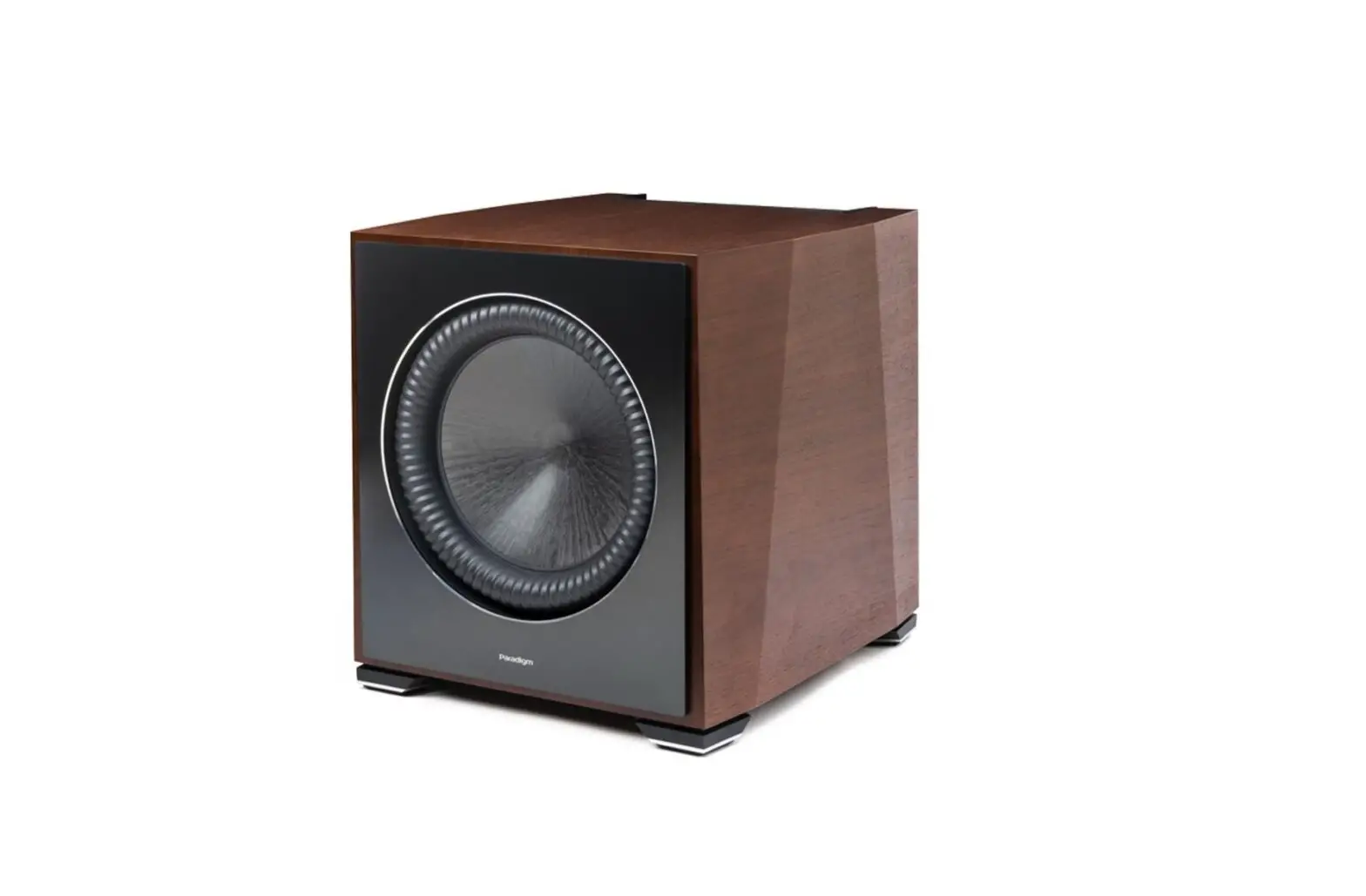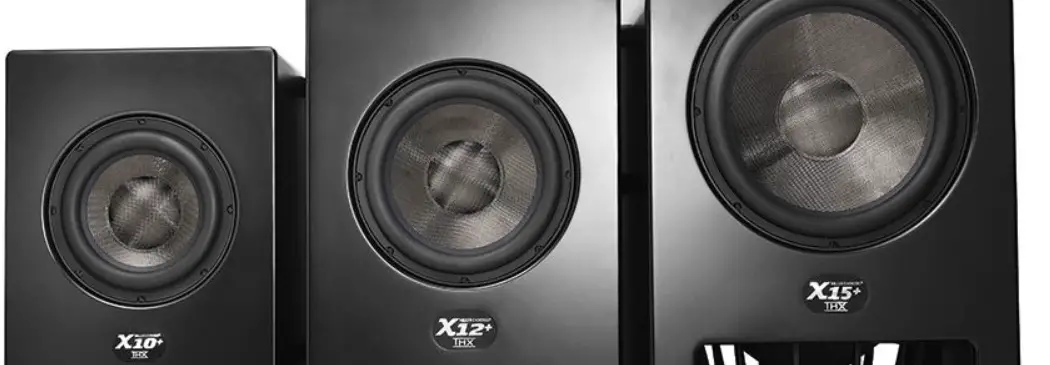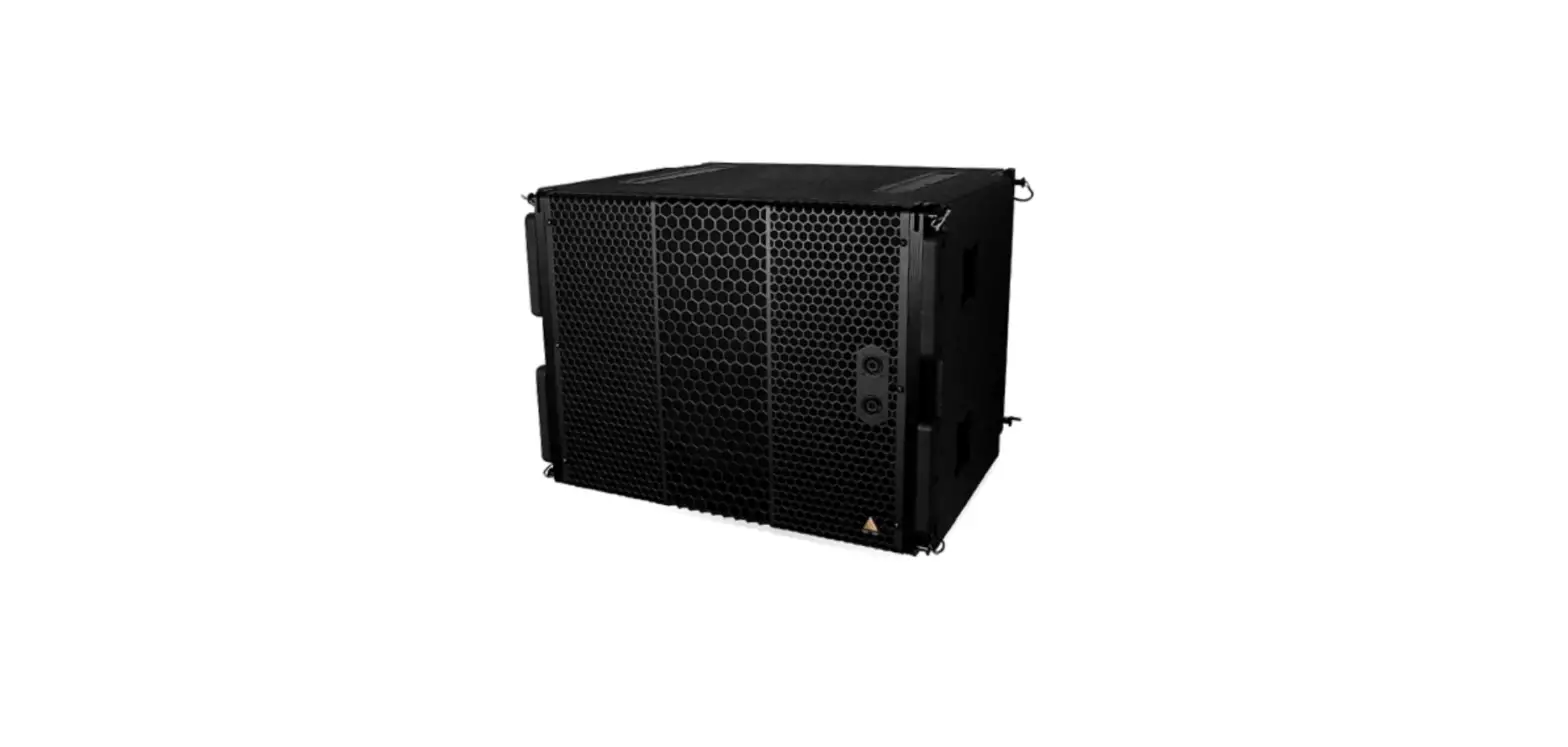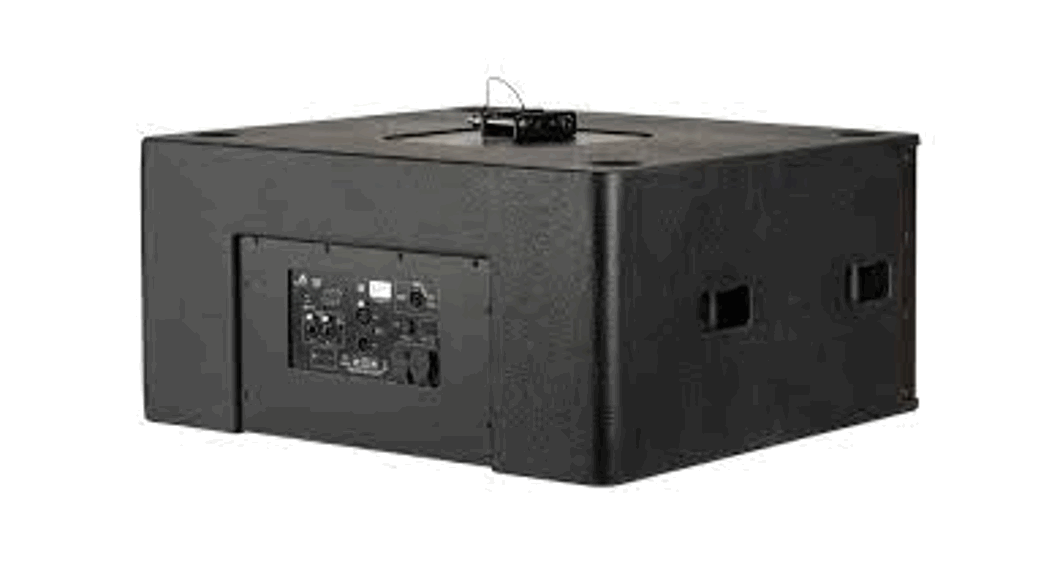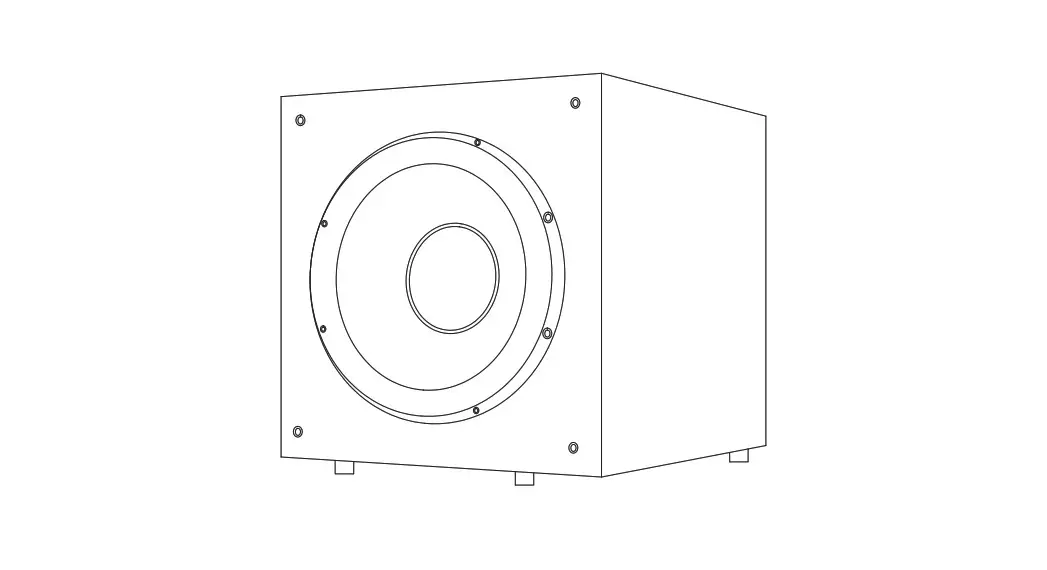

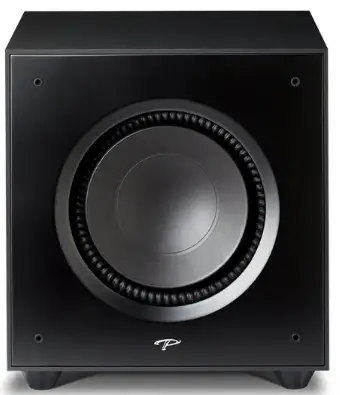
Paradigm X15 Defiance Subwoofer
IMPORTANT INSTRUCTIONS
- Keep these instructions.
- Heed all warnings.
- Follow all instructions.
- Do not use this apparatus near water.
- Clean only with dry cloth.
- Do not block any ventilation openings. Install in accordance with the manufacturer’s instructions.
- Do not install near any heat sources such as radiators, heat registers, stoves, or other apparatus (including amplifiers) that produce heat.
- Do not defeat the safety purpose of the polarized or grounding type plug. A polarized plug has two blades with one wider than the other.
- A grounding type plug has two blades and a third grounding prong.
- The wide blade or the third prong are provided for your safety.
- If the provided plug does not fit into your outlet, consult an electrician for the replacement of the obsolete outlet.
- Protect the power cord from being walked on or pinched, particularly at plugs, convenience receptacles, and the point where they exit from the apparatus.
- Unplug this apparatus during lightning storms or when unused for long periods of time.
- Refer all servicing to qualified service personnel..
- Maintain a minimum of 20-30cm distance around the apparatus for sufficient ventilation;
- The ventilation should not be impeded by covering the ventilation openings with items, such as newspapers, tablecloths, curtains, etc.;
- No naked flame sources, such as candles, should be placed on the apparatus;
- The use of apparatus in moderate climates.
Paradigm Defiance Subwoofer
Thank you for choosing a Paradigm® Defiance Subwoofer. You are about to hear the difference that Paradigm subwoofers make in your home theater system! They are the product of countless hours of comprehensive research and development and will reward you with truly exceptional sound for many years. To ensure proper installation, please read this manual and follow all instructions. If you have further questions contact your Authorized Paradigm Dealer or visit the Q&A page on our website at www.paradigm.com.
SAFETY WARNINGS AND QUICK INSTALLATION
- Hazardous voltages exist inside—do not remove cover.
- Refer servicing to a qualified technician.
- To prevent fire or shock hazard, do not expose this module to moisture.
- Turn amplifier off and unplug subwoofer should any abnormal conditions occur.
- The power cord should not be installed, removed, or left detached from the speaker while the other end is connected to an AC power source.
- The main power switch near the AC inlet shall remain readily operable.
- Use only with a grounded electrical outlet.
- No candles or other sources of open flame should be placed on the speaker.
- No liquids either in glasses or vases should be placed on speaker.
- Speaker should not be exposed to dripping or splashing liquids.
- The terminals marked with the lightning bolt symbol should be connected by an instructed person or by way of ready made terminals.
- The power cord should remain readily operable should any abnormal conditions occur.
Unpacking
Remove your new subwoofer from its packaging. Please retain the original packaging materials for future use — replacement packaging may be expensive.
Placement You may choose to begin by placing the subwoofer in a corner near the front of the room. If placed in a corner, align the subwoofer diagonally so both woofers are equidistant from the adjacent wall. Before deciding on a permanent corner placement, experiment with other positions. Locations away from corners often prove more effective in providing ideal low-frequency performance and blend with the main speakers. Please see the Placement section for details.
Signal Connection Use the best cables you can. High quality cables, available from your specialty dealer, are recommended and will give you superior performance. Attach your receiver/preamplifier outputs to the signal input connectors located on the subwoofer’s rear panel. Please see the Controls and Connections section for details. If you plan to connect your subwoofer using Speaker Level (high level) inputs, refer to the Speaker Level Inputs section for details.
Power Connection (AC) Make sure the level knob is set at 0. Plug the subwoofer into a wall outlet. Review the AC Power Connection section of this manual for details.
YOUR NEW SUBWOOFER
Break In Although Paradigm® Defiance subwoofers sound great “out of the carton,” they will sound even better once they are “broken in.” Allow them to play for several hours before you begin any critical listening.
Cleaning Paradigm Defiance Subwoofers have a durable premium finish. To clean, use a damp soft cloth. Do not use a strong or abrasive cleaner. Avoid getting any part of the subwoofer system wet. Do not place wet objects (drinking glasses, potted plants, etc.) on top of the subwoofer— if allowed to soak in, even a small amount of water may permanently damage the subwoofer enclosure.
Power Requirements The ‘Watts’ (W) rating indicated on the rear panel is the maximum AC power your subwoofer will draw when producing its maximum power output. However, the actual wattage draw will vary with the bass content of the program material — more if there is a lot of deep bass, less when there is not as much bass. Although generally not required for typical music and movie program material, if the bass content of your program material is very loud and more continuous in nature, we recommend connecting subwoofers with higher wattage ratings (i.e. 1500 W) to dedicated AC circuits.
Room Acoustics You are about to experience the astonishing bass performance of a stateof- the-art Paradigm Defiance subwoofer. These subwoofers incorporate highly advanced patented technology and set all new standards for deep bass extension, ultra-low distortion and sound power output and provide unprecedented bass articulation and slam. It is important to note that just as the amount of soft furnishings has a decided impact on mid and high frequencies, those below 150Hz are dramatically affected by the room itself — its size, shape, as well as by physical boundaries throughout the room. Experimenting with subwoofer placement and control adjustments is the best way to achieve optimal bass performance in any room. Keep in mind the following guideline when deciding on best subwoofer placement:
SUBWOOFER PLACEMENT
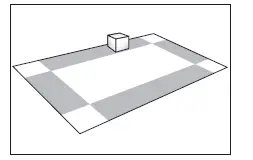
Bass is less and less directional as it goes down in frequency. For best sonic integration, locating your subwoofer between your front speakers or beside one of them will usually provide the best bass performance. If this location is not possible your subwoofer may be placed anywhere in the room without affecting the stereo image of your front speakers or the soundstage of your multichannel speaker system. Fig. 1a and Fig. 1b highlight how bass output is generally affected by room placement. When seated in a typical listening area of your room, placing the subwoofer inside the “shaded” areas will typically result in bass performance as follows:
Corner placement provides the most bass, but sometimes at the expense of accuracy.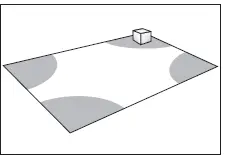 A subwoofer placed near a wall usually provides a good balance of quantity and accuracy.
THE ADVANTAGE OF USING TWO SUBWOOFERS
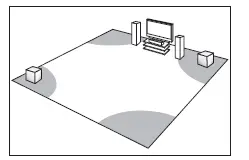
When using two subwoofers, placing one in the front of the room and the other in the rear of the room usually provides the best bass performance and sonic integration. Consult the “Fine Tuning” section of this Owners Manual for more information on adjusting phase settings. If those locations are not possible, or if you want to experiment with placement options using two subwoofers, the following procedure will be a helpful guide to achieving better bass performance. Refer to “Subwoofer Connection” (below) then proceed
CONNECTING YOUR SUBWOOFER
Before proceeding with this section, be sure to read and follow all safety precaution notices and warnings at the beginning of this manual. Turn all components OFF before connecting the subwoofer. Speakers set to “Large” on your receiver/ preamplifier will still be reproducing bass frequencies—be careful not to overdrive them! We recommend the use of high-quality cables and connectors. (See your Dealer for more information).
WIRED CONNECTION
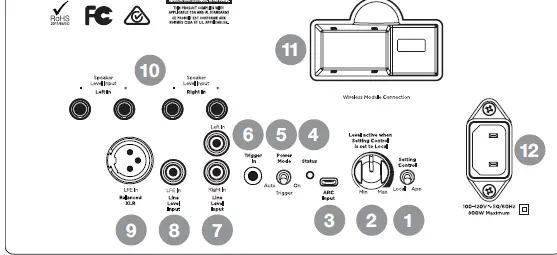
Line Level Input (LFE) — Recommended
Line-Level Input From Sub/LFE Output — for use with a receiver / pre amplifier that has a Sub-Out/ LFE-Out jack. Using a RCA to RCA interconnect cable (not included) connect the subwoofer as shown.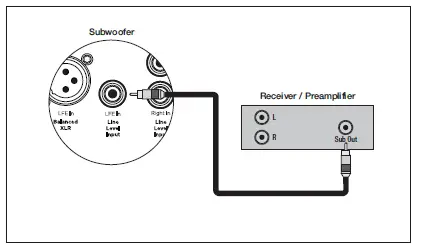
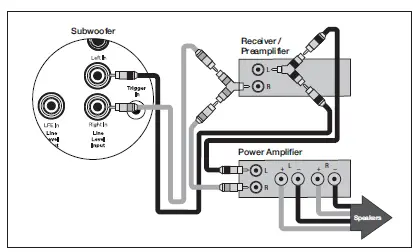
Line Level Inputs (Left/Right)
Line-Level Input From Pre-Out/Front-Out Without High-Pass Output from Sub — for use with a receiver/preamplifier with Pre-Out/Front- Out and Main-In jacks. Using a RCA to RCA interconnect cables and ‘Y’ splitters (not included) connect the subwoofer as shown.
Speaker Level Inputs (Left/Right)
Speaker-Level Input — for use with a receiver/preamplifier that has no Sub-Out/LFE-Out or Pre-Out/Front-Out facilities. Using high-quality speaker cables, connect your subwoofer as shown in either of the following connection options.
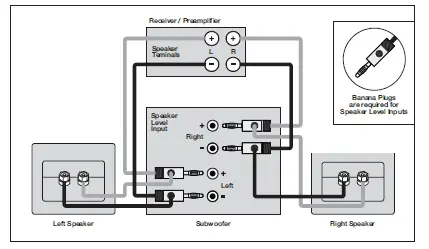
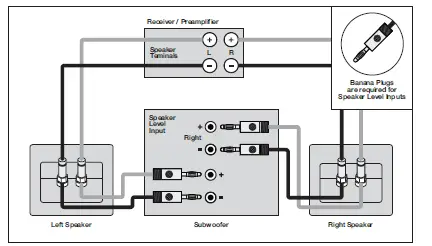
Line-Level Input From Sub/LFE Output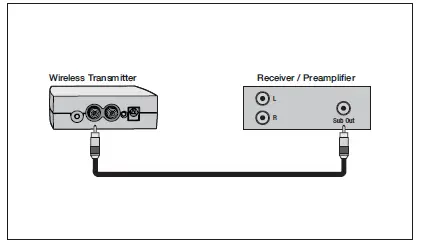
Line-Level Input From Pre-Out/Front-Out Without High-Pass Output from Subwoofer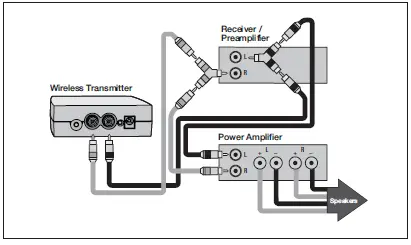
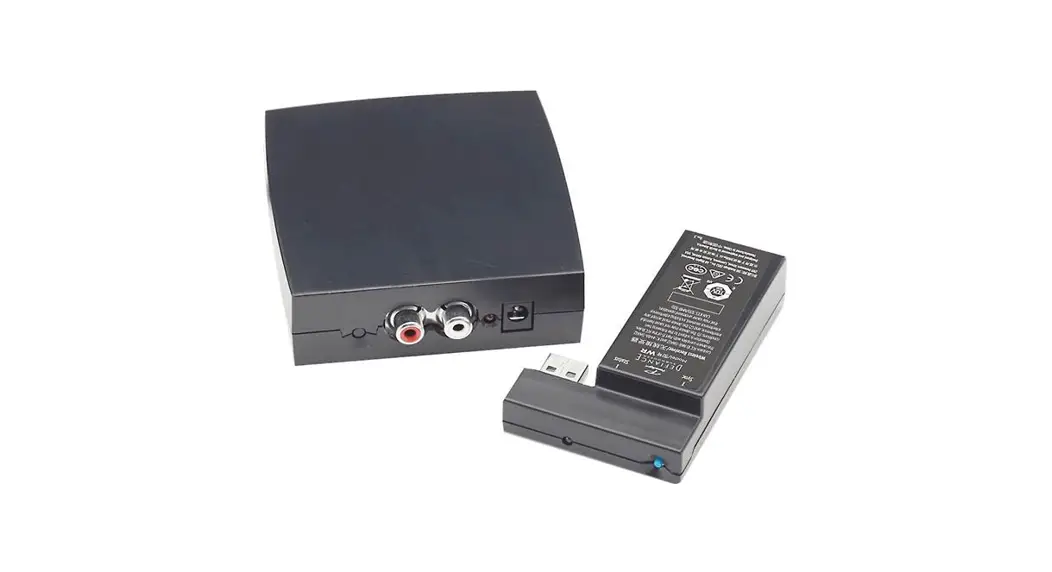
PAIRING’ THE DEFIANCE WT WIRELESS SYSTEM
WIRELESS OPERATION
Subwoofer placement plays a major role in optimizing bass performance. However, placement can impose the inconvenience, not to mention the unsightliness, of running long lengths of cable through walls, along baseboards and under floors and carpets. Going wireless means you no longer have to worry about placement while cable clutter becomes a thing of the past. Actual system setup time is often drastically reduced with the wireless option
TRANSMITTER OPERATION
In a typical listening room your new wireless transmitter has a maximum range of 50’ (15 m). Obstructions such as walls, large pieces of furniture, room dividers, etc., may reduce the wireless transmitter’s range. Do not place the subwoofer and wireless transmitter farther apart than the recommended range. We do not recommend installing your wireless transmitter in another room. The wireless transmitter’s compact dimensions allow it to fit neatly into a standard audio/video rack. Your wireless transmitter features a 2.4 GHz uncompressed digital self sensing design that will automatically adjust for the best wireless connection while monitoring the integrity of the data stream. An RCA audio cable is required (not included) to connect the wireless transmitter to your receiver/preamplifier— see your dealer for cable recommendations. One wireless transmitter is required for each wireless subwoofer in operation
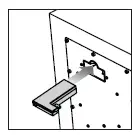
The Defiance WT Wireless System is shipped already paired. To re-sync the wireless system:
- Verify the subwoofer is powered on and that the subwoofer’s status light is red or white.
- If the Wireless Transmitter’s power cord is plugged in, unplug it for 10 seconds.
- Plug in the Wireless Transmitter’s power cord.
- Plug the Wireless Receiver into the “Wireless Module Connection” input on the back of the subwoofer (see diagram below).
CONTROLS & CONNECTIONS
CONTROLLING YOUR SUBWOOFER USING THE APP/FINE TUNING
Your Defiance subwoofer uses an advanced app based system to control its many features. This app is available for both iOS and Android. Visit Paradigm’s web site for details on downloading this free subwoofer app or download from iOS or Android app stores. Please note that this subwoofer app is subject to updates, and may differ slightly from what is described in the following pages.
OPERATION: Press on the logo button to see basic subwoofer information.
Menu Bar Home: Lets you adjust your subs volume, select a listening mode and run a tone sweep
Help: Displays a pop-up window with a description of the control currently displayed on the screen.
Discovery: Choose the sub model, from the list, that you want to control. If you can’t see your subwoofer, make sure the Setting Control is set to “app” on the back of the subwoofer and that ARC mobile isn’t running on your device. Also, check that it isn’t being controlled by another mobile device running ARC or the subwoofer control app.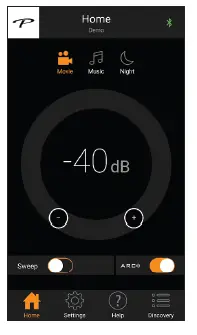
SETTINGS: Lets you select the subs control functions: volume, low pass filter, phase, room correction and more.
Volume: Adjusts loudness of your subwoofer. For most applications, a setting between –14dB and 0dB is adequate.
Sweep: The Sweep feature is useful for locating areas in your listening room where troublesome rattles or resonances may occur. Pressing the pause button pauses the subwoofer at a specific tone frequency and also allows you to set a specific tone frequency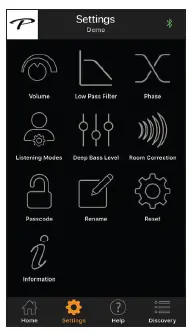
Low Pass Filter: Applied to Left/Right inputs (Not LFE). This setting allows you to select the frequency (point at which the filter starts) and order of the Low Pass filter. (The order of the filter refers to how steep the roll off it is, each additional order noted is another 6dB of roll off per octave, 1st order is 6dB, 2nd order is 12dB, etc.) These settings depend on how low your main speakers play. It is often best to set to bypass and use your receiver/preamp’s bass management settings so there is no overlap or missing information between the main speakers and the subwoofer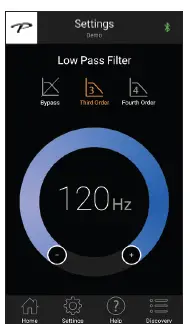
Bypass: engage if you intend to use your receiver/preamp’s bass management to set a low pass filter.
Third Order: If you are using the subwoofers left/right inputs, select this option to use a third order crossover to adjust the roll off characteristics of your subwoofer’s upper frequencies as they approach the low-pass filter frequency setting. A third order filter has a slope of 189dB per octave – a slow roll off than a fourth order. For most applications a third order corssover is ideal
Fourth Order: IF you are using the subwoofer’s Left/Right inputs, elect this option to use a fourth order crossover to adjust the roll off characteristics of your subwoofer’s upper frequencies as they approach the low-pass filter frequency setting. A fourth order filter has a slope of 24dB per octave – a faster roll off than a third order.
Phase: This setting allows you to adjust the timing relationship between your main speakers and your subwoofer. Allows you to adjust the phase of the subwoofer from 0 – 180 degrees in increments of 1 degree and allows you to invert the polarity of the phase. Phase control is entirely dependent on numerous factors including the size and configuration of your listening environment, the placement of the unit, and seating arrangement. A good rule of thumb is to set phase at 0 if your sub is at the front of the room and 180 if it is in the rear.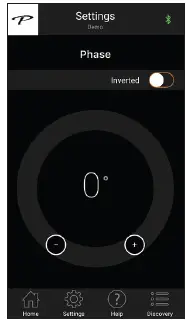
Deep Bass Level: The Deep Bass Level screen allows you to adjust subwoofer output from –10dB to +10dB in the 20-30Hz range. This control and Anthem Room Correction (ARC®) serve similar purposes. Where this control is limited to the 20-30Hz frequency range, ARC adjusts your subwoofer’s output across its entire frequency range. If not using ARC, this control can be used to modify your subwoofer’s response to compensate for the room anomalies or to modify the subwoofers sound to your personal taste. The frequencies adjusted are between 20-30Hz – a range where peaks and dips of different amplitudes often develop in listening rooms. The ideal setting is dependent on room size and construction, system configuration, and personal preference. As a rule of thumb, if your low-bass sounds weak, increase this control. If your low-bass sounds bloated, decrease this control.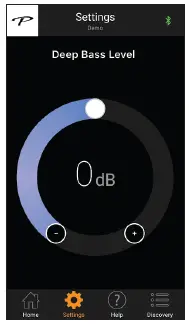
SETTING SUBWOOFER CONTROLS
- Turn the Level control completely counter clockwise to its minimum.
- Turn the Low Pass Filter control to Bypass.
- Turn the Phase control to 0° (completely counter clockwise).
- Listen to a bass music or video selection while seated in your primary listening area and turn up the Level control until the subwoofer can be clearly heard.
- Rotate the Phase control until you hear the most bass. Your subwoofer and front speakers are now in phase. Do not change phase alignment again unless you move the subwoofer or front speakers to a different location in your room, or move or remove any large items of furniture or room furnishings (i.e. carpet, draperies, etc.)
- Turn the Level control completely counter clockwise to its minimum.
- Slowly rotate the Level control until you match the subwoofer’s volume with the Volume of your front speakers. Bass should be clearly audible, but not intrusive
ANTHEM ROOM CORRECTION (ARC®)
True Scientific Solution to the Problems of the Room
Even when the finest speakers are perfectly positioned, the room itself still has a dramatic impact on any system’s sound, an impact more profound than that of any individual component. Various solutions have fallen in and out of favor over the years, but none has solved the problem of “the room,” until Anthem Room Correction (ARC®)technology. ARC technology is a proprietary digital signal processing system that allows you to quickly and accurately optimize the performance of your audio equipment to better suit the unique parameters of your room. By listening to your room’s acoustic signature, ARC can tune your equipment to correct for the performance-robbing effects (reflections, resonances, standing waves, etc.) of the various surfaces and other obstacles in your room. ARC is easy to use, and just a few simple steps can optimize your subwoofer for your unique listening space. ARC is sophisticated, one of the most accurate and detailed digital room correction technologies available today. ARC will work tomorrow, too; with constant advances and updates available for download on the Anthem website. Now there are THREE ways to calibrate your system using ARC or ARC Mobile — each takes only a few minutes to complete.
HOW TO USE ARC TECHNOLOGY
- Download the latest version of ARC-2 software from www.anthemav.com and install it. Follow the on-screen instructions.
- Using the USB cables provided, connect one from the ARC microphone to the PC and the other from the PC to the back of the subwoofer.
- Look for the icon on your desktop and launch the ARC program.
- Follow the prompts on your computer screen to successfully run the ARC software; the entire process should take approximately 15 minutes.
- Hold the ARC microphone with your arm fully extended, the ARC microphone tip must point towards the ceiling and it must be positioned at ear level.
- For best results, hold the microphone in 5 different positions around the room.
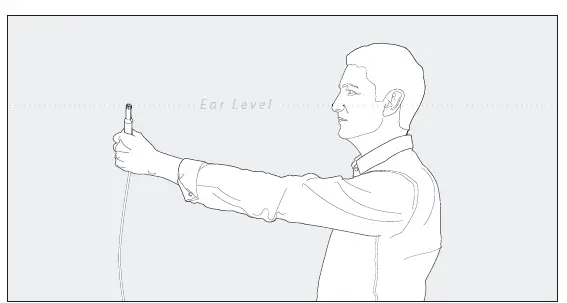
TIP! Once the ARC process is complete, the audio will be played back reflecting these corrections. To turn ARC correction on and off, use the Paradigm Subwoofer App and navigate to ‘Anthem Room Correction’.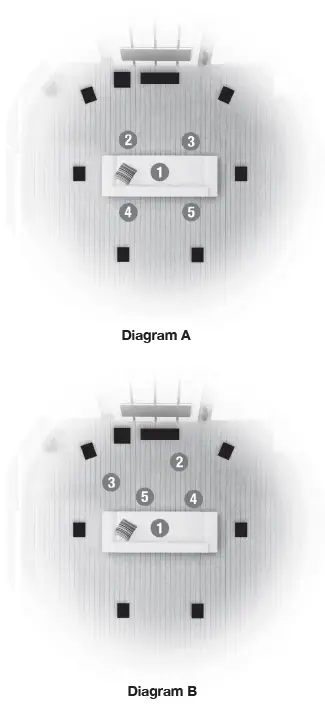
LIMITED WARRANTY
PARADIGM® SUBWOOFERS: The Paradigm Subwoofers covered in this manual are warranted to be and remain free of manufacturing and/or material defects for a period of three (3) years from the date of the original retail purchase. Within the time period specified, repair, replacement or adjustment of parts for manufacturing and/or material defects will be free of charge to the original owner.
DEFIANCE WT WIRELESS SYSTEM (SOLD SEPARATELY): Details on the warranty for the Defiance WT Wireless System can be found in the Defiance WT Wireless System Owners Manual
Limitations:
- Warranty begins on date of original retail purchase from an
- Authorized Paradigm® Dealer only. It is not transferable;
- Warranty applies to product in normal home use only. If the product is subjected to any of the conditions outlined in the next section, warranty is void;
- Warranty does not apply if the product is used in professional or commercial applications. Warranty is Void if:
- The product has been abused (intentionally or accidentally);
- The product has been used in conjunction with unsuitable or faulty equipment;
- The product has been subjected to damaging signals, derangement in transport, mechanical damage or any abnormal conditions;
- The product (including cabinet) has been tampered with or damaged by an unauthorized service facility;
- The serial number has been removed or defaced. Owner Responsibilities:
- Provide normal/reasonable operating care and maintenance;
- Provide or pay for transportation charges for product to service facility
EU COMPLIANCE INFORMATION
Hereby, SVI Holdings (US) Inc.’s declares that this Defiance Suwoofer is in compliance with the essential requirements and other relevant provisions of the following EU Compliance Directive Information
- Conforms to European Union Low Voltage Directive 2014/35/EU;
- European Union EMC Directive 2014/30/EU;
- European Union Radio Equipment Directive (RED) 2014/53/EU.
- European Union Eco-Design Directive 2009/125/EC; European Union WEEE Directive 2012/19/EU;
- European Union Restriction of Hazardous Substances Recast (RoHS2) Directive 2011/65/EU;
- European Union Registration, Evaluation, Authorization and Restriction of Chemicals (REACH) Directive 2006/121/EC;
- You may obtain a free copy of the Declaration of Conformity by contacting your dealer, distributor, or SVI Holdings (US) Inc.’s worldwide headquarters.
- Contact information can be found here: www.paradigm.com.
INDUSTRY CANADA (IC) COMPLIANCE NOTICE
This device complies with Industry Canada licenceexempt RSS standard(s). Operation is subject to the following two conditions
- this device may not cause interference, and
- this device must accept any interference, including interference that may cause undesired operation of the device
Any changes or modifications not expressly approved by the party responsible for compliance could void the user’s authority to operate the equipment. This equipment complies with IC radiation exposure limits set forth for an uncontrolled environment
FCC
The FCC Rules. Operation is subject to the following two conditions:
- This device may not cause harmful interference, and
- this device must accept any interference received, including interference that may cause undesired operation.
Per FCC regulation 47 CFR 15.21: Changes or modifications not expressly approved by the party responsible for compliance could void the user’s authority to operate the equipment. NOTE: This equipment has been tested and found to comply with the limits for a Class B digital device, pursuant to part 15 of the FCC Rules. These limits are designed to provide reasonable protection against harmful interference in a residential installation. This equipment generates uses and can radiate radio frequency energy and, if not installed and used in
- Reorient or relocate the receiving antenna.
- Increase the separation between the equipment and receiver.
- Connect the equipment into an outlet on a circuit different from that to which the receiver is connected.
- Consult the dealer or an experienced radio/TV technician for help.
FAQS
What are the two types of paradigm?
Within research, there are two main paradigms, namely positivist and interpretive. The paradigm that a researcher uses depends on where they see themselves in relation to the world around them as well as their views and thoughts
What are the three types of paradigm?
The three paradigms (positivist, constructivist, and critical) which are different by ontological, epistemological, and methodological aspects are also often included in the classification of scholarly paradigms
Which Paradigm speakers are made in China?
The 601 S3 was made in England and cost $450 USD. The current 685 (essentially the same speaker) is made in China and costs $650
Why is paradigm powerful?
Paradigms are important because they define how we perceive reality and how we behave within it.
Why does paradigm have a silent G?
When ⟨gh⟩ occurs at the beginning of a word, it is pronounced hard (/ɡ/) as in “ghost” and “ghetto”. In a few words of Greek origin, the digraph ⟨gm⟩ is pronounced #mmm_, with the (g) being silent, such as in “phlegm”, “paradigm” and “diaphragm”
Are paradigm subwoofers good?
The PARADIGM DEFIANCE X10 and V10 SUBWOOFERS deliver excellent performance in a small size and at a low price
Which is better Klipsch or Paradigm?
The Klipsch speakers are more sensitive than the Paradigm speakers. Thus they can produce more sound with the same amount of electricity
What happened Paradigm speakers?
Today, Paradigm is still located in Canada — only now they have their own research facility and their own 33,000 cubic foot anechoic chamber
Are Paradigm speakers high-end?
Paradigm speakers have become a cornerstone of enjoyable, affordable high-end audio solutions. With a reputation that ranks them among the highest-selling speaker brands on six continents, it’s time to enjoy the Paradigm difference in your Honolulu, Hawaii home.
Are Paradigm speakers still good?
It’s a Top Choice for a an “affordable premium” speaker system. They may be big, expensive and undeniable heavy, but Paradigm’s Persona 9H speakers are outstanding in every respect, from the superb quality of build and finish to their scintillating sound.
Who owns Paradigm audio?
This is not the case for Paradigm and its three founders Jerry VanderMarel assisted by his brother Bill and Scott Bagby who, from the suburbs of Toronto, put forward a concept that was new at the time
How long has Paradigm been around?
It was founded in 1980 by speaker designer Scott Bagby and by sales and marketing specialist Jerry VanderMarel
Are Paradigm speakers still made in Canada?
It’s been that way since 1982.
Is Anthem made by Paradigm?
In 1998, Paradigm founders Jerry VanderMarel and Scott Bagby acquired Sonic Frontiers and its Anthem brand
What does the name paradigm mean?
Paradigm traces to a Greek verb meaning “to show,” and has been used in English to mean “example” or “pattern” since the 15th century. Some debate exists, however, about what kind of example qualifies as a paradigm