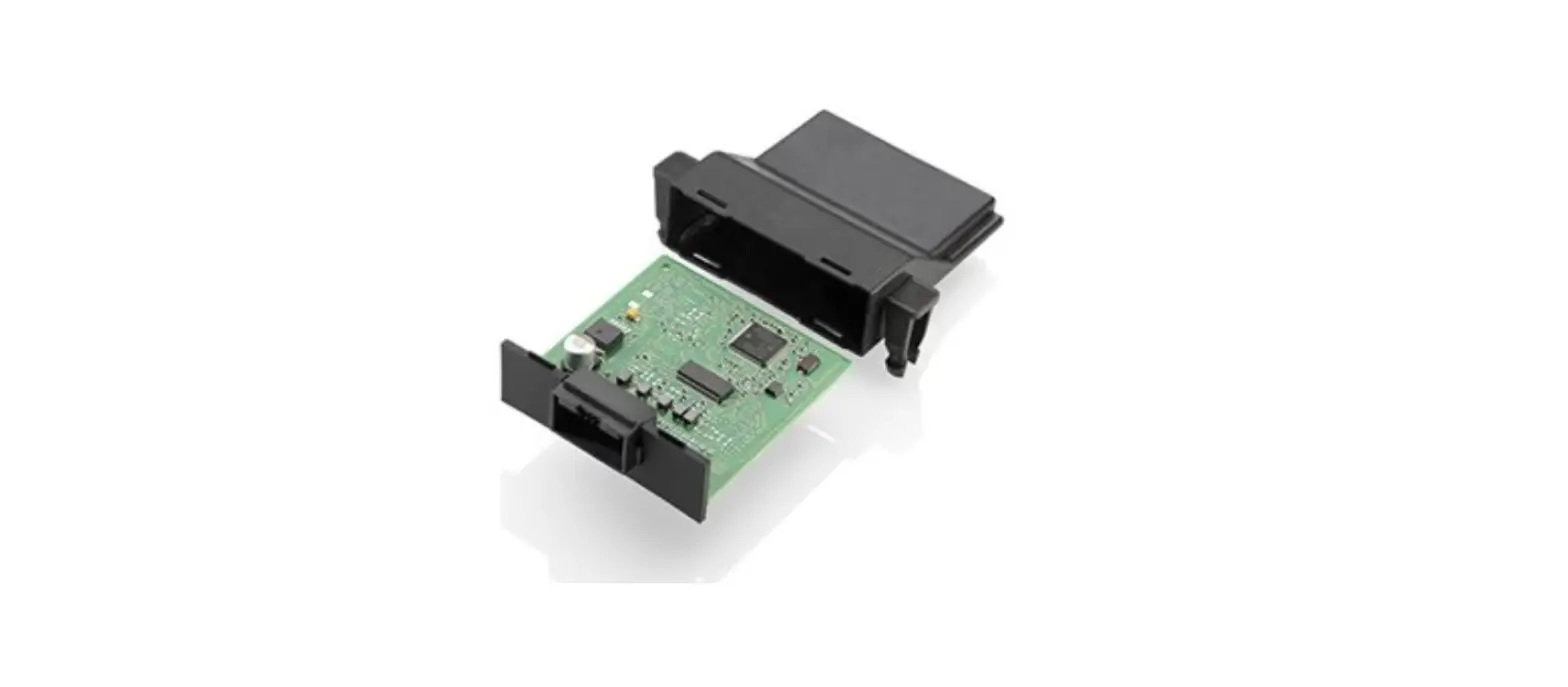
 SLA8 sense Line Assembly electronic module
User Manual
| Model Name: | SLA8 |
| Type of product: | Sense Line Assembly |
| Brand Name: | Visteon |
| Manufacturer: | Visteon Corporation |
| Manufacturer Address: | One Village center drive, Van Buren Township 48111-5711 Michigan United States of America |
SLA Features
The SLA (Sense Line Assembly) is an electronic module intended to monitor battery module cell groups voltages and module temperatures from the High Voltage battery bus in addition to activating cell balancing to improve battery cell life.
All cell voltages and module temperatures are reported directly to the VICM3 on a regular periodic basis via Wireless communication through the BRFM.
The SLA implements a Cell Monitoring Unit board that uses a Pinnacle IC (ADRF8800), this is an IC that provides wireless communication between the Battery Cell Monitoring chip and the Battery Management System Controller
SLA operates in the frequency range 2.405 GHz – 2.480 GHz (ISM band) by using Wireless battery management technology.
The network periodicity is 100ms; meaning, each particular CMU will send once or twice every 100ms, and the transmission time is 1.85ms*2* R (R=2 for SLA).
There is no simultaneous transmission on the system; there can be CMUs that communicate at the same time but on different channels.
System interaction:
| Module-to-Vehicle Electrical Interface | |
| Analog Input | The satiety module provides voltage to SLA. The power nominal value is 29.211 Minimum voltage expected is 8V and the maximum is 35.2V. NTCI, NTC2, and NTC3 thermistors from ICB. |
| Digital (discrete state) Input | NA |
| Analog Output | NA |
| Digital (discrete state) Output | NA |
| Communication Bus | NA |
| RF Link(s) | ISM Band (2.4GHz to 2.5GHz) is used to communicate with BRFM modules. Rx sensitivity shall be around 50% of PER, where each measurement shall vary by no more than +1- 2.0dB from the golden sample. Tx output power shall vary by no more than +/-2.5dB from the golden sample. Radiofrequency reference shall be within ± 2OPPM from desired frequency (2.44GHz, channel 7). |
| Module-to-Vehicle Non-Electrical Interface | |
| N/A | |
| User Interface | |
| NA | |
| Internal Interface Note: For these internal I/O, monitoring shall only occur via communication bus data or via indirect methods. Direct monitoring using attachments leads to external monitoring devices shall not be included. | |
| Analog Input | NA |
| Digital (discrete state) Input —steady-state I/O | NA |
| Switching & Clock Frequency Content | SPI communication shall be I Mbps nominal. Used to communicate between RF manager to Sensors ASIC. RF Manager IC XTAL frequency shall be 40MHz nominal. |
| Digital (discrete state) Input —dynamic I/O | NA |
| Analog Output | Main power supply SMPS 0302 O shall have an output voltage of 3.3V with ±5mV peak-to-peak ripple voltage |
| Digital (discrete state) Output | |
| Communication Bus | |
| Note: This section assumes that production software is not mandatory; the use of specialized software is acceptable. Note: Software diagnostic timers should be reset to minimum detection values, to facilitate assertion of potential diagnostic flags during the RF exposure time (maximum 2 seconds). Note: States/faults/issues shall be reported directly over the communication bus (Le., Class Z Controller Area Network (CAN), etc.) or indirectly if the communication bus is not available via the cycling of output(s) (e.g., PWM duty cycle change, telltale flash rate change, etc.) Note: Unless otherwise specified in the EMC Test Plan, in order to ensure a refreshed value, all information related to data monitoring (such as analog input voltages, operating states, etc.) shall be via parameter requests (e.g., Parameter ID (PID)) and not via scheduled, or periodic, broadcast messages. This ensures bi-directional communications during immunity testing. | |
The following information shall also be included in the case of radio equipment intentionally emitting radio waves:
a. Frequency band: 2.4 – 2.5 GHz
b. Maximum radio-frequency power is transmitted in the frequency band(s) in which the radio equipment operates. Max output power = 10 dBm
(the U.S.A. and Canada)
FCC
This device complies with Part 15 of the FCC Rules. Operation is subject to the following two conditions:
- This device may not cause harmful interference, and
- The device must accept any interference received, including interference that may cause undesired operation.
Changes or modifications not expressly approved by the party responsible for compliance could void the user’s authority to operate the equipment.
RF exposure safety
This device complies with the FCC RF exposure limits and has been evaluated in compliance with portable exposure conditions.
The equipment must be installed and operated and was evaluated with a minimum distance of 5.668 cm from the human body. This distance or greater is maintained by vehicle design and ensures compliance with the normal use of the vehicle.
ISED CANADA
This device complies with Industry Canada License-exempt RSS standard(s). Operation is subject to the following two conditions:
- This device may not cause harmful interference, and
- The device must accept any interference received, including interference that may cause undesired operation.
Changes or modifications not expressly approved by the party responsible for compliance could void the user’s authority to operate the equipment.
RF exposure safety
This device complies with the FCC RF exposure limits and has been evaluated in compliance with portable exposure conditions.
The equipment must be installed and operated and was evaluated with a minimum distance of 5.668 cm from the human body. This distance or greater is maintained by vehicle design and ensures compliance with the normal use of the vehicle.