DE8800 Series Fiber Optic Inspection Scope
Product Information: DE8800 Series Fiber Optic Inspection
Scope
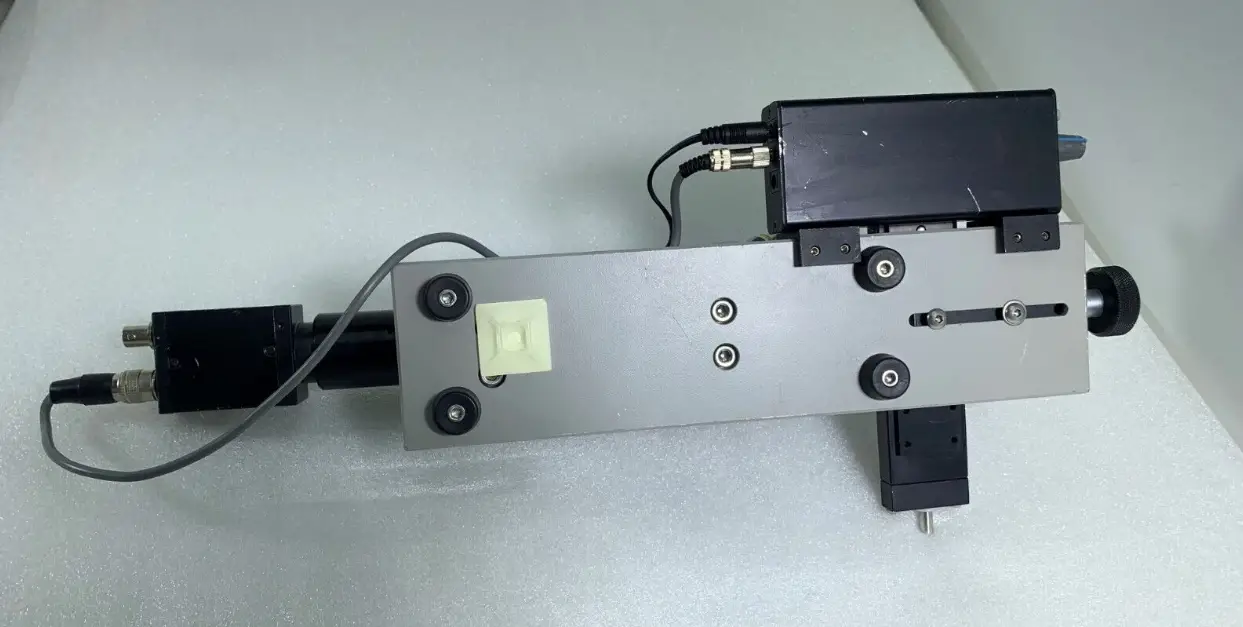
The DE8800 Series Fiber Optic Inspection Scope is manufactured
by Domaille Engineering, LLC and is designed for high-quality
visual end-face inspection of fiber optic connectors in a research
or production environment. This scope has a unique stage with
inverted optics allowing the operator to inspect connectors without
removing them from the polishing fixture, thereby increasing
throughput during inspection.
Parts and Functions
The DE8800 Series Fiber Optic Inspection Scope has the following
parts and functions:
- U-Bend Adapter: Mounts the camera to the
microscope base by bending it out of the way of the operator. - CCD Camera: High-resolution monochrome cameras
that are standard components of the DE8800 series microscope.
Additional camera options are available, contact Domaille
Engineering for details. - X-Y Stage Assembly: Provides a centering
adjustment for the polishing fixture and allows traversing of
multiple fiber connectors. - X-Axis Fine Adjustment: Slight X-axis
adjustment that moves the image up and down on the monitor’s
screen. - Y-Axis Adjustment and Slide: Provides a
side-to-side centering adjustment on the monitor and allows the
operator to quickly scan MT style connectors for defects. - Light Block Assembly: Transmits light from the
light source to the vertical illuminator. - Focus Knob: A course and fine focus adjustment
are located on each side of the focus unit. Turning this knob
towards the operator will bring the optics closer to the
stage. - Stage Insert: A variety of inserts are
available to fit a wide range of polishing fixtures from several
different manufacturers.
Product Usage Instructions
Follow the below instructions to use the DE8800 Series Fiber
Optic Inspection Scope:
- Initial Setup: Set up the microscope on a
stable surface, plug in the power cord, and connect the camera to a
monitor using the appropriate cable. - Operation:
- Focusing and Focus Tension Adjustments: Use
the focus knob to adjust the focus of the scope. The course and
fine focus adjustments are located on each side of the focus unit.
Turning this knob towards the operator will bring the optics closer
to the stage. Adjust the focus tension by turning the tension
adjustment ring located on the focus knob. - Lighting: Use the light block assembly to
transmit light from the light source to the vertical
illuminator. - Changing Magnifications: Use the turret or
nosepiece to change magnifications. - Determining Actual Magnification: To determine
the actual magnification, divide the monitor size by the objective
magnification. - Linear Stage Adjustments: Use the X-Y stage
assembly to provide a centering adjustment for the polishing
fixture and allows traversing of multiple fiber connectors.
- Focusing and Focus Tension Adjustments: Use
- Changing Inserts: To change inserts, remove
the stage insert from the microscope and replace it with the
desired insert. - Preventive Maintenance: Regularly clean the
microscope lenses and stage insert, and ensure that the microscope
is stored in a clean and dry environment when not in use. - Troubleshooting Advice: Refer to the
troubleshooting section of the user manual for assistance with any
issues. - Polishing Fixture Inserts: A variety of
inserts are available to fit a wide range of polishing fixtures
from several different manufacturers. Contact Domaille Engineering
for details.
DE8800 Series
Fiber Optic Inspection Scope
User’s Guide
Table of Contents
DE8800 Series
Fiber Optic Inspection Scope
User’s Guide
Overview ……………………………………………………………………..1 Parts & Functions…………………………………………………………..2 Features………………………………………………………………………..4 Initial Setup…………………………………………………………………..4 Operation………………………………………………………………………5
Focusing and Focus Tension Adjustments ………………………..5 Lighting ………………………………………………………………..5 Changing Magnifications…………………………………………….5 Determining Actual Magnification …………………………………6
Linear Stage Adjustments……………………………………………..6
Changing Inserts …………………………………………………….7
Preventive Maintenance ………………………………………………..8
Caution & Warnings………………………………………………….8 General Cleaning……………………………………………………..9 Centering the Illumination………………………………………….9 Cleaning the Dust Cover …………………………………………..10 Cleaning the Objective Lenses ……………………………………11 Changing the Detent Tension……………………………………..11 Cleaning the CCD Camera ………………………………………..11
Troubleshooting Advice ………………………………………………..13 Polishing Fixture Inserts ………………………………………………14 Limited Warranty……………………………………………………….16 Company Information ………………………………………………….17
Overview
Manufactured by Domaille Engineering, LLC, the DE8800 Series Video Microscopes are designed for high quality visual end-face inspection of fiber optic connectors in a research or production environment. This scope has a unique stage with inverted optics allowing the operator to inspect connectors, without removing them from the polishing fixture thereby increasing throughput during inspection.
Printing History
Edition 2, July 2014 © Copyright 2014 by Domaille Engineering LLC
1
Parts and Functions
1 U-Bend Adapter 2 CCD Camera 3 X-Y Stage Assembly 4 X-Axis Fine Adjustment 5 Y-Axis Adjustment
and Slide
6 Light Block Assembly 7 Focus Knob
8 Stage Insert
2
LWD Objectives 9 Turret or Nosepiece 10
Dust Cover 11 Light Block 12 Light Source Mount 13
1
U-Bend Adapter Mounts the camera to the microscope base by bending
it out of the way of the operator.
2
CCD Camera High resolution monochrome which are standard
components of the DE8800 series microscope.
Additional camera options available, contact
Domaille Engineering for details.
3
X-Y Stage Assembly Provides a centering adjustment for the polishing fixture
and allows transvering of Multiple Fiber Connectors.
4
X-Axis Fine Adjustment Slight X-axis adjustment that moves the image up and
down on the monitor’s screen.
5
Y-Axis Adjustment Provides a side to side centering adjustment on the
and Slide monitor and allows the opertator to quickly scan MT
style connectors for defects.
6
Light Block Assembly Transmits light from the light source to the vertical
illuminator.
7
Focus Knob A course and fine focus adjustment are located on
each side of the focus unit. Turning this knob towards
the operator will bring the optics closer to the stage.
8
Stage Insert A variety of inserts are available to fit a wide range of polishing fixtures from several different manufacturers.
9
LWD Objectives High quality Long Working Distances Lenses are the
primary factor when determining magnification and
resolution. Standard models are equipped with: ME-12006 5x
ME- 12007 10x
ME- 12008 20x
Optional 40x and 3.3x objectives are also available.
10
Turret or Nosepiece Mounts the objectives to the base of the microscope.
By turning the nosepiece the operator may quickly
change the magnification of the microscope.
11
Dust Cover Protective covering that prevents dust and debris from
obstructing the optics.
12
Light Block Mounts the Fiber Optic Bundle to the Light Source
Base. Also mounts the beamsplitter which directs the
light toward the stage.
13
Light Source Mounts all the light components. Two screws located
Mount on the sides provide centering adjustment.
3
Features
· High Resolution video and CCD camera, digital cameras also available. · Four Position Nosepiece with 5x, 10x, and 20x LWD objectives. · Long Working Distance Optics for UPC and APC inspection. · An extensive range of inserts, reference pages 14-15. · Precision illumination Control.
Initial Setup
After unpacking the DE8800 series microscope and accessories, set up can be quickly achieved through a few simple connections. There are three main components to the microscope system, the microscope, power supply/LED Controller, and monitor (or personal computer using a frame grabber or digital camera).
The ME-12013 LED/ME-12015 Controller operates from a 24 volt DC output power adapter (ME12015) with switching transformer to accept AC voltage 90-240 volt, 50-60Hz for domestic or international use. This unit is used to power both the CCD camera and the illumination of the microscope. We provide two different monitor types, in several different sizes. These monitors are high resolution monitors specifically chosen to provide the best solution for inspecting connector end-faces. We do not recommend any of the lower priced security type monitors as the resolution and image quality are not sufficient. A computer may also be used to capture images, contact Domaille Engineering for more information on digital camera options or video frame grabbers.
4
Operation
Focusing and Focus Tension Adjustments
The Focus Adjustment Knob on the DE8800 series is conveniently located on each side of the base. Both course and fine adjustment are provided. A tension adjustment is also located on the right side of the scope.
Clockwise = Focuses the Stage Out Counter-Clockwise = Focuses the Stage In
Lighting
The illumination can be controlled using the “On/Off LED Intensity” control knob (Dark grey knob) located on the ME-12013 power adapter/LED controller. This allows the operator to control the brightness of the image when inspecting the dark fiber cladding and highly reflective metal or ceramic ferrules. A dimmer switch button is also provided for this function.
Clockwise = Increases Illumination Counter-Clockwise = Decreases Illumination
Changing Magnifications
Each DE8800 model is equipped with three LWD objective lenses: 5x, 10x, and 20x. The objective lenses are mounted to a microscope turret or nosepiece allowing the operator to quickly change magnifications when inspecting connectors. Optional objective lenses are also available in 3.3x and 40x.
Adjust Tension Focus In
Focus Out
5
Determining Actual Magnification
The best method to calculate the exact “total” magnification used on the DE8800 series is to measure the diameter of the fiber, cladding on the video display. Take the measurement in millimeters and divide that amount by the actual size of the fiber cladding, typically 125 micron. The result is the “total” optical and video magnification being used. For example: taking a set of calipers, we measured the diameter of the ferrule viewed through DE8800 on a monitor to be approximately 53.49mm. Actual size on display/cladding diameter in mm = total magnification 53.49mm / .125mm = 427.92X
Linear Stage Adjustments
The stage on the DE8800 has three adjustments. The polishing fixture insert rotates to view new connectors mounted on the polishing fixture. Most inserts feature detents that allow the operator to stop rotating precisely over the next connector. Y-axis travel is provided to scan multiple fiber style connectors and a X-axis adjustment is provided to center the image on the monitor.
6
Y-Axis
turn for Y-Axis
turn for X-Axis
X-Axis
Changing Inserts
All inserts, except DE8134, simply lift up and out of the stage assembly. This enables operators to quickly change inserts to accommodate different types of connectors when inspecting jumpers with different types of connectors.
The DE8134 12 position insert for Domaille and Seikoh Giken 510 polishers is fixed directly to the stage assembly. Use a hex wrench to loosen the release screw in the back stage.
7
Preventive Maintenance Caution:
The following instructions should only be performed by qualified service personnel.
Warning:
If equipment is used in a manner not specified by the manufacturer, the protection provided by the equipment may be impaired. There is NO SERVICEABLE EQUIPMENT inside the ME-12013 LED controller. All equipment requiring repair should be sent back to the manufacturer or an authorized dealer.
Note: The DE8800 series microscopes are relatively low maintenance. Basic care and precaution in using the instrument is required. Depending upon the cleanliness of the general working area as well as the age of the equipment, we would suggest at least semi-annual service and maintenance.
8
General Cleaning
Harsh solvents are not recommended on a regular basis. Typical safe degreaser solvents can be used to clean old grease or grime from mechanical parts. Ordinary lens cleaner (offered at most photo/camera supply stores) is safe to use on the optics of our microscopes. Lens cleaner can be used with a soft lens tissue/cloth to remove any soil, fingerprints, etc. from the front of the objectives.
Centering the Illumination
Centering the illumination of the DE8800 is critical in order to maximize performance of the microscope. All scopes are set up from the factory, but periodic cleaning may require the operator to re-center the illumination.
1. Using a 3/32″ hex wrench, loosen the two screws on either side of the light source mount.
2. While viewing a fiber on the monitor, slide the light block around until the greatest amount of light is over the cladding area of the fiber.
3. Re-tighten the two screws.
Note: adjust the light intensity up and down to confirm the light is centered
Incorrect Illumination: Notice how the light is towards the bottom of the screen.
Correct Illumination: Notice how the light surrounds the cladding. Light scratches can now be easily detected.
9
Cleaning the Dust Cover
Depending the type of production environment, the dust cover will need periodic cleaning to remove dust, debris and polishing material from the optical system. Since the illumination and optical path travels though the dust cover it is essential to keep this surface clean in order to ensure maximum performance of the DE8800. 1. Power off the unit and remove the light block assembly from
the fiber optic light source. 2. Using a 9/64″ hex wrench, remove the Light Source Mount
by unscrewing the screws located on each side, slide the sub-assembly out of the side of the unit. 3. Try to blow large particles off of the dust cover using compressed air. 4. Using a lens cleaner and a soft lens cloth, in a circular motion, carefully wipe the surface of the dust cover starting from the center and working towards the edges. 5. Replace the light source mount and re-connect the light block assembly to the fiber optic light source. 6. Follow instructions on centering the illumination.
10
Cleaning Objective Lenses
Oils, dirt, and finger prints may reduce the resolving power of the objective lenses. To ensure maximum levels of performance of the DE8800 series, wipe the lens of the objectives with a lint-free tissue and lens cleaner. Ordinary lens cleaner, available at most photography supply stores works the best. Perform this procedure weekly or as needed, depending on the type of environment inspection is being held.
Changing the Detent Tension
To adjust the indexing tension, locate the hole at the side of the stage. Using a flat head screw driver, adjust the ball plunger inside the stage. Turning the screw clockwise increases tension.
Cleaning the CCD Camera
Use extreme caution when attempting to clean the camera. Any scratches, solvent, streaks or dirt left on the IR filter of the CCD will show up in the field of view of the microscopes. Before attempting to clean the IR filter on the CCD camera, first confirm that the visible dirt on the monitor is actually on the camera. While viewing the suspected dirt on the video monitor, slowly rotate the CCD camera on the Microscope.
11
Due to the orientation of the CCD, if the dirt remains in the same spot and does not rotate with the camera, the dirt is most likely on the camera itself. 1. Carefully unscrew the camera from the camera mount. 2. Using clean, compressed air, blow across the surface of the
IR filter. 3. Recheck the camera for dirt. 4. If the dirt is still there, use plastic tweezers, soft lens cloth and
lens cleaner to carefully wipe the surface of the IR filter. Use a wiping spiral pattern from center of filter out to edges, to remove debris. 5. Re-check the camera for dirt. 6. Repeat this process until the camera is clean.
Caution!
Blow air across and not directly at the CCD chip of the camera.
12
Troubleshooting Advice
Image is Not Clear Try adjusting the focus mechanism to bring the image into focus. Increase or decrease the light intensity on the fiber optic light source. Adjust to 5x objective and verify fiber is in the field of view.
No Illumination Check the set-up, confirm that all connections are made and that everything is powered on. Increase the light intensity on the fiber optic light source. Check the fiber optic light source, replace it if necessary.
No Video Image Check the set-up, confirm that all connections are made and that everything is powered on.
Re-set the light intensity to approximately half power, too much light will bleed out the image resulting in an all-white screen.
Try adjusting the focus in and out.
Image Not Centered Use the Z-axis stage adjustment and the linear slide knob to bring the fiber to the center of the screen.
Fine tune the adjustments on the Z-axis using the knobs on top of each bracket.
Spots and/or Lines Slightly decrease the contrast control on the monitor on the Monitor as this may enhance optical interference with the CCD Chip.
Check the CCD Camera of dirt and debris.
Isolate the scope from other electronic devices that may cause video interference.
13
Loss of Resolution or Check the objective lenses for dirt, scratches or film. Image Contrast Adjust the brightness and contrast controls on the monitor. Make sure the impedance switch on the back of the monitor is set to 75. Check the CCD camera for dirt and film. Make sure the shutter on the CCD is set to the OFF position. Image Drifts In Tighten the focus tension knob.
and Out of Focus Tighten the side adjustment screw on the connector bracket.
Image is Not Centered Check that each objective is screwed on tight. Between Objectives
Polishing Fixture Inserts
DE8182: 12 position MT EZ Domaille
DE8180: PF–0.0625 2.0-DCL-12 Domaille
14
DE8166: 6 position MT-RJ insert with indexing Domaille
DE8153-N: 10 position MT PC and APC Insert Domaille
DE8153: 10 position MT PC and APC Insert Domaille
DE8134: 12 position Insert with indexing Domaille Seiko Giken 510
DE8121: 12 position Insert Domaille Seiko Giken 510
15
Limited Warranty
Domaille Engineering, LLC (“Domaille”) products are warranted by Domaille to be free from defects in workmanship and materials for a period of oneyear from the original purchase date. This warranty covers defects in materials or workmanship only and does not include damage due to abuse, misuse, problems with electrical power, problems with compressed air supply, servicing not authorized by Domaille, failure to properly care for and maintain the products, or normal wear and tear. In addition, use of parts, components, or accessories not supplied or approved by Domaille will void this warranty.
Domaille’s sole liability arising from any use of its products and this warranty is limited to repair or, at Domaille’s sole discretion, replacement of defective products or defective component parts thereof. To request warranty service, you must contact Domaille at 7100 Dresser Dr. N.E., Rochester, MN 55906, USA. If warranty service is required, Domaille will issue a Return Material Authorization Number (RMA#). You must ship the products back to Domaille in their original or equivalent packaging, pre-pay shipping charges, and insure the shipment or accept the risk of loss or damage during shipment. Along with your RMA # include your name, telephone number, return address, proof of original purchase date, and a description of the claimed defect. If shipping the APM HDC-5200 for warranty repair, back up process data to the memory card, referring to User’s Guide for process transfer instructions. Remove and retain memory card, as Domaille will not accept liability for lost data. If the defect is covered by this limited warranty, Domaille will repair or replace (at its option) the product or the defective component part(s) and ship them freight prepaid to an address in the continental U.S. Shipments to locations outside of the U.S. that are not the original shipped to location will be made freight collect or will be shipped to the original shipped to location, at the discretion of Domaille.
NO WARRANTY OTHER THAN THE ABOVE LIMITED WARRANTY IS MADE, EITHER EXPRESS OR IMPLIED. ALL EXPRESS AND IMPLIED WARRANTIES FOR THE PRODUCT, INCLUDING BUT NOT LIMITED TO ANY IMPLIED WARRANTIES OF MERCHANTABILITY AND FITNESS FOR A PARTICULAR PURPOSE, ARE LIMITED IN DURATION TO THE ONE YEAR LIMITED WARRANTY PERIOD. DOMAILLE SHALL HAVE NO LIABILITY FOR ANY INCIDENTALOR CONSEQUENTIAL DAMAGES RELATING TO ITS PRODUCTS.
SOME STATES (OR JURISDICTIONS) DO NOT ALLOW LIMITATIONS ON THE DURATION OF IMPLIED WARRANTIES, OR EXCLUSION OR LIMITATION OF INCIDENTAL OR CONSEQUENTIAL DAMAGES FOR CERTAIN PURCHASERS, SO THE ABOVE LIMITATIONS OR EXCLUSIONS MAY NOT APPLY TO YOU. THIS LIMITED WARRANTY GIVES YOU SPECIFIC LEGAL RIGHTS, AND YOU MAY ALSO HAVE OTHER RIGHTS WHICH VARY FROM STATE TO STATE (OR JURISDICTION TO JURISDICTION.)
16
Company Information:
Domaille Engineering, LLC is an precision manufacturer distinguished by the accuracy of our products and services. One of our critical goals is to provide excellent customer service. Please contact us for service, support or input on how we can improve our service to you. Domaille Engineering, LLC 7100 Dresser Drive NE Rochester, MN 55906 Phone: 507-281-0275 Fax: 507-281-8277 [email protected]
www.DomailleEngineering.com
17
Domaille Engineering, LLC 7100 Dresser Drive NE Rochester, MN 55906
Phone: 507-281-0275 Fax: 507-281-8277 [email protected]
www.DomailleEngineering.com