
User Manual
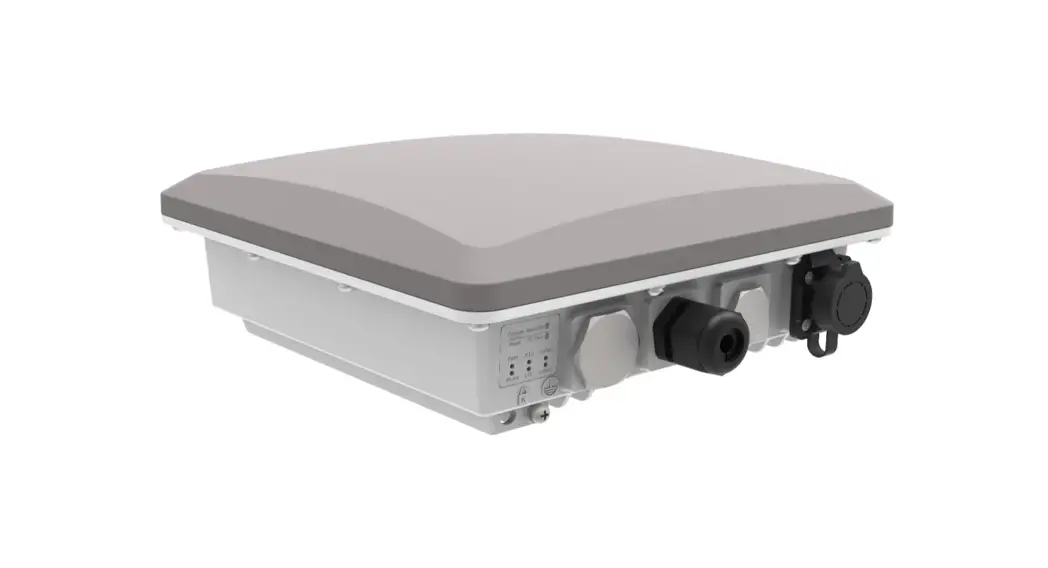
Product Name: Outdoor LoraWAN Gateway
Model Name: DSGW-010C
Revision History
| Specification | Sect. | Update Description | By | |
| Rev | Date | |||
| 1.0 | 2020-01-30 | New version release | ||
| 1. | ||||
Approvals
| Organization | Name | Title | Date |
Introduction
1.1 Purpose& Description
Earn HNT cryptocurrency by mining Helium and building coverage for The People’s Network using the DSGW-010C HNT Outdoor Hotspot Miner. Anyone can join The People’s Network and provide hundreds of square miles of wireless network coverage while mining HNT on the Helium Blockchain just as hotspot miners do.
The Outdoor HNT Hotspot Miner opens up a plethora of opportunities, such as the ability to mount a hotspot to the side of buildings, houses, and roofs. It’s an ideal solution for wider coverage applications across villages, towns, and cities.
1.2 Product Feature Summary
- Support the POE switch power supply
- Support IEEE802.3-2012 Type 1, the IEEE802.3-2012 Type 1 requires a power supply device (PSE) to provide 44 to 57V, and the power of the powered device (PD) must not exceed 12.95 W and the current does not exceed 350 mA.
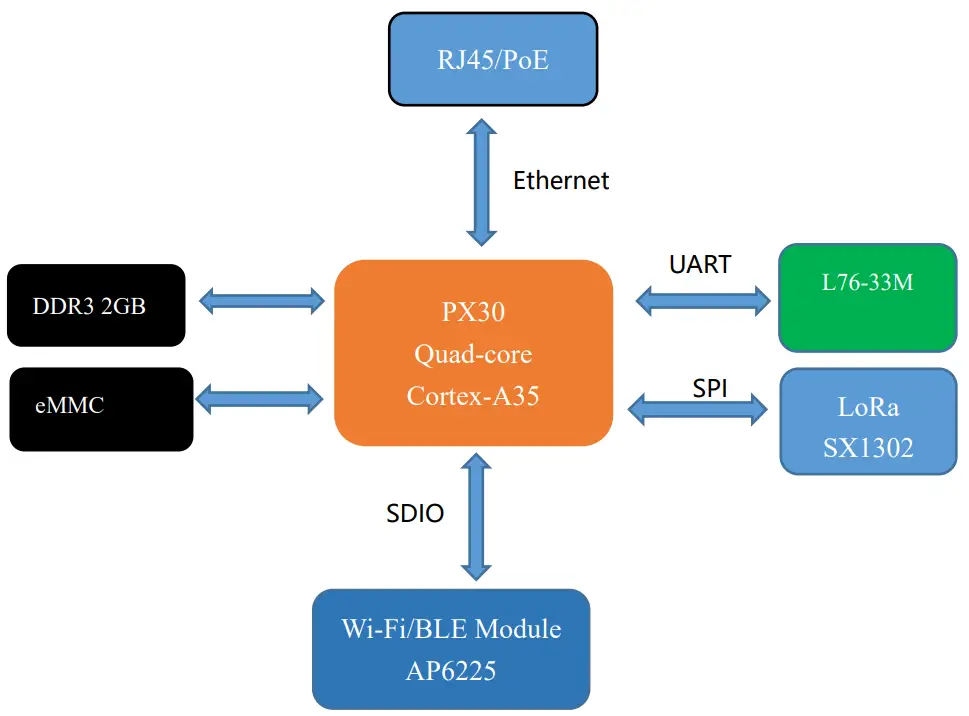
- CPU: Quad-core Cortex A35
- 2GB on-board RAM
- 32GB eMMC
- Base on the LoRa Concentrator Engine: Semtech SX1302
- TX power up to 27dBm, RX sensitivity down to -139dBm @SF12, BW125kHz
- LoRa Frequency band support: RU864, IN865, EU868, US915, AU915, KR920, AS923.
- Support Wi-Fi 2.4G/5G IEEE 802.11b/g/n/ac
- Support BLE5.0
- Support GPS ,GLONASS ,Galileo and QZSS
- Support OTA
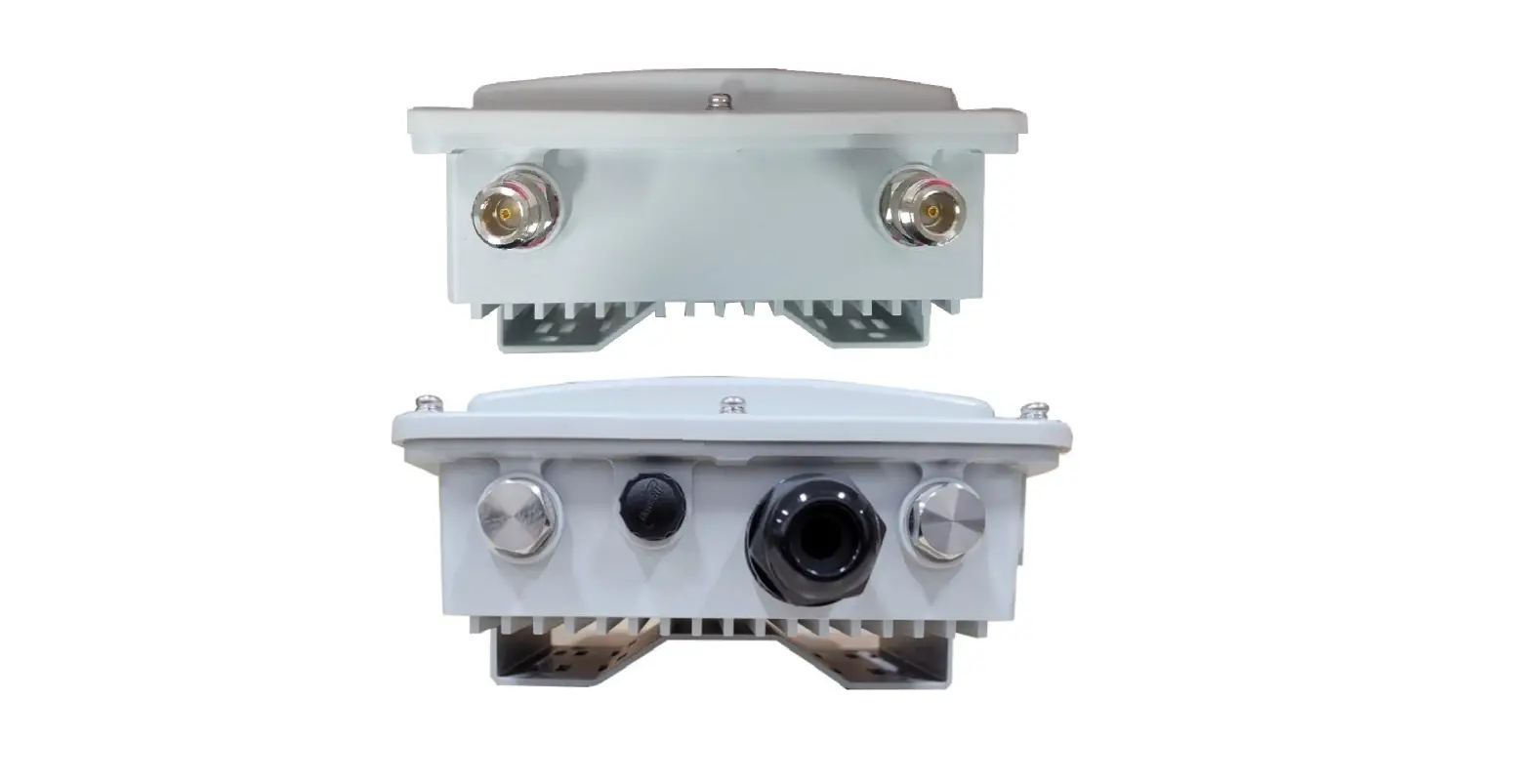
- One WAN variable network port
- RoHS/WEEE compliance(Lead-free)
1.3 LongFi™ Technology
Helium LongFi™ is a technology architecture that combines leading wireless technology, LoRaWAN, and the Helium Blockchain. LongFi™ is optimized for miles of range, and long battery life for IoT devices.
1.4 Proof of Coverage
The HNT Outdoor Hotspot Miner earns HNT Helium tokens when devices connect, and for validating wireless coverage delivered by peers. Using a system called Proof-of-Coverage, Hotspot Miners earn more HNT when they’re in range of other miners, but need to be at least 300 meters apart. The range depends on the environment:
Rural areas: ~10 miles or more.
Dense areas: ~ 1 mile.
Single HNT Hotspot Miners earn less as they can only issue Challenges over the internet, and can’t participate in Proof-of-Coverage.
1.5 Hardware block diagram
Mechanical Requirement
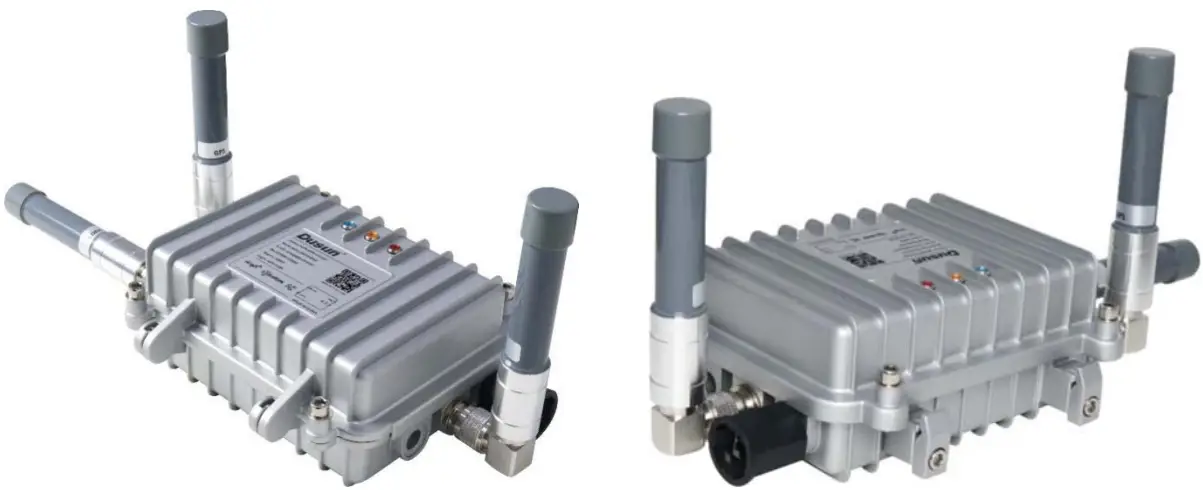
2.1 Drawings
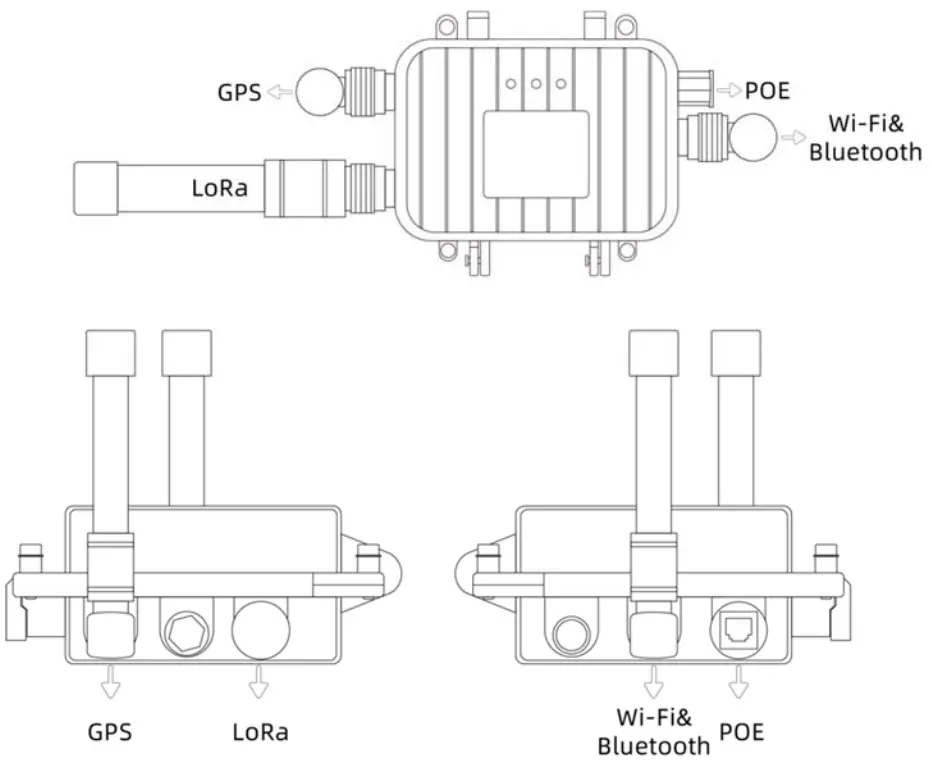
2.2 Interface
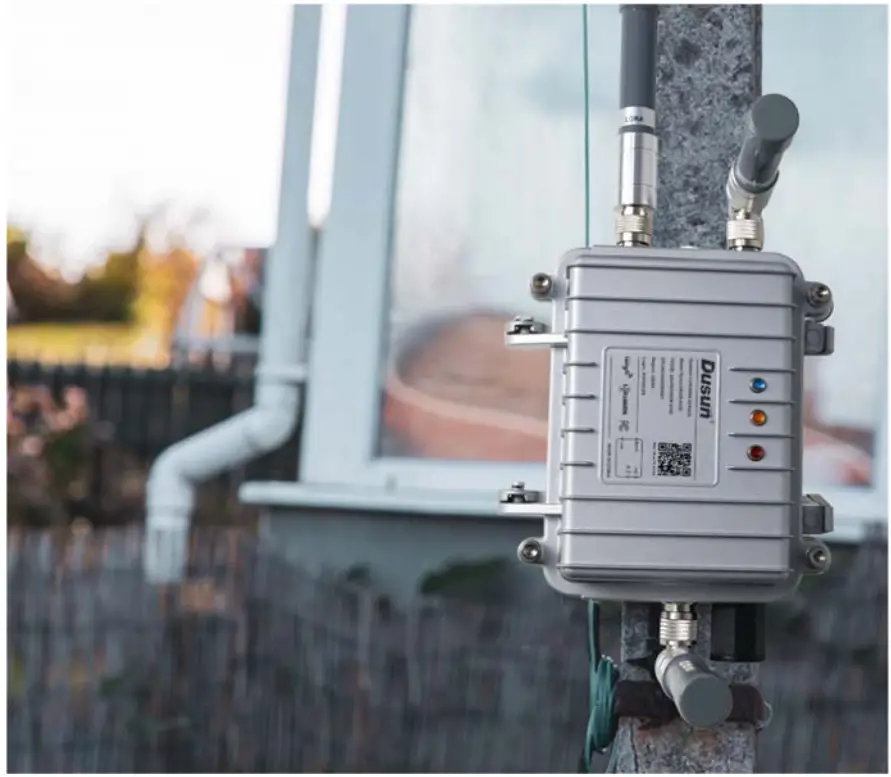
2.3 installation
Electrical Requirements
3.1 Hardware Information
| Category | Specifications |
| CPU | Quad-core Cortex-A35 |
| RAM | 2GB |
| ROM | eMMC 32GB |
| System | Linux |
| Security module | ATECC608 |
| Power Supply Port | Support DC input, input Voltage range is 4.75V to 5.25V. The power seat aperture is 3.5mm. The needle diameter is1.35 mm and is positive. Power adapter: 100-240V,50/60HZ, Output is 5V/2A |
| Reset button | The reset button inside the gateway, After pressing the reset button for more than 5 seconds, the Wi-Fi unit will be restored to the factory settings. |
| Network Interface | The network interface supports CAT-5/CAT-5E to transmit data and POE Power Supply (voltage range is 44- 57V). It is a WAN/LAN variable. |
| Indicator LEDs | 1). Power LED normally on when powered on (green ) 2). Network LED is normally off when connected ( red ) 3). Card indicator (yellow) |
| TF card | Up to 128GB |
| Temperature rise | In the environment of 25 degrees, the surface temperature of the product shell does not exceed 45 degrees. |
| Operating Temperature | O’C-65t |
| storage temperature | -10t-70t |
| Humidity range | 10% RH -85% RH |
| atmospheric pressure | 76Kpa-106Kpa |
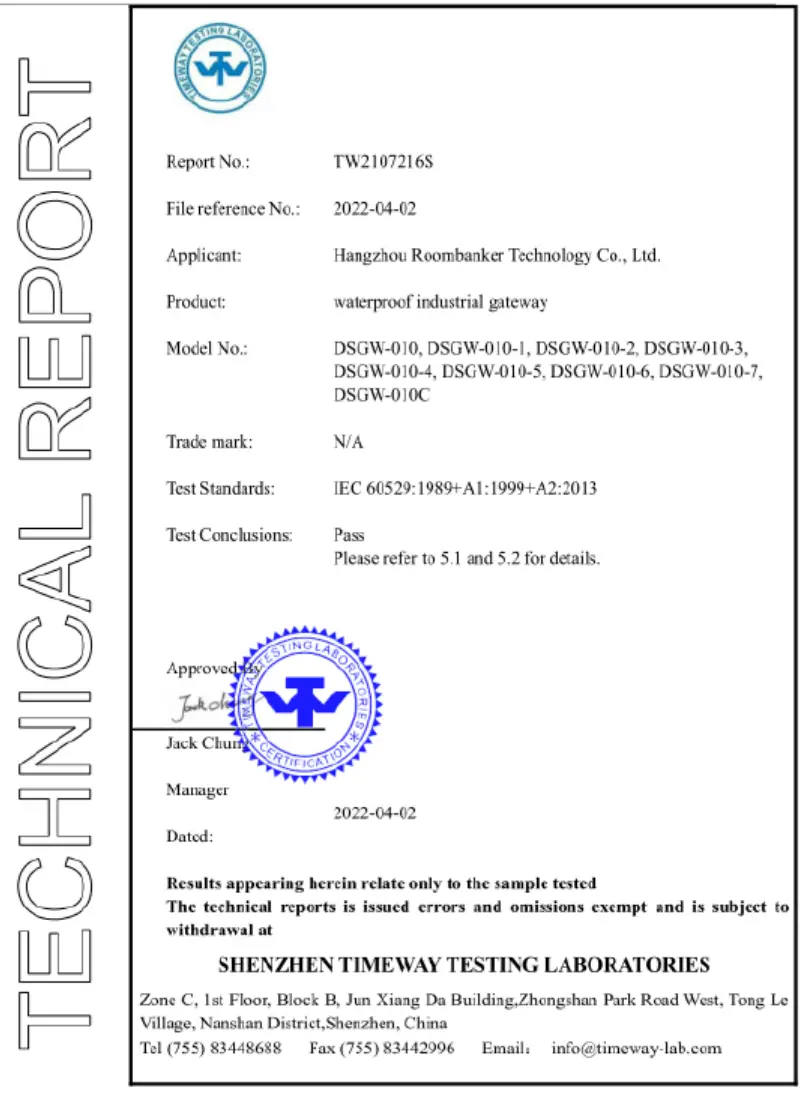
| waterproof level | IP66 |
| Certification | FCC, CE, IC |
3.2 Performance Requirement
| Wi-Fi RF Performance | • 2.4GHz WLAN standard: IEEE802.11b/g/n Frequency Range:2.4~2.4835GHz(2.4GHz ISM Band) Channels: Ch1~Ch13 (For 20MHz Channels) Modulation: 802.11b (DSSS): DBPSK, DQPSK, CCK; 802.11a/g (OFDM): BPSK, QPSK, QAM16, QAM64; 802.11n (OFDM): BPSK, QPSK, QAM16, QAM64; Data Rate: 802.11b: 1, 2, 5.5, 11Mbps; 802.11g: 6, 9, 12, 18, 24, 36, 48, 54Mbps; 802.11n (HT20): MCS0~MCS7 6.5~72.2Mbps; 802.11n (HT40): MCS0~MCS7 13.5~150Mbps; Frequency offset: +/-30KHz Sensitivity: 802.11b@11Mbps: -86dBm@10% PER 802.11g@54Mbps: -74dBm@10% PER 802.11n@HT20_MCS7 : -69dBm@10% PER 802.11n@HT40_MCS7 : -67dBm@10% PER Transmit Power: 802.11b: 17±1.5dBm @11MHz 802.11g: 15±1.5dBm @54MHz 802.11n: 15±1.5dBm @HT20 MCS7 802.11n: 14.5±1.5dBm @HT40 MCS7 5GHz WLAN standard: IEEE802.11a/n/ac Frequency Range: 5.15~5.25GHz; 5.25~5.35GHz; 5.47~5.73GHz; 5.735~5.835GHz(5GHz ISM Band) Channels: Ch36, Ch40, Ch44, Ch48; Ch52~Ch64; Ch100~Ch140; Ch149~Ch165(For 20MHz Channels) Modulation: 802.11a (OFDM): BPSK, QPSK, QAM16, QAM64; 802.11n (OFDM): BPSK, QPSK, QAM16, QAM64; 802.11ac (OFDM): BPSK, QPSK, QAM16, QAM64, QAM256; Data Rate: 802.11a: 6, 9, 12, 18, 24, 36, 48, 54Mbps; 802.11n (HT20): MCS0~MCS7 6.5~72.2Mbps; 802.11n (HT40): MCS0~MCS7 13.5~150Mbps; 802.11ac (VHT20): MCS0~MCS8 6.5~86.7Mbps; 802.11ac (VHT40): MCS0~MCS9 13.5~200Mbps; 802.11ac (VHT80): MCS0~MCS9 29.3~433.3Mbps; Frequency offset: +/-30KHz Sensitivity: 802.11a@54Mbps: -72dBm@10% PER 802.11n@HT20_MCS7 : -69dBm@10% PER 802.11n@HT40_MCS7 : -67dBm@10% PER 802.11n@VHT80_MCS9 : -57dBm@10% PER Transmit Power: 802.11a: 13±2dBm @54MHz 802.11n: 13±2dBm @HT20 MCS7 802.11n: 13±2dBm @HT40 MCS7 802.11ac: 12±2dBm @VHT80 MCS9 • Wireless Security: WPA/WPA2, WEP, TKIP, and AES • Working mode: Bridge、Gateway、AP Client • E.i.r.p (Equivalent Isotopically Radiated power) (mW)<100mW |
| Bluetooth RF Specification | • Bluetooth Specification: Bluetooth v2.1+EDR/4.0/4.2 • Frequency Range:2.4~2.4835GHz(2.4GHz ISM Band) • Channels: Bluetooth Classic: Ch0~Ch78 (For 1MHz Channels); Bluetooth Low Energy: Ch0~Ch39 (For 2MHz Channels); • Power Classes Bluetooth Classic: Class1; Bluetooth Low Energy: Class1.5; • Date Rate & Modulation BR_1Mbps: GFSK; EDR_2Mbps: π/4-DQPSK; EDR_3Mbps: 8DPSK; LE_1Mbps: GFSK; • TX Power: 2~8dBm • Receiving Sensibility: BR@1M : [email protected]% BER EDR@3M : [email protected]% BER BLE: [email protected]% BER • Frequency offset: +/-30KHz • Bandwidth (MHz):2MHz • E.i.r.p (Equivalent Isotopically Radiated power) (mW)<10mW |
| LoRa Performance | • Supports class A, C • Frequency band support • RU864, IN865, EU868, US915, AU915, KR920, AS923 • TX power up to 27dBm, • RX sensitivity down to -139dBm @SF12 • Frequency offset: +/-1KHz • BandWidth:125kHz |
| GPS Performance | • Supported Bands GPS L1 C/A: 1575.42 MHz GLONASS L1: 1602.5625 MHz BeiDou B1I: 1561.098 MHz Galileo E1:1575.42 MHz • Default GNSS Constellation:GPS + GLONASS Number of Concurrent GNSS:3 • Channels 33 Tracking Channels 99 Acquisition Channels 210 PRN Channels • Horizontal Position Accuracy:Autonomous: < 2.5 m CEP • Velocity Accuracy:Without Aid: < 0.1 m/s • Acceleration Accuracy:Without Aid: < 0.1 m/s² • TTFF@-130dBm with EASY™ Cold Start:<15s Warm Start:<5s Hot Start:<2s • TTFF@-130dBm without EASY™ Cold Start:<32s Warm Start:<30s Hot Start:<2s • Timing Accuracy:1pps<100ns • Reacquisition Time:<1S • Sensitivity: Acquisition:<-149dBm Tracking:<-167dBm Re-acquisition:<-161dBm |
| Ethernet | WAN port:10M/100Mbps |
Software functions
4.1 Initialization
After power on, the power indicator flashes at a frequency of 1Hz until the system starts up.
4.2 Clock Calibration
After the system is started and connected to the network, time synchronization is performed immediately, and then every 24 hours.
4.3 Main and auxiliary power supply switching
The adapter input is the main power supply, and the POE is the auxiliary power supply. When the main power supply is input, the auxiliary power supply is automatically cut off.
4.4 LED:
| name | Color | states |
| pON\ CI | green | Start: 1Hz frequency flashing Normal: flashes off for 1 second every 15 seconds. |
| Sub-de \ ice | orange | communication: 2Hz flashing, 50% duty No communication: off |
| Internet | red | Internet available: off No network: long-on |
4.5 Key
| name | operation | function |
| Reset key | Short press(less than Is) | reset device |
| Function key | Short press(less than Is) | Pair Sub-device |
| Long press | factory reset |
FCC
This device has been tested and found to comply with the limits for a Class B digital device, pursuant to Part 15 of the FCC Rules. These limits are designed to provide reasonable protection against harmful interference in a residential installation. This device generates, uses, and can radiate radio frequency energy and, if not installed and used in accordance with the instructions, may cause harmful interference to radio communications. However, there is no guarantee that interference will not occur in a particular installation. If this device does cause harmful interference to radio or television reception, which can be determined by turning the device off and on, the user is encouraged to try to correct the interference by one or more of the following measures:
- Reorient or relocate the receiving antenna.
- Increase the separation between the device and receiver.
- Connect the device to an outlet on a circuit different from that to which the receiver is connected.
- Consult the dealer or an experienced radio/TV technician for help
Changes or modifications not expressly approved by the party responsible for compliance could void the user’s authority to operate the equipment
FCC Radiation Exposure Statement The antennas used for this transmitter must be installed to provide a separation distance of at least 20 cm from all persons and must not be co-located for operating in conjunction with any other antenna or transmitter.
A DUSUN company
Hangzhou Roombanker Technology Co., Ltd.
Tel:86-571-86769027/8 8810480
Website: www.dusuniot.com
www.dusunremotes.com
Floor 8, Building A, Wantong center,
Hangzhou 310004, china
www.dusunlock.com
 Dusun IoT: IoT Gateway Hardware Suppplier & Solutions Vendor- DusunIoT
 Dusunremotes | Custom Intelligent Remote Control Manufacturer