myRoom Plus Guestroom Control Unit User Manual
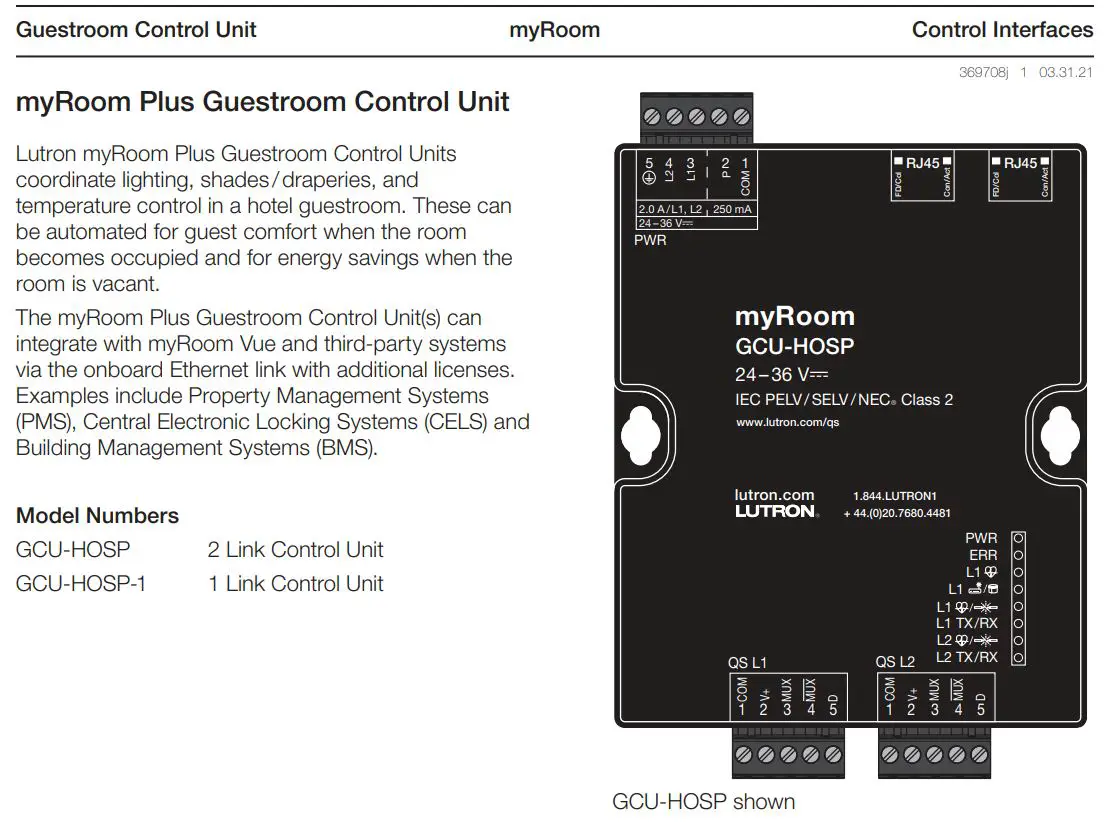
Specifications
Regulatory Approvals
- RoHS Compliant
- Complies with UL508
- Complies with CSA-C22.2 No. 14
- Complies with IEC / EN 60669
- NOM
Power - GCU-HOSP
– Processor (P): 24 36 V- 250 mA
– Links (L1/L2): 24 36 V- 2 A per link - GCU-HOSP-1 – Processor (P): 24 36 V- 250 mA
Typical Power Consumption - 5 W; 8 Power Draw Units (PDUs)
Environment - Ambient Temperature Operating Range: 32 °F to 104 °F (0 °C to 40 °C)
- Unit generates heat, maximum 24 BTU/hr
- Relative humidity: 0% to 90% non-condensing
- For indoor use only.
Cooling Method - Passive cooling
Internal Timeclock - ±1 minute per year
Power Failure Memory - System data stored in non-volatile memory. System programming retention for 10 years.
Misfire Protection - All terminal block inputs are over-voltage and misfire protected against wire reversals and shorts.
Communications Link Wire Type - Two pairs: one pair 18 AWG (0.75 mm2), one pair 18 AWG to 22 AWG (0.75 mm2 to 0.34 mm2) twisted, shielded: IEC PELV/NECR Class 2 cable
- Total wire length for each link must not exceed 500 ft (152.4 m)
Power Supply Wire Type
- 18 AWG (0.75 mm2)
Link Capacities - QS Wired Device Link: maximum 50 devices, 50 zones, 50 occupancy sensors, and 100 switch legs (ballasts, drivers, and interfaces).
- QS RF Link: maximum 50 devices and 100 zones.
- 230 V~ Thermostat Control Link: maximum 32 room thermostats (LR-HVAC-230-S).
- Power Panel Link – 16 addresses / 256 zones
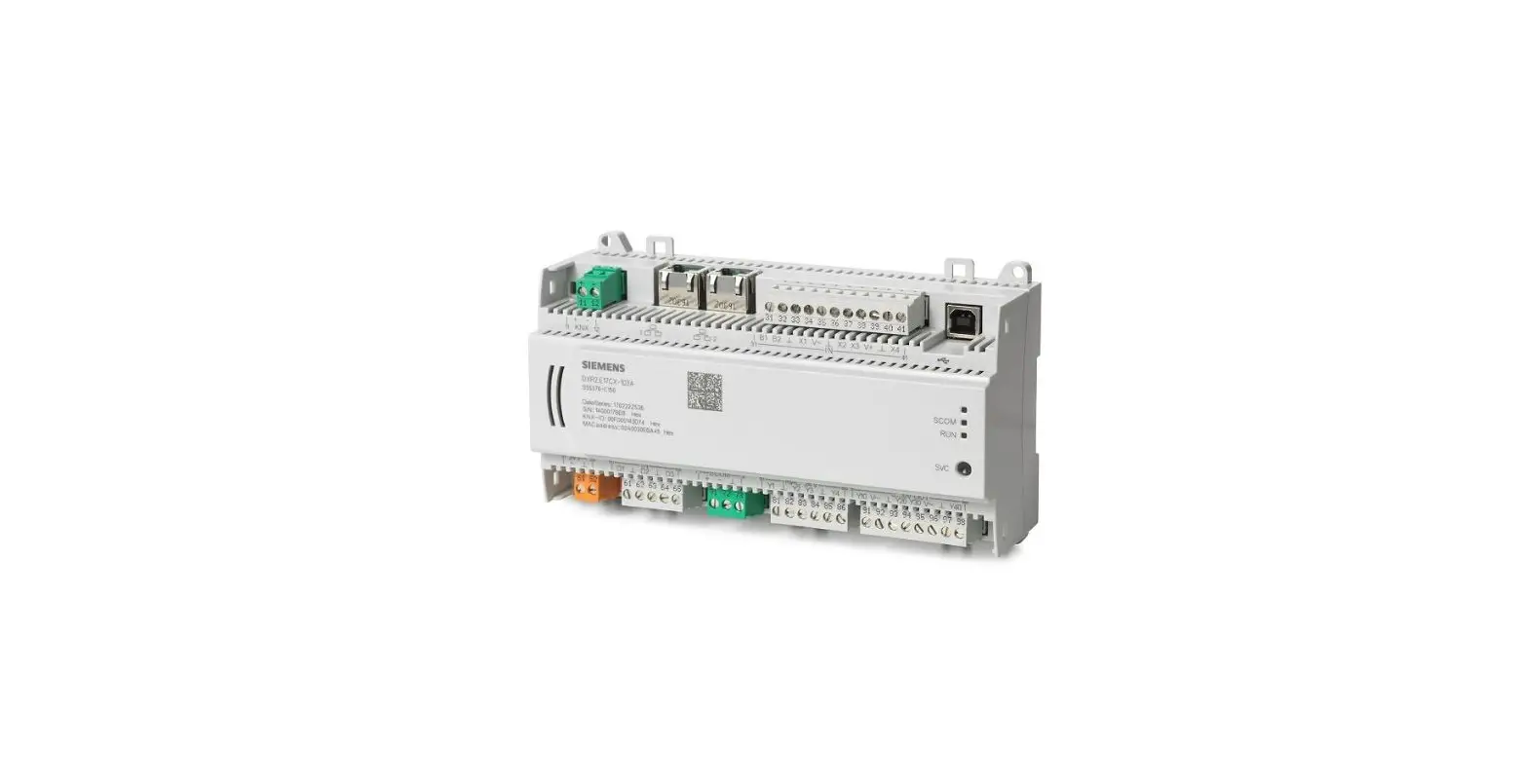
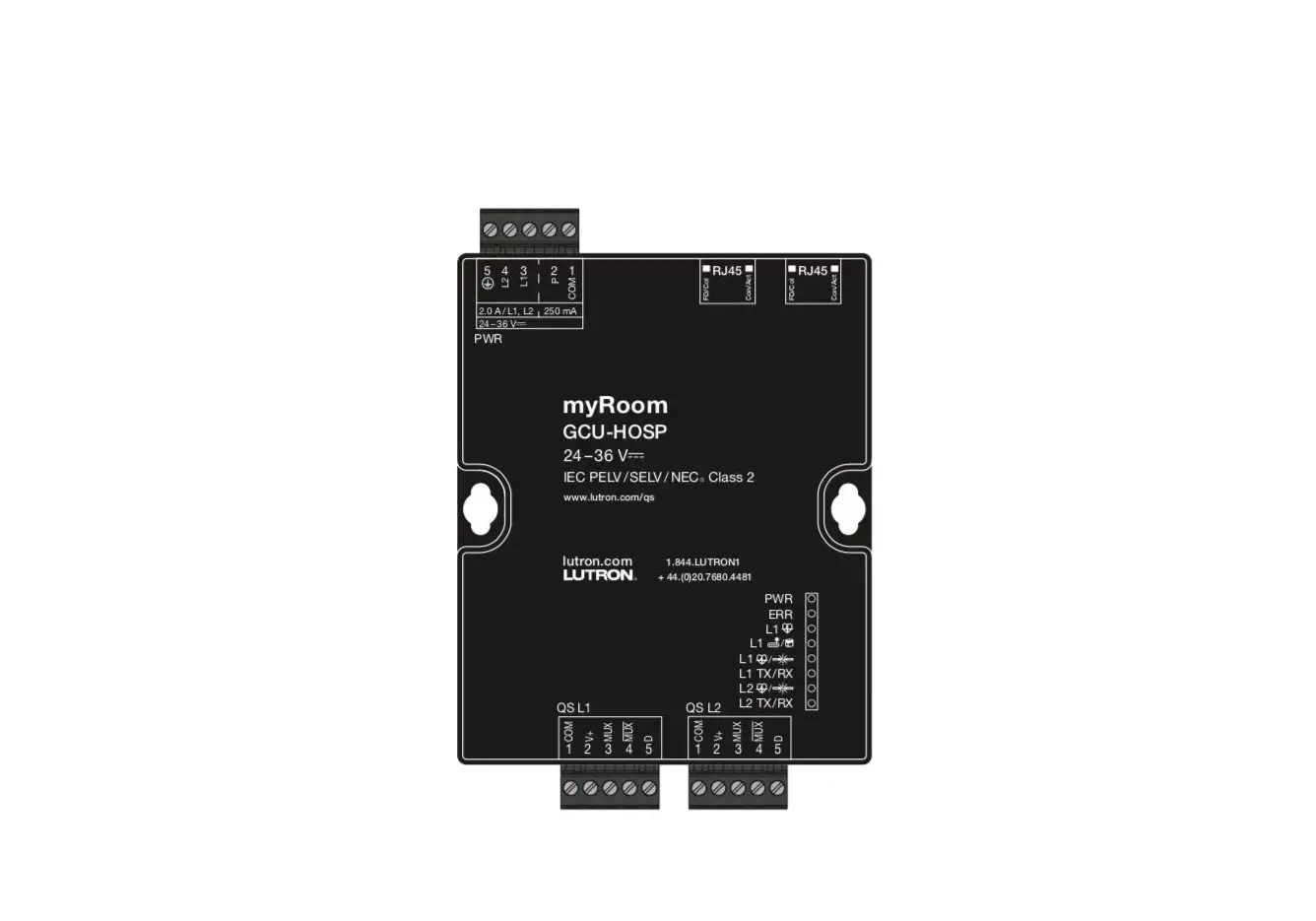
Connections - GCU-HOSP – Two 5-pin, removable terminal blocks* for Link 1 and Link 2 communications. – One 5-pin, removable terminal block* for Power Input.
- GCU-HOSP-1 – One 5-pin, removable terminal block* for Power Input / Link 1 communications.
Communication Links - Each Lutron myRoom Plus Guestroom Control Unit has up to three communication links:
— Link 1 and Link 2 (GCU-HOSP only): Lutron® QS wired device link, QS RF link, or thermostat control link.
— Ethernet:- GCU-HOSP — 2 Ethernet jacks for system start-up and PMS / BMS / CELS integration. Up to 2 GCU-HOSP processors can be daisy chained for very large guestrooms.
- GCU-HOSP-1 — 1 Ethernet jack for system start-up and PMS / BMS / CELS integration. Can only be daisy chained via Ethernet to one GCU-HOSP processor.
System Capabilities
- Lutron QS Link allows control and programming of:
— DIN rail power modules
— Palladium and see Touch QS keypads
— Palladium QS thermostat
— Pico wireless controls (through QS sensor module)
— Silvia QS motorized shades / draperies
— Interfaces for door sensors, window sensors, room chimes, and privacy and service controls - 230 V~ thermostat control link allows control of Lutron room thermostat (LR-HVAC-230-S).
- Keypad buttons can be programmed to toggle lights, select room scenes, or raise and lower lighting or shades / draperies.
- Conditional logic can be programmed to select different actions based on inputs (e.g., time of day).
- Lutron myRoom Plus Guestroom Control Unit can interface with the hotel Property Management System (PMS) via a wired Ethernet hotel network connection. A software license is required. For example, LMR-OPERA-PR is required to interface with Micros R Opera T PMS.
- Lutron myRoom Plus Guestroom Control Unit can interface with the hotel Central Electronic Lock System (CELS) via a wired Ethernet hotel network connection. A software license is required. For example, LMR-SAFLOK-PR, LMR-SALTO-PR, or LMR-VINGCARD-PR is required depending on which CELS vendor is being used (KABAR Suffolk, SALTOR, or ASSA ABLOY Vanguard interface).
- Lutron myRoom Plus Guestroom Control Unit can interface with the Hotel Service Optimization System (Hot SOS) via a wired Ethernet hotel network connection. Software license LMR-HOTSOS-PR is required for a Newmarket Hot SOS interface.
- Lutron myRoom Plus Guestroom Control Unit can interface with the hotel Building Management System (BMS) via a wired Ethernet hotel network connection. Software license LMR-BAC-PR required for native BACnet interface.
- BACnet interface allows BMS to monitor and control room lighting, shades / draperies, temperature, room occupancy and vacancy status, and identify system faults.
- Lighting and HVAC load schedule data can be programmed at start-up. This data is used to calculate room lighting and HVAC power usage, and is available to the hotel BMS for logging and reporting via the native BACnet interface.
- myRoom Vie can provide a powerful software interface to control, configure, monitor, analyze and report on the myRoom Plus system. This requires license LMR-MYRMVUE-PR.
Dimensions
Dimensions shown as: in (mm)
GCU-HOSP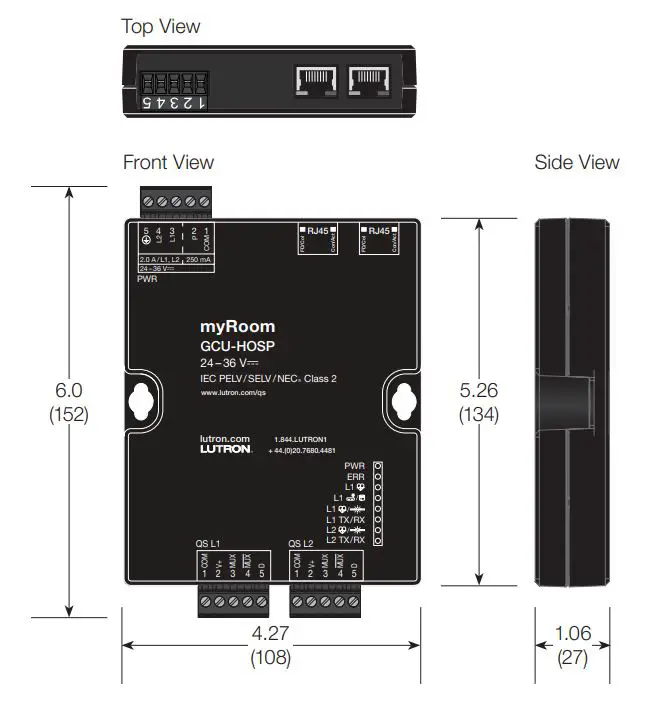 Dimensions shown as: in (mm)
GCU-HOSP-1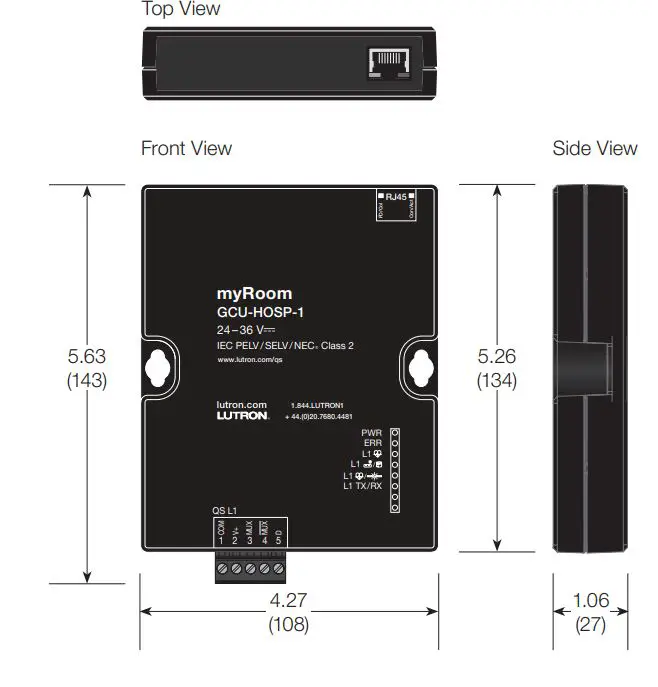 Mounting
Mount the myRoom Plus Guestroom Control Unit (GCU) in an enclosure according to national and local codes. The GCU is typically powered using the QSPS-DH-1-75 or MQSPS-DH-1-30 power supply. The GCU and enclosure must be mounted vertically due to thermal management. The figure below gives examples of acceptable and unacceptable mounting.
Ceiling
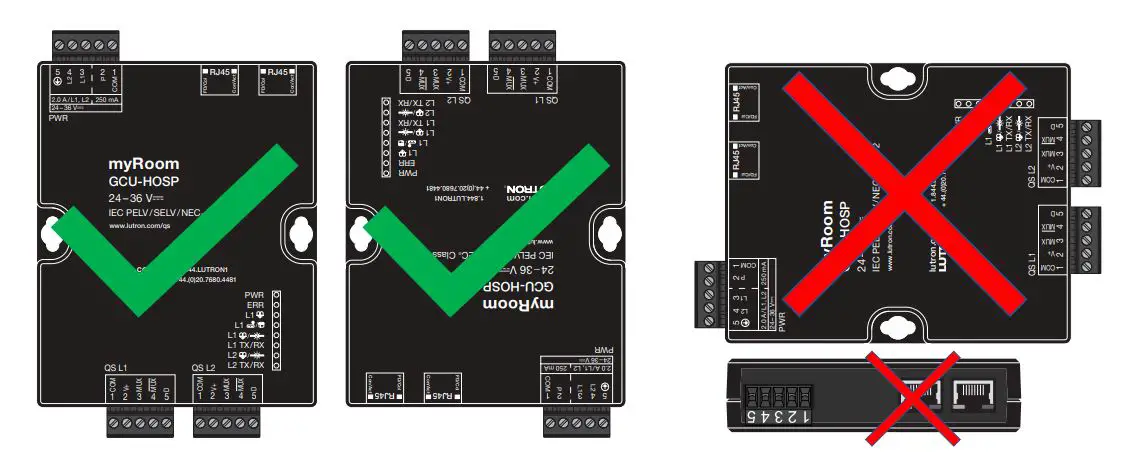
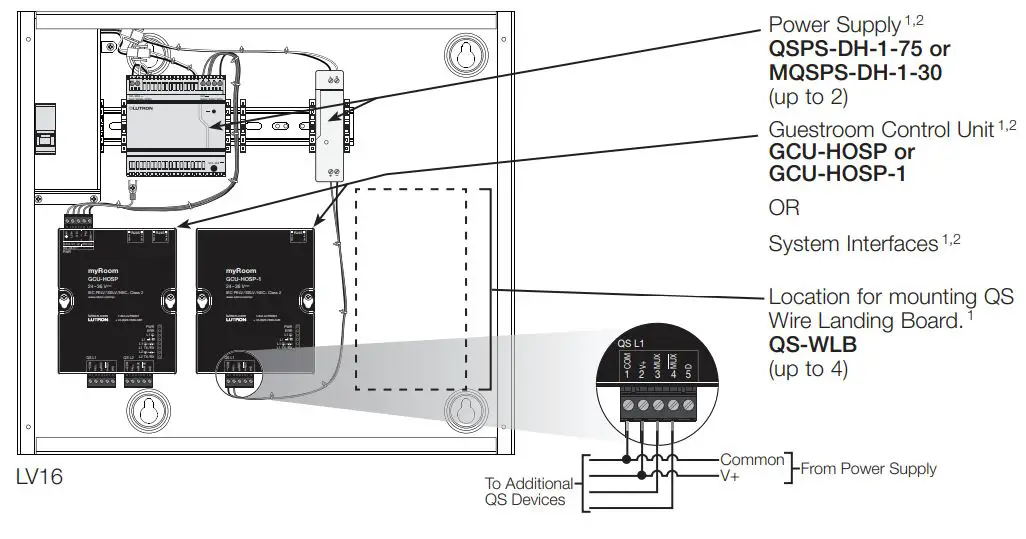
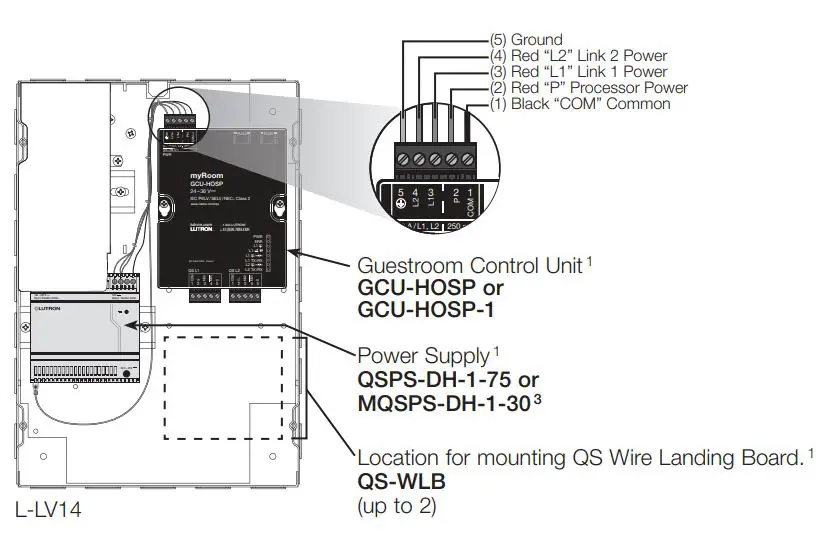
- All components sold separately.
- Maximum of 2 Control Units / Interfaces allowed per enclosure.
- Requires mounting kit MQSPS-BRK.
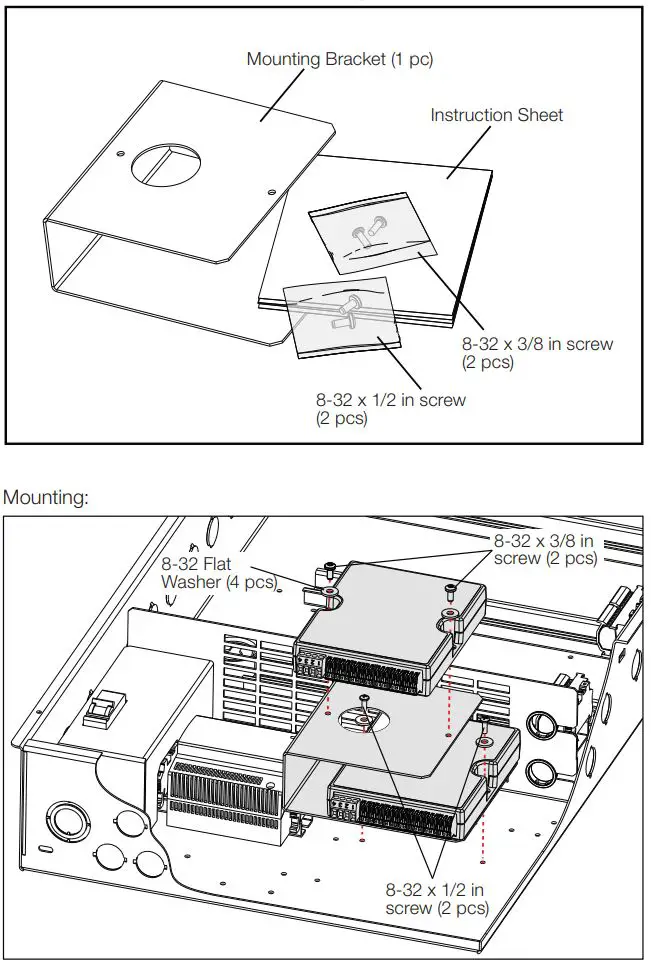
Adding Interfaces with the Low-Voltage Dual Accessory Bracket
If the GCU cannot fit in the panel with other devices, the Low-Voltage Accessory Bracket (DIN-2CD-CGP2948) may be an acceptable option to mount the GCU over another GCU or interface. The DIN-2CD-CGP2948 is a metal bracket designed to stack two Lutron low-voltage devices in a single location. The bracket is installed under the original device. This allows a second device to be install on top of the GCU. The second device is offset, allowing the LED indicators of the lower device to remain visible. The DIN-2CD-CGP2948 is only compatible with panels that contain a low-voltage section. Sold separately. Contact Lutron Customer Service for ordering.
DIN-2CD-CGP2948 contains the following:
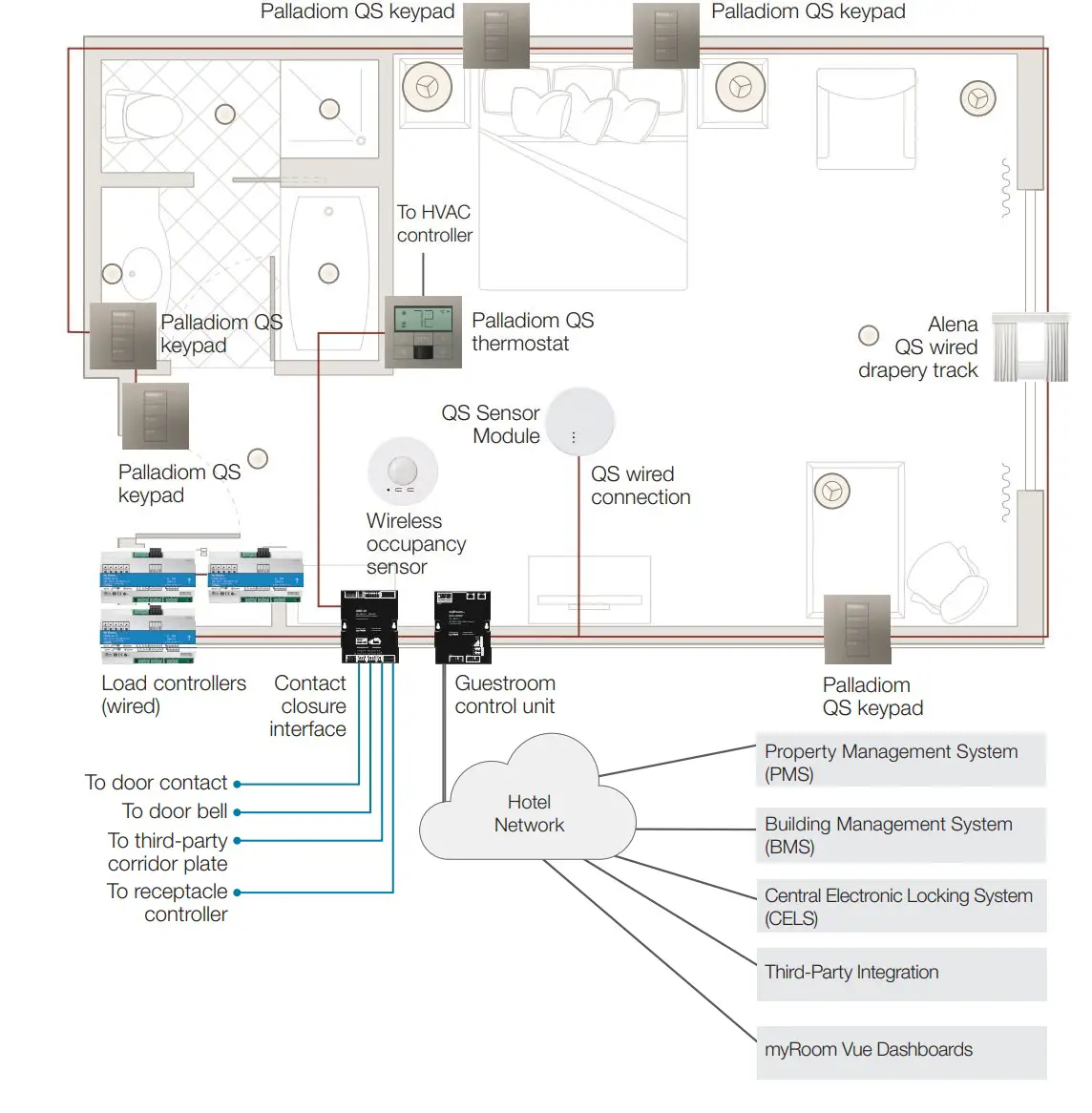
System Diagram Example
 Lutron, Lutron, Palladium, see Touch, Pico, Silvia, myRoom and Alena Aare trademarks or registered trademarks of Lutron Electronics Co., Inc. in the US and/or other countries. All other product names, logos, and brands are property of their respective owners.

 Lutron: Beautiful light. Intelligent Shades. Powerful Controls
 Lutron GRAFIK Eye QS System Overview