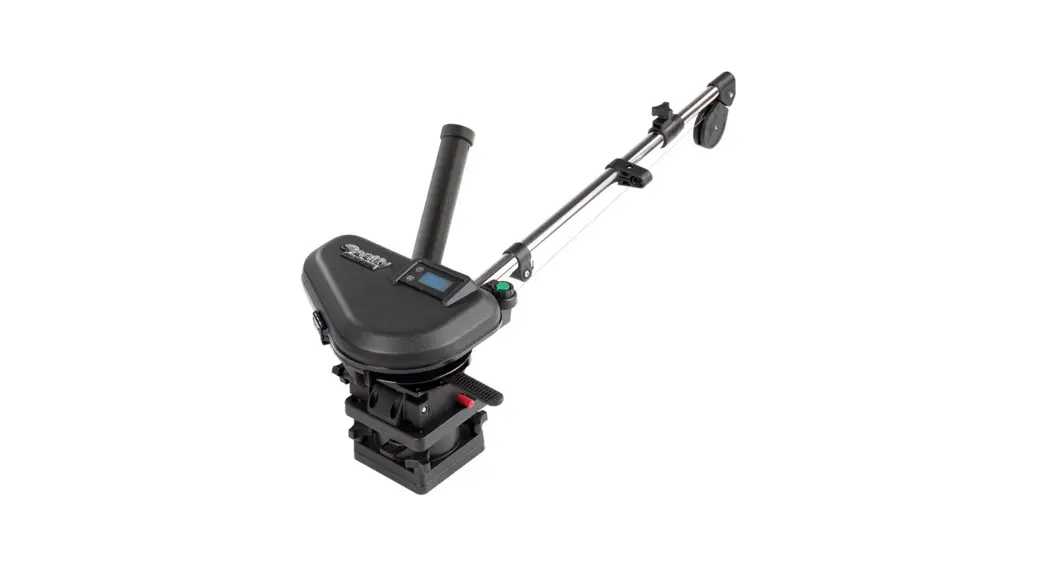
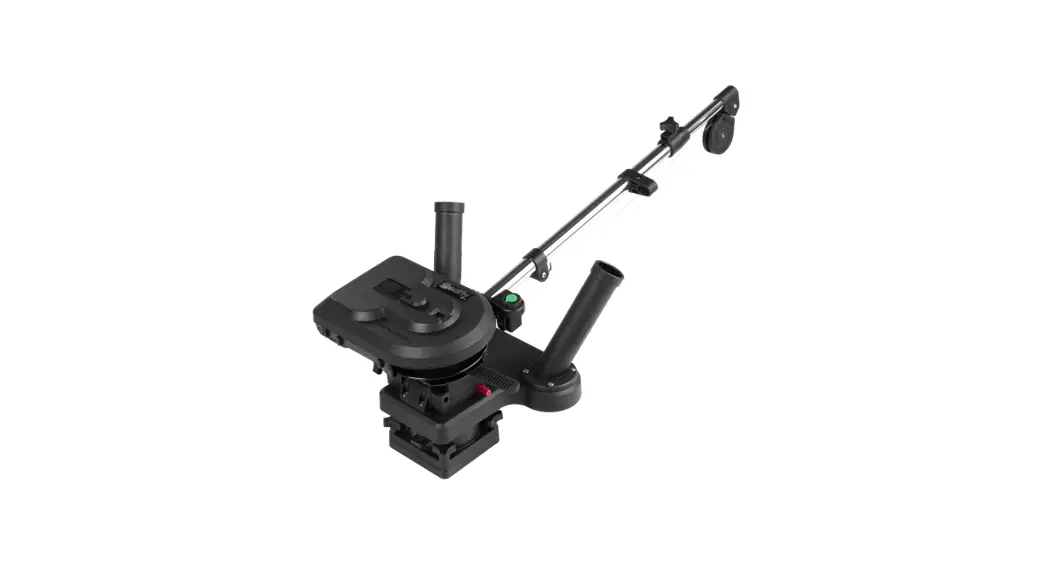
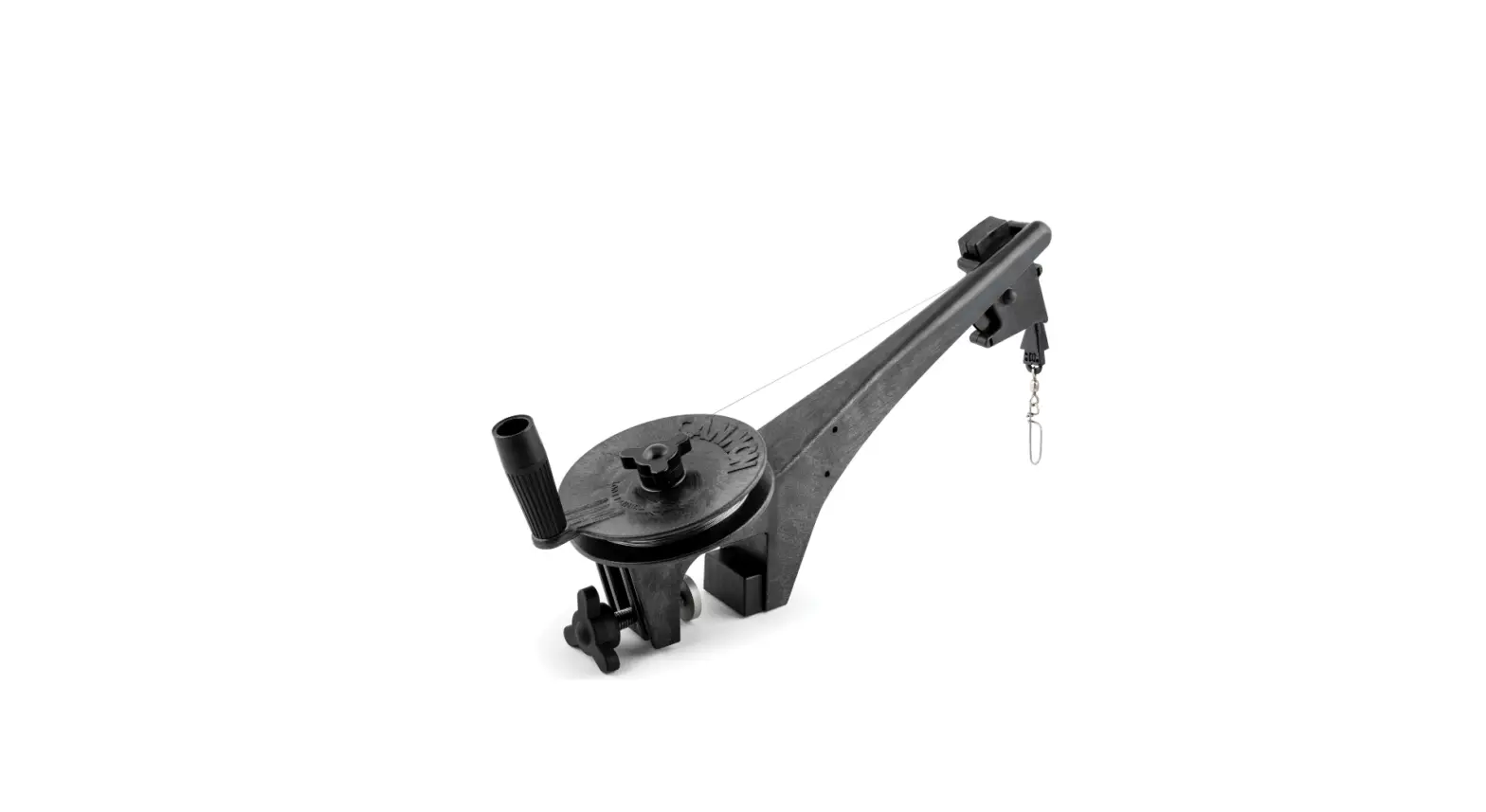
1050-MP Manual Downrigger Display Packed
Product Information:
The Scotty Downrigger is a high-quality downrigger designed for
fishing in marine environments. It was first produced in 1973 and
has since become a popular choice for anglers. The downrigger comes
in both manual and electric models and is built to withstand the
demanding conditions of fishing.
Key Features:
- Auto Brake: The downrigger features an auto
brake system that releases automatically when winding up the
downrigger and sets automatically when the handle is released. - Limited Lifetime Warranty: Scotty offers a
limited lifetime warranty for the downrigger, which covers the
original owner. For warranty inquiries, customers can contact
Scotty Fishing, Marine, and Outdoors or one of their authorized
warranty repair service centers. - Horizontal Spool Design: The downrigger has a
low-profile horizontal spool design, making it easy to wind and
store. It can be wound with either the left or right arm. - Positive Drive Depth Counter: The downrigger
features a spray-protected positive drive depth counter that reads
in feet. - Extendable Handle Arm: Models 1060, 1080,
1085, and 1091 have an extendable handle arm for extra cranking
leverage and a fast retrieve of two feet per turn of the
spool.
Product Usage Instructions:
Before operating your Scotty Downrigger, it is important to read
through the entire user manual to ensure proper usage and avoid any
damage or safety risks.
1. Mounting:
- Choose a strong and reinforced area on your boat to mount the
downrigger. - If the mounting area is weak, reinforce it with a backing plate
made of wood or metal.
2. Safety Precautions:
- Avoid tangling the downrigger wire in your boat prop by
mounting the downrigger near the stern of the boat. - Avoid sharp turns that could cause the wire to go under the
boat. - If your model has a tilt-up base, make sure to tilt the boom
back past vertical and tuck the red lock lever fully under the
downrigger base when it is tilted up. - Keep your fingers away from the underside of the downrigger
base and remove the lead weight when the downrigger is tilted up or
unattended. - Do not attempt to retrieve a weighted or snagged downrigger
cable by hand as it could cause serious injury due to wave or boat
motion. - When retrieving or hooking up, avoid leaning out as a sudden
roll or a slippery deck could lead to falling overboard.
3. Fishing with Downriggers:
- Follow the instructions in the user manual for setting up and
using your specific Scotty Downrigger model. - When hitting bottom, take appropriate action to avoid getting
the downrigger cable stuck or causing damage to the downrigger.
Refer to the user manual for guidance on handling this
situation.
By following these instructions, you can ensure proper usage of
your Scotty Downrigger, improve your fishing results, and maintain
safety while operating the device.
MANUAL downrigger 1050 · 1050MP · 1060 1080 · 1085 · 1091
INSTALLATION
MAINTENANCE
USE & SAFETY
CAUTION! Read through this entire booklet before operating your Scotty Downrigger. Improper use may damage your Downrigger and void the warranty. You may also expose yourself to unnecessary danger and physical injury.
Introduction
Thank you for choosing a Scotty Downrigger. In 1973 Scotty produced its first downrigger. Our goal was to manufacture a superior downrigger, built to withstand the demanding marine environment, and we now produce many manual and electric models. This instruction book will give you basic instruction on mounting and using your downrigger. Please read carefully. It will improve your results and also give you important tips on downrigger safety and care. Good Fishing!
Features
AUTO BRAKE Releases automatically when winding up the downrigger and sets automatically when the handle is released.
CLUTCH BRAKE The Scotty clutch brake allows descent of the downrigger at any speed you choose. Most of the time you will want a uniform slow speed to avoid tangles. However, in instances where you want a lure deep very quickly, the Scotty will respond, giving you complete control. In addition, the brake is factory set to allow the line to pay out if you hang up on the bottom. If you do happen to hang up on the bottom, the clutch brake may allow you time to turn the boat around and lift the weight free. It is advisable to always carry a good set of wire cutters in case the downrigger weight cannot be set free.
LIMITED LIFETIME WARRANTY Scotty is proud to warranty your downrigger for the lifetime of the original owner. For warranty inquires, please contact Scotty Fishing, Marine and outdoors at 1-800-214-0141, or one of our authorized warranty repair service centers (see www.scotty.com or call us for the Scotty service center nearest you). We will do our best to get you back fishing as soon as possible. Please read your warranty agreement carefully and retain the certification section in a safe place.
HORIZONTAL SPOOL DESIGN Low profile horizontal spool design for easy winding and compact storage. Can be wound with either your left or right arm.
POSITIVE DRIVE DEPTH COUNTER Spray protected positive drive depth counter, reads in feet.
EXTENDABLE HANDLE ARM Models 1060, 1080, 1085, and 1091 have an extendable handle arm for extra cranking leverage and a fast retrieve two-foot per turn spool.
2
Fishing with Downriggers
Downrigger fishing is a whole new style of trolling. It may take a little while to get used to it, but after you begin to catch fish with it, you’ll never go back to using heavy tackle. Unlike conventional trolling, the first evidence of a strike may show with just a wiggle of your rod tip or your Downrigger pulley. When a fish strikes, your rod tip goes up, the line will momentarily go slack and you now have your fish on the line with no weight at all! Quite often, the fish will rush to the surface (with no weight to hold him down) and put up a spectacular fight right on top. After a strike, note the reading on the depth counter so you can get your line back to the exact same depth after landing the fish. Many suspended fish travel in schools and returning to the exact same location will increase your chances of hooking up again. If the fish is large we suggest you retrieve the Downrigger before you land the fish. This eliminates the possibility of the fish tangling in the downrigger line or the weight hitting the bottom if you drift into shallow water while playing the fish. To avoid tangles you should wind up all downriggers on the boat before you stop to drift. If fishing alone, you should get your fish under control and then retrieve the downrigger.
3
Downrigger Safety
The Scotty Models 1085 and 1091 are designed for use on wide beam boats of 16 ft. long and up. Installation on smaller boats is not recommended. All sports have some physical hazards connected with them and fishing with Downrigger calls for some common sense and precaution.
There are natural physical forces associated with long armed downriggers. The load of strain at the mounting point of a downrigger is proportional to the length of the arm. In the event of a bottom hang-up with a 30″-60″ arm and high strength trolling wire, the arm leverage can exert a tremendous amount of force on the gunnel of your boat. It is obvious that this force could overcome a weak mounting point on the boat. In the case of a small boat, it could cause the boat to submerge or overturn if the wire is caught on the bottom in a strong tide or in a heavy wind.
Care must always be exercised to avoid tangling your downrigger wire in your boat prop. The best way to avoid this risk is to mount the downrigger near the stern of the boat so that the wire never gets under the boat in a turn. Sharp turns should be avoided.
If your model has the tilt-up base and the downrigger is tilted up, the boom must be tilted back past vertical, and the red lock lever tucked fully under the downrigger base.
Keep your fingers away from the underside of the downrigger base and remove the lead weight when the downrigger is tilted up or unattended.
Make sure the area where you are mounting your Downrigger is strong and reinforced. If it is weak, reinforce it with a backing plate of wood or metal.
Don’t attempt to retrieve a weighted or snagged downrigger cable by hand. Wave or boat motion could cause serious injury.
Always try to bring weights, release and tackle inboard to you. When retrieving or hooking up, do not lean out, as a sudden roll or a slippery deck could send you overboard.
4
What happens when you hit bottom?
When your weight touches bottom while trolling, you will see the Downrigger boom bounce. You should immediately bring your weight up to a safer depth. WARNING! Be very cautious when fishing in strong tidal currents or on windy days. If the weight or wire snags on the bottom, the force of the tide or wind on the boat can put a terrific strain on the Downrigger. KEEP a pair of wire cutters handy in case you have to cut the wire in an emergency! Because of the built in tilt-up feature, the Downrigger boom may fly up quickly when the wire breaks or is cut, so be sure to stand clear, not leaning over the boom. We recommend you always have a large scale chart of your fishing area and know your position at all times when deep trolling. With a relatively smooth bottom, if your weight hangs up on a small ledge it can often be released by turning around and pulling from the opposite direction. The wire line can be paid out if necessary while you turn the boat to the direction of the hang-up. After a hang-up, the wire should be examined for any broken strands. If strands are broken, it can be cut and rejoined as a temporary measure but should be replaced as soon as possible.
5
Mounting Instructions
Our recommendations with regard to mounting locations are: Downriggers work best if they are mounted near the stern of the boat. They will work at any location but the risk of tangling wire line in your prop during a turn is minimized the further back the downrigger is mounted. The downrigger should be mounted in a location where it is easy to reach and operate. Remember you will be handling heavy weights on and off and you will be setting lines and releases. The downrigger needs to be convenient for these activities. Do not mount it where you have to reach or lean a long way to make the connections. FOR MODELS 1050 & 1060 These models mount using the 1010 slide-in mounting bracket supplied with the downrigger. This bracket should be securely mounted to the boat as shown below. Slide your downrigger into the mounting bracket and secure the lock bar. We recommend that a wood or metal backing always be installed on the underside of the mounting surface. This spreads the load and avoids damage to the boat, in the event of a bottom hang up.
INBOARD
6
Mounting Instructions
FOR MODELS 1080, 1085 & 1091 These models mount onto a Scotty 1023 tilt-up mounting bracket supplied with the downrigger. This bracket should be securely mounted to the boat as shown below. The downrigger can be mounted on the side of the boat, the stern or off the corner. The mounting bracket must be mounted on a flat surface and the rear of the bracket must be within ¼” of the edge of the gunnel so that the downrigger spool has clearance for tilting (see diagram). Because of the heavy stresses placed on the boat gunnel by the leverage of the long downrigger arm, we recommend that a wood or metal backing plate always be installed on the underside of the mounting surface. This spreads the load and avoids damage to the boat, in the event of a bottom hang up. Position the downrigger on the tilt bracket. Insert the stainless steel mounting bolt through the downrigger base and mounting bracket. Hand tighten.
NOTE: If your boat’s gunnel configuration does not allow this standard mounting, see the optional mounts on page 11
7
Rigging your fishing lines
Tighten your downrigger brake by moving it counter clockwise, and attach your weight to the downrigger snap hook. It is best to do this outside the boat so if you drop the weight it won’t damage anything.
Clip the snap end of the release clip to the downrigger weight.
Attach your fishing line to the Power Grip release by squeezing the jaws apart and placing your fishing line between the pads. You can adjust the release tension by placing the fishing line further into the jaws. To further increase the release tension you can move the tension adjuster slider to the out position.
With your fishing rod in a rod holder, set the tension on your reel so that the line will pay out, but with enough down drag tension so that it doesn’t free wheel. It is important to have your fishing line tight to the Downrigger line because you may lose the fish if he has slack line after releasing off the downrigger.
Moving the brake handle in a clockwise direction lowers the downrigger weight. You can go as fast or as slow as you wish, but if you are using a flasher or dodger it is best to descend at a slow, even rate to eliminate fouling the flasher or dodger with the downrigger cable.
To Rod
Harder Release
To Downrigger weight
Lighter Release
To Lure back-10-30 ft
8
Tension Adjuster
Downriggers Do’s & Don’ts
DO
Attach your rod and reel line to your downrigger while your boat is in
forward motion. It avoids tangles.
DO
Read the depth counter when you catch a fish, then go back to the
same depth.
DO
Replace badly worn or kinked wire.
DO
Use enough weight (7 to 15 lbs.) on your downrigger to keep your line
at a sharp downward angle, approximately 30 degrees or less when
your trolling speed is correct.
DO
Keep a pair of wire cutters handy in the event of a serious bottom
hang-up.
DO
Rinse off your downrigger with fresh water after each use, if used in
saltwater.
DON’T Let the downrigger wire go slack. Kinks may form and also the wire could spill off spool edges.
DON’T Let your fishing reel spin free while you lower your down- rigger. Set a light drag.
DON’T
Use nylon or other monofilament line on your downrigger. Nylon will stretch in use and shrink back on the spool with enough force to damage it. Use of nylon line will void the downrigger warranty.
DON’T Spray downrigger or wire with spray lubricants, oils, etc.
DON’T Attempt to retrieve a weighted or snagged downrigger cable by hand. Wave or boat motion could cause serious injury.
9
Care & Maintenance
Your Scotty downrigger is constructed of corrosion resistant materials. The following regular maintenance checks should be performed:
1. Rinse with fresh water after every use. 2. Routinely check the stainless steel fastenings with a screwdriver to see that
they are snug and secure. 3. Do not use any lubricants. Lubricants will attack the plastic components. 4. Do not expose the downrigger to ultraviolet light for extended periods of time.
BRAKE ADJUSTMENT It may be necessary to adjust the brake tension if either the weight does not descend freely or cannot be held when the brake is in the on position.
1. Lift up (do not twist) to remove the counter cover. 2. Remove the jam nut, which holds down the counter assembly. Lift the counter
assembly off the downrigger. It lifts straight up and sometimes requires some gentle prying with two screw drivers under the opposite edges. 3. Using two 9/16 wrenches or two small crescent wrenches, hold the bottom nut with one wrench and loosen the top jam nut with the other wrench. With the brake in the off or “6 o’ clock” position, either tighten or loosen the bottom nut as required to obtain the correct brake setting. 4. Tighten down the jam nut and re-assemble the counter assembly. With a weight on, the brake should engage automatically when the handle is released, yet slip if constant strain is applied to the wire.
Downrigger Line/Wire Maintenance
We have found that many things can affect the life of your line/wire. Included in this are such things as an unobserved kink, electrolysis caused by stray electrical currents emanating from the boat, and certain types of jelly fish and minute sea creatures which may have corroding effect when left on the line/wire. Frequent inspection and wiping or washing line/wire with fresh water may help prolong your line/wires usefulness.
HOW TO REPLACE LINE If you have occasion to replace the line, proceed as follows: Mount the downrigger someplace secure (its regular boat mount is good) and pull off the old line/wire. When you come to the end of the line cut the loop off the downrigger spool. Take the free end of the line from the supply spool and thread it through the pulley and any fairleads. Thread the line/wire through the holes from the inside of the spool. Tie an overhand knot in the line/wire, pulling it snug against the spool. Tie a second overhand knot giving you a “square knot” and pull it snug. The loose end of the line should be pointing back towards the pulley. Secure the loose end with tape to keep it from fouling the remainder of the line/wire. Keep tension on the supply spool to wind the new line on as tight as possible. Avoid twisting or kinking the line/wire, or winding it onto the spool too loosely. This operation is best carried out with two people. Attach a new Scotty bumper and snap hook.
NOTE: Winding more than 300′ of 150 lb. test line onto the spool will affect the accuracy of the depth counter, use of heavier test wire will also affect the counter accuracy.
10
Optional Mounts for your Downrigger
2612 Downrigger Pedestal Mount 12″ 6″ (2106)
1027 Rail Mount
1026 Pedestal Swivel Mount
1025 Right Angle Side Gunnel Mount
1028 Gimbal Mount – 9″ 12″ (1029)
1021 Clamp Mount
For more information on these and other Scotty products, go to our website at www.scotty.com
11
SCOTTY FISHING & OUTDOOR PRODUCTS
2065 Henry Ave West Sidney, British Columbia Canada V8L 5Z6
PHONE TOLL FREE FAX EMAIL
250 656 8102 1 800 214 0141 250 656 8126 [email protected]
www.scotty.com
To obtain parts, information or to locate the warranty service depot nearest you, check out our website: scotty.com/contact
Although Scotty makes every effort to ensure the accuracy of specifications at the time of publication, specifications for products described in this publication are subject to change without notice.
Contact Scotty for the most current information.
In order to maintain your warranty, don’t forget to register your downrigger.
SERIAL #