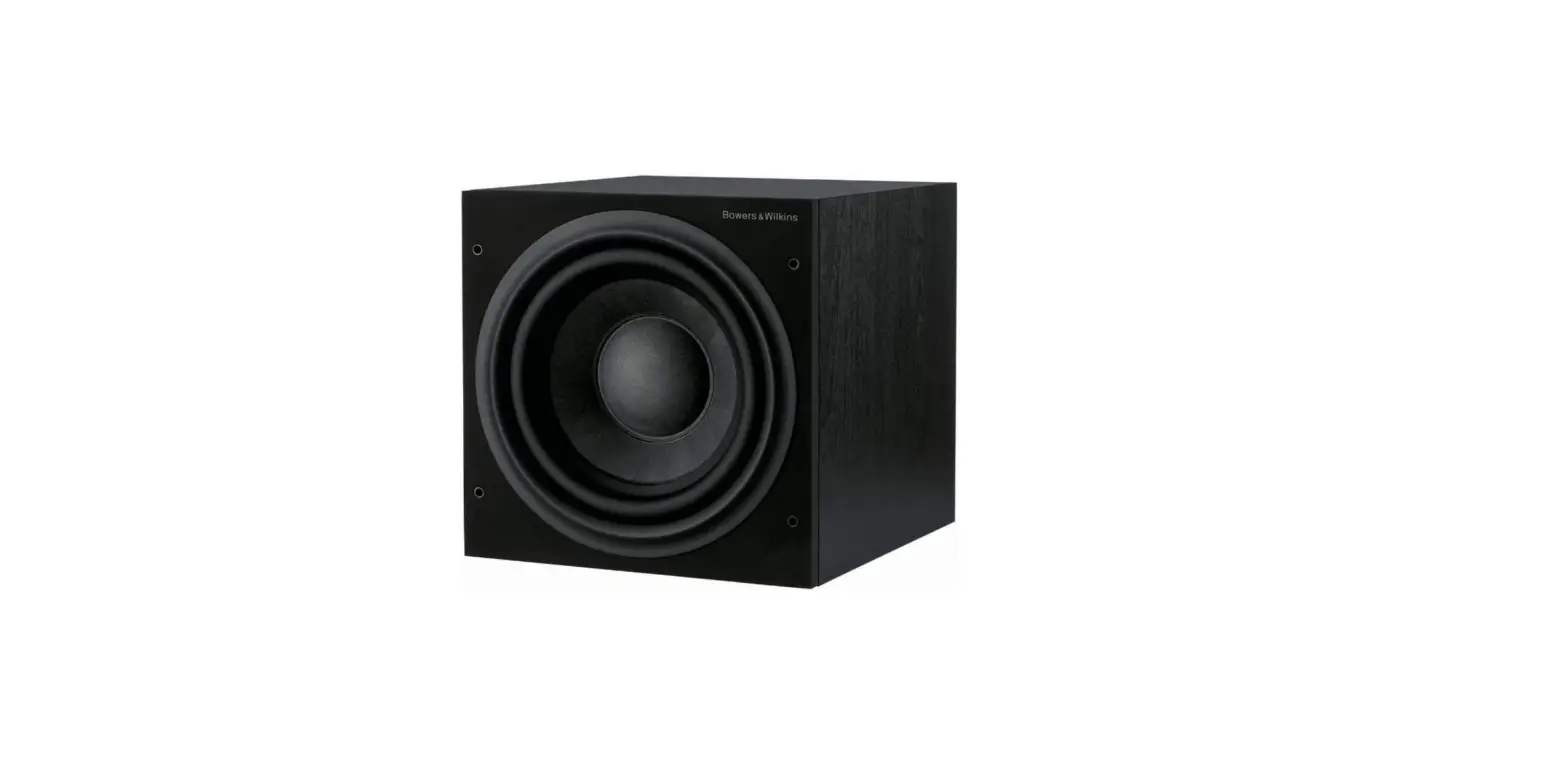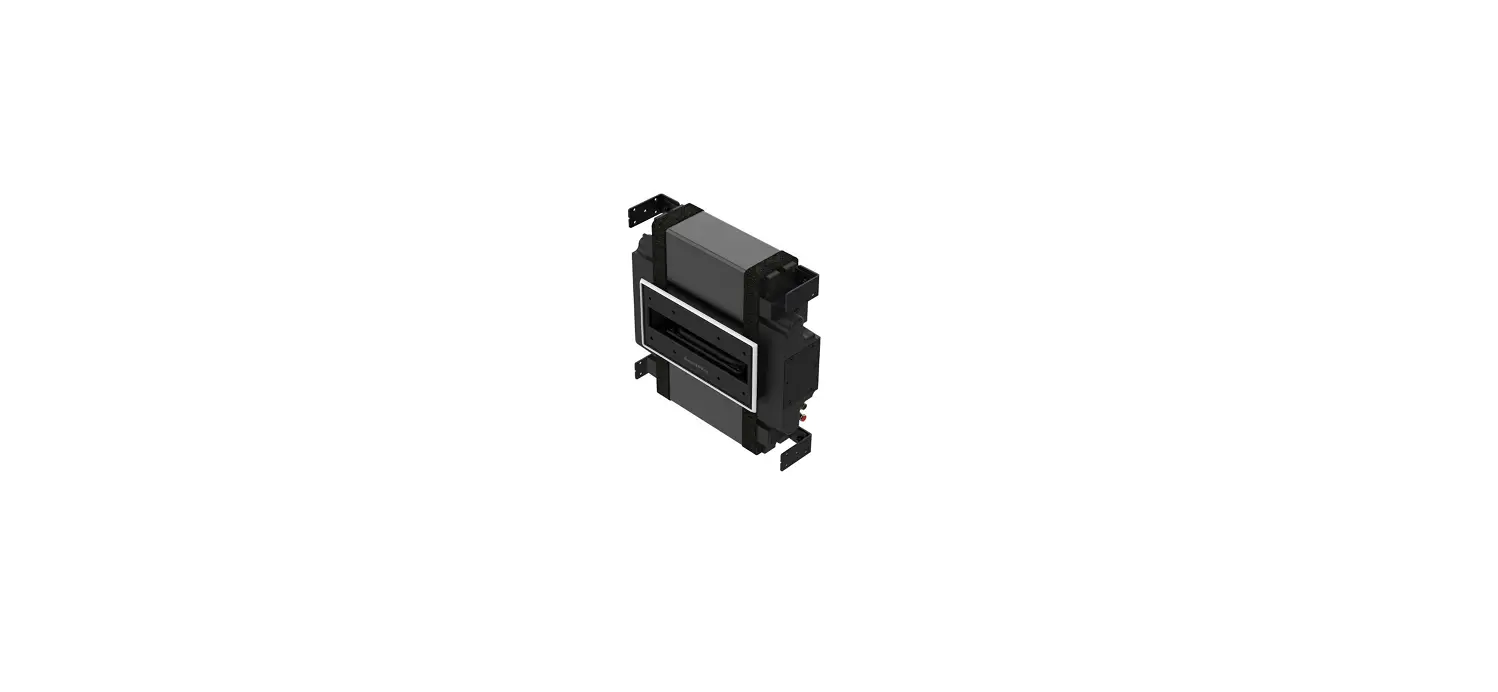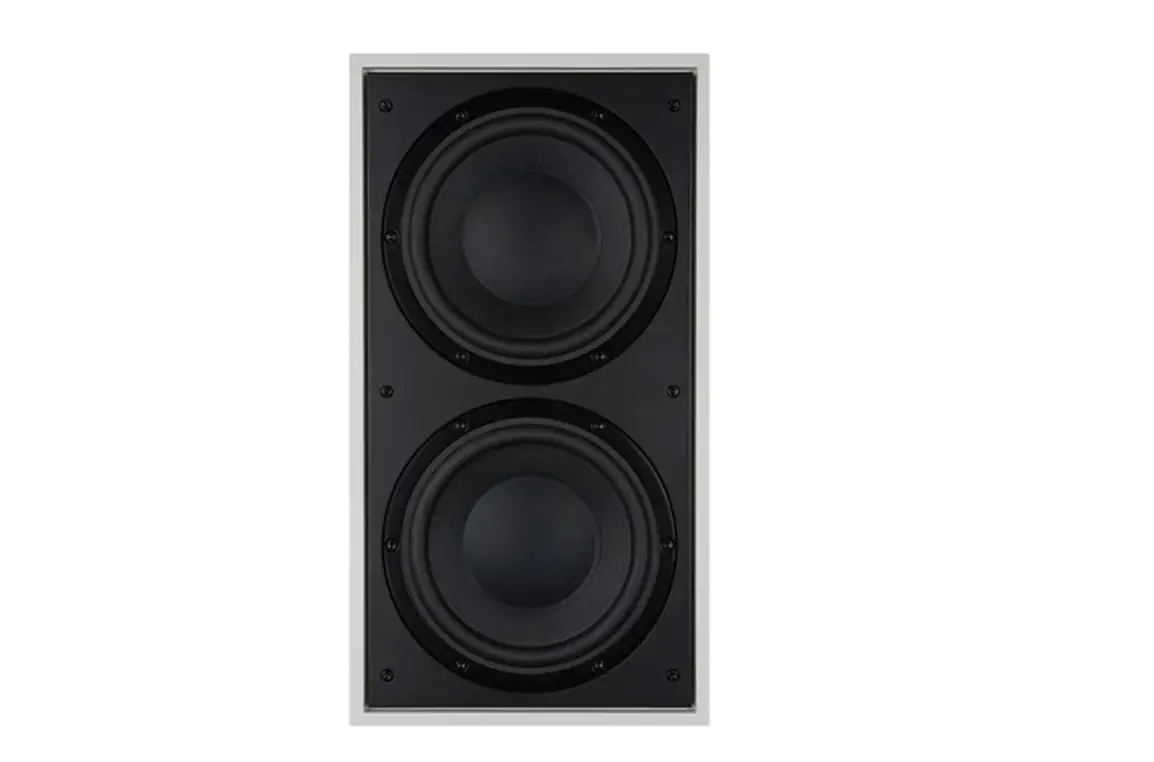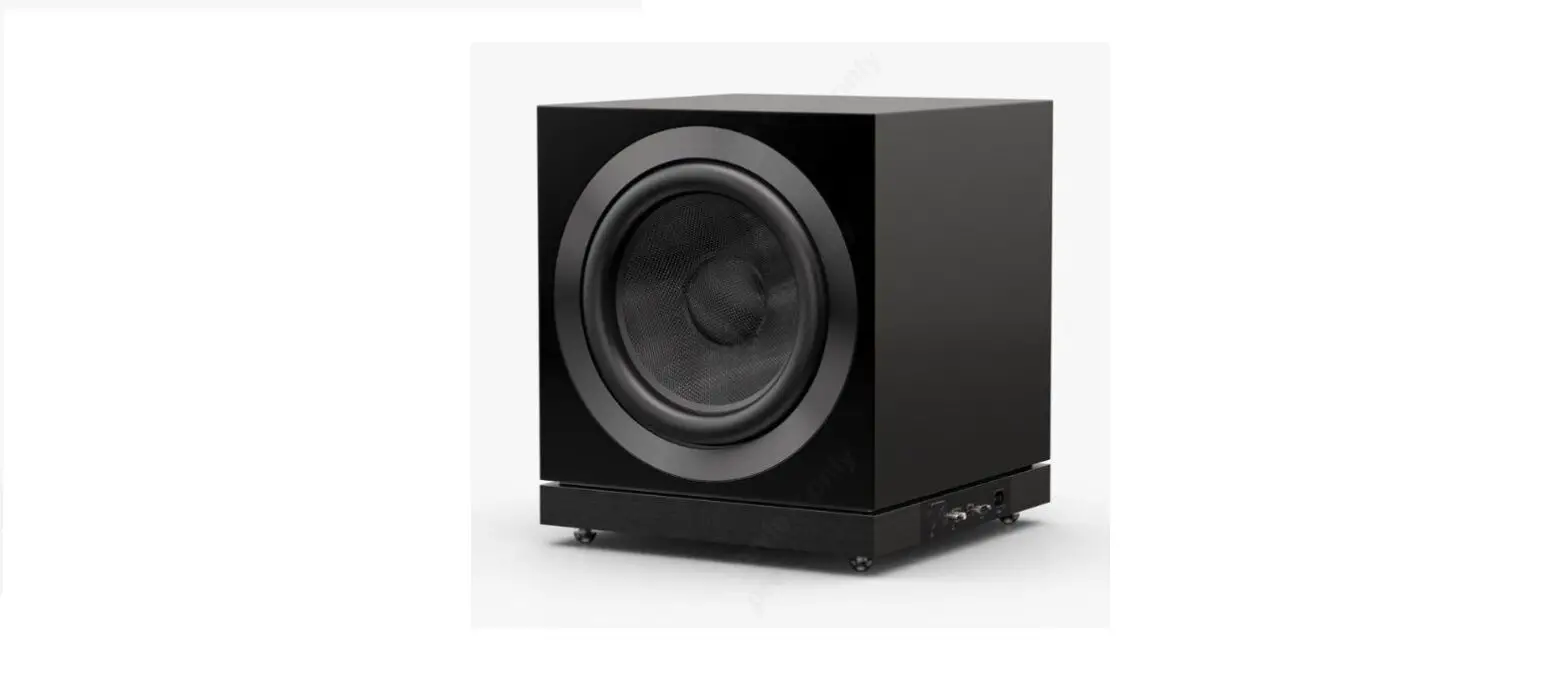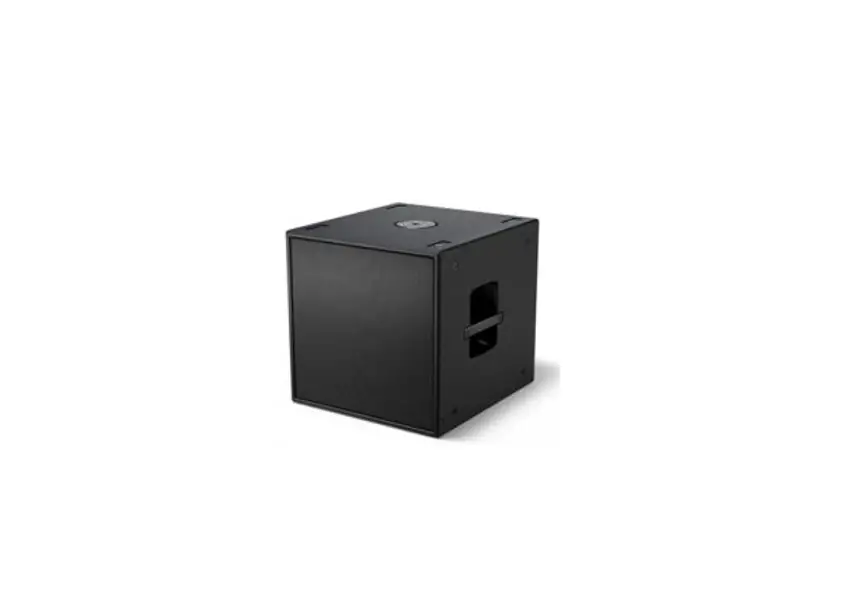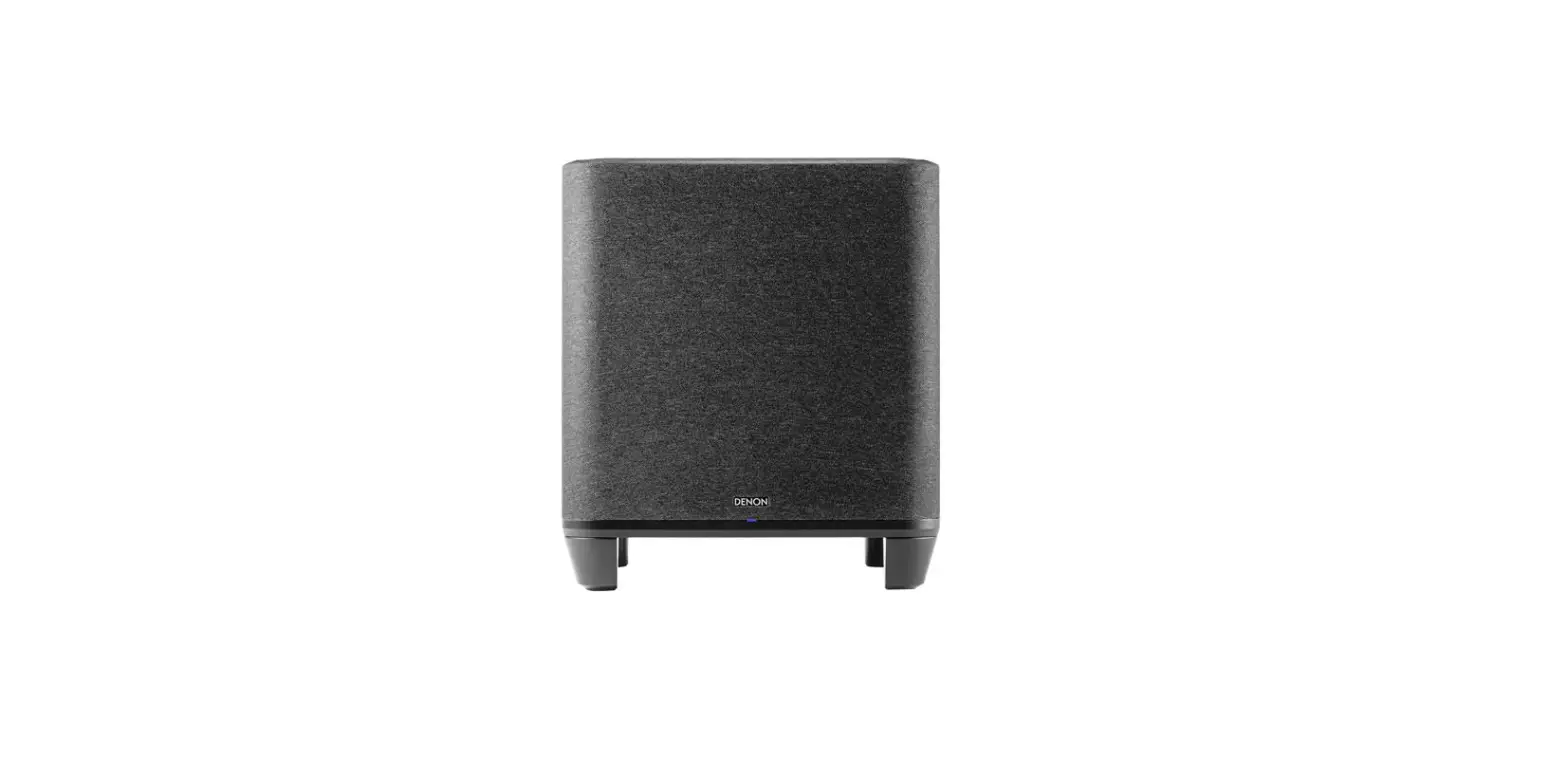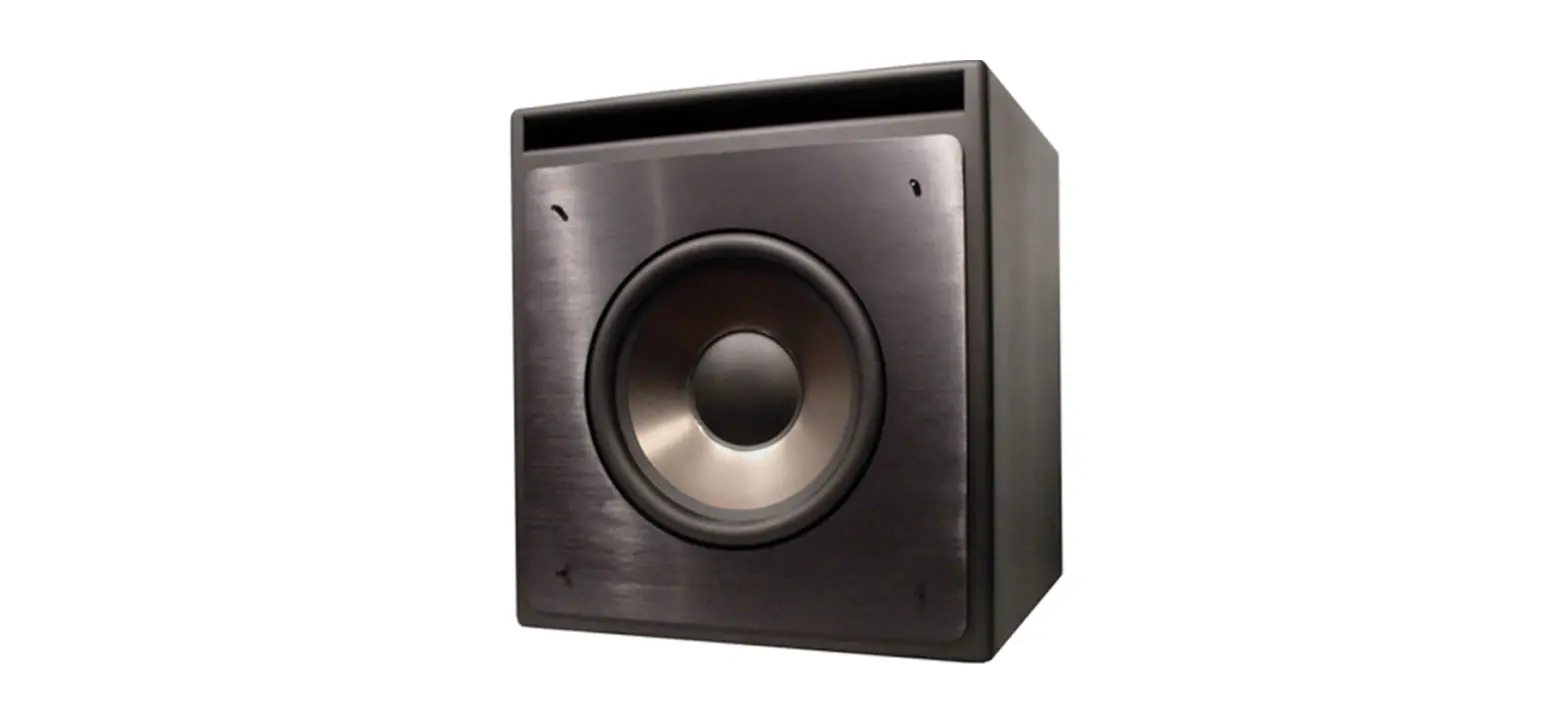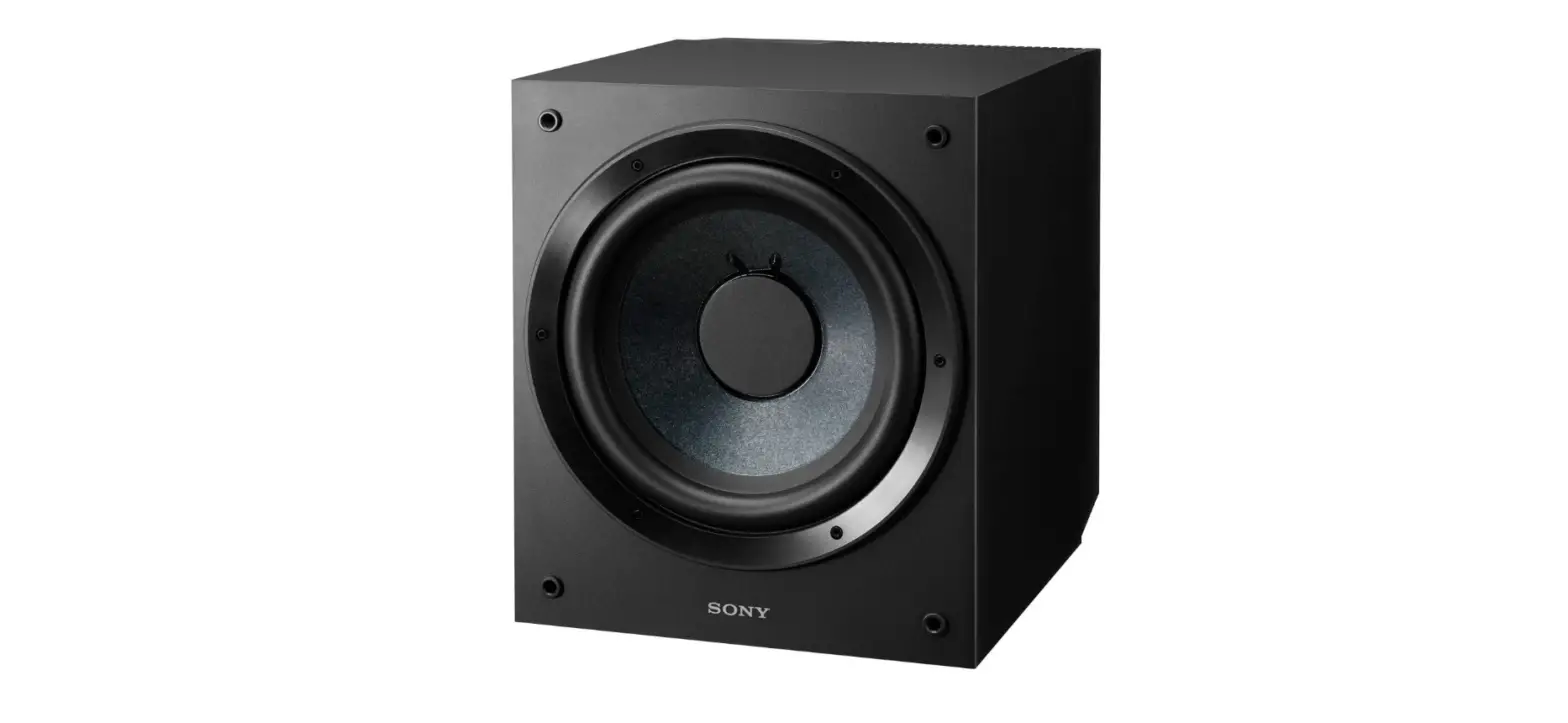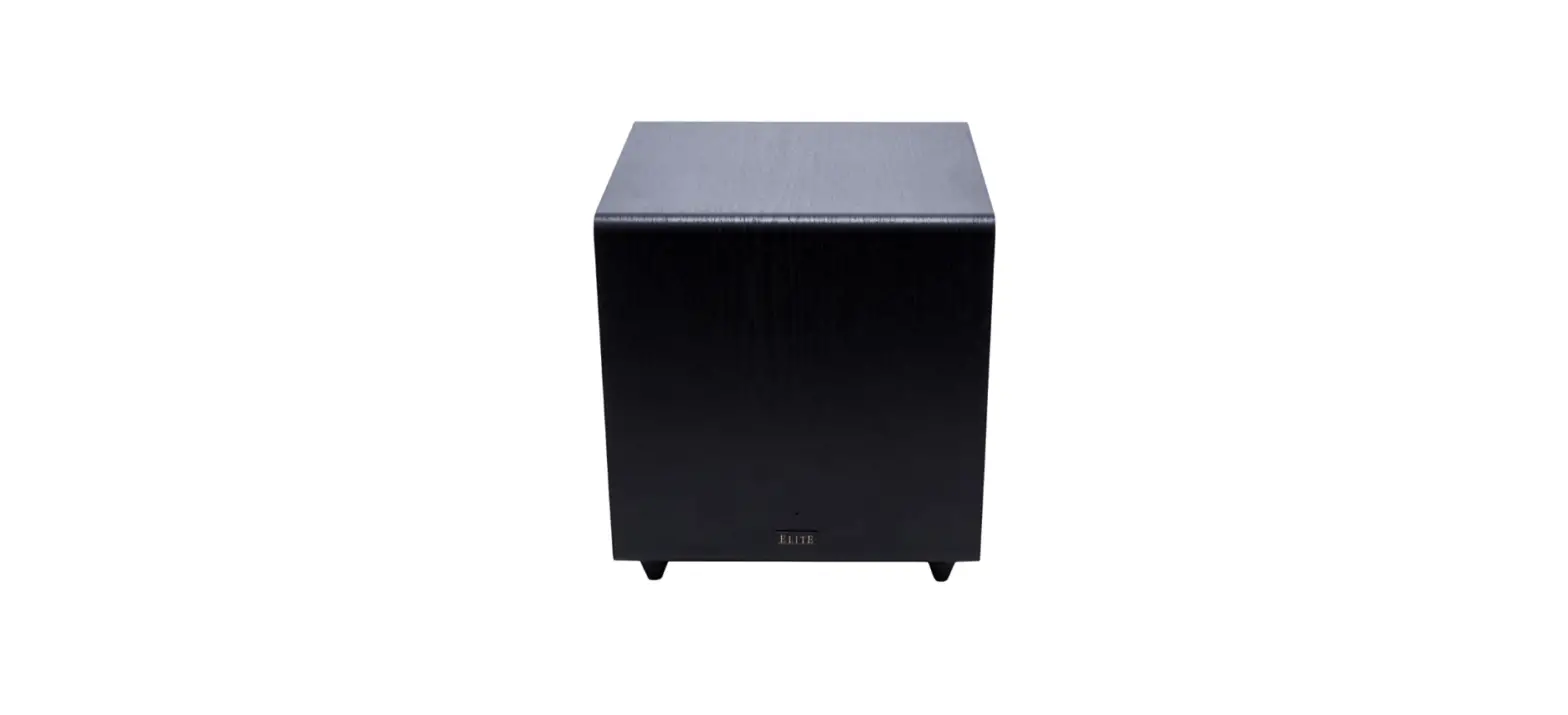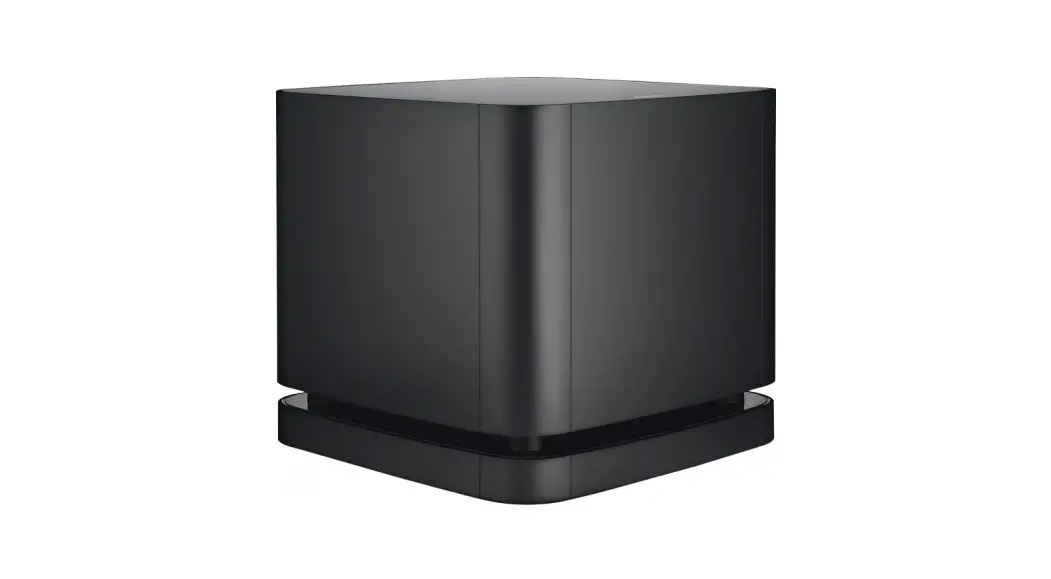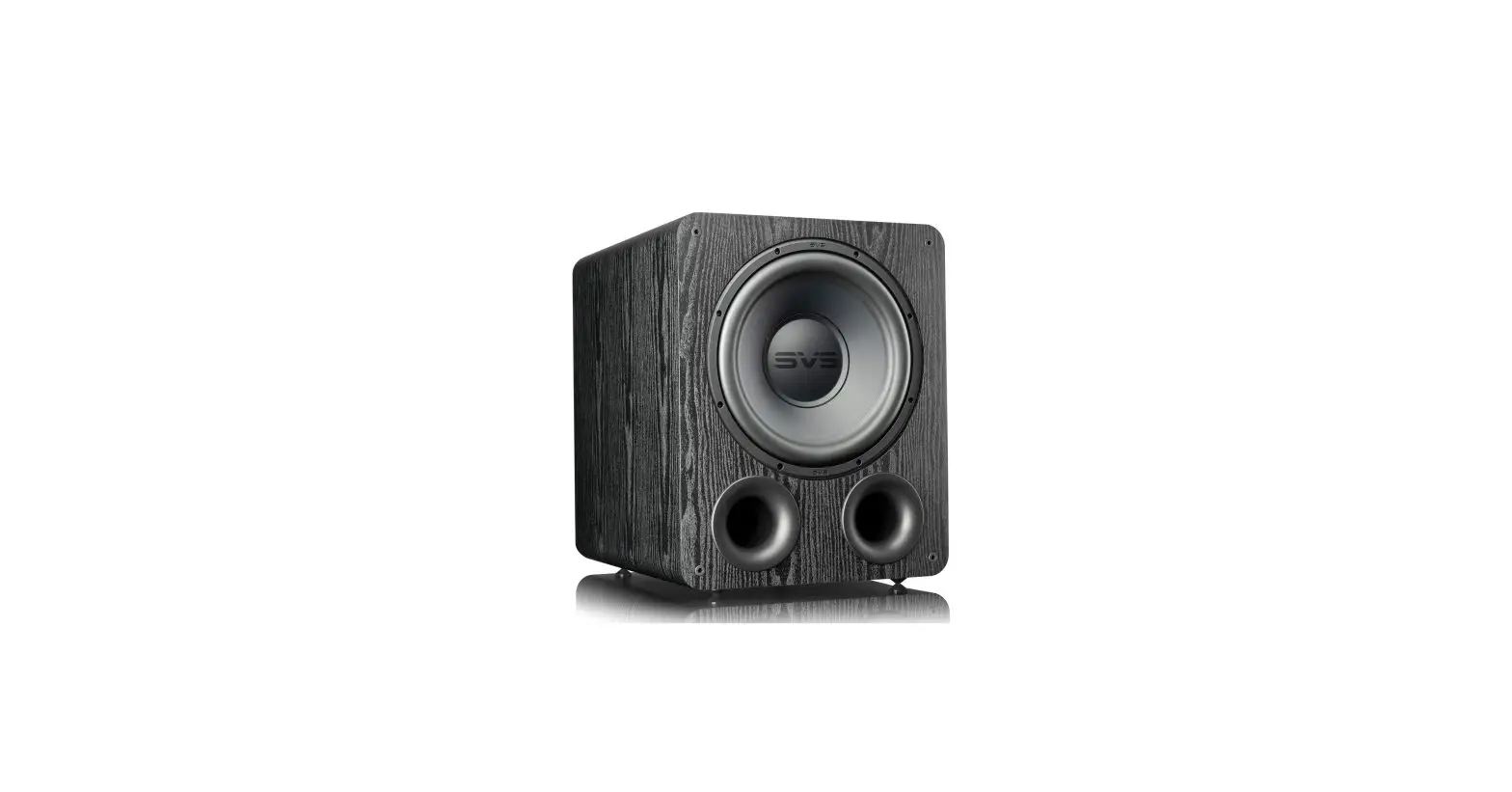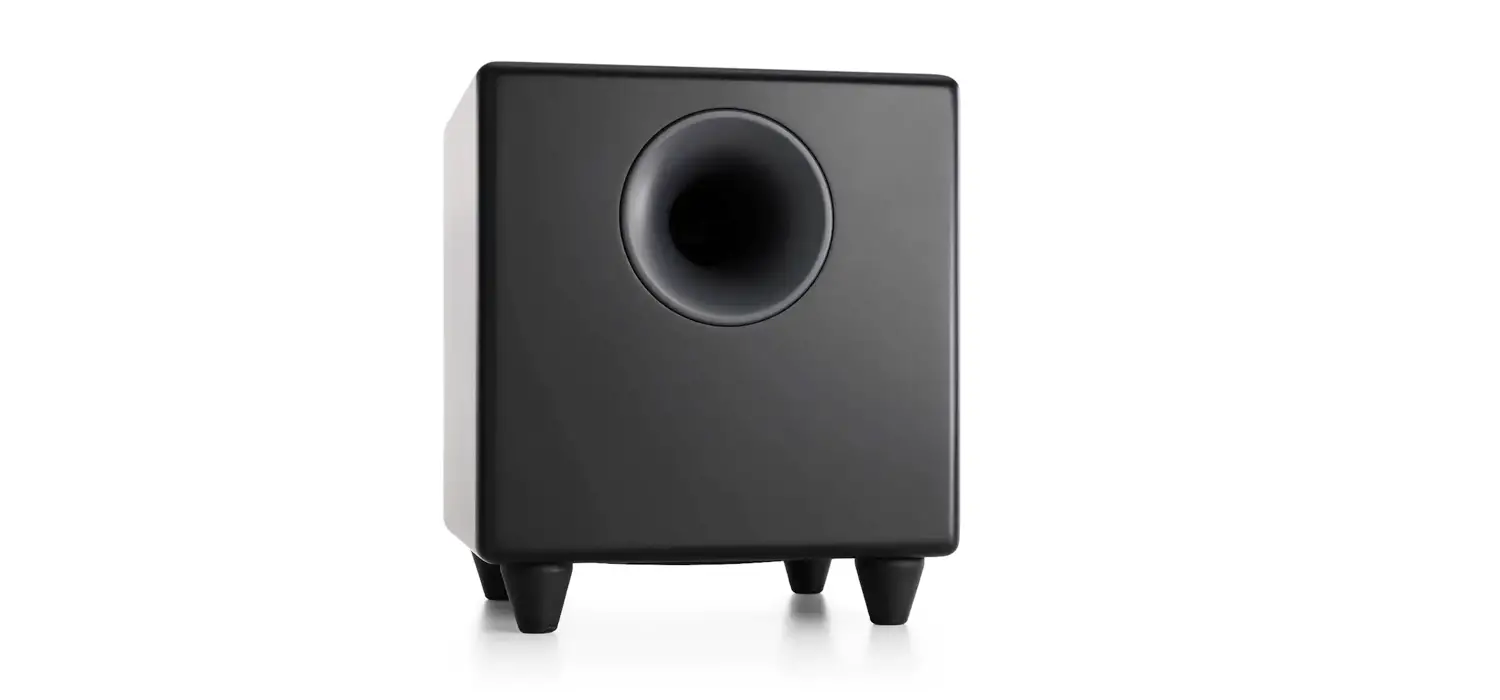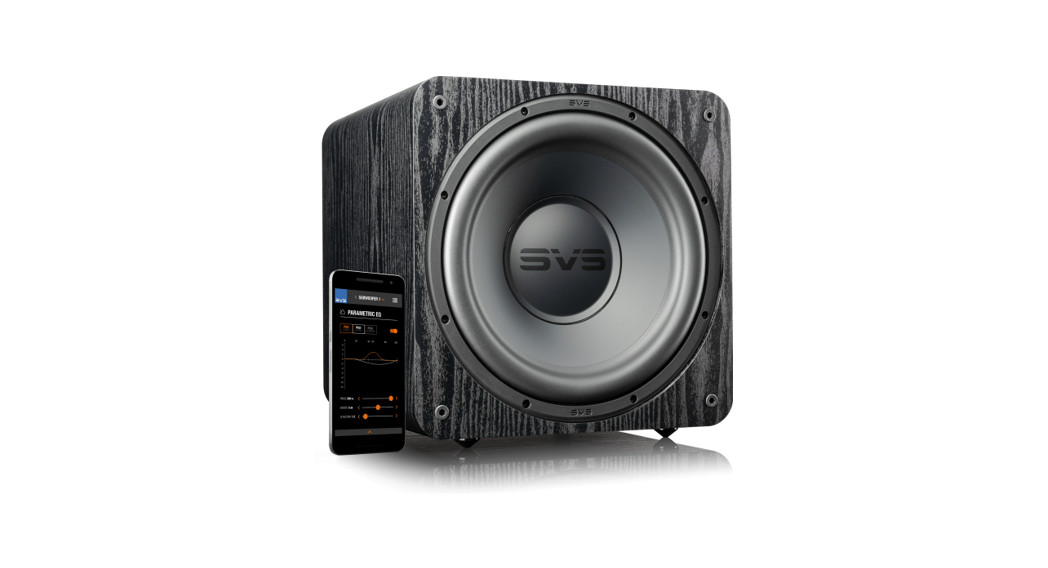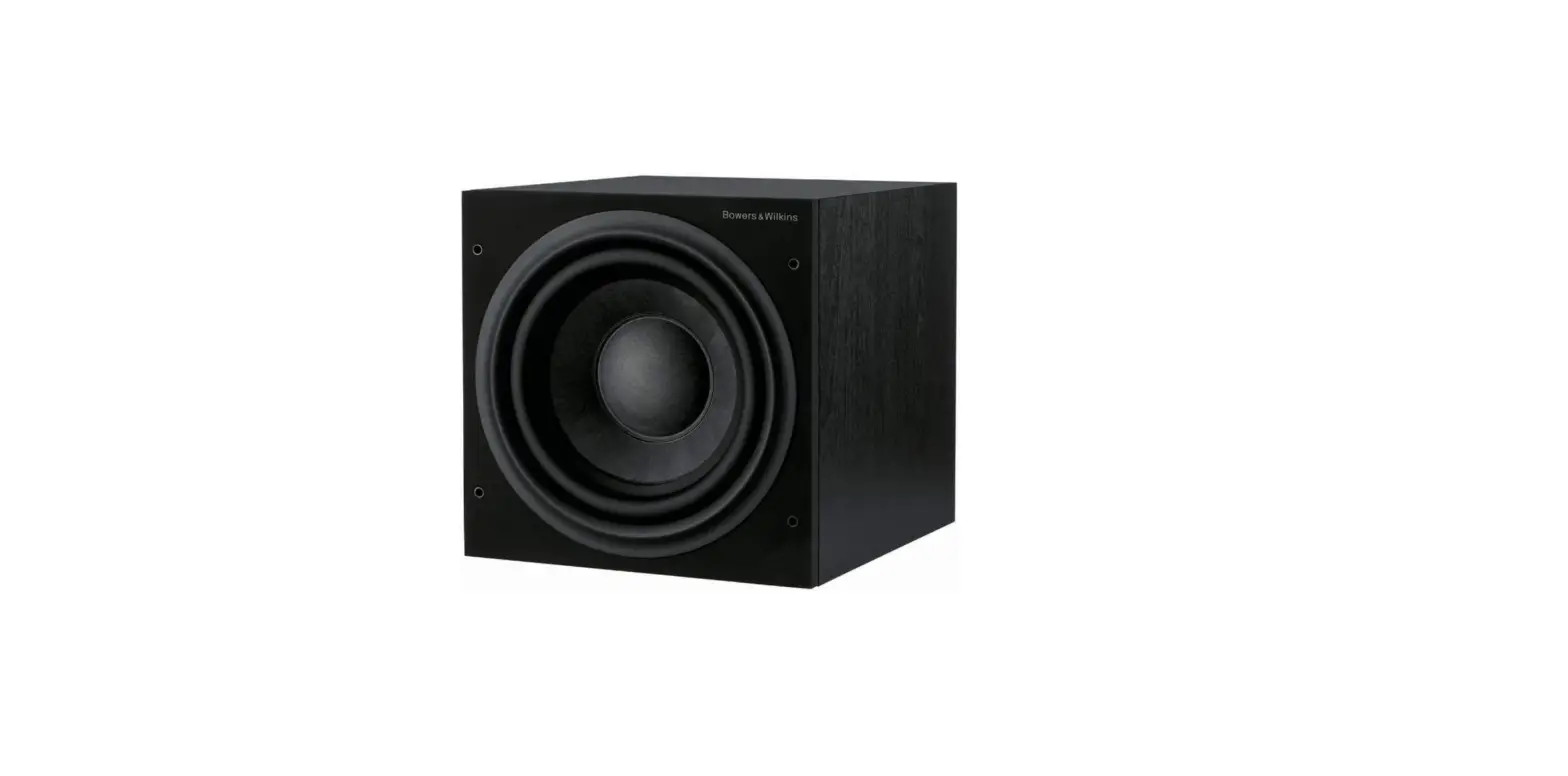
 Bowers & Wilkins ASW610 Black Hi-Fi Subwoofer
 Bowers & Wilkins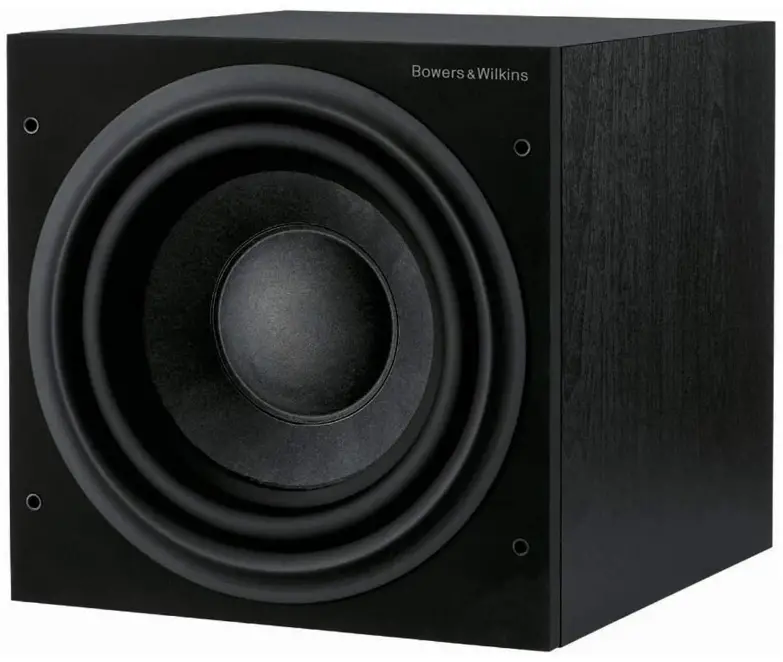
Dear customer,
Thank you for choosing Bowers & Wilkins. Please read this manual fully before unpacking and installing the product. It will help you to optimize its performance. B&W maintains a network of dedicated distributors in over 60 countries who will be able to help you should you have any problems your dealer cannot resolve.
SPECIFICATION
- DESCRIPTION: Active closed-box subwoofer system
- DRIVE UNIT: 1x ø250mm (10 in) paper/Aramid Fiber cone long-throw
- FREQUENCY RANGE: -6dB at 20Hz and 25/140Hz adjustable (EQ at A)
- FREQUENCY RESPONSE: ±3dB 27Hz – 40/140Hz adjustable (EQ at A)
- BASS EXTENSION: -6dB at 20Hz (position A), -6dB at 25Hz (position B), -6dB at 30Hz (position C)
- POWER OUTPUT: 200W
- RATED POWER CONSUMPTION: 40W / 0.5W standby
- INPUT IMPEDANCE: 33kΩ
- SIGNAL / NOISE: >90dB
- DIMENSIONS: 310mm (12.2 in) not including feet x 310mm (12.2 in) x 375mm (14.8 in) including grille and controls
- NET WEIGHT: 12.5kg (27.6 lb.)


Environmental Information
All B&W products are designed to comply with international directives on the Restriction of Hazardous Substances (RoHS) in electrical and electronic equipment and the disposal of Waste Electrical and Electronic Equipment (WEEE). These symbols indicate compliance and that the products must be appropriately recycled or processed in accordance with these directives. Consult your local waste disposal authority for guidance.
Carton Contents
Check in the carton for:
- 1 Mains cable
- 1 Accessory pack containing:
- 4 M6 spike feet
- 4 M6 rubber feet
- 4 Lock nuts (10mm across flats)
Installation
The subwoofer has been designed both for Home Theatre installations and to augment the bass performance of ‘full range’ speakers in 2-channel audio systems. All audio installations require some thought in installation if they are to reach their full performance potential and this manual will guide you through the process.
The subwoofer requires connection to the mains power supply, so it is important that you familiarize yourself with the safety instructions and heed all the warnings. Keep this manual in a safe place for future reference.
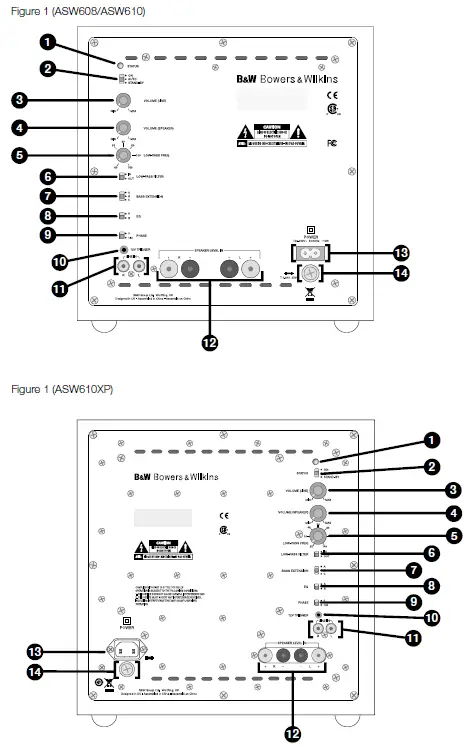
The Subwoofer Connection and Control Panel (Figure 1)
- Status indicator.
- On, Auto, Stand-by switch.
- Line-level input volume.
- Speaker level input volume.
- Low-pass filter frequency.
- Low-pass filter selection switch.
- Bass extension switch.
- Equalization switch.
- Phase reverse switch.
- 12V trigger input.
- Line level input sockets (left and right).
- Speaker level input binding posts (left and right).
- Mains input.
- External fuse holder.
Subwoofer Applications
The primary function of a subwoofer is to reproduce signals from an audio-visual processor Low Frequency Effects (LFE) channel. In addition, the processor may be configured to divert the low bass portion from some or all of the other channels and add it to the LFE information. This is usually done by selecting “small” loudspeakers in the processor set-up procedure.
In 2-channel audio applications a subwoofer is used to extend the bass response lower than that provided by the satellite speakers. The subwoofer low-pass filter should be set so that the subwoofer takes over as the output of the satellite speakers falls.
Subwoofer Positioning and Installation
The ear poorly perceives the source location of low frequency sound so the position of subwoofers in the listening room is generally less critical compared to full-range speakers. However, best results are usually obtained if the subwoofer is placed between the left and right speakers or in the vicinity of one of them. If two subwoofers are used, it is best to put one near the left and one near the right speaker. Placing a subwoofer behind the listening position, even in multi-channel surround sound installations, generally results in inferior imaging, but may be an acceptable compromise if domestic considerations dictate.
As with all speakers, the proximity of room boundaries affects the sound of a subwoofer. Bass volume increases as more surfaces come into close proximity with the speaker. Unlike full-range speakers, however, the overall system balance can be corrected by adjusting the volume level of the subwoofer. The more boost gained from the room, the lower the volume can be set and the less hard the subwoofer has to work; but there is a down side. Subwoofers positioned near corners often generate more low-frequency room resonances, making the bass more uneven with frequency. There is no substitute for experiment as all rooms behave differently, so the subwoofer should be tried in a variety of positions before a final decision is made. A piece of music with a bass line ascending or descending the musical scale is useful for assessing the smoothness of the bass response. Listen for exaggerated or quiet notes.
If the subwoofer is to be used in a confined space (e.g. built into furniture), the space must be ventilated to allow sufficient air to circulate and cool the unit. Ask your dealer for advice.
The subwoofer is intended to be floor mounted only. It is important to ensure the subwoofer stands firmly on the floor using the spike feet supplied whenever possible. The spike feet are designed to pierce carpet and rest on the floor surface. Initially, screw the lock nuts onto the spikes enough to leave the nuts floating just above the carpet when the spikes are resting on the floor beneath. Screw the spikes fully into the threaded inserts in the base of the cabinet. If the cabinet rocks when placed on the floor, unscrew the two spikes that do not touch the floor until the cabinet rests firmly without rocking. Finally, lock the nuts against the cabinet. It may be more convenient to fit and adjust the spike feet after speaker positioning has been optimized.
If there is no carpet and you wish to avoid scratching the floor surface, use either a protective metal disc (a coin perhaps) between the spike and the floor or use the supplied rubber feet. Fit the rubber feet by screwing one into each of the holes in the underside of the cabinet.
The grille fitted to the front of the subwoofer may be removed if desired. Take care however not to touch the moving parts of the drive unit as damage may result.
Using Multiple Subwoofers
Using multiple subwoofers in a single installation can improve performance in the following ways:
- Maintain stereo separation to the lowest frequencies.
- Smooth out the effects of low frequency room resonances.
- Enable a higher maximum sound output.
In the case of two subwoofers used in a 2-channel audio system, stereo separation will only be improved if each channel has its own subwoofer located close to the appropriate satellite speaker.
Electrical Connections
Disconnect all audio system equipment from the mains until the signal connections have been made and checked. This avoids the risk of damage whilst connections are made or broken. The subwoofer can accept both line level signals via the RCA Phono sockets (Item 11 in Figure 1) and speaker level signals via the binding posts (Item 12 in Figure 1). Use the following guide to select the appropriate connection method for your installation:
Application: Home Theatre
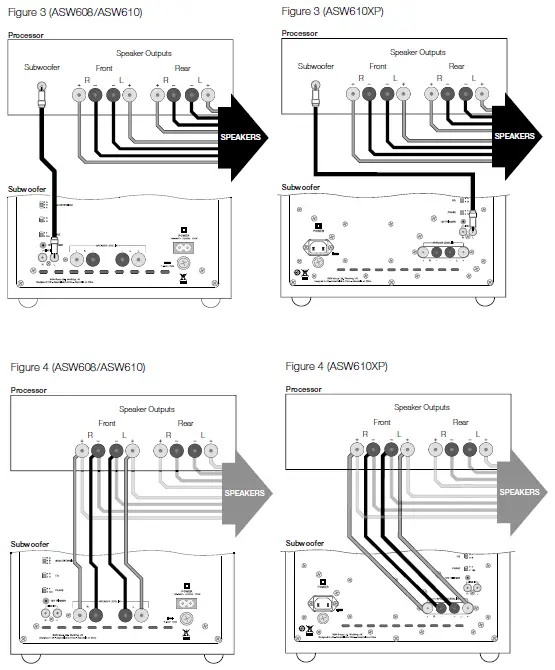
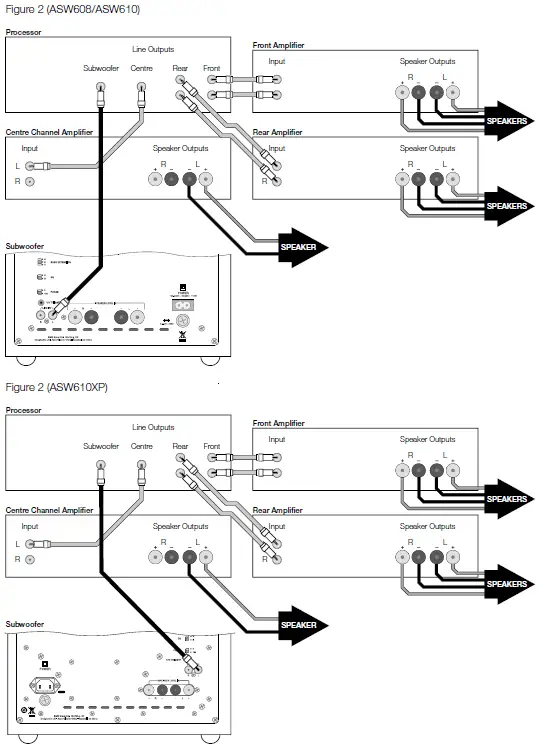
Subwoofer connected to AV Processor with separate power amplifiers: Figure 2
Subwoofer connected to AV Processor with integrated power amplifiers:
- using line-level inputs: Figure 3
- using speaker level inputs: Figure 4
Note: The subwoofer is always better connected via its line level inputs in home theatre applications.
Application: 2-channel audio
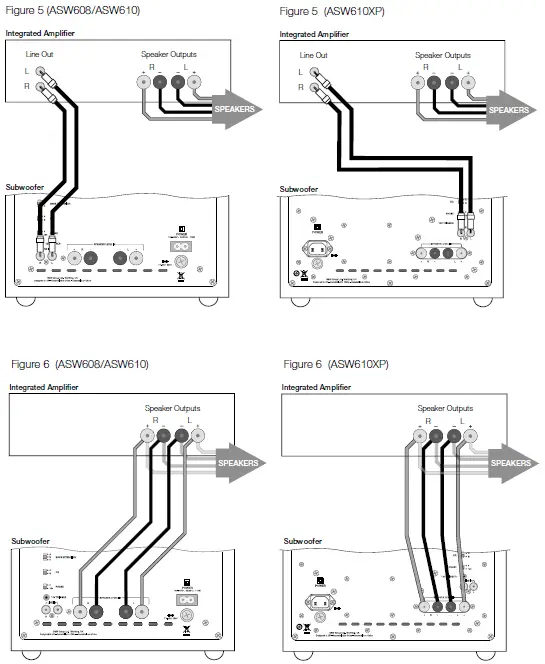
Subwoofer connected to Integrated Amplifier:
- using line-level inputs: Figure 5
- using speaker level inputs: Figure 6
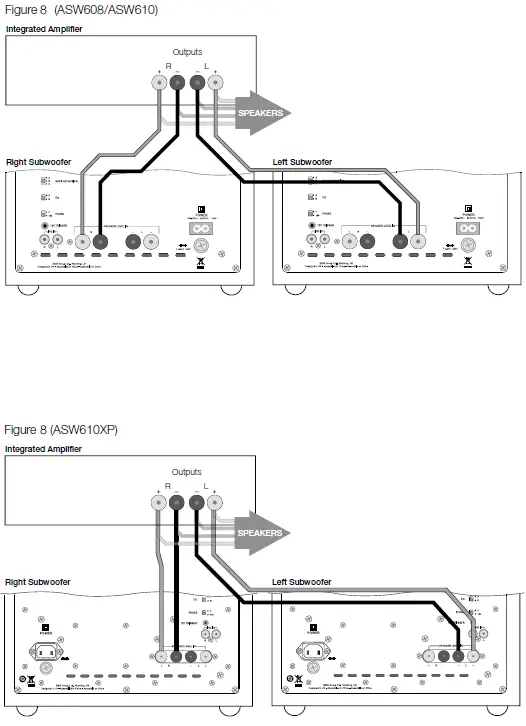
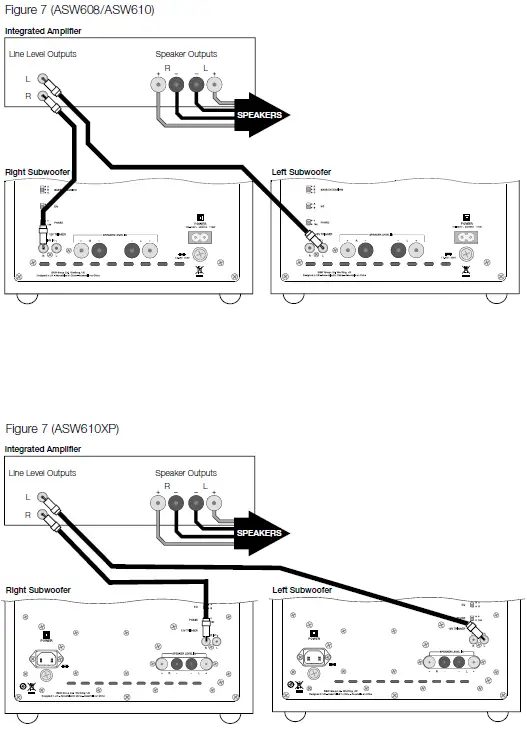
Two Subwoofers connected to Integrated Amplifier:
- using line-level inputs: Figure 7
- using speaker level inputs: Figure 8
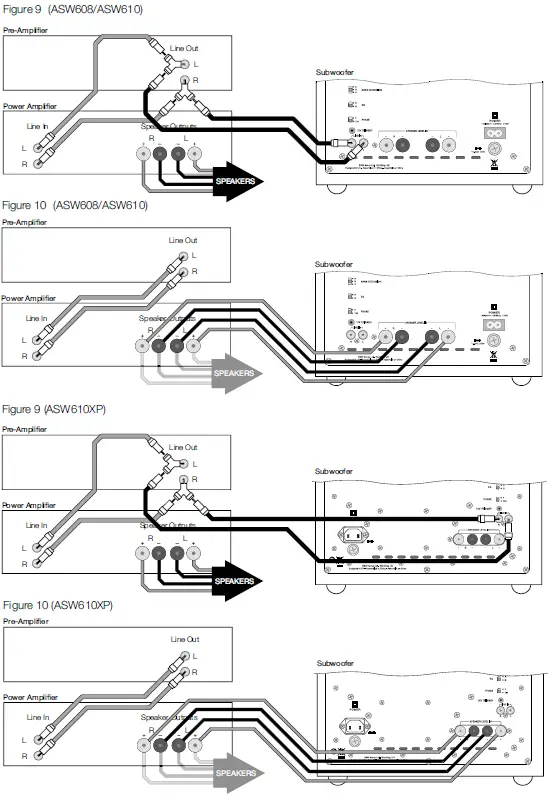
Subwoofer connected to Pre/Power Amplifier:
- using line-level input: Figure 9
- using speaker level inputs: Figure 10
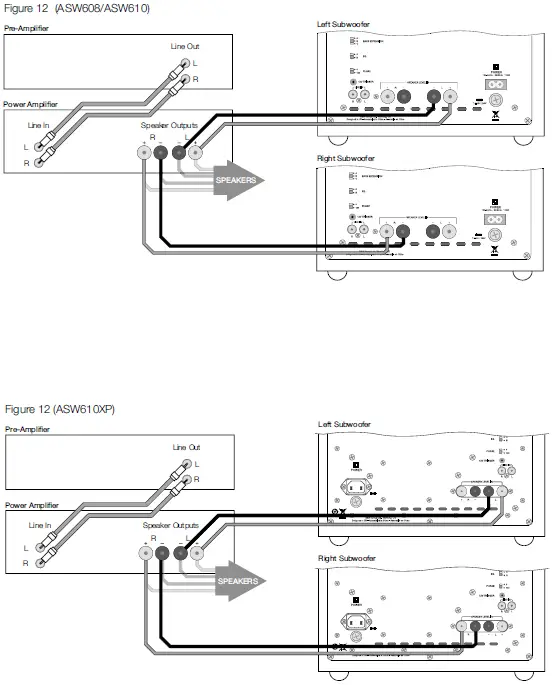
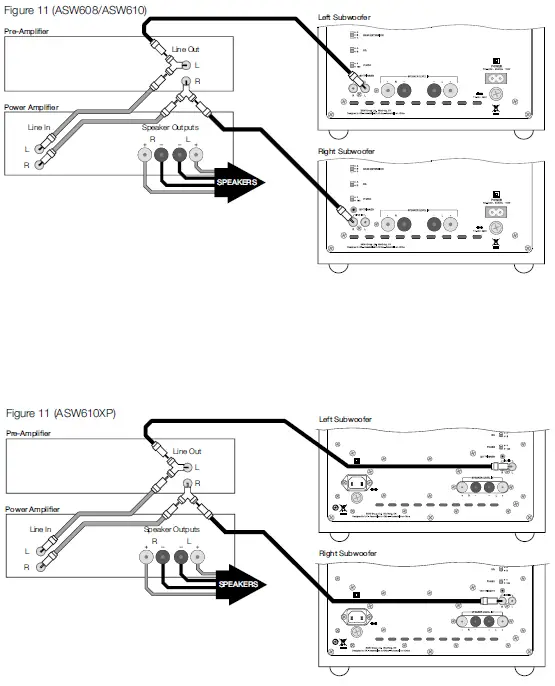
Two Subwoofers connected to Pre/Power Amplifier:
- using line-level inputs: Figure 11
- using speaker level inputs: Figure 12
Before Auditioning
Before auditioning your new subwoofer, installation and fine-tuning it, double check the connections. Make sure in particular that:
- The phasing is correct. If the speaker level inputs are used, ensure that the positive terminals on the subwoofer (marked + and colored red) are connected to the positive output terminals on the amplifier and that the negative terminals on the subwoofer (marked – and colored black) are connected to the negative output terminals on the amplifier. Incorrect connection can result in a confused sound with poor bass.
- Left and right channels are not interchanged. Left/right confusion can result for example in orchestral elements appearing in the wrong place in the stereo image, or Home Theatre sound effects not matching the action on screen.
Switching On and Off
Subwoofers are best switched on after any other item and switched off first. The On/Auto/Standby switch (Item 2 in Figure 1) and Status Indicator (Item 1 in Figure 1) operate as follows:
- On: With the switch to On, the subwoofer will remain fully active and the indicator will glow green.
- Auto: With the switch set to Auto, the subwoofer will initially become fully active and the indicator will glow green. After about 5 minutes without an input signal, the subwoofer will automatically enter “sleep” mode. The indicator will glow red. When an input signal is detected, the subwoofer will automatically become active and the indicator will glow green. The subwoofer will return to sleep after about 5 minutes with no input signal.
Audio-visual processors incorporating an “automatic” set up procedure may be “confused” by subwoofers with an auto switch-on/sleep function. A potentially damaging fault condition can arise. Subwoofers are best left switched on and fully active during set up if such a processor is used. - Standby: With the switch set to Standby the subwoofer will become active when 12V is applied to the Trigger Input (Item 10 in Figure 1). Zero volts at the input will return the subwoofer to sleep. The indicator will glow green when the subwoofer is active and red when the subwoofer is in sleep.
Setting The Subwoofer Controls
There are 7 controls to consider:
The VOLUME (LINE) control (Item 3 in Figure 1)
- The VOLUME (SPEAKER) control (Item 4 in Figure 1)
- The LOW-PASS FREQ (frequency) control (Item 5 in Figure 1)
- The LOW-PASS FILTER switch (Item 6 in Figure 1) Note: This applies only to the LINE input. The filter is always in circuit with the SPEAKER LEVEL input.
- The BASS Extension switch (Item 7 in Figure 1)
- The EQ (equalization) switch (Item 8 in Figure 1)
- The PHASE switch (Item 9 in Figure 1)
The appropriate settings depend on the equipment used with the subwoofer and the modes of connection. If using more than one subwoofer, ensure the controls on each one are set the same.
Note: The VOLUME (LINE) and VOLUME (SPEAKER) controls only operate on their respective line and volume inputs. An unused volume control is best set to Min.
Home Theatre Settings
- Set the VOLUME (LINE or SPEAKER) control initially to the 9 o’clock position.
- Set the LOW-PASS FILTER switch to OUT.
- Set the EQ switch initially to position A.
- Set the PHASE switch initially to 0°.
- Set the LOW-PASS FREQ (frequency) control to 140 if the speaker level inputs are used. The setting is irrelevant if the line level inputs are used.
See the “Fine Tuning” section for more.
The subwoofer is not a THX® licensed component, but may be used with a THX® controller if desired. If a THX® controller is used, ensure that the subwoofer function is enabled. This incorporates all the filtering and level setting required for the subwoofer in all modes. For level calibration, the internal test noise and channel level controls in the THX® controller should be used. In all cases the levels should be set to obtain 75dB SPL (C-weighted) at the listening position from the controller’s internal noise test signal.
With other processors, configure the front and surround speakers to “large” or “small” as appropriate before setting the levels. Use the internal noise test signal and volume controls of the processor to set the levels of all the speakers. Only change the VOLUME control on the subwoofer if there is not enough range in the processor to achieve the correct levels. Inexpensive sound level meters are readily available from electronics stores and can be used to calibrate the levels. Refer to your processor manual for further details on how to set the levels.
2-channel Audio Settings
- Set the VOLUME (LINE or SPEAKER) control initially to the 9 o’clock position.
- Set the LOW-PASS FILTER switch to IN.
- Set the EQ switch initially to position A.
- Set the PHASE switch initially to 0°.
Set the LOW-PASS FREQ control to match the -6dB low frequency cut-off frequency of the satellite speakers. Note: Both -3dB and -6dB figures can be found in the specification of each B&W speaker model. If the satellite speaker manufacturer quotes only a -3dB frequency, the optimum setting for the LOW-PASS FREQ control should be between 0.6 and 0.9 times that figure. The more gradual the low frequency roll-off of the satellite speakers, the lower the frequency should be set.
See the Fine-Tuning section for more.
Fine-tuning Home Theatre
In home theatre systems, the subwoofer (LFE) signal is a separate channel rather than an extension of the signal to the satellite speakers. The LOW-PASS FILTER is switched out (or set to maximum), because the processor provides all the filtering for any speakers set to “small”. However, the position of the PHASE switch must still be assessed. Normally the phase will be set to 0°, but if the subwoofer is positioned at a distance significantly different from the other speakers, or the power amplifier driving the other speakers happens to invert the signal, the 180° position may be preferable. Listen with the switch in both positions and choose the one that gives the fullest sound. If there is little difference, leave the switch at 0°.
Surround sound processors normally have a calibrated noise signal that can be used to set the relative levels of all the speakers, making the task somewhat more straightforward than for 2 channel audios. However, do not be afraid to alter the settings to your personal preference. It is all too easy to get carried away with the capabilities of the subwoofer, especially with some special low-frequency effects. Often a more realistic portrayal, and one more satisfying in the long term, is to be had by setting the subwoofer level lower than the standard calibration level.
2-channel Audio
Set the system up in the preferred position and play some program with a steady bass content.
The optimum settings of the PHASE switch and the LOW-PASS FREQ control are inter-related and also dependent on the low-frequency cut-off characteristic of the satellite speakers. However, the settings recommended above for the LOW PASS FREQ control and PHASE switch have been chosen to integrate well with most satellite speaker bass alignments.
Using the initial settings, first check the setting of the PHASE switch. Choose the option that gives the fullest sound. Normally the recommended option will be optimum, but may not be in certain circumstances. These may be that the power amplifiers feeding the satellite speakers invert the signal or that the subwoofer is not placed close to the satellite speakers.
Next, adjust the VOLUME (LINE or SPEAKER) of the subwoofer relative to the satellite systems to your liking. Use a wide variety of program material to get an average setting. A setting that sounds impressive on one piece may sound overpowering on another. Listen at a realistic volume level as the perception of musical balance varies with sound level.
Finally, adjust the LOW-PASS FREQ control to give the smoothest transition between the subwoofer and satellite speakers.
All Applications
The BASS EXTENSION switch offers three options of subwoofer bass extension. Position A gives the greatest extension and position C gives the least extension. Position B provides a compromise setting. If the system is to be used at very high-volume levels or in a large listening room, restricting the bass extension by selecting either B or C may help ensure that the subwoofer is not asked to exceed its performance limits. In most situations the BASS EXTENSION switch should be left in position A.
The EQ switch alters the subwoofer bass roll-off alignment. The bass you hear is a combination of the subwoofer plus the effects of the room and you should choose the position that best complements your room and the location of the subwoofer. Position A gives a “drier” alignment, more suited to placing the subwoofer in a corner or compensating for a resonant room. Position B is suited to a less resonant room acoustic and use away from a corner.
If you get problems with uneven bass – certain bass notes are exaggerated more than others – then you probably have a room interface problem and it is worth experimenting with the location of the subwoofer. What may seem like small changes in position – 15cm (6in) or so – can have a profound effect on the sound. The use of multiple subwoofers can smooth the effects of room resonances, as each subwoofer will tend to excite resonances at different frequencies. If you appreciably alter the relative distances from the subwoofer(s) and satellite speakers to the listening position, re-assess the PHASE switch setting. You should also check the volume of the subwoofer (using either the processor output levels or the VOLUME control on the subwoofer amplifier as appropriate), but only after setting the phase correctly.
Aftercare
The cabinet surfaces usually only requires dusting. If you wish to use an aerosol or other cleaner, remove the grille first by gently pulling it away from the cabinet. Spray aerosols onto the cleaning cloth, not directly onto the product. Test a small area first, as some cleaning products may damage some of the surfaces. Avoid products that are abrasive, or contain acid, alkali or anti-bacterial agents. Do not use cleaning agents on the drive unit. The grille fabric may be cleaned with a normal clothes brush whilst the grille is detached from the cabinet. Avoid touching the drive unit, as damage may result. Switch off the subwoofer before cleaning.
Do not use the subwoofer as a table. When in use, objects left on top of the subwoofer are liable to rattle. In particular, avoid the risk of liquids being spilled (e.g. from drinks or vases of flowers).
If the system is taken out of use for a long period, disconnect the subwoofer from the mains supply.
FREQUENTLY ASKED QUESTIONS
Does it have a crossover that can be adjusted?
Yes, the crossover on these subwoofers is adjustable and may be turned on or off as needed.
Is the M1 compatible with ATM6 center channel?
The M-1 Satellite Speakers are compatible with the Bowers and Wilkins HTM6 Center Channel Speaker.
The sub generates a low buzzing sound when the amp is turned off and it is not being loaded. Is this standard?
Low-level hum or buzz depends on the host amplifier and type of connection.
Does subwoofer have ports or is it sealed?
The subwoofer is made of a sealed box.
Does it include shoes or spikes?
There are 4 little feet on the B&W ASW608. To disconnect the woofer from the floor, SVS SoundPath Subwoofer Isolation Feet could be fitted.
Who can recommend a soundbar that works with this subwoofer?
A single “phono / cinch / RCA” connector can be used to connect this subwoofer to any soundbar that supports wired connections.
A speaker wire terminals input is there on a sub? Will a Marantz 2275 from the 1970s work to power the sub?
The ASW608 does indeed have speaker level inputs. Utilizing the Marantz 2275’s regular speaker wire, connect the subwoofer.
Has this speaker a relation to LFE?
To be used with a stereo system, this subwoofer incorporates stereo RCA connections. You only need to use one of these connections to use an A/V system.
Is an 8-inch subwoofer good enough?
There are some 8-inch subwoofers that sound pretty excellent and some may even compare them to a lower end 10″ or 12″, but in general, an 8 subwoofer is going to provide you nice, inexpensive, clean bass.
Do smaller subwoofers sound better?
The principles of physics state that a massive subwoofer driver has the capacity to create greater SPL and deeper bass than a smaller subwoofer driver, and that low frequency extension and sound pressure level (SPL) are often regarded as the two most critical components of a subwoofer’s performance.
Is a woofer better than a subwoofer?
Woofers are better at producing low-frequency sounds in general, whereas subwoofers are better at producing bass.
Should Subs be louder than bass?
If you want to have enough headroom for the rest of the song, subbass should peak at -12 dB. Keep the subbass 2 to 5 dB below the kickdrum as a general rule of thumb if mixing with headroom isn’t working for you.
What happens if you overpower a subwoofer?
Turning it up is nice, but doing so causes the sound to get distorted. In addition to sounding horrible, doing this repeatedly can harm your speakers and subwoofers.