
DUSUN DSM-04C Zigbee Cloud Module
Introduction
Purpose& Description
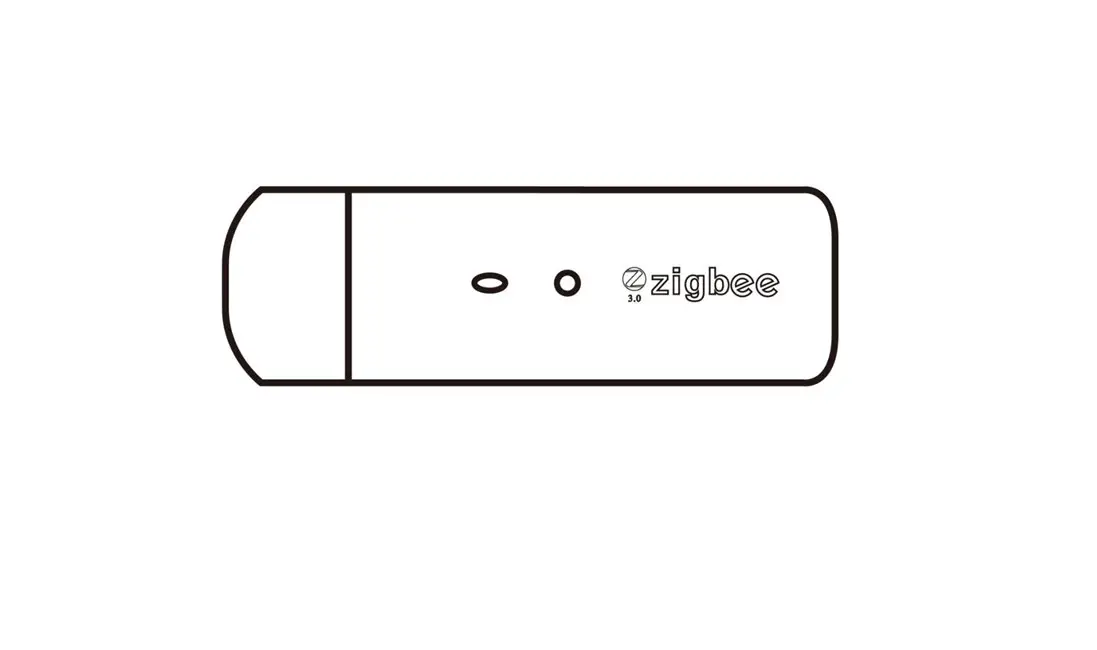
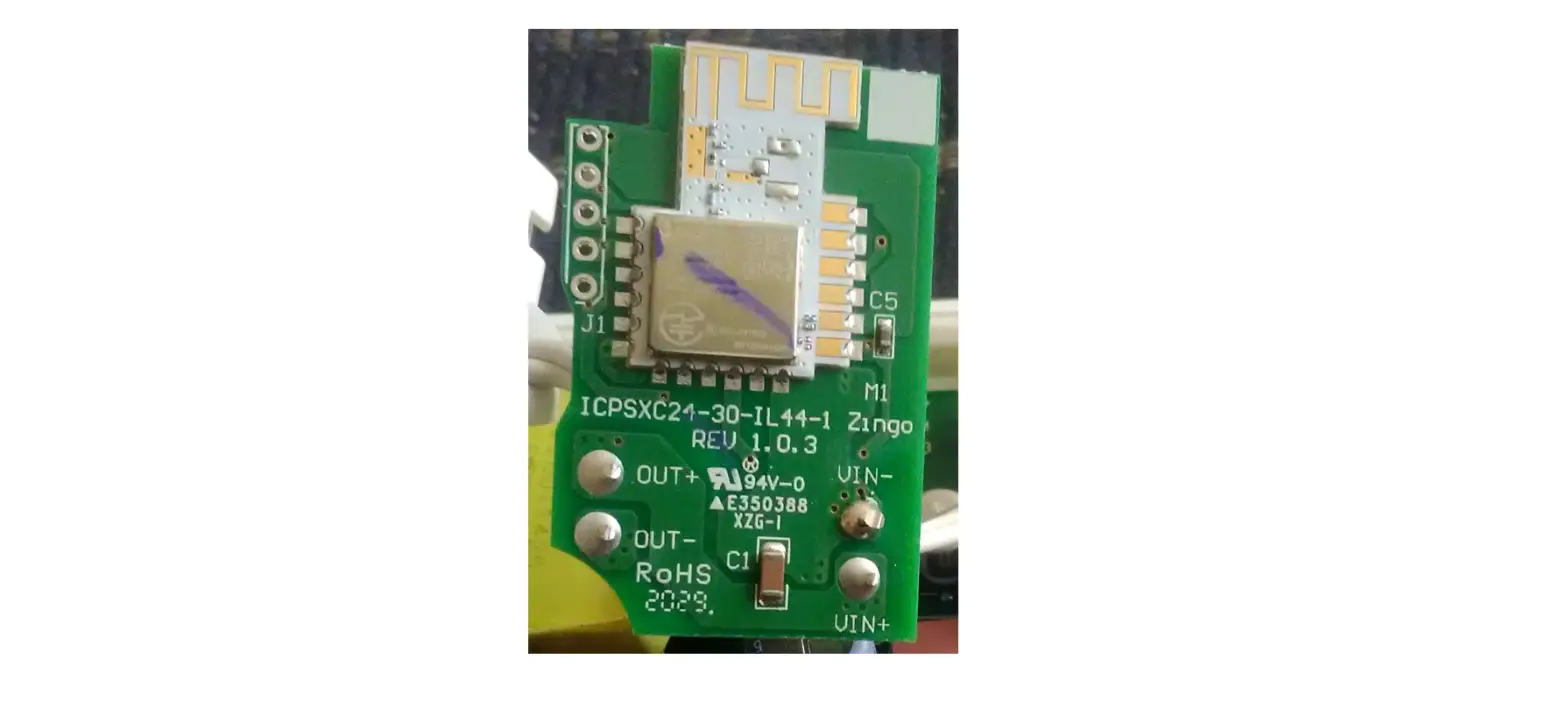
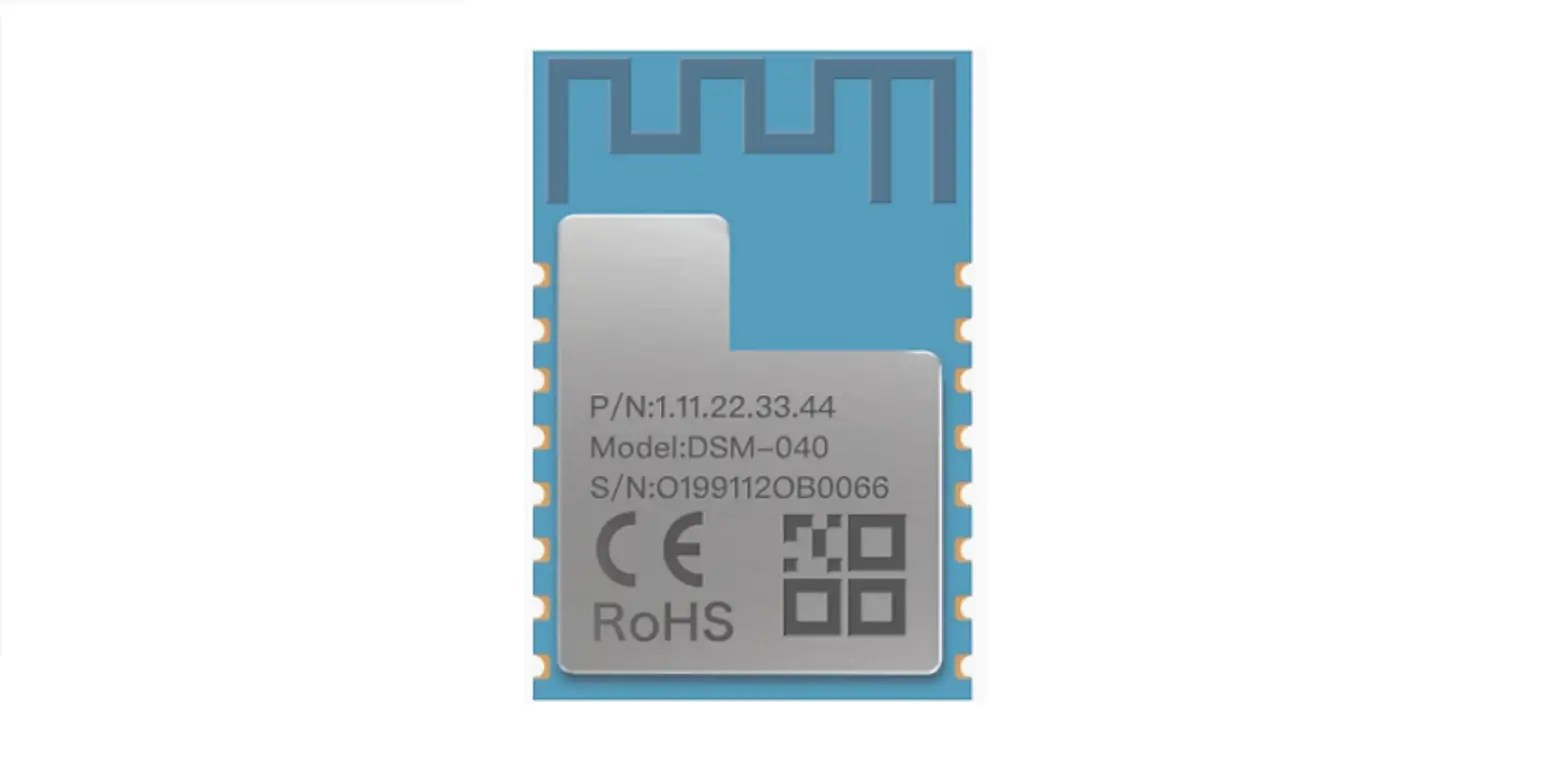
DSM-04C is a low-power-consuming embedded Zigbee module developed By Dusun. It consists of the highly integrated wireless radio processor chip, EFR32MG1B232F256GM32, and several peripherals, with a built-in 802.15.4 PHY/MAC Zigbee network protocol stack and robust library functions.
This data terminal device is embedded with a low-power-consuming 32-bit 40MHz ARM Cortex®-M4 CPU, 256 KB flash memory, 32 KB RAM data memory, and robust peripheral resources. It is mainly used for Zigbee coordinator device to support ZigBee 3.0 protocol stack.
Product Feature Summary
- High-performance 32-bit 40 MHz ARM Cortex®-M4 with DSP instructions and floating point unit for efficient signal processing
- Up to 256kB Flash programming memory
- Up to 32kB RAM data memory
- Working voltage: 2.0 V to 3.8 V
- Zigbee operating feature
- 802.15.4 MAC/PHY supported
- Working channel: 11 to 26 @2.405 GHz to 2.480 GHz, with an air interface, rate of 250 Kbps
- Dimension: 17 x 22 x 2.8 mm
- Working temperature: –40°C to +85°C
- Certification CE, FCC, SRRC
Scenario
- Intelligent Building
- Intelligent Home And Household Applications
- Industrial Wireless Control
- Intelligent Public Traffic
Mechanical Requirement
Drawing 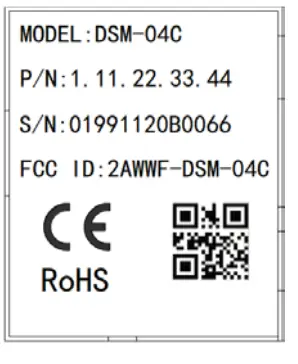
Dimensions
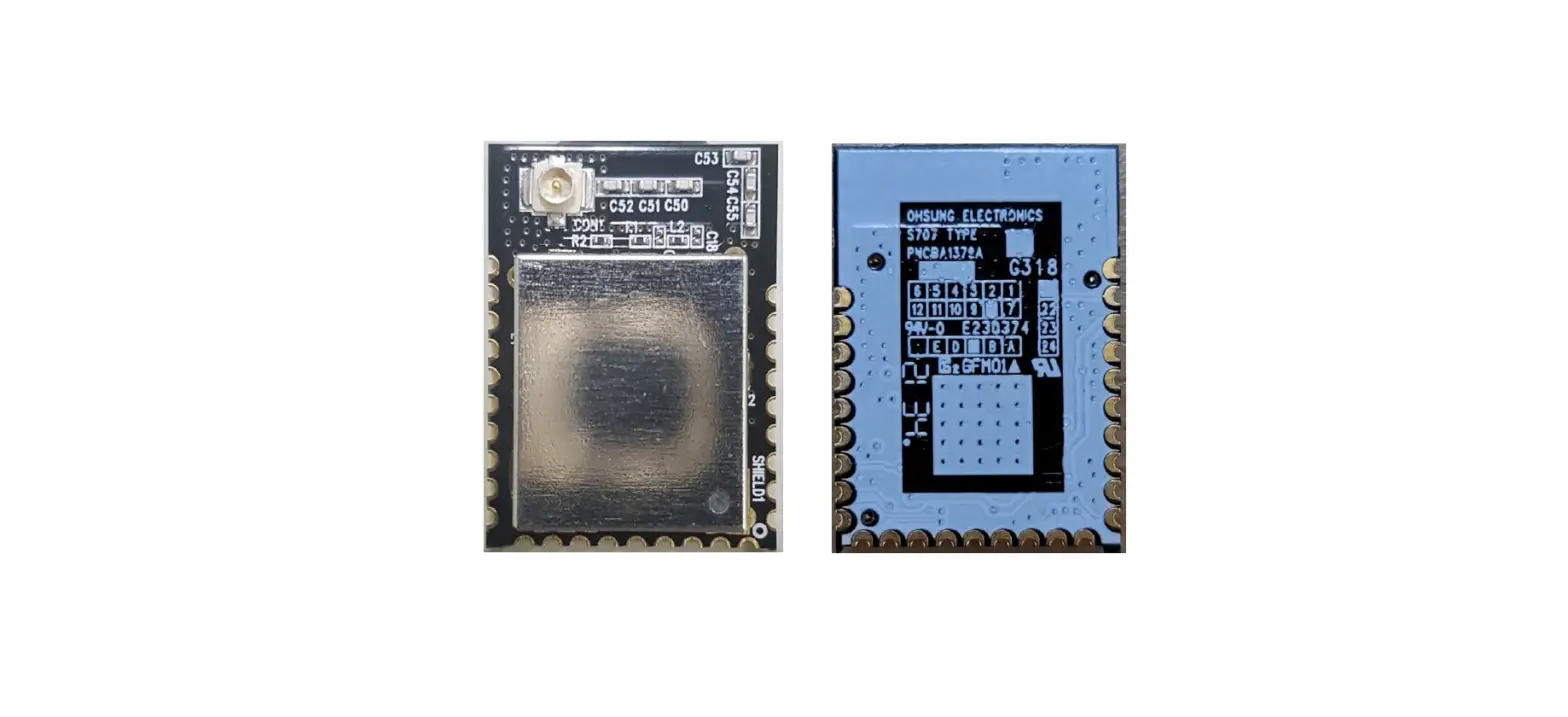
DSM-04C provides two rows of pins(2 * 14) with the pin pitch of 1.27±0.1mm Dimensions: 17±0.35 mm (W) x 22±0.35 mm (L) x 2.8±0.15 mm (H).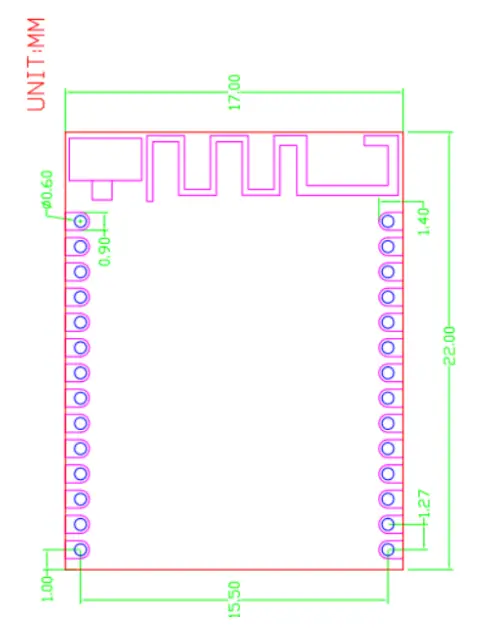
Pin Definition
| Pin Number | Symbol | IO Type | Function |
| 1 | NC | Not connect | |
| 2 | NC | Not connect | |
| 3 | NC | Not connect |
| 4 | NC | Not connect | |
| 5 | NC | Not connect | |
| 6 | TXD1 | I/O | Corresponding to Uart_TXD1 of IC |
| 7 | RXD1 | I/O | Corresponding to Uart_RXD1 of IC |
| 8 | PD15 | I/O | Corresponding to PD15 of IC |
| 9 | PB11 | I/O | Corresponding to PB11 of IC |
| 10 | PB12 | I/O | Corresponding to PB12 of IC |
| 11 | PB13 | I/O | Corresponding to PB13 of IC |
| 12 | PB14 | I/O | Corresponding to PB14 of IC |
| 13 | PB15 | I/O | Corresponding to PB15 of IC |
| 14 | NC | Not connect | |
| 15 | nRST | I/O | Hardware reset pin, which is at a high level by default and is active at a low level |
| 16 | PC10 | I/O | Corresponding to PF3 of IC |
| 17 | PC11 | I/O | Corresponding to PF3 of IC |
| 18 | SWCLK | I/O | Corresponding to PF3 of IC |
| 19 | SWDIO | I/O | Corresponding to PF3 of IC |
| 20 | TDX0 | Corresponding to PF3 of IC | |
| 21 | RXD0 | Corresponding to PF3 of IC | |
| 22 | VCC | P | Power supply pin (3.3V) |
| 23 | GND | P | Power supply reference ground |
| 24 | NC | Not connect | |
| 25 | PF2 | I/O | Corresponding to PF2 of IC |
| 26 | PF3 | I/O | Corresponding to PF3 of IC |
| 27 | NC | Not connect | |
| 28 | NC | Not connect |
P indicates power supply pins, I/O indicates input/output pins
Electrical parameters
Absolute electrical parameters
| Parameter | Description | Typical value | Minimum value | Maximum value | Unit |
| Ts | Storage temperature | -50 | 105 | ℃ | |
| VCC | Power supply voltage | 2.0 | 3.8 | V | |
| Static electricity voltage (human body model) | TAMB-25℃ | – | 2 | KV | |
| Static electricity voltage (machine model) | TAMB-25℃ | – | 0.5 | KV |
Working conditions
| Parameter | Description | Minimum value | Maximum value | Typical Value | Unit |
| Ta | Working temperature | -40 | 85 | – | ℃ |
| VCC | Power supply voltage | 2.0 | 3.0 | 3.8 | V |
| VIL | I/O low-level input | – | I0VDD*0.3 | V | |
| VIH | I/O high-level input | I0VDD*0.7 | – | – | V |
| VOL | I/O low-level output | – | I0VDD*0.2 | – | V |
| VOH | I/O high-level output | I0VDD*0.8 | – | – | V |
Current consumption during constant transmission and receiving
| Working status | Mode | Rate | TX Power/ Receiving | Typical value | Average value | Unit |
| TX | 250 Kbit/s | +15.43dBm | 130 | mA | ||
| TX | 250 Kbit/s | +10dBm | 35 | mA | ||
| TX | 250 Kbit/s | +0dBm | 9.8 | mA | ||
| RX | 1Mbps | Constant | 9 | mA |
| receiving | ||||||
| RX | 2Mbps | Constant receiving | 10 | mA | ||
| RX | 250Mbps | Constant receiving | 11 | mA |
RF features
Basic RF feature
| Parameter | Description |
| Frequency band | 2.405~2.480GHz |
| Standard | IEEE 802.15.4 |
| Data transmission rate | 250 Kbps |
| Antenna port | IPEX interface |
TX performance (Performance during constant transmission)
| Parameter | Minimum value | Typical value | Maximum value | Unit |
| Maximum output power | – | 15.43 | – | dBm |
| Minimum output power | – | -30 | – | dBm |
| Output power adjustment step | – | 0.5 | 1 | dBm |
| Output spectrum adjacent-channel rejection ratio | – | -31 | – | dBc |
| Frequency error | -15 | – | 15 | ppm |
RX performance (RX sensitivity)
| Parameter | Minimum value | Typical value | Maximum value | Unit |
| PER<1%, RX sensitivity(Zigbee 250Kbps) | -103 | -102 | -100 | dBm |
Antenna
Antenna type
This product uses IPEX interface connect to stick antenna.
Antenna interference reduction
To ensure optimal RF performance, it is recommended that the antenna be at least 15 mm away from other metal parts. If metal materials are wrapped around the antenna, the wireless signals will be reduced greatly, deteriorating the RF performance.
Firmware
API
Support customized various product solutions, including temperature/door/window/PIR/leakage sensors, smart meter, smart lock, etc., and provide related API documents and support. Customers can pair the device to the gateway (Dusun gateway or Private gateway )according to the API description and standard Zigbee 3.0 protocol.
API content includes reading sensor data, controlling device switches, changing device configuration, OTA, etc.
Production instructions
- Use an SMT placement machine to mount components to the stamp hole module that DUSUN produces within 24 hours after the module is unpacked and the firmware is burned. If not, vacuum packs the module again. Bake the module before mounting components to the module.
- SMT placement equipment:
- Reflow soldering machine
- Automated optical inspection (AOI) equipment
- Nozzle with a 6 mm to 8 mm diameter
Baking equipment: - Cabinet oven
- Anti-static heat-resistant trays
- Anti-static heat-resistant gloves
- Storage conditions for a delivered module are as follows:
- The moisture-proof bag is placed in an environment where the temperature is below 30℃ and the relative humidity is lower than 70%.
- The shelf life of a dry-packaged product is six months from the date when the product is packaged and sealed.
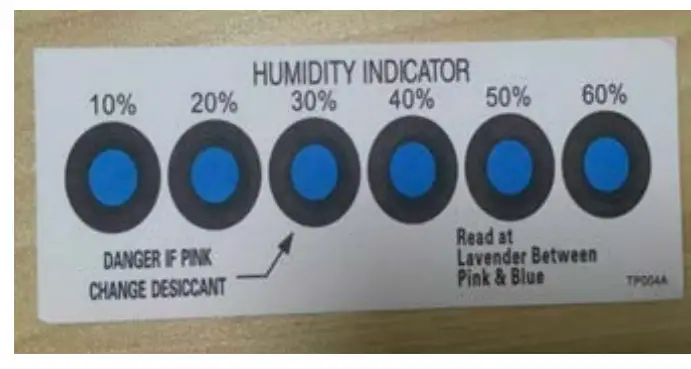
- The package contains a humidity indicator card (HIC).

- Bake a module based on HIC status as follows when you unpack the module package:
- If the 30%, 40%, and 50% circles are blue, bake the module for 2 consecutive hours.
- If the 30% circle is pink, bake the module for 4 consecutive hours.
- If the 30% and 40% circles are pink, bake the module for 6 consecutive hours.
- If the 30%, 40%, and 50% circles are pink, bake the module for 12 consecutive hours.
- Baking settings:
- Baking temperature: 125±5℃
- Alarm temperature: 130℃
- SMT placement ready temperature after natural cooling: < 36℃
- Number of drying times: 1
- Rebaking condition: The module is not soldered within 12 hours after baking.
- Do not use SMT to process modules that have been unpacked for over three months.
Electroless nickel immersion gold (ENIG) is used for the PCBs. If the solder pads are exposed to the air for over three months, they will be oxidized severely and dry joints or solder skips may occur. Dusun is not liable for such problems and consequences. - Before SMT placement, take electrostatic discharge (ESD) protective measures.
- To reduce the reflow defect rate, draw 10% of the products for visual inspection and AOI before first SMT placement to determine a proper oven temperature and component placement method. Draw 5 to 10 modules every hour from subsequent batches for visual inspection and AOI.
Recommended oven temperature curve
Perform SMT placement based on the following reflow oven temperature curve. The highest temperature is 245℃. Based on the IPC/JEDEC standard, perform reflow soldering on a module at most twice. 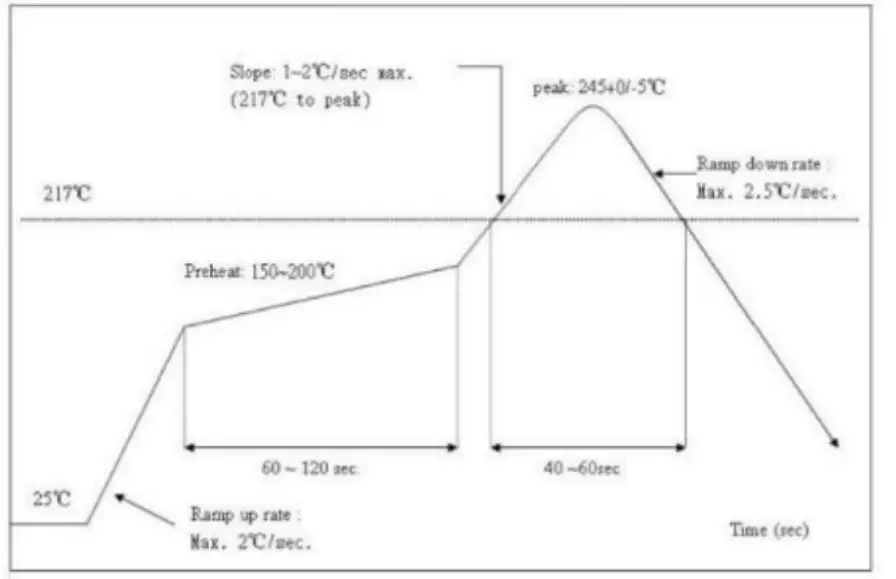
Storage conditions 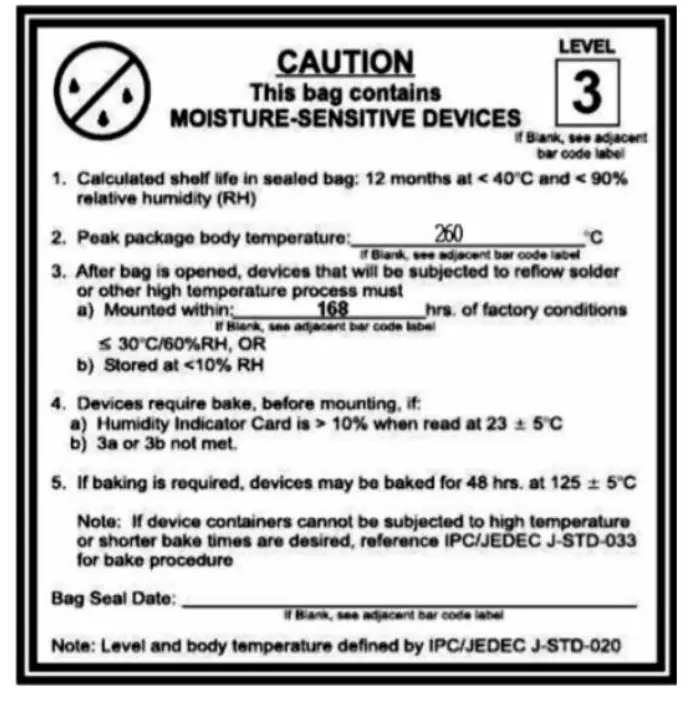
MOQ and packing
| Product model | MOQ(pcs) | Packing method | Number of Modules in each reel pack | Number of reel packs in each box |
| DSM-04C | 4000 | Carrier tape and reel packing | 1000 | 4 |
FCC
Any Changes or modifications not expressly approved by the party responsible for compliance could void the user’s authority to operate the equipment. This device complies with part 15 of the FCC Rules. Operation is subject to the following two conditions:
- This device may not cause harmful interference.
- This device must accept any interference received, including interference that may cause undesired operation.
FCC Radiation Exposure Statement:
This equipment complies with FCC radiation exposure limits set forth for an uncontrolled environment. This equipment should be installed and operated with minimum distance 20cm between the radiator & your body.
Note: This equipment has been tested and found to comply with the limits for a Class B digital device, pursuant to part 15 of the FCC Rules. These limits are designed to provide reasonable protection against harmful interference in a residential installation. This equipment generates, uses and can radiate radio frequency energy and, if not installed and used in accordance with the instructions, may cause harmful interference to radio communications. However, there is no guarantee that interference will not occur in a particular installation. If this equipment does cause harmful interference to radio or television reception, which can be determined by turning the equipment off and on, the user is encouraged to try to correct the interference by one or more of the following measures:
- Reorient or relocate the receiving antenna.
- Increase the separation between the equipment and receiver.
- Connect the equipment into an outlet on a circuit different from that to which the receiver is connected.
- Consult the dealer or an experienced radio/TV technician for help.
Integration instructions for host product manufacturers according to KDB 996369 D03 OEM
List of applicable FCC rules
CFR 47 FCC PART 15 SUBPART C has been investigated. It is applicable to the modular.
Specific operational use conditions
This module is stand-alone modular. If the end product will involve the Multiple simultaneously transmitting condition or different operational conditions for a stand-alone modular transmitter in a host, host manufacturer have to consult with module manufacturer for the installation method in end system.
Limited module procedures
Not applicable
Trace antenna designs
Not applicable
RF exposure considerations
To maintain compliance with FCC’s RF Exposure guidelines, this equipment should be and operated with minimum distance of 20cm from your body.
Antennas
This radio transmitter FCC ID:2AWWF-DSM-04C has been approved by Federal Communications Commission to operate with the antenna types listed below, with the maximum permissible gain indicated. Antenna types not included in this list that have a gain greater than the maximum gain indicated for any type listed are strictly prohibited for use with this device.
| Antenna type | Maximum Antenna gain |
| Stick Antenna | 1.78dBi |
Label and compliance information
The final end product must be labeled in a visible area with the following ” Contains FCCID:2AWWF-DSM-04C”
Information on test modes and additional testing requirements
Host manufacturer is strongly recommended to confirm compliance with FCC requirements for the transmitter when the module is installed in the host.
Additional testing, Part 15 Subpart B disclaimer
Host manufacturer is responsible for compliance of the host system with module installed with all other applicable requirements for the system such as Part 15 B
Zhejiang Dusun Electron Co.,
Ltd Tel: 86-571-86769027/8 8810480
Website: www.dusuniot.