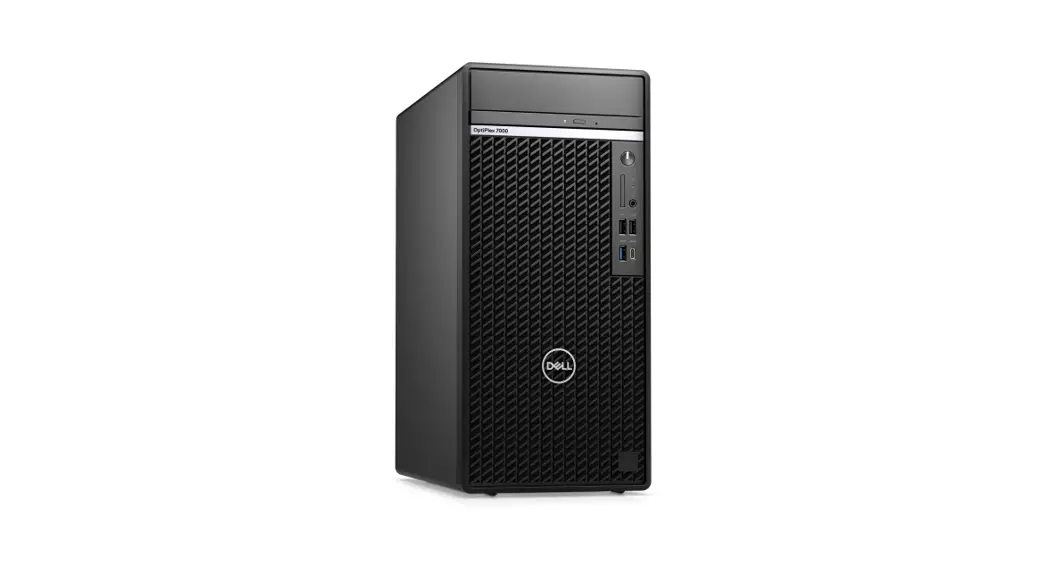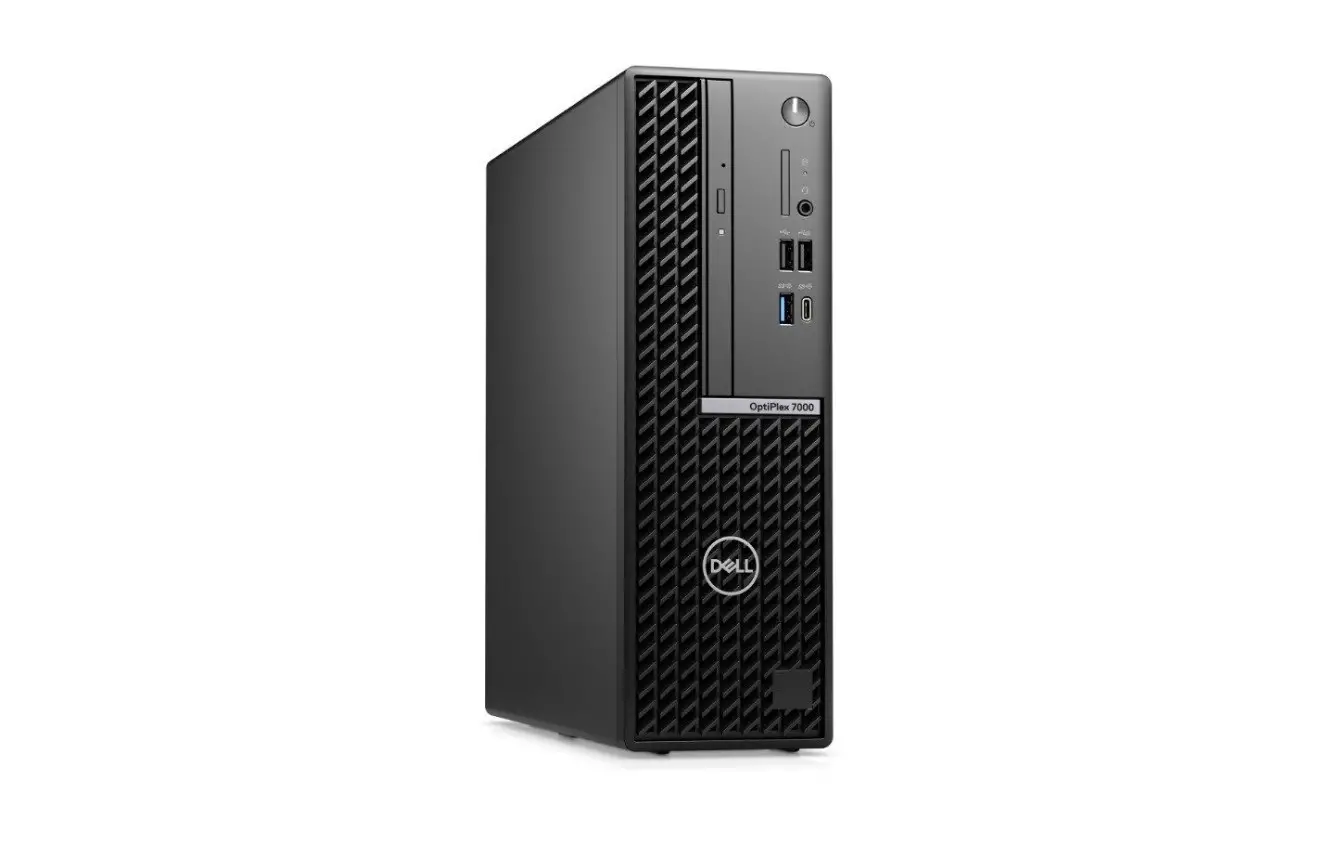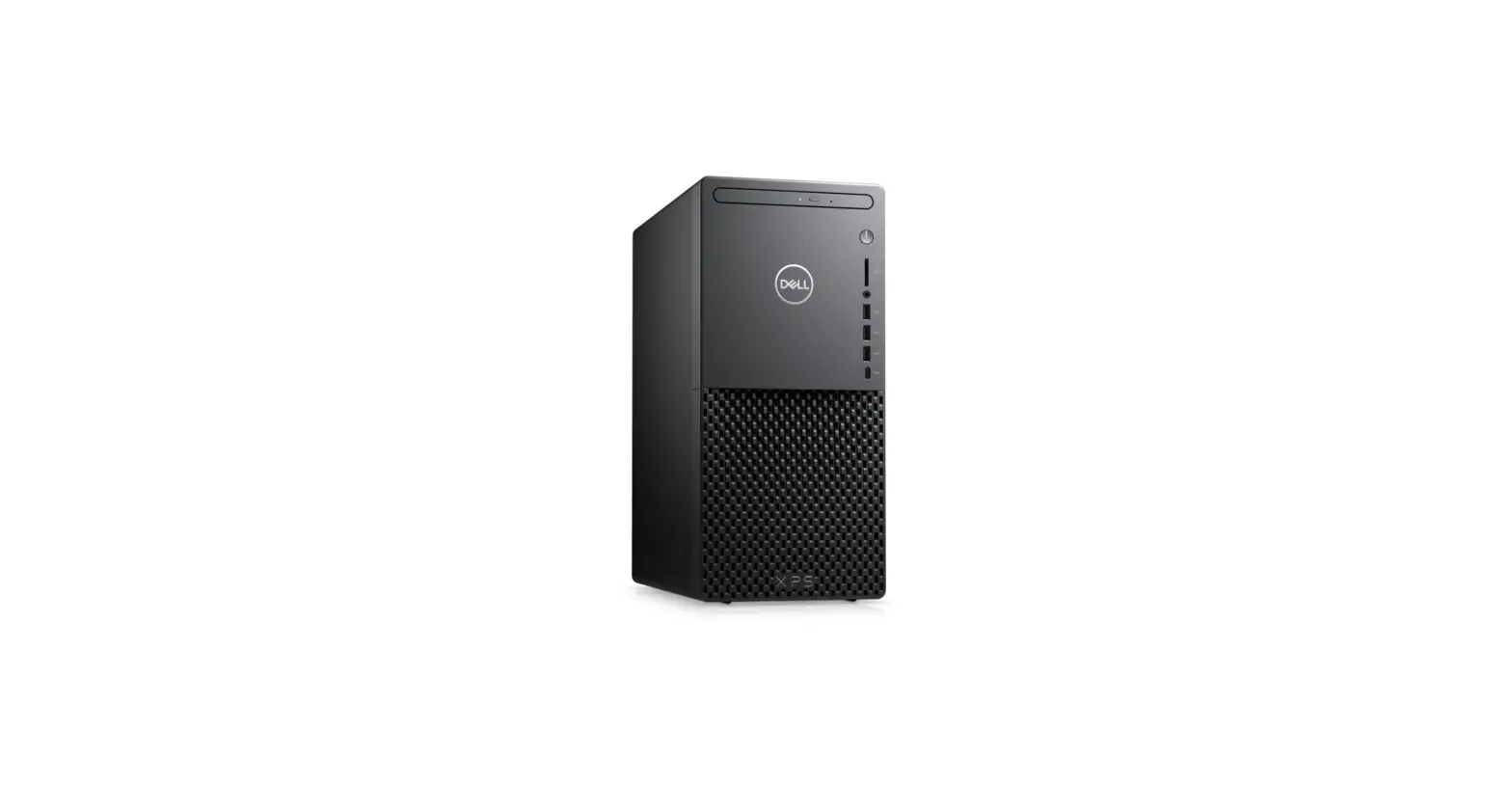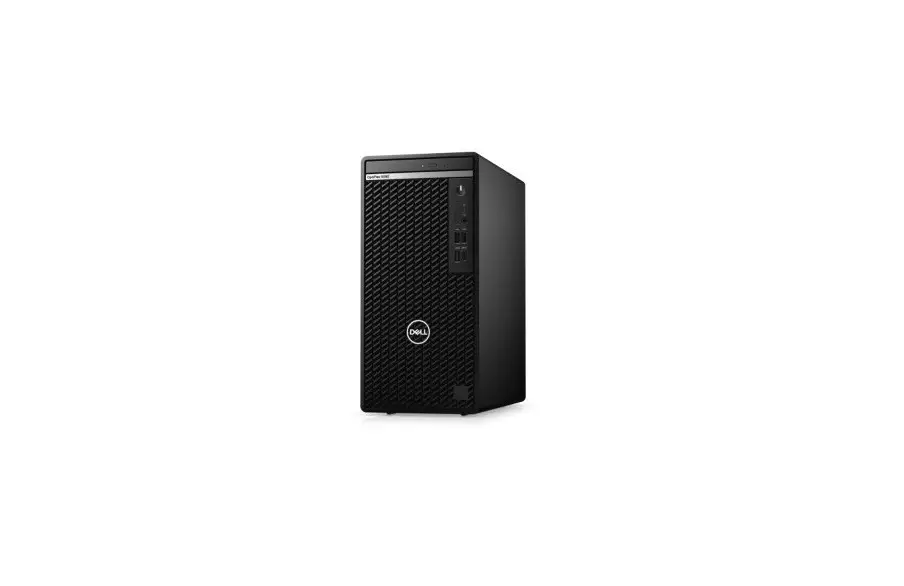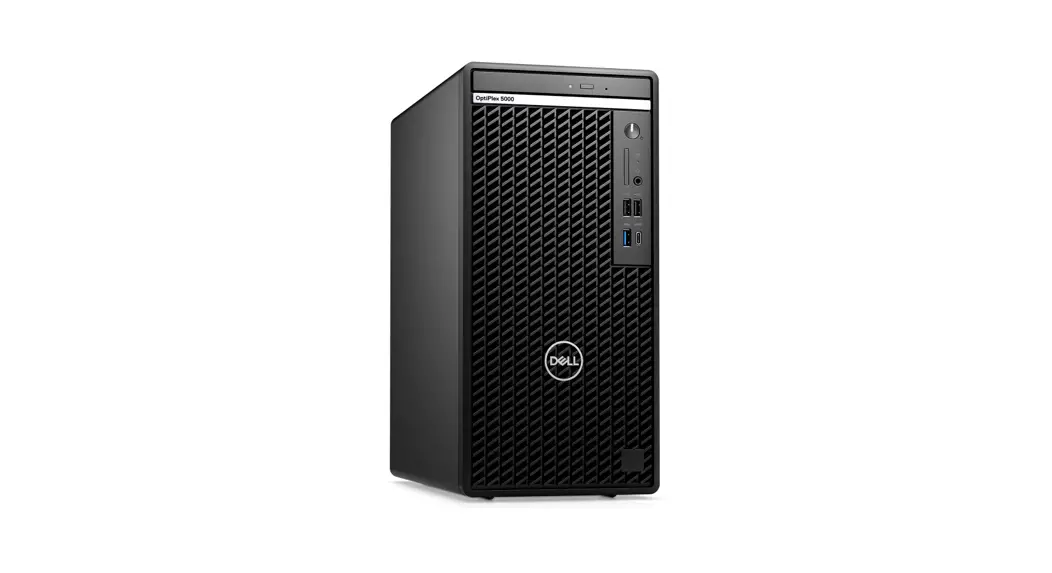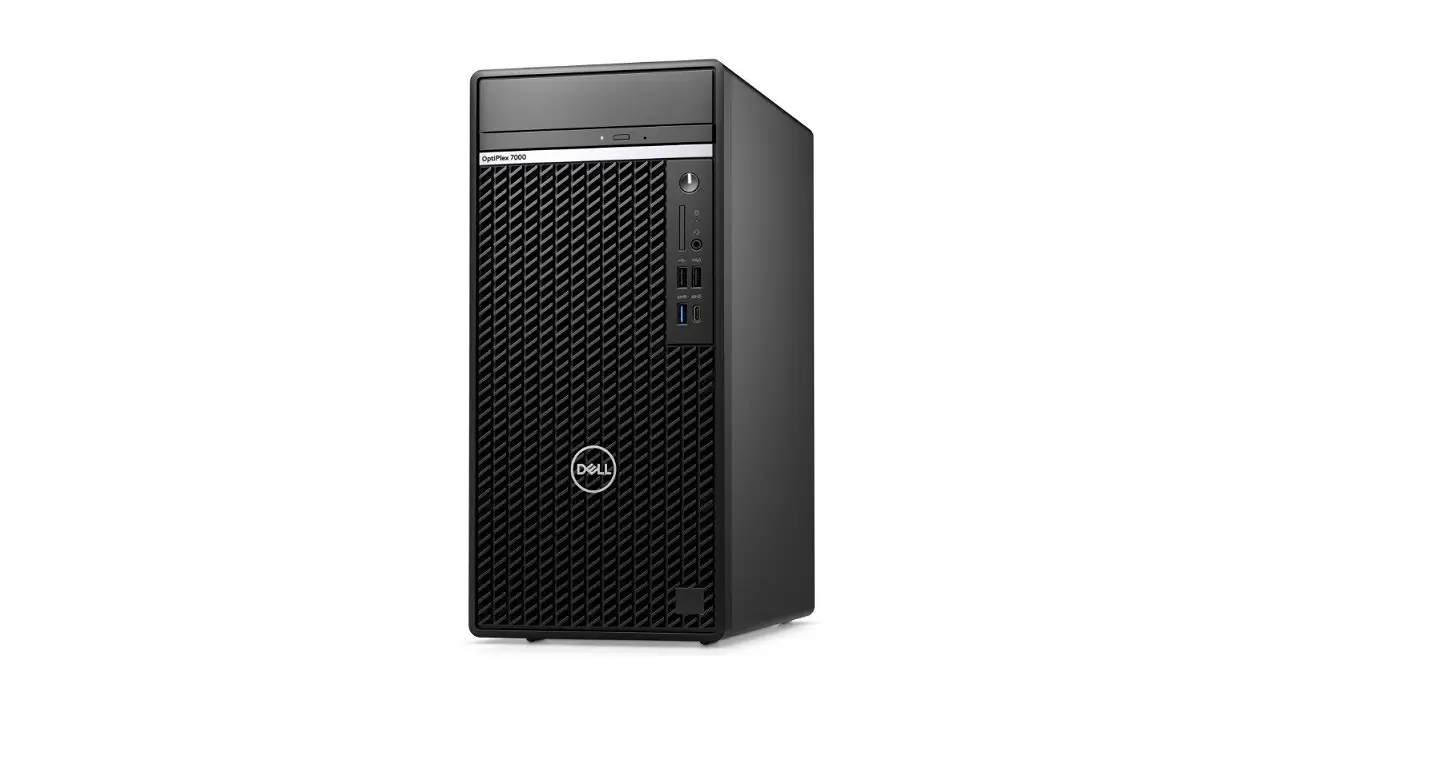

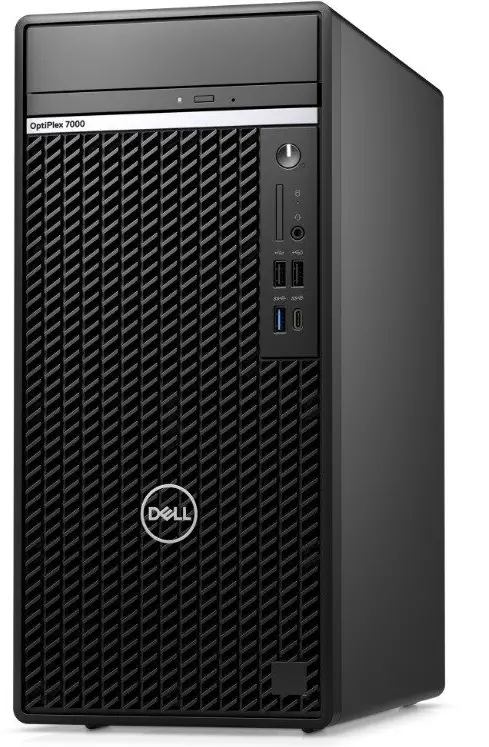
DELL OptiPlex 7000 Tower Desktop
NOTE: A NOTE indicates important information that helps you make better use of your product.
CAUTION: A CAUTION indicates either potential damage to hardware or loss of data and tells you how to avoid the problem.
WARNING: A WARNING indicates a potential for property damage, personal injury, or death.
Steps
- Connect the keyboard and mouse.

- Connect to your network using a cable.

NOTE: Alternatively, you can connect to a wireless network. - Connect the display.

NOTE: If you ordered your computer with a discrete graphics card, the HDMI and the display ports on the back panel of your computer are covered. Connect the display to the port on the discrete graphics card. - Connect the power cable.

- Press the power button.

- Finish Windows setup.
Follow the on-screen instructions to complete the setup. When setting up, Dell recommends that you:
Connect to a network for Windows updates.
NOTE: If connecting to a secured wireless network, enter the password for the wireless network access when prompted.
If connected to the internet, sign-in with or create a Microsoft account. If not connected to the internet, create an offline account.
On the Support and Protection screen, enter your contact details. - Locate and use Dell apps from the Windows Start menu—Recommended
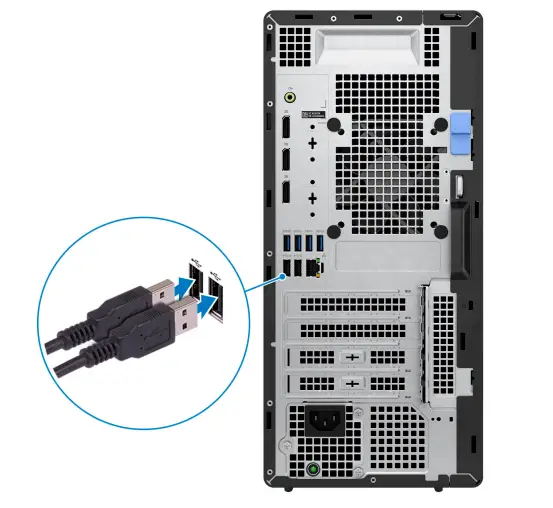
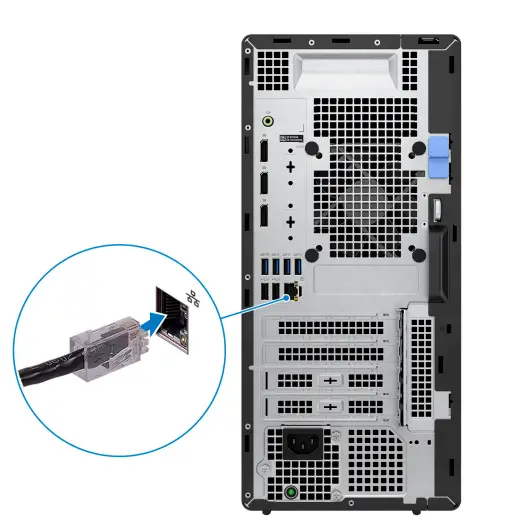
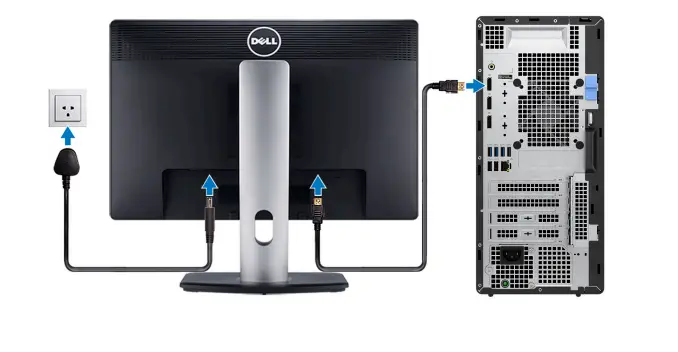
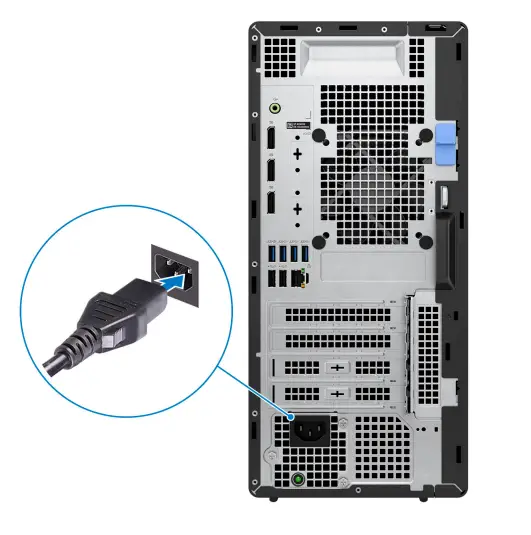
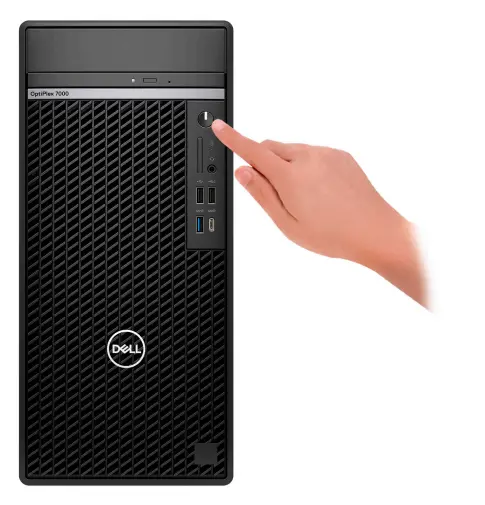
Table 1. Locate Dell apps
| Resources | Description |
 | My Dell Centralized location for key Dell applications, help articles, and other important information about your computer. It also notifies you about the warranty status, recommended accessories, and software updates if available. |
 | SupportAssist SupportAssist proactively and predictively identifies hardware and software issues on your computer and automates the engagement process with Dell Technical support. It addresses performance and stabilization issues, prevents security threats, monitors, and detects hardware |
| Resources | Description |
| failures. For more information, see SupportAssist for Home PCs User’s Guide at www.dell.com/ serviceabilitytools. Click SupportAssist and then, click SupportAssist for Home PCs. NOTE: In SupportAssist, click the warranty expiry date to renew or upgrade your warranty. | |
 | Dell Update Updates your computer with critical fixes and latest device drivers as they become available. For more information on using Dell Update, search in the Knowledge Base Resource at www.dell.com/ support. |
 | Dell Digital Delivery Download software applications, which are purchased but not preinstalled on your computer. For more information on using Dell Digital Delivery, search in the Knowledge Base Resource at www.dell.com/support. |
Display
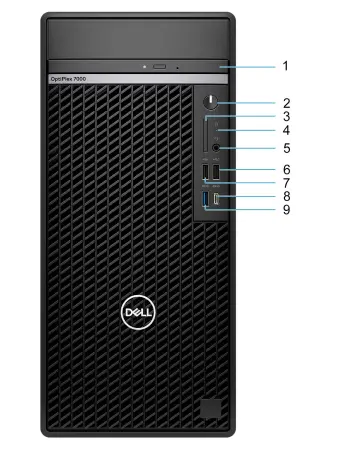
- Optical disk drive (optional)
- Power button with diagnostic LED
- SD-card slot (optional)
- The hard-disk drive activity light
- Universal audio jack
- USB 2.0 port with PowerShare
- USB 2.0 port
- USB 3.2 Gen 2×2 Type-C port
- USB 3.2 Gen 2 port
Back
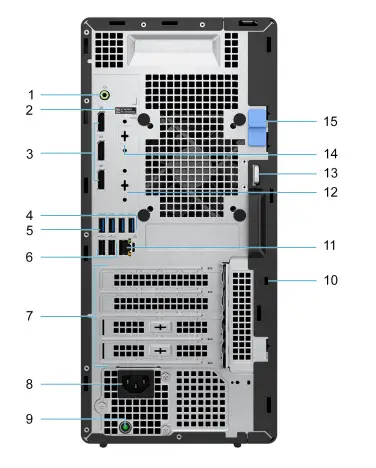
- Line-out audio port with re-tasking to Line-in
- Service tag label
- Three DisplayPort 1.4a ports
- Three USB 3.2 Gen 1 ports
- One USB 3.2 Gen 2 port
- Two USB 2.0 ports with Smart Power On
- Four expansion card slots
- Power cord connector port
- Power supply diagnostic light
- Kensington security-cable slot
- RJ45 Ethernet port
- One video port (HDMI 2.0b/DisplayPort 1.4a/VGA/USB Type-C with DisplayPort Alt mode) (optional)
- Padlock ring
- Serial port (optional)
- Release latch
Dimensions and weight
The following table lists the height, width, depth, and weight of your OptiPlex 7000 Tower.
Table 2. Dimensions and weight
| Description | Values |
| Height | 367.00 mm (14.45 in.) |
| Width | 169.00 mm (6.65 in.) |
| Depth | 300.80 mm (11.84 in.) |
| Weight NOTE: The weight of your computer depends on the configuration ordered and manufacturing variability. | ● Minimum – 5.92 kg (13.06 lb) ● Maximum – 9.68 kg (21.35 lb) |
Processors
The following table lists the details of the processors supported by your OptiPlex 7000 Tower.
NOTE: Global Standard Products (GSP) is a subset of Dell’s relationship products that are managed for availability and synchronized transitions on a worldwide basis. They ensure the same platform is available for purchase globally. This allows customers to reduce the number of configurations managed on a worldwide basis, thereby reducing their costs. They also enable companies to implement global IT standards by locking in specific product configurations worldwide.
- Device Guard (DG) and Credential Guard (CG) are the new security features that are only available on Windows today.
- Device Guard is a combination of enterprise-related hardware and software security features that, when configured together, will lock a device down so that it can only run trusted applications. If it is not a trusted application, it cannot run.
- Credential Guard uses virtualization-based security to isolate secrets (credentials) so that only privileged system software can access them. Unauthorized access to these secrets can lead to credential theft attacks. Credential Guard prevents these attacks by protecting NTLM password hashes and Kerberos Ticket Granting Tickets.
NOTE: Processor numbers are not a measure of performance. Processor availability is subject to change and may vary by region/country.
Table 3. Processors
| Processors | Wattage | Core count | Thre ad cou nt | Speed | Cache | Integrated graphics | GSP | DG/CG Ready |
| 12th Generation Intel Core i3-12100 | 60 W | 4 | 8 | 3.30 GHz to 4.30 GHz | 12 MB | Intel UHD Graphics 730 | No | Yes |
| 12th Generation Intel Core i3-12300 | 60 W | 4 | 8 | 3.50 GHz to 4.40 GHz | 12 MB | Intel UHD Graphics 730 | No | Yes |
| Processors | Wattage | Core count | Thre ad cou nt | Speed | Cache | Integrated graphics | GSP | DG/CG Ready |
| 12th Generation Intel Core i3-12100 | 60 W | 4 | 8 | 3.30 GHz to 4.30 GHz | 12 MB | Intel UHD Graphics 730 | No | Yes |
| 12th Generation Intel Core i3-12300 | 60 W | 4 | 8 | 3.50 GHz to 4.40 GHz | 12 MB | Intel UHD Graphics 730 | No | Yes |
| Processors | Wattage | Core count | Thre ad cou nt | Speed | Cache | Integrated graphics | GSP | DG/CG Ready |
| 12th Generation Intel Core i5-12400 | 65 W | 6 | 12 | 2.50 GHz to 4.40 GHz | 18 MB | Intel UHD Graphics 730 | No | Yes |
| 12th Generation Intel Core i5-12500, vPro | 65 W | 6 | 12 | 3.00 GHz to 4.60 GHz | 18 MB | Intel UHD Graphics 770 | Yes | Yes |
| 12th Generation Intel Core i5-12600, vPro | 65 W | 6 | 12 | 3.30 GHz to 4.80 GHz | 18 MB | Intel UHD Graphics 770 | Yes | Yes |
| 12th Generation Intel Core i7-12700, vPro | 65 W | 12 | 20 | 2.10 GHz to 4.90 GHz | 25 MB | Intel UHD Graphics 770 | Yes | Yes |
| 12th Generation Intel Core i9-12900, vPro | 65 W | 16 | 24 | 2.40 GHz to 5.10 GHz | 30 MB | Intel UHD Graphics 770 | Yes | Yes |
| 12th Generation Intel Core i5-12600K, vPro | 125 W | 10 | 16 | 3.70 GHz to 4.90 GHz | 20 MB | Intel UHD Graphics 770 | Yes | Yes |
| 12th Generation Intel Core i7-12700K, vPro | 125 W | 12 | 20 | 3.60 GHz to 5.00 GHz | 25 MB | Intel UHD Graphics 770 | Yes | Yes |
| 12th Generation Intel Core i9-12900K, vPro | 125 W | 16 | 24 | 3.20 GHz to 5.20 GHz | 30 MB | Intel UHD Graphics 770 | Yes | Yes |
Chipset
The following table lists the details of the chipset supported by your OptiPlex 7000 Tower.
Table 4. Chipset
| Description | Values |
| Chipset | Intel Q670 |
| Description | Values |
| Processor | 12th Generation Intel Core i3/i5/i7/i9 |
| DRAM bus width | 64-bit |
| Flash EPROM | 32 MB + 16 MB |
| PCIe bus | Up to Gen4 |
Operating system
Your OptiPlex 7000 Tower supports the following operating systems:
- Windows 11 Home, 64-bit
- Windows 11 Pro, 64-bit
- Windows 11 Downgrade (Windows 10 image)
- Windows 11 Pro National Education, 64-bit
- Windows 11 CMIT Government Edition, 64-bit (China only)
- Kylin Linux Desktop version 10.1 (China only)
- Ubuntu Linux 20.04 LTS, 64-bit
Memory
The following table lists the memory specifications of your OptiPlex 7000 Tower.
Table 5. Memory specifications
| Description | Values |
| Memory slots | Four-DIMM slots |
| Memory type | DDR5 |
| Memory speed | ● 3600 MHz ● 4000 MHz ● 4400 MHz |
| Maximum memory configuration | 128 GB |
| Minimum memory configuration | 8 GB |
| Memory size per slot | 8 GB, 16 GB, and 32 GB |
| Memory configurations supported | ● 8 GB, 1 x 8 GB, DDR5, 4400 MHz, single-channel ● 16 GB, 1 x 16 GB, DDR5, 4400 MHz, single-channel ● 16 GB, 2 x 8 GB, DDR5, 4000 MHz, dual-channel ● 32 GB, 1 x 32 GB, DDR5, 4400 MHz, single-channel ● 32 GB, 2 x 16 GB, DDR5, 4000 MHz, dual-channel ● 32 GB, 4 x 8 GB, DDR5, 4000 MHz, dual-channel ● 64 GB, 2 x 32 GB, DDR5, 3600 MHz, dual-channel ● 64 GB, 4 x 16 GB, DDR5, 4000 MHz, dual-channel ● 128 GB, 4 x 32 GB, DDR5, 3600 MHz, dual-channel |
Memory matrix
The following table lists the memory configurations supported on your OptiPlex 7000 Tower.
Table 6. Memory matrix
| Configurati on | Slot | |||
| DIMM1 | DIMM2 | DIMM3 | DIMM4 | |
| 8 GB DDR5 | 8 GB | NA | NA | NA |
| 16 GB DDR5 | 16 GB | NA | NA | NA |
| 16 GB DDR5 | 8 GB | NA | 8 GB | NA |
| 32 GB DDR5 | 32 GB | NA | NA | NA |
| 32 GB DDR5 | 16 GB | NA | 16 GB | NA |
| 32 GB DDR5 | 8 GB | 8 GB | 8 GB | 8 GB |
| 64 GB DDR5 | 32 GB | NA | 32 GB | NA |
| 64 GB DDR5 | 16 GB | 16 GB | 16 GB | 16 GB |
| 128 GB DDR5 | 32 GB | 32 GB | 32 GB | 32 GB |
External ports
The following table lists the external ports of your OptiPlex 7000 Tower.
Table 7. External ports
| Description | Values |
| Network port | ● One RJ45 Ethernet port, 1 GHz ● One RJ45 Ethernet port, 2.5 GHz (optional) |
| USB ports | Front: ● One USB 2.0 (480 Mbps) port ● One USB 2.0 (480 Mbps) port with PowerShare ● One USB 3.2 Gen 2 (10 Gbps) port ● One USB 3.2 Gen 2×2 (20 Gbps) Type-C port Rear: ● Two USB 2.0 ports (480 Mbps) with Smart Power On ● One USB 3.2 Gen 2 (10 Gbps) port ● Three USB 3.2 Gen 1 (5 Gbps) ports |
| Audio port | Universal audio jack |
| Video port | ● Three DisplayPort 1.4a ports ● One optional video port (HDMI 2.0b/DisplayPort 1.4a/VGA/USB 3.2 Gen 2 Type-C with DisplayPort Alt mode) NOTE: Download and install the latest Intel Graphics driver from www.dell.com/support to enable multiple displays. |
| I/O port | One Serial port (optional) |
| Media-card reader | One SD-card slot (optional) |
| Description | Values |
| Power-adapter port | NA |
| Security-cable slot | ● One Kensington security-cable slot ● Padlock ring |
Internal slots
The following table lists the internal slots of your OptiPlex 7000 Tower.
Table 8. Internal slots
| Description | Values |
| M.2 | ● One M.2 2230 slot for WiFi and Bluetooth card ● Three M.2 2230/2280 slots for solid-state drives NOTE: To learn more about the features of different types of M.2 cards, search in the Knowledge Base Resource at www.dell.com/support. |
Ethernet
The following table lists the wired Ethernet Local Area Network (LAN) specifications of your OptiPlex 7000 Tower.
Table 9. Ethernet specifications
| Description | Values |
| Model number | Intel I225 |
| Transfer rate | 10/100/1000/2500 Mbps |
Wireless module
The following table lists the Wireless Local Area Network (WLAN) module specifications of your OptiPlex 7000 Tower.
Table 10. Wireless module specifications
| Description | Option one | Option two | Option three |
| Model number | Intel AX211 | Intel 9462 | MediaTek MT7921 |
| Transfer rate | 2400 Mbps | 433 Mbps | 1200 Mbps |
| Frequency bands supported | 2.40 GHz/5 GHz/6 GHz NOTE: The 6 GHz frequency is supported on computers installed with Windows 11 operating system only. | 2.40 GHz/5 GHz | 2.40 GHz/5 GHz |
| Wireless standards | ● WiFi 802.11a/b/g ● Wi-Fi 4 (WiFi 802.11n) | ● WiFi 802.11a/b/g ● Wi-Fi 4 (WiFi 802.11n) ● Wi-Fi 5 (WiFi 802.11ac) | ● WiFi 802.11a/b/g ● Wi-Fi 4 (WiFi 802.11n) |
| Description | Option one | Option two | Option three |
| ● Wi-Fi 5 (WiFi 802.11ac) ● Wi-Fi 6E (WiFi 802.11ax) | ● Wi-Fi 5 (WiFi 802.11ac) ● Wi-Fi 6 (WiFi 802.11ax) | ||
| Encryption | ● 64-bit/128-bit WEP ● AES-CCMP ● TKIP | ● 64-bit/128-bit WEP ● AES-CCMP ● TKIP | ● 64-bit/128-bit WEP ● AES-CCMP ● TKIP |
| Bluetooth | Bluetooth 5.2 | Bluetooth 5.1 | Bluetooth 5.2 |
Audio
The following table lists the audio specifications of your OptiPlex 7000 Tower.
Table 11. Audio specifications
| Description | Values | |
| Audio controller | Realtek ALC3246-CG | |
| Stereo conversion | 24-bit DAC (Digital-to-Analog) and ADC (Analog-to-Digital) | |
| Internal audio interface | Intel HDA (high-definition audio) | |
| External audio interface | ● Universal audio jack ● One Line-out audio port with re-tasking to Line-in (rear) | |
| Number of speakers | One | |
| Internal-speaker amplifier | Integrated in ALC3246-CG (Class-D 2 W) | |
| External volume controls | Keyboard shortcut controls | |
| Speaker output: | ||
| Average speaker output | 2 W | |
| Peak speaker output | 2.5 W | |
| Subwoofer output | Not supported | |
| Microphone | Not supported | |
Storage
This section lists the storage options on your OptiPlex 7000 Tower.
Table 12. Storage Matrix
| Storage | 1st 2.5- inch hard drive | 2nd 2.5- inch hard drive | 1st 3.5- inch hard drive | 2nd 3.5- inch hard drive | Single M.2 socket | 2nd M.2 2230/22 80 socket | 3rd M.2 2230/2280 socket |
| 2.5-inch hard drive | Y | N | N | ||||
| Dual 2.5-inch hard drive | Y | Y | N |
| Storage | 1st 2.5- inch hard drive | 2nd 2.5- inch hard drive | 1st 3.5- inch hard drive | 2nd 3.5- inch hard drive | Single M.2 socket | 2nd M.2 2230/22 80 socket | 3rd M.2 2230/2280 socket | |
| 3.5-inch hard drive | N | N | Y | |||||
| Dual 3.5-inch hard drive | N | N | Y | Y | ||||
| 2.5-inch hard drive | 3.5-inch hard drive | Y | N | Y | ||||
| 3.5-inch hard drive | 2.5-inch hard drive | N | Y | Y | ||||
| 3.5-inch hard drive | Dual 2.5-inch hard drive | Y | Y | Y | ||||
| Dual 2.5-inch hard drive | 3.5-inch hard drive | Y | Y | Y | ||||
| Dual 2.5-inch hard drive | Dual 3.5-inch hard drive | Y | Y | Y | Y | |||
| Dual 3.5-inch hard drive | Dual 2.5-inch hard drive | Y | Y | Y | Y | |||
| M.2 solid-state drive | N | N | N | N | Y | N | ||
| Dual M.2 solid-state drive | N | N | N | N | Y | Y | ||
| Triple M.2 solid-state drive | N | N | N | N | Y | Y | Y | |
| Dual M.2 solid-state drive | 2.5-inch hard drive | Y | Y | Y | ||||
| Dual M.2 solid-state drive | 3.5-inch hard drive | Y | Y | Y | ||||
| Dual M.2 solid-state drive | Dual 2.5-inch hard drive | Y | Y | N | N | Y | Y | N |
| Dual M.2 solid-state drive | Dual 3.5-inch hard drive | N | N | Y | Y | Y | Y | N |
| Triple M.2 solid-state drive | 2.5-inch hard drive | Y | N | N | N | Y | Y | Y |
| Triple M.2 solid-state drive | 3.5-inch hard drive | N | N | Y | N | Y | Y | Y |
| Triple M.2 solid-state drive | Dual 2.5-inch hard drive | Y | Y | N | N | Y | Y | Y |
| Triple M.2 solid-state drive | Dual 3.5-inch hard drive | N | N | Y | Y | Y | Y | Y |
| M.2 solid-state drive | 3.5-inch hard drive | N | N | Y | N | Y | N | |
| M.2 solid-state drive | 2.5-inch hard drive/ solid-state drive | N | Y | N | N | Y | N | |
| M.2 solid-state drive | Dual 2.5-inch hard drive | Y | Y | N | N | Y | N | |
Table 13. Storage specifications
| Storage type | Interface type | Capacity |
| 2.5-inch, 5400 RPM, hard-disk drive | SATA 3.0 | Up to 2 TB |
| 2.5-inch, 7200 RPM, hard-disk drive | SATA 3.0 | Up to 1 TB |
| Storage type | Interface type | Capacity |
| 2.5-inch, 7200 RPM, FIPS Self Encrypting Opal 2.0, hard-disk drive | SATA 3.0 | 500 GB |
| 3.5-inch, 5400 RPM, hard-disk drive | SATA 3.0 | 4 TB |
| 3.5-inch, 7200 RPM, hard-disk drive | SATA 3.0 | Up to 2 TB |
| M.2 2230 solid-state drive | PCIe 3 Gen x4 NVMe, Class 35 | Up to 1 TB |
| M.2 2230 Opal Self-Encrypting solid- state drive | PCIe 3 Gen x4 NVMe, Class 35 | 256 GB |
| M.2 2280 Opal Self-Encrypting solid- state drive | PCIe 3 Gen x4 NVMe, Class 40 | Up to 1 TB |
| M.2 2280 solid-state drive | PCIe NVMe Gen4 x4, Class 40 | Up to 2 TB |
RAID (Redundant Array of Independent Disks)
For optimal performance when configuring drives as a RAID volume, Dell recommends drive models that are identical.
NOTE: RAID is not supported on Intel Optane configurations.
RAID 0 (Striped, Performance) volumes benefit from higher performance when drives are matched because the data is split across multiple drives: any IO operations with block sizes larger than the stripe size will split the IO and become constrained by the slowest of the drives. For RAID 0 IO operations where block sizes are smaller than the stripe size, whichever drives the IO operation targets will determine the performance, which increases variability and results in inconsistent latencies. This variability is particularly pronounced for write operations and it can be problematic for applications that are latency sensitive. One such example of this is any application that performs thousands of random writes per second in very small block sizes.
RAID 1 (Mirrored, Data Protection) volumes benefit from higher performance when drives are matched because the data is mirrored across multiple drives: all IO operations must be performed identically to both drives, thus variations in drive performance when the models are different, results in the IO operations completing only as fast as the slowest drive. While this does not suffer the variable latency issue in small random IO operations as with RAID 0 across heterogeneous drives, the impact is nonetheless large because the higher performing drive becomes limited in all IO types. One of the worst examples of constrained performance here is when using unbuffered IO. To ensure writes are fully committed to non-volatile regions of the RAID volume, unbuffered IO bypasses the cache (for example by using the Force Unit Access bit in the NVMe protocol) and the IO operation will not complete until all the drives in the RAID volume have completed the request to commit the data. This kind of IO operation completely negates any advantage of a higher-performing drive in the volume. Care must be taken to match not only the drive vendor, capacity, and class, but also the specific model. Drives from the same vendor, with the same capacity, and even within the same class, can have very different performance characteristics for certain types of IO operations. Thus, matching by model ensures that the RAID volumes is comprised of a homogeneous array of drives that will deliver all the benefits of a RAID volume without incurring the additional penalties when one or more drives in the volume are lower performings. OptiPlex 7000 Tower supports RAID with more than one hard drive configuration.
Media-card reader
The following table lists the media cards supported by your OptiPlex 7000 Tower.
Table 14. Media-card reader specifications
| Description | Values |
| Media-card type | SD card |
| Description | Values |
| Media-cards supported | ● Secure Digital (SD) ● Secure Digital High Capacity (SDHC) ● Secure Digital Extended Capacity (SDXC) |
| NOTE: The maximum capacity supported by the media-card reader varies depending on the standard of the media card installed in your computer. | |
Power ratings
The following table lists the power rating specifications of OptiPlex 7000 Tower.
Table 15. Power ratings
| Description | Option one | Option two | Option three | Option four | |
| Type | 240 W internal power supply unit (PSU), 85% Efficient, 80 Plus Bronze | 260 W internal power supply unit (PSU), 85% Efficient, 80 Plus Bronze | 400 W internal power supply unit (PSU), 92% Efficient, 80 Plus Platinum | 500 W internal power supply unit (PSU), 92% Efficient, 80 Plus Platinum | |
| Input voltage | 90 VAC–264 VAC | 90 VAC–264 VAC | 90 VAC–264 VAC | 90 VAC–264 VAC | |
| Input frequency | 47 Hz-63 Hz | 47 Hz-63 Hz | 47 Hz-63 Hz | 47 Hz-63 Hz | |
| Input current (maximum) | 4.0 A | 4.2 A | 5.4 A | 7 A | |
| Output current (continuous) | ● 12 VA/18 A ● 12 VB/15 A Standby mode: ● 12 VA/1.5 A ● 12 VB/3.3 A | ● 12 VA/18 A ● 12 VB/16 A Standby mode: ● 12 VA/1.5 A ● 12 VB/3.3 A | ● 12 VA/18 A ● 12 VB/18 A ● 12 VC/12 A Standby mode: ● 12 VA/1.5 A ● 12 VB/3.3 A ● 12 VC/0 A | ● 12 VA/18 A ● 12 VB/18 A ● 12 VC/18 A Standby mode: ● 12 VA/1.5 A ● 12 VB/3.3 A ● 12 VC/0 A | |
| Rated output voltage | ● +12 VA ● +12 VB | ● +12 VA ● +12 VB | ● +12 VA ● +12 VB ● +12 VC | ● +12 VA ● +12 VB ● +12 VC | |
| Temperature range: | |||||
| Operating | 10°C-35°C (50°F-95°F) | 10°C-35°C (50°F-95°F) | 10°C-35°C (50°F-95°F) | 10°C-35°C (50°F-95°F) | |
| Storage | -40°C-70°C (-40°F-158°F) | -40°C-70°C (-40°F-158°F) | -40°C-70°C (-40°F-158°F) | -40°C-70°C (-40°F-158°F) | |
Power supply connector
The following table lists the Power supply connector specifications of your OptiPlex 7000 Tower.
Table 16. Power supply connector
| 240 W (80 PLUS Bronze) | ● Two 4 pin connectors for processor ● One 8 pin connector for system board |
| 260 W (80 PLUS Bronze) | ● Two 4 pin connectors for processor ● One 8 pin connector for system board |
| 400 W (80 PLUS Platinum) | ● Two 4 pin connectors for processor ● One 8 pin connector for system board ● One 2 + 6 pin connector for graphic card |
| 500 W (80 PLUS Platinum) | ● Two 4 pin connectors for processor ● One 8 pin connector for system board ● One 6 pin and one 2 + 6 pin connectors for graphic card |
GPU—Integrated
The following table lists the specifications of the integrated Graphics Processing Unit (GPU) supported by your OptiPlex 7000 Tower.
Table 17. GPU—Integrated
| Controller | External display support | Memory size | Processor |
| Intel UHD Graphics 730 | Three DisplayPort 1.4 ports | Shared system memory | 12th Generation Intel Core i3/i5 |
| Intel UHD Graphics 770 | Three DisplayPort 1.4 ports | Shared system memory | 12th Generation Intel Core i5/i7/i9 |
Multiple display support matrix
The following table lists the multiple display support matrix for your OptiPlex 7000 Tower.
Table 18. Multiple display support matrix
| Description | Option one | Option two |
| Integrated Graphics Card | Intel UHD Graphics 730 | Intel UHD Graphics 770 |
| Optional Module | HDMI 2.0b/ DisplayPort 1.4a/ VGA/ USB Type-C with DisplayPort Alt mode | HDMI 2.0b/ DisplayPort 1.4a/ VGA/ USB Type-C with DisplayPort Alt mode |
| Supported 4K Displays | DP1.4 HBR2, 4096 x 2304 @ 60 Hz | DP1.4 HBR2, 4096 x 2304 @ 60 Hz |
| Supported 5K Displays | 5K tiled resolution (5120 x 2880) support on DP panels. NOTE: Needs two DP cables driven through two separate DDIs from the source, and using DP-SST (Single Stream Transport) mechanism. | 5K tiled resolution (5120 x 2880) support on DP panels. NOTE: Needs two DP cables driven through two separate DDIs from the source, and using DP-SST (Single Stream Transport) mechanism. |
GPU—Discrete
The following table lists the specifications of the discrete Graphics Processing Unit (GPU) supported by your OptiPlex 7000 Tower.
Table 19. GPU—Discrete
| Controller | External display support | Memory size | Memory type |
| AMD Radeon 540 | Two DisplayPort 1.4 ports | 1 GB | GDDR5
|
| Controller | External display support | Memory size | Memory type |
| AMD Radeon 550 | Two DisplayPort 1.4 ports | 2 GB | GDDR5 |
| AMD Radeon RX640 | ● One DisplayPort 1.4 ● Two mini DisplayPort (mDP) ports | 4 GB | GDDR5 |
| NVIDIA GeForce RTX 3070 | ● Three DisplayPort 1.4 ports ● One HDMI 2.1 | 8 GB | GDDR6 |
Multiple display support matrix
The following table lists the multiple display support matrix for your OptiPlex 7000 Tower.
Table 20. Multiple display support matrix
| Graphics Card | Memory | Ports | Supported external displays with Direct Connect | Supported external displays with DP Multi- Stream | Supported 4K Displays | Supported 5K Displays | Resolution | Total Power |
| AMD Radeon 540 | 1 GB GDDR5 | Two DisplayPort 1.4 ports | 2 | 2 | 1 | 1 | 5120 x 2880 @60 Hz | 50 W |
| AMD Radeon 550 | 2 GB GDDR5 | Two DisplayPort 1.4 ports | 2 | 2 | 1 | 1 | 5120 x 2880 @60 Hz | 50 W |
| AMD Radeon RX640 | 4 GB GDDR5 | ● Two Mini- DisplayP ort 1.4 ports | 3 | 1 | 2 | 1 | 5120 x 2880 @60 Hz | 50 W |
| ● One DisplayP ort 1.4 port | ||||||||
| NVIDIA RTX 3070 | 8 GB GDDR6 | ● Three DisplayP ort 1.4 ports ● One HDMI 2.1 port | 4 | 3 | 3 | 1 | ● DisplayP ort – 5120 x 2880 @60 Hz ● HDMI- 4096 x 2160 @ 120 Hz | 220 W |
Hardware security
The following table lists the hardware security of your OptiPlex 7000 Tower.
Table 21. Hardware security
| Hardware security |
| Kensington security-cable slot |
| Padlock ring |
| Chassis lock slot support |
| Chassis intrusion switch |
| Lockable cable covers |
| Supply chain tamper alerts |
| SafeID including Trusted Platform Module (TPM) 2.0 |
| Smart card keyboard (FIPS) |
| Microsoft Windows Device Guard and Credential Guard (Enterprise SKU) |
| Microsoft Windows Bitlocker |
| Local hard drive data wipe through BIOS (Secure Erase) |
| Self-encrypting storage drives (Opal, FIPS) |
| Trusted Platform Module TPM 2.0 |
| China TPM |
| Intel Secure Boot |
| Intel Authenticate |
| SafeBIOS: includes Dell Off-host BIOS Verification, BIOS Resilience, BIOS Recovery, and additional BIOS Controls |
Environmental
The following table lists the environmental specifications of your OptiPlex 7000 Tower.
Table 22. Environmental
| Feature | Values |
| Recyclable packaging | Yes |
| BFR/PVC—free chassis | No |
| Vertical orientation packaging support | Yes |
| Multi-Pack packaging | Yes (optional) |
| Energy-Efficient Power Supply | Standard |
| ENV0424 compliant | Yes |
NOTE: Wood‐based fiber packaging contains a minimum of 35% recycled content by total weight of wood‐based fiber. Packaging that contains without wood‐based fiber can be claimed as Not Applicable. The anticipated required criteria for EPEAT 2018.
Regulatory compliance
The following table lists the regulatory compliance of your OptiPlex 7000 Tower.
Table 23. Regulatory compliance
| Regulatory compliance |
| EPEAT registered configurations available |
| ENERGY STAR compliant configurations available |
| GS mark compliance |
| TCO 8.0 certified configurations available |
| US CEC MEPS compliant configurations available |
| Australia and New Zealand MEPS compliant configurations available |
| CEL |
| WEEE |
| Japan Energy Law |
| South Korea E-standby |
| EU RoHS |
| China RoHS |
Operating and storage environment
This table lists the operating and storage specifications of your OptiPlex 7000 Tower. Airborne contaminant level: G1 as defined by ISA-S71.04-1985
Table 24. Computer environment
| Description | Operating | Storage |
| Temperature range | 10°C-35°C (50°F-95°F) | -40°C-70°C (-40°F-158°F) |
| Relative humidity (maximum) | 20% to 80% (non-condensing) (non- condensing, Max dew point temperature = 26°C) | 0% to 95% (non-condensing) 5% to 95% (non-condensing, Max dew point temperature = 33°C) |
| Vibration (maximum)* | 0.26 GRMS random at 5 Hz-350 Hz | 1.37 GRMS random at 5 Hz-350 Hz |
| Shock (maximum) | Bottom/Right half-sine pulse 40G, 2 ms | 105G, 2 ms half-sine pulse |
| Altitude range | -15.2 m to 3048 m (-49.8 ft to 10,000 ft) | -15.2 m to 10,668 m (-49.8 ft to 35,000 ft) |
| CAUTION: Operating and storage temperature ranges may differ among components, so operating or storing the device outside these ranges may impact the performance of specific components. | ||
Measured using a random vibration spectrum that simulates user environment. Measured using a 2 ms half-sine pulse.
Self-help resources
You can get information and help on Dell products and services using these self-help resources:
Table 25. Self-help resources
| Self-help resources | Resource location |
| Information about Dell products and services | www.dell.com |
| My Dell app | |
| Tips |  |
| Contact Support | In Windows search, type Contact Support, and press Enter. |
| Online help for operating system | www.dell.com/support/windows |
| Access top solutions, diagnostics, drivers and downloads, and learn more about your computer through videos, manuals, and documents. | Your Dell computer is uniquely identified by a Service Tag or Express Service Code. To view relevant support resources for your Dell computer, enter the Service Tag or Express Service Code at www.dell.com/support. For more information on how to find the Service Tag for your computer, see Locate the Service Tag on your computer. |
| Dell knowledge base articles for a variety of computer concerns | 1. Go to www.dell.com/support. 2. On the menu bar at the top of the Support page, select Support > Knowledge Base. 3. In the Search field on the Knowledge Base page, type the keyword, topic, or model number, and then click or tap the search icon to view the related articles. |
Contacting Dell
To contact Dell for sales, technical support, or customer service issues, see www.dell.com/contactdell.
NOTE: Availability varies by country/region and product, and some services may not be available in your country/region.
NOTE: If you do not have an active Internet connection, you can find contact information about your purchase invoice, packing slip, bill, or Dell product catalog.