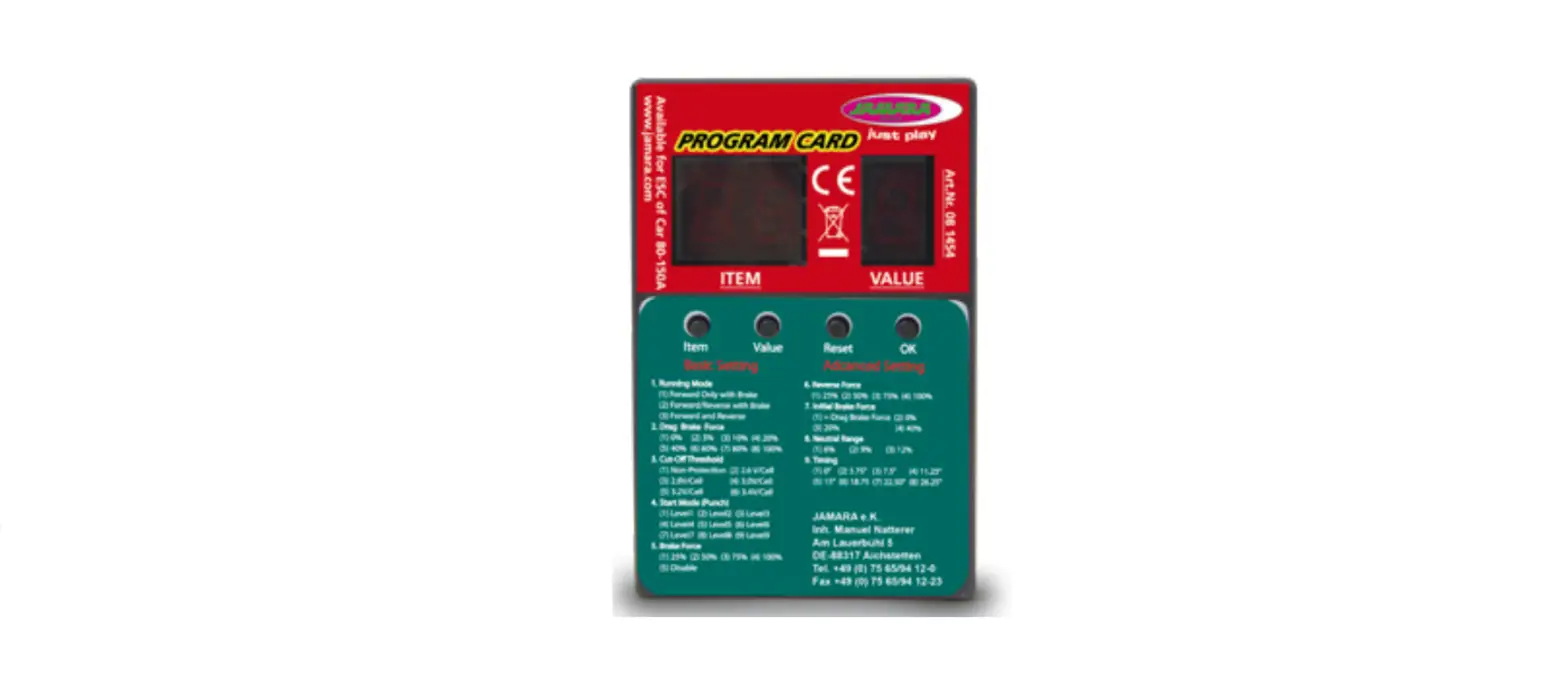
081459 Programming Card
Product Information
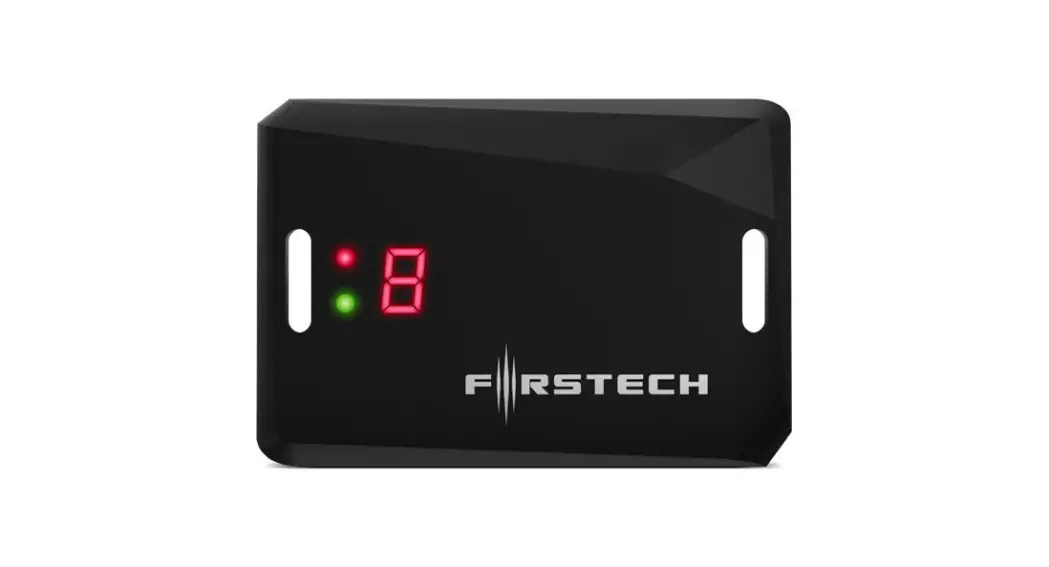
The Programming card, No. 081459, is a product manufactured by
JAMARA e.K. It is a programmable card used for configuring and
customizing the settings of an ESC (Electronic Speed Controller) in
a model vehicle. The card allows users to adjust various parameters
such as cutoff voltage, motor timing, throttle limits, braking
percentage, motor rotation, and neutral range.
JAMARA e.K. is not liable for any damage caused to the product
or any other damages resulting from improper operation or handling
errors. The customer is solely responsible for the proper use and
handling of the product, including assembly, charging process, use,
and choice of operation area. It is important to read and follow
the operating and user instructions provided, as they contain
important information and warnings.
The product, Programming card No. 081459, complies with
Directive 2014/30/EU and 2011/65/EU. The EU Declaration of
Conformity can be found at the following Internet address: www.jamara-shop.com/Conformity.
Product Usage Instructions
Please read the complete instructions and security instructions
carefully before using the model to ensure safe and proper
usage.
- Using the Programming Card:
- Turn on the ESC (Electronic Speed Controller) and connect the
programming card. - DE: Schalten Sie den Regler ein und
stecken - GB: Turn on the ESC. Remove the Signal
wire
- Turn on the ESC (Electronic Speed Controller) and connect the
- Programming the ESC:
- Cutoff Voltage: Automatically detect the
number of cells in your battery. Set up the type of batteries and
Low Voltage Cutoff Threshold using PC software or the program card.
The ESC will stop working if the battery voltage goes below the
preset threshold. - Motor Timing: Adjusts the power band and
efficiency of the electric motor. The default setting is
Normal. - Throttle Percent Reverse: Limits the power
available in reverse throttle. Lower percentages reduce the speed
available in reverse. - Throttle Limit: Controls the forward throttle
speed. Lower percentages reduce the speed available in forward
throttle. - Percentage Braking: Adjusts the amount of
brake applied to the vehicle. Higher percentages provide stronger
braking. - Motor Rotation: Sets the motor rotation
direction. The default setting is Normal. - Neutral Range: Adjusts the amount of Deadband
off neutral on the throttle trigger. Smaller values require less
movement off-center for throttle functions to begin.
- Cutoff Voltage: Automatically detect the
- Disposal Restrictions:
Electrical appliances, including this product, should not be
disposed of in domestic waste. Please dispose of them separately,
following local regulations. If possible, remove the batteries
before disposal. If personal data is stored on the appliance,
ensure it is removed before disposal.
All rights reserved. Copyright JAMARA e.K. 2023. Copying or
reproduction in whole or part only with expressed permission from
JAMARA e.K.
No. 081459
DE – Gebrauchsanleitung GB – Instruction
Programmierkarte Programming card
DE – Allgemeine Hinweise JAMARA e.K. übernimmt keine Haftung für Schäden, die an dem Produkt selbst oder durch dieses entstehen, sofern diese auf falsche Bedienung oder Handhabungsfehler zurückzuführen sind. Der Kunde allein trägt die volle Verantwortung für die richtige Bedienung und Handhabung; dies umfasst insbesondere die Montage, den Ladevorgang, die Verwendung bis hin zur Wahl des Einsatzbereiches. Bitte beachten Sie hierzu die Bedienungs- und Gebrauchsanleitung, diese enthält wichtige Informationen und Warnhinweise.
GB – General information JAMARA e.K. is not liable for any damage caused to the product itself or through this, provided this is due to improper operation or handling errors. The Customer alone bears the full responsibility for the proper use and handling, including without limitation, the assembly, the charging process, the use and choice of the operation area. Please refer to the operating and user instructions, it contains important information and warnings.
DE – Konformitätserklärung Hiermit erklärt JAMARA e.K., dass das Produkt, ,,Programmierkarte, No. 081459″ den Richtlinien 2014/30/EU und 2011/65/EU entspricht. Der vollständige Text der EU-Konformitätserklärung ist unter der folgenden Internetadresse verfügbar: www.jamara-shop.com/Konformitaet
GB – Certificate of Conformity Hereby JAMARA e.K. declares that the product ,,Programming card, No. 081459″ complies with Directive 2014/30/EU and 2011/65/EU. The full text of the EU Declaration of Conformity is available at the following Internet address: www.jamara-shop.com/Conformity
DE – Bitte lesen Sie die komplette Bedienungsanleitung und Sicherheitshinweise sorgfältig durch bevor Sie das Modell in Betrieb nehmen. Achtung! Warnhinweise / Sicherheitshinweise unbedingt komplett lesen. Diese dienen Ihrer Sicherheit und können Unfälle / Verletzungen vermeiden.
GB – Read the complete instructions and security
instructions carefully before using the model.
Caution! Please fully and carefully read warnings/ safety instructions. These are for our own security and can avoid accidents/injuries.
1 234 5
6
DE – Benutzen der Programmierkarte 1. Schalten Sie den Regler ein und stecken
das Signalkabel in die Programmierkarte (6) (Einsteckrichtung beachten) und warten Sie ca. 2 Sek. bis das Display der Karte aktiv ist. Der erste Programmierschritt wird links angezeigt. 2. Falls der Regler nicht mit einem Akku verbunden ist muss an der Karte zusätzlich ein Akku angeschlossen werden (5 – 6,3 V) (auf richtige Polung achten). 3. Drücken Sie die Taste “Menu” (2) und schalten Sie nach Wunsch durch die verschiedenen Programmierschritte durch erneutes Drücken der Taste. Wenn der gewünschte Schritt ausgewählt ist können Sie den Wert durch drücken der ,,Value” (3) Taste verändern. Der Wert wird auf der rechten Displayseite angezeigt. Nach jeder Änderung muss diese durch drücken der Taste “OK” (4) abgespeichert werden. Schalten Sie den Regler aus die Änderungen bleiben dauerhaft im Speicher des Reglers gespeichert. 4. Über die Taste “Reset” (5) können die Einstellungen zurück gesetzt werden.
GB – Using CR Program card 1. Turn on the ESC. Remove the Signal wire
and plug it into the topsocket on the Program card (6), wait for 2 seconds until the LED is ON. The first programmable function will be shown. 2. If ESC is not connected with the batteries, the Program card should be connected with other power supply, the range of power supply is within 5.0 – 6.3 V. 3. Press the button “Menu” (2) on the Program card and circularly select each programmable function. At that time the number of the programmable function will be displayed on the left of the LED, the current value will be displayed on the right side. Then press the button ,,Value” (3) to change the value and press the button ,,OK” (4) to confirm. At the same time the red indicating LEDs of both program card and the ESC blink. Turn off the ESC, the modified settings will be saved in the ESC’s memory. 4. Press the button ,,Reset” (5) to restore the default settings.
12/23
DE – Programmierung des Reglers
1. Unterspannungsabschaltung Automatische Erkennung der Zellenzahl Je nach Zustand des Akku´s und Einsatzzweckes sollte die Unterspannungsabschaltung des Reglers gewählt werden. Der Regler erkennt anhand der angelegten Spannung automatisch die Zellenzahl und berechnet anschließend anhand der gewählten Einstellungen den Abschaltzeitpunkt um den Akku vor Tiefenentladung zu schützen.
2. Fahrmodus · Vorwärts ohne Bremse
Das ist eine Wettbewerbseinstellung in der der Rückwärtsgang deaktiviert ist. · Vorwärts mit Pause dann Rückwärts (Standard) Eine Einstellung um beim Fahren alle Funktionen des Fahrzeugs zu haben. Achtung: In dieser Einstellung ist der Rückwärtsgang nicht direkt vom Vorwärtsausgang möglich sondern es muss erst gebremst werden und anschließend der Gasknüppel in die Neutralstellung gebracht werden. Erst dann ist der Rückwärtsgang verfügbar. Dies dient dem Schutz des Antriebes durch Überlastung. · Vorwärts / Rückwärts Wenn diese Funktion aktiviert ist kann vorwärts und rückwärts gefahren werden aber es ist keine Bremse verfügbar.
3. Motor Timing Das Timing beeinflusst direkt die abgegebene Leistung und die Effizienz des Motors. Die Standarteinstellung ist “normal” und ist eine gute mittlere Einstellung für die meisten BrushlessMotoren.
· Sehr niedrig Bietet maximale Effizienz bei weniger Höchstleistung. Höheres Timing bietet spürbar höhere Leistung aber auf Kosten der Effizienz und Kühlung des Motors. Jeder Motor reagiert unterschiedlich auf das Timing. Diese Einstellung ist gut für entspanntes Training mit Motoren mit wenigen Wicklungen und hoher KV Leistung.
· Niedrig Bietet ausreichende Leistung für schnelle Fahrten auf weichem Untergrund bei ausreichender Fahrzeit.
· Normal (Standard) Guter Mix zwischen Effizienz und Leistung für die meisten Motoren.
· Hoch Mehr Höchstleistung als Effektivität mit Reduzierung der Laufdauer. Der Motor sollte Temperaturüberwacht werden. Umso höher die KV und umso niedriger die Wicklungszahl des Motors ist wird bei dieser Einstellung die Temperatur schnell ansteigen. Eine sichere Höchsttemperatur in den motor zu betreiben liegt bei 74° – 82° Celsius. Höhere Temperaturen werden den Motor unvermeidlich schädigen!
· Sehr hoch Diese Einstellung bedeutet höchste Leistung und sollte mit höchster Vorsicht angewandt werden! Beachten Sie: Jeder Motor kann grundsätzlich überhitzen. Deshalb kontrollieren Sie regelmäßig die Temperatur des Motors und betreiben Ihn nicht über 74° – 82° Celsius. Ihr Motor wird sonst dauerhaft geschädigt und kann ebenfalls den Regler in Mitleidenschaft ziehen.
4. Beschleunigungsverhalten Hiermit wird das Beschleunigungsverhalten des Motors vom Stand aus beeinflusst. Wenn die niedrigste Einstellung verwendet wird startet das Fahrzeug sehr sanft und wird eine höhere Laufzeit erzielen. Bei Verwendung der höchsten Einstellung wird am meisten Durchdrehen der Räder bei verkürzter Laufzeit erzielt. Diese Einstellung belastet auch den Akku sehr stark da die Stromstärke sehr schnell ansteigt. Wenn das Fahrzeug beim Beschleunigen Aussetzer hat sollte hier eine niedrigere Einstellung verwendet werden.
· Niedrig Längere Laufzeit und geringste Belastung für die Akku´s. Eine gute Einstellung für Einsteiger.
· Medium Etwas höhere Belastung der Akku´s bei gutem Startverhalten auf losem Untergrund.
· Hoch Hohe Beschleunigung bei hoher Belastung der Akku´s.
· Sehr hoch Höchste Beschleunigung bei höchster Belastung der Akku´s.
5. max. Rückwärtsleistung Hier wird die max. Rückwärtsgeschwindigkeit des Modells eingestellt. 20%, 30%, 40%, 50%, 60% (Standard), 70%, 80%, 90%, 100%
6. Max. Vollgas Es wird die maximale Höchstleistung im Vorwärtsgang eingestellt. Umso niedriger die Prozentzahl umso langsamer wird das Fahrzeug fahren. 0% (keine Begrenzung), 20%, 30%, 40%, 50%, 60%, 70%, 80%, 90%
7. Bremskraft Stellt die maximale Bremskraft des Fahrzeugs ein. 10%, 20%, 30%, 40%, 50% (Standard), 60%, 70%, 80%, 100%
8. Automatische Zugbremse 0%( Standard) 4%,8%,12%,15%,20%,25%,30% Die Einstellung der Zugbremse bestimmt die Kraft mit der das Fahrzeug in Neutralstellung automatisch Abgebremst wird. Hiermit lässt sich das Bremsfeeling eines Bürstenmotors simulieren. Die Einstellung muss von Strecke zu Strecke ab gewägt werden. Es kann Sinn machen die Einstellung bei leichten Kurven zu nutzen, da der Fahrer nicht erst runter bremsen muss bei jeder Kurve. Auf sandigen rutschigen Untergrund kann es eher Sinn machen die Option zu deaktivieren.
9. Motor Rotation Normal (Standard), umgekehrt
10. Neutralzone Diese Einstellung bestimmt den toten Bereich des Gashebels (Neutralzone) bevor der Regler auf den Gashebel reagiert. Umso niedriger der eingestellte Wert ist umso kürzer wird der Weg des Gashebels sein um das Signal am Regler auszulösen. Umso größer der Wert umso länger wird der Weg.g.
· 2% · 3% · 4% (Standard) · 5% · 6% · 10%
2
GB – Programming the ESC
1. Cutoff Voltage Automatically detect the number of the cells. According to the type of your batteries , set up the type of the batteries and Low Voltage Cutoff Threshold via PC software or program card. The ESC can detect the Voltage of the battery anytime and will stop working once the Voltage of the battery is lower than the preset Low Voltage Cutoff Threshold.
2. Running Mode · Forward w/o Reverse
This is a Race setting – Reverse is disabled. You will find in racing, most tracks will not allow racing with reverse enabled. · Forward with pause then Reverse: (Default) General bashing around (FUN) or racing if reverse is allowed for the event. The Electronic Speed Controller requires 2 seconds of continuous neutral from the transmitter prior to allowing reverse to operate. Note: There is automatic protection within the ESC. Only after you have stopped and returned the trigger to neutral will reverse become available. If while traveling in reverse, pull the trigger to go forward. This is to help prevent serious damage to the drive train. · Forward / Reverse If the option is actived, the RC car could go forward and backward, but couldn`t brake.
3. Motor Timing This option affects the power band and efficiency (run time) of an electric motor. The default is “Normal” and is a good starting point to deliver power and provide good run time.
· Very Low Provides maximum efficiency with less power. Higher timing produces significantly more power but at the expense of efficiency (less run time) and typically the motor will generate more heat. Each brushless motor will respond to timing differently. Good for running around on paved, or harder surfaces, and racing with high KV rated or low-turn motors
· Low Provides power for running through soft surfaces, having fun and longer run time.
· Normal (Default) Good mix of power and efficiency using any motor
· High More power than efficiency so run time will reduce, and you should be monitoring motor heat. The higher KV or lower turn motors will generate heat quickly using this setting. A safe high temperature range is 165F to 180F (74° – 82°C), going higher may damage your motor.
· Very high This is maximum power and must be used with caution. Note: Any motor has the potential to over-heat in this setting. Frequently check the motor temperature and make sure you’re not operating higher than 165° and 180° Fahrenheit (74°- 82° C), which may damage your motor, or damage your Electronic Speed Controller (ESC).
4. Initial Acceleration Use this to limit the initial power that is sent to the motor when starting from a complete stop. Using the low option, the vehicle will launch very slowly and provide the longest run times. When using the HIGH choice, you will have wheel-spinning acceleration at the cost of run time. This is also very tough on the batteries as the amperage draw can be very high. If your vehicle cuts out, hesitates or loses radio control, you should consider setting this at a lower value.
· Low Using this option will provide longer run times and is easiest on the batteries. It is a good choice for beginners.
· Medium Medium requires more from your batteries, and is good for low traction surfaces.
· High This option will provide full acceleration and requires stout batteries to supply the load required in this setting.
· Very high This option will provide full acceleration and requires stout batteries to supply the load required in this setting.
5. Throttle Percent Reverse Use this to limit the power available using reverse throttle. The lower the percent or level the less speed will be available in reverse. 20%, 30%, 40%, 50%, 60% ( Default), 70%, 80%, 90%, 100%
6. Throttle Limit The lower the percent the less forward throttle speed will be available.0%(Default), 20%, 30%, 40%, 50%, 60%, 70%, 80%, 90%
7. Percentage Braking Gives you the ability to have full control over the amount of brake your vehicle will have. 10%, 20%, 30%, 40%, 50% (Default), 60%, 70%, 80%, 100%
8. Percentage Drag Brake 0% (Default), 4%, 8%, 12%, 15%, 20%, 25%, 30% The drag brake function provides the driver a set percentage of brake when you have the transmitter resting in neutral. This will create the “feel” of a brushed motor. Drag brake are used in racing to slow a vehicle as you let off approaching a corner versus the driver having to push the brake at every corner. Try working with this to get a sense of how you might use this for your track. If you are running on a high traction track with tight corners, a stronger setting should work best. If you are running in an open area, you will find a smaller percentage will result in better control. If you are running in dusty or slippery surfaces, you will more than likely want to use the lowest option.
9. Motor Rotation Normal (default), Reverse
10.Neutral Range This setting adjusts the amount of “Deadband” off neutral on the throttle trigger. This is in Milli-Seconds (MS) and is the amount of neutral when you pull the trigger. The smaller the value the less “Deadband” or movement is required off-center for the ESC to begin throttle functions. Using a higher value for this setting will provide a wider Deadband.
· 2% · 3% · 4% (Default) · 5% · 6% · 10%
3
Irrtum und technische Änderungen vorbehalten. Copyright JAMARA e.K. 2023 Kopie und Nachdruck, auch auszugsweise, nur mit Genehmigung von JAMARA e.K.
All rights reserved. Copyright JAMARA e.K. 2023 Copying or reproduction in whole or part, only with the expressed permission of JAMARA e.K.
DE – Entsorgungshinweise Elektrogeräte dürfen nicht im Hausmüll entsorgt werden, sondern müssen getrennt entsorgt werden. Sie sind verpflichtet, die Batterien wenn möglich herauszunehmen und das Elektroaltgerät bei den kommunalen Sammelstellen abzugeben. Sollten sich personenbezogene Daten auf dem Elektroaltgerät befinden, müssen diese von Ihnen selbst entfernt werden.
GB – Disposal restrictions Electrical appliances must not be disposed of in domestic waste and must be disposed of separately. You are obliged to take out the batteries, if possible, and to dispose of the electrical equipment at the communal collection points. Should personal data be stored on the electrical appliance you must remove them by yourself.
DE – Servicehändler | GB – Service centre
DE – Servicehändler | GB – Service centre | FR – Revendeur de service IT – Centro assistenza | ES – Servicio asistencia | CZ – Servisní centrum
PL – Partner serwisowy | NL – Servicepartner | SK – Servisný partner
DE – Reitter Modellbau Versand, Patricia Reitter, Degerfeldstrasse 11, 72461 Albstadt Tel. 07432 9802700, Fax 07432 2009594, [email protected], www.modellbauversand.de
DE – Mooser T-Trade, Thomas Mooser, Bürgermeister-Koch-Str. 32a, DE-82178 Puchheim, Tel +49 (0) 89 17929867, Fax +49 (0) 89 17929869, [email protected], www.mooser-t-trade.de
EU – JAMARA e.K., Manuel Natterer, Am Lauerbühl 5, DE-88317 Aichstetten, Tel +49 (0) 7565 9412-0, Fax +49 (0) 7565 9412-23, [email protected], www.jamara.com
CH – Modellbau Zentral, Peter Hofer, Bresteneggstrasse 2, CH-6460 Altdorf, Tel +41 79 429 62 25, Mobil +41 41 870 02 13, [email protected], www.modellbau-zentral.ch
CZ – PenTec s.r.o., Distributor Jamara for Czech Republic and Slovakia, Veleslavínská 30/19, CZ-162 00 Praha 6, Tel +420 235 364 664, Mobil +420 739 075 380, [email protected], www.topdrony.cz
SI – Janus Trade D.O.O., Distributor Jamara for Slovenia, Koroska cesta 53c, SI-4000 Kranj, [email protected], www.janustrade.si
HR – Viva-net d.o.o., Distributor Jamara for Croatia, Ante Topic – Mimare 8, HR-10000 Zagreb-Susedgrad, [email protected], www.viva-net.hr
HU – Nettrade Kft., Distributor Jamara for Hungary, 1033 Budapest, Hévízi út 3/b, Tel +36 30 664 3835, [email protected]
JAMARA e.K.
Inh. Manuel Natterer
Am Lauerbühl 5 – DE-88317 Aichstetten Tel. +49 (0) 75 65/94 12-0 – Fax +49 (0) 75 65/94 12-23
[email protected] www.jamara.com
Service – Tel. +49 (0) 75 65/94 12-777 service@ jamara.com
References
 jamara.com
 Naslovnica
 t-trade.de is available for purchase - Sedo.com
-
JAMARA - DoC (Declarations of Conformity)
-
JAMARA - DoC (Declarations of Conformity)
-
jamara.com
-
Janus Trade
-
Modellbau Zentral - Peter Hofer - Altdorf UR
-
Reitter Modellbau & Robotics - Zubehör, Ersatzteile, Bausätze
-
Mooser T-Trade Ihr Fachhändler für Plastik und RC Modellbau - Osmose -
-
e-dite.cz
-
Veleprodaja informatičke, foto, dječje i ugostiteljske opreme te konzumne elektronike
-
Öffentliches Personal Schweiz - Wir vertreten die Interessen des öffentlichen Personals.
 jamara.com
 Naslovnica
 t-trade.de is available for purchase - Sedo.com
 JAMARA - DoC (Declarations of Conformity)
 jamara.com
 Janus Trade
 Modellbau Zentral - Peter Hofer - Altdorf UR
 Reitter Modellbau & Robotics - Zubehör, Ersatzteile, Bausätze
 Mooser T-Trade Ihr Fachhändler für Plastik und RC Modellbau - Osmose -
 e-dite.cz
 Veleprodaja informatičke, foto, dječje i ugostiteljske opreme te konzumne elektronike
 Öffentliches Personal Schweiz - Wir vertreten die Interessen des öffentlichen Personals.