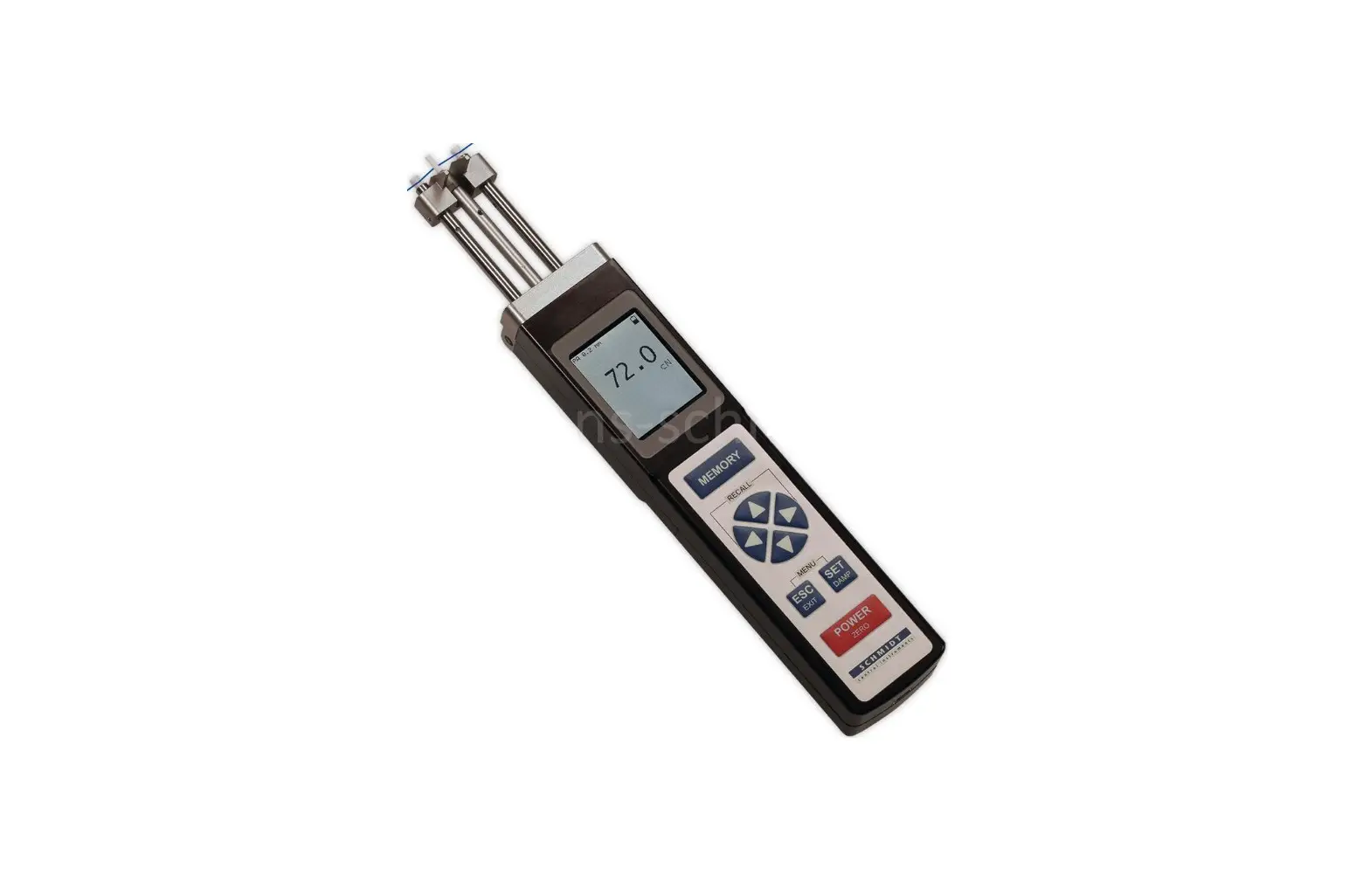
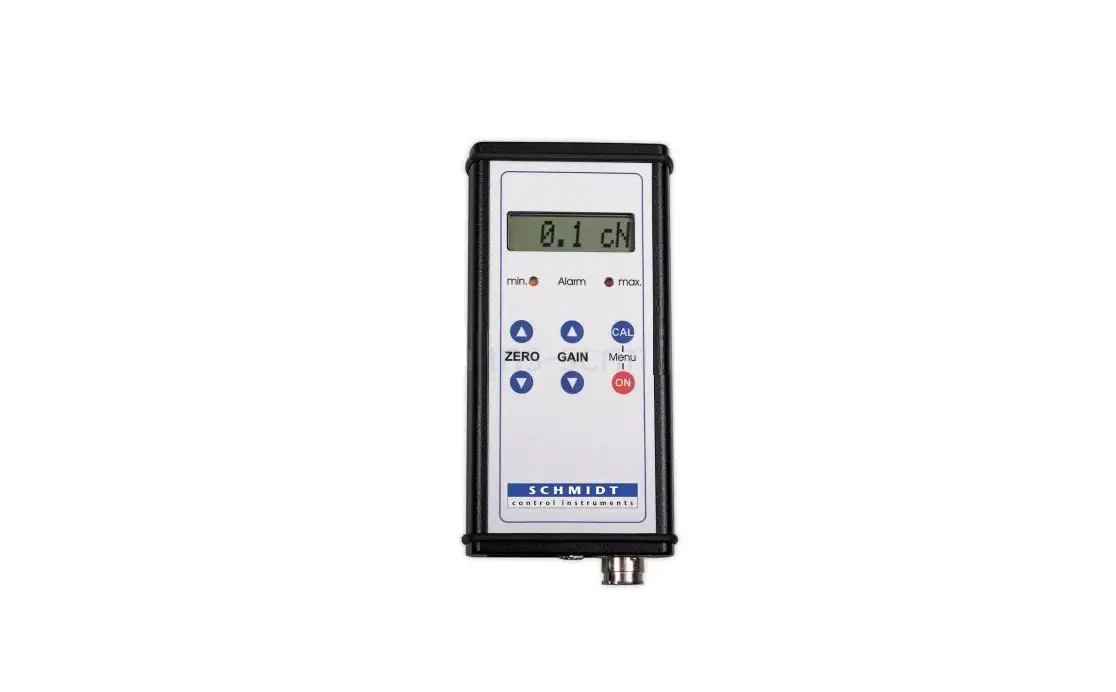
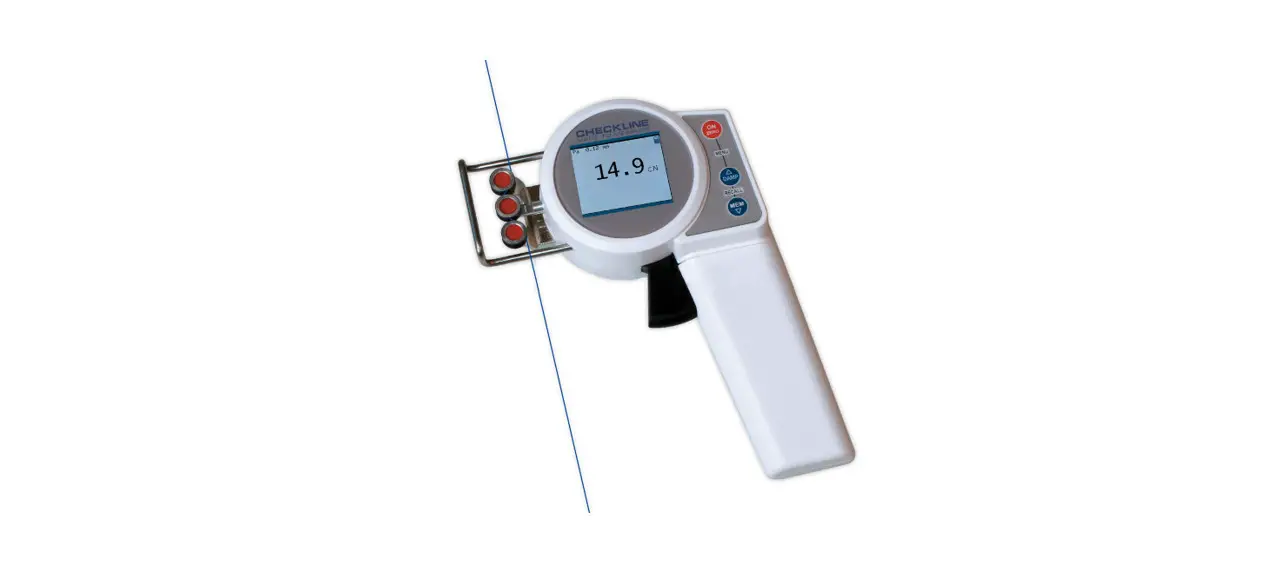
TS Series Tension Meter
Tension Meter TS Series
The Tension Meter TS Series is a product line of control
instruments designed and manufactured by HANS SCHMIDT & Co
GmbH. The product line includes the following models: TS1, TSP,
TSH, TSL, TSF, TSF1, TSW, TSB1, and TSB2. The product is intended
exclusively to be used as a tension meter and complies with all
safety regulations and standards.
Warranty and Liability
The product comes with a warranty and liability agreement.
Please refer to the instruction manual for detailed
information.
Service and Maintenance
The product requires regular service and maintenance to ensure
its proper functioning. Please refer to the instruction manual for
detailed instructions on rollers, cleaning, verification interval,
correspondence, and repairs.
Responsibilities of the Personnel
All personnel who work with the device must observe basic
regulations on industrial safety and accident prevention. They must
also read the chapter on safety and warning notices in these
operating instructions and confirm that they have understood them
by signing.
Informal Safety Measures
The operating instructions must always be kept on hand where the
device is operated. Apart from the operating instructions, the
general and local valid regulations on accident prevention and
environmental protection must be provided and complied with.
Training of the Personnel
Only trained and instructed personnel are permitted to work with
the device. The responsibilities of the personnel must be clearly
defined for mounting, commissioning, operation, setup, maintenance,
and repair. Trainees may only work with the device under the
supervision of experienced personnel.
Intended Use
The device is intended exclusively to be used as a tension
meter. Any other use or any use exceeding this intention will be
regarded as misuse. Under no circumstances shall HANS SCHMIDT &
Co GmbH be held liable for damage resulting from misuse. The
intended use also includes complying with all notices included in
the operating instructions and observing all inspection and
maintenance works.
Dangers in Handling the Device
The device was designed according to the state of the art and
the approved safety standards. Nevertheless, its use may cause
serious or fatal injury to the user or third persons, and/or an
impairment of the device or of other material assets. The device
may only be applied for its intended use in a faultless condition
with regard to the safety requirements. Malfunctions that could
impair safety must be remedied immediately. Personal protective
equipment must be used according to the EC Directive 89/686/EEC.
The device must not be operated in potential explosive areas and
must not come into contact with aggressive substances.
Copyright
The copyright on these operating instructions remains with the
company HANS SCHMIDT & Co GmbH. These operating instructions
are intended for the operating company and its personnel only. They
contain instructions and notices that may only be reproduced on the
prior written permission of HANS SCHMIDT & Co GmbH and under
indication of the complete reference data. Violations will be
prosecuted.
Product Usage Instructions
To use the Tension Meter TS Series, follow these
instructions:
- Ensure that you are a trained and instructed personnel to work
with the device. - Read and understand the safety chapter and warning notices in
the operating instructions before starting work. - Confirm that you have understood the safety chapter and warning
notices by signing. - Comply with all notices included in the operating instructions
and observe all inspection and maintenance works. - Use the device exclusively as a tension meter.
- Ensure that the device is in a faultless condition with regard
to the safety requirements before applying it. - Remedy any malfunctions that could impair safety
immediately. - Use personal protective equipment according to the EC Directive
89/686/EEC. - Do not operate the device in potential explosive areas or come
into contact with aggressive substances.
Tension Meter
TS Series
Model TS1 TSP TSH TSL TSF TSF1 TSW TSB1 TSB2
SCH M I DT
control instruments
Edition
TS 05.5.E
Instruction Manual
Valid as of: 01.01.2013 ·Pleasekeepthemanualforfuturereference!
Contents 1 Warranty and Liability …………………………………………………………………………………. 3
1.1 Notices within the Operating Instructions……………………………………………………… 3 1.2 Responsibilities of the Operating Company ………………………………………………….. 3 1.3 Responsibilities of the Personnel ………………………………………………………………… 3 1.4 Informal Safety Measures ………………………………………………………………………….. 4 1.5 Training of the Personnel …………………………………………………………………………… 4 1.6 Intended Use……………………………………………………………………………………………. 4 1.7 Dangers in Handling the Device………………………………………………………………….. 4 1.8 Copyright…………………………………………………………………………………………………. 4 1.9 Declaration of Conformity, RoHs II and WEEE Registration……………………………. 4
2 Available Models…………………………………………………………………………………………. 5 2.1 General Information ………………………………………………………………………………….. 5 2.1.1 Available TS1 Models…………………………………………………………………………… 5 2.1.2 Available TSP Models ………………………………………………………………………….. 6 2.1.3 Available TSH Models ………………………………………………………………………….. 7 2.1.4 Available TSW Models …………………………………………………………………………. 7 2.1.5 Available TSL Models…………………………………………………………………………… 8 2.1.6 Available TSF Models…………………………………………………………………………… 8 2.1.7 Available TSF Models…………………………………………………………………………… 9 2.1.8 Available TSB1 Models ………………………………………………………………………… 9 2.1.9 Available TSB2 Models ………………………………………………………………………. 10 2.2 Specifications of the TS Series …………………………………………………………………. 10 2.3 Assignment of the Connector……………………………………………………………………. 11 2.3.1 Connecting the Tension Meter …………………………………………………………….. 11 2.4 Optional Accessories ………………………………………………………………………………. 12 2.5 Delivery Includes…………………………………………………………………………………….. 12 2.6 Unpacking ……………………………………………………………………………………………… 12
3 Operating Procedure …………………………………………………………………………………. 12 3.1 Initial Setup ……………………………………………………………………………………………. 13 3.2 Internal Adjustment of the Sensors ……………………………………………………………. 13 3.2.1 ZERO Adjustment………………………………………………………………………………. 13 3.2.2 GAIN Adjustment……………………………………………………………………………….. 14
4 Service and Maintenance…………………………………………………………………………… 15 4.1 Rollers …………………………………………………………………………………………………… 15
5 Cleaning……………………………………………………………………………………………………. 15
6 Verification Interval …………………………………………………………………………………… 15
7 Correspondence ……………………………………………………………………………………….. 16
8 Repairs……………………………………………………………………………………………………… 16
2
1 Warranty and Liability In principle, the supply of the device is subject to our “General Conditions of Sale and Delivery.” These have been provided to the operating company on conclusion of the contract, at the latest. Warranty: – SCHMIDT tension meters are warranted for 12 months. Parts subject to wear, electronic components and measuring springs are not covered by the warranty. No warranty or liability will be accepted for bodily injury or property damage resulting from one or several of the following causes: – Misuse or abuse of the device. – Improper mounting, commissioning, operation and maintenance of the device (e.g. verification interval). – Operation of the device if any safeguards are defective or if any safety and protection precautions are not properly installed or not operative. – Failure to comply with the notices in the Operating Instructions regarding transport, storage, mounting, commissioning, operation, maintenance and setup of the device. – Any unauthorized structural alteration of the device. – Insufficient inspection of device components that are subject to wear. – Opening the device or improper repair work. – Disasters caused by the effects of foreign objects or by force majeure.
1.1 Notices within the Operating Instructions The fundamental prerequisite for the safe handling of this device and its troublefree operation is the knowledge of the basic safety notices and safety instructions. These Operating Instructions contain the most important notices for the safe operation of the device. These Operating Instructions, in particular the safety notices, must be observed by any person who works with the device. In addition, the local valid rules and regulations for the prevention of accidents must be complied with. The representations within the Operating Instructions are not true to scale. The dimensions given are not binding. General indications of direction, such as FRONT, REAR, RIGHT, LEFT apply when viewing the front of the device.
1.2 Responsibilities of the Operating Company In compliance with the EC Directive 89/655/EEC, the operating company agrees to only permit persons to work with the device who: – are familiar with the basic regulations on industrial safety and accident prevention and who have been trained in handling the device. – have read and understood the chapter on safety and the warning notices in these Operating Instructions and have confirmed this with their signatures. – are examined regularly on their safe and conscientious working method.
1.3 Responsibilities of the Personnel All persons who work with the device agree to perform the following duties before starting work: – to observe the basic regulations on industrial safety and accident prevention. – to read the chapter on safety and the warning notices in these Operating Instructions and to confirm with their signatures that they have understood them.
3
1.4 Informal Safety Measures The Operating Instructions must always be kept on hand where the device is operated. Apart from the Operating Instructions, the general and local valid regulations on accident prevention and environmental protection must be provided and complied with.
1.5 Training of the Personnel Only trained and instructed personnel is permitted to work with the device. The responsibilities of the personnel must be clearly defined for mounting, commissioning, operation, setup, maintenance, and repair. Trainees may only work with the device under the supervision of experienced personnel.
1.6 Intended Use The device is intended exclusively to be used as a tension meter. Any other use or any use exceeding this intention will be regarded as misuse. Under no circumstances shall HANS SCHMIDT & Co GmbH be held liable for damage resulting from misuse. The intended use also includes: – Complying with all notices included in the Operating Instructions and observing all inspection and maintenance works.
1.7 Dangers in Handling the Device The device was designed according to the state of the art and the approved safety standards. Nevertheless, its use may cause serious or fatal injury to the user or third persons, and/or an impairment of the device or of other material assets.
The device may only be applied: – For its intended use in a faultless condition with regard to the safety requirements. – Malfunctions that could impair safety must be remedied immediately. – Personal protective equipment must be used according to the EC Directive 89/686/EEC.
The device must not be operated in potential explosive areas and must not come into contact with aggressive substances.
1.8 Copyright The copyright on these Operating Instructions remains with the company HANS SCHMIDT & Co GmbH. These Operating Instructions are intended for the operating company and its personnel only. They contain instructions and notices that may only be reproduced on the prior written permission of HANS SCHMIDT & Co GmbH and under indication of the complete reference data. Violations will be prosecuted.
1.9 Declaration of Conformity, RoHs II and WEEE Registration In compliance with the EU Directives 2014/30/EU and 2011/65/EU
HANS SCHMIDT & CO GmbH is registered in compliance with the German Electrical and Electronic Equipment Act (ElektroG) under WEEE Reg. No. DE 48092317.
4
2 Available Models 2.1 General Information
These Operating Instructions refer to the TS1 Model of the TS Series; they are also applicable to the following models: TSP, TSH, TSW, TSL,TSF, TSF1, TSW, TSB1, TSB2 The individual models of the TS Series are also available with the following modifications (customized versions): – Customized measuring head width – Special tension ranges – Customized roller dimensions and materials – Customized distance between outside guide rollers – Special calibration using customer supplied material The Operating Instructions can also be used for these instruments as their handling is the same.
Model Numbers:
Model with tension rCa(onifdgneeoftosrtagnudidaredr)ollers
Complete Model No.
TS1-1000
+ ASY
= TS1-1000-ASY
2.1.1 Available TS1 Models
Model
Tension *Measuring Head
**Schmidt
Ranges [cN] Width [mm] Calibration Material
TS1-50 0 – 50
64
PA: 0.12 mm Ø
TS1-100 0 – 100
64
PA: 0.12 mm Ø
TS1-200 0 – 200
64
PA: 0.12 mm Ø
TS1-500 0 – 500
64
PA: 0.20 mm Ø
TS1-1000 0 – 1000
64
PA: 0.30 mm Ø
TS1-2000 0 – 2000
124
PA: 0.50 mm Ø
TS1-5000 0 – 5000
124
PA: 0.80 mm Ø
TS1-10K 0 – 10 daN
124
PA: 1.00 mm Ø
TS1-20K 0 – 20 daN
224
PA: 1.50 mm Ø
TS1-50K 0 – 50 daN
224
Steel rope: 1.5mm Ø (7 x 7 x 0.20)
* Outside dimensions of front plate.
** Suitable for 95% of applications. PA = Polyamide Monofilament
Should the process material differ significant from the SCHMIDT calibration material
in size, rigidity or shape, we recommend special calibration using customer supplied
material.
International unit of tensile force:
1 cN = 1.02 g = 0.01 N
1 daN = 1.02 kg = 10.00 N
5
2.1.1 Available TS1 Models (Cont.)
TS1 Guide Rollers:
V-Groove
Standard Code K
Code H
Code ST
Code B
Code CE2 Asymmetrical
Groove Code ASY
Code ASYB
U-Groove Code U
Line Speed [m/min … max.]
2000 3500 5000 1000 1000 1000
1000
1000
2000
Roller Material
Hard-coated aluminium Hard-coated aluminium Plasma-coated aluminium (TS1-100 and higher ranges)
Hardened steel Tempered steel, specially for
measuring tire cord aluminium ceramic-coated
Hard-coated aluminium (TS1-500 and higher ranges)
Tempered steel (TS1-500 and higher ranges)
Hard-coated aluminium (TS1-500 and higher ranges)
2.1.2 Available TSP Models
Model
Tension *Measuring Head
**Schmidt
Ranges [cN] Width [mm] Calibration Material
TSP-50
0 – 50
64
PA: 0.12 mm Ø
TSP-100 0 – 100
64
PA: 0.12 mm Ø
TSP-200 0 – 200
64
PA: 0.12 mm Ø
TSP-500 0 – 500
64
PA: 0.20 mm Ø
TSP-1000 0 – 1000
64
PA: 0.30 mm Ø
TSP Guide Rollers:
Ceramic Pins Standard
Line Speed [m/min … max.] 6000
Pin Material Oxide ceramic 5.2 mm Ø
* Outside dimensions of front plate.
** Suitable for 95% of applications. PA = Polyamide Monofilament
Should the process material differ significant from the SCHMIDT calibration material
in size, rigidity or shape, we recommend special calibration using customer supplied
material.
International unit of tensile force:
1 cN = 1.02 g = 0.01 N
1 daN = 1.02 kg = 10.00 N
6
2.1.3 Available TSH Models Model
TSH-1000 TSH-2000 TSH-5000 TSH-10K TSH-20K
TSH-50K
Tension *Measuring Head
**Schmidt
Ranges [cN] Width [mm] Calibration Material
0 – 1000
150
PA: 0.30 mm Ø
0 – 2000
150
PA: 0.50 mm Ø
0 – 5000
200
PA: 0.80 mm Ø
0 – 10 daN
200
PA: 1.00 mm Ø
0 – 20 daN
250
PA: 1.50 mm Ø
0 – 50 daN
250
Steel rope 1.5 mm Ø (7 x 7 x 0.20)
TSH Guide Rollers:
V-Groove
Standard U-Groove Code R1
Code R4
Code R4
flat Code B6 Code B10
Line Speed [m/min … max.]
4000 4000
1000
1000
2000 2000
Roller Material
Hardened steel (max. 4 mm Ø) Hard chrome plated steel (3 – 9 mm Ø)
Hardened steel (8 – 11 mm Ø) Model TSH-50K and higher
Hardened steel (12 – 15 mm Ø) Model TSH-50K and higher
Hardened steel, width 6 mm
Hardened steel, width 10 mm
2.1.4 Available TSW Models
Model
Tension *Measuring Head
**Schmidt
Ranges [daN] Width [mm] Calibration Material
TSW-20K 0 – 20
550
steel rope 1.5 mm Ø (7x7x0.25)
TSW-50K 0 – 50
550
steel rope 1.5 mm Ø (6x7x0.30)
TSW-100K 0 – 100
550
steel rope 1.5 mm Ø (6x7x0.50)
TSW Guide Rollers:
V-Groove
Standard Code R2 Code R3
Line Speed [m/min … max.]
2000
2000 2000
Roller Material
Hard-coated aluminium max. wire diameter 5 mm Hard-coated aluminium (radius R 5) Hard-coated aluminium (radius R8)
* Outside dimensions of front plate.
** Suitable for 95% of applications. PA = Polyamide Monofilament
Should the process material differ significant from the SCHMIDT calibration material
in size, rigidity or shape, we recommend special calibration using customer supplied
material.
International unit of tensile force:
1 cN = 1.02 g = 0.01 N
1 daN = 1.02 kg = 10.00 N
7
2.1.5 Available TSL Models
Model
Tension *Measuring Head **Schmidt Ranges [cN] Width [mm] Calibration Material
TSL-50
0 – 50
150
PA: 0.12 mm Ø
TSL-100 0 – 100
150
PA: 0.12 mm Ø
TSL-200 0 – 200
150
PA: 0.12 mm Ø
TSL-500 0 – 500
150
PA: 0.20 mm Ø
TSL-1000 0 – 1000
150
PA: 0.30 mm Ø
TSL Guide Rollers:
V-Groove Standard
Code T
Line Speed [m/min … max.]
4000
4000
Roller Material
Hard-coated aluminium Plastic (PVC red)
(same dimensions as standard roller)
* Outside dimensions of front plate.
** Suitable for 95% of applications. PA = Polyamide Monofilament
Should the process material differ significant from the SCHMIDT calibration material
in size, rigidity or shape, we recommend special calibration using customer supplied
material.
International unit of tensile force:
1 cN = 1.02 g = 0.01 N
1 daN = 1.02 kg = 10.00 N
2.1.6 Available TSF Models
Model
Tension *Measuring Head **Schmidt
Ranges [cN] Width [mm] Calibration Material
TSF-100 0 – 100
270
PA: 0.12 mm Ø
TSF-200 0 – 200
270
PA: 0.12 mm Ø
TSF-500 0 – 500
270
PA: 0.20 mm Ø
TSF-1000 0 – 1000
270
PA: 0.30 mm Ø
TSF-2000 0 – 2000
270
PA: 0.50 mm Ø
TSF-5000 0 – 5000
270
PA: 0.80 mm Ø
TSF Guide Rollers: V-Groove Standard
Line Speed [m/min … max.] 5000
Roller Material Hard-coated aluminium
* Outer distance between outside guide rollers.
** Suitable for 95% of applications. PA = Polyamide Monofilament
Should the process material differ significant from the SCHMIDT calibration material
in size, rigidity or shape, we recommend special calibration using customer supplied
material.
International unit of tensile force:
1 cN = 1.02 g = 0.01 N
1 daN = 1.02 kg = 10.00 N
8
2.1.7 Available TSF Models
Model
TSF1-100 TSF1-200 TSF1-500 TSF1-1000 TSF1-2000 TSF1-5000 TSF1-10K
Tension *Measuring Head **Schmidt
Ranges [cN] Width [mm] Calibration Material
0 – 100
300
PA: 0.12 mm Ø
0 – 200
300
PA: 0.12 mm Ø
0 – 500
300
PA: 0.20 mm Ø
0 – 1000
300
PA: 0.30 mm Ø
0 – 2000
330
PA: 0.50 mm Ø
0 – 5000
330
PA: 0.80 mm Ø
0 – 10 daN
330
PA: 1.00 mm Ø
TSF1 Guide Rollers:
V-Groove Standard
Line Speed [m/min … max.] 5000
Code FB
5000
Roller Material
Hard-coated aluminium Tempered steel
(TSF1-2000 and higher ranges)
* Depending on model, either outside dimension of front plate or outer distance between
outside guide rollers.
** Suitable for 95% of applications. PA = Polyamide Monofilament
Should the process material differ significant from the SCHMIDT calibration material
in size, rigidity or shape, we recommend special calibration using customer supplied
material.
International unit of tensile force:
1 cN = 1.02 g = 0.01 N
1 daN = 1.02 kg = 10.00 N
2.1.8 Available TSB1 Models
Model
Tension *Measuring Head Roller Widths
Ranges [cN] Width [mm] [mm]
TSB1-100 0 – 100
60
7, 10, 15, 20
TSB1-200 0 – 200
60
7, 10, 15, 20
TSB1-500 0 – 500
60
7, 10, 15, 20
TSB1-1000 0 – 1000
60
7, 10, 15, 20
TSB1-2000 0 – 2000
120
7, 10, 15, 20
TSB1-5000 0 – 5000
120
7, 10
*Outside dimensions of front plate.
TSB1 Guide Rollers:
V-Groove Standard
Line Speed [m/min … max.] 1000
Roller Material Hard-coated aluminium
9
2.1.9 Available TSB2 Models
Model
TSB2-500 TSB2-1000 TSB2-2000 TSB2-5000 TSB2-10K TSB2-20K TSB2-50K TSB2-100K
Tension Ranges [cN] 0 – 500 0 – 1000 0 – 2000 0 – 5000 0 – 10 daN 0 – 20 daN 0 – 50 daN 0 – 100 daN
Roller Widths [mm] 20, 30, 36, 41, 50, 100 20, 30, 36, 41, 50, 100 20, 30, 36, 41, 50, 100 20, 30, 36, 41, 50, 100 15, 20, 30, 36, 41, 50, 100 15, 20, 30, 36, 41, 50, 100 15, 20, 30, 36, 41, 50, 100 15, 20, 30, 36, 41, 50, 100
TSB2 Guide Rollers:
V-Groove Standard
Line Speed [m/min … max.] 1000
Roller Material Hard-coated aluminium 13 mm Ø
2.2 Specifications of the TS Series
Calibration:
According to SCHMIDT factory procedure
Accuracy:
For 10% to 100% of range: ± 1% FS*
Other calibration material: ± 3% FS* or better
Overload Protection:
100% of range
Measuring Principle:
Strain gauge bridge
Meas. Roller Deflection: 0.5 mm, max.
Natural Frequency of
Measuring Spring:
Approx. 500 Hz, depending on tension range
Signal Processing:
Analog
Output Signal:
0 – 1 V DC, impedance: > 5 kOhm (standard)
Option Code A2:
0 – 10 V DC
Option Code A3:
4 – 20 mA
Option Code A10
Analog DMS output mV / without amplifier
Damping (fg): Temperature Coefficient:
Standard: approx. 30 Hz (other values on request) Zero point: less than ± 0.05% FS* / °C
Temperature Range:
10 – 45 °C
Air Humidity:
85% RH, max.
Power Supply:
15 … 24 V DC, 21 mA (regulated)
Code A3: 50 mA (regulated)
Code A10: max. 5 V, max. 20 mA (regulated)
Housing:
Aluminium
*Full Scale
10
2.3 Assignment of the Connector
To assure immunity to random noise, the measuring head must be installed in such a way that it is insulated from ground (GND). The shield of the connecting cable must be connected to the metal housing of the connecting plug.
1
5 Pin assignment when viewed from outside: 5 – Vcc + 15 to 24 V DC regulated
6 – Ground – Vcc
1 – Ground – analog signal
6
7 7 – Signal output Pins 2 – 3 – 4 – 8 not assigned
Shield
fig. 2.3b
fig. 2.3a Shield
Strand assignment of cable EK0612:
1 1 (white) – Ground – analog signal
2 2 (grey) – Signal output
3 4
3 (pink) – Ground – Vcc
4 (yellow) – Vcc + 15 to 24 V DC regulated
Assignment of the cable for sensors with output signal Code A10 (max. cable length 15 m)
– green
V1 + yellow
brown V2
white + fig. 2.3c
V1: signal output V2: Vcc max. 5 V
2.3.1 Connecting the Tension Meter
The requirements of the CE specification are only complied with if the tension sensor is equipped and operated with display units and connecting cables supplied by HANS SCHMIDT & Co GmbH. Certification to the CE specification does not extend to, and shall be invalid for any other combination. Under no circumstances shall HANS SCHMIDT & Co GmbH be held liable for any damage resulting from the use of non-SCHMIDT sensors or cables.
11
2.4 Optional Accessories Code A2: Analog output 0 – 10 V DC Code A3: Analog output 4 – 20 mA Code A10: Analog DMS output mV / without amplifier
E10061 EK0603 EK0605 EK0610 EK0612 EK0614 EK0615
Diode plug with bayonet cap Connecting cable with 2 diode plugs, length 3 m Connecting cable with 2 diode plugs, length 5 m Connecting cable with 2 diode plugs, length 10 m Connecting cable with 1 diode plug and open ends, length 3 m Connecting cable with 1 diode plug and open ends, length 5 m Connecting cable with 1 diode plug and open ends, length 10 m
2.5 Delivery Includes Sensor 1 Operating Instruction
2.6 Unpacking Unpack the instrument and inspect it for any shipping damage. Notices of defect must be announced immediately, in writing, at the latest within 7 days on receipt of the goods.
3 Operating Procedure Tensions that exceed the tension range of the instrument by more than 100% may cause permanent damage to the measuring spring and must be avoided under any circumstances.
CE conformity testing was carried out and successfully passed by Hans Schmidt & Co GmbH with a complete unit consisting of: TS sensor, SCD-1 display unit and an 5 m long connecting cable (special cable).
In no event shall HANS SCHMIDT & Co GmbH take over any warranty coverage for, or shall be held liable for, any damage resulting from self-made cables.
The model number, the serial number, the calibration label (option) and the SCHMIDT Quality Seal are provided on the cylindrical portion of the sensor.
12
3.1 Initial Setup – Install the sensor at the desired measuring location. For mounting sensor model TSW at least 8 screws (front plate) had to be used. – Connect the sensor to the supplied or existing display unit. The pin assignment of the 8-pin connector located on the rear side of the sensor is described in Chapter 2.3 – If the material path is other than vertical or if the process material deviates significantly from the SCHMIDT calibration material, you need to carry out zero adjustment and gain adjustment as described in Chapters 3.2.1 and 3.2.2 before starting measurement. – Allow approx. 10 minutes for thermal stabilization of the sensor. – Thread the process material through the measuring and guide rollers, following the material path symbol on the front of the sensor.
3.2 Internal Adjustment of the Sensors
General information: If the sensor has been delivered with a display unit, the ZERO and GAIN adjustments should only be carried out with the supplied display unit. All tension meters are calibrated with standard materials – such as polyamide monofilament (PA) – according to the SCHMIDT factory procedure; the material path is vertical (TSB2 horizontal). Any difference in process material size and rigidity from the standard material may cause a deviation of the accuracy. In 95% of all industrial applications the SCHMIDT calibration has been proven to provide the best results and is used for comparative purposes. If required you can also operate the sensors with a material path other than vertical (TSB2 horizontal). Should the process material differ significantly from the SCHMIDT calibration material in size, rigidity or shape, we recommend special calibration using customer supplied material. If the material path is other than vertical or if the process material deviates significantly from the SCHMIDT calibration material, you need to carry out static ZERO and GAIN adjustment as described in Chapters 3.2.1 and 3.2.2.
3.2.1 ZERO Adjustment Mounting holes 4x
Material path symbol GAIN
Guide rollers 2x
ZERO
fig. 3.2.1a
Measuring roller
fig. 3.2.1b
fig. 3.2.1c
Weight
– Install the sensor in the desired position at the measuring location using the provided mounting holes. 13
3.2.1 ZERO Adjustment (Cont.) – Screw the countersunk bolts (M2.5) labelled ZERO and GAIN all the way out on the rear side of the sensor. – Allow approx. 10 minutes for thermal stabilization of the sensor. – Thread the process material through the measuring and guide rollers, following the material path symbol on the front of the sensor.
When threading the process material through the rollers, follow the material path symbol on the front of the sensor. If a force is applied to the middle sensor roller in the incorrect direction, damage could result.
Since ZERO and GAIN adjustments are always performed statically, the readings may differ under dynamic load.
– Hang a weight that corresponds to e.g. 10 % of the tension range from the process material.
– Connect a volt meter to pins 1 and 7 of the connector on the rear side of the unit. – Adjust the potentiometer, which you can reach through the ZERO hole in the housing,
with a screwdriver (with a point width of max. 1.9 mm) until the display of the connected volt meter reads, for example: Sensor model TS1-200: Weight 20 cN = Display 0.100 V for the TS standard version or Weight 20 cN = Display 1.00 V for the TS version with 10 V output signal.
Do not insert the screwdriver at an angle as this may damage the potentiometer. Zero adjustment of sensors with output signal Code A10 has to be realized with display unit SC-PM
3.2.2 GAIN Adjustment
Requirement: ZERO adjustment carried out. Thread the process material through the measuring and guide rollers, following the material path symbol on the front of the sensor.
– Hang a weight that corresponds to e.g. 95% of the tension range from the process material.
– Adjust the potentiometer, which you can reach through the GAIN hole in the housing, with a screwdriver (with a point width of max. 1.9 mm) until the display of the connected volt meter reads, for example: Sensor model TS1-200: Weight 190 cN = Display 0.950 V for TS standard version or Weight 190 cN = Display 9.50 V for TS version with 10 V output signal.
– Check the adjustments with a new filament of the process material and repeat the procedure, if required, as described in Chapters 3.2.1 and 3.2.2.
– Screw the ZERO and GAIN countersunk bolts back in on the rear side of the sensor.
Do not insert the screwdriver at an angle as this may damage the potentiometer. Gain adjustment of sensors with output signal Code A10 has to be realized with display unit.
14
4 Service and Maintenance The tension meter is easy to maintain. Depending on operating time and load, the instrument should be checked according to the locally valid regulations and conditions (as described in Chapter 3.3). The use of other test methods than the procedure described in Chapter 3.3 may cause deviating measuring results.
4.1 Rollers You should regularly inspect the rollers to assure that they are running easily and smoothly. You can replace the rollers yourself, as necessary. Please indicate the tension meter model and the serial number in your spare-parts order.
5 Cleaning For cleaning the unit, do not use any AGGRESSIVE SOLVENTS such as trichloroethylene or similar chemicals. NO WARRANTY OR LIABILITY shall be accepted for damage resulting from improper cleaning.
6 Verification Interval The question of finding the right frequency of calibration accuracy verification depends on several different factors: Operating time and load of the SCHMIDT tension meter Tolerance band defined by the customer Changes to the tolerance band compared to previous calibrations Therefore, the interval between verifications of calibration must be determined by the user`s Quality Assurance Department, based on the user`s experience. Assuming normal operating time and load as well as careful handling of the tension meter, we recommend a verification interval of one year.
15
7 Correspondence Should you have any questions regarding the instrument or Operating Instructions, or their use, please indicate above all the following details which are given on the ID plate: 1) Model 2) Serial number
8 Repairs Shipping instructions: We kindly ask for return free of charge for us, if possible by airmail parcel. All occurring charges, if any (such as freight, customs clearance, duty etc.), will be billed to customer. For return from foreign countries, we ask you to include a proforma invoice with a low value for customs clearance only, e.g. 50 Euro, each and to advise the shipment in advance by fax or eMail.
To avoid unnecessary follow-up questions, and the resulting loss of time or possible misunderstandings, please return the instrument with a detailed fault description to our service department. Please indicate in your order whether you require an Inspection Certificate 3.1 according to DIN EN 10204.
Service address:
HANS SCHMIDT & Co GmbH Schichtstr. 16
84478 Waldkraiburg Germany
Subject to change without notice!
Notes:
More than 70 years – Worldwide –
Hans Schmidt & Co GmbH
Mailing address: P.O.B.1154 84464WaldkraiburgGermany
Shipping address: Schichtstr.16 84478WaldkraiburgGermany
Phone: int.+49/(0)8638/9410-0
Fax: int.+49/(0)8638/4825 int.+49/(0)8638/67898
e-mail: [email protected]
Internet: http://www.hans-schmidt.com