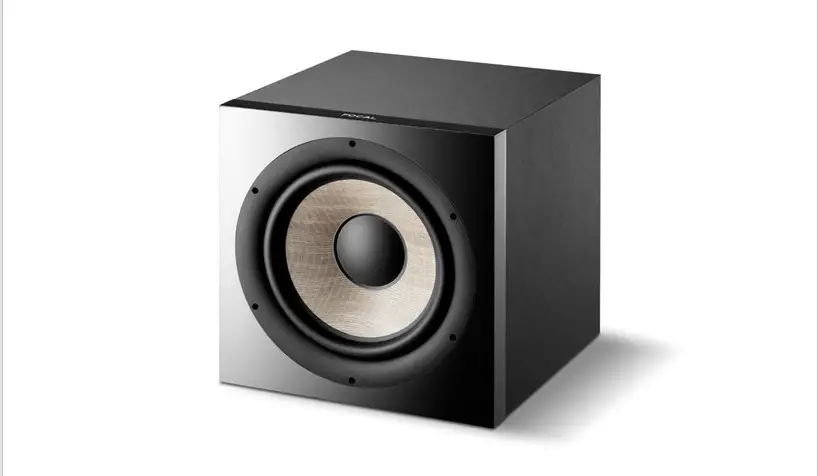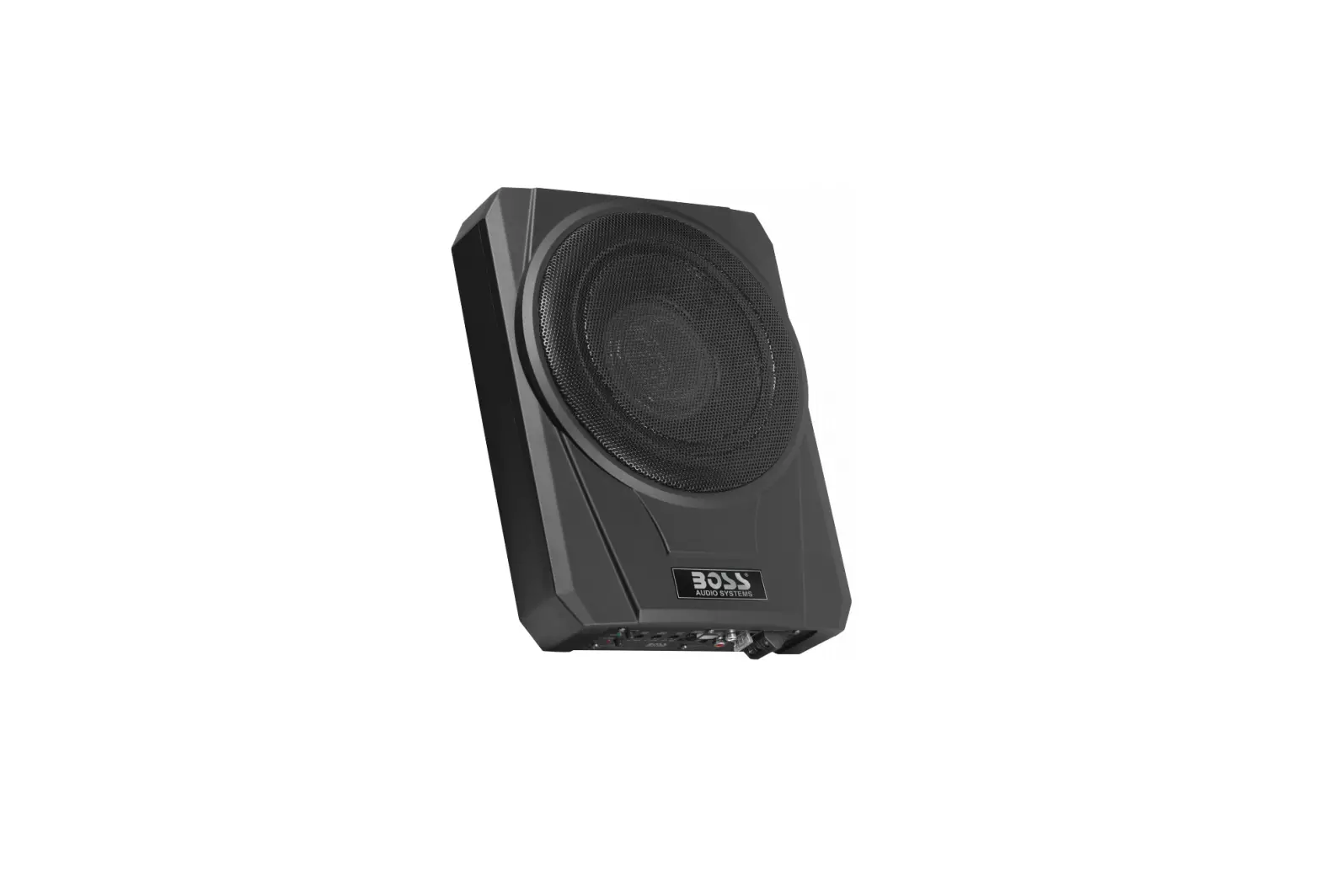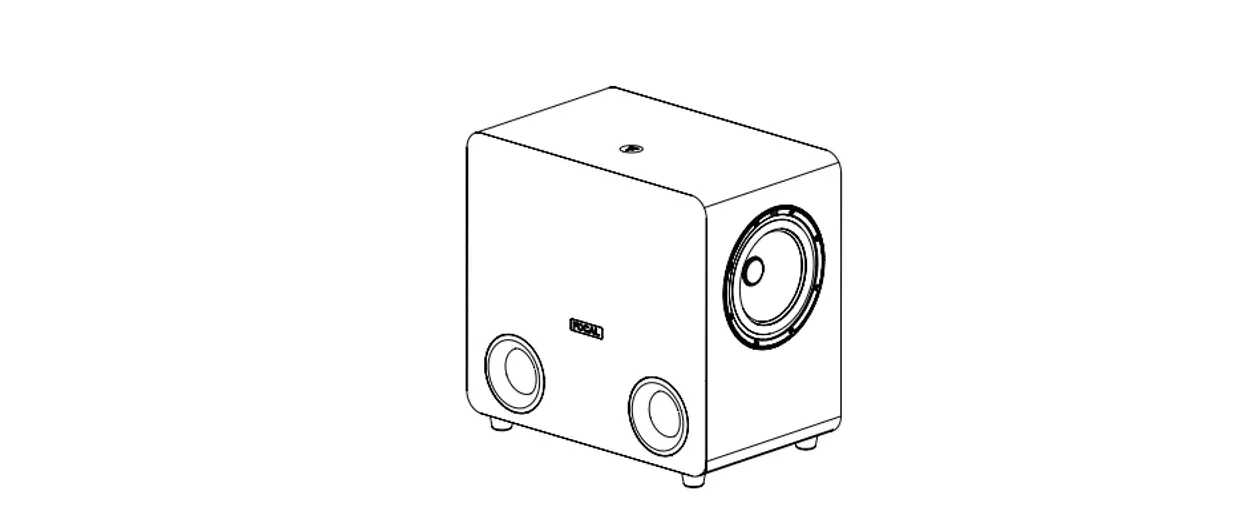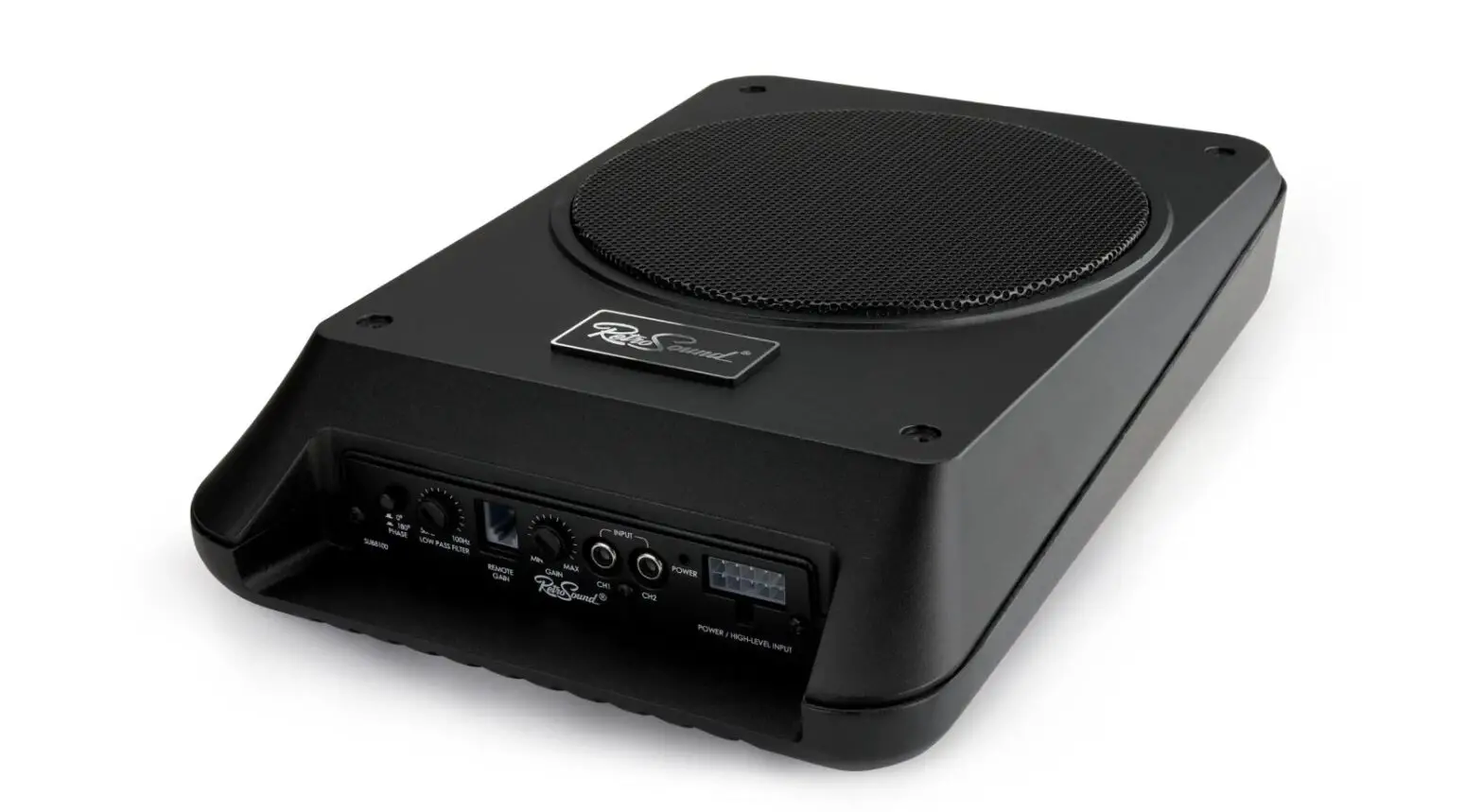

Focal Sub Air Black Flat Bass Subwoofer Amplifier
INTRODUCTION
Thank you for choosing Focal loudspeakers. We are pleased to share with you our philosophy : “the Spirit of Sound”. These high-performance speakers feature the latest technical developments from Focal in terms of speaker design, whether it is for high fidelity or home theater systems. In order to enjoy the maximum of their performance, we advise you to read this user’s manual and to keep it carefully so that you can consult it later.
Important Instruction
- Do not install the equipment near a source of heat, a cooker, a heating duct or other equipment (including amplifiers) which gives off heat.
- Respect safety instructions for power cable. The power cable has two prongs, one of which is larger than the other. A grounded cable has two prongs as well as a third which is the grounding prong.
- The largest or third prong is there for your safety. If the power cable doesn’t fit your power socket, seek the advice of an electrician and replace the old power socket.
- Make sure the cable cannot be stepped on, crushed or pinched. Extreme care must be paid to the plug and the connection of the cable to the equipment.
- Only use accessories recommended by the manufacturer.
- Only use handling equipment, legs, tripods, supports or tables recommended by the manufacturer or those sold with the equipment. When using a cart, take extra care when moving the cart and equipment to avoid injury in case something falls.
- Disconnect the equipment in case of a thunderstorm or if left unused for extended periods of time.
- All maintenance must be carried out by a qualified professional. Maintenance is required following any damage caused to the equipment such as deterioration of the power cable or plug, spillage of liquid or insertion of objects inside the equipment, exposure to rain or humidity, poor functioning or physical damage.
- Do not use any accessories which aren’t recommended by the manufacturer to avoid any risk.
- This product should only be connected to the type of power supply as indicated on the label on the equipment. In case of uncertainty as to the type of power supply of your electrical installation, consult the manufacturer of the product or your electricity provider. For equipment requiring a battery or another power source, consult the user manual.
- Do not overload power sockets, extension cables or power strips. This could lead to fire or electric shock.
- Never insert objects in the ventilation outlets of the equipment. The object may come in contact with components exposed to high voltages or cause short-circuiting and lead to fire or electric shock. Never spill liquid on the equipment.
- Never try to repair this equipment yourself; opening the equipment may expose you to high voltages or other risks. For all maintenance, consult a qualified professional.
- In case a replacement part is required, make sure the maintenance technician uses parts specified by the manufacturer or which have identical specifications to the original part. Non-compliant parts may lead to fire or have other risks.
- Following any intervention or repair to the equipment, ask the technician to carry out tests to verify the product works safely.
- The equipment must not be mounted to the wall or ceiling unless the manufacturer has intended it to, and only depending on antenna cables.
- The ON/OFF switch situated at the back of the subwoofer is the power supply cutoff device. The equipment must always be accessible to the user.
- Do not expose to dripping water or splashing
Description
Package contents
- 1 x Sub Air
- 1 x Sub Air Transmitter
- 1 x grille cable cover
- 1 Sub Air wall mounting kit
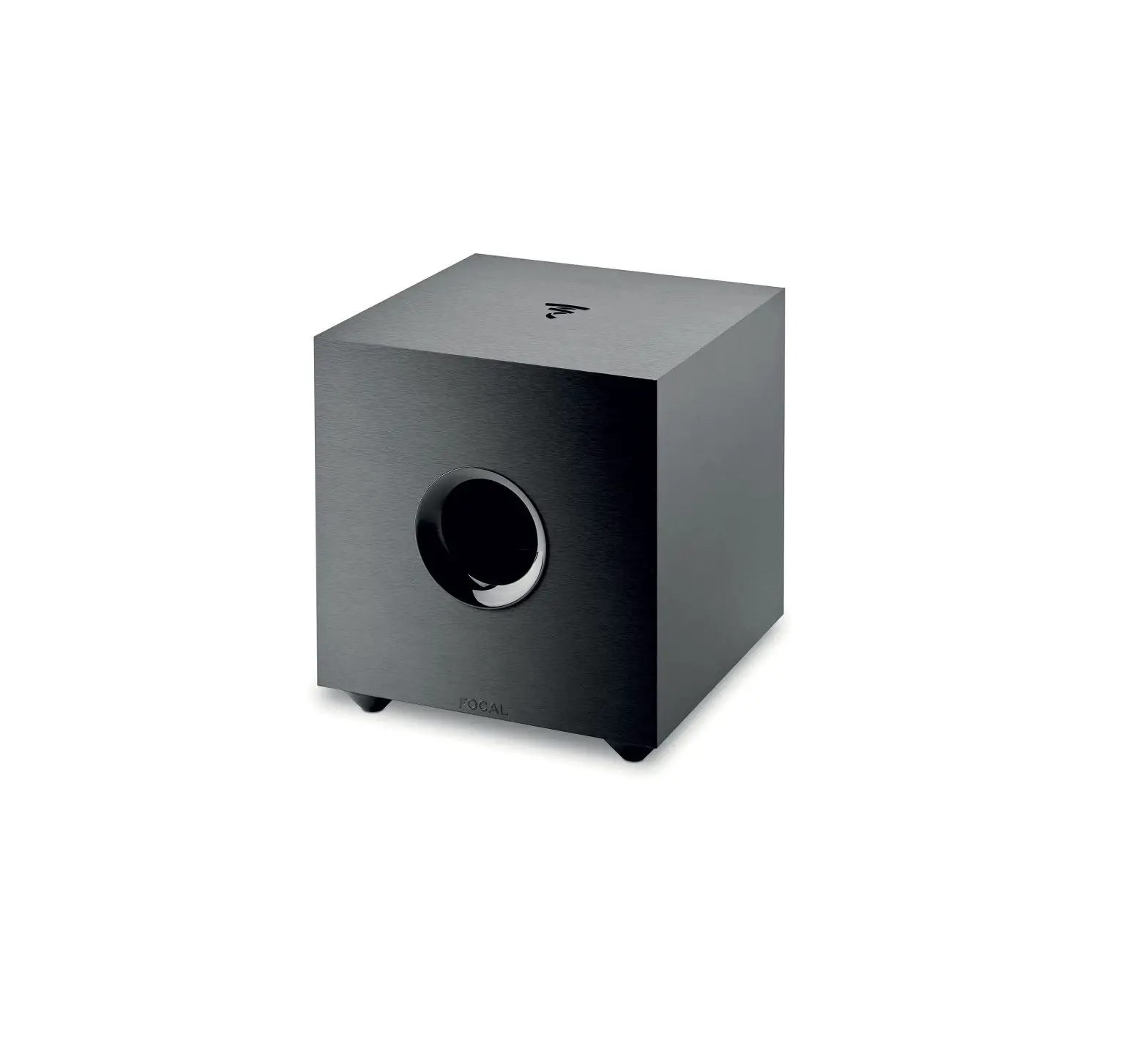
Sub Air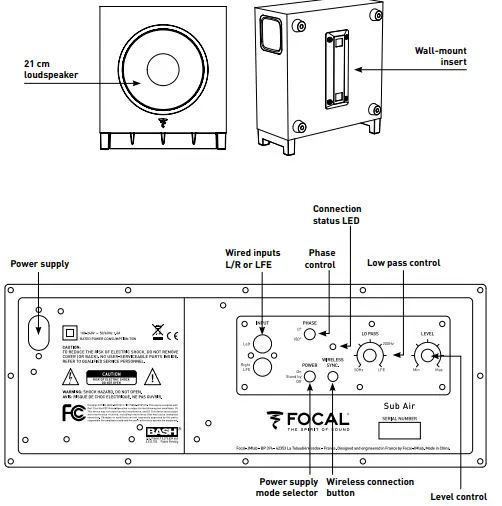
Sub Air transmitter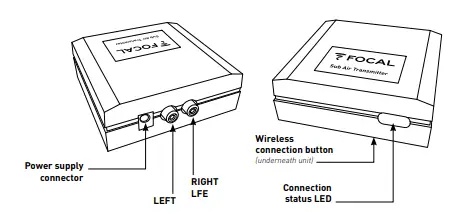
Positioning the Sub Air in your listening room
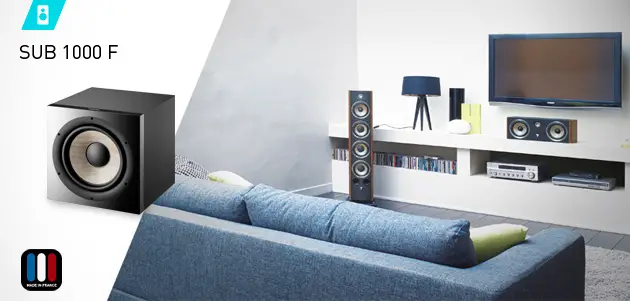
Unlike loudspeakers, which have to be at a sufficient distance from the walls and corners of the listening room, our advice is to position the Sub Air subwoofer in a corner. If the Sub Air is positioned up against a wall, not in a corner, or a long way away from the room walls, the very long wavelengths of the low frequencies reproduced will cause random excitation of resonances in the listening space. The frequency response will not be linear and the quality of the bass will be seriously affected (lack of depth, “tinny sound”, poorly defined and/or poorly held bass, difficult or impossible overlap crossover with main speakers). By placing Sub Air in a corner, the room resonance will be excited in a more linear and predictable way. Not only will the perception of the bass be optimal, but this arrangement will make it possible to boost the bass by + 6 dB. If, for practical reasons, you cannot position the Sub Air in a corner, try different positions in the room until you arrive at the best possible compromise. Generally speaking, it is best to take care to position the sub-woofer towards the front of the room. As the frequency bands in question are Omnidirectional, the bass is not, in principle, affected by an object or item of furniture placed between the sub-woofer and the listening position.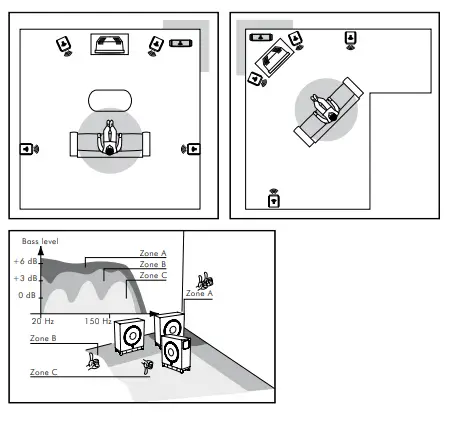
Sub Air setup
Please refer to the “Positioning the Sub Air” section for optimal positioning of your Sub Air in your listening room. May be placed on the floor or fixed to a wall.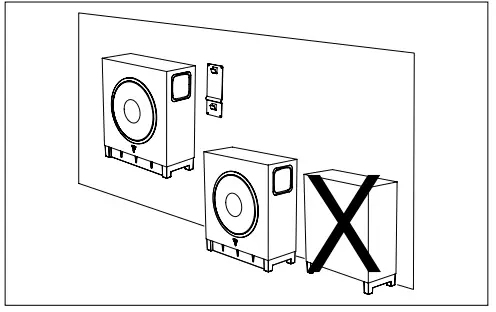
Using the Sub Air wall mounting kit. Screw the female part to the Sub Air, using the screws supplied. Secure the male part to the wall where you want to fit the Sub Air. Attach the rubber feet to the rear of the Sub Air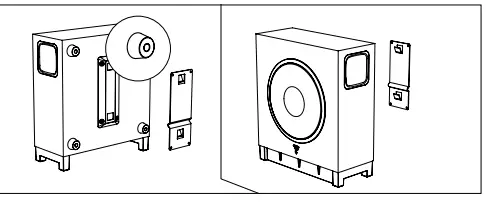
Connecting the Sub Air in wireless mode
Sub Air transmitter setup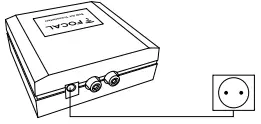
Plug the 5 volt supply into the Sub Air transmitter.
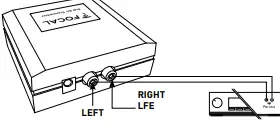
Connect low level RCA inputs
When a 2-channel amplifier with pre-out line outputs is used, Sub Air transmitter must always be connected using the RCA stereo Right/Left inputs.
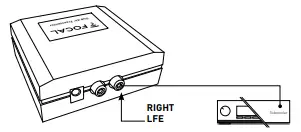
Switching Sub Air on
Automatic power-up and standby. Sub Air is fitted with an automatic audio signal detection system. If “Auto” mode is selected on the “Power” switch,
the unit powers up the moment it detects an audio signal. In “Power On” mode, the audio signal detector is disabled and the unit remains permanently powered up. When, on the other hand, the unit goes without detecting an audio signal, it automatically goes into standby. If the unit is going to be unused for an extended period of several days or more, it is recommended to put the “Power” switch to its “Off” position.
Caution: in the event of lightning, disconnect the power lead from the mains supply.
Connect mains power and put the “Power” switch into “On” or “Standby” mode. The connection status LED should be glowing steadily. This shows that the Sub Air Transmitter and Sub Air are connected. Installation is now complete and you can go on to adjust your Sub Air’s Phase, Low pass control and level. Please refer to the Settings and Operation section to make the most of these settings.
Note: synchronization procedure
Your Sub Air Transmitter and Sub Air come from the factory already wirelessly connected. If, after powering up, the connection status LED does not glow steadily, but instead flashes slowly (one flash per second), you will need to carry out the connection procedure by taking the following steps:
- On Sub Air, hold down the connection button for 4 seconds. The connection status LED will flash quickly.
- You now have 30 seconds in which to hold the connection button on Sub Air Transmitter down for 4 seconds. The connection status LED on Sub Air Transmitter will flash quickly.
- Connection is now complete and the connection status LEDs on Sub Air and Sub Air transmitter will be glowing steadily.
Low pass control
If you are using the LFE input on Sub Air or Sub Air Transmitter, turn the low pass rotary control (LO PASS) to its LFE position. If you are using the Left and Right inputs on the Sub Air or Sub Air Transmitter, low pass setting depends on which satellite speakers you use and their diameter. Here are our recommendations for Focal satellites
| Satellite speaker/ diameter | Little Bird / Dôme / 10 cm woofer | Sib / 13 cm woofer | Bird / 14 cm woofer | Super Bird / 14 cm woofer with 14 cm passive radiator |
| Low pass frequency | 120Hz | 110Hz | 100Hz | 80Hz |
Phase control switch
- The phase setting on your Sub Air is heavily dependent on your room interior, listening point and satellites. However, once you have installed your system we advise you to take the following steps to ensure the best setting:
- Play a piece of music with high bass energy.w
- From you ideal listening position, listen to the music with the switch first in the 0° position and then in the 180° position.
- Choose the switch setting which gives you the strongest sensation of the bass. This shows that the Sub Air is in phase with your satellites.
- If there is no detectable difference between the two settings, put the phase selector in its 0° position.
Level control
If you have a 5.1 set-up, we advise you to set the Sub Air at ¾ volume and to then adjust the sub-woofer volume with your Home Cinema amplifier. If you have a 2.1 set-up, the volume setting of your Sub Air is heavily dependent on your room interior and listening point. Simply adjust its volume to suit your wishes and taste in listening
Wired connection of Sub Air
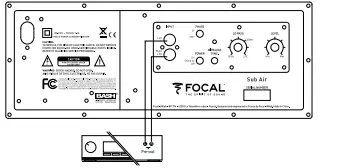
Connection to low level RCA inputs
When a 2-channel amplifier with pre-out line outputs is used, Sub Air must always be connected using the RCA stereo Right/Left inputs.
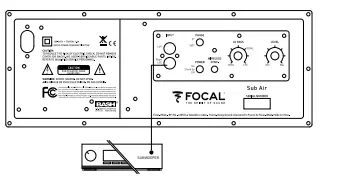
LED meaning guide
| LED status | Meaning | Additional information |
| Glowing continuously | Sub Air and Sub Air Transmitter are synchronized | The transmitter is able to send audio signals to Sub Air and the system is ready for use. |
| Flashing slowly (1 flash per second) | Sub Air and Sub Air Transmitter are not synchronized | Please see the end of the “Connecting the Sub Air in wireless mode” section to connect your Sub air with its Sub Air Transmitter. |
| Flashing quickly (5 flashes per second) | Sub Air and Sub Air Transmitter are pending synchronization. | The LED enters this state when you press the connection button. To complete connection, please see the “Connecting the Sub Air in wireless” mode” section. |
| LED status | Meaning | Additional information |
| Lighted | Sub Air is powered up. | Sub Air is reproducing or is able to reproduce an audio signal. |
| OFF | Sub Air is not powered up or standby. | Sub Air is not receiving an audio signal. |
Running-in period
The driver used in the Sub Air is made up of complex mechanical elements and requires an adaptation period before it delivers the best of its performances. They must get adapted to the temperature and humidity conditions of their environment. This breaking-in period depends upon the encountered conditions and can last several weeks. In order to shorten this period, we advise you to let your subwoofer operate for about twenty hours at medium level, playing standard music programs, but with a large amount of bass. Once the components of the speaker are completely stabilized, it is possible to enjoy the true performances of your self powered subwoofer.
Spécifications
| Type | Flat bass-reflex subwoofer, integrated 150W BASH amp |
| Speaker driver (diameter) | 21cm (8″) |
| Bass cutoff frequency (-6dB) | 35Hz |
| Frequency response (+/- 3dB) | 40Hz – 200Hz |
| Crossover cutoff frequency | variable 50Hz – 200Hz |
| Input panel | Left Right / LFE |
| RMS power | 110W |
| Peak power | 150W |
| Phase adjustment | 0 – 180° switch |
| Power functions | ON Auto (1 W) OFF (0,5 W) |
| Dimensions (HxWxD) | 16.1″x14.2″x6.3″ (410mmx360mmx160mm) |
| Weight | 17 lbs (7,65 Kg) |
| Type | Wireless connection |
| Range in Meter | 15m (in a room) |
| Sound Sampling | 16 bits |
| Sampling Frequency | 44,1kHz |
| Coding delay (latency) | 13ms |
| Radio transmission powers or sensitivity | 0dBm |
| Radio transmission frequency band | 2,4 Ghz ISM band |
Conditions of guarantee
All Focal loudspeakers are covered by guarantee drawn up by the official Focal distributor in your country. Your distributor can provide all details concerning the conditions of guarantee. Guarantee cover extends at least to that granted by the legal guarantee in force in the country where the original purchase invoice was issued
FAQS
What frequency should I set my subwoofer amp to?
70-80 Hz you can set the subwoofer amp
What makes a subwoofer more powerful?
The power is determined by the wattage of the subwoofer in question, where a higher wattage demonstrates a more powerful subwoofer
How do I know if my subwoofer amp is blown?
Test the sound at a low volume to listen for whether your sub has been blown
What frequency is best for bass?
For normally tuned bass guitar and upright double bass, note fundamentals extend down to E1, (open E). I would consider bass arbitrarily to be below C2 (65.41 Hz). That is two octaves below middle C
How do I get more bass on my subwoofer?
It is recommended that for optimal quality sound, you should place your subwoofer within 8-12 inches of a wall, facing outwards towards the rest of the room.
How do you know if a subwoofer is good?
The internal amplifier is the beating heart of your subwoofer and the most important thing it does is power the speaker driver
What wattage is best for subwoofer?
As a general rule of thumb, it is best to go with at least 300 watts in order to get enough power for your subwoofer
What does a good subwoofer sound like?
A great subwoofer will reach down to 20Hz or lower, right down to the limit of human hearing
Can a subwoofer amp overheat?
If your gain is turned up too high, not only will this create distortion and drastically decrease your audio quality, it can also cause your amp to overheat by trying to work much harder than it’s able to.
How long does a subwoofer amplifier last?
The lifespan of a subwoofer can range from around 4-14 years. If it’s properly maintained and not abused, the average person should be able to get 10+ years out of their subwoofer.
What causes amp to burn?
If a component dissipates too much heat, or experiences excessive voltage, it may start to burn up.
Which sound mode is best for bass?
Every musical note corresponds with a frequency. If you want to maximize your bass-heavy music, you need to adjust your equalizer within the 20-200Hz range by boosting the decibels (dB) in that range.
What is the best bass boost level?
In my years of reading audio forums, I’ve seen a bass boost of 4 to 6dB touted as ideal for music, and a boost of 6 to 8dB as ideal for home-theater systems.
Which class of subwoofer is best?
The very best amplifier for a subwoofer is a class AB or Class H amplifier. Class D amplifiers are too slow and cannot keep up with repetitive bass
What causes subwoofer failure?
The main cause of sub-woofer failure is overdriving or driving a clipped or distorted signal continuously to your sub-woofer. This can result in a mechanical or electrical failure.