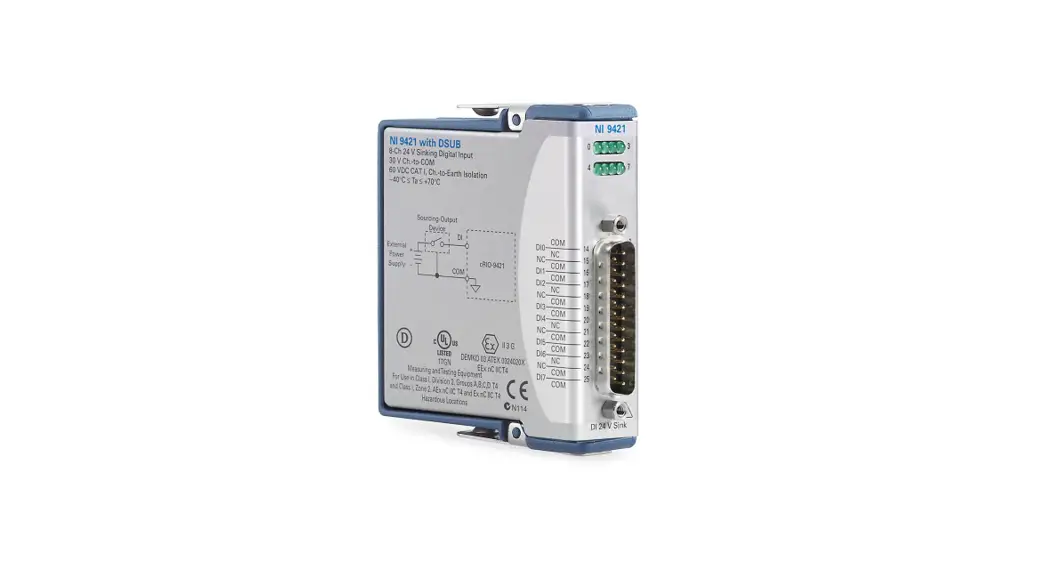
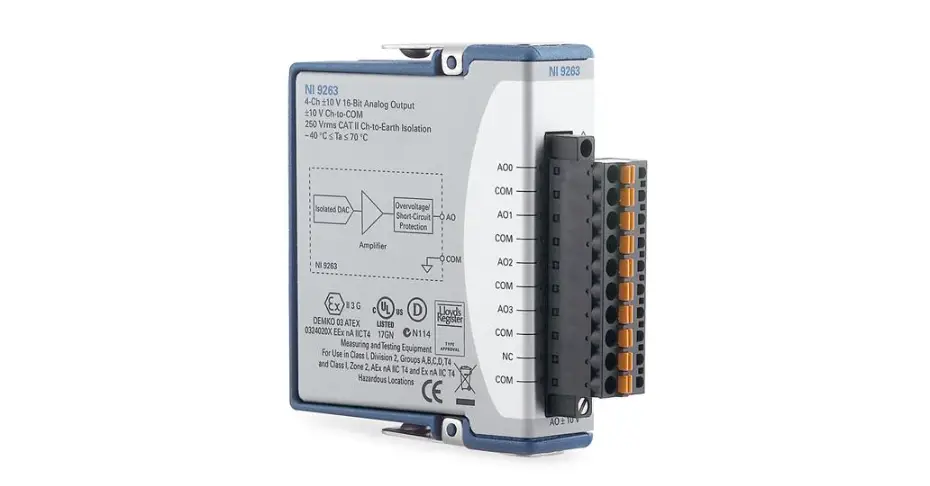
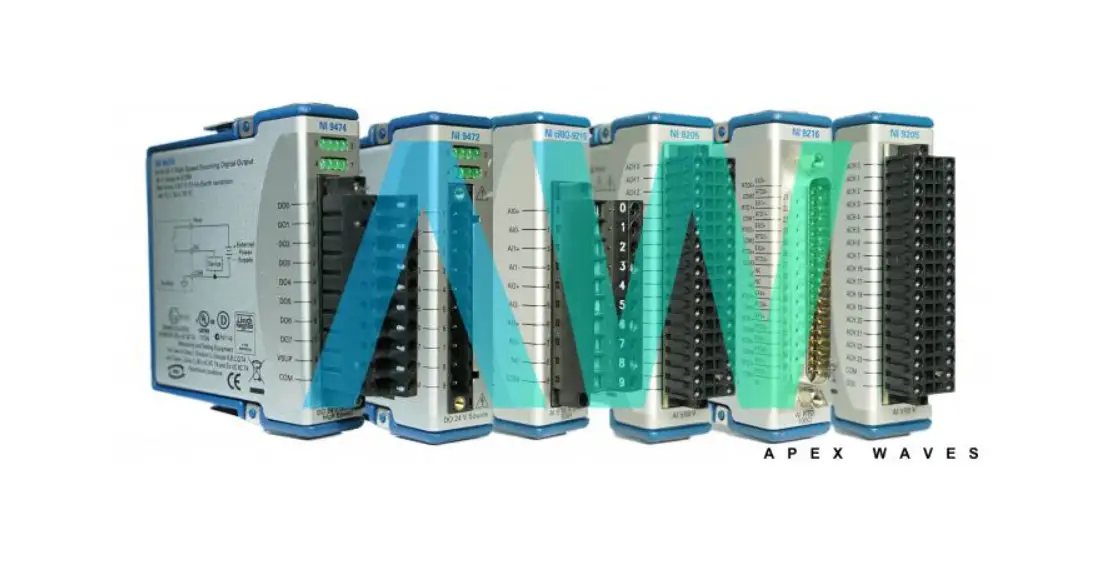
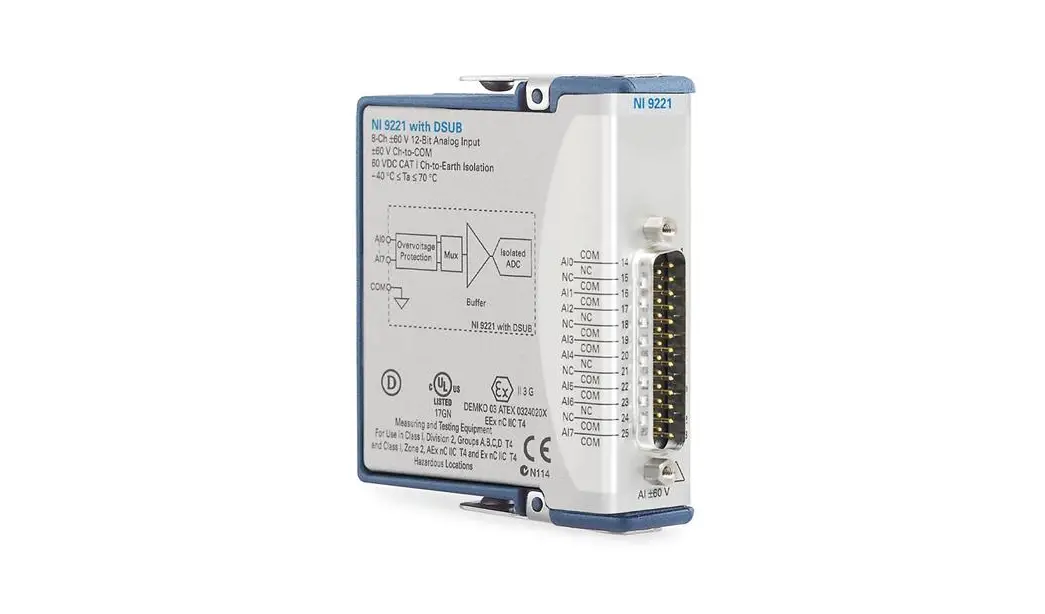
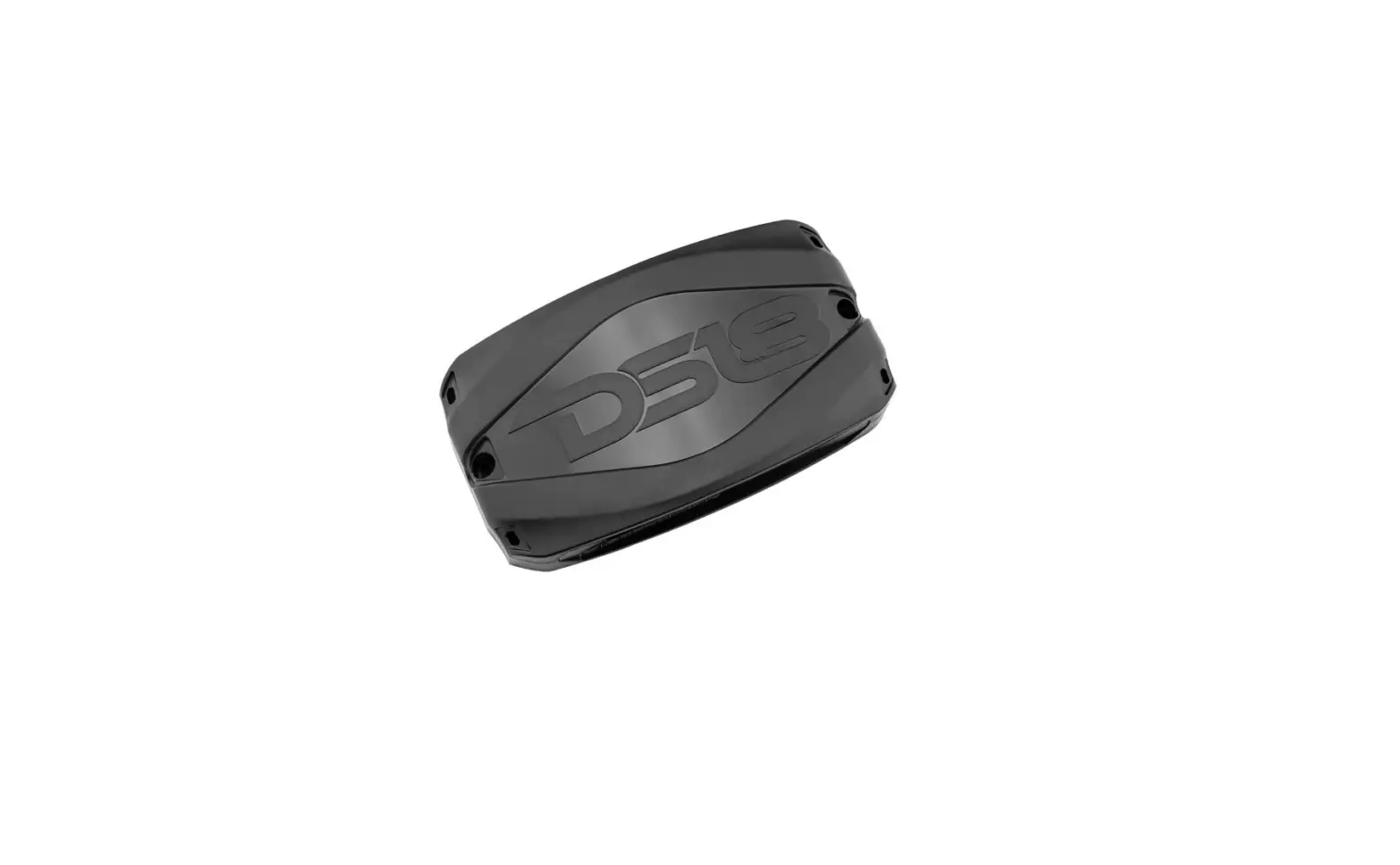
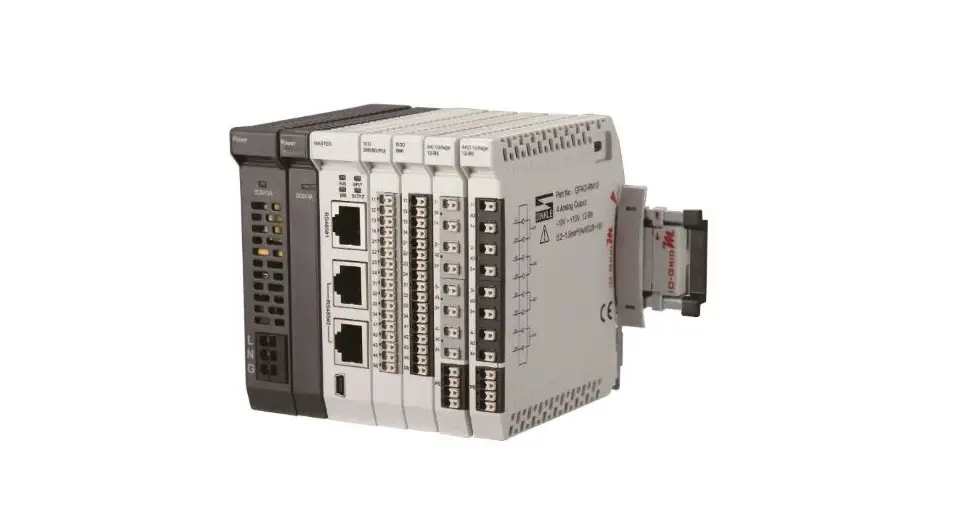
NI-9423 8 Channel Sinking Digital Input Module
NI-9927 Getting Started Guide
NI 9423 8-Channel Sinking Digital Input Module
The NI 9423 is a digital input module that comes in two
versions: one with a screw terminal and the other with a spring
terminal. This guide explains how to connect to the NI 9423. Before
beginning, complete the software and hardware installation
procedures in your chassis documentation. The guidelines in this
document are specific to the NI 9423. Refer to the documentation
for each component in the system to determine the safety and EMC
ratings for the entire system.
Safety Guidelines
It is important to operate the NI 9423 only as described in this
document. Do not operate the NI 9423 in a way that is not specified
in this document. Product misuse can result in a hazard. You can
compromise the safety protection built into the product if the
product is damaged in any way. If the product is damaged, return it
to NI for repair.
Safety Guidelines for Hazardous Voltages
If hazardous voltages are connected to the device, take the
following precautions:
- Hazardous voltage wiring should be performed only by qualified
personnel adhering to local electrical standards. - Do not mix hazardous voltage circuits and human-accessible
circuits on the same module. - Ensure that devices and circuits connected to the module are
properly insulated from human contact. - When module terminals are hazardous voltage LIVE (>42.4
Vpk/60 VDC), ensure that devices and circuits connected to the
module are properly insulated from human contact. Use the NI 9932
connector backshell kit to ensure that the terminals are not
accessible.
NI 9423 Safety Voltages
Connect only voltages that are within the following limits:
- Channel-to-COM: 30 V max
- Isolation Channel-to-channel: None
- Channel-to-earth ground Continuous: 250 Vrms, Measurement
Category II - Withstand: 2,300 Vrms, verified by a 5 s dielectric withstand
test
Measurement Category II is for measurements performed on
circuits directly connected to the electrical distribution system.
This category refers to local-level electrical distribution, such
as that provided by a standard wall outlet, for example, 115 V for
U.S. or 230 V for Europe. Do not connect the NI 9423 to signals or
use for measurements within Measurement Categories III or IV.
Safety Guidelines for Hazardous Locations
The NI 9423 is suitable for use in Class I, Division 2, Groups
A, B, C, D, T4 hazardous locations; Class I, Zone 2, AEx nA IIC T4
and Ex nA IIC T4 hazardous locations; and nonhazardous locations
only. Follow these guidelines if you are installing the NI 9423 in
a potentially explosive environment. Not following these guidelines
may result in serious injury or death.
Product Usage Instructions
To use the NI 9423:
- Ensure that you have completed the software and hardware
installation procedures in your chassis documentation. - Connect only voltages that are within the limits specified in
the NI 9423 Safety Voltages section. - If hazardous voltages are connected to the device, take the
necessary precautions as outlined in the Safety Guidelines for
Hazardous Voltages section. - If installing the NI 9423 in a potentially explosive
environment, follow the guidelines in the Safety Guidelines for
Hazardous Locations section. - Operate the NI 9423 only as described in this document to avoid
product misuse and potential hazards.
NI-9927
GETTING STARTED GUIDE
NI 9423
8-Channel Sinking Digital Input Module
This document explains how to connect to the NI 9423. In this document, the NI 9423 with screw terminal and the NI 9423 with spring terminal are referred to inclusively as the NI 9423.
Note Before you begin, complete the software and hardware installation procedures in your chassis documentation.
Note The guidelines in this document are specific to the NI 9423. The other components in the system might not meet the same safety ratings. Refer to the documentation for each component in the system to determine the safety and EMC ratings for the entire system.
Safety Guidelines
Operate the NI 9423 only as described in this document.
Caution Do not operate the NI 9423 in a manner not specified in this document. Product misuse can result in a hazard. You can compromise the safety protection built into the product if the product is damaged in any way. If the product is damaged, return it to NI for repair.
2 | ni.com | NI 9423 Getting Started Guide
Safety Guidelines for Hazardous Voltages
If hazardous voltages are connected to the device, take the following precautions. A hazardous voltage is a voltage greater than 42.4 Vpk voltage or 60 VDC to earth ground.
Caution Ensure that hazardous voltage wiring is performed only by qualified personnel adhering to local electrical standards.
Caution Do not mix hazardous voltage circuits and human-accessible circuits on the same module.
Caution Ensure that devices and circuits connected to the module are properly insulated from human contact.
Caution When module terminals are hazardous voltage LIVE (>42.4 Vpk/60 VDC), you must ensure that devices and circuits connected to the module are properly insulated from human contact. You must use the NI 9932 connector backshell kit to ensure that the terminals are not accessible.
NI 9423 Getting Started Guide | © National Instruments | 3
NI 9423 Safety Voltages
Connect only voltages that are within the following limits:
.C..h..a..n..n..e..l.-.t.o..-..C..O…M…………………………….30 V max
Isolation .C..h..a..n..n..e..l.-.t.o..-..c.h..a..n..n..e..l………………..None Channel-to-earth ground .C..o..n..t.i.n..u..o..u..s……………………..250 Vrms, Measurement Category II .W…i.t.h..s..t.a..n..d……………………….2,300 Vrms, verified by a 5 s dielectric withstand test
Measurement Category II is for measurements performed on circuits directly connected to the electrical distribution system. This category refers to local-level electrical distribution, such as that provided by a standard wall outlet, for example, 115 V for U.S. or 230 V for Europe.
Caution Do not connect the NI 9423 to signals or use for measurements within Measurement Categories III or IV.
4 | ni.com | NI 9423 Getting Started Guide
Safety Guidelines for Hazardous Locations
The NI 9423 is suitable for use in Class I, Division 2, Groups A, B, C, D, T4 hazardous locations; Class I, Zone 2, AEx nA IIC T4 and Ex nA IIC T4 hazardous locations; and nonhazardous locations only. Follow these guidelines if you are installing the NI 9423 in a potentially explosive environment. Not following these guidelines may result in serious injury or death.
Caution Do not disconnect I/O-side wires or connectors unless power has been switched off or the area is known to be nonhazardous.
Caution Do not remove modules unless power has been switched off or the area is known to be nonhazardous.
Caution Substitution of components may impair suitability for Class I, Division 2.
Caution For Division 2 and Zone 2 applications, install the system in an enclosure rated to at least IP54 as defined by IEC/EN 60079-15.
NI 9423 Getting Started Guide | © National Instruments | 5
Caution For Division 2 and Zone 2 applications, connected signals must be within the following limits.
C…a..p..a..c.i..t.a.n..c..e…………………………………..0.2 µF max
Special Conditions for Hazardous Locations Use in Europe and Internationally The NI 9423 has been evaluated as Ex nA IIC T4 Gc equipment under DEMKO Certificate No. 03 ATEX 0324020X and is IECEx 14.0089X certified. Each NI 9423 is marked II 3G and is suitable for use in Zone 2 hazardous locations, in ambient temperatures of -40 °C Ta 70 °C. If you are using the NI 9423 in Gas Group IIC hazardous locations, you must use the device in an NI chassis that has been evaluated as Ex nC IIC T4, Ex IIC T4, Ex nA IIC T4, or Ex nL IIC T4 equipment.
Caution You must make sure that transient disturbances do not exceed 140% of the rated voltage.
Caution The system shall only be used in an area of not more than Pollution Degree 2, as defined in IEC 60664-1.
6 | ni.com | NI 9423 Getting Started Guide
Caution The system shall be mounted in an ATEX/IECEx-certified enclosure with a minimum ingress protection rating of at least IP54 as defined in IEC/EN 60079-15.
Caution The enclosure must have a door or cover accessible only by the use of a tool.
Electromagnetic Compatibility Guidelines
This product was tested and complies with the regulatory requirements and limits for electromagnetic compatibility (EMC) stated in the product specifications. These requirements and limits provide reasonable protection against harmful interference when the product is operated in the intended operational electromagnetic environment.
This product is intended for use in industrial locations. However, harmful interference may occur in some installations, when the product is connected to a peripheral device or test object, or if the product is used in residential or commercial areas. To minimize interference with radio and television reception and prevent unacceptable performance degradation, install and use this
NI 9423 Getting Started Guide | © National Instruments | 7
product in strict accordance with the instructions in the product documentation.
Furthermore, any changes or modifications to the product not expressly approved by National Instruments could void your authority to operate it under your local regulatory rules.
Special Conditions for Marine Applications
Some products are Lloyd’s Register (LR) Type Approved for marine (shipboard) applications. To verify Lloyd’s Register certification for a product, visit ni.com/certification and search for the LR certificate, or look for the Lloyd’s Register mark on the product.
Caution In order to meet the EMC requirements for marine applications, install the product in a shielded enclosure with shielded and/or filtered power and input/output ports. In addition, take precautions when designing, selecting, and installing measurement probes and cables to ensure that the desired EMC performance is attained.
8 | ni.com | NI 9423 Getting Started Guide
Preparing the Environment
Ensure that the environment in which you are using the NI 9423 meets the following specifications.
.O..p..e..r.a..t.i.n..g…t..e.m…p..e..r..a.t.u..r..e……………………-40 °C to 70 °C (IEC 60068-2-1, IEC 60068-2-2)
.O..p..e..r.a..t.i.n..g…h..u..m….i.d..i.t.y………………………..10% RH to 90% RH,
(IEC 60068-2-78)
noncondensing
.P..o..l.l.u..t.i.o..n…D…e..g..r.e..e……………………………2
.M…a..x..i.m…u..m….a..l.t.i.t.u..d..e………………………….2,000 m
Indoor use only.
Note Refer to the device datasheet on ni.com/manuals for complete specifications.
Connecting the NI 9423
The NI 9423 provides connections for eight digital input channels.
NI 9423 Getting Started Guide | © National Instruments | 9
Figure 1. NI 9423 Pinout
0
3
4
7
DI0
0
DI1
1
DI2
2
DI3
3
DI4
4
DI5
5
DI6
6
DI7
7
NC
8
COM
9
DI0
0
DI1
1
DI2
2
DI3
3
DI4
4
DI5
5
DI6
6
DI7
7
NC
8
COM
9
Note You must use 2-wire ferrules to create a secure connection when connecting more than one wire to a single terminal on the NI 9423.
10 | ni.com | NI 9423 Getting Started Guide
NI 9423 Signals
Each channel of the NI 9423 has a DI terminal or pin to which you can connect voltage or current signals. The NI 9423 also has COM, a common terminal or pin that is internally connected to the isolated ground reference of the module.
The NI 9423 has sinking inputs, meaning that when the external device drives current or applies voltage to the DI terminal or pin, DI provides a path to COM for the current or voltage. The NI 9423 internally limits current signals connected to DI.
Connecting Sourcing-Output Devices
You can connect 2-, 3-, and 4-wire sourcing-output devices to the NI 9423. A sourcing-output device drives current or applies voltage to DI. An example of a sourcing-output device is an open collector PNP.
Connect the output of the sourcing-output device to DI on the NI 9423. Connect the common of the external device to the COM terminal or pin.
NI 9423 Getting Started Guide | © National Instruments | 11
Figure 2. Connecting a Device to the NI 9423 (3-Wire Device Shown)
External + Power Supply
Sourcing-Output Device DI
COM
NI 9421/9423
The NI 9423 channel registers as ON when the sourcing-output device applies a voltage or drives a current that is in the input ON range to DI. The channel registers as OFF when the device applies a voltage or drives a current that is in the input OFF range to DI. If no device is connected to DI, the channel registers as OFF.
LED Indications
Each channel has an LED that indicates the state of the channel, as the following table describes. The LEDs are disabled when the chassis is in sleep mode.
12 | ni.com | NI 9423 Getting Started Guide
Table 1. LED Indications
LED State
Indication
Illuminated Not illuminated
Channel is on Channel is off
High-Vibration Application Connections
If your application is subject to high vibration, NI recommends that you follow these guidelines to protect connections to the NI 9423: · Use ferrules to terminate wires to the detachable connector. · Use the NI 9927 backshell kit with the NI 9423 with screw
terminal or the NI 9981 backshell kit with the NI 9423 with spring terminal.
NI 9423 Getting Started Guide | © National Instruments | 13
Where to Go Next
CompactRIO
NI CompactDAQ
NI 9423 Datasheet NI-RIO Help LabVIEW FPGA Help
NI 9423 Datasheet NI-DAQmx Help LabVIEW Help
RELATED INFORMATION
C Series Documentation & Resources ni.com/info cseriesdoc
Services ni.com/services
Located at ni.com/manuals
Installs with the software
14 | ni.com | NI 9423 Getting Started Guide
Worldwide Support and Services
The National Instruments website is your complete resource for technical support. At ni.com/support, you have access to everything from troubleshooting and application development self-help resources to email and phone assistance from NI Application Engineers.
Visit ni.com/services for NI Factory Installation Services, repairs, extended warranty, and other services.
Visit ni.com/register to register your National Instruments product. Product registration facilitates technical support and ensures that you receive important information updates from NI.
A Declaration of Conformity (DoC) is our claim of compliance with the Council of the European Communities using the manufacturer’s declaration of conformity. This system affords the user protection for electromagnetic compatibility (EMC) and product safety. You can obtain the DoC for your product by visiting ni.com/certification. If your product supports calibration, you can obtain the calibration certificate for your product at ni.com/calibration.
NI 9423 Getting Started Guide | © National Instruments | 15
National Instruments corporate headquarters is located at 11500 North Mopac Expressway, Austin, Texas, 78759-3504. National Instruments also has offices located around the world. For telephone support in the United States, create your service request at ni.com/support or dial 1 866 ASK MYNI (275 6964). For telephone support outside the United States, visit the Worldwide Offices section of ni.com/niglobal to access the branch office websites, which provide up-to-date contact information, support phone numbers, email addresses, and current events.
Refer to the NI Trademarks and Logo Guidelines at ni.com/trademarks for information on National Instruments trademarks. Other product and company names mentioned herein are trademarks or trade names of their respective companies. For patents covering National Instruments products/technology, refer to the appropriate location: Help»Patents in your software, the patents.txt file on your media, or the National Instruments Patent Notice at ni.com/ patents. You can find information about end-user license agreements (EULAs) and third-party legal notices in the readme file for your NI product. Refer to the Export Compliance Information at ni.com/legal/export-compliance for the National Instruments global trade compliance policy and how to obtain relevant HTS codes, ECCNs, and other import/export data. NI MAKES NO EXPRESS OR IMPLIED WARRANTIES AS TO THE ACCURACY OF THE INFORMATION CONTAINED HEREIN AND SHALL NOT BE LIABLE FOR ANY ERRORS. U.S. Government Customers: The data contained in this manual was developed at private expense and is subject to the applicable limited rights and restricted data rights as set forth in FAR 52.227-14, DFAR 252.227-7014, and DFAR 252.227-7015.
© 2003–2015 National Instruments. All rights reserved.
375423A-01 May15
References
 Engineer Ambitiously - NI
-
Engineer Ambitiously - NI
-
Calibration Services - NI
-
Product Certifications - NI
-
Using Info Codes - NI
-
Trade Compliance - NI
-
Product Documentation - NI
-
Contact Us - NI
-
Log In - National Instruments
-
NI Services - NI
-
Support - NI
-
NI Trademarks and Logo Guidelines - NI
-
Calibration Services - NI
-
Product Certifications - NI
-
Product Documentation - NI
-
Contact Us - NI
-
Log In - National Instruments
-
NI Services - NI
-
Support - NI
 NI-9927 National Instruments Backshell Connector Kit | Apex Waves
 Engineer Ambitiously - NI
 Calibration Services - NI
 NI-9927 National Instruments Backshell Connector Kit | Apex Waves