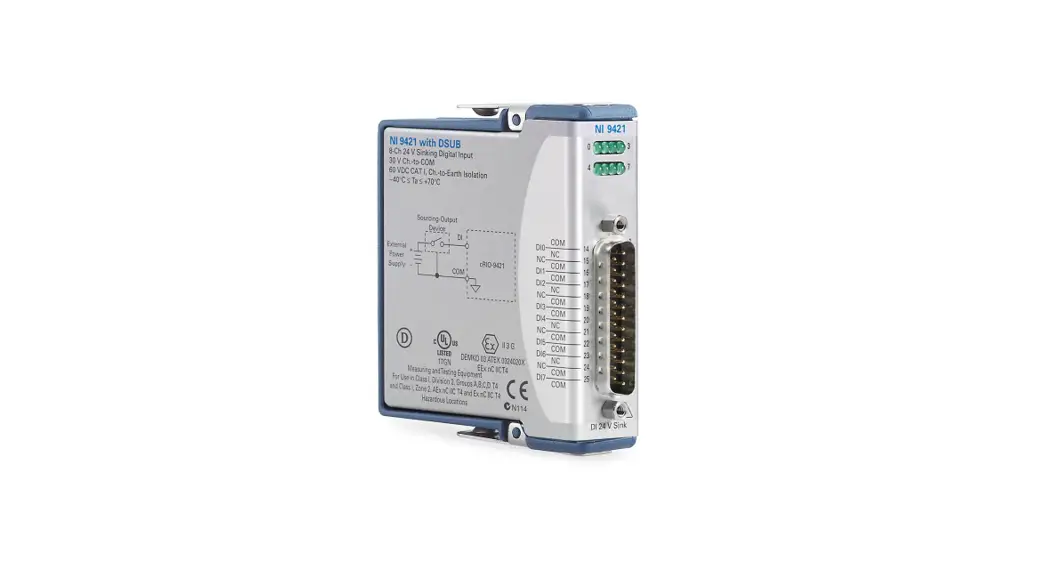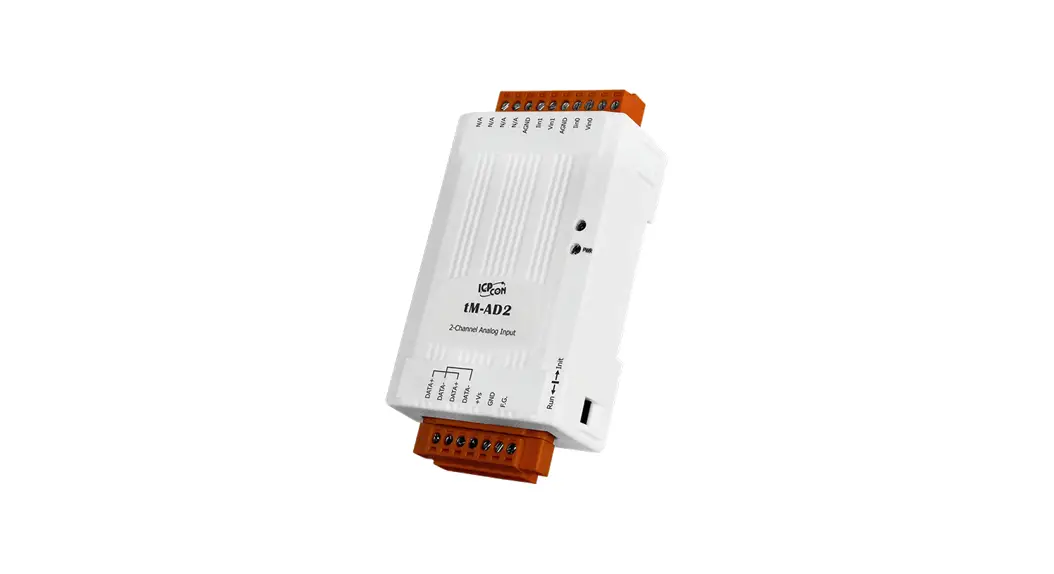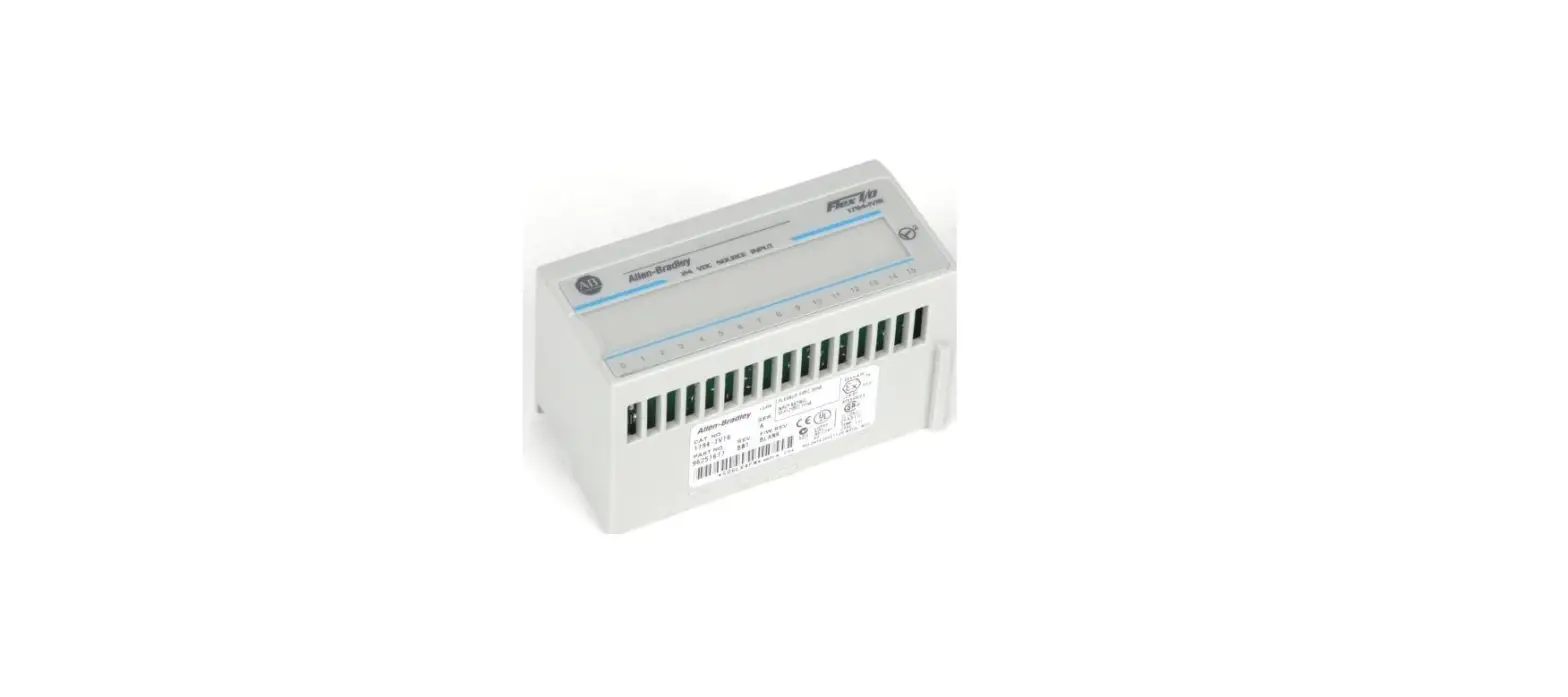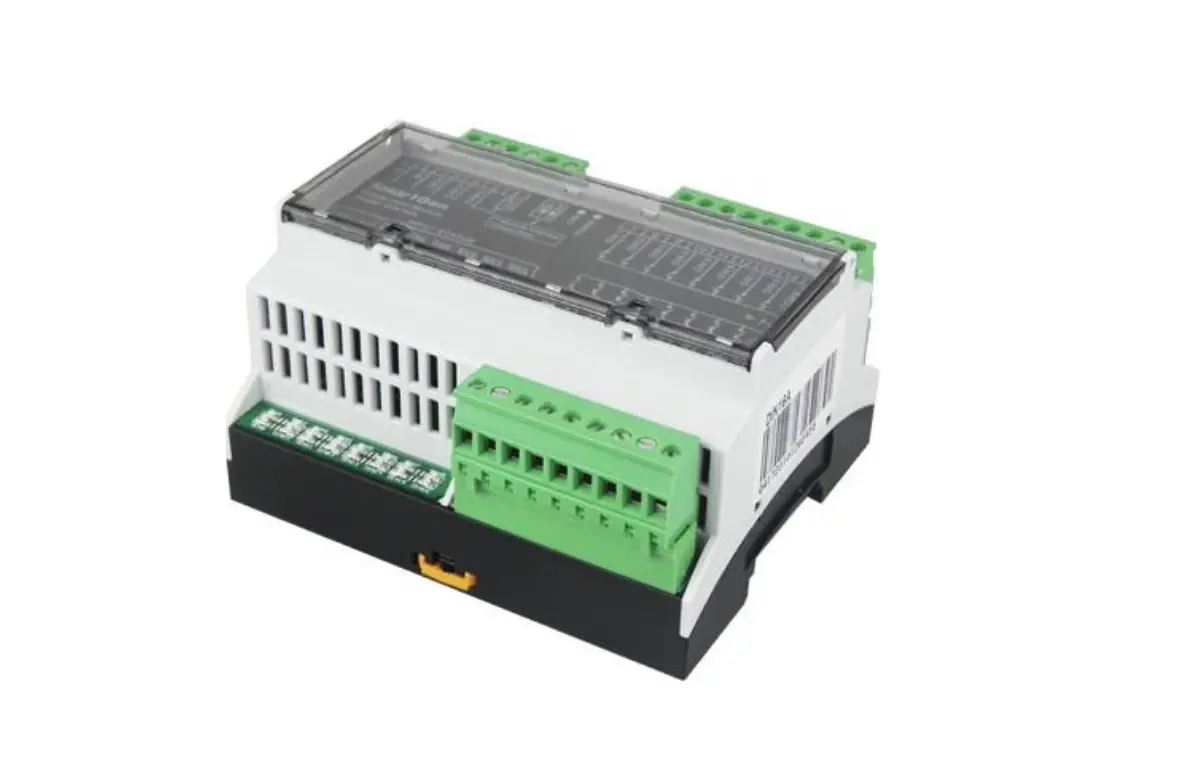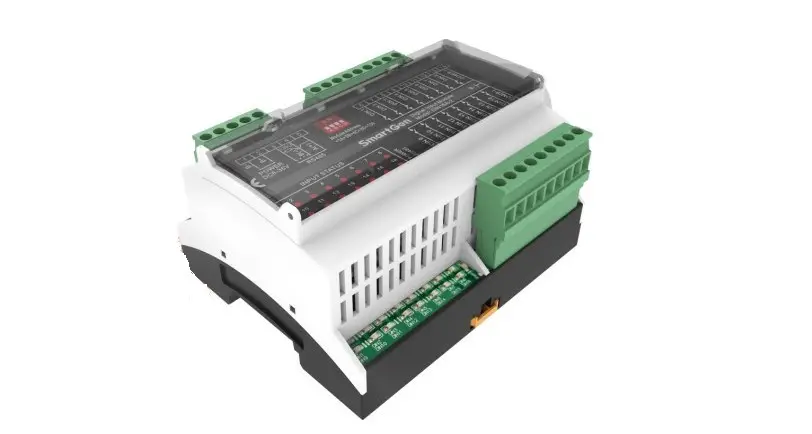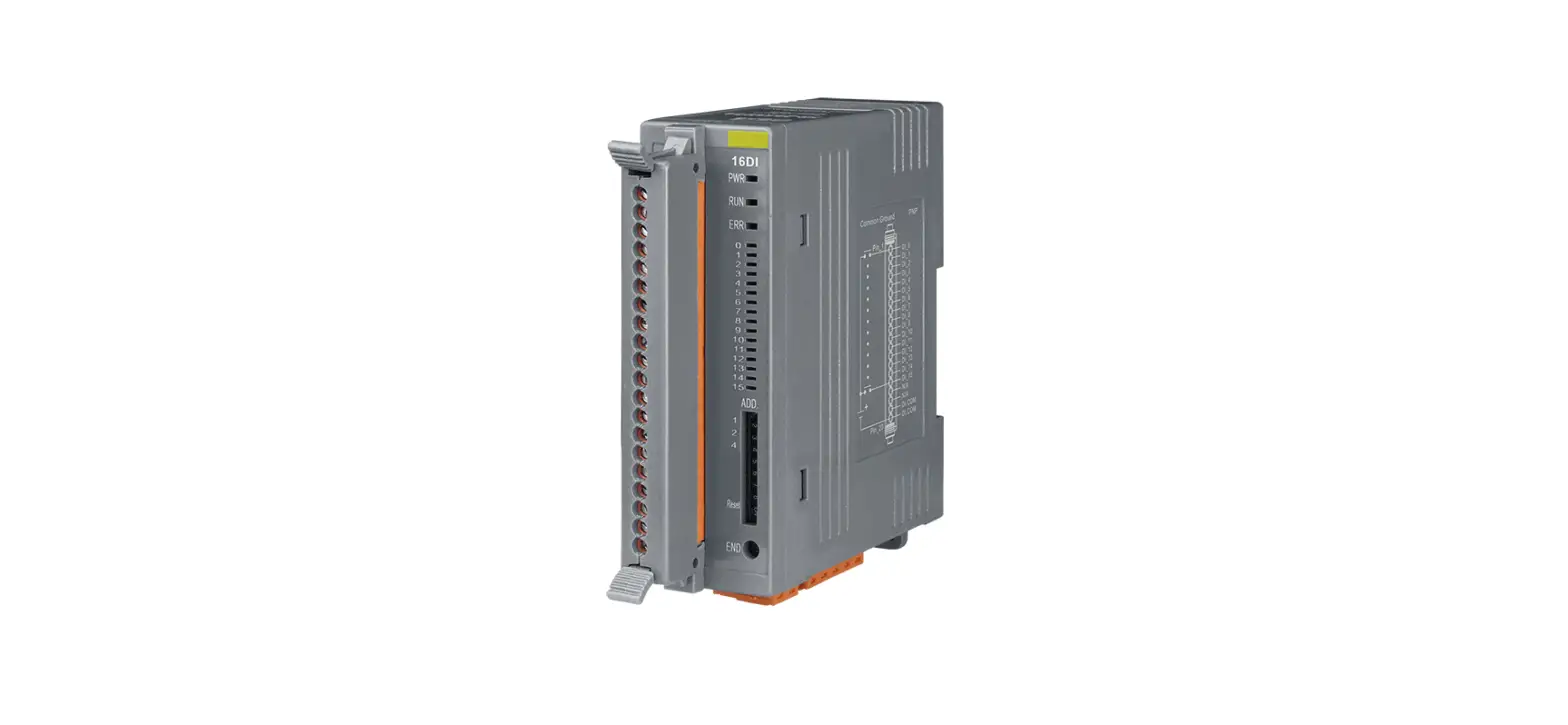

ICP DAS FR-2053HTA 16-Channel Isolated Sink Source Digital Input Module
Warranty
All products manufactured by ICP DAS are warranted against defective materials for a period of one year from the date of delivery to the original purchaser.
Warning
ICPDAS assumes no liability for damages consequent to the use of this product. ICP DAS reserves the right to change this manual at any time without notice. The information furnished by ICP DAS is believed to be accurate and reliable. However, no responsibility is assumed by ICP DAS for its use, not for any infringements of patents or other rights of third parties resulting from its use.
Copyright
Copyright 2004 by ICP DAS. All rights are reserved.
Trademark
The names used for identification only may be registered trademarks of their respective companies.
Introduction
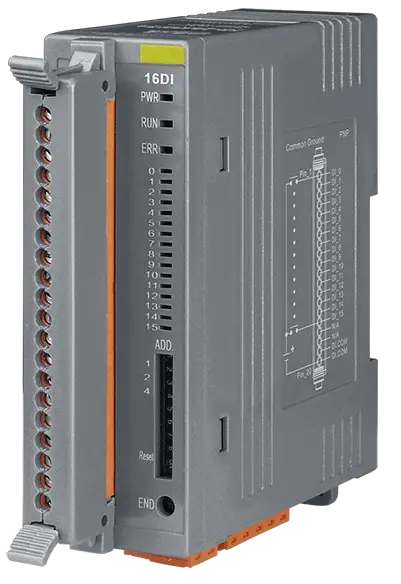
The FR-2053TA/FR-2053HTA module provides a 16-channel isolated sink/source digital output in the FRnet. The “-T” denotes the screw terminal connector, allowing users to connect to the DO signals on the module directly. The I/O data transmission is controlled by the FRnet control chip which was developed by ICP DAS. It was designed to provide for deterministic high-speed network communication. The communication mechanism is dominated by the token stream, which is generated by the network manager located at a specific node (SA0). This manager provides for fixed scan-time and I/O synchronization capability without the need of any special communication protocol. Furthermore, special anti-noise circuitry has also been considered and built into the FRnet control chip to ensure communication reliability. This distributive digital output module must be connected to another module or a host controller with a network manager built in.
However, the effectiveness of the FRnet connection depends on and is then ensured when the correct hardware configurations for the sender address (SA) and receiver address (RA) on the host controller and the remote module in the network have been installed properly. In general, the operating principle is structured by the strategy of delivering the 16-bit data from the specified sender address (SAn) to the corresponding receiver address (RAn) via the broadcasting method controlled by the token stream of the network manager, SA0. Based on this algorithm, there are some general rules that need to be followed:
- The sender’s address needs to be unique in order to avoid any communication collisions.
- Each of FRnet needs at least one network manager defined as SA0. It plays an important role of producing the token stream in the network.
- The baud rates of the controller and the remote modules need to be the same as on the front.
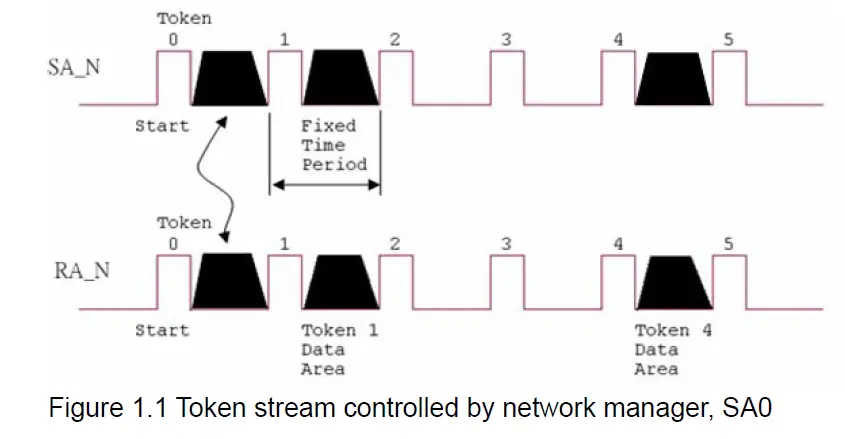
- The communication method is controlled by delivering the data of the specified sender address (SA) to the corresponding receiver address (RA) in the sequence of token 0 to N cyclically, as depicted below.
- Due to the broadcasting algorithm adopted, the receiver address is not required to be unique. Therefore, it is easy to build a data delivery from one node (16-bit data) to a multi-node.

An example of the FRnet application structure for delivering data from the specified sender address (SAn) to the corresponding receiver address (RAn) by a 4-wire inter module cable, including a 2-wire power supply cable, is shown in the figure below.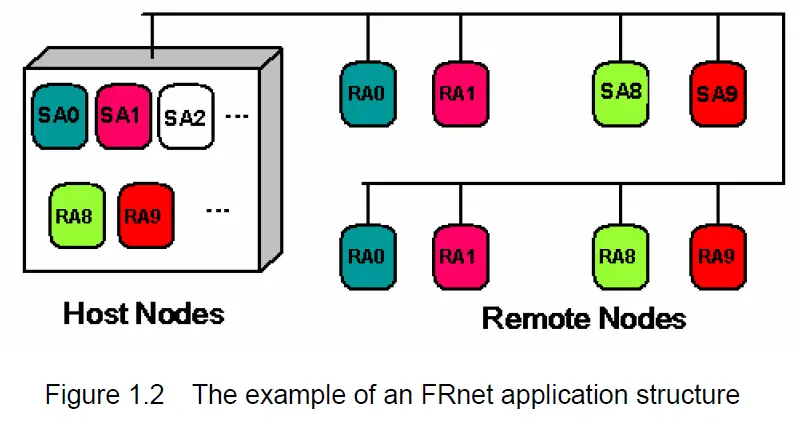
Features
- The Token stream is used to activate data transmission from the specified SA node to the corresponding RA nodes.
- The Network Manager is defined as SA0. Each of the FRnet must have SA0 because it issues the Token stream into the network.
- The Token stream is produced cyclically by the hardware system (SA0) at the fixed time interval, see Figure 1.1. Therefore, the FRnet system can provide for both Isochronous and Deterministic functionalities.
- It can provide data transmission from one node (16-bit) to one node or from one node to multiple nodes at the same time because FRnet uses the principle of delivering the data from the sender address to the receiver address. Therefore, the sender address must be unique, but the receiver address can be different or the same in the network.
- The FRnet system can easily be extended by adding new modules to the network according to the FRnet principle.
- Device Inter-communication: A single device can talk to other devices by setting appropriate SA and RA node configurations.
- No software overhead: All data transmissions are performed automatically via the FRnet control chip. Therefore, there is no need for the CPU or firmware to process transmission protocols.
- It only needs simple RS-485 wiring.
- The DIN-Rail mounting is provided.
Specifications
Table 1.1 Specifications for FR-2053TA/2053HTA modules.
| Digital Input | |
| Input Channel | 16 (Sink/Source) |
| Input Type | Isolation, One Common for All Digital Inputs |
| On Voltage Level | +3.5V ~ 30V |
| Off Voltage Level | +1V max |
| Input Impedance | 3K Ohms |
| Isolation Voltage | 3750Vrms |
| Interface | |
| 2-wire cabling | CPEV 0.9 (2P twisted-pair cable), When different cables are used, the transmission distance may change |
| Transfer distance | Max. 400m Max. 100m for “H” version |
| LED Indicators | Power, Communication Run, Communication Error, Terminal resistor, Digital output |
| Transfer speed | 250Kbps 1Mbps for “H” version |
| Cyclic scan time | 2.88ms 0.72ms for “H” version |
| Connection | Removable 20-pin Terminal Block |
| Power | |
| Input Voltage Range | +10 ~ +30VDC (Non-isolation) |
| Power consumption | 2.4W Max |
| Protection | Power reverse polarity protection |
| Frame Ground for EMS Protection | Yes |
| Connection | 5-Pin Removable Terminal Block |
| Mechanical | |
| Case | Plastic |
| Flammability | UL 94V-0 materials |
| Dimensions | 32.5 x 110 x 102 mm (W x H x D) |
| Installation | DIN-Rail |
| Mechanical | |
| Operating Temperature | -25 °C~ +75°C |
| Storage Temperature | -30 ~ +85°C |
| Ambient Relative Humidity | 10% to 90% non-condensing |
Ordering information
| Model No. | Description |
| FR-2053TA | 250Kbps SA 8,9,10,11,12,13,14,15 |
| FR-2053HTA | 1Mbps SA 8,9,10,11,12,13,14,15 |
Note: The H version (high speed version) is optional. It is recommended to choose the normal speed version first. Modules of different speed version are not allowed to work together. If you need high-speed version, please make contact with manufacturer.
Hardware description
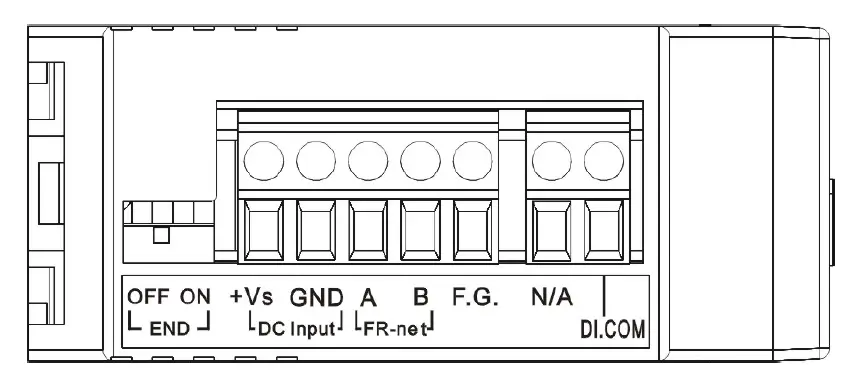
- OFF(END) : 120R terminating resistor Disable
- ON(END) : 120R terminating resistor Enable
In additional to these connectors, there is also one switch on the side of the module which can decide to use the internal terminal resistor on the network or not. If you switch it on, it means that the module will provide the terminal resistor on the network. Note that each network needs two modules to be on, which are usually the first and last module on the network.
- +Vs(DC Input) : Power input (+10 to +30V) and should be connected to the power supply (+)
- GND(DC Input) : Ground and should be connected to the power supply (-)
- A(FR-net) : Communication line “A(Data+)”
- B(FR-net) : Communication line “B(Data-)”
- F.G. : F.G. stands for Frame Ground (protective ground). It is optional. If you use this pin, it can reduce EMI radiation; improve EMI performance and ESD protection.
- DI.COM : Common Power for NPN type. Common Ground for PNP type.
LED indicator:
There are several LED indicators located on the top side of the module. They are Power LED, Communication Run LED, Communication error LED, I/O LED and termination resistor LED. Users can understand the meaning directly from the label on the LED indicator. Note that the Communication Run LED and the Communication error LED illustrate whether the quality of communication is OK or not.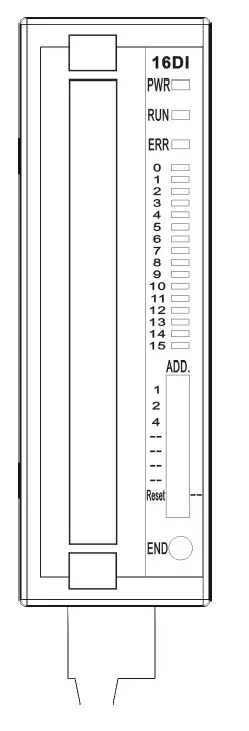
| LED Mapping | |
| PWR | Power LED |
| RUN | Communication Run LED |
| ERR | Communication Error LED |
| 0 | CH _0 Status LED |
| 1 | CH _1 Status LED |
| 2 | CH _2 Status LED |
| 3 | CH _3 Status LED |
| 4 | CH _4 Status LED |
| 5 | CH _5 Status LED |
| 6 | CH _6 Status LED |
| 7 | CH _7 Status LED |
| 8 | CH _8 Status LED |
| 9 | CH _9 Status LED |
| 10 | CH _10 Status LED |
| 11 | CH _11 Status LED |
| 12 | CH _12 Status LED |
| 13 | CH _13 Status LED |
| 14 | CH _14 Status LED |
| 15 | CH _15 Status LED |
| END | Terminal resistor On |
Pin Assignment and I/O wire connection 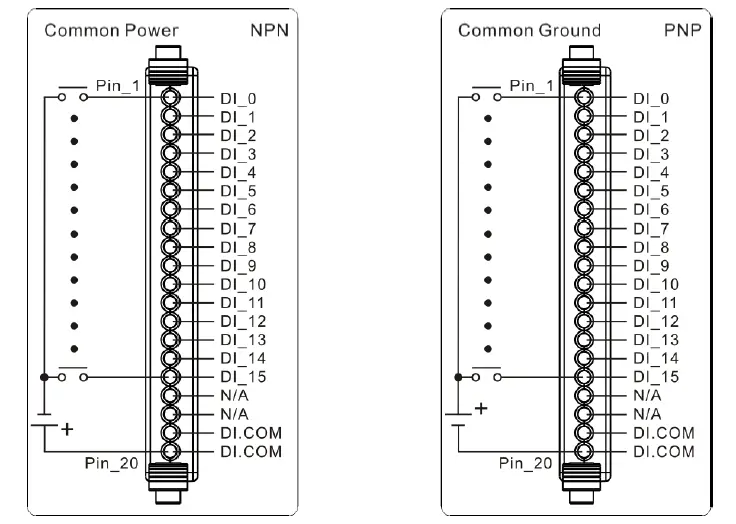
Address Setting
Receiver address setting :
Since the FR-2053TA is a digital input module, the module can only configure the sender address (SA) by the dip-switch, as shown in the following figure. This means that the FR-2053TA can only transmit 16-bit data of the digital input circuit to the node of the corresponding receiver address. The configuration method is depicted in the following figure: 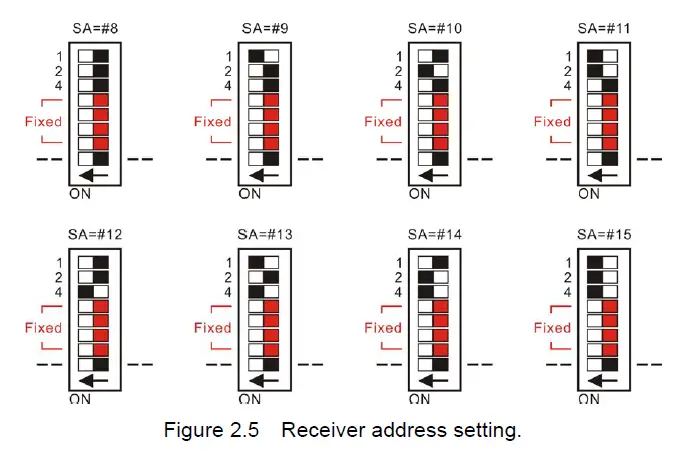
FRnet Application Structure
Within conventional communication methods in the control network system, the master (host) controller (CPU) must send a command with data to the slave module. Then it must wait for confirmation from the slave’s response, which is based on a complicated and fixed transmission protocol. If there are many devices on the network, all the data transmission within the network must be controlled by the master (host) controller (CPU). Therefore, the performance of communication efficiency between the host controller and each of the devices will usually be deteriorated when more and more devices are added in. In contrast to this solution, our FRnet provides innovative data transmission method which adopts the hardware FRnet control chip to do communication broadcasting and gets rid of the software transmission protocol. It is easy to set up a reliable network merely by hardware setting both the “Sender Address” and “Receiver Address” of all the modules.
There are two FRnet host controllers provided by ICPDAS products, the FRB-100/200/200U and the 7188EF-016. The first one is a PCI interface add-on card, and the other one is an Ethernet embedded controller. Two possible application configurations are demonstrated as follows.
Case 1: If the PC-based FRB-200(U)/100 is used as the host controller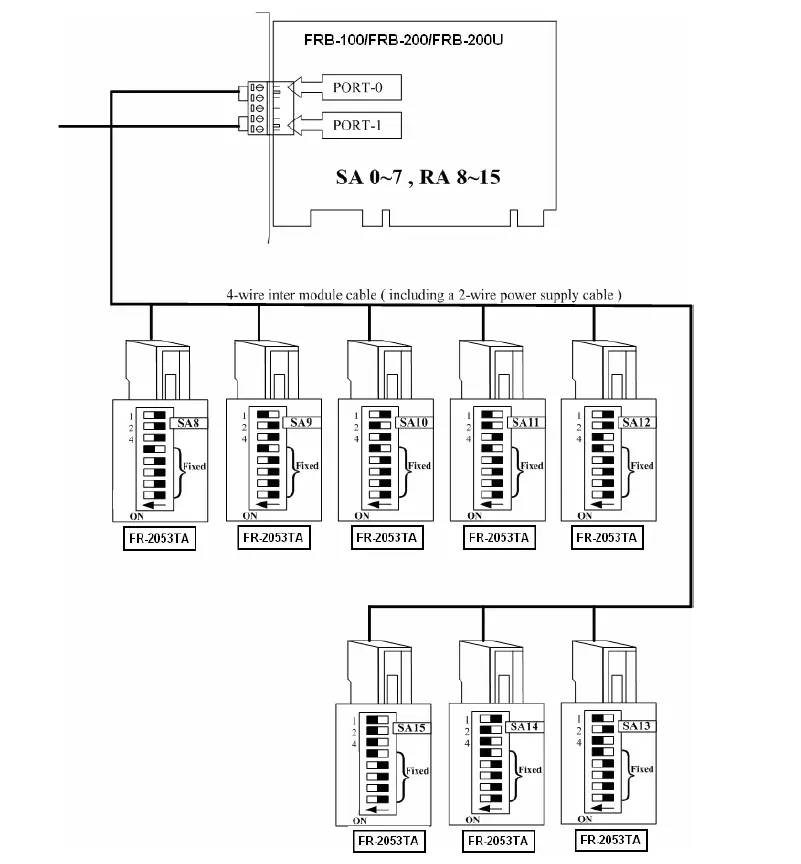
Case 2: If the embedded controller i-7188EF-016 is used as the host controller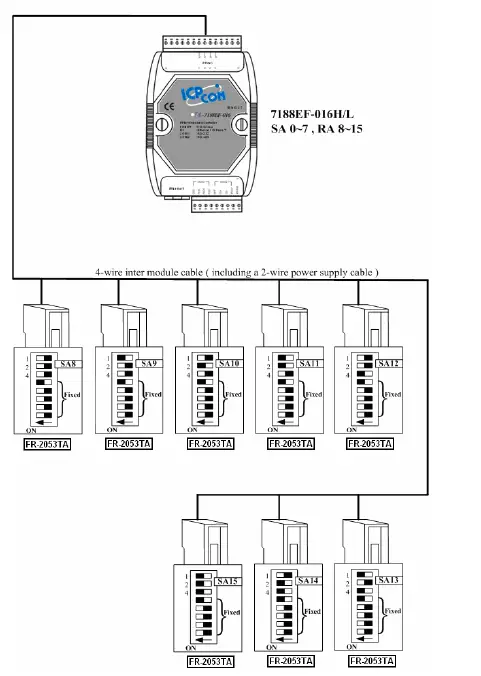
Dimensions
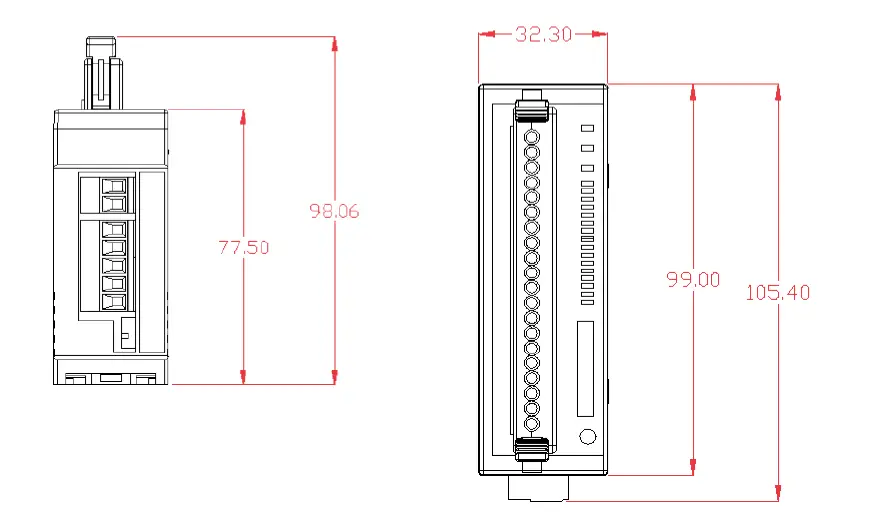
Unit: mm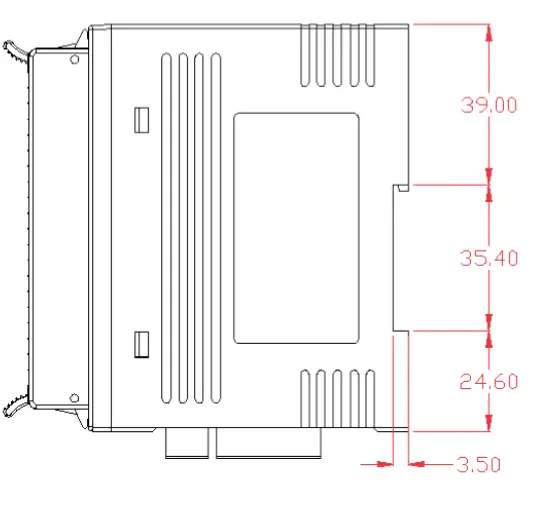
FR-2053TA User Manual (Ver 1.1 , Jan/2008 ) —— 16
 www.di.com