 User Manual
FS19S
Passive Entry / Passive Start
radio identification devices
Passive Entry Passive Start Radio Identification Devices
This document is confidential. Its contents are not to be exploited, passed on, or disclosed to third parties without our express permission. All rights are reserved.
FS19S family overview
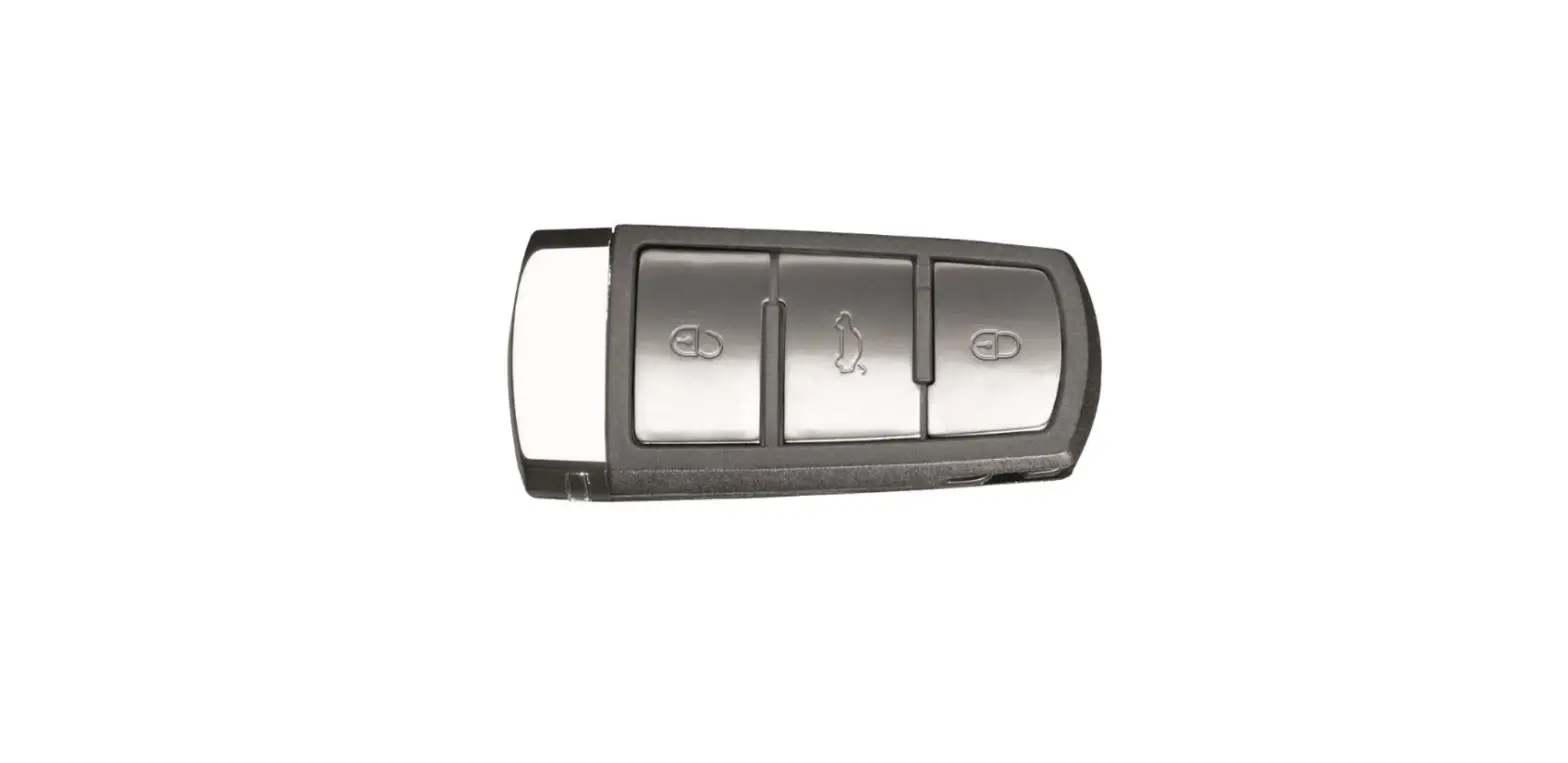
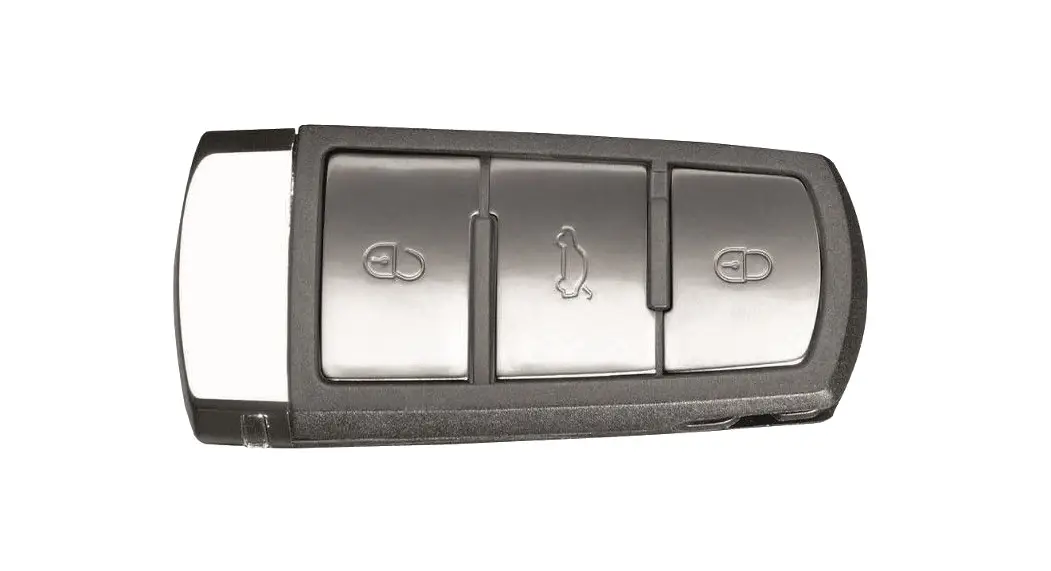
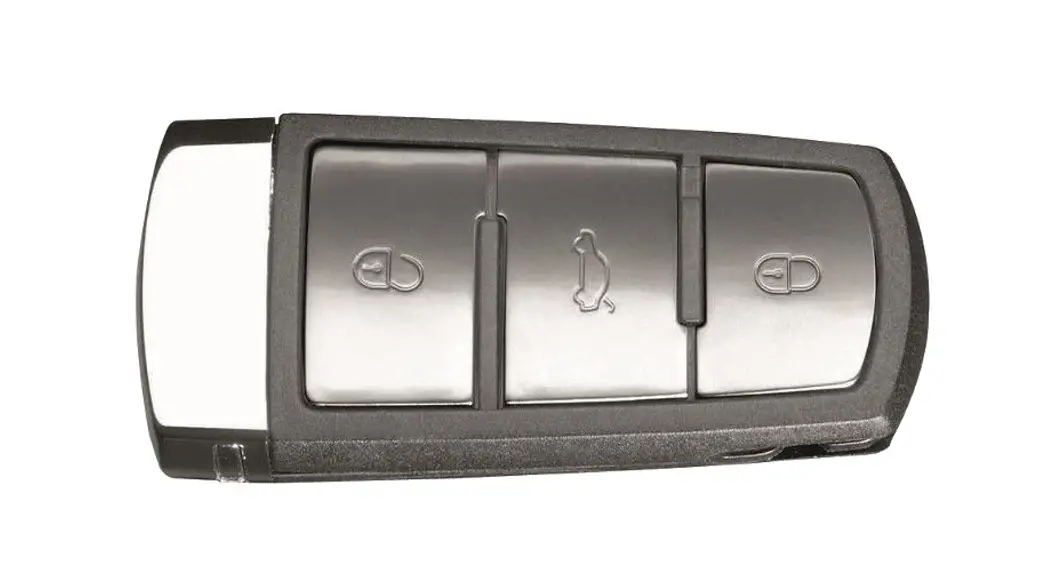
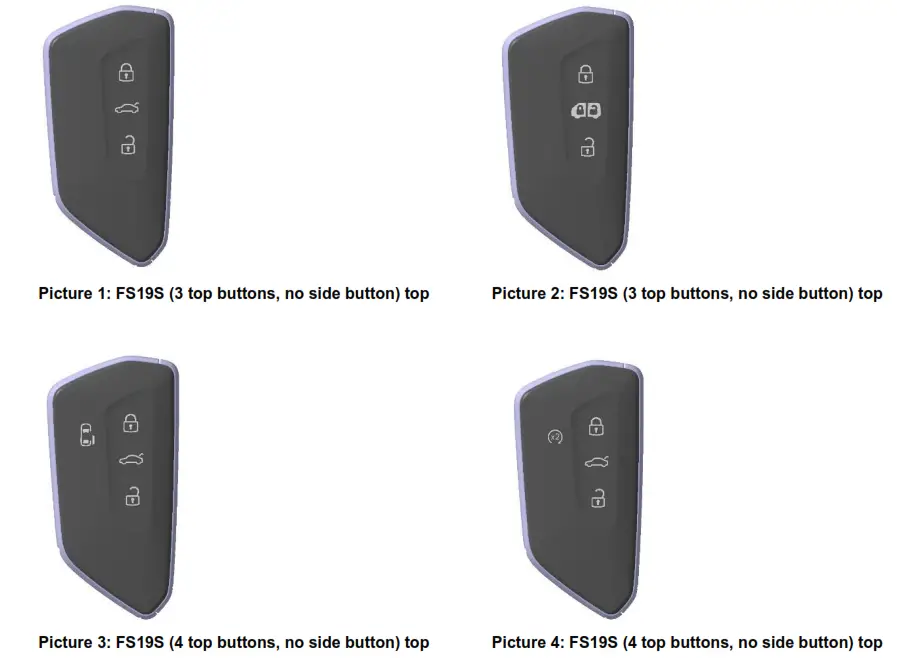
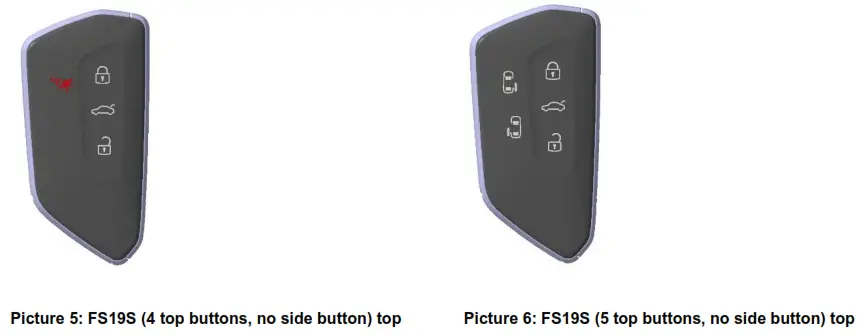
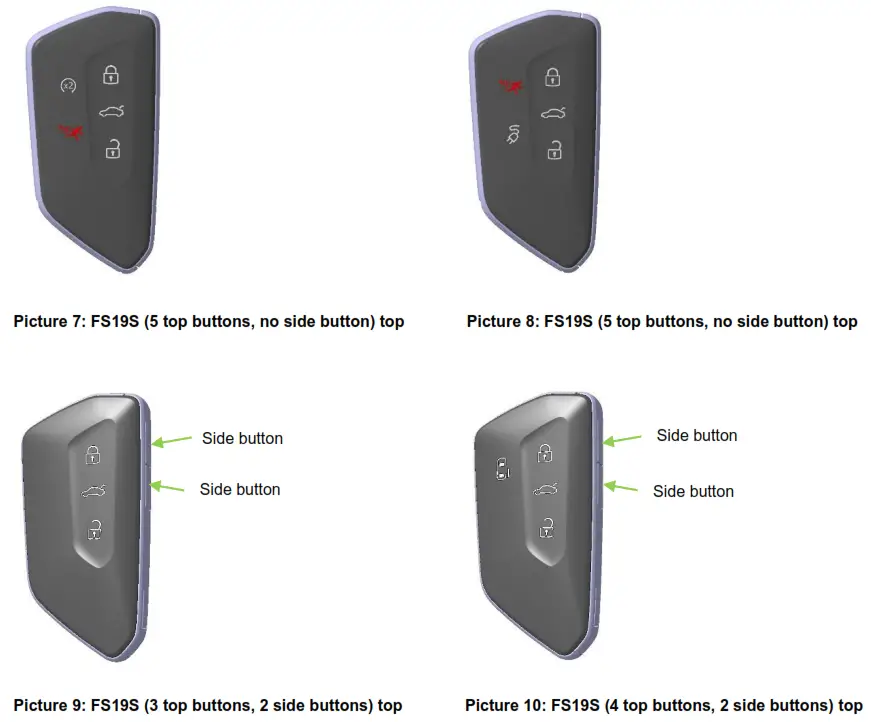
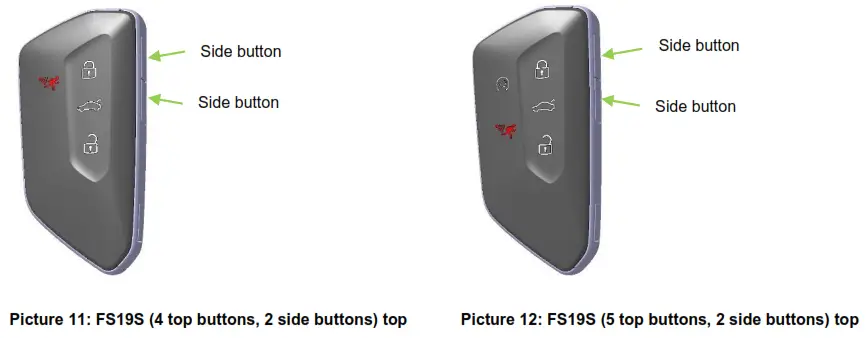
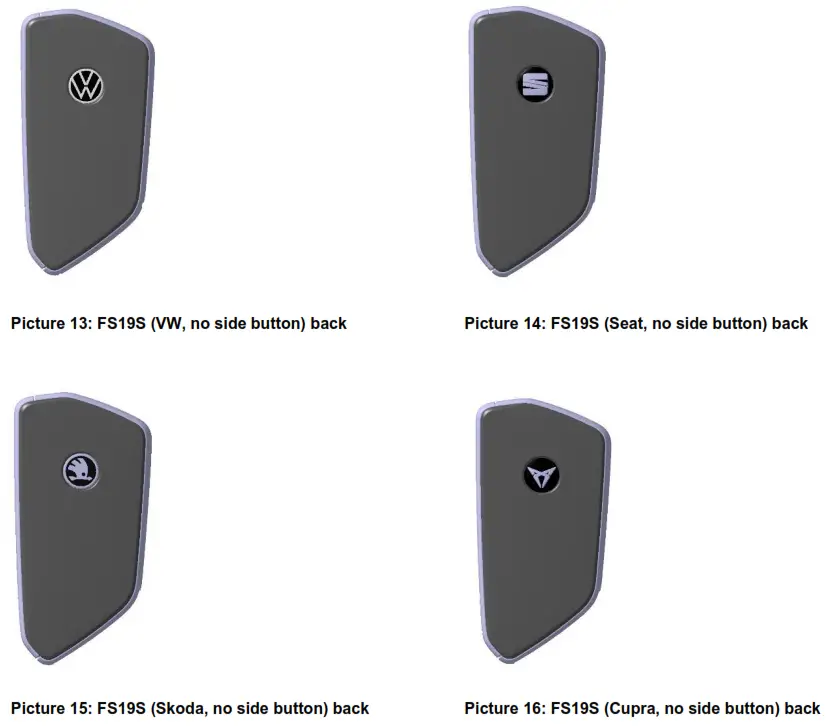
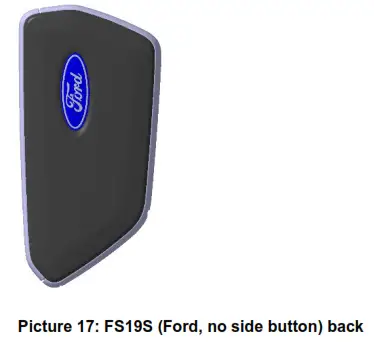
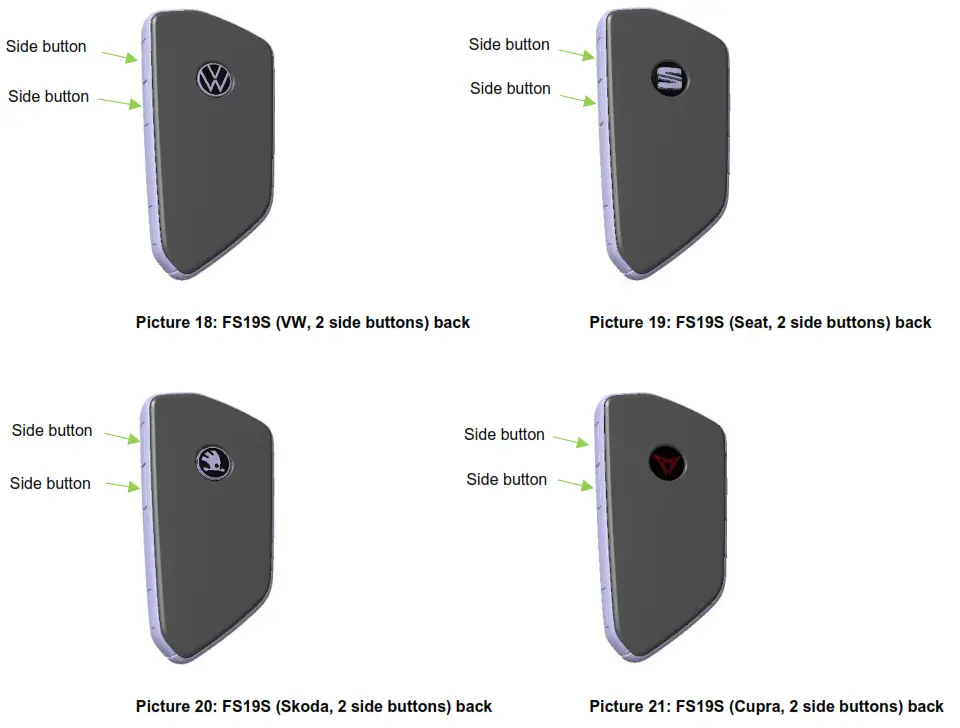
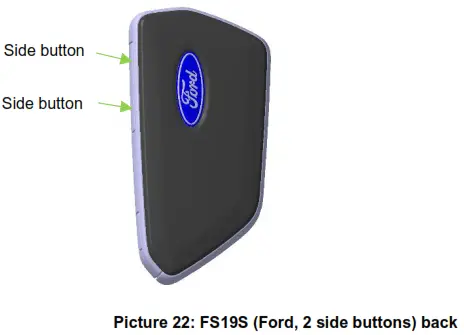
This document is to describe the FS19S family of Radio Identification Devices (RID) intended for use in automotive Passive Entry / Passive Start systems. All family members use the same PCB layout and basic type of housing. There are different variants regarding the number of buttons, finish of the housing, labeling of the housing, etc. Images of the devices are given in chapter 5.
Safety warnings and precautions
 Do not ingest battery, Chemical Burn Hazard
This product contains a coin/button cell battery. If the coin/button cell battery is swallowed, it can cause severe internal burns in just 2 hours and can lead to death.
Keep new and used batteries away from children. Should a child swallow a battery, consult a physician immediately.
If the battery compartment does not close securely, stop using the product and keep it away from children.
If you think batteries might have been swallowed or placed inside any part of the body, seek immediate medical attention.
CAUTION
Risk of explosion if the battery is replaced by an incorrect type
Keep batteries away from direct sunlight, high temperature, and high humidity
Please be sure to observe the following warnings. As batteries contain flammable substances such as lithium or other organic solvents, they may cause heating, rupture or ignition
Warning
- Do not charge, short, disassemble, deform, or heat batteries. Do not throw batteries into fire.
- When discarding batteries, insulate the positive and negative terminals of batteries with insulating tape, etc. When disposed of improperly, lithium batteries may short, causing them to become hot, burst, or ignite.
Caution
- Be sure to connect the positive and negative electrodes correctly.
- Avoid mixed use of batteries, i.e. new, used or different types.
- Avoid direct soldering to batteries.
Communication technologies
There are three basic communication technologies implemented in the FS19S devices:
- Low Frequency (LF) communication, is used for waking up the devices and for communication with the immobilizer system of the vehicle
- RF (UHF) communication, used for communication between radio identification devices and vehicle
- Ultra Wide Band (UWB) communication, is used for range operations. UWB is an option that will not be present in all FS19S variants manufactured.
FS19S Technical data summary
| Markets | USA, Canada | |
| Model name | FS19S | |
| DC Supply voltage range | Approx. 2.2V to 3.2 V | |
| Technology | ||
| RF (UHF) | Number of RF channels (1) | 3 |
| RF channel frequencies (1) | 433.46 MHz 433.92 MHz 434.36 MHz | |
| RF radiated power | Approx. 78 dBpV/m A 3m (average) | |
| Mode of operation | Simplex TX only (RKE mode) Half duplex TRX (PKE mode) | |
| Modulation method | FSK (F1D) | |
| Frequency deviation | +/- 7.8 KHz (RKE mode) +/ – 20 KHz (PKE mode) | |
| Data rate | 7.8 Kbit / s (RKE mode) 19.2 Kbit / s (PKE mode) | |
| RF Antenna | Integrated PCB loop | |
| LF | Operating frequency | 125 kHz |
| Modes of operation | LF detector Passive Transponding | |
| WEB | Operating frequencies | 6.52GHz 7.04GHz 7.56GHz |
| Mode of operation | Half duplex (TRX) | |
| Modulation method | FSK Impulse radio | |
| UWB antenna | Integrated monopole | |
| -10dB RF bandwidth | approx. 500 MHz | |
| Spectral power density | approx. -41.3dBm / MHz | |
(1) Not all channels may be used for every RF mode of operation
Table 1: Versions of Hella FS19S
FS19S pictures
The following illustrations show the exterior view of the FS19S devices.
The images are exemplary, other designs e.g. with fewer buttons or fewer side buttons or different button labels or different button positions or different colors or different customer labels,s or different finishes may exist.
FS19S Modes of operation
The following chapters describe the modes of operation that can be carried out by the FS19S devices.
6.1 Remote keyless entry (RKE)
The Remote Keyless Entry (RKE) functions enable the user to control the central locking system and other functions of a vehicle from a distance. It is always manually activated by pressing one of the buttons on the device. When activated, the device will transmit a sequence of RF messages on two of the available RF channels.
6.2 Keyless Entry / Keyless Go (PKE)
Keyless Entry / Keyless Go functions allow the user control of the central locking system and engine start / stop without manual operation of the key. For these functions, the devices can be woken up by a 125 kHz low frequency (LF) signal generated by the vehicle. For recognition of LF signals, the devices contain a set of 3 orthogonal sensor coils (LF antenna array) and a detection circuit that is integrated into the main μC. For Keyless Entry / Keyless Go functions RF communication takes place in half-duplex mode on two of the available RF channels.
6.3 Transponder mode
The transponder mode serves as a backup means for communication with the immobilizer system if the Keyless Go function is not available for any reason. In transponder mode, the device is supplied from the magnetic field generated by the immobilizer system of the vehicle and communicates with the vehicle using damping modulation. The nominal working frequency of the transponder system is 125 kHz. No active RF communication is used in transponder mode. Therefore, the device does not generate or emit any RF energy in this mode.
6.4 Ranging mode
In ranging mode, the devices communicate with the vehicle-mounted parts of the system using ultra-wideband (UWB) modulation. Due to the very high bandwidth of the signal, it is possible to determine the distance between the identification device and the vehicle.
Statement:
This device complies with Part 15 of the FCC Rules. Operation is subject to the following two conditions:
- this device may not cause harmful interference, and
- this device must accept any interference received, including interference that may cause undesired operation.
Processed:
O. Kushova E-CA-D-HW
Dr. F. Panhwar E-CA-D-HW
Revision: 1.2