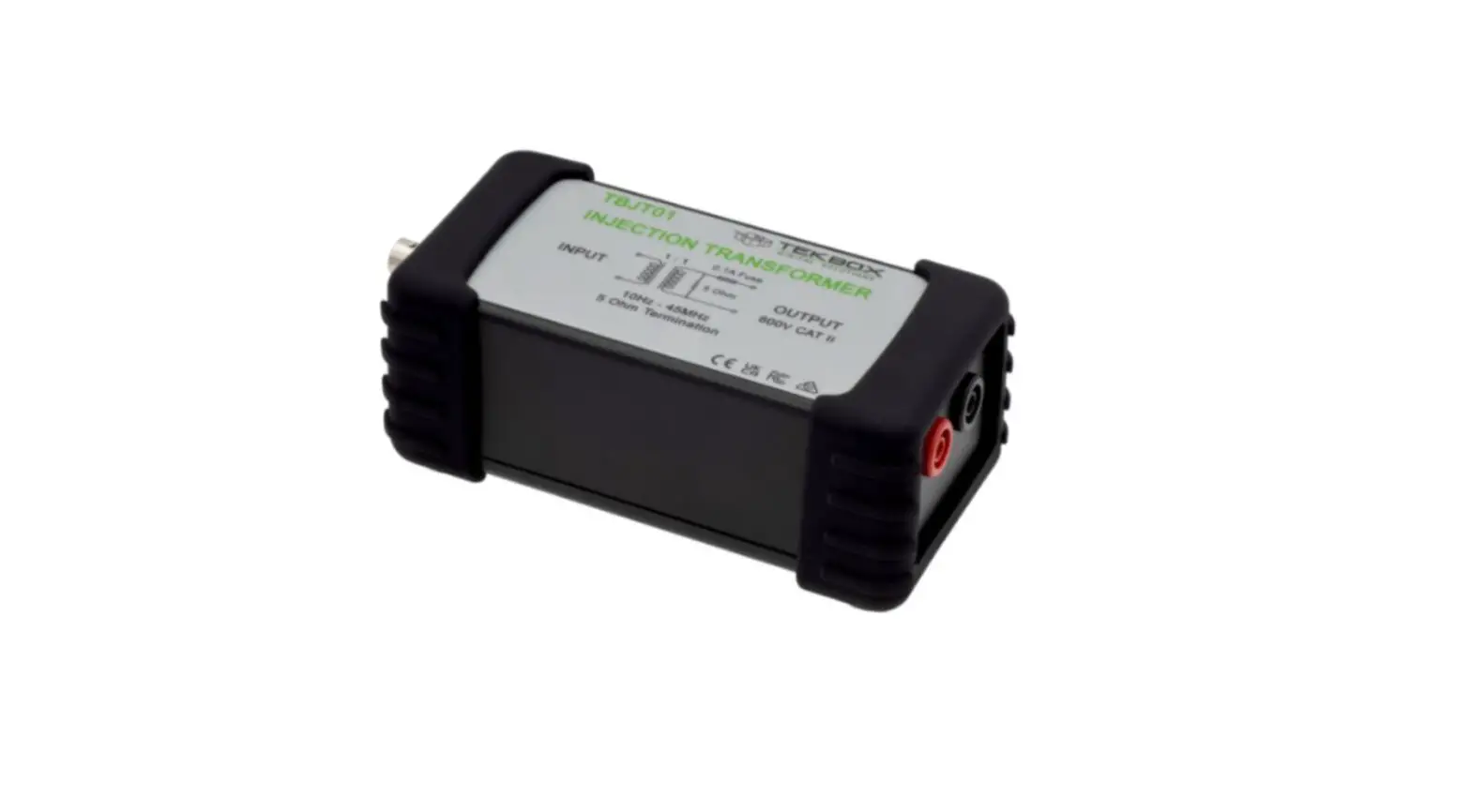
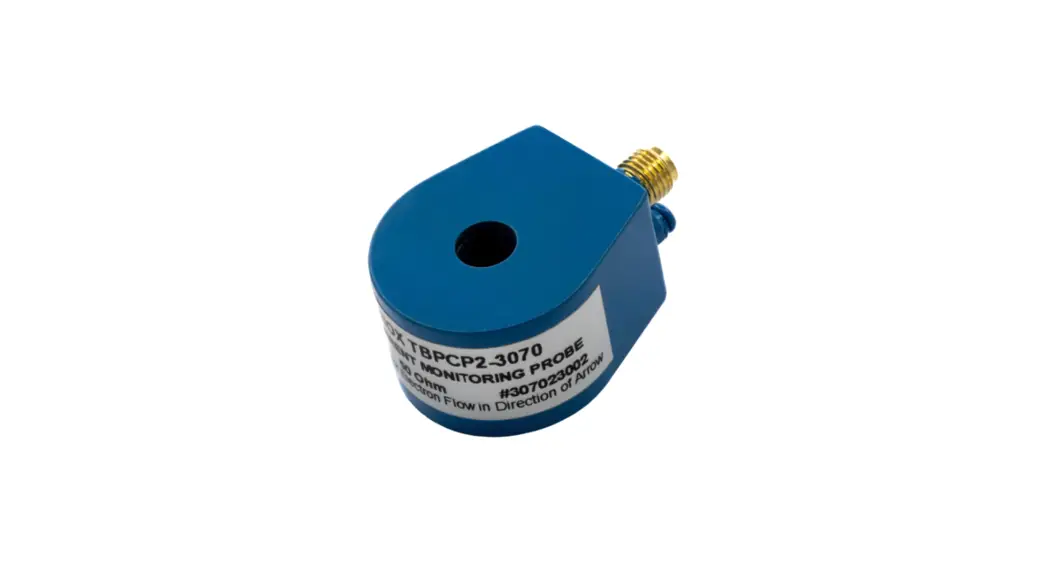
TBJT02 Injection Transformer
Product Information
The TBJT02 is a wideband injection transformer designed for
control loop stability measurements. It provides galvanic isolation
between the swept signal source and the control loop. The injection
transformer is internally terminated with a 5 Ohm resistor and
protected with a 100 mA fuse. It has a usable frequency range of 1
Hz to 7 MHz and a turns ratio of 1:1. The insertion loss is 16 dB
typ. and it has a DC saturation current of 12 mA. The input
connector is a 50 Ω BNC female, while the output connector is 4 mm
safety banana jacks with 20 mm spacing.
Specifications
- Compliance: RoHS
- Termination resistor: 5 Ω
- Fuse: 100 mA (Littlefuse 0451.100MRL); secondary (output)
side - Characterized frequency range: 1 Hz to 100 MHz
- Insertion loss (S21): 16 dB typ.
- Capacitance: 310 pF @ 1 Khz; primary to secondary winding
- DC saturation current: 12 mA
- Max. voltage rating: 600V CAT II; primary to secondary
winding - Input connector: 50 Ω BNC female
- Output connector: 4 mm safety banana jacks, 20 mm spacing
- Enclosure dimensions: 70 mm x 60 mm x 140 mm
- Weight: 300 g
Frequency Response
Figure 1 shows the typical insertion loss of the TBJT02
injection transformer.

Product Usage Instructions
To use the TBJT02 injection transformer, follow these steps:
- Break the control loop at the point between the amplifier
output and the input of the feedback network. - Insert the isolation transformer into the control loop.
- Connect the TBJT02 injection transformer to the
BodeAnalyzer. - Adjust the BodeAnalyzer to sweep the desired frequency
range. - Measure the control loop stability using the BodeAnalyzer and
the TBJT02 injection transformer.
It is important to note that the usable frequency range of the
TBJT02 injection transformer is 1 Hz to 7 MHz, and it is internally
terminated with a 5 Ohm resistor and protected with a 100 mA fuse.
The input connector is a 50 Ω BNC female, while the output
connector is 4 mm safety banana jacks with 20 mm spacing.
V1.0
TBJT02
Injection Transformer
1 Introduction
The TBJT02 is a wideband injection transformer for control loop stability measurements. It provides galvanic isolation between the swept signal source and the control loop. The injection transformer is internally terminated with a 5 Ohm resistor and protected with a 100 mA fuse. The usable frequency range is 1 Hz to 7 MHz.
Picture 1: TBJT02 injection transformer
2 Specification
Compliance:
RoHS
Termination resistor:
5
Fuse:
100 mA (Littlefuse 0451.100MRL); secondary (output) side
Turns ratio:
1:1
Characterized freq. range: 1 Hz to 100 MHz
Usable frequency range: 1 Hz 7 MHz
3 dB frequency range: 2 Hz 3 MHz typ.
Insertion loss (S21):
16 dB typ.
Capacitance:
310 pF @ 1 Khz; primary to secondary winding
DC saturation current: 12 mA
Max. voltage rating:
600V CAT II; primary to secondary winding
Input connector:
50 BNC female,
Output connector:
4 mm safety banana jacks, 20 mm spacing
Operating temp. range: 0°C 60°C
Enclosure dimensions: 70 mm x 60 mm x 140 mm
Weight:
300 g
1
V1.0
TBJT02
Injection Transformer
3 Frequency response
Figure 1: typical insertion loss
4 Application
The control loop is commonly broken at the point between the amplifier output and the input of the feedback network:
The isolation transformer is inserted into the control loop and connected to the BodeAnalyzer:
2
V1.0
TBJT02
Injection Transformer
5 Ordering Information
Part Number TBJT02
Description 1 Hz 5 MHz injection transformer
6 History
Version Date
V 1.0
18.2.2023
Author Mayerhofer
Changes Creation
www.tekbox.com TekBox Digital Solutions Vietnam Pte. Ltd. Factory 4, F4, Lot I-3B-1, Saigon Hi-Tech Park, Tan Phu Ward, District 9, Ho Chi Minh City, Vietnam
3
 Tekbox Digital Solutions |