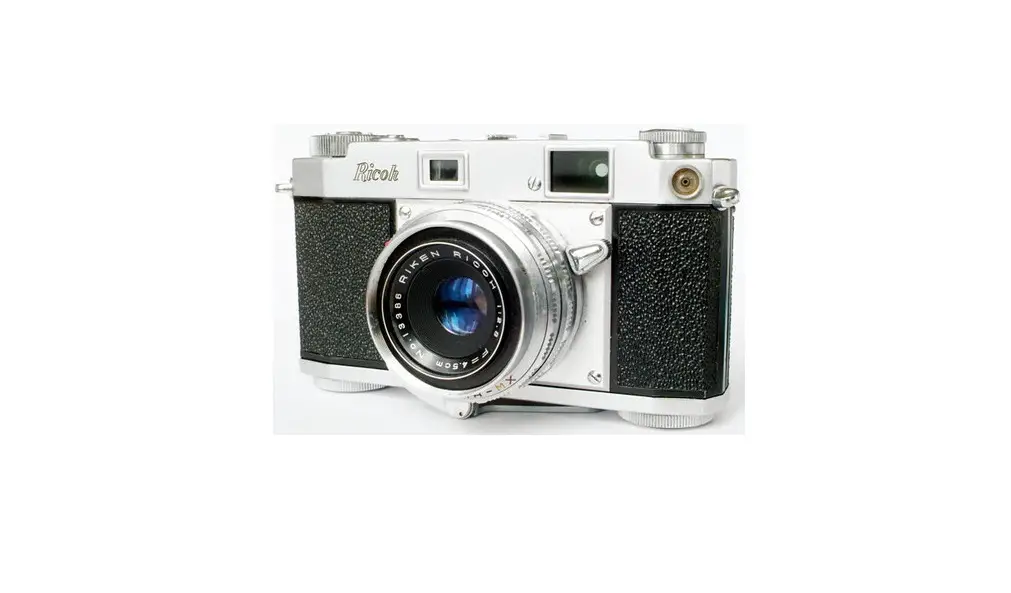
VITO Automatic Camera
Product Information: VITO automatic Camera
The VITO automatic camera is an optical and mechanical precision
instrument that is easy to use and provides perfectly exposed
shots. It has a distance scale with a milled setting ring, a film
speed scale for DIN and ASA ratings with milled setting rings, a
honeycomb window of exposure meter cell, a film type indicator in
the rewind knob, a threaded socket for cable release or self-timer,
a flash socket, an aperture scale for flash shots at 1/ second, a
B-setting for long time exposures at full aperture, a tripod bush,
and a film counter with a milled setting button. The camera has a
brilliant frame in the viewfinder that outlines everything that
will be captured on the film.
Product Usage Instructions:
- Open the four folded pages of the user manual to the top and
bottom for clear and labeled illustrations. - Set the film speed in ASA or DIN when loading the film.
- Estimate the distance in feet between the camera and the
subject and set this distance on the camera by turning the scale
(1). - For portraits, groups, or views, set one of the three red marks
on the scale (1) opposite the black triangle according to the
subject in front of the camera. - Set the control ring (5) to AUTO.
- Look through the viewfinder and watch the exposure indicator
above the brilliant frame. If the field is GREEN, press the release
to take the picture. - If the field turns partly RED, the available light is no longer
adequate for a correctly exposed shot. You can still take a picture
after all and risk a certain degree of underexposure. If the field
is completely RED, no acceptable picture is possible. - To take a picture, the shutter must always be tensioned. Pull
the rapid winding lever (21) fully to the right to advance the film
and the film counter.
E
INSTRUCTIONS FOR USE
When reading this booklet open up th e four folded pages to the top and bottom . The clearly labelled illustrations will show you exactly what is what. The reference numbers occur In brackets ( ) throughout the text.
Dear Amateur,
Don ‘t be afraid that we shall worry you in this little booklet on the ” VITO automatic” with technicalities of photography. There is no need for thot. Just a few words are enough to make you familiar with the camera, and to tell you how quickly and simply you can get perfectly exposed shots – even if you have never taken a picture before.
One more point right at the start: the “VITO automatic” is a very robust camera, but nevertheless an optical and mechanical precision instrument. So handl e it gently and sensibly – and you will be- sure of perfect pictures for many years to come.
VOIGTL AND ER A. G . BRAUNSCHW E IG
VITO automatic
Distance scale with milled setting ring
2 Film speed scale far DIN ratings with milled setting ring
3 Lacking key for adjustment of the film speed setting ring
Back lack
Control ring set to · AUTO’
Release
7 Honeycomb window of exposure meter cell
Film type indicator in rewind knob
9 Film speed scale far ASA ratings with milled setting ring
10 Threaded socket for cable release or self-timer
11 Flash socket
12 Aperture scale for flash shots at 1/” second
13 B-setting for long time exposures at full aperture
14 Tripod bush
15 Film counter with milled setting button
View Th rough
the Finder
·
– and Shoot …
. .. that is all you have to do to take pictures with the “VITO automatic”.
Look through the finder, and shoot – after you have set the film speed in ASA or DIN (that you do when you load the film). The camera automatically looks after the correct exposure for your pictures.
However, there is one small matter which even the best automatic system cannot do for you: setting the distance. So before shooting you simply estimate the distance in feet between the camera and the subject, and set this distance on the camera by turning the scale (1 ).
If you are not very good at guessing, or for action shots, you only have to set one of the three red marks on the scale (1) opposite the black triangle . , according to the subject in front of the ca”mera :
·
PORTRAITS
V o
GROUPS = VIEWS
– 2-
E
· .. and Now Shoot
The control ring (5) must be set to “AUTO”. Then iust look through the finder ond wotch the exposure indicotor a bove the brilliant frame: if the field is “GREEN”, press the release to take the picture.
Go ahead – shoot
Note: If the field turns partly “RED”, the available light is no lo nger adequate for a correctly exposed shot. However, as the release is deliberately left unblocked, you are still free to decide whether you want to take 0 picture after all and risk a certain degree of underex posure. If the field is com pletely ” RED”, no acceptable picture is possible.
To toke a picture the shutter must always be tensioned. So pull the rapid winding lever (21) fully to the right. This at the same time advances the film and the film counter.
– 3-
E
Exposure just possible
Exposure no longer possible
The Brilliant Frame
in the viewfinder clearly and accurately outlines everything you get on the fi lm. The field within the bright reflected frame also shows the subiect in natural size, so that you can keep bath eyes open while viewing. Thus yau have a clear view also over the surroundings of the subiect.
The dot indicates the centre · of th e subject field . With near views at about 3’/. feet the limits of the field of view are displaced downwards or sideways, according to whether you hold the camera horizontally or upright. It is shown by the two short lines on the brilliant image frame.
-4 –
VITO automatic
~
Setting the Film Speed
~
Inserting the Cassette
~ Setting the Film Counter
Now that you kn ow how beautifully
easy picture taking is with the · VITO
~
Unloading the Film
automatic·, we shall show you how to
load and unload the film.
~
Shutter Speeds
Further, you can olso read more about
~
Flash Shots
the scope of your camera and about
accessories available for it.
~
Camera Accessories
-5-
E
Setting the Film Speed
Make it a rule to set the film speed on the shutter (in ASA or DIN, a s marked on the film packing) before loading a film cassette into the camera. Correct exposures depend on this setting.
The scales for the ASA and DIN ratings are on the ring (9) or (2) . To set the speed, press the small key (3) and at the same time rotate the large milled ring, to bring the red dot on this ring opposite the ASA or DIN figure corresponding to the film loaded.
The speed ratings for colour reversal film apply to bright sunny weather. In dull weather and for subjects of law contrast colour reve rsal film has a lower effective speed. So carefully note the instructions enclosed with every. colour reversal film. If these instructions give no specific recommendations and you are shooting with an overcast sky, set the scale (9) or (2) to a speed two divisions lower than indicated on the film packing . In very dull weathe r use a setting three to five divisions lower. In very bright sunlight – especially in high mountains and at the sea side – set the film speed two to three divisions higher.
Note : These corrections apply only to colou, ,eve,sal films for making colour slides. Black-and-white and colour negative films need no correction .
-6-
Inserting the Film Cassette
Press together the locking catches (4) and open the camero bock. Push the film reversing lever (20) to the left. The rewind knob (19) springs up; pull it out fully (see Fig. III) .
AnchoJ the beginning of the film into the hook (23). Draw the cossette across the film track and insert it into the cassette chamber. Now tur n the milled ring at the bottom of the take-up spool until two teeth of the film sprocket engage two film perforations (22) and fully push back the film rewi nd knob (see Fig. IV). Then cl ose the camero back.
-7-
You can load with any make of perforated 35-mm. film on the market. The usua l daylight cassettes yield 36 or 20 exposures 36x24mm. – in black-andwhite or in colour.
The cassettes are light-tight. Nevertheless, do not expose them to strong light. Above all always load and unload the camera in the shade – even the shadow of your awn body will do.
Setting the Film Counter
Turn the milled button (15) until the mark . (a) –
for a 36-exposure cassette – or the mark 0 (c) –
for a 20-exposure cassette – is opp osite the red dot. Then alternately work the rapid winding lever and the release until the film counter indicates No. 36 (b) or 20 (d) respectively.
The film counter now automatically shows the numbe r of frames still available every time you advance the film. It thus runs backwards towards No . 1.
The Film Type Indicator (8)
is only intended as a memory aid to remind you of the type of film you have loaded. It does not affect the exposure in any way. Set the film indicator before loading the film (with the rewind knob fully extended ) by turning the disc as follows :
– 8-
‘*~
= Black-and-white film
Daylight type colour film
0- = Artificial light type colour film
Unloading the Film
Push the reversing lever (20) to the left. This extends the rewind knob (19).
Now turn this knob in the direction of the arrow until the · or <:) mark
reappears in the window of the film counter (15). Then open the camero back, fully pullout the rewind knob, and remove the cassette.
Changing Partly Exposed Films
With the · VITO automatic· you can always unload a partly exposed film in the middle and change it for another one (for example to change from blackand-white to colour film).
Note the number of the last exposed frame (write it dawn, if possible), and rewind
the partly exposed film into its cassette as described above . When reloading this film
later on, proceed as already indicated up to the point of setting the film counter to
the . or 0 mark. Then press the release , let go, press dawn again and keep it pressed
down. Ke:e;t on pulling out the rapid winding lever as for as it will go until the film
caunte..
S’ the number of the frame you noted before. Now let go off the release,
work the rapid winder once more, and you can carryon shooting.
-9-
Shutter Speeds
The camera works at a fixed shutter speed at every fi lm speed setting :
ASA/DIN t orresponds to
12112 1130
25115 1160
50/18 111 25
100’21 11250
200/24 1/500 second
With the control ring set to ·AUTO’ you therefore always shaot at the shutter speed
carresponding to the ASA ar DIN speed of your film. Intermediate ASA or DIN settings yield intermediate shutter speeds.
Keep in mind that fixed relationship between the shutter speed and film speed setting ,
especially when you want to take fast moving subjects (for example sports shots) . In such cases it is therefore best to use a fast film .
Time exposure s. When you set the control
ring to the green letter B (13), the automa-
tic control system is disengaged. On pressing the release, the shutter o pens and
B
remains open as long as you keep the
release depressed . The lens then always
works at its full aperture (fl2.8).
For such long time exposures you must mount the camera on a firm support (tripod ,
table, etc.) and expose with cable release, this screws into the threaded socket below the release.
– 10 –
Flash Shots
are nat only suitable for evenings at home and for really live shots and parties and other festive occasions, but also provide attractive sunlight effects with outdoor portraits on dull days. When shooting against the light, fill-in flash can also illuminate deep shadows.
For flash shots turn the control ring to the red flash range (12). This again disengages the automatic control system, but the shutter is now set to ‘ /.. second with any of the red apertu re figures. This is suitable for synchronising all flash bulbs and electronic flash units on the market.
Mount the flash gun in the accessory shoe on the top of the camera and plug the flash cable from the gun into the socket (11). The flash bulb packing usually gives exposure data for the correct aperture in the form of so-called guide numbers. The correct aperture is obtained by dividing the appropriate guide number by the distance from the flash to the subject.
In brief : aperture = guide numbe r : distance.
– 11-
U seful and Handy Accessories
· The lens hood not only cuts out stray side light (which can give rise to reflectians and reduced brilliance) but also protects your precious lens against rain and snaw.
· Naturally you can alsa use filters with yaur “VITO autamatic” . A well-graded selection of Vaigtlonder filters is available far black-and-white and calour films.
· If yau find estimating distances difficult, the accessory Voigt/onder rangefinder does the job for you.
· Voigtlonder also make a f lash gun. With this you can take fascinating .shots indoors, in dull light, and even at dusk. The flash gun provides all the light you need for the exposure and helps you capture live and natural scenes .
· Our special leaflet, “The Complete Art of Picture Shooting”, gives you detailed information on all camera accessories. Your photo dealer will be glad to reserve a copy for you .
– 12 –
Care of the Camera and Lens
Successful results with, and long life of, your va luable camera largely depend on proper care and correct operation.
So always handle the camera gently and never use force.
Protect the camera against hard knocks, and do not drop it. When you are travelling by car, do not keep the camera in the glove compartment. In the long run the vibration there may harm the photo-e lectric exposure meter.
Clean the lens only with a soft, fluffless cloth . First carefully dust off coarse particles of grit (or sand at the sea side) with a soft sable brush. Fingermarks and other traces of grease on the lens surface or the finder window can be removed with a piece of cotton wool moistened with pure alcohol or ether.
This camera – like ather Vaigtlander products is accompanied by a GUARANTEE CERTIFICATE. Please make sure that your photo dealer fills in and stamps the certificate when you buy the camera. Then you can be sure of free repair and servicing at our works or through our agents in the case of any defect arising within the guarantee period laid down by us (see the guarantee certificate).
However, keep this guarantee certificate even after the expiry of the guarantee period. For if you should ever lose your camera, the serial number of the camera and lens noted in the certificate may help you towards recovery.
VITO automatic
16 Viewfinder eyepiece
17 Film track
18 Casselle chamber
19 Rewind knob, lu Ily extended
20 Film reversing lever
21 Rapid winding lever lor tensioning the shutter and advancing the lilm
22 Film transport shaft
23 Take-up spool with hook for attaching the fi lm leader
24 Shaft of rew ind knob, must engage the cassette spaol
25 Rewind knob, pushed into camera body
· .. and to show your lovely colour shots you must of course have a Voigtlander projector – fully equal in performance and finish to the Voigtlander cameras.
because the lens is so good