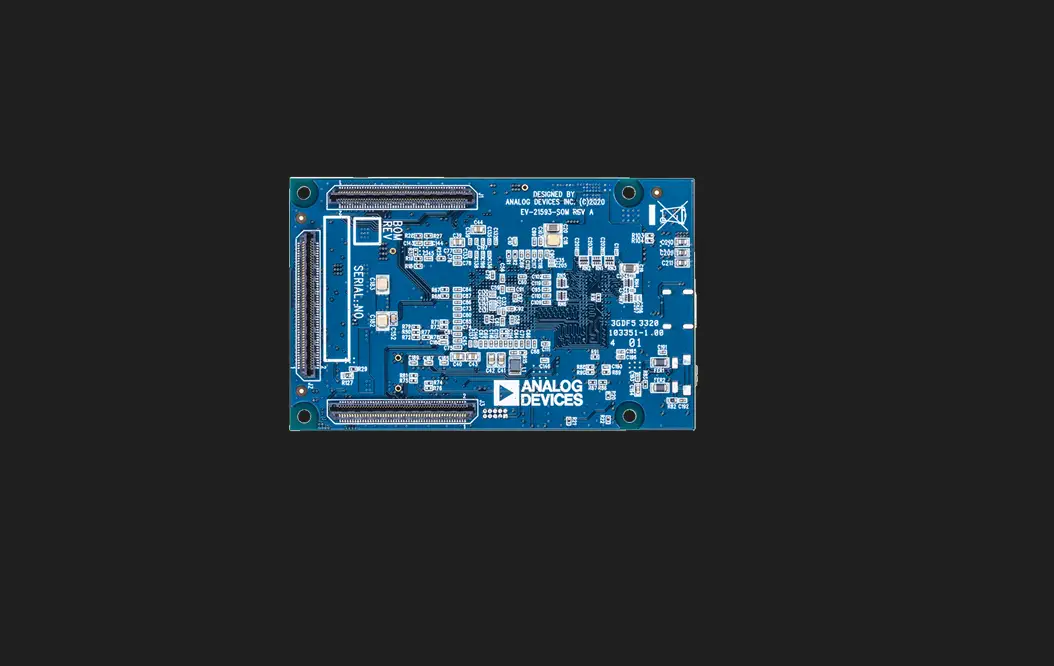
STEVAL-AKI002V1 Evaluation Board for ADC1283 Analog to Digital Donverter
Product Information
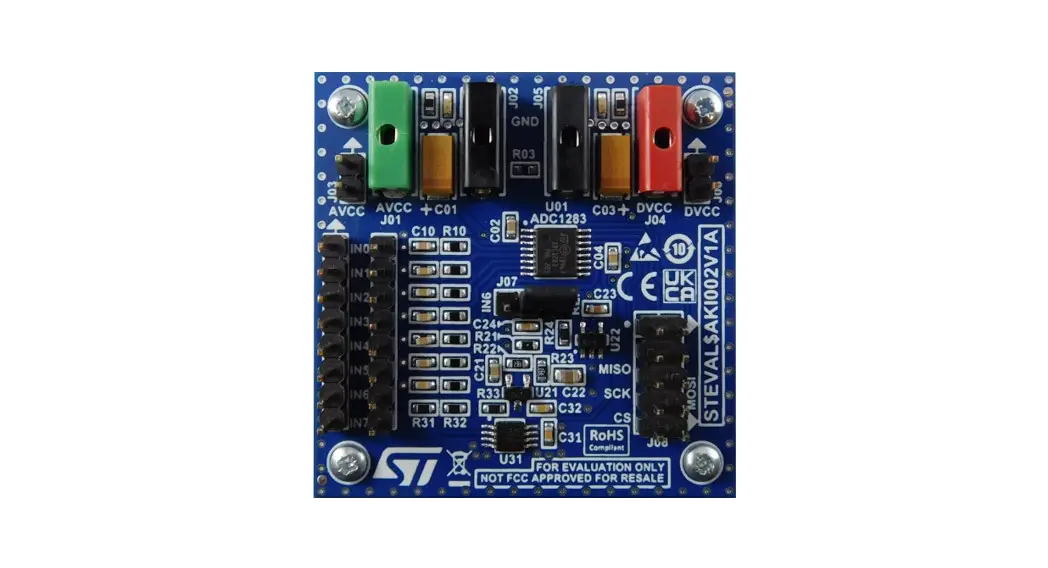
The STEVAL-AKI002V1 evaluation board is designed for the ADC1283
analog-to-digital converter. It features six direct inputs with RC
filters, one input switchable between a direct input and a
reference voltage, and one input with a rail-to-rail amplifier. The
ADC1283 is a low-power, eight-channel CMOS 12-bit analog-to-digital
converter, with an architecture based on a successive-approximation
register with an internal track-and-hold cell. It features eight
single-ended multiplexed inputs and has a straight binary output
serial data that is SPI compatible.
Product Usage Instructions
- Connect the power generators to AVCC and DVCC connectors. The
allowed voltages for AVCC and DVCC are 2.7 to 5.5 V. - Connect the SPI section using Aardvark compatible pinout.
- Refer to the table provided in the manual for the connection
between the STEVALAKI002V1 SPI pins and the NUCLEO-L476RG pins when
using the STSW-AKI GUI. - Connect your inputs, which include:
- IN0-IN5: direct inputs with RC filters (301 ohms/10 nF).
- IN6: input switchable through the J07 jumper between a direct
input and a reference voltage given by a TS3431 and buffered by a
TSX711. - IN7: input with a rail-to-rail amplifier, TSV772, with a gain
equals to -1.
- To communicate with the ADC1283, there are two options:
- Option A: use the STSW-AKI GUI, which communicates with the
ADC1283 of the STEVAL-AKI002V1 through the SPI protocol at 125
ksps. The STSW-AKI allows the user to monitor each channel and plot
data on a graph. It is also a tool to save values measured by the
ADC1283 in a .csv file. - Option B: use the STEVAL-AKI002V1 directly with your test
solution. The SPI communication to access the ADC1283 registers
giving access to the measured values of each channel is shown in
the manual.
- Option A: use the STSW-AKI GUI, which communicates with the
UM3086
User manual
Getting started with the STEVAL-AKI002V1 evaluation board for the ADC1283 analog-to-digital converter
Introduction
The STEVAL-AKI002V1 evaluation board allows evaluating the conversion performance of the ADC1283 eight-channel analogto-digital converter, which is designed for 50 ksps to 200 ksps conversion. The board can accept external signals to measure and evaluate the ADC1283 conversion performance, based on its successive approximation register (SAR) with an internal track-and-hold cell. A reference voltage is also present on the board that can be connected to one of the channels through a jumper. The board can be supplied in standalone mode. It can also be connected to a NUCLEO-L476RG development board hosting an STM32 microcontroller, which enables further signal processing and PC communication. To monitor the STEVAL-AKI002V1 performance, when connected to the NUCLEO-L476RG, you can use the STSW-AKI GUI.
Figure 1. STEVAL-AKI002V1 evaluation board
UM3086 – Rev 1 – March 2023 For further information contact your local STMicroelectronics sales office.
www.st.com
1
1.1
1.2
1.2.1 1.2.2 1.2.3
1.2.4
UM3086
Getting started
Getting started
Features
·
Six direct inputs with RC filters (301 ohms/10 nF)
·
One input switchable between a direct input and a reference voltage, given by a TS3431 buffered by a
TSX711
·
One input with a rail-to-rail amplifier (TSV772 with a gain equals to -1)
·
SPI communication with Aardvark compatible pinout
Main components
ADC1283 The ADC1283 is a low-power, eight-channel CMOS 12-bit analog-to-digital converter for conversion from 50 ksps to 200 ksps, tested at 200 ksps (3.2 MHz clock frequency). The architecture is based on a successive-approximation register with an internal track-and-hold cell. The ADC1283 features eight single-ended multiplexed inputs. The output serial data is straight binary and is SPI compatible.
TS3431 The TS3431 is an adjustable shunt voltage reference with guaranteed temperature stability over the entire operating temperature range (- 40°C to + 125°C). The output voltage can be set to any value between 1.24 and 24 V through an external resistor bridge. Available in a SOT23-3 surface mount package, it can be used in application designs where space saving is critical.
TSX711 The TSX711 operational amplifier offers high precision functioning with low input offset voltage down to a maximum of 200 µV at 25°C. In addition, thanks to its rail-to-rail input and output functionality, it can be used on a full range input and output without limitations. Thus, the TSX711 has the big advantage of offering a large span of supply voltages, ranging from 2.7 to 16 V. The low input bias current performance makes the device extremely suited when used for signal conditioning in sensor interface applications. The high ESD tolerance (4 kV HBM) and wide temperature range make the device suitable also for the automotive market segment.
TSV7722 The TSV7722 is a 22 MHz-bandwidth unity-gain-stable amplifier. The input offset voltage of 200 µV max. (50 µV typical) at room temperature, optimized for common-mode close to ground, makes the device ideal for low-side current measurements. The TSV7722 can operate from 1.8 to 5.5 V single supply, on a load of 47 pF, allowing an easy usage as A/D converter input buffer. The device offers rail-to-rail output, excellent speed/power consumption ratio, and 22 MHz gain bandwidth product, while consuming just 1.7 mA at 5 V. It also features an ultra-low input bias current that enables the connection to photodiodes and other sensors where the current is the key value to be measured. These features make the TSV7722 ideal for high-accuracy, high-bandwidth sensor interfaces.
UM3086 – Rev 1
page 2/17
UM3086
How to use the board
2
How to use the board
To use the board, follow the procedure below.
Step 1. Connect the power generators to AVCC and DVCC connectors. The allowed voltages for AVCC and DVCC are 2.7 to 5.5 V.
Figure 2. AVCC and DVCC connectors
Step 2. Connect the SPI section. The pinout is compatible with Aardvark by TotalPhase.
Figure 3. SPI connection pins
UM3086 – Rev 1
page 3/17
UM3086
How to use the board
Step 3. When using the STSW-AKI GUI, refer to the table below for the connection between the STEVALAKI002V1 SPI pins and the NUCLEO-L476RG pins.
Table 1. Pinout connection between the STEVAL-AKI002V1 and the NUCLEO-L476RG
NUCLEO-L476RG pin PB12 PB13 PB14 PB15
STEVAL-AKI002V1 SPI pin Chip select SCLK MISO MOSI
Step 4.
Connect your inputs. Step 4a. IN0-IN5: direct inputs with RC filters (301 ohms/10 nF).
Step 4b. IN6: input switchable through the J07 jumper between a direct input and a reference voltage given by a TS3431 and buffered by a TSX711.
Step 4c. IN7: input with a rail-to-rail amplifier, TSV772, with a gain equals to -1.
Figure 4. Board section for input connection
UM3086 – Rev 1
page 4/17
UM3086
Communication with the ADC1283
3
Communication with the ADC1283
Option A: use the STSW-AKI GUI
The STEVAL-AKI002V1 can be used with the STSW-AKI GUI. To use it. It is necessary to use a nucleo-64 L476RG. The STSW-AKI runs on an STM32 Nucleo-64 development board. It communicates with the ADC1283 of the STEVAL-AKI002V1 through the SPI protocol at 125 ksps. The STSW-AKI allows the user to monitor each channel and plot data on a graph. It is also a tool to save values measured by the ADC1283 in a .csv file. For more information on the STSW-AKI GUI, go to the relevant ST web page.
Figure 5. STSW-AKI: GUI for ADC120 and ADC1283
Option B: use the STEVAL-AKI002V1 directly with your test solution
The STEVAL-AKI002V1 can be plugged directly to your solution. The SPI communication to access to the ADC1283 registers giving access to the measured values of each channel is shown in the next tables.
Bit # Symbol
7 (MSB) DONTC
6 DONTC
Table 2. Control register bits
5 ADD2
4 ADD1
3 ADD0
2 DONTC
1 DONTC
0 DONTC
UM3086 – Rev 1
page 5/17
Bit # 7, 6, 2, 1, 0
5 4 3
Symbol DONTC ADD2 ADD1 ADD0
ADD2 0 0 0 0 1 1 1 1
ADD1 0 0 1 1 0 0 1 1
UM3086
Communication with the ADC1283
Table 3. Control register bit description Description Don’t care
These bits determine which input channel is converted, as per Table 4
Table 4. Input channel description
ADD0 0 1 0 1 0 1 0 1
Address value (h) 00 08 10 18 20 28 30 38
Input channel IN0 IN1 IN2 IN3 IN4 IN5 IN6 IN7
UM3086 – Rev 1
page 6/17
UM3086
VREF measurement and inverter amplifier
4
VREF measurement and inverter amplifier
A) 1.8 V reference voltage on channel 6
The STEVAL-AKI002V1 includes a reference voltage based on a TS3431 and buffered by a TSX711. This reference voltage can be measured on the channel IN6 by selecting “REF” on the J07 jumper. The reference voltage varies slightly according to the voltage supply. It is still stable around 1.8 V. Hence, it is possible to use it to control the voltage supply applied on the ADC1283 and calibrate it.
Figure 6. 1.8 V reference voltage can be used on IN6
B) Inverter amplifier with a gain of -1 on IN7 On the IN7 input, a TSV772 is used in the inverter function with a gain of -1. This gives the opportunity to test the functionality of the TSV772 and measure negative values through the ADC1283. This inverter is directly connected to IN7. The negative value between -AVCC and GND must be applied on IN7.
Figure 7. -1 inverter on IN7
UM3086 – Rev 1
page 7/17
UM3086
STEVAL-AKI002V1 versions
5
STEVAL-AKI002V1 versions
Table 5. STEVAL-AKI002V1 versions
PCB version
Schematic diagrams
Bill of materials
STEVAL$AKI002V1A (1)
STEVAL$AKI002V1A schematic diagrams
STEVAL$AKI002V1A bill of materials
1. This code identifies the STEVAL-AKI002V1 expansion board first version. It is printed on the board PCB.
UM3086 – Rev 1
page 8/17
UM3086 – Rev 1
6
Schematic diagram
Figure 8. STEVAL-AKI002V1 circuit schematic
J01 AVCC
COLOR GREEN
J03 AVCC
J02 GND
COLOR BLACK
AVCC
C01 22µF C Ca se
R01 680R
D01
GND GND
J11 GND
J12 INPUT
GND
R10
301R
R11
301R
R12
301R
R13
301R
R14
301R
R15
301R
R16
301R
C10 10nF
C11 10nF
C12 10nF
C13 10nF
C14 10nF
C15 10nF
C16 10nF
GND
IN6
REF J07 IN6 SET UP
C02 100nF
GND
SPI1_SCK SPI1_MOSI SPI1_CS
16 SCLK 14 DIN
1 /CS
IN0
4 IN0
IN1
5 IN1
IN2
6 IN2
IN3
7 IN3
IN4
8 IN4
IN5
9 IN5
SIP
10 IN6
11 IN7
VA 2 VB 13
R03
49.9R
NC
C04 100nF
GND
DOUT 15
U01 ADC1283
AOP 3 AGND
12 DGND
GND
GND
AVCC
REFERENCE VOLTAGE
R21
499R
C21 100nF
U21 TS3431
R22 1.8K 0.1%
C22 10µF SMT 0805
3.9K R23 0.1%
U22
5
3
+
TSX711
V+
1
-4
2
V-
C23
22nF
GND
R24
330R
C24 10nF
GND
10K R31
AVCC
U31
8
3
+
TSV772
V+
1
-2
4
V-
C31
22nF
R33
330R
C32 10nF
GND
GND
R32
10K
GND
DVCC
R02 680R
D02
C03 22µF C Ca se
GND GND
J04 DVCC
COLOR RED
J06 DVCC
J05 GND
COLOR BLACK
J08 SIP 2X10 MALE
SPI1_MISO SPI1_SCK SPI1_CS
SPI1_MOSI GND
GND
IN7
COM M ENT
– All passives components without package indication are SMT-0603 package – All test jack components without package indication are HORIZONTAL TEST JACK 2MM package – All connector without package indication are MALE HEADER SIP with 2.54 mm STEP package
UM3086
Schematic diagram
page 9/17
UM3086
Bill of materials
7
Bill of materials
Item 1 2 3 4 5 6 7 8
9
10
11
12
13
14 15 16 17
Q.ty 2 3 9 1 2 1 1 1
2
2
1
1
1
2 1 4 4
Table 6. STEVAL-AKI002V1 bill of materials
Ref.
Part/value
Description
C01, C03
22µF C case 25V ±20%
Tantalum capacitors
C02, C04, C21
100nF SMT
Ceramic
0603 50V ±10% capacitors
C10, C11, C12, C13, C14, C15, C16, C24, C32
10nF SMT 0603 Ceramic
50V ±10%
capacitors
C22
10µF SMT 0603 Ceramic
25V ±10%
capacitors
C23, C31
22nF SMT 0603 Ceramic
50V ±10%
capacitors
COLOR
D01
GREEN SMT LED
0603 2V 20mA
COLOR RED
D02
SMT 0603 2V LED
20mA
COLOR GREY
J01
HORIZONTAL TEST JACK
Test jack
2MM 2100 V 5A
J02, J05
COLOR BLACK HORIZONTAL TEST JACK 2MM 2100 V 5A
Test jack
J03, J06
SIP 1X2 MALE SIP 2 STEP 2.54MM 250VAC 3A
Pin header
COLOR RED
J04
HORIZONTAL TEST JACK
Test jack
2MM 2100 V 5A
SIP 1X3 MALE
J07
SIP 1X3 STEP Connector
2.54MM
header
250VAC 3A
SIP 2X10 MALE
J08
SIP 2X5 STEP 2.54MM
Pin header
250VAC 3A
J11, J12
SIP 1X8 MALE SIP 1X8 STEP 2.54MM 250VAC 3A
Pin header
JU07
COLOR BLACK STEP 2.54 MM Jumper 250VAC 3A
M-01, M-02, M-03, M-04
10MM HOLE M2
Threaded spacer
M-05, M-06, M-07, M-08
6MM HOLE M3 Screw
Manufacturer
Order code
KEMET
T491C226M025AT
WURTH ELEKTRONIK
885012206095
WURTH ELEKTRONIK
885012206089
MURATA
GRM21BR61E106KA73L
WURTH ELEKTRONIK
885012206091
WURTH ELEKTRONIK
150060VS55040
WURTH ELEKTRONIC
150060RS55040
JOHNSON CINCH CONNECTIVIT Y
JOHNSON CINCH CONNECTIVIT Y
105-0754-001 105-0753-001
WURTH ELEKTRONIK
61300211121
JOHNSON CINCH CONNECTIVIT Y
105-0752-001
WURTH ELEKTRONIC
61300311121
WURTH ELEKTRONIK
61301021121
WURTH ELEKTRONIK
61300811121
WURTH ELEKTRONIK
609002115121
WURTH ELEKTRONIK
MULTICOMP PRO
970100244 MP006574
UM3086 – Rev 1
page 10/17
UM3086
Bill of materials
Item 18 19 20 21 22 23 24 25 26
27
28
29
Q.ty 1 1 7 1 1 1 2 2 1
1
1
1
Ref.
Part/value
Description Manufacturer
Order code
R01, R102
680R SMT 0603 0.25W±1%
Resistor
PANASONIC ERJPA3F6800V
R03
NC SMT 0603 Resistor (not
±1%
mounted)
PANASONIC
ERJPA3F49R9V
R10, R11, R12, R13, R14, R15, R16
301R SMT 0603 0.25W±1%
Resistor
PANASONIC ERJPA3F3010V
R21
449R SMT 0603 ±1%
Resistor
PANASONIC ERJPA3F4990V
R22
1.8K SMT 0603 0.1%
Resistor
YAGEO
RT0603BRD071K8L
R23
3.9K SMT 0603 0.1%
Resistor
YAGEO
RT0603BRD073K9L
R24, R33
330R SMT 0603 ±1%
Resistor
PANASONIC ERJPA3F3300V
R31, R32
10K SMT 0603 ±1%
Resistor
PANASONIC ERJPA3F1002V
8-channel, 50
U01
ADC1283IPT, TSSOP-16L
ksps to 200 ksps, 12-bit A-D
ST
converter
ADC1283IPT
1.24 V
U21
TS3431CILT, SOT23
adjustable shunt voltage
ST
reference
TS3431CILT
Precision (200
U22
TSX711ILT, SOT23-5L
µV), rail-to-rail 16 V CMOS op- ST amp, single,
GBP 2.7 MHz
TSX711ILT
High bandwidth
U31
TSV7722IST, MiniSO-8
(22 MHz) low offset (200 µV) ST low-rail 5 V op-
amp
TSV7722IST
UM3086 – Rev 1
page 11/17
UM3086
Regulatory compliance information
8
Regulatory compliance information
Notice for US Federal Communication Commission (FCC)
For evaluation only; not FCC approved for resale FCC NOTICE – This kit is designed to allow: (1) Product developers to evaluate electronic components, circuitry, or software associated with the kit to determine whether to incorporate such items in a finished product and (2) Software developers to write software applications for use with the end product. This kit is not a finished product and when assembled may not be resold or otherwise marketed unless all required FCC equipment authorizations are first obtained. Operation is subject to the condition that this product not cause harmful interference to licensed radio stations and that this product accept harmful interference. Unless the assembled kit is designed to operate under part 15, part 18 or part 95 of this chapter, the operator of the kit must operate under the authority of an FCC license holder or must secure an experimental authorization under part 5 of this chapter 3.1.2.
Notice for Innovation, Science and Economic Development Canada (ISED)
For evaluation purposes only. This kit generates, uses, and can radiate radio frequency energy and has not been tested for compliance with the limits of computing devices pursuant to Industry Canada (IC) rules. À des fins d’évaluation uniquement. Ce kit génère, utilise et peut émettre de l’énergie radiofréquence et n’a pas été testé pour sa conformité aux limites des appareils informatiques conformément aux règles d’Industrie Canada (IC).
Notice for the European Union
This device is in conformity with the essential requirements of the Directive 2014/30/EU (EMC) and of the Directive 2015/863/EU (RoHS).
Notice for the United Kingdom
This device is in compliance with the UK Electromagnetic Compatibility Regulations 2016 (UK S.I. 2016 No. 1091) and with the Restriction of the Use of Certain Hazardous Substances in Electrical and Electronic Equipment Regulations 2012 (UK S.I. 2012 No. 3032).
UM3086 – Rev 1
page 12/17
Revision history
Date 08-Mar-2023
UM3086
Table 7. Document revision history
Revision 1
Initial release.
Changes
UM3086 – Rev 1
page 13/17
UM3086
Contents
Contents
1 Getting started . . . . . . . . . . . . . . . . . . . . . . . . . . . . . . . . . . . . . . . . . . . . . . . . . . . . . . . . . . . . . . . . . . . .2 1.1 Features . . . . . . . . . . . . . . . . . . . . . . . . . . . . . . . . . . . . . . . . . . . . . . . . . . . . . . . . . . . . . . . . . . . . . . 2 1.2 Main components . . . . . . . . . . . . . . . . . . . . . . . . . . . . . . . . . . . . . . . . . . . . . . . . . . . . . . . . . . . . . . 2
1.2.1 ADC1283 . . . . . . . . . . . . . . . . . . . . . . . . . . . . . . . . . . . . . . . . . . . . . . . . . . . . . . . . . . . . . . 2 1.2.2 TS3431 . . . . . . . . . . . . . . . . . . . . . . . . . . . . . . . . . . . . . . . . . . . . . . . . . . . . . . . . . . . . . . . . 2 1.2.3 TSX711 . . . . . . . . . . . . . . . . . . . . . . . . . . . . . . . . . . . . . . . . . . . . . . . . . . . . . . . . . . . . . . . . 2 1.2.4 TSV7722. . . . . . . . . . . . . . . . . . . . . . . . . . . . . . . . . . . . . . . . . . . . . . . . . . . . . . . . . . . . . . . 2
2 How to use the board . . . . . . . . . . . . . . . . . . . . . . . . . . . . . . . . . . . . . . . . . . . . . . . . . . . . . . . . . . . . . .3 3 Communication with the ADC1283 . . . . . . . . . . . . . . . . . . . . . . . . . . . . . . . . . . . . . . . . . . . . . . . . . 5 4 VREF measurement and inverter amplifier . . . . . . . . . . . . . . . . . . . . . . . . . . . . . . . . . . . . . . . . . . 7 5 STEVAL-AKI002V1 versions. . . . . . . . . . . . . . . . . . . . . . . . . . . . . . . . . . . . . . . . . . . . . . . . . . . . . . . . 8 6 Schematic diagram . . . . . . . . . . . . . . . . . . . . . . . . . . . . . . . . . . . . . . . . . . . . . . . . . . . . . . . . . . . . . . . .9 7 Bill of materials . . . . . . . . . . . . . . . . . . . . . . . . . . . . . . . . . . . . . . . . . . . . . . . . . . . . . . . . . . . . . . . . . . .10 8 Regulatory compliance information . . . . . . . . . . . . . . . . . . . . . . . . . . . . . . . . . . . . . . . . . . . . . . .12 Revision history . . . . . . . . . . . . . . . . . . . . . . . . . . . . . . . . . . . . . . . . . . . . . . . . . . . . . . . . . . . . . . . . . . . . . . .13 List of tables . . . . . . . . . . . . . . . . . . . . . . . . . . . . . . . . . . . . . . . . . . . . . . . . . . . . . . . . . . . . . . . . . . . . . . . . . .15 List of figures. . . . . . . . . . . . . . . . . . . . . . . . . . . . . . . . . . . . . . . . . . . . . . . . . . . . . . . . . . . . . . . . . . . . . . . . . .16
UM3086 – Rev 1
page 14/17
UM3086
List of tables
List of tables
Table 1. Table 2. Table 3. Table 4. Table 5. Table 6. Table 7.
Pinout connection between the STEVAL-AKI002V1 and the NUCLEO-L476RG . . . . . . . . . . . . . . . . . . . . . . . . . 4 Control register bits . . . . . . . . . . . . . . . . . . . . . . . . . . . . . . . . . . . . . . . . . . . . . . . . . . . . . . . . . . . . . . . . . . 5 Control register bit description . . . . . . . . . . . . . . . . . . . . . . . . . . . . . . . . . . . . . . . . . . . . . . . . . . . . . . . . . . . 6 Input channel description . . . . . . . . . . . . . . . . . . . . . . . . . . . . . . . . . . . . . . . . . . . . . . . . . . . . . . . . . . . . . . 6 STEVAL-AKI002V1 versions . . . . . . . . . . . . . . . . . . . . . . . . . . . . . . . . . . . . . . . . . . . . . . . . . . . . . . . . . . . . 8 STEVAL-AKI002V1 bill of materials . . . . . . . . . . . . . . . . . . . . . . . . . . . . . . . . . . . . . . . . . . . . . . . . . . . . . . 10 Document revision history . . . . . . . . . . . . . . . . . . . . . . . . . . . . . . . . . . . . . . . . . . . . . . . . . . . . . . . . . . . . . 13
UM3086 – Rev 1
page 15/17
UM3086
List of figures
List of figures
Figure 1. Figure 2. Figure 3. Figure 4. Figure 5. Figure 6. Figure 7. Figure 8.
STEVAL-AKI002V1 evaluation board . . . . . . . . . . . . . . . . . . . . . . . . . . . . . . . . . . . . . . . . . . . . . . . . . . . . . 1 AVCC and DVCC connectors . . . . . . . . . . . . . . . . . . . . . . . . . . . . . . . . . . . . . . . . . . . . . . . . . . . . . . . . . . 3 SPI connection pins . . . . . . . . . . . . . . . . . . . . . . . . . . . . . . . . . . . . . . . . . . . . . . . . . . . . . . . . . . . . . . . . 3 Board section for input connection . . . . . . . . . . . . . . . . . . . . . . . . . . . . . . . . . . . . . . . . . . . . . . . . . . . . . . 4 STSW-AKI: GUI for ADC120 and ADC1283 . . . . . . . . . . . . . . . . . . . . . . . . . . . . . . . . . . . . . . . . . . . . . . . . 5 1.8 V reference voltage can be used on IN6 . . . . . . . . . . . . . . . . . . . . . . . . . . . . . . . . . . . . . . . . . . . . . . . . 7 -1 inverter on IN7 . . . . . . . . . . . . . . . . . . . . . . . . . . . . . . . . . . . . . . . . . . . . . . . . . . . . . . . . . . . . . . . . . . 7 STEVAL-AKI002V1 circuit schematic . . . . . . . . . . . . . . . . . . . . . . . . . . . . . . . . . . . . . . . . . . . . . . . . . . . . . 9
UM3086 – Rev 1
page 16/17
UM3086
IMPORTANT NOTICE READ CAREFULLY STMicroelectronics NV and its subsidiaries (“ST”) reserve the right to make changes, corrections, enhancements, modifications, and improvements to ST products and/or to this document at any time without notice. Purchasers should obtain the latest relevant information on ST products before placing orders. ST products are sold pursuant to ST’s terms and conditions of sale in place at the time of order acknowledgment. Purchasers are solely responsible for the choice, selection, and use of ST products and ST assumes no liability for application assistance or the design of purchasers’ products. No license, express or implied, to any intellectual property right is granted by ST herein. Resale of ST products with provisions different from the information set forth herein shall void any warranty granted by ST for such product. ST and the ST logo are trademarks of ST. For additional information about ST trademarks, refer to www.st.com/trademarks. All other product or service names are the property of their respective owners. Information in this document supersedes and replaces information previously supplied in any prior versions of this document.
© 2023 STMicroelectronics All rights reserved
UM3086 – Rev 1
page 17/17
References
 STMicroelectronics: Our technology starts with you
-
STMicroelectronics Trademark List - STMicroelectronics
-
ADC1283 - 8-Channel, 50ksps to 200ksps, 12-Bit A/D Converter - STMicroelectronics
-
NUCLEO-L476RG - STM32 Nucleo-64 development board with STM32L476RG MCU, supports Arduino and ST morpho connectivity - STMicroelectronics
-
STEVAL-AKI002V1 - Evaluation board for the ADC1283 8-channel, 50 to 200 ksps, 12-bit analog to digital converter - STMicroelectronics
-
STSW-AKI - Graphical user interface for the STEVAL-AKI001V1/STEVAL-AKI002V1 boards - STMicroelectronics
-
TS3431 - 1.24 V adjustable shunt voltage reference - STMicroelectronics
-
TSV772 - High bandwidth (20 MHz) low offset (200 µV) rail-to-rail 5V op amp - STMicroelectronics
-
TSV7722 - High bandwidth (22MHz) Low offset (200 µV) low-rail 5V op amp - STMicroelectronics
-
TSX711 - Precision (200uV), rail-to-rail 16V CMOS Op-Amp, single, GBP 2.7MHz - STMicroelectronics
 STMicroelectronics: Our technology starts with you